Mathematical Background in Physics
Field, Scalar field, Vector field, Gradient,
Divergence and Curl
By
Dr. Gajanan B. Harde
Associate Professor and Head
Department of Physics
Shri R. R. Lahoti Science Collage, Morshi
 INDEX
1. FIELD
2. SCALAR FIELD
3. VECTOR FIELD
4. DIFFERENTIAL OPERATOR
5. GRADIENT
6. PHYSICAL SIGNIFICANCE OF GRADIENT
7. DIVERGENCE
8. PHYSICAL SIGNIFICANCE OF DIVERGENCE
9. CURL
10. PHYSICAL SIGNIFICANCE OF CURL
 In cartesian coordinate system, a particular point is
denoted by (x, y, z) with respect to origin.
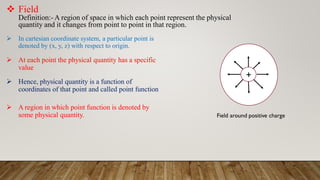
 Field
Definition:- A region of space in which each point represent the physical
quantity and it changes from point to point in that region.
 At each point the physical quantity has a specific
value
 Hence, physical quantity is a function of
coordinates of that point and called point function
 A region in which point function is denoted by
some physical quantity.
+
Field around positive charge
 Scalar Field
Definition:- If the value of physical function at each point is a scalar
quantity, then the field is known as a scalar field.
 The scalar field can be expressed by a continuous scalar function ϕ(x, y, z).
 ϕ(x, y, z) representing the value of physical function at each point.
 The magnitude of such a function changes continuously when it passes from
one point to another point close to it.
Example:
 Electric potential field.
 Temperature of the room (kitchen).
 Density of air.
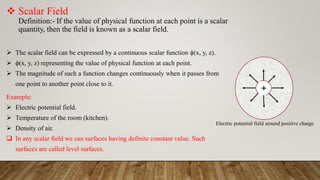
 In any scalar field we can surfaces having definite constant value. Such
surfaces are called level surfaces.
+
Electric potential field around positive charge
 Vector Field
Definition:- If the value of physical function at each point is a vector
quantity, then the field is known as a scalar field.
 The vector field can be expressed by a continuous vector function
Ā(x, y, z).
 Ā(x, y, z) representing the value of vector of definite magnitude and
direction at each point.
 The magnitude and direction of such a function changes
continuously when it passes from one point to another point close to
it.
Example:
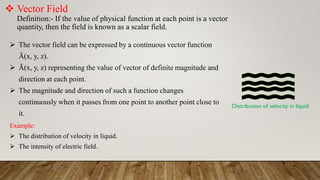
 The distribution of velocity in liquid.
 The intensity of electric field.
Distribution of velocity in liquid
 Vector differential 0perator (𝛁)
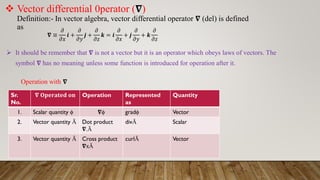
Definition:- In vector algebra, vector differential operator 𝛁 (del) is defined
as
𝛁 ≡
𝜕
𝜕𝑥
𝒊 +
𝜕
𝜕𝑦
𝒋 +
𝜕
𝜕𝑧
𝒌 = 𝒊
𝜕
𝜕𝑥
+ 𝒋
𝜕
𝜕𝑦
+ 𝒌
𝜕
𝜕𝑧
 It should be remember that 𝛁 is not a vector but it is an operator which obeys laws of vectors. The
symbol 𝛁 has no meaning unless some function is introduced for operation after it.
Sr.
No.
𝛁 𝐎𝐩𝐞𝐫𝐚𝐭𝐞𝐝 𝐨𝐧 Operation Represented
as
Quantity
1. Scalar quantity ϕ 𝛁ϕ gradϕ Vector
2. Vector quantity Ā Dot product
𝛁.Ā
divĀ Scalar
3. Vector quantity Ā Cross product
𝛁xĀ
curlĀ Vector
Operation with 𝛁
 Gradient
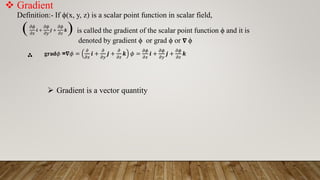
Definition:- If ϕ(x, y, z) is a scalar point function in scalar field,
( ) is called the gradient of the scalar point function ϕ and it is
denoted by gradient ϕ or grad ϕ or 𝛁 ϕ
‫؞‬
𝜕𝜙
𝜕𝑥
𝒊 +
𝜕𝜙
𝜕𝑦
𝒋 +
𝜕𝜙
𝜕𝑧
𝒌
grad𝜙 =𝛁𝜙 =
𝜕
𝜕𝑥
𝒊 +
𝜕
𝜕𝑦
𝒋 +
𝜕
𝜕𝑧
𝒌 𝜙 =
𝜕𝜙
𝜕𝑥
𝒊 +
𝜕𝜙
𝜕𝑦
𝒋 +
𝜕𝜙
𝜕𝑧
𝒌
 Gradient is a vector quantity
 Physical significance of Gradient
S2
S1
B
C
∂n
A
∂r
ϕ ϕ + dϕ
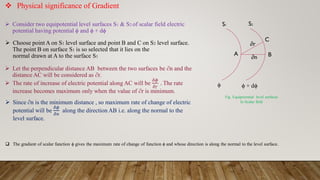
 Consider two equipotential level surfaces S1 & S2 of scalar field electric
potential having potential ϕ and ϕ + dϕ
 Choose point A on S1 level surface and point B and C on S2 level surface.
The point B on surface S1 is so selected that it lies on the
normal drawn at A to the surface S1
 Let the perpendicular distance AB between the two surfaces be ∂n and the
distance AC will be considered as ∂r.
 The rate of increase of electric potential along AC will be
𝛿𝜙
𝛿𝑟
. The rate
increase becomes maximum only when the value of ∂r is minimum.
 Since ∂n is the minimum distance , so maximum rate of change of electric
potential will be
𝛿𝜙
𝛿𝑛
along the direction AB i.e. along the normal to the
level surface.
 The gradient of scalar function ϕ gives the maximum rate of change of function ϕ and whose direction is along the normal to the level surface.
Fig. Equipotential level surfaces
In Scalar field
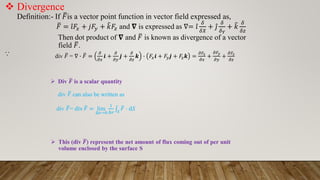
 Divergence
Definition:- If ത
𝐹is a vector point function in vector field expressed as,
ത
𝐹 = Ƹ
𝑖𝐹𝑥 + 𝑗𝐹𝑦 + ෠
𝑘𝐹𝑧 and 𝛁 is expressed as ∇= Ƹ
𝑖
𝛿
𝛿𝑋
+ Ƹ
𝑗
𝛿
𝛿𝑌
+ ෠
𝑘
𝛿
𝛿𝑧
Then dot product of 𝛁 and ത
𝐹 is known as divergence of a vector
field ത
𝐹.
⸪ div ത
𝐹 = ∇ ∙ ത
𝐹 =
𝜕
𝜕𝑥
𝒊 +
𝜕
𝜕𝑦
𝒋 +
𝜕
𝜕𝑧
𝒌 ∙ 𝐹𝑥𝒊 + 𝐹𝑦𝒋 + 𝐹𝑧𝒌 =
𝜕𝐹𝑥
𝜕𝑥
+
𝜕𝐹𝑦
𝜕𝑦
+
𝜕𝐹𝑧
𝜕𝑧
 Div ഥ
𝑭 is a scalar quantity
div ത
𝐹 can also be written as
div ത
𝐹= div ത
𝐹 = lim
Δ𝑣→0
1
Δ𝑣
‫׬‬𝑆
ത
𝐹 ⋅ d𝑆
 This (div ഥ
𝑭) represent the net amount of flux coming out of per unit
volume enclosed by the surface S
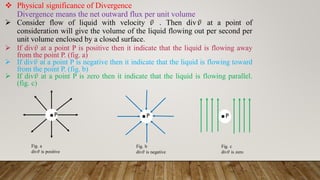
 Physical significance of Divergence
Divergence means the net outward flux per unit volume
 Consider flow of liquid with velocity ҧ
𝑣 . Then div ҧ
𝑣 at a point of
consideration will give the volume of the liquid flowing out per second per
unit volume enclosed by a closed surface.
 If div ҧ
𝑣 at a point P is positive then it indicate that the liquid is flowing away
from the point P. (fig. a)
 If div ҧ
𝑣 at a point P is negative then it indicate that the liquid is flowing toward
from the point P. (fig. b)
 If div ҧ
𝑣 at a point P is zero then it indicate that the liquid is flowing parallel.
(fig. c)
.P .P .P
Fig. a
div ҧ
𝑣 is positive
Fig. b
div ҧ
𝑣 is negative
Fig. c
div ҧ
𝑣 is zero
C
S
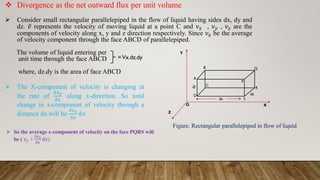
 The X-component of velocity is changing at
the rate of
𝛿𝑣𝑥
𝛿𝑥
along x-direction. So total
change in x-component of velocity through a
distance dx will be
𝛿𝑣𝑥
𝛿𝑥
d𝑥
 Divergence as the net outward flux per unit volume
 Consider small rectangular parallelepiped in the flow of liquid having sides dx, dy and
dz. ҧ
𝑣 represents the velocity of moving liquid at a point C and 𝜈𝑥 , 𝜈𝑦 , 𝜈𝑧 are the
components of velocity along x, y and z direction respectively. Since 𝜈𝑥 be the average
of velocity component through the face ABCD of parallelepiped.
The volume of liquid entering per
unit time through the face ABCD
where, dz.dy is the area of face ABCD
=Vx.dz.dy
dx
P
R
A
Q
B
D
X
Y
Z
O
dz
dy
Figure. Rectangular parallelepiped in flow of liquid
 So the average x-component of velocity on the face PQRS will
be ( 𝜈𝑥 +
𝛿𝑣𝑥
𝛿𝑥
d𝑥)
⸪
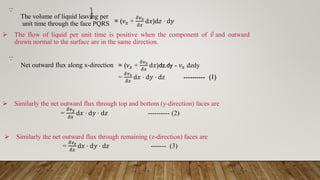
Net outward flux along x-direction = (𝜈𝑥 +
𝛿𝑣𝑥
𝛿𝑥
d𝑥)dz.dy - 𝜈𝑥 dzdy
=
𝛿𝑣𝑥
𝛿𝑥
d𝑥 ⋅ d𝑦 ⋅ d𝑧 ---------- (1)
 The flow of liquid per unit time is positive when the component of Ԧ
𝑣 and outward
drown normal to the surface are in the same direction.
⸪
The volume of liquid leaving per
unit time through the face PQRS = (𝜈𝑥 +
𝛿𝑣𝑥
𝛿𝑥
d𝑥)d𝑧 ⋅ d𝑦
 Similarly the net outward flux through top and bottom (y-direction) faces are
=
𝛿𝑣𝑦
𝛿𝑥
d𝑥 ⋅ d𝑦 ⋅ d𝑧 ---------- (2)
 Similarly the net outward flux through remaining (z-direction) faces are
=
𝛿𝑣𝑧
𝛿𝑥
d𝑥 ⋅ d𝑦 ⋅ d𝑧 ------- (3)
 So the net outward flux through a parallelepiped through all faces will be [the sum of eq. (1),
eq. (2) & eq. (3)]
=(
𝛿𝑣𝑥
𝛿𝑥
+
𝛿𝑣𝑦
𝛿𝑥
+
𝛿𝑣𝑧
𝛿𝑥
) d𝑥 ⋅ d𝑦 ⋅ d𝑧
 Since the volume of the parallelepiped is d𝑥 ⋅ d𝑦 ⋅ d𝑧 so the net outward
flux per unit volume will be
=
𝛿𝑣𝑥
𝛿𝑥
+
𝛿𝑣𝑦
𝛿𝑥
+
𝛿𝑣𝑧
𝛿𝑥
 Which is the divergence of velocity of liquid
i. e. div ҧ
𝑣 =
𝛿𝑣𝑥
𝛿𝑥
+
𝛿𝑣𝑦
𝛿𝑥
+
𝛿𝑣𝑧
𝛿𝑥
So divergence is the amount of flux coming out of per unit volume
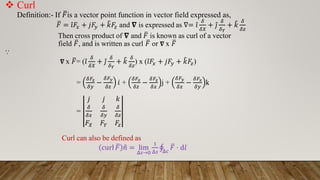
 Curl
Definition:- If ത
𝐹is a vector point function in vector field expressed as,
ത
𝐹 = Ƹ
𝑖𝐹𝑥 + 𝑗𝐹𝑦 + ෠
𝑘𝐹𝑧 and 𝛁 is expressed as ∇= Ƹ
𝑖
𝛿
𝛿𝑋
+ Ƹ
𝑗
𝛿
𝛿𝑌
+ ෠
𝑘
𝛿
𝛿𝑧
Then cross product of 𝛁 and ത
𝐹 is known as curl of a vector
field ത
𝐹, and is written as curl ത
𝐹 or 𝛁 x ത
𝐹
⸪
𝛁 x ത
𝐹= ( Ƹ
𝑖
𝛿
𝛿𝑋
+ Ƹ
𝑗
𝛿
𝛿𝑌
+ ෠
𝑘
𝛿
𝛿𝑧
) x ( Ƹ
𝑖𝐹𝑥 + 𝑗𝐹𝑦 + ෠
𝑘𝐹𝑧)
=
𝛿𝐹𝑧
𝛿𝑦
−
𝛿𝐹𝑦
𝛿𝑧
𝑖 +
𝛿𝐹𝑥
𝛿𝑧
−
𝛿𝐹𝑧
𝛿𝑥
j +
𝛿𝐹𝑦
𝛿𝑥
−
𝛿𝐹𝑥
𝛿𝑦
k
=
𝑗 𝑗 𝑘
𝛿
𝛿𝑥
𝛿
𝛿𝑦
𝛿
𝛿𝑧
𝐹𝑋 𝐹𝑌 𝐹𝑧
Curl can also be defined as
curl ത
𝐹 ො
𝑛 = lim
Δ𝑠→0
1
Δ𝑠
‫ׯ‬
Δ𝑐
ത
𝐹 ⋅ d𝑙
 Physical significance of curl
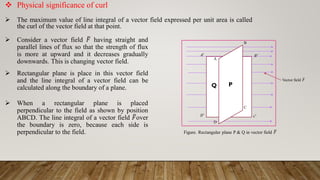
 The maximum value of line integral of a vector field expressed per unit area is called
the curl of the vector field at that point.
 Consider a vector field ത
𝐹 having straight and
parallel lines of flux so that the strength of flux
is more at upward and it decreases gradually
downwards. This is changing vector field.
 Rectangular plane is place in this vector field
and the line integral of a vector field can be
calculated along the boundary of a plane.
 When a rectangular plane is placed
perpendicular to the field as shown by position
ABCD. The line integral of a vector field ത
𝐹over
the boundary is zero, because each side is
perpendicular to the field.
𝐵′
B
C
D
A
Vector field ത
𝐹
𝐴′
𝐷′
𝑐′
P
Q
Figure. Rectangular plane P & Q in vector field ത
𝐹
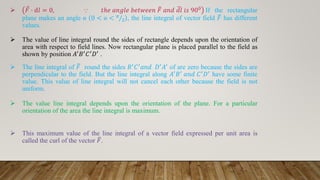
 Ԧ
𝐹 ⋅ d𝑙 = 0, ⸪ 𝑡ℎ𝑒 𝑎𝑛𝑔𝑙𝑒 𝑏𝑒𝑡𝑤𝑒𝑒𝑛 ത
𝐹 𝑎𝑛𝑑 ഥ
𝑑𝑙 𝑖𝑠 900 If the rectangular
plane makes an angle ɵ 0 < ɵ < Τ
𝜋
2 , the line integral of vector field ത
𝐹 has different
values.
 The value of line integral round the sides of rectangle depends upon the orientation of
area with respect to field lines. Now rectangular plane is placed parallel to the field as
shown by position 𝐴′𝐵′𝐶′𝐷′ .
 The line integral of ത
𝐹 round the sides 𝐵′𝐶′𝑎𝑛𝑑 𝐷′𝐴′ of are zero because the sides are
perpendicular to the field. But the line integral along 𝐴′𝐵′ 𝑎𝑛𝑑 𝐶′𝐷′ have some finite
value. This value of line integral will not cancel each other because the field is not
uniform.
 The value line integral depends upon the orientation of the plane. For a particular
orientation of the area the line integral is maximum.
 This maximum value of the line integral of a vector field expressed per unit area is
called the curl of the vector ത
𝐹.
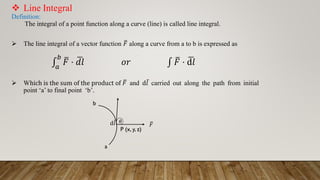
 Line Integral
Definition:
The integral of a point function along a curve (line) is called line integral.
 The line integral of a vector function ത
𝐹 along a curve from a to b is expressed as
‫׬‬
𝑎
𝑏
ത
𝐹 ⋅ ഥ
𝑑𝑙 𝑜𝑟 ‫׬‬ ത
𝐹 ⋅ ഥ
d𝑙
 Which is the sum of the product of ത
𝐹 and d ҧ
𝑙 carried out along the path from initial
point ‘a’ to final point ‘b’.
𝜃
d ҧ
𝑙 ത
𝐹
P (x, y, z)
a
b
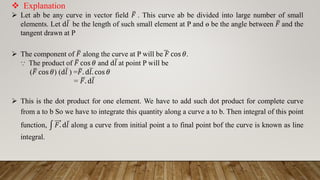
 Explanation
 Let ab be any curve in vector field ത
𝐹 . This curve ab be divided into large number of small
elements. Let d ҧ
𝑙 be the length of such small element at P and ɵ be the angle between ത
𝐹 and the
tangent drawn at P
 The component of ത
𝐹 along the curve at P will beഥ
𝐹 cos 𝜃.
⸪ The product of ത
𝐹 cos 𝜃 and d ҧ
𝑙 at point P will be
( ത
𝐹 cos 𝜃) (d ҧ
𝑙 ) = ത
𝐹. dത
𝑙. cos 𝜃
= ഥ
𝐹. d ҧ
𝑙
 This is the dot product for one element. We have to add such dot product for complete curve
from a to b So we have to integrate this quantity along a curve a to b. Then integral of this point
function, ධ 𝐹. d ҧ
𝑙 along a curve from initial point a to final point bof the curve is known as line
integral.
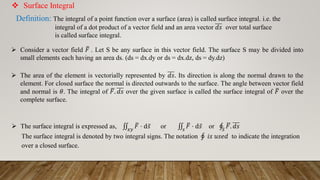
 Surface Integral
Definition: The integral of a point function over a surface (area) is called surface integral. i.e. the
integral of a dot product of a vector field and an area vector 𝑑𝑠 over total surface
is called surface integral.
 Consider a vector field ത
𝐹 . Let S be any surface in this vector field. The surface S may be divided into
small elements each having an area ds. (ds = dx.dy or ds = dx.dz, ds = dy.dz)
 The area of the element is vectorially represented by 𝑑𝑠. Its direction is along the normal drawn to the
element. For closed surface the normal is directed outwards to the surface. The angle between vector field
and normal is 𝜃. The integral of ഥ
𝐹. 𝑑𝑠 over the given surface is called the surface integral of ത
𝐹 over the
complete surface.
 The surface integral is expressed as, ‫׭‬
𝑥𝑦
ത
𝐹 ⋅ d ҧ
𝑠 or ‫׭‬
𝑠
ത
𝐹 ⋅ d ҧ
𝑠 or ‫ׯ‬
𝑆
ഥ
𝐹. 𝑑𝑠
The surface integral is denoted by two integral signs. The notation ‫ׯ‬ 𝑖𝑠 𝑢𝑠𝑒𝑑 to indicate the integration
over a closed surface.
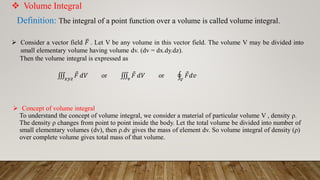
 Volume Integral
Definition: The integral of a point function over a volume is called volume integral.
 Consider a vector field ത
𝐹 . Let V be any volume in this vector field. The volume V may be divided into
small elementary volume having volume dv. (dv = dx.dy.dz).
Then the volume integral is expressed as
‫׮‬
𝑥𝑦𝑧
Ԧ
𝐹 𝑑𝑉 or ‫׮‬
𝑣
Ԧ
𝐹 𝑑𝑉 or ය
𝑉
Ԧ
𝐹𝑑𝑣
 Concept of volume integral
To understand the concept of volume integral, we consider a material of particular volume V , density ρ.
The density ρ changes from point to point inside the body. Let the total volume be divided into number of
small elementary volumes (dv), then ρ.dv gives the mass of element dv. So volume integral of density (ρ)
over complete volume gives total mass of that volume.
Mathematical Background in Physics.pdf

Mathematical Background in Physics.pdf

  • 1.
    Mathematical Background inPhysics Field, Scalar field, Vector field, Gradient, Divergence and Curl By Dr. Gajanan B. Harde Associate Professor and Head Department of Physics Shri R. R. Lahoti Science Collage, Morshi
  • 2.
     INDEX 1. FIELD 2.SCALAR FIELD 3. VECTOR FIELD 4. DIFFERENTIAL OPERATOR 5. GRADIENT 6. PHYSICAL SIGNIFICANCE OF GRADIENT 7. DIVERGENCE 8. PHYSICAL SIGNIFICANCE OF DIVERGENCE 9. CURL 10. PHYSICAL SIGNIFICANCE OF CURL
  • 3.
     In cartesiancoordinate system, a particular point is denoted by (x, y, z) with respect to origin.  Field Definition:- A region of space in which each point represent the physical quantity and it changes from point to point in that region.  At each point the physical quantity has a specific value  Hence, physical quantity is a function of coordinates of that point and called point function  A region in which point function is denoted by some physical quantity. + Field around positive charge
  • 4.
     Scalar Field Definition:-If the value of physical function at each point is a scalar quantity, then the field is known as a scalar field.  The scalar field can be expressed by a continuous scalar function ϕ(x, y, z).  ϕ(x, y, z) representing the value of physical function at each point.  The magnitude of such a function changes continuously when it passes from one point to another point close to it. Example:  Electric potential field.  Temperature of the room (kitchen).  Density of air.  In any scalar field we can surfaces having definite constant value. Such surfaces are called level surfaces. + Electric potential field around positive charge
  • 5.
     Vector Field Definition:-If the value of physical function at each point is a vector quantity, then the field is known as a scalar field.  The vector field can be expressed by a continuous vector function Ā(x, y, z).  Ā(x, y, z) representing the value of vector of definite magnitude and direction at each point.  The magnitude and direction of such a function changes continuously when it passes from one point to another point close to it. Example:  The distribution of velocity in liquid.  The intensity of electric field. Distribution of velocity in liquid
  • 6.
     Vector differential0perator (𝛁) Definition:- In vector algebra, vector differential operator 𝛁 (del) is defined as 𝛁 ≡ 𝜕 𝜕𝑥 𝒊 + 𝜕 𝜕𝑦 𝒋 + 𝜕 𝜕𝑧 𝒌 = 𝒊 𝜕 𝜕𝑥 + 𝒋 𝜕 𝜕𝑦 + 𝒌 𝜕 𝜕𝑧  It should be remember that 𝛁 is not a vector but it is an operator which obeys laws of vectors. The symbol 𝛁 has no meaning unless some function is introduced for operation after it. Sr. No. 𝛁 𝐎𝐩𝐞𝐫𝐚𝐭𝐞𝐝 𝐨𝐧 Operation Represented as Quantity 1. Scalar quantity ϕ 𝛁ϕ gradϕ Vector 2. Vector quantity Ā Dot product 𝛁.Ā divĀ Scalar 3. Vector quantity Ā Cross product 𝛁xĀ curlĀ Vector Operation with 𝛁
  • 7.
     Gradient Definition:- Ifϕ(x, y, z) is a scalar point function in scalar field, ( ) is called the gradient of the scalar point function ϕ and it is denoted by gradient ϕ or grad ϕ or 𝛁 ϕ ‫؞‬ 𝜕𝜙 𝜕𝑥 𝒊 + 𝜕𝜙 𝜕𝑦 𝒋 + 𝜕𝜙 𝜕𝑧 𝒌 grad𝜙 =𝛁𝜙 = 𝜕 𝜕𝑥 𝒊 + 𝜕 𝜕𝑦 𝒋 + 𝜕 𝜕𝑧 𝒌 𝜙 = 𝜕𝜙 𝜕𝑥 𝒊 + 𝜕𝜙 𝜕𝑦 𝒋 + 𝜕𝜙 𝜕𝑧 𝒌  Gradient is a vector quantity
  • 8.
     Physical significanceof Gradient S2 S1 B C ∂n A ∂r ϕ ϕ + dϕ  Consider two equipotential level surfaces S1 & S2 of scalar field electric potential having potential ϕ and ϕ + dϕ  Choose point A on S1 level surface and point B and C on S2 level surface. The point B on surface S1 is so selected that it lies on the normal drawn at A to the surface S1  Let the perpendicular distance AB between the two surfaces be ∂n and the distance AC will be considered as ∂r.  The rate of increase of electric potential along AC will be 𝛿𝜙 𝛿𝑟 . The rate increase becomes maximum only when the value of ∂r is minimum.  Since ∂n is the minimum distance , so maximum rate of change of electric potential will be 𝛿𝜙 𝛿𝑛 along the direction AB i.e. along the normal to the level surface.  The gradient of scalar function ϕ gives the maximum rate of change of function ϕ and whose direction is along the normal to the level surface. Fig. Equipotential level surfaces In Scalar field
  • 9.
     Divergence Definition:- Ifത 𝐹is a vector point function in vector field expressed as, ത 𝐹 = Ƹ 𝑖𝐹𝑥 + 𝑗𝐹𝑦 + ෠ 𝑘𝐹𝑧 and 𝛁 is expressed as ∇= Ƹ 𝑖 𝛿 𝛿𝑋 + Ƹ 𝑗 𝛿 𝛿𝑌 + ෠ 𝑘 𝛿 𝛿𝑧 Then dot product of 𝛁 and ത 𝐹 is known as divergence of a vector field ത 𝐹. ⸪ div ത 𝐹 = ∇ ∙ ത 𝐹 = 𝜕 𝜕𝑥 𝒊 + 𝜕 𝜕𝑦 𝒋 + 𝜕 𝜕𝑧 𝒌 ∙ 𝐹𝑥𝒊 + 𝐹𝑦𝒋 + 𝐹𝑧𝒌 = 𝜕𝐹𝑥 𝜕𝑥 + 𝜕𝐹𝑦 𝜕𝑦 + 𝜕𝐹𝑧 𝜕𝑧  Div ഥ 𝑭 is a scalar quantity div ത 𝐹 can also be written as div ത 𝐹= div ത 𝐹 = lim Δ𝑣→0 1 Δ𝑣 ‫׬‬𝑆 ത 𝐹 ⋅ d𝑆  This (div ഥ 𝑭) represent the net amount of flux coming out of per unit volume enclosed by the surface S
  • 10.
     Physical significanceof Divergence Divergence means the net outward flux per unit volume  Consider flow of liquid with velocity ҧ 𝑣 . Then div ҧ 𝑣 at a point of consideration will give the volume of the liquid flowing out per second per unit volume enclosed by a closed surface.  If div ҧ 𝑣 at a point P is positive then it indicate that the liquid is flowing away from the point P. (fig. a)  If div ҧ 𝑣 at a point P is negative then it indicate that the liquid is flowing toward from the point P. (fig. b)  If div ҧ 𝑣 at a point P is zero then it indicate that the liquid is flowing parallel. (fig. c) .P .P .P Fig. a div ҧ 𝑣 is positive Fig. b div ҧ 𝑣 is negative Fig. c div ҧ 𝑣 is zero
  • 11.
    C S  The X-componentof velocity is changing at the rate of 𝛿𝑣𝑥 𝛿𝑥 along x-direction. So total change in x-component of velocity through a distance dx will be 𝛿𝑣𝑥 𝛿𝑥 d𝑥  Divergence as the net outward flux per unit volume  Consider small rectangular parallelepiped in the flow of liquid having sides dx, dy and dz. ҧ 𝑣 represents the velocity of moving liquid at a point C and 𝜈𝑥 , 𝜈𝑦 , 𝜈𝑧 are the components of velocity along x, y and z direction respectively. Since 𝜈𝑥 be the average of velocity component through the face ABCD of parallelepiped. The volume of liquid entering per unit time through the face ABCD where, dz.dy is the area of face ABCD =Vx.dz.dy dx P R A Q B D X Y Z O dz dy Figure. Rectangular parallelepiped in flow of liquid  So the average x-component of velocity on the face PQRS will be ( 𝜈𝑥 + 𝛿𝑣𝑥 𝛿𝑥 d𝑥)
  • 12.
    ⸪ Net outward fluxalong x-direction = (𝜈𝑥 + 𝛿𝑣𝑥 𝛿𝑥 d𝑥)dz.dy - 𝜈𝑥 dzdy = 𝛿𝑣𝑥 𝛿𝑥 d𝑥 ⋅ d𝑦 ⋅ d𝑧 ---------- (1)  The flow of liquid per unit time is positive when the component of Ԧ 𝑣 and outward drown normal to the surface are in the same direction. ⸪ The volume of liquid leaving per unit time through the face PQRS = (𝜈𝑥 + 𝛿𝑣𝑥 𝛿𝑥 d𝑥)d𝑧 ⋅ d𝑦  Similarly the net outward flux through top and bottom (y-direction) faces are = 𝛿𝑣𝑦 𝛿𝑥 d𝑥 ⋅ d𝑦 ⋅ d𝑧 ---------- (2)  Similarly the net outward flux through remaining (z-direction) faces are = 𝛿𝑣𝑧 𝛿𝑥 d𝑥 ⋅ d𝑦 ⋅ d𝑧 ------- (3)
  • 13.
     So thenet outward flux through a parallelepiped through all faces will be [the sum of eq. (1), eq. (2) & eq. (3)] =( 𝛿𝑣𝑥 𝛿𝑥 + 𝛿𝑣𝑦 𝛿𝑥 + 𝛿𝑣𝑧 𝛿𝑥 ) d𝑥 ⋅ d𝑦 ⋅ d𝑧  Since the volume of the parallelepiped is d𝑥 ⋅ d𝑦 ⋅ d𝑧 so the net outward flux per unit volume will be = 𝛿𝑣𝑥 𝛿𝑥 + 𝛿𝑣𝑦 𝛿𝑥 + 𝛿𝑣𝑧 𝛿𝑥  Which is the divergence of velocity of liquid i. e. div ҧ 𝑣 = 𝛿𝑣𝑥 𝛿𝑥 + 𝛿𝑣𝑦 𝛿𝑥 + 𝛿𝑣𝑧 𝛿𝑥 So divergence is the amount of flux coming out of per unit volume
  • 14.
     Curl Definition:- Ifത 𝐹is a vector point function in vector field expressed as, ത 𝐹 = Ƹ 𝑖𝐹𝑥 + 𝑗𝐹𝑦 + ෠ 𝑘𝐹𝑧 and 𝛁 is expressed as ∇= Ƹ 𝑖 𝛿 𝛿𝑋 + Ƹ 𝑗 𝛿 𝛿𝑌 + ෠ 𝑘 𝛿 𝛿𝑧 Then cross product of 𝛁 and ത 𝐹 is known as curl of a vector field ത 𝐹, and is written as curl ത 𝐹 or 𝛁 x ത 𝐹 ⸪ 𝛁 x ത 𝐹= ( Ƹ 𝑖 𝛿 𝛿𝑋 + Ƹ 𝑗 𝛿 𝛿𝑌 + ෠ 𝑘 𝛿 𝛿𝑧 ) x ( Ƹ 𝑖𝐹𝑥 + 𝑗𝐹𝑦 + ෠ 𝑘𝐹𝑧) = 𝛿𝐹𝑧 𝛿𝑦 − 𝛿𝐹𝑦 𝛿𝑧 𝑖 + 𝛿𝐹𝑥 𝛿𝑧 − 𝛿𝐹𝑧 𝛿𝑥 j + 𝛿𝐹𝑦 𝛿𝑥 − 𝛿𝐹𝑥 𝛿𝑦 k = 𝑗 𝑗 𝑘 𝛿 𝛿𝑥 𝛿 𝛿𝑦 𝛿 𝛿𝑧 𝐹𝑋 𝐹𝑌 𝐹𝑧 Curl can also be defined as curl ത 𝐹 ො 𝑛 = lim Δ𝑠→0 1 Δ𝑠 ‫ׯ‬ Δ𝑐 ത 𝐹 ⋅ d𝑙
  • 15.
     Physical significanceof curl  The maximum value of line integral of a vector field expressed per unit area is called the curl of the vector field at that point.  Consider a vector field ത 𝐹 having straight and parallel lines of flux so that the strength of flux is more at upward and it decreases gradually downwards. This is changing vector field.  Rectangular plane is place in this vector field and the line integral of a vector field can be calculated along the boundary of a plane.  When a rectangular plane is placed perpendicular to the field as shown by position ABCD. The line integral of a vector field ത 𝐹over the boundary is zero, because each side is perpendicular to the field. 𝐵′ B C D A Vector field ത 𝐹 𝐴′ 𝐷′ 𝑐′ P Q Figure. Rectangular plane P & Q in vector field ത 𝐹
  • 16.
     Ԧ 𝐹 ⋅d𝑙 = 0, ⸪ 𝑡ℎ𝑒 𝑎𝑛𝑔𝑙𝑒 𝑏𝑒𝑡𝑤𝑒𝑒𝑛 ത 𝐹 𝑎𝑛𝑑 ഥ 𝑑𝑙 𝑖𝑠 900 If the rectangular plane makes an angle ɵ 0 < ɵ < Τ 𝜋 2 , the line integral of vector field ത 𝐹 has different values.  The value of line integral round the sides of rectangle depends upon the orientation of area with respect to field lines. Now rectangular plane is placed parallel to the field as shown by position 𝐴′𝐵′𝐶′𝐷′ .  The line integral of ത 𝐹 round the sides 𝐵′𝐶′𝑎𝑛𝑑 𝐷′𝐴′ of are zero because the sides are perpendicular to the field. But the line integral along 𝐴′𝐵′ 𝑎𝑛𝑑 𝐶′𝐷′ have some finite value. This value of line integral will not cancel each other because the field is not uniform.  The value line integral depends upon the orientation of the plane. For a particular orientation of the area the line integral is maximum.  This maximum value of the line integral of a vector field expressed per unit area is called the curl of the vector ത 𝐹.
  • 17.
     Line Integral Definition: Theintegral of a point function along a curve (line) is called line integral.  The line integral of a vector function ത 𝐹 along a curve from a to b is expressed as ‫׬‬ 𝑎 𝑏 ത 𝐹 ⋅ ഥ 𝑑𝑙 𝑜𝑟 ‫׬‬ ത 𝐹 ⋅ ഥ d𝑙  Which is the sum of the product of ത 𝐹 and d ҧ 𝑙 carried out along the path from initial point ‘a’ to final point ‘b’. 𝜃 d ҧ 𝑙 ത 𝐹 P (x, y, z) a b
  • 18.
     Explanation  Letab be any curve in vector field ത 𝐹 . This curve ab be divided into large number of small elements. Let d ҧ 𝑙 be the length of such small element at P and ɵ be the angle between ത 𝐹 and the tangent drawn at P  The component of ത 𝐹 along the curve at P will beഥ 𝐹 cos 𝜃. ⸪ The product of ത 𝐹 cos 𝜃 and d ҧ 𝑙 at point P will be ( ത 𝐹 cos 𝜃) (d ҧ 𝑙 ) = ത 𝐹. dത 𝑙. cos 𝜃 = ഥ 𝐹. d ҧ 𝑙  This is the dot product for one element. We have to add such dot product for complete curve from a to b So we have to integrate this quantity along a curve a to b. Then integral of this point function, ධ 𝐹. d ҧ 𝑙 along a curve from initial point a to final point bof the curve is known as line integral.
  • 19.
     Surface Integral Definition:The integral of a point function over a surface (area) is called surface integral. i.e. the integral of a dot product of a vector field and an area vector 𝑑𝑠 over total surface is called surface integral.  Consider a vector field ത 𝐹 . Let S be any surface in this vector field. The surface S may be divided into small elements each having an area ds. (ds = dx.dy or ds = dx.dz, ds = dy.dz)  The area of the element is vectorially represented by 𝑑𝑠. Its direction is along the normal drawn to the element. For closed surface the normal is directed outwards to the surface. The angle between vector field and normal is 𝜃. The integral of ഥ 𝐹. 𝑑𝑠 over the given surface is called the surface integral of ത 𝐹 over the complete surface.  The surface integral is expressed as, ‫׭‬ 𝑥𝑦 ത 𝐹 ⋅ d ҧ 𝑠 or ‫׭‬ 𝑠 ത 𝐹 ⋅ d ҧ 𝑠 or ‫ׯ‬ 𝑆 ഥ 𝐹. 𝑑𝑠 The surface integral is denoted by two integral signs. The notation ‫ׯ‬ 𝑖𝑠 𝑢𝑠𝑒𝑑 to indicate the integration over a closed surface.
  • 20.
     Volume Integral Definition:The integral of a point function over a volume is called volume integral.  Consider a vector field ത 𝐹 . Let V be any volume in this vector field. The volume V may be divided into small elementary volume having volume dv. (dv = dx.dy.dz). Then the volume integral is expressed as ‫׮‬ 𝑥𝑦𝑧 Ԧ 𝐹 𝑑𝑉 or ‫׮‬ 𝑣 Ԧ 𝐹 𝑑𝑉 or ය 𝑉 Ԧ 𝐹𝑑𝑣  Concept of volume integral To understand the concept of volume integral, we consider a material of particular volume V , density ρ. The density ρ changes from point to point inside the body. Let the total volume be divided into number of small elementary volumes (dv), then ρ.dv gives the mass of element dv. So volume integral of density (ρ) over complete volume gives total mass of that volume.