MATHEMATICS
PRESENTATION
Submitted by:- Yugank singh rajawat
Roll no:- 0901ce231108
Submitted to :- Prof. vijayshankar
sharma
TOPICS OF THE PRESENTARION
◦ VECTOR :-
◦ Directional derivative
◦ Solinoidal
◦ Irrotational vector
◦ Vector calculus ( vector differential and integration )
Introduction:-
Vector calculus, or vector analysis, is concerned with differentiation and
integration of vector fields, primarily in 3-dimensional Euclidean space.
 The term “vector calculus” is sometimes used as a synonym for the broader
subject of multivariable calculus, which includes vector calculus as well as
partial differentiation and multi integration.
 Vector calculus plays an important role in differential geometry and in the
study of partial differential equation
Basics objects
Scalar fields
 A scalar field associates a scalar value to every point in a space.
 The scalar may either be a mathematical number or a physical
quantity
 Examples of scalar fields in applications include
◦ the temperature distribution throughout space,
◦ the pressure distribution in a fluid,
◦ spin-zero quantum fields, such as the Higgs field
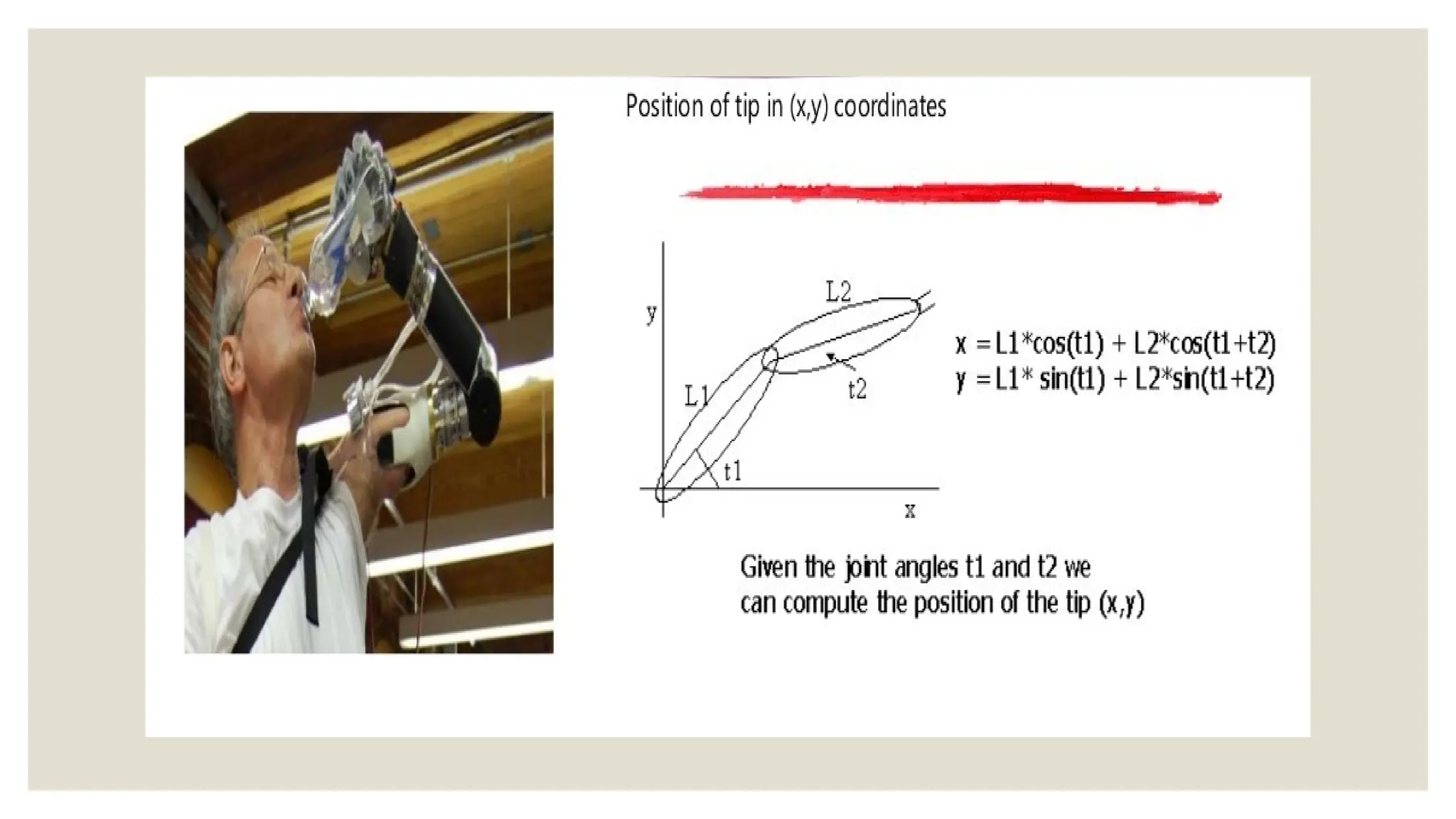
Application in Engineering
 An Architect Engineer uses integration in determining the amount of the necessary
materials to construct curved shape constructions and also to measure the weight of
that structure.
Calculus is used to improve the architecture not only of buildings but also of important
infrastructures such as bridges.
 In Electrical Engineering, Calculus is used to determine the exact length of power
cable needed to connect two substations.
 Space flight engineers frequently use calculus when planning for long missions
Vector fields
◦ A vector field is an assignment of a vector to each point in a subset of
space.
◦ Vector fields are often used to model.
◦ for example, the speed and direction of a moving fluid throughout
space, or the strength and direction of some force, such as the
magnetic or gravitational force, as it changes from point to point.
Applications
◦ Application in medical science :-
Biologists use differential calculus to determine the exact rate of growth in a
bacterial culture when different variables such as temperature and food source
are changed.
Application in graphics:-
A graphics artist uses calculus to determine how different three-dimensional
models will behave when subjected to rapidly changing conditions.
It can create a realistic environment for movies or video games.
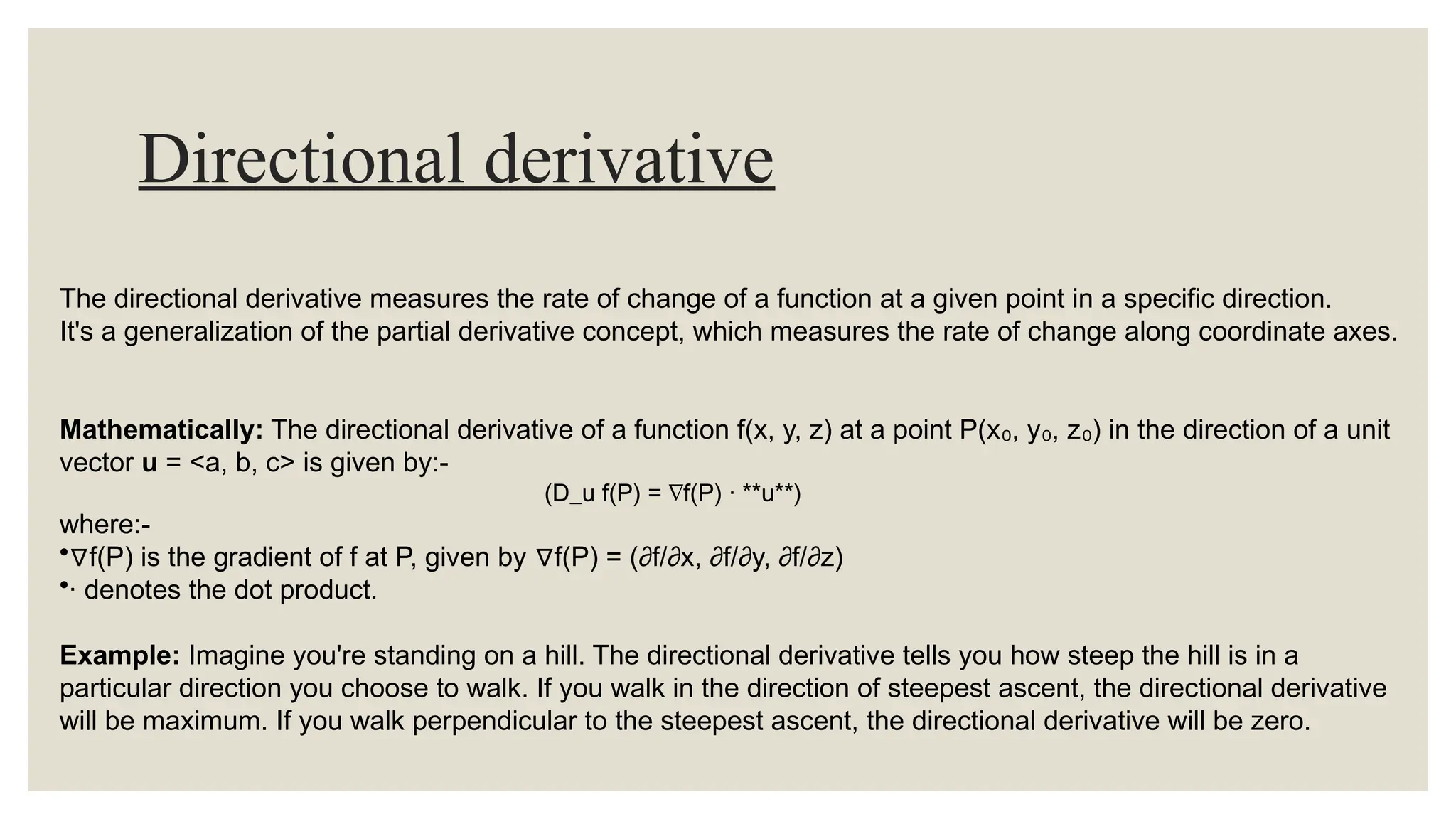
Directional derivative
The directional derivative measures the rate of change of a function at a given point in a specific direction.
It's a generalization of the partial derivative concept, which measures the rate of change along coordinate axes.
Mathematically: The directional derivative of a function f(x, y, z) at a point P(x , y , z ) in the direction of a unit
₀ ₀ ₀
vector u = <a, b, c> is given by:-
(D_u f(P) = ∇f(P) · **u**)
where:-
•∇f(P) is the gradient of f at P, given by f(P) = (∂f/∂x, ∂f/∂y, ∂f/∂z)
∇
•· denotes the dot product.
Example: Imagine you're standing on a hill. The directional derivative tells you how steep the hill is in a
particular direction you choose to walk. If you walk in the direction of steepest ascent, the directional derivative
will be maximum. If you walk perpendicular to the steepest ascent, the directional derivative will be zero.
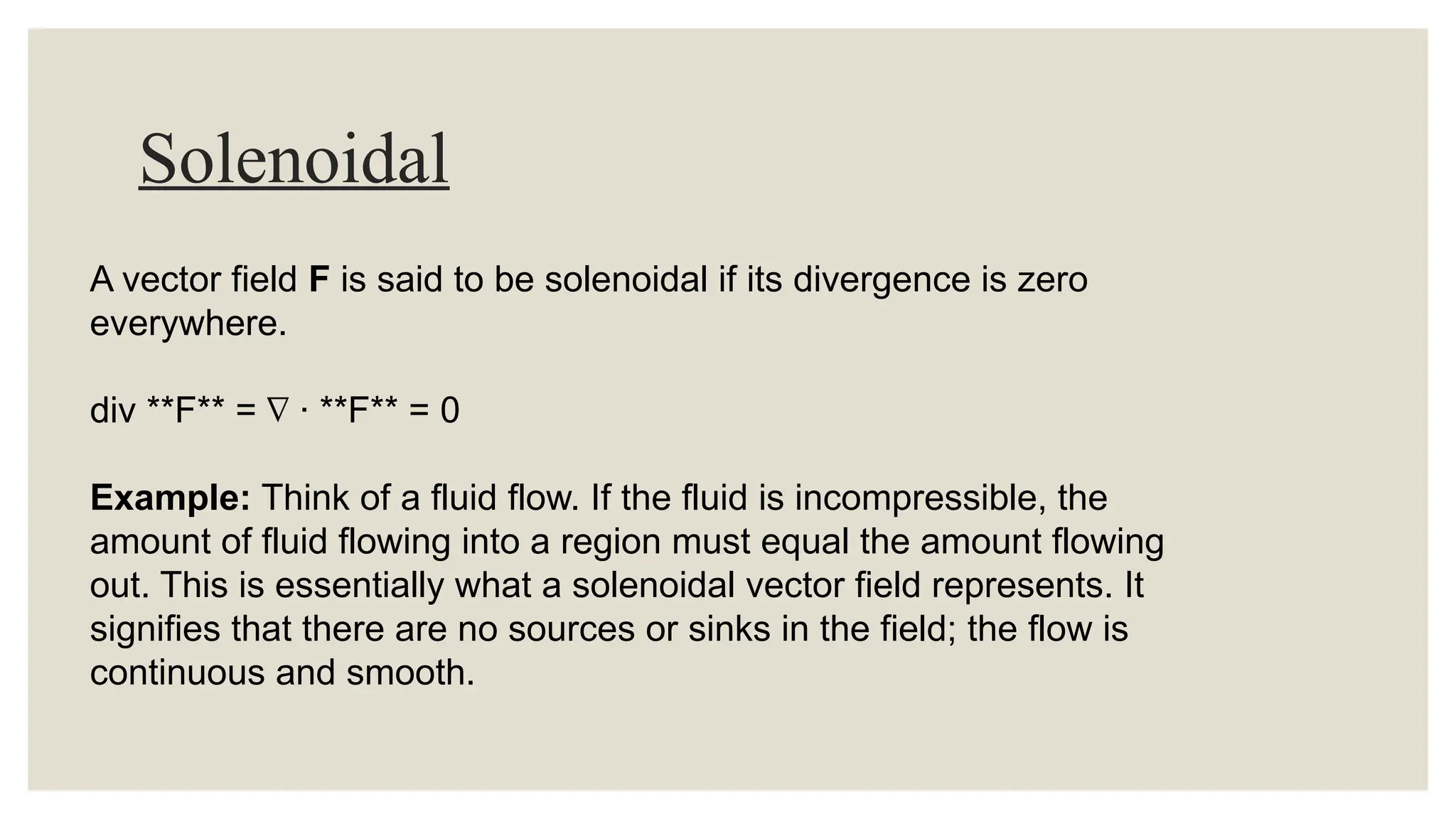
Solenoidal
A vector field F is said to be solenoidal if its divergence is zero
everywhere.
div **F** = ∇ · **F** = 0
Example: Think of a fluid flow. If the fluid is incompressible, the
amount of fluid flowing into a region must equal the amount flowing
out. This is essentially what a solenoidal vector field represents. It
signifies that there are no sources or sinks in the field; the flow is
continuous and smooth.
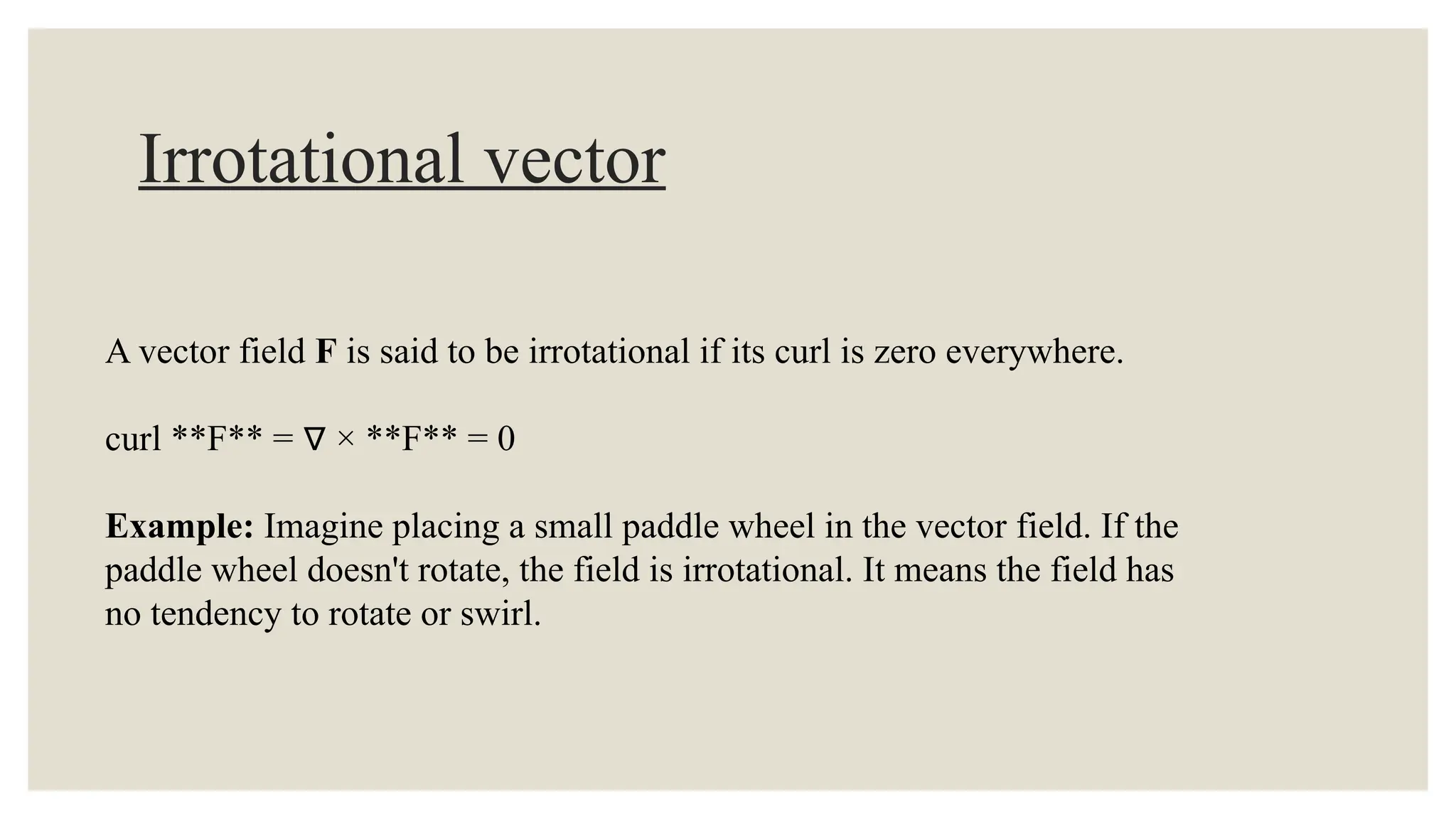
Irrotational vector
A vector field F is said to be irrotational if its curl is zero everywhere.
curl **F** = × **F** = 0
∇
Example: Imagine placing a small paddle wheel in the vector field. If the
paddle wheel doesn't rotate, the field is irrotational. It means the field has
no tendency to rotate or swirl.
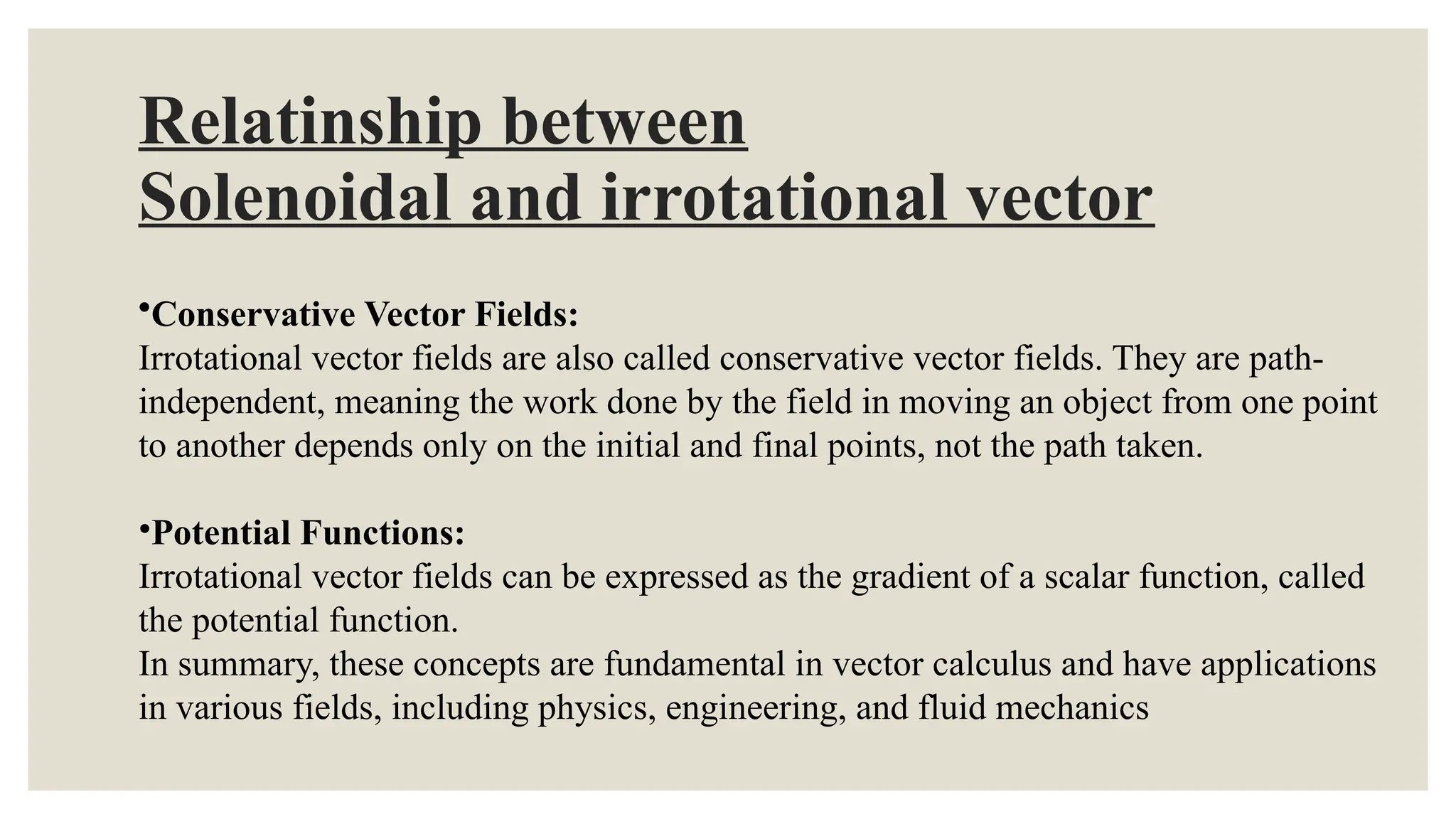
Relatinship between
Solenoidal and irrotational vector
•Conservative Vector Fields:
Irrotational vector fields are also called conservative vector fields. They are path-
independent, meaning the work done by the field in moving an object from one point
to another depends only on the initial and final points, not the path taken.
•Potential Functions:
Irrotational vector fields can be expressed as the gradient of a scalar function, called
the potential function.
In summary, these concepts are fundamental in vector calculus and have applications
in various fields, including physics, engineering, and fluid mechanics

MATHEMATICS ppt on vector and vector calculus.pptx

  • 1.
    MATHEMATICS PRESENTATION Submitted by:- Yuganksingh rajawat Roll no:- 0901ce231108 Submitted to :- Prof. vijayshankar sharma
  • 2.
    TOPICS OF THEPRESENTARION ◦ VECTOR :- ◦ Directional derivative ◦ Solinoidal ◦ Irrotational vector ◦ Vector calculus ( vector differential and integration )
  • 3.
    Introduction:- Vector calculus, orvector analysis, is concerned with differentiation and integration of vector fields, primarily in 3-dimensional Euclidean space.  The term “vector calculus” is sometimes used as a synonym for the broader subject of multivariable calculus, which includes vector calculus as well as partial differentiation and multi integration.  Vector calculus plays an important role in differential geometry and in the study of partial differential equation
  • 4.
    Basics objects Scalar fields A scalar field associates a scalar value to every point in a space.  The scalar may either be a mathematical number or a physical quantity  Examples of scalar fields in applications include ◦ the temperature distribution throughout space, ◦ the pressure distribution in a fluid, ◦ spin-zero quantum fields, such as the Higgs field
  • 5.
    Application in Engineering An Architect Engineer uses integration in determining the amount of the necessary materials to construct curved shape constructions and also to measure the weight of that structure. Calculus is used to improve the architecture not only of buildings but also of important infrastructures such as bridges.  In Electrical Engineering, Calculus is used to determine the exact length of power cable needed to connect two substations.  Space flight engineers frequently use calculus when planning for long missions
  • 6.
    Vector fields ◦ Avector field is an assignment of a vector to each point in a subset of space. ◦ Vector fields are often used to model. ◦ for example, the speed and direction of a moving fluid throughout space, or the strength and direction of some force, such as the magnetic or gravitational force, as it changes from point to point.
  • 8.
    Applications ◦ Application inmedical science :- Biologists use differential calculus to determine the exact rate of growth in a bacterial culture when different variables such as temperature and food source are changed. Application in graphics:- A graphics artist uses calculus to determine how different three-dimensional models will behave when subjected to rapidly changing conditions. It can create a realistic environment for movies or video games.
  • 9.
    Directional derivative The directionalderivative measures the rate of change of a function at a given point in a specific direction. It's a generalization of the partial derivative concept, which measures the rate of change along coordinate axes. Mathematically: The directional derivative of a function f(x, y, z) at a point P(x , y , z ) in the direction of a unit ₀ ₀ ₀ vector u = <a, b, c> is given by:- (D_u f(P) = ∇f(P) · **u**) where:- •∇f(P) is the gradient of f at P, given by f(P) = (∂f/∂x, ∂f/∂y, ∂f/∂z) ∇ •· denotes the dot product. Example: Imagine you're standing on a hill. The directional derivative tells you how steep the hill is in a particular direction you choose to walk. If you walk in the direction of steepest ascent, the directional derivative will be maximum. If you walk perpendicular to the steepest ascent, the directional derivative will be zero.
  • 10.
    Solenoidal A vector fieldF is said to be solenoidal if its divergence is zero everywhere. div **F** = ∇ · **F** = 0 Example: Think of a fluid flow. If the fluid is incompressible, the amount of fluid flowing into a region must equal the amount flowing out. This is essentially what a solenoidal vector field represents. It signifies that there are no sources or sinks in the field; the flow is continuous and smooth.
  • 11.
    Irrotational vector A vectorfield F is said to be irrotational if its curl is zero everywhere. curl **F** = × **F** = 0 ∇ Example: Imagine placing a small paddle wheel in the vector field. If the paddle wheel doesn't rotate, the field is irrotational. It means the field has no tendency to rotate or swirl.
  • 12.
    Relatinship between Solenoidal andirrotational vector •Conservative Vector Fields: Irrotational vector fields are also called conservative vector fields. They are path- independent, meaning the work done by the field in moving an object from one point to another depends only on the initial and final points, not the path taken. •Potential Functions: Irrotational vector fields can be expressed as the gradient of a scalar function, called the potential function. In summary, these concepts are fundamental in vector calculus and have applications in various fields, including physics, engineering, and fluid mechanics