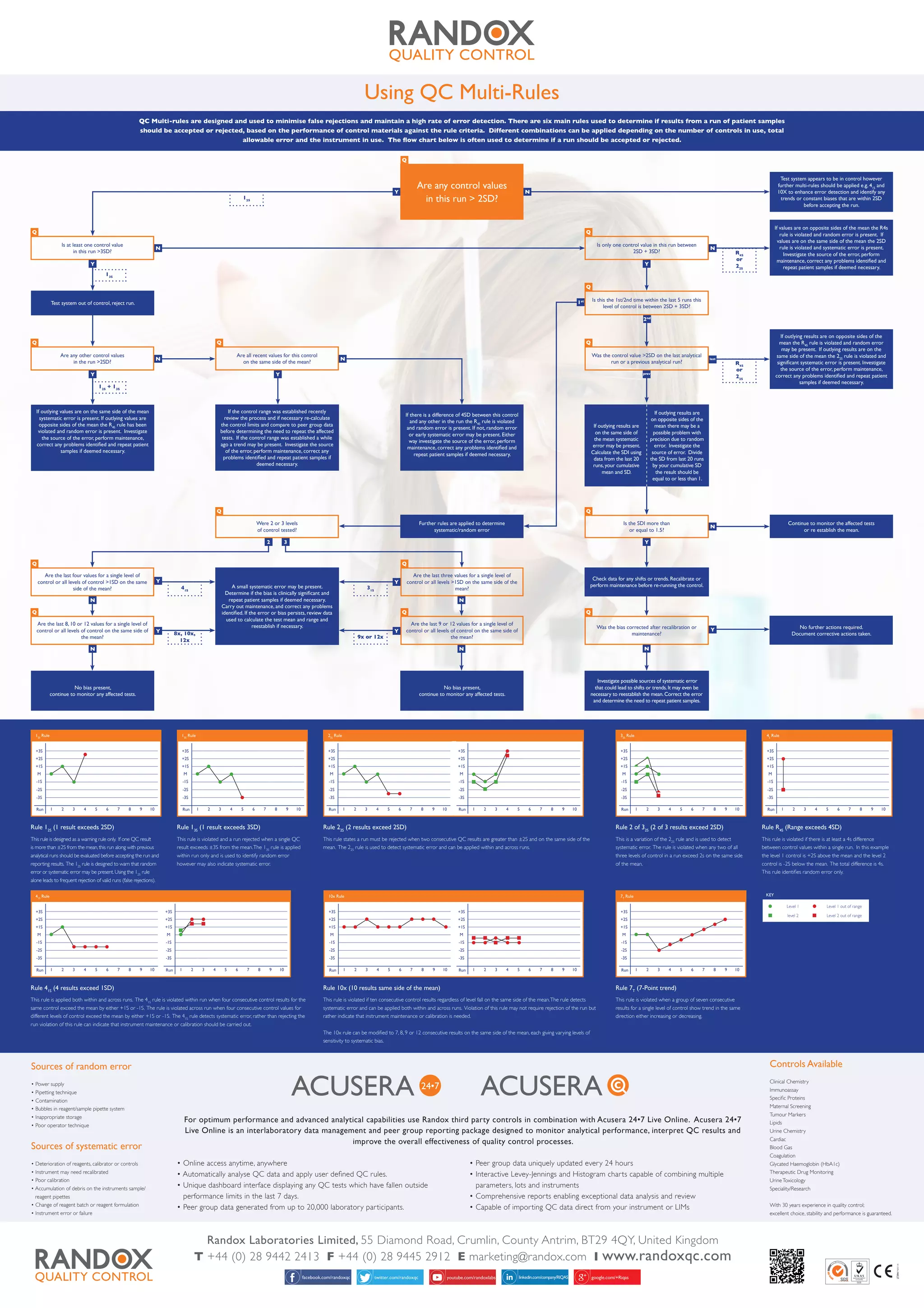
QC Multi-rules are designed and used to minimise false rejections and maintain a high rate of error detection. There are six main rules used to determine if results from a run of patient samples
should be accepted or rejected, based on the performance of control materials against the rule criteria. Different combinations can be applied depending on the number of controls in use, total
allowable error and the instrument in use. The flow chart below is often used to determine if a run should be accepted or rejected.
Using QC Multi-Rules
Randox Laboratories Limited, 55 Diamond Road, Crumlin, County Antrim, BT29 4QY, United Kingdom
T +44 (0) 28 9442 2413 F +44 (0) 28 9445 2912 E marketing@randox.com I www.randoxqc.com
Sources of random error
• Power supply
• Pipetting technique
• Contamination
• Bubbles in reagent/sample pipette system
• Inappropriate storage
• Poor operator technique
Sources of systematic error
• Deterioration of reagents, calibrator or controls
• Instrument may need recalibrated
• Poor calibration
• Accumulation of debris on the instruments sample/
reagent pipettes
• Change of reagent batch or reagent formulation
• Instrument error or failure
Rule 12S
(1 result exceeds 2SD)
This rule is designed as a warning rule only. If one QC result
is more than ±2S from the mean,this run along with previous
analytical runs should be evaluated before accepting the run and
reporting results. The 12S
rule is designed to warn that random
error or systematic error may be present.Using the 12S
rule
alone leads to frequent rejection of valid runs (false rejections).
Rule R4S
(Range exceeds 4SD)
This rule is violated if there is at least a 4s difference
between control values within a single run. In this example
the level 1 control is +2S above the mean and the level 2
control is -2S below the mean. The total difference is 4s.
This rule identifies random error only.
Rule 13S
(1 result exceeds 3SD)
This rule is violated and a run rejected when a single QC
result exceeds ±3S from the mean.The 13S
rule is applied
within run only and is used to identify random error
however may also indicate systematic error.
Rule 41S
(4 results exceed 1SD)
This rule is applied both within and across runs. The 41S
rule is violated within run when four consecutive control results for the
same control exceed the mean by either +1S or -1S. The rule is violated across run when four consecutive control values for
different levels of control exceed the mean by either +1S or -1S. The 41S
rule detects systematic error, rather than rejecting the
run violation of this rule can indicate that instrument maintenance or calibration should be carried out.
Rule 22S
(2 results exceed 2SD)
This rule states a run must be rejected when two consecutive QC results are greater than ±2S and on the same side of the
mean. The 22S
rule is used to detect systematic error and can be applied within and across runs.
Rule 10x (10 results same side of the mean)
This rule is violated if ten consecutive control results regardless of level fall on the same side of the mean.The rule detects
systematic error and can be applied both within and across runs. Violation of this rule may not require rejection of the run but
rather indicate that instrument maintenance or calibration is needed.
The 10x rule can be modified to 7, 8, 9 or 12 consecutive results on the same side of the mean, each giving varying levels of
sensitivity to systematic bias.
Rule 2 of 32S
(2 of 3 results exceed 2SD)
This is a variation of the 22S
rule and is used to detect
systematic error. The rule is violated when any two of all
three levels of control in a run exceed 2s on the same side
of the mean.
Rule 7T
(7-Point trend)
This rule is violated when a group of seven consecutive
results for a single level of control show trend in the same
direction either increasing or decreasing.
Controls Available
Clinical Chemistry
Immunoassay
Specific Proteins
Maternal Screening
Tumour Markers
Lipids
Urine Chemistry
Cardiac
Blood Gas
Coagulation
Glycated Haemoglobin (HbA1c)
Therapeutic Drug Monitoring
UrineToxicology
Speciality/Research
With 30 years experience in quality control;
excellent choice, stability and performance is guaranteed.
• Online access anytime, anywhere
• Automatically analyse QC data and apply user defined QC rules.
• Unique dashboard interface displaying any QC tests which have fallen outside
performance limits in the last 7 days.
• Peer group data generated from up to 20,000 laboratory participants.
• Peer group data uniquely updated every 24 hours
• Interactive Levey-Jennings and Histogram charts capable of combining multiple
parameters, lots and instruments
• Comprehensive reports enabling exceptional data analysis and review
• Capable of importing QC data direct from your instrument or LIMs
For optimum performance and advanced analytical capabilities use Randox third party controls in combination with Acusera 24•7 Live Online. Acusera 24•7
Live Online is an interlaboratory data management and peer group reporting package designed to monitor analytical performance, interpret QC results and
improve the overall effectiveness of quality control processes.
KEY
Level 1 Level 1 out of range
level 2 Level 2 out of range
If there is a difference of 4SD between this control
and any other in the run the R4S
rule is violated
and random error is present. If not, random error
or early systematic error may be present. Either
way investigate the source of the error, perform
maintenance, correct any problems identified and
repeat patient samples if deemed necessary.
Investigate possible sources of systematic error
that could lead to shifts or trends.It may even be
necessary to reestablish the mean.Correct the error
and determine the need to repeat patient samples.
A small systematic error may be present.
Determine if the bias is clinically significant and
repeat patient samples if deemed necessary.
Carry out maintenance, and correct any problems
identified. If the error or bias persists, review data
used to calculate the test mean and range and
reestablish if necessary.
If the control range was established recently
review the process and if necessary re-calculate
the control limits and compare to peer group data
before determining the need to repeat the affected
tests. If the control range was established a while
ago a trend may be present. Investigate the source
of the error, perform maintenance, correct any
problems identified and repeat patient samples if
deemed necessary.
If values are on opposite sides of the mean the R4s
rule is violated and random error is present. If
values are on the same side of the mean the 2SD
rule is violated and systematic error is present.
Investigate the source of the error, perform
maintenance, correct any problems identified and
repeat patient samples if deemed necessary.
If outlying results are on opposite sides of the
mean the R4S
rule is violated and random error
may be present. If outlying results are on the
same side of the mean the 22S
rule is violated and
significant systematic error is present. Investigate
the source of the error, perform maintenance,
correct any problems identified and repeat patient
samples if deemed necessary.
Test system appears to be in control however
further multi-rules should be applied e.g. 41S
and
10X to enhance error detection and identify any
trends or constant biases that are within 2SD
before accepting the run.
Is at least one control value
in this run 3SD?
Is only one control value in this run between
2SD + 3SD?
Is this the 1st/2nd time within the last 5 runs this
level of control is between 2SD + 3SD?
Further rules are applied to determine
systematic/random error
Was the control value 2SD on the last analytical
run or a previous analytical run?
Were 2 or 3 levels
of control tested?
Are the last three values for a single level of
control or all levels 1SD on the same side of the
mean?
Are the last 9 or 12 values for a single level of
control or all levels of control on the same side of
the mean?
No bias present,
continue to monitor any affected tests.
Are the last four values for a single level of
control or all levels of control 1SD on the same
side of the mean?
Are the last 8, 10 or 12 values for a single level of
control or all levels of control on the same side of
the mean?
No bias present,
continue to monitor any affected tests.
Test system out of control, reject run.
Are any other control values
in the run 2SD?
If outlying values are on the same side of the mean
systematic error is present. If outlying values are
opposite sides of the mean the R4S
rule has been
violated and random error is present. Investigate
the source of the error, perform maintenance,
correct any problems identified and repeat patient
samples if deemed necessary.
Are all recent values for this control
on the same side of the mean?
If outlying results are
on the same side of
the mean systematic
error may be present.
Calculate the SDI using
data from the last 20
runs, your cumulative
mean and SD.
If outlying results are
on opposite sides of the
mean there may be a
possible problem with
precision due to random
error. Investigate the
source of error. Divide
the SD from last 20 runs
by your cumulative SD
the result should be
equal to or less than 1.
Is the SDI more than
or equal to 1.5?
Continue to monitor the affected tests
or re establish the mean.
Check data for any shifts or trends. Recalibrate or
perform maintenance before re-running the control.
Was the bias corrected after recalibration or
maintenance?
No further actions required.
Document corrective actions taken.
Y
Y
Y Y
Y
2 3
Y
Y Y Y
Y
2nd
prev
1st
last
Y
N
N
N
N N
N N N
N
N
N
Q
Q
Q
13S
12S
+ 13S
41S
31S
8x, 10x,
12x
9x or 12x
Q Q
Q Q
Q
Q
Q
Q
Q
Q
Q
Are any control values
in this run  2SD?12S
R4S
or
22S
R4S
or
22S
12S
Rule
1 2 3 4 5 6 7 8 9 10Run
-3S
-2S
-1S
M
+1S
+2S
+3S
22S
Rule
1 2 3 4 5 6 7 8 9 10Run
-3S
-2S
-1S
M
+1S
+2S
+3S
1 2 3 4 5 6 7 8 9 10Run
-3S
-2S
-1S
M
+1S
+2S
+3S
13S
Rule
1 2 3 4 5 6 7 8 9 10Run
-3S
-2S
-1S
M
+1S
+2S
+3S
32S
Rule
1 2 3 4 5 6 7 8 9 10Run
-3S
-2S
-1S
M
+1S
+2S
+3S
4S
Rule
1 2 3 4 5 6 7 8 9 10Run
-3S
-2S
-1S
M
+1S
+2S
+3S
41S
Rule 10x Rule
1 2 3 4 5 6 7 8 9 10 1 2 3 4 5 6 7 8 9 10Run Run
-3S -3S
-2S -2S
-1S -1S
M M
+1S +1S
+2S +2S
+3S +3S
1 2 3 4 5 6 7 8 9 10 1 2 3 4 5 6 7 8 9 10Run Run
-3S -3S
-2S -2S
-1S -1S
M M
+1S +1S
+2S +2S
+3S +3S
7T
Rule
1 2 3 4 5 6 7 8 9 10Run
-3S
-2S
-1S
M
+1S
+2S
+3S
LT394MAY14
QUALITY CONTROL
QUALITY CONTROL

Using QC Multi-rules

  • 1.
    QC Multi-rules aredesigned and used to minimise false rejections and maintain a high rate of error detection. There are six main rules used to determine if results from a run of patient samples should be accepted or rejected, based on the performance of control materials against the rule criteria. Different combinations can be applied depending on the number of controls in use, total allowable error and the instrument in use. The flow chart below is often used to determine if a run should be accepted or rejected. Using QC Multi-Rules Randox Laboratories Limited, 55 Diamond Road, Crumlin, County Antrim, BT29 4QY, United Kingdom T +44 (0) 28 9442 2413 F +44 (0) 28 9445 2912 E marketing@randox.com I www.randoxqc.com Sources of random error • Power supply • Pipetting technique • Contamination • Bubbles in reagent/sample pipette system • Inappropriate storage • Poor operator technique Sources of systematic error • Deterioration of reagents, calibrator or controls • Instrument may need recalibrated • Poor calibration • Accumulation of debris on the instruments sample/ reagent pipettes • Change of reagent batch or reagent formulation • Instrument error or failure Rule 12S (1 result exceeds 2SD) This rule is designed as a warning rule only. If one QC result is more than ±2S from the mean,this run along with previous analytical runs should be evaluated before accepting the run and reporting results. The 12S rule is designed to warn that random error or systematic error may be present.Using the 12S rule alone leads to frequent rejection of valid runs (false rejections). Rule R4S (Range exceeds 4SD) This rule is violated if there is at least a 4s difference between control values within a single run. In this example the level 1 control is +2S above the mean and the level 2 control is -2S below the mean. The total difference is 4s. This rule identifies random error only. Rule 13S (1 result exceeds 3SD) This rule is violated and a run rejected when a single QC result exceeds ±3S from the mean.The 13S rule is applied within run only and is used to identify random error however may also indicate systematic error. Rule 41S (4 results exceed 1SD) This rule is applied both within and across runs. The 41S rule is violated within run when four consecutive control results for the same control exceed the mean by either +1S or -1S. The rule is violated across run when four consecutive control values for different levels of control exceed the mean by either +1S or -1S. The 41S rule detects systematic error, rather than rejecting the run violation of this rule can indicate that instrument maintenance or calibration should be carried out. Rule 22S (2 results exceed 2SD) This rule states a run must be rejected when two consecutive QC results are greater than ±2S and on the same side of the mean. The 22S rule is used to detect systematic error and can be applied within and across runs. Rule 10x (10 results same side of the mean) This rule is violated if ten consecutive control results regardless of level fall on the same side of the mean.The rule detects systematic error and can be applied both within and across runs. Violation of this rule may not require rejection of the run but rather indicate that instrument maintenance or calibration is needed. The 10x rule can be modified to 7, 8, 9 or 12 consecutive results on the same side of the mean, each giving varying levels of sensitivity to systematic bias. Rule 2 of 32S (2 of 3 results exceed 2SD) This is a variation of the 22S rule and is used to detect systematic error. The rule is violated when any two of all three levels of control in a run exceed 2s on the same side of the mean. Rule 7T (7-Point trend) This rule is violated when a group of seven consecutive results for a single level of control show trend in the same direction either increasing or decreasing. Controls Available Clinical Chemistry Immunoassay Specific Proteins Maternal Screening Tumour Markers Lipids Urine Chemistry Cardiac Blood Gas Coagulation Glycated Haemoglobin (HbA1c) Therapeutic Drug Monitoring UrineToxicology Speciality/Research With 30 years experience in quality control; excellent choice, stability and performance is guaranteed. • Online access anytime, anywhere • Automatically analyse QC data and apply user defined QC rules. • Unique dashboard interface displaying any QC tests which have fallen outside performance limits in the last 7 days. • Peer group data generated from up to 20,000 laboratory participants. • Peer group data uniquely updated every 24 hours • Interactive Levey-Jennings and Histogram charts capable of combining multiple parameters, lots and instruments • Comprehensive reports enabling exceptional data analysis and review • Capable of importing QC data direct from your instrument or LIMs For optimum performance and advanced analytical capabilities use Randox third party controls in combination with Acusera 24•7 Live Online. Acusera 24•7 Live Online is an interlaboratory data management and peer group reporting package designed to monitor analytical performance, interpret QC results and improve the overall effectiveness of quality control processes. KEY Level 1 Level 1 out of range level 2 Level 2 out of range If there is a difference of 4SD between this control and any other in the run the R4S rule is violated and random error is present. If not, random error or early systematic error may be present. Either way investigate the source of the error, perform maintenance, correct any problems identified and repeat patient samples if deemed necessary. Investigate possible sources of systematic error that could lead to shifts or trends.It may even be necessary to reestablish the mean.Correct the error and determine the need to repeat patient samples. A small systematic error may be present. Determine if the bias is clinically significant and repeat patient samples if deemed necessary. Carry out maintenance, and correct any problems identified. If the error or bias persists, review data used to calculate the test mean and range and reestablish if necessary. If the control range was established recently review the process and if necessary re-calculate the control limits and compare to peer group data before determining the need to repeat the affected tests. If the control range was established a while ago a trend may be present. Investigate the source of the error, perform maintenance, correct any problems identified and repeat patient samples if deemed necessary. If values are on opposite sides of the mean the R4s rule is violated and random error is present. If values are on the same side of the mean the 2SD rule is violated and systematic error is present. Investigate the source of the error, perform maintenance, correct any problems identified and repeat patient samples if deemed necessary. If outlying results are on opposite sides of the mean the R4S rule is violated and random error may be present. If outlying results are on the same side of the mean the 22S rule is violated and significant systematic error is present. Investigate the source of the error, perform maintenance, correct any problems identified and repeat patient samples if deemed necessary. Test system appears to be in control however further multi-rules should be applied e.g. 41S and 10X to enhance error detection and identify any trends or constant biases that are within 2SD before accepting the run. Is at least one control value in this run 3SD? Is only one control value in this run between 2SD + 3SD? Is this the 1st/2nd time within the last 5 runs this level of control is between 2SD + 3SD? Further rules are applied to determine systematic/random error Was the control value 2SD on the last analytical run or a previous analytical run? Were 2 or 3 levels of control tested? Are the last three values for a single level of control or all levels 1SD on the same side of the mean? Are the last 9 or 12 values for a single level of control or all levels of control on the same side of the mean? No bias present, continue to monitor any affected tests. Are the last four values for a single level of control or all levels of control 1SD on the same side of the mean? Are the last 8, 10 or 12 values for a single level of control or all levels of control on the same side of the mean? No bias present, continue to monitor any affected tests. Test system out of control, reject run. Are any other control values in the run 2SD? If outlying values are on the same side of the mean systematic error is present. If outlying values are opposite sides of the mean the R4S rule has been violated and random error is present. Investigate the source of the error, perform maintenance, correct any problems identified and repeat patient samples if deemed necessary. Are all recent values for this control on the same side of the mean? If outlying results are on the same side of the mean systematic error may be present. Calculate the SDI using data from the last 20 runs, your cumulative mean and SD. If outlying results are on opposite sides of the mean there may be a possible problem with precision due to random error. Investigate the source of error. Divide the SD from last 20 runs by your cumulative SD the result should be equal to or less than 1. Is the SDI more than or equal to 1.5? Continue to monitor the affected tests or re establish the mean. Check data for any shifts or trends. Recalibrate or perform maintenance before re-running the control. Was the bias corrected after recalibration or maintenance? No further actions required. Document corrective actions taken. Y Y Y Y Y 2 3 Y Y Y Y Y 2nd prev 1st last Y N N N N N N N N N N N Q Q Q 13S 12S + 13S 41S 31S 8x, 10x, 12x 9x or 12x Q Q Q Q Q Q Q Q Q Q Q Are any control values in this run 2SD?12S R4S or 22S R4S or 22S 12S Rule 1 2 3 4 5 6 7 8 9 10Run -3S -2S -1S M +1S +2S +3S 22S Rule 1 2 3 4 5 6 7 8 9 10Run -3S -2S -1S M +1S +2S +3S 1 2 3 4 5 6 7 8 9 10Run -3S -2S -1S M +1S +2S +3S 13S Rule 1 2 3 4 5 6 7 8 9 10Run -3S -2S -1S M +1S +2S +3S 32S Rule 1 2 3 4 5 6 7 8 9 10Run -3S -2S -1S M +1S +2S +3S 4S Rule 1 2 3 4 5 6 7 8 9 10Run -3S -2S -1S M +1S +2S +3S 41S Rule 10x Rule 1 2 3 4 5 6 7 8 9 10 1 2 3 4 5 6 7 8 9 10Run Run -3S -3S -2S -2S -1S -1S M M +1S +1S +2S +2S +3S +3S 1 2 3 4 5 6 7 8 9 10 1 2 3 4 5 6 7 8 9 10Run Run -3S -3S -2S -2S -1S -1S M M +1S +1S +2S +2S +3S +3S 7T Rule 1 2 3 4 5 6 7 8 9 10Run -3S -2S -1S M +1S +2S +3S LT394MAY14 QUALITY CONTROL QUALITY CONTROL