29
Monitoring EQA Performance
EachEQAreportshouldbeevaluatedandanypoorperformanceinvestigated.
Astepbystepapproachshouldbeadoptedconsistingofthefollowingthreesteps:
1
Investigate the source of
the problem
2
Implement
corrective actions
3
Check the effectiveness of
the corrective actions
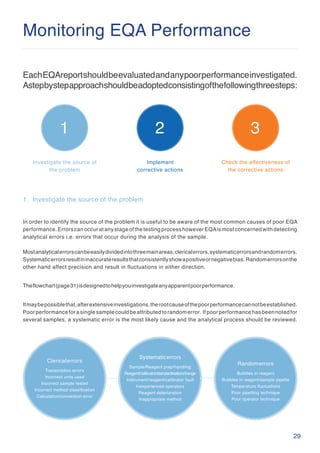
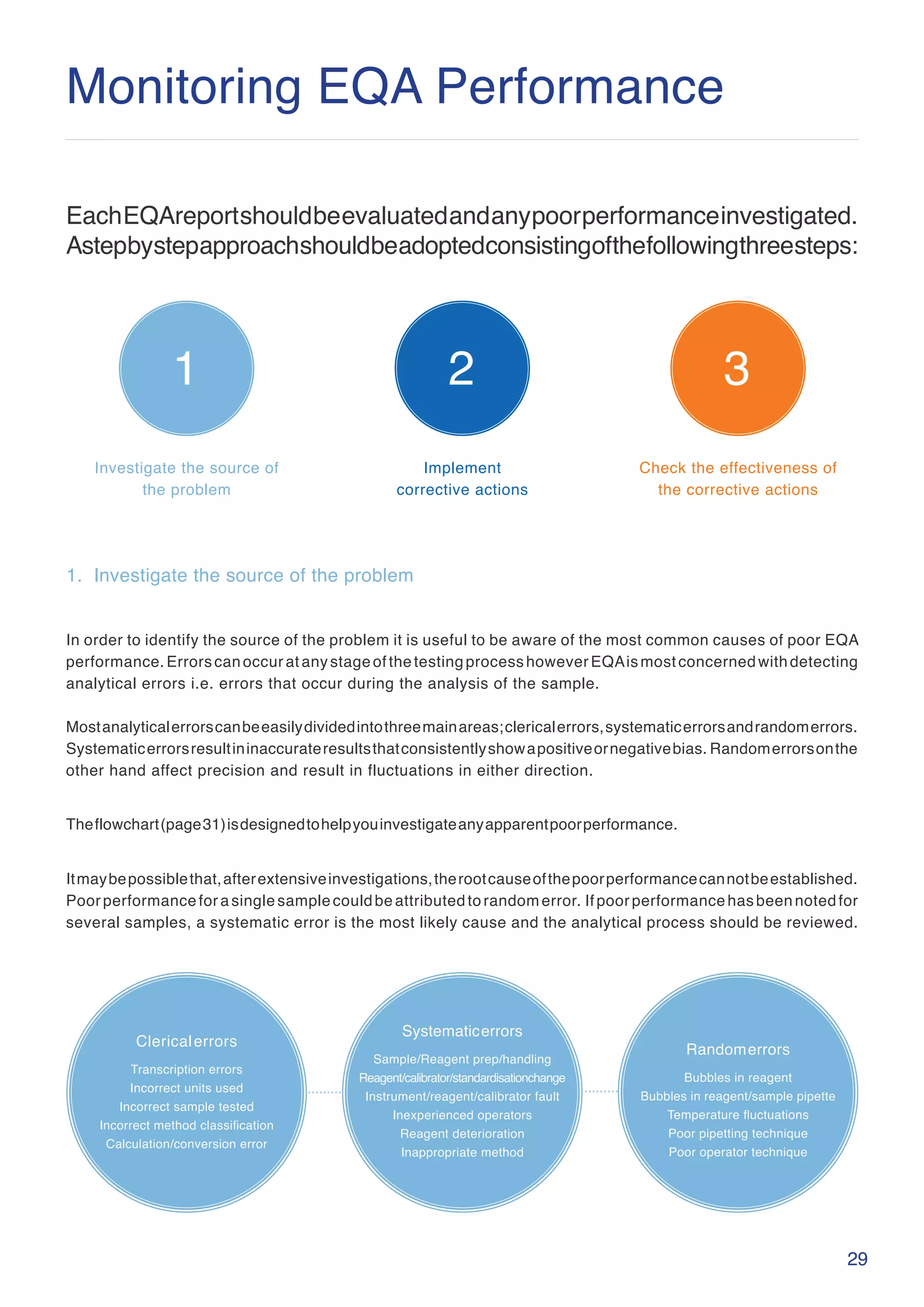
In order to identify the source of the problem it is useful to be aware of the most common causes of poor EQA
performance.Errors can occurat any stage of thetestingprocesshowever EQAismost concernedwithdetecting
analytical errors i.e. errors that occur during the analysis of the sample.
Mostanalyticalerrorscanbeeasilydividedintothreemainareas;clericalerrors,systematicerrorsandrandomerrors.
Systematicerrorsresultininaccurateresultsthatconsistentlyshowapositiveornegativebias. Randomerrorsonthe
other hand affect precision and result in fluctuations in either direction.
1. Investigate the source of the problem
Transcription errors
Incorrect units used
Incorrect sample tested
Incorrect method classification
Calculation/conversion error
Clericalerrors
Sample/Reagent prep/handling
Reagent/calibrator/standardisationchange
Instrument/reagent/calibrator fault
Inexperienced operators
Reagent deterioration
Inappropriate method
Systematicerrors
Bubbles in reagent
Bubbles in reagent/sample pipette
Temperature fluctuations
Poor pipetting technique
Poor operator technique
Randomerrors
Itmaybepossiblethat,afterextensiveinvestigations,therootcauseofthepoorperformancecannotbeestablished.
Poor performance for a single sample could be attributed to random error. If poor performance has been noted for
several samples, a systematic error is the most likely cause and the analytical process should be reviewed.
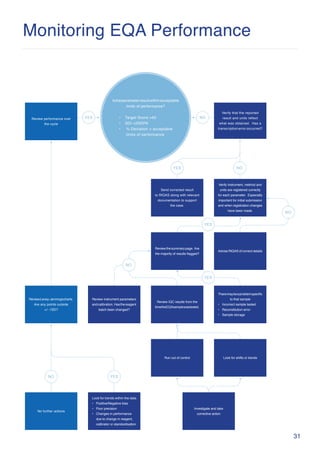
Theflowchart(page31)isdesignedtohelpyouinvestigateanyapparentpoorperformance.
30
Monitoring EQA Performance
Lab Manager:			 Date: Lab Director:			 Date:
Conclusion: Remedial Action:
Laboratory:
Cycle Number:
Analysis Date:
Mean for Comparison:
Sample Number:
Analyte:
Lab Result:	 SDI:	 % Dev:
1. Specimen Handling
a. Samples received in good condition
b. Samples stored/prepared appropriately
c. Integrity of the sample is acceptable
2. Clerical
a. Correct result entered
b. Correct use of decimal point and units
c. Calculations, if any, performed correctly
(even if automated)
d. Conversionfactorsappliedtoresultsbeforesubmission
3. Registration and Mean for Comparison
a. Registered in the correct method/instrument group
b. ChangedmethodorinstrumentwithoutadvisingRIQAS
c. Mean for comparison changed due to the number of
participantsreturningresultse.g.frommethodtoinstrument
d. Anobviousbiasbetweenmethodandinstrumentmeans
(check histogram and stats sections)
4. Internal Quality Control
a. %DeviationofIQC(atsimilarconctothatofEQA)on
sample analysis date acceptable
b. Shift in IQC in the periods just before and after EQA
sample analysis
c. Trends in IQC in the periods before and after EQA
sample analysis
d. Random IQC variation on sample analysis date
e. Error due to imprecision; check IQC in terms of %
deviation compared to deviation observed in EQA
f. IQC target correctly assigned
5. Calibration
a. Date of last calibration
b. Calibration frequency acceptable
c. Last calibration acceptable
6. Instrument
a. Dailymaintenanceperformedondateofsampleanalysis
b. Specialmaintenanceperformedpriortosampleanalysis
c. Instrument operated correctly
d. Operator fully trained
7. Reagents
a. Reagents prepared and stored correctly
b. Reagents within open vial stability
8. EQA sample
a. Initial value
b. Re-run value
c. IssueobservedinpreviousEQAsamplesatasimilar
concentration(check%deviationbyconcentrationand
Levey Jennings charts)
d. All parameters affected (to the same extent) - possible
reconstitutionerror(check%deviationonsummarypages)
Y Y
YY
Y
Y Y
Y
Y
Y
Y
Y
Y
Y
Y
Y
Y
Y
Y
Y
Y
Y
Y
Y
Y
Y
Y
N N
NN
N
N N
N
N
N
N
N
N
N
N
N
N
N
N
N
N
N
N
N
N
N
N
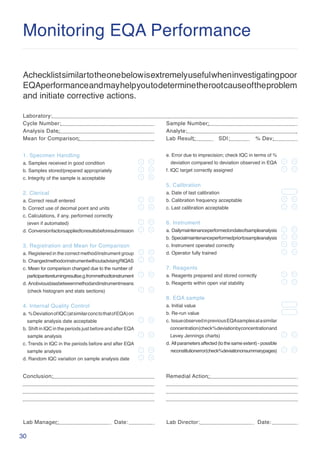
Achecklistsimilartotheonebelowisextremelyusefulwheninvestigatingpoor
EQAperformanceandmayhelpyoutodeterminetherootcauseoftheproblem
and initiate corrective actions.
31
Monitoring EQA Performance
NOYES
YES
Review performance over
the cycle
Verify that the reported
result and units reflect
what was obtained. Has a
transcription error occurred?
Send corrected result
to RIQAS along with relevant
documentation to support
the case.
Verify instrument, method and
units are registered correctly
for each parameter. Especially
important for initial submission
and when registration changes
have been made.
Review the summary page. Are
the majority of results flagged?
Run out of control Look for shifts or trends
ReviewLevey-Jenningscharts.
Are any points outside
+/- 1SD?
Theremaybeaproblemspecific
to that sample
•	 Incorrect sample tested
•	 Reconstitution error
•	 Sample storage
Review IQC results from the
timetheEQAsamplewastested.
Review instrument parameters
andcalibration. Hasthereagent
batch been changed?
No further actions
Investigate and take
corrective action
Look for trends within the data
•	 Positive/Negative bias
•	 Poor precision
•	 Changes in performance
due to change in reagent,
calibrator or standardisation
YES
YES
YES
NO
NO
NO
NO
Istheparameterresultwithinacceptable
limits of performance?
•	 Target Score 50
•	 SDI 2SDPA
•	 % Deviation  acceptable
limits of performance
Advise RIQAS of correct details
32
The effectiveness or impact of any corrective actions taken can be assessed by continuing to monitor analytical
performance over time.
3. Check the effectiveness of corrective actions
2. Implement corrective actions
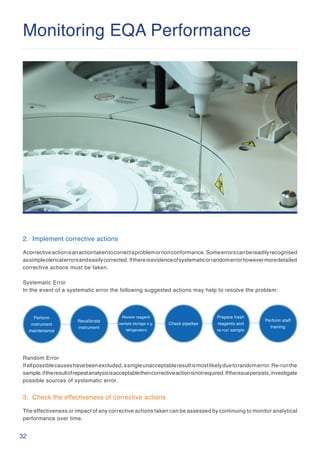
Acorrectiveactionisanactiontakentocorrectaproblemornonconformance. Someerrorscanbereadilyrecognised
assimpleclericalerrorsandeasilycorrected. Ifthereisevidenceofsystematicorrandomerrorhowevermoredetailed
corrective actions must be taken.
Systematic Error
In the event of a systematic error the following suggested actions may help to resolve the problem:
Random Error
Ifallpossiblecauseshavebeenexcluded,asingleunacceptableresultismostlikelyduetorandomerror.Re-runthe
sample,iftheresultofrepeatanalysisisacceptablethencorrectiveactionisnotrequired.Iftheissuepersists,investigate
possible sources of systematic error.
Perform
instrument
maintenance
Review reagent/
sample storage e.g.
refrigerators
Prepare fresh
reagents and
re-run sample
Recalibrate
instrument
Check pipettes
Perform staff
training
Monitoring EQA Performance

Troubleshooting Poor EQA/QC Performance in the Laboratory

  • 1.
    29 Monitoring EQA Performance EachEQAreportshouldbeevaluatedandanypoorperformanceinvestigated. Astepbystepapproachshouldbeadoptedconsistingofthefollowingthreesteps: 1 Investigatethe source of the problem 2 Implement corrective actions 3 Check the effectiveness of the corrective actions In order to identify the source of the problem it is useful to be aware of the most common causes of poor EQA performance.Errors can occurat any stage of thetestingprocesshowever EQAismost concernedwithdetecting analytical errors i.e. errors that occur during the analysis of the sample. Mostanalyticalerrorscanbeeasilydividedintothreemainareas;clericalerrors,systematicerrorsandrandomerrors. Systematicerrorsresultininaccurateresultsthatconsistentlyshowapositiveornegativebias. Randomerrorsonthe other hand affect precision and result in fluctuations in either direction. 1. Investigate the source of the problem Transcription errors Incorrect units used Incorrect sample tested Incorrect method classification Calculation/conversion error Clericalerrors Sample/Reagent prep/handling Reagent/calibrator/standardisationchange Instrument/reagent/calibrator fault Inexperienced operators Reagent deterioration Inappropriate method Systematicerrors Bubbles in reagent Bubbles in reagent/sample pipette Temperature fluctuations Poor pipetting technique Poor operator technique Randomerrors Itmaybepossiblethat,afterextensiveinvestigations,therootcauseofthepoorperformancecannotbeestablished. Poor performance for a single sample could be attributed to random error. If poor performance has been noted for several samples, a systematic error is the most likely cause and the analytical process should be reviewed. Theflowchart(page31)isdesignedtohelpyouinvestigateanyapparentpoorperformance.
  • 2.
    30 Monitoring EQA Performance LabManager: Date: Lab Director: Date: Conclusion: Remedial Action: Laboratory: Cycle Number: Analysis Date: Mean for Comparison: Sample Number: Analyte: Lab Result: SDI: % Dev: 1. Specimen Handling a. Samples received in good condition b. Samples stored/prepared appropriately c. Integrity of the sample is acceptable 2. Clerical a. Correct result entered b. Correct use of decimal point and units c. Calculations, if any, performed correctly (even if automated) d. Conversionfactorsappliedtoresultsbeforesubmission 3. Registration and Mean for Comparison a. Registered in the correct method/instrument group b. ChangedmethodorinstrumentwithoutadvisingRIQAS c. Mean for comparison changed due to the number of participantsreturningresultse.g.frommethodtoinstrument d. Anobviousbiasbetweenmethodandinstrumentmeans (check histogram and stats sections) 4. Internal Quality Control a. %DeviationofIQC(atsimilarconctothatofEQA)on sample analysis date acceptable b. Shift in IQC in the periods just before and after EQA sample analysis c. Trends in IQC in the periods before and after EQA sample analysis d. Random IQC variation on sample analysis date e. Error due to imprecision; check IQC in terms of % deviation compared to deviation observed in EQA f. IQC target correctly assigned 5. Calibration a. Date of last calibration b. Calibration frequency acceptable c. Last calibration acceptable 6. Instrument a. Dailymaintenanceperformedondateofsampleanalysis b. Specialmaintenanceperformedpriortosampleanalysis c. Instrument operated correctly d. Operator fully trained 7. Reagents a. Reagents prepared and stored correctly b. Reagents within open vial stability 8. EQA sample a. Initial value b. Re-run value c. IssueobservedinpreviousEQAsamplesatasimilar concentration(check%deviationbyconcentrationand Levey Jennings charts) d. All parameters affected (to the same extent) - possible reconstitutionerror(check%deviationonsummarypages) Y Y YY Y Y Y Y Y Y Y Y Y Y Y Y Y Y Y Y Y Y Y Y Y Y Y N N NN N N N N N N N N N N N N N N N N N N N N N N N Achecklistsimilartotheonebelowisextremelyusefulwheninvestigatingpoor EQAperformanceandmayhelpyoutodeterminetherootcauseoftheproblem and initiate corrective actions.
  • 3.
    31 Monitoring EQA Performance NOYES YES Reviewperformance over the cycle Verify that the reported result and units reflect what was obtained. Has a transcription error occurred? Send corrected result to RIQAS along with relevant documentation to support the case. Verify instrument, method and units are registered correctly for each parameter. Especially important for initial submission and when registration changes have been made. Review the summary page. Are the majority of results flagged? Run out of control Look for shifts or trends ReviewLevey-Jenningscharts. Are any points outside +/- 1SD? Theremaybeaproblemspecific to that sample • Incorrect sample tested • Reconstitution error • Sample storage Review IQC results from the timetheEQAsamplewastested. Review instrument parameters andcalibration. Hasthereagent batch been changed? No further actions Investigate and take corrective action Look for trends within the data • Positive/Negative bias • Poor precision • Changes in performance due to change in reagent, calibrator or standardisation YES YES YES NO NO NO NO Istheparameterresultwithinacceptable limits of performance? • Target Score 50 • SDI 2SDPA • % Deviation acceptable limits of performance Advise RIQAS of correct details
  • 4.
    32 The effectiveness orimpact of any corrective actions taken can be assessed by continuing to monitor analytical performance over time. 3. Check the effectiveness of corrective actions 2. Implement corrective actions Acorrectiveactionisanactiontakentocorrectaproblemornonconformance. Someerrorscanbereadilyrecognised assimpleclericalerrorsandeasilycorrected. Ifthereisevidenceofsystematicorrandomerrorhowevermoredetailed corrective actions must be taken. Systematic Error In the event of a systematic error the following suggested actions may help to resolve the problem: Random Error Ifallpossiblecauseshavebeenexcluded,asingleunacceptableresultismostlikelyduetorandomerror.Re-runthe sample,iftheresultofrepeatanalysisisacceptablethencorrectiveactionisnotrequired.Iftheissuepersists,investigate possible sources of systematic error. Perform instrument maintenance Review reagent/ sample storage e.g. refrigerators Prepare fresh reagents and re-run sample Recalibrate instrument Check pipettes Perform staff training Monitoring EQA Performance