Total Allowable Error (TEa)
or
Allowable Total Error( ATE)
Labs for Life Project
QUALITY CONTROL TRAINING
What is a Quality
Specification/ requirement?
Quality requirements care set to help
guide interpretation of laboratory test
results because they
◦provide perspective about variability of
results within an acceptable interval
◦potential significance of abnormal findings
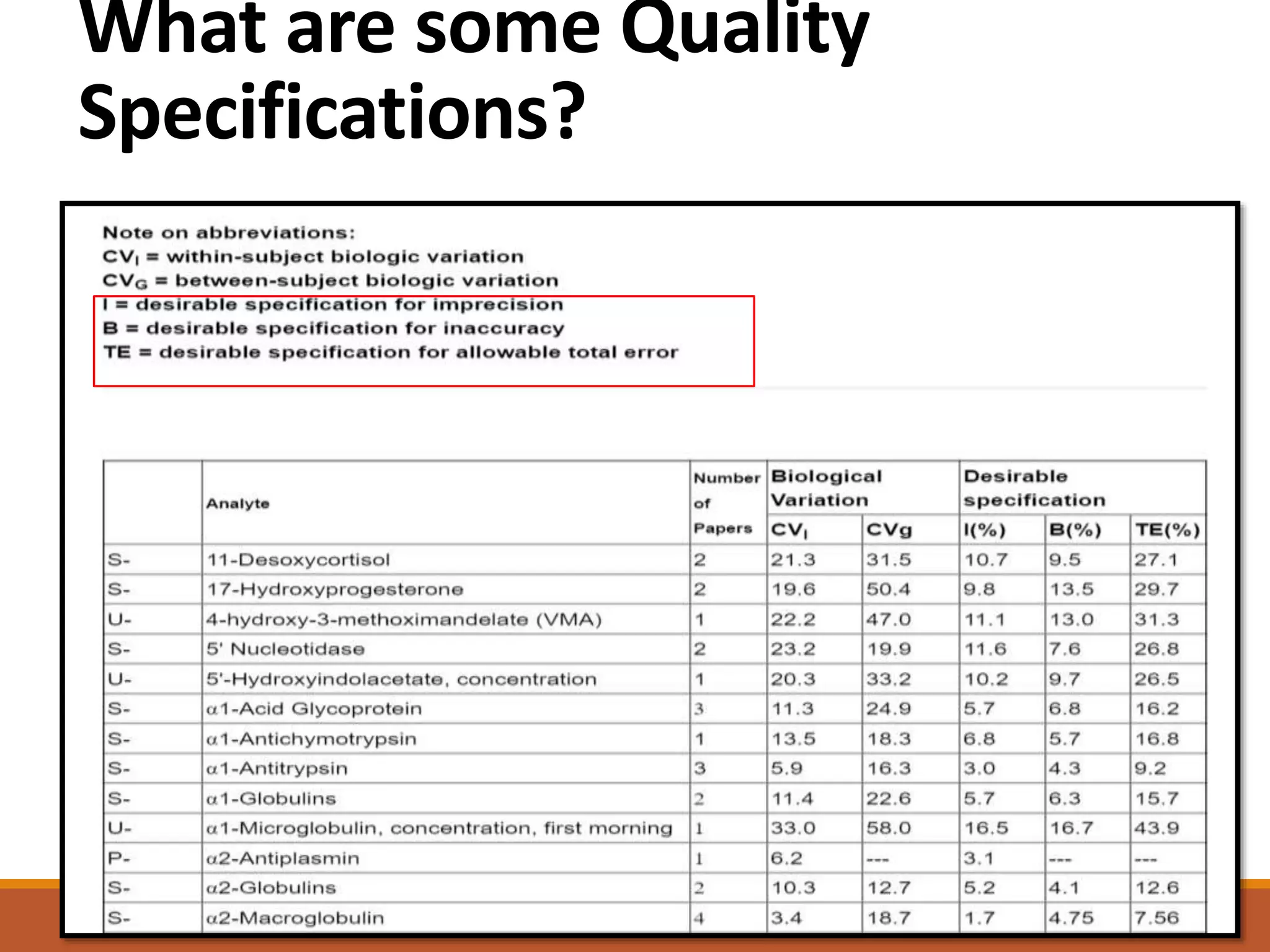
What are some Quality
Specifications?
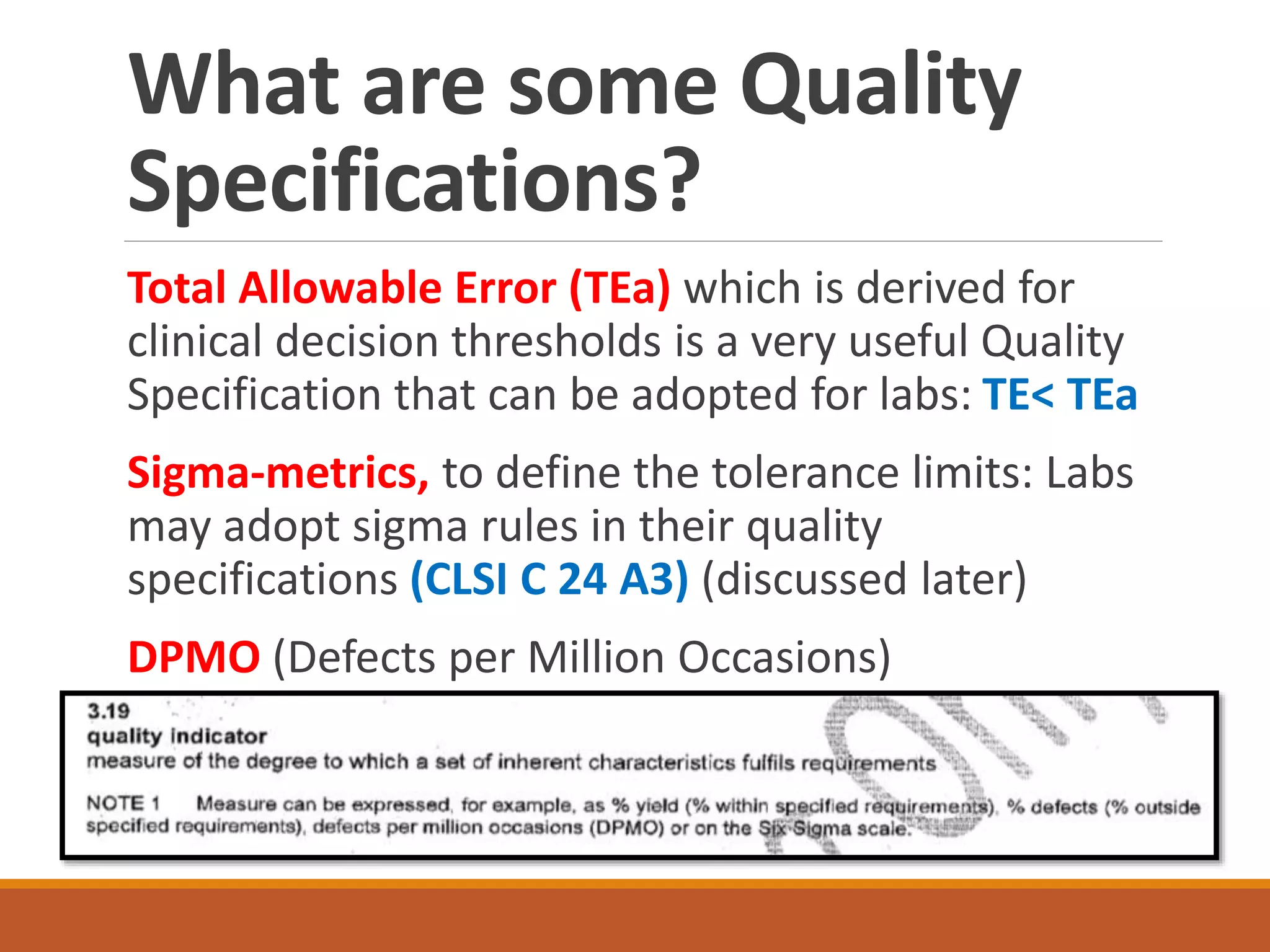
Total Allowable Error (TEa) which is derived for
clinical decision thresholds is a very useful Quality
Specification that can be adopted for labs: TE< TEa
Sigma-metrics, to define the tolerance limits: Labs
may adopt sigma rules in their quality
specifications (CLSI C 24 A3) (discussed later)
DPMO (Defects per Million Occasions)
What are some Quality
Specifications?
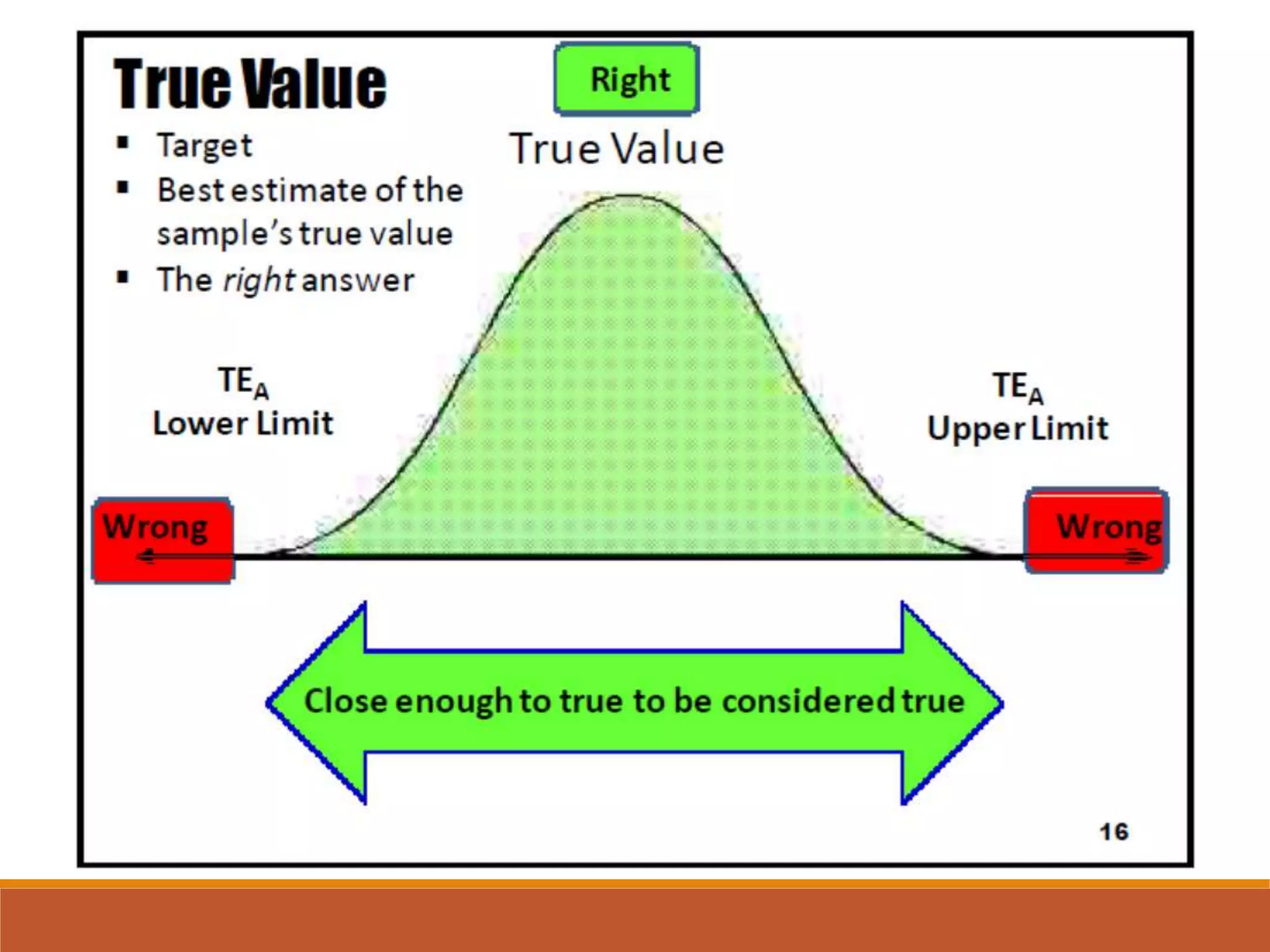
What is and Why TEa?
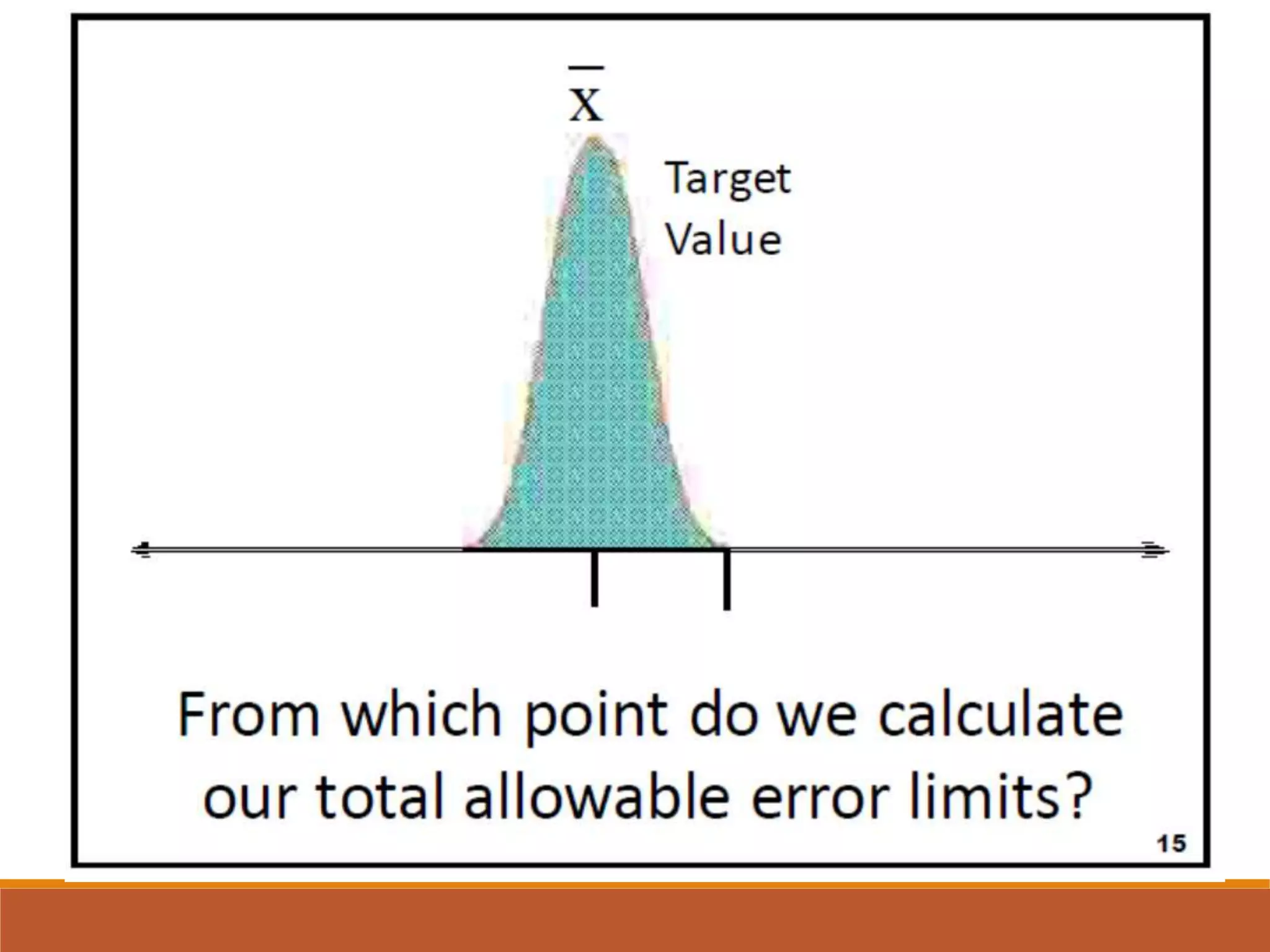
Total Allowable Error (TEa) is the amount of
error that can be tolerated without
invalidating the medical usefulness of the
analytic result.
Knowing the Total Error in a system will be of
clinical use only if there is benchmarking for
the allowable error for that analyte.
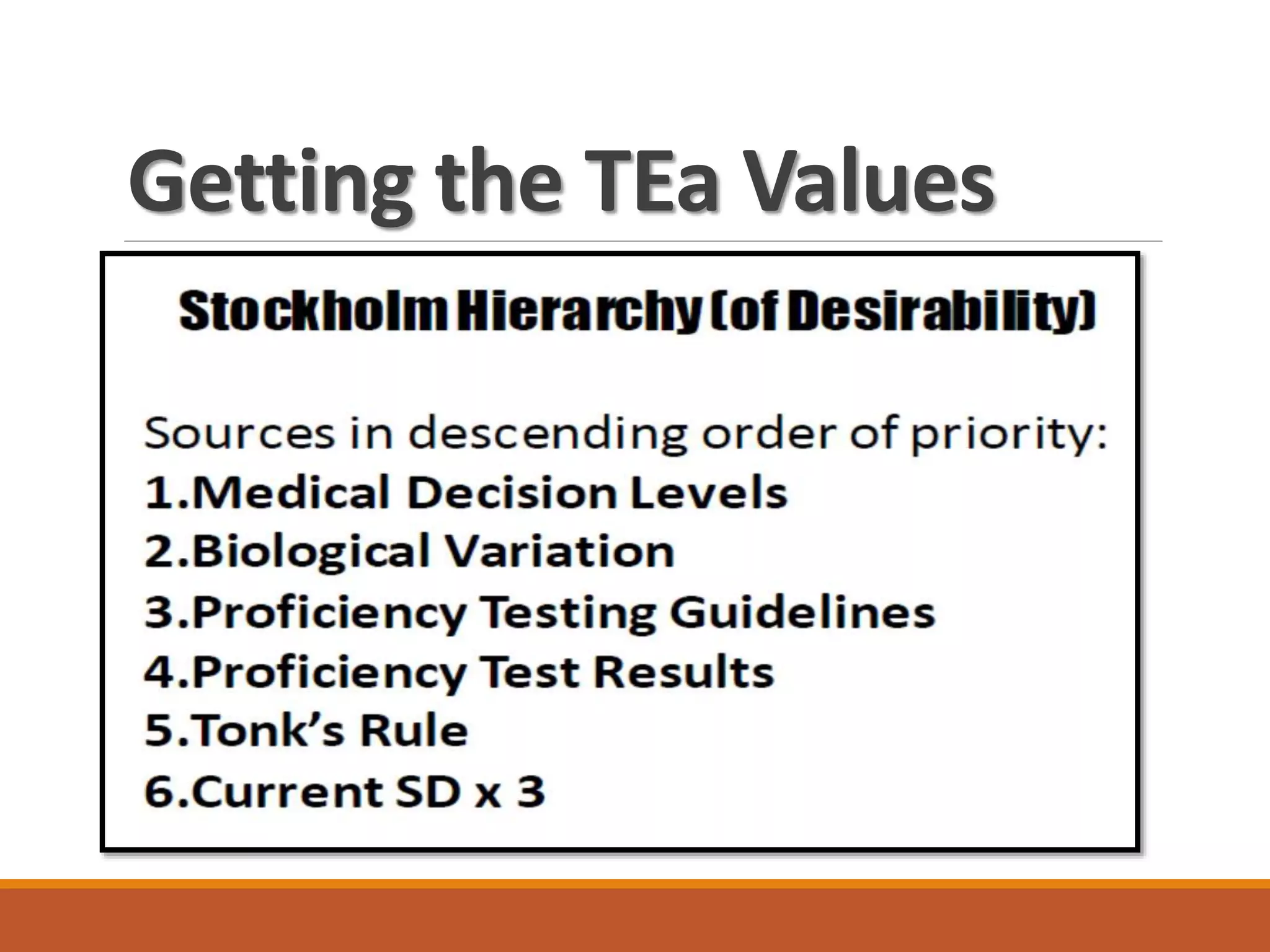
Getting the TEa Values
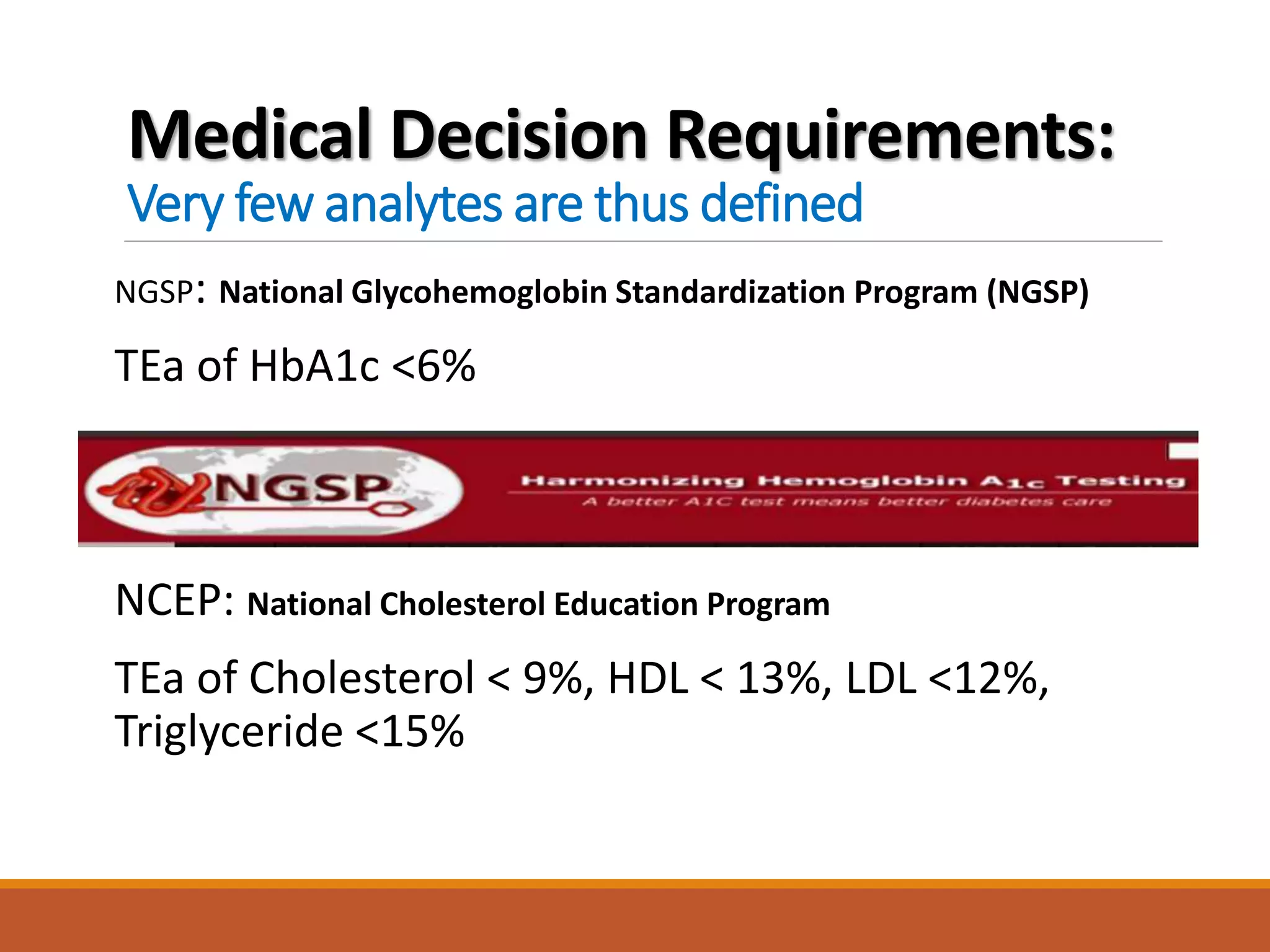
Medical Decision Requirements:
Very few analytes are thus defined
NGSP: National Glycohemoglobin Standardization Program (NGSP)
TEa of HbA1c <6%
NCEP: National Cholesterol Education Program
TEa of Cholesterol < 9%, HDL < 13%, LDL <12%,
Triglyceride <15%
Biological Variation Database
The natural fluctuation of body fluid constituents
around the homeostatic setting point, has two
components: within and between-subject variation.
These have been used for many purposes
oTo set analytical quality specifications (As used here)
oTo evaluate the significance of changes in serial results
oTo assess the utility of population-based reference values
oTo assess the number of specimens required to estimate
the homeostatic set point
oTo assess the clinical utility of tests
Biological Variation Database
Within and between-subject variation.
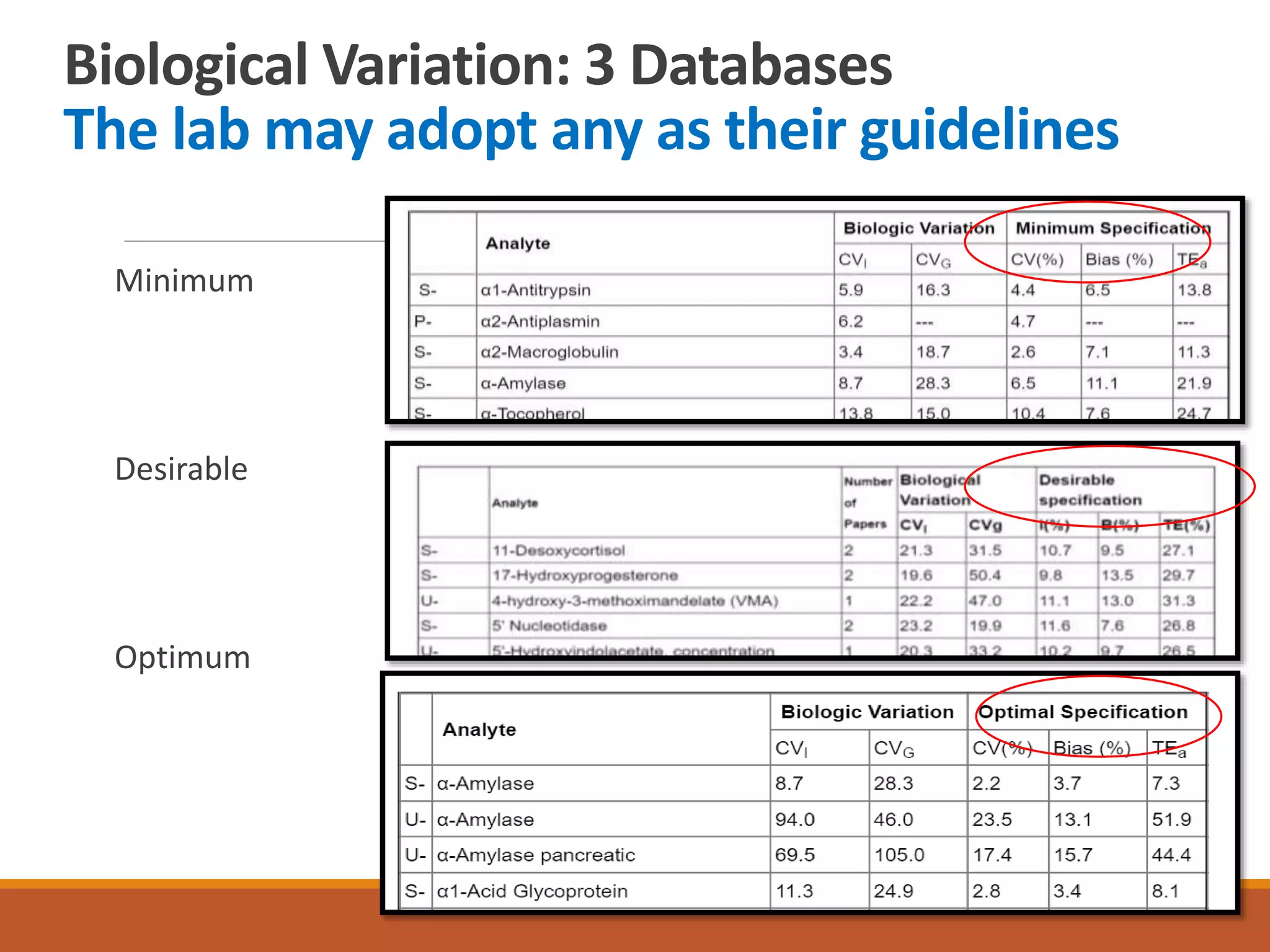
Biological Variation: 3 Databases
The lab may adopt any as their guidelines
Minimum
Desirable
Optimum
CLIA Proficiency Testing
Guidelines
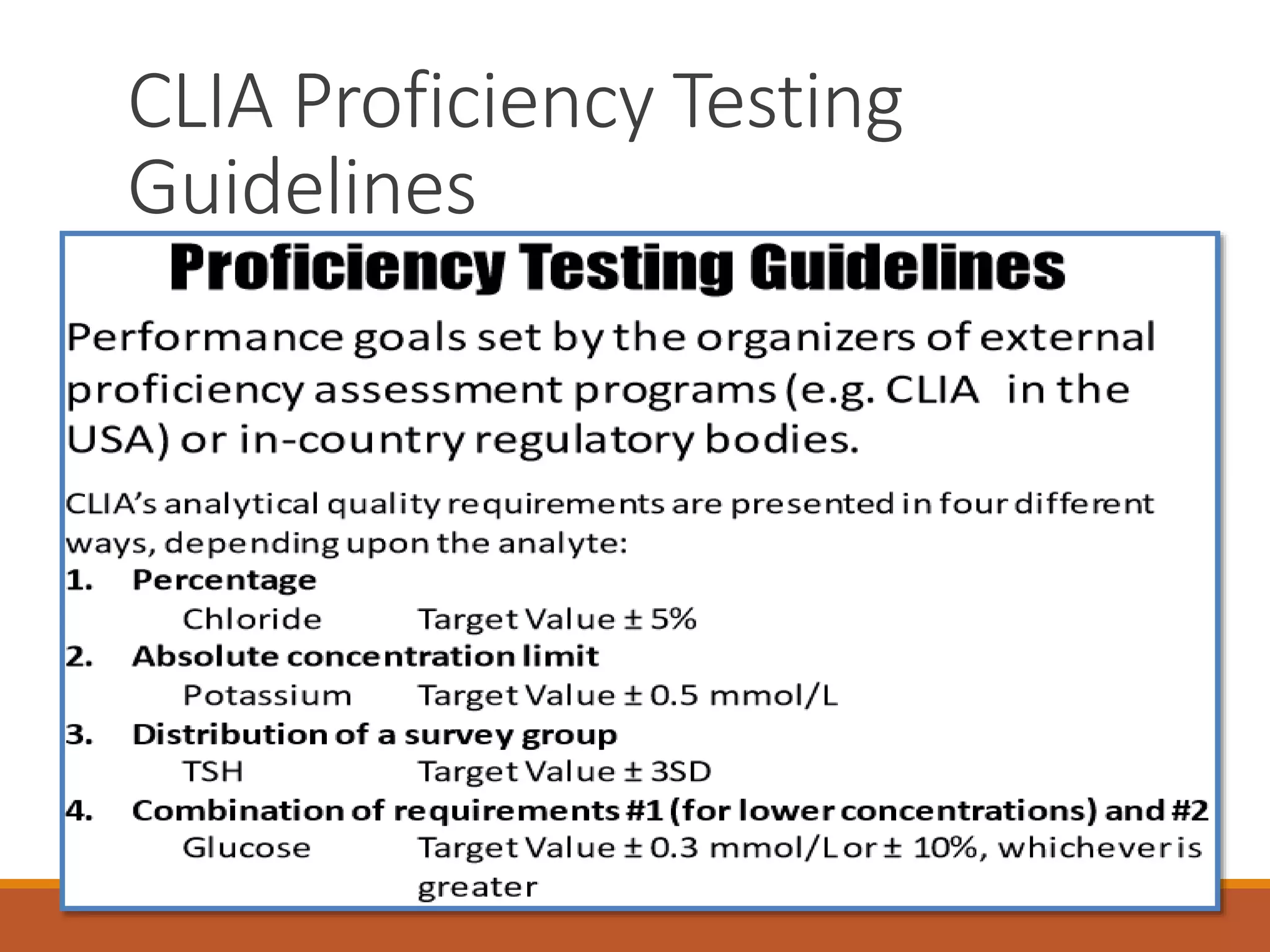
Performance goals set by organizers of external
proficiency assessment programs (e.g. CLIA)
In order that QC procedures can ascertain stable
equipment performance, CLIA has prescribed the
TEa limits on deviations from the observations in
the PT program and as per the criticality of the
analyte.
CLIA specifies the goal as percentages or ±
absolute values at the target or as ± 3 SD or a
combination
CLIA Proficiency Testing Guidelines
CLIA Proficiency Testing
Guidelines
CLIA Proficiency Testing Limits
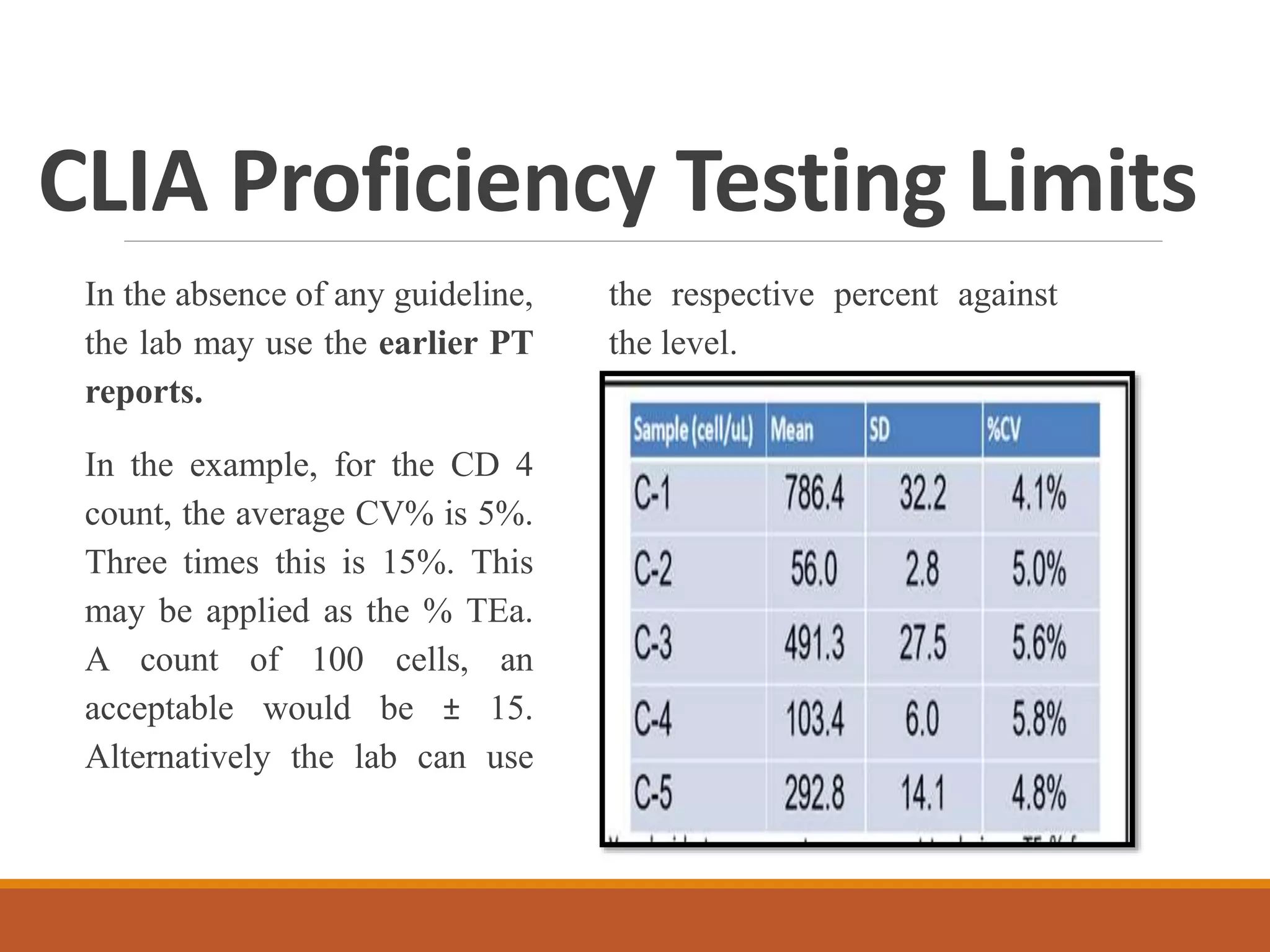
In the absence of any guideline,
the lab may use the earlier PT
reports.
In the example, for the CD 4
count, the average CV% is 5%.
Three times this is 15%. This
may be applied as the % TEa.
A count of 100 cells, an
acceptable would be ± 15.
Alternatively the lab can use
the respective percent against
the level.
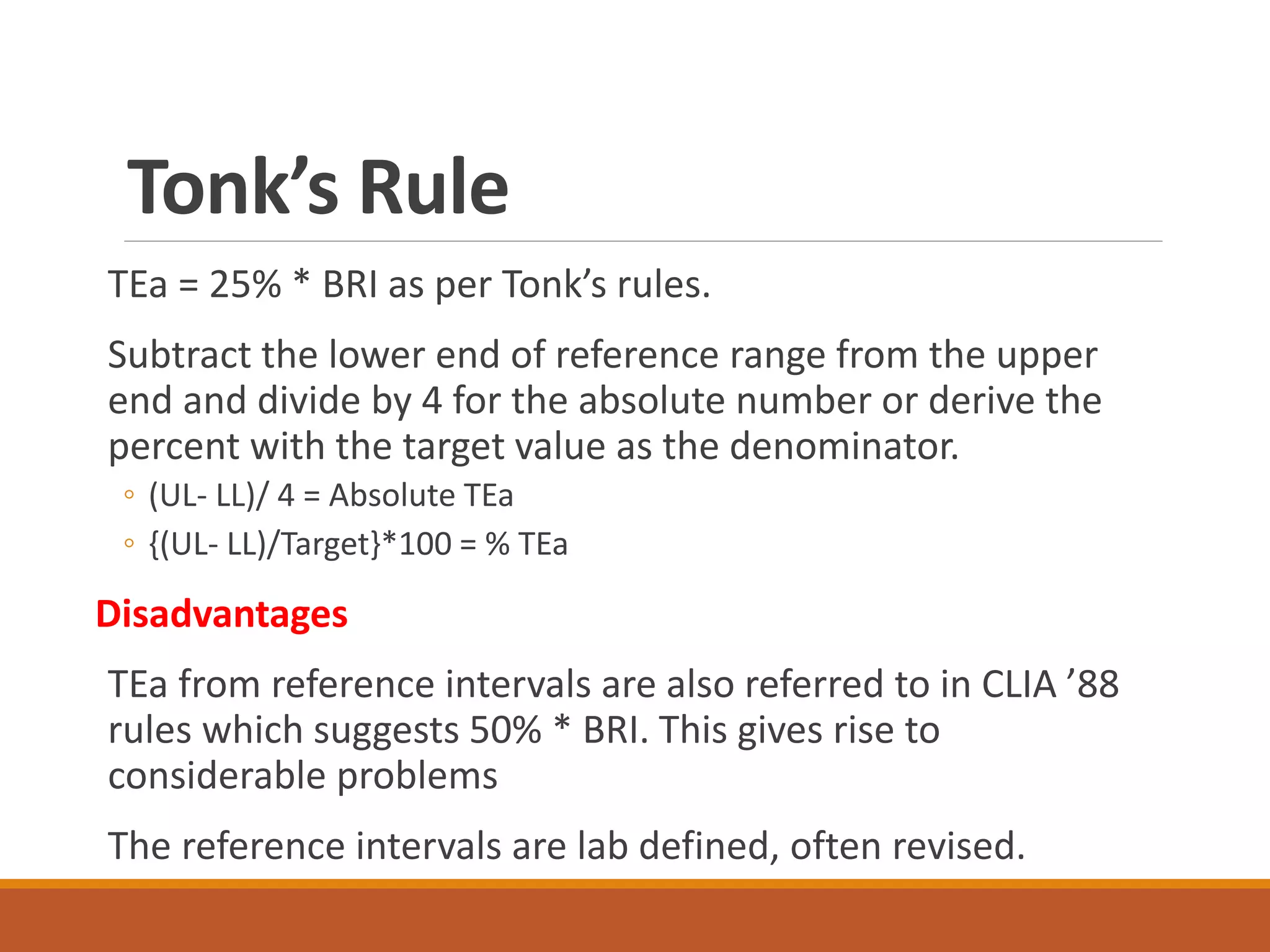
Tonk’s Rule
TEa = 25% * BRI as per Tonk’s rules.
Subtract the lower end of reference range from the upper
end and divide by 4 for the absolute number or derive the
percent with the target value as the denominator.
◦ (UL- LL)/ 4 = Absolute TEa
◦ {(UL- LL)/Target}*100 = % TEa
Disadvantages
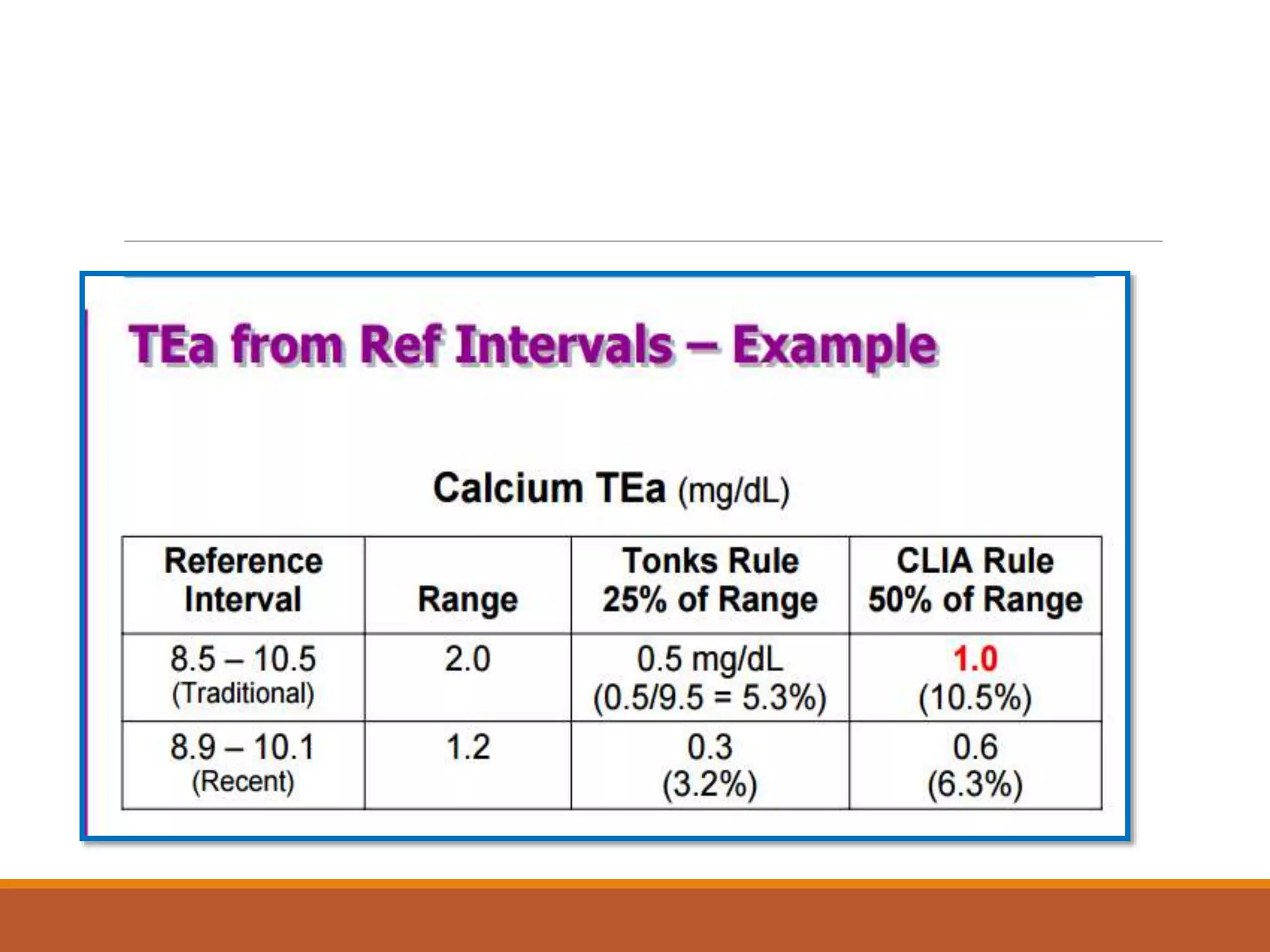
TEa from reference intervals are also referred to in CLIA ’88
rules which suggests 50% * BRI. This gives rise to
considerable problems
The reference intervals are lab defined, often revised.
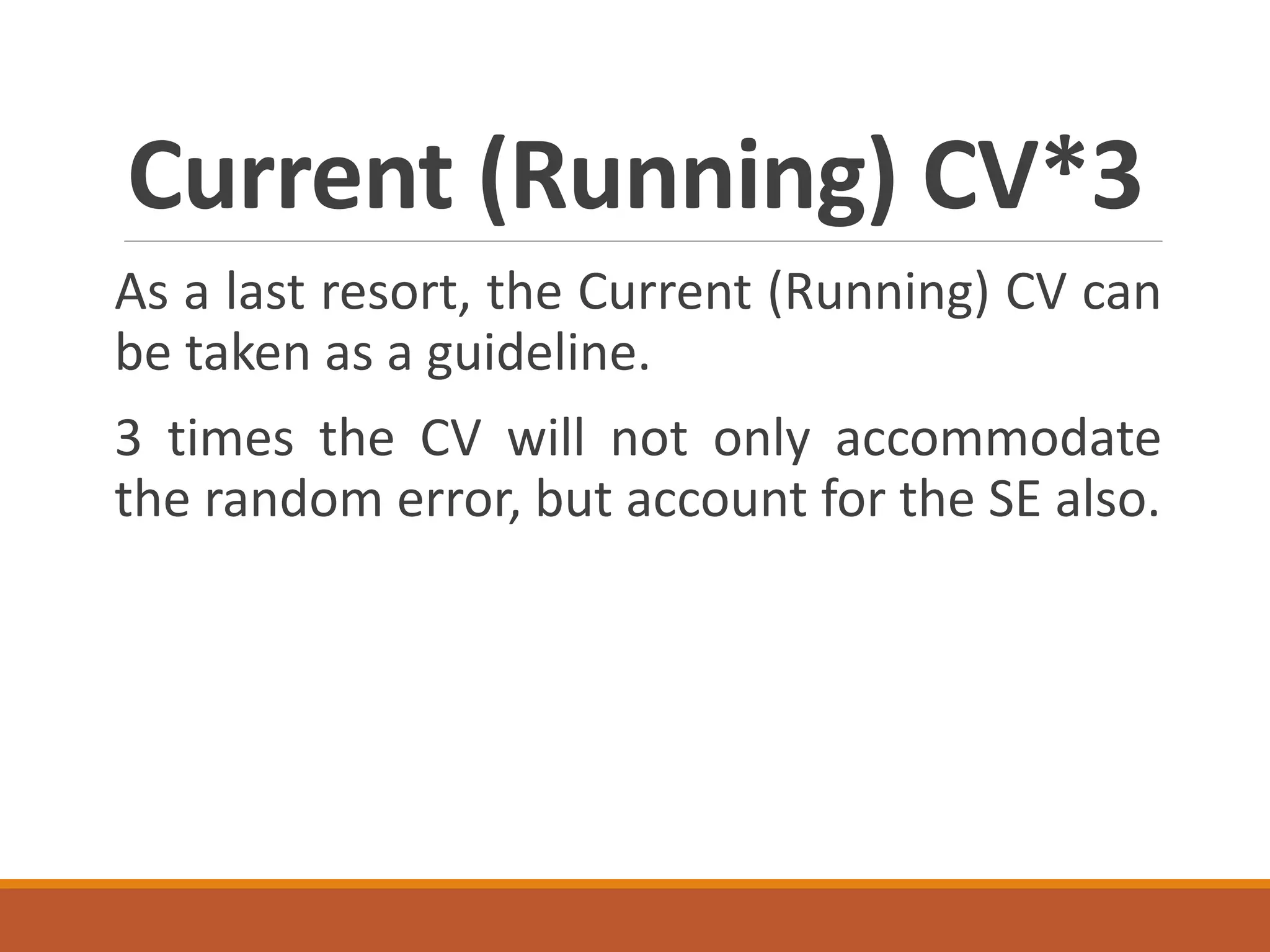
Current (Running) CV*3
As a last resort, the Current (Running) CV can
be taken as a guideline.
3 times the CV will not only accommodate
the random error, but account for the SE also.
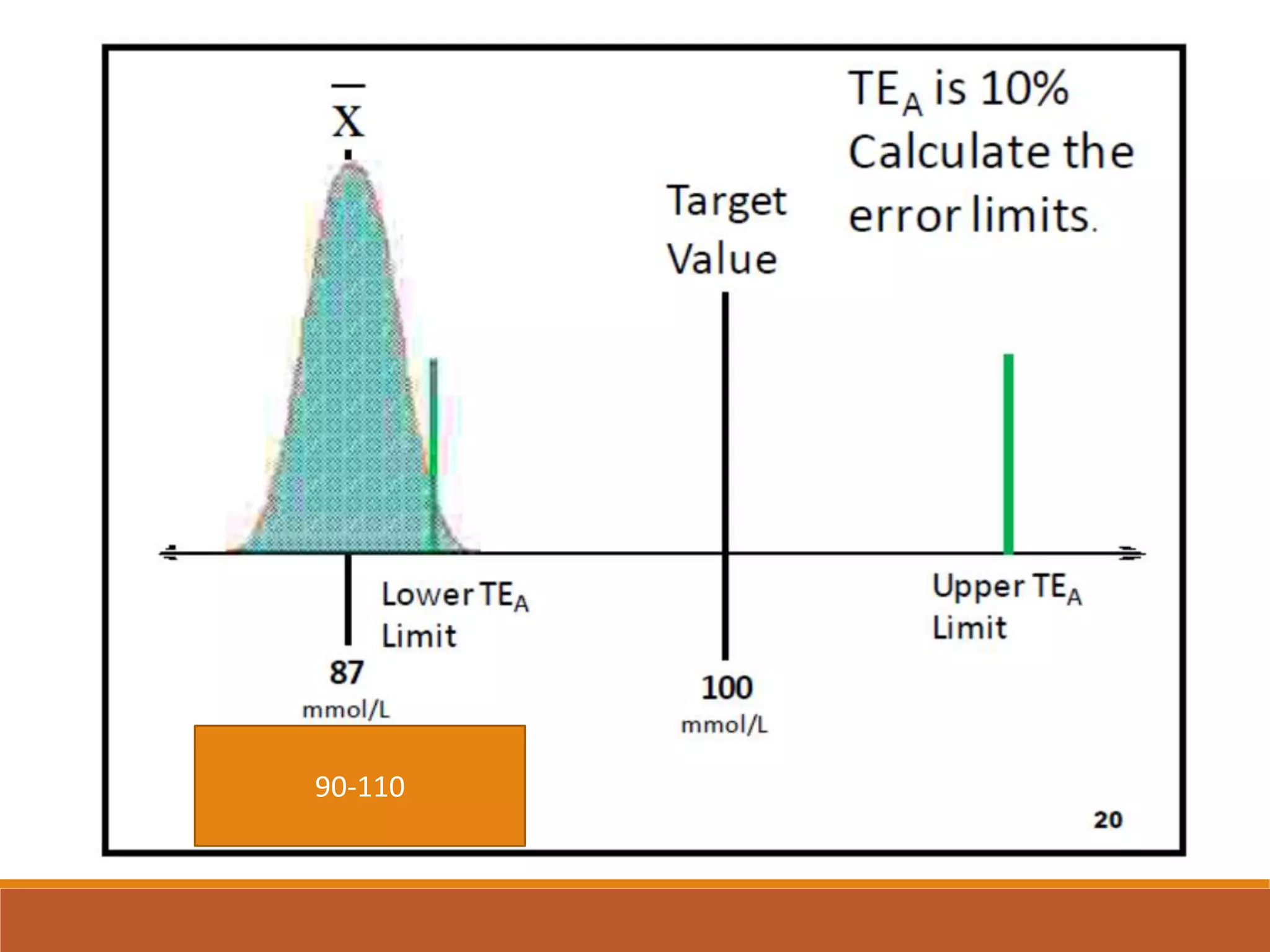
Quiz Time
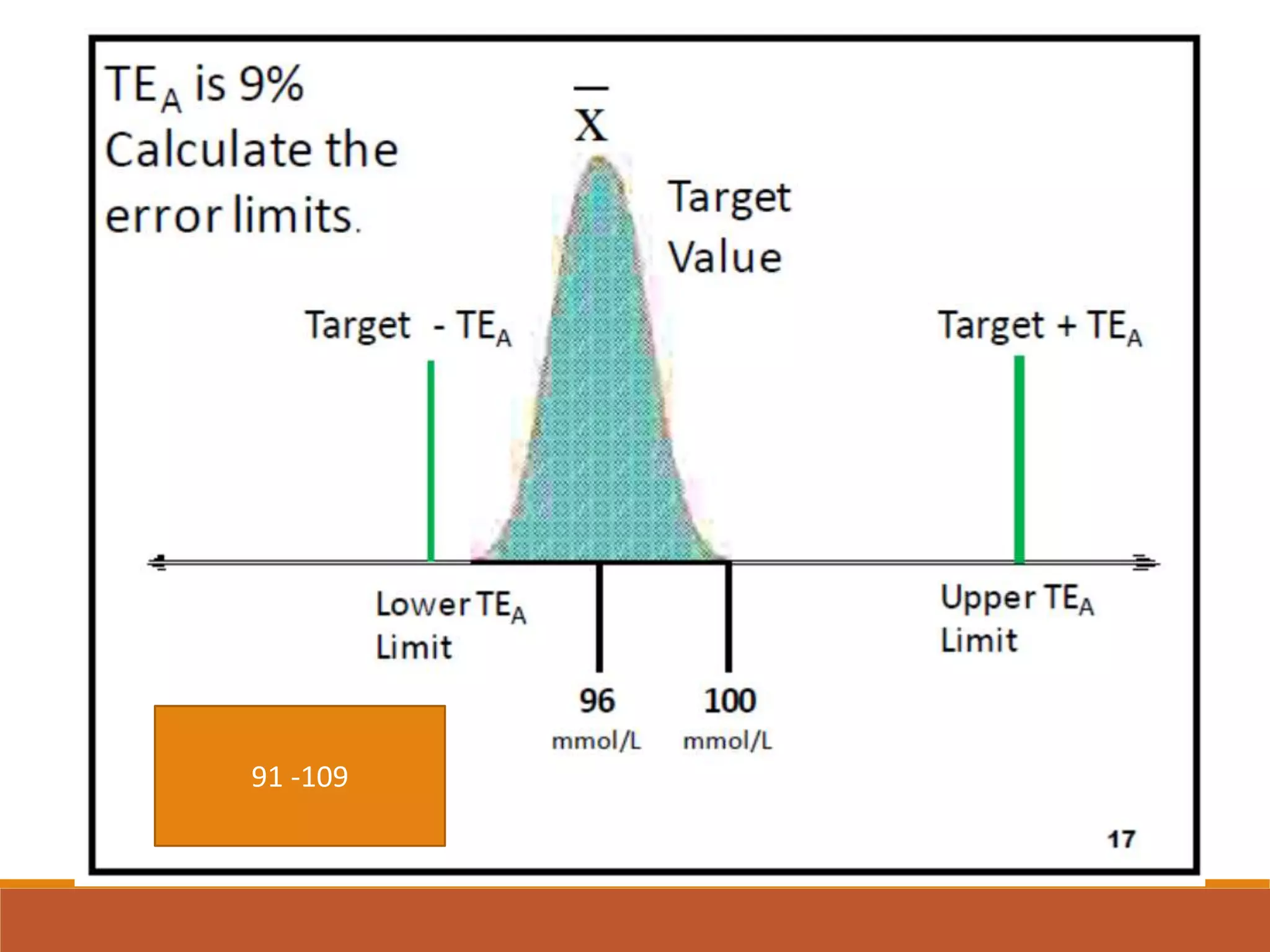
91 -109
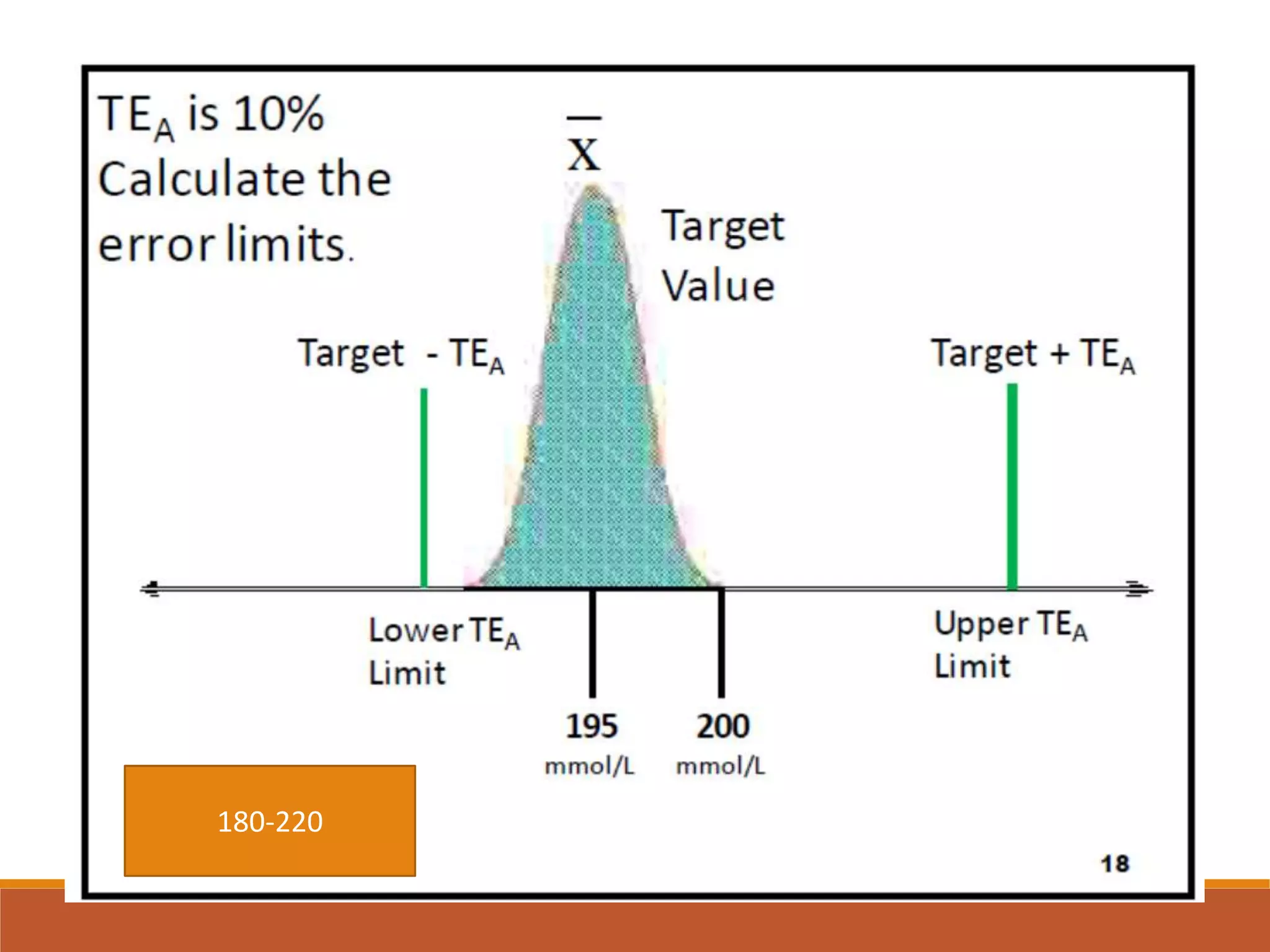
180-220
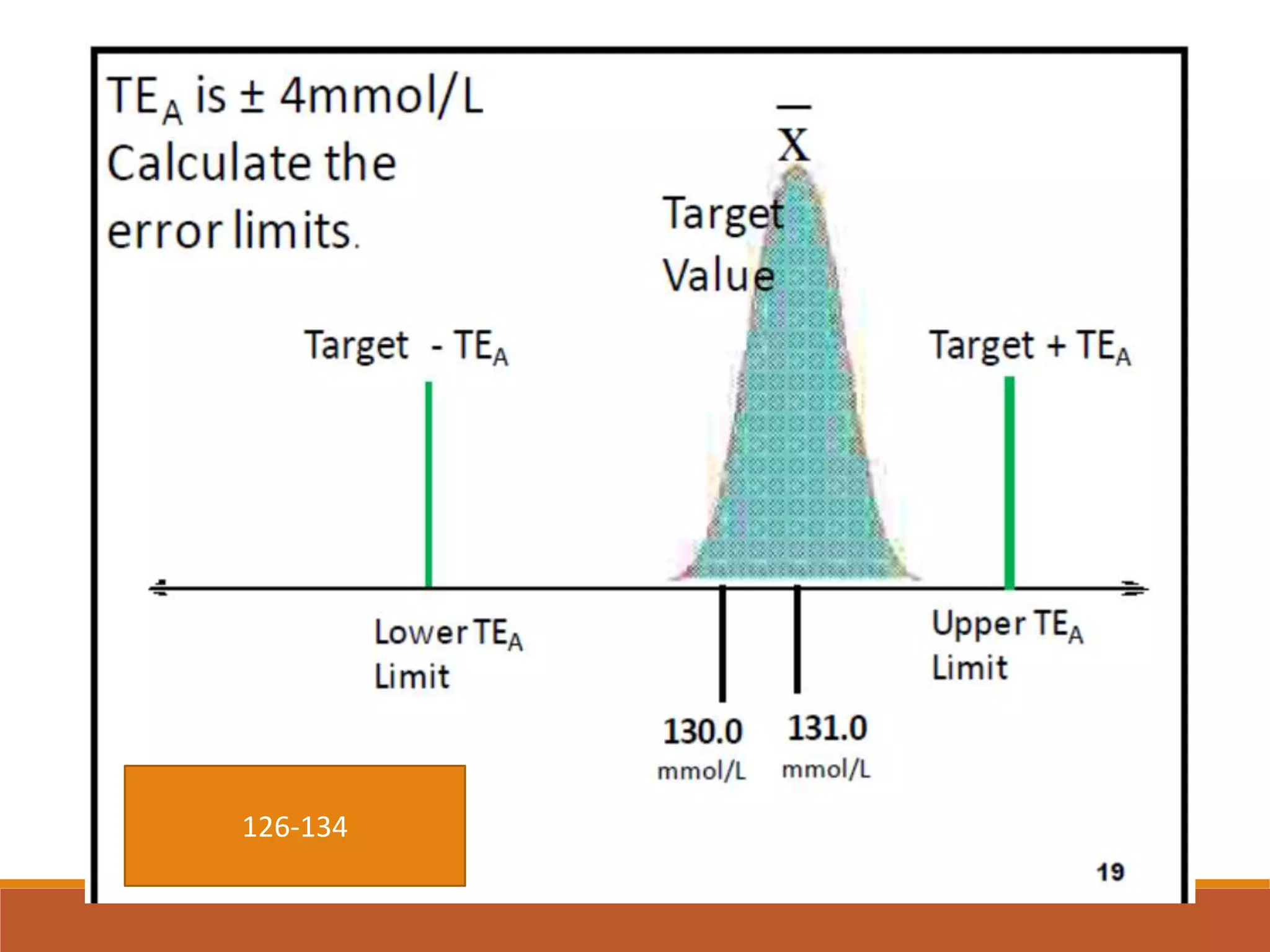
126-134
90-110
Thanks

Total Allowable Error (TEa).pptx

  • 1.
    Total Allowable Error(TEa) or Allowable Total Error( ATE) Labs for Life Project QUALITY CONTROL TRAINING
  • 2.
    What is aQuality Specification/ requirement? Quality requirements care set to help guide interpretation of laboratory test results because they ◦provide perspective about variability of results within an acceptable interval ◦potential significance of abnormal findings
  • 3.
    What are someQuality Specifications? Total Allowable Error (TEa) which is derived for clinical decision thresholds is a very useful Quality Specification that can be adopted for labs: TE< TEa Sigma-metrics, to define the tolerance limits: Labs may adopt sigma rules in their quality specifications (CLSI C 24 A3) (discussed later) DPMO (Defects per Million Occasions)
  • 4.
    What are someQuality Specifications?
  • 5.
    What is andWhy TEa? Total Allowable Error (TEa) is the amount of error that can be tolerated without invalidating the medical usefulness of the analytic result. Knowing the Total Error in a system will be of clinical use only if there is benchmarking for the allowable error for that analyte.
  • 6.
  • 7.
    Medical Decision Requirements: Veryfew analytes are thus defined NGSP: National Glycohemoglobin Standardization Program (NGSP) TEa of HbA1c <6% NCEP: National Cholesterol Education Program TEa of Cholesterol < 9%, HDL < 13%, LDL <12%, Triglyceride <15%
  • 8.
    Biological Variation Database Thenatural fluctuation of body fluid constituents around the homeostatic setting point, has two components: within and between-subject variation. These have been used for many purposes oTo set analytical quality specifications (As used here) oTo evaluate the significance of changes in serial results oTo assess the utility of population-based reference values oTo assess the number of specimens required to estimate the homeostatic set point oTo assess the clinical utility of tests
  • 9.
    Biological Variation Database Withinand between-subject variation.
  • 10.
    Biological Variation: 3Databases The lab may adopt any as their guidelines Minimum Desirable Optimum
  • 11.
    CLIA Proficiency Testing Guidelines Performancegoals set by organizers of external proficiency assessment programs (e.g. CLIA) In order that QC procedures can ascertain stable equipment performance, CLIA has prescribed the TEa limits on deviations from the observations in the PT program and as per the criticality of the analyte. CLIA specifies the goal as percentages or ± absolute values at the target or as ± 3 SD or a combination
  • 12.
  • 13.
  • 14.
    CLIA Proficiency TestingLimits In the absence of any guideline, the lab may use the earlier PT reports. In the example, for the CD 4 count, the average CV% is 5%. Three times this is 15%. This may be applied as the % TEa. A count of 100 cells, an acceptable would be ± 15. Alternatively the lab can use the respective percent against the level.
  • 15.
    Tonk’s Rule TEa =25% * BRI as per Tonk’s rules. Subtract the lower end of reference range from the upper end and divide by 4 for the absolute number or derive the percent with the target value as the denominator. ◦ (UL- LL)/ 4 = Absolute TEa ◦ {(UL- LL)/Target}*100 = % TEa Disadvantages TEa from reference intervals are also referred to in CLIA ’88 rules which suggests 50% * BRI. This gives rise to considerable problems The reference intervals are lab defined, often revised.
  • 17.
    Current (Running) CV*3 Asa last resort, the Current (Running) CV can be taken as a guideline. 3 times the CV will not only accommodate the random error, but account for the SE also.
  • 18.
  • 21.
  • 22.
  • 23.
  • 24.
  • 25.