

RANDOX INTERNATIONAL QUALITY ASSESSMENT SCHEME
RIQAS
RIQAS
The largest global EQA scheme
with over 45,000 lab participants
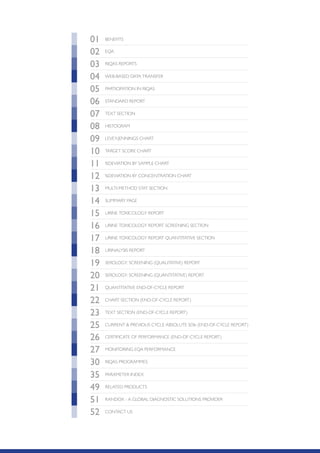
RIQAS REPORTS
01
03
05
02
04
06
07
08
09
11
13
10
12
EQA
WEB-BASED DATA TRANSFER
PARTICIPATION IN RIQAS
STANDARD REPORT
TEXT SECTION
HISTOGRAM
LEVEY-JENNINGS CHART
TARGET SCORE CHART
%DEVIATION BY SAMPLE CHART
%DEVIATION BY CONCENTRATION CHART
MULTI-METHOD STAT SECTION
BENEFITS
CONTACT US
16
17
18
19
20
21
22
URINE TOXICOLOGY REPORT SCREENING SECTION
URINE TOXICOLOGY REPORT QUANTITATIVE SECTION
URINALYSIS REPORT
SEROLOGY: SCREENING (QUALITATIVE) REPORT
SEROLOGY: SCREENING (QUANTITATIVE) REPORT
QUANTITATIVE END-OF-CYCLE REPORT
23
CHART SECTION (END-OF-CYCLE REPORT)
25 CURRENT & PREVIOUS CYCLE ABSOLUTE SDIs (END-OF-CYCLE REPORT)
26 CERTIFICATE OF PERFORMANCE (END-OF-CYCLE REPORT)
27 MONITORING EQA PERFORMANCE
30 RIQAS PROGRAMMES
49 RELATED PRODUCTS
51 RANDOX - A GLOBAL DIAGNOSTIC SOLUTIONS PROVIDER
52
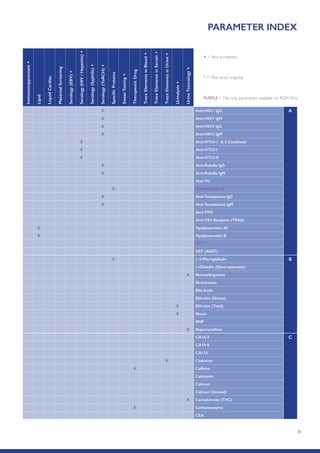
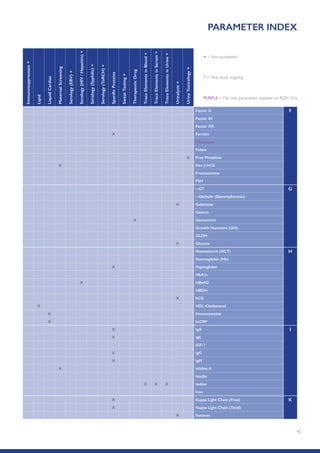
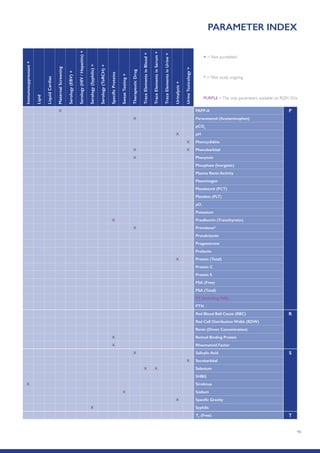
35 PARAMETER INDEX
14
15
SUMMARY PAGE
URINE TOXICOLOGY REPORT
TEXT SECTION (END-OF-CYCLE REPORT)
1
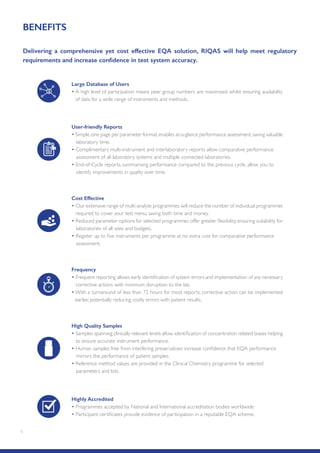
BENEFITS
Delivering a comprehensive yet cost effective EQA solution, RIQAS will help meet regulatory
requirements and increase confidence in test system accuracy.
Large Database of Users
• A high level of participation means peer group numbers are maximised whilst ensuring availability
of data for a wide range of instruments and methods.
High Quality Samples
• Samples spanning clinically relevant levels allow identification of concentration related biases helping
to ensure accurate instrument performance.
• Human samples free from interfering preservatives increase confidence that EQA performance
mirrors the performance of patient samples.
• Reference method values are provided in the Clinical Chemistry programme for selected
parameters and lots.
User-friendly Reports
• Simple,one page per parameter format,enables at-a-glance performance assessment,saving valuable
laboratory time.
• Complimentary multi-instrument and interlaboratory reports allow comparative performance
assessment of all laboratory systems and multiple connected laboratories.
• End-of-Cycle reports, summarising performance compared to the previous cycle, allow you to
identify improvements in quality over time.
Cost Effective
• Our extensive range of multi-analyte programmes will reduce the number of individual programmes
required to cover your test menu, saving both time and money.
• Reduced parameter options for selected programmes offer greater flexibility, ensuring suitability for
laboratories of all sizes and budgets.
• Register up to five instruments per programme at no extra cost for comparative performance
assessment.
Frequency
• Frequent reporting allows early identification of system errors and implementation of any necessary
corrective actions with minimum disruption to the lab.
• With a turnaround of less than 72 hours for most reports, corrective action can be implemented
earlier, potentially reducing costly errors with patient results.
Highly Accredited
• Programmes accepted by National and International accreditation bodies worldwide.
• Participant certificates provide evidence of participation in a reputable EQA scheme.
2
RIQAS is the largest international EQA scheme in the world. It is used by more than 45,000
laboratory participants in 133 countries. 32 programmes are currently available.
Accreditation
• RIQAS provides certificates as proof of EQA participation and performance for laboratory accreditation purposes.
• RIQAS is a UKAS accredited Proficiency Testing Provider, No. 0010, and is accredited to ISO/IEC 17043:2010, 'Conformity
Assessment- General Requirements for ProficiencyTesting'.
• Accreditation to ISO/IEC 17043:2010 highlights the superior quality and excellence of RIQAS.
Independent Advisory Panel
RIQAS participants have access to an independent advisory panel consisting of scientific and clinical experts.This ensures professional
and ethical conduct of the scheme and participant confidentiality.
EQA
RIQAS support staff are on hand to offer
advice and troubleshoot technical queries.
RIQAS Programmes
• Ammonia/Ethanol
• Anti-TSH Receptor
• Blood Gas
• BNP
• Cardiac
• Cerebrospinal Fluid (CSF)
• Clinical Chemistry
• Coagulation
• CYFRA 21-1
• ESR
• Glycated Haemoglobin (HbA1c)
• Haematology
• Human Urine
• Immunoassay
• Immunoassay Speciality 1
• Immunoassay Speciality 2
• Immunosuppressant Drugs
• Lipid
• Liquid Cardiac
• Maternal Screening
• Serology Epstein BarrVirus (EBV)
• Serology (HIV/Hepatitis)
• Serology (Syphilis)
• Serology (ToRCH)
• Specific Proteins
• SweatTesting
•Therapeutic Drugs
•Trace Elements in Blood
•Trace Elements in Serum
•Trace Elements in Urine
• Urinalysis
• UrineToxicology
UK Performance Surveillance
• Recognised by the Joint Working Group on Quality Assurance (JWG QA).
• Recognised by various National Quality Assurance Advisory Panels (NQAAP).
3
RIQAS REPORTS
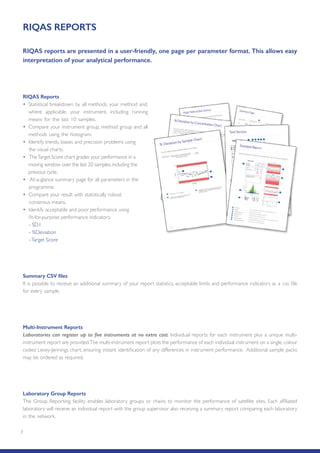
RIQAS reports are presented in a user-friendly, one page per parameter format. This allows easy
interpretation of your analytical performance.
Summary CSV files
It is possible to receive an additional summary of your report statistics, acceptable limits and performance indicators as a .csv file
for every sample.
Multi-Instrument Reports
Laboratories can register up to five instruments at no extra cost. Individual reports for each instrument plus a unique multi-
instrument report are provided.The multi-instrument report plots the performance of each individual instrument on a single, colour
coded Levey-Jennings chart, ensuring instant identification of any differences in instrument performance. Additional sample packs
may be ordered as required.
RIQAS Reports
• Statistical breakdown by all methods, your method and,
where applicable, your instrument, including running
means for the last 10 samples.
• Compare your instrument group, method group and all
methods using the histogram.
• Identify trends, biases and precision problems using
the visual charts.
• TheTarget Score chart grades your performance in a
moving window over the last 20 samples, including the
previous cycle.
• At-a-glance summary page for all parameters in the
programme.
• Compare your result with statistically robust
consensus means.
• Identify acceptable and poor performance using
fit-for-purpose performance indicators: 	
- SD1
- %Deviation
-Target Score
Laboratory Group Reports
The Group Reporting facility enables laboratory groups or chains to monitor the performance of satellite sites. Each affiliated
laboratory will receive an individual report with the group supervisor also receiving a summary report comparing each laboratory
in the network.
4
WEB-BASED DATA TRANSFER
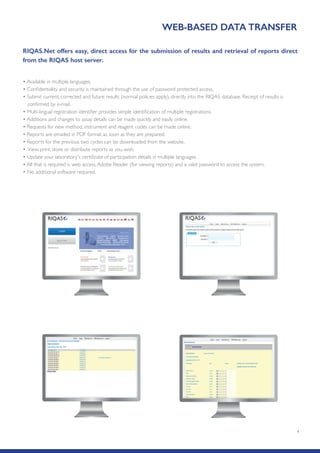
RIQAS.Net offers easy, direct access for the submission of results and retrieval of reports direct
from the RIQAS host server.
• Available in multiple languages.
• Confidentiality and security is maintained through the use of password protected access.
• Submit current, corrected and future results (normal policies apply), directly into the RIQAS database. Receipt of results is
confirmed by e-mail.
•Multi-lingual registration identifier provides simple identification of multiple registrations.
• Additions and changes to assay details can be made quickly and easily online.
• Requests for new method, instrument and reagent codes can be made online.
• Reports are emailed in PDF format as soon as they are prepared.
• Reports for the previous two cycles can be downloaded from the website.
• View, print, store or distribute reports as you wish.
• Update your laboratory's certificate of participation details in multiple languages.
• All that is required is web access,Adobe Reader (for viewing reports) and a valid password to access the system.
• No additional software required.
5
PARTICIPATION IN RIQAS
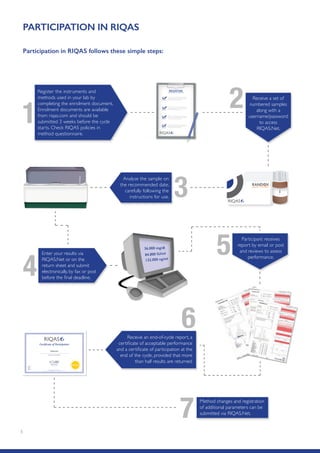
Participation in RIQAS follows these simple steps:
REGISTER
1
36.000 mg/dl
84.800 IU/ml
132.000 ng/ml
Certificate of Participation
Stephen Doherty
RIQAS Manager
Randox International Quality Assessment Scheme
Randox Laboratories Ltd., 55 Diamond Road, Crumlin, Co.Antrim, BT29 4QY, United Kingdom
PR-281APR15
Name
Laboratory/Hospital
abc
Register the instruments and
methods used in your lab by
completing the enrolment document.
Enrolment documents are available
from riqas.com and should be
submitted 3 weeks before the cycle
starts. Check RIQAS policies in
method questionnaire.
1
Receive a set of
numbered samples
along with a
username/password
to access
RIQAS.Net.
2
Analyse the sample on
the recommended date,
carefully following the
instructions for use. 3
Enter your results via
RIQAS.Net or on the
return sheet and submit
electronically, by fax or post
before the final deadline.
4
Participant receives
report by email or post
and reviews to assess
performance.
5
Receive an end-of-cycle report, a
certificate of acceptable performance
and a certificate of participation at the
end of the cycle, provided that more
than half results are returned.
6
Method changes and registration
of additional parameters can be
submitted via RIQAS.Net.
7
6
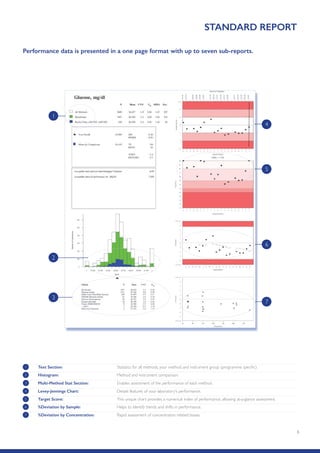
STANDARD REPORT
Performance data is presented in a one page format with up to seven sub-reports.
1 Text Section:	 Statistics for all methods, your method and instrument group (programme specific).
2 Histogram:	 Method and instrument comparison.
3 Multi-Method Stat Section: 	 Enables assessment of the performance of each method.
4 Levey-Jennings Chart: 	 Details features of your laboratory’s performance.
5 Target Score: 	 This unique chart provides a numerical index of performance, allowing at-a-glance assessment.
6 %Deviation by Sample: 	 Helps to identify trends and shifts in performance.
7 %Deviation by Concentration: 	 Rapid assessment of concentration related biases.
1
2
3
4
5
6
7
7
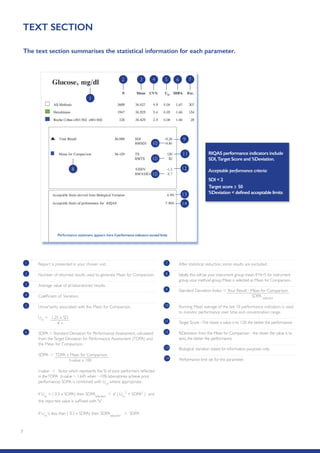
TEXT SECTION
1 Report is presented in your chosen unit.
2 Number of returned results used to generate Mean for Comparison.
3 Average value of all laboratories’ results.
4 Coefficient of Variation.
5 Uncertainty associated with the Mean for Comparison.
Um
= 1.25 x SD
√ n
7 After statistical reduction, some results are excluded.
8 Ideally this will be your instrument group mean. If N5 for instrument
group, your method group Mean is selected as Mean for Comparison.
9 Standard Deviation Index = Your Result - Mean for Comparison
SDPA adjusted
10 Running Mean average of the last 10 performance indicators is used
to monitor performance over time and concentration range.
11 Target Score -The closer a value is to 120, the better the performance.
%Deviation from the Mean for Comparison - the closer the value is to
zero, the better the performance.
12
Biological Variation stated for information purposes only.13
Performance limit set for this parameter.14
6 SDPA = Standard Deviation for Performance Assessment, calculated
from theTarget Deviation for Performance Assessment (TDPA) and
the Mean for Comparison.
SDPA = TDPA x Mean for Comparison
t-value x 100
t-value = factor which represents the % of poor performers reflected
in theTDPA (t-value ~ 1.645 when ~10% laboratories achieve poor
performance) SDPA is combined with Um
, where appropriate.
If Um
 ( 0.3 x SDPA) then SDPAadjusted
= √ ( Um
2
+ SDPA2
) and
the reported value is suffixed with a
If Um
is less than ( 0.3 x SDPA) then SDPAadjusted
= SDPA
RIQAS performance indicators include
SDI,Target Score and %Deviation.
Acceptable performance criteria:
SDI  2
Target score  50
%Deviation  defined acceptable limits
Performance statement appears here if performance indicators exceed limits
765432
8
10
10
10
11
9
12
13
14
1
The text section summarises the statistical information for each parameter.
8
HISTOGRAM
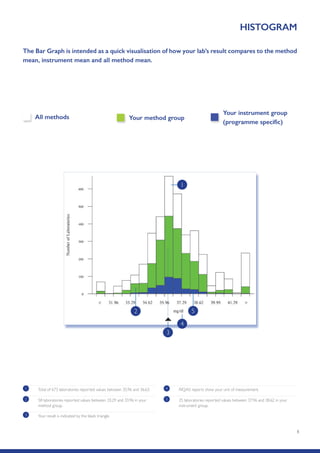
1 Total of 673 laboratories reported values between 35.96 and 36.63.
2 58 laboratories reported values between 33.29 and 33.96 in your
method group.
3 Your result is indicated by the black triangle.
4 RIQAS reports show your unit of measurement.
5 25 laboratories reported values between 37.96 and 38.62 in your
instrument group.
The Bar Graph is intended as a quick visualisation of how your lab’s result compares to the method
mean, instrument mean and all method mean.
Your method groupAll methods
Your instrument group
(programme specific)
1
2 5
4
3
9
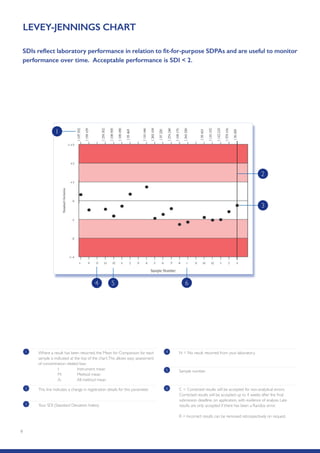
LEVEY-JENNINGS CHART
SDIs reflect laboratory performance in relation to fit-for-purpose SDPAs and are useful to monitor
performance over time. Acceptable performance is SDI  2.
1 Where a result has been returned, the Mean for Comparison for each
sample is indicated at the top of the chart.This allows easy assessment
of concentration related bias:
	 I:	 Instrument mean	
	 M:	 Method mean	
	 A:	 All method mean
2 This line indicates a change in registration details for this parameter.
3 Your SDI (Standard Deviation Index).
4 N = No result returned from your laboratory.
5 Sample number.
6 C = Corrected results will be accepted for non-analytical errors.
Corrected results will be accepted up to 4 weeks after the final
submission deadline, on application, with evidence of analysis. Late
results are only accepted if there has been a Randox error.
R = Incorrect results can be removed retrospectively on request.
8 C
1
2
3
4 5 6
10
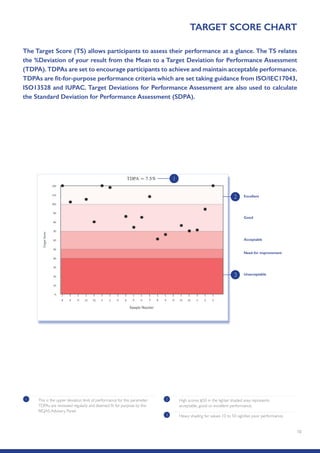
TARGET SCORE CHART
The Target Score (TS) allows participants to assess their performance at a glance. The TS relates
the %Deviation of your result from the Mean to a Target Deviation for Performance Assessment
(TDPA).TDPAs are set to encourage participants to achieve and maintain acceptable performance.
TDPAs are fit-for-purpose performance criteria which are set taking guidance from ISO/IEC17043,
ISO13528 and IUPAC. Target Deviations for Performance Assessment are also used to calculate
the Standard Deviation for Performance Assessment (SDPA).
1 This is the upper deviation limit of performance for this parameter.
TDPAs are reviewed regularly and deemed fit for purpose by the
RIQAS Advisory Panel.
2 High scores 50 in the lighter shaded area represents
acceptable, good or excellent performance.
3 Heavy shading for values 10 to 50 signifies poor performance.
Excellent
Good
Acceptable
Need for improvement
Unacceptable
1
2
3
11
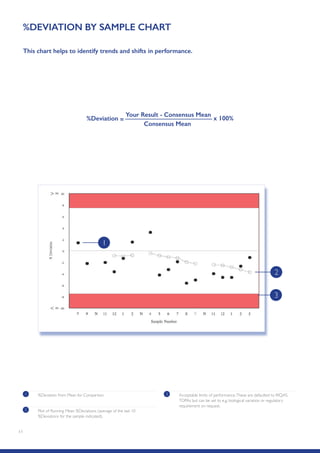
%DEVIATION BY SAMPLE CHART
This chart helps to identify trends and shifts in performance.
1 %Deviation from Mean for Comparison.
2 Plot of Running Mean %Deviations (average of the last 10
%Deviations for the sample indicated).
3 Acceptable limits of performance.These are defaulted to RIQAS
TDPAs but can be set to e.g. biological variation or regulatory
requirement on request.
8 C
1
2
3
%Deviation =
Your Result - Consensus Mean
Consensus Mean
x 100%
12
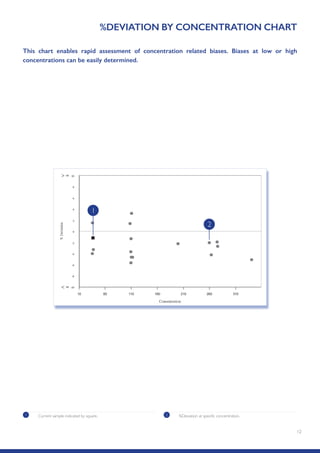
%DEVIATION BY CONCENTRATION CHART
This chart enables rapid assessment of concentration related biases. Biases at low or high
concentrations can be easily determined.
1 Current sample indicated by square. 2 %Deviation at specific concentration.
1
2
13
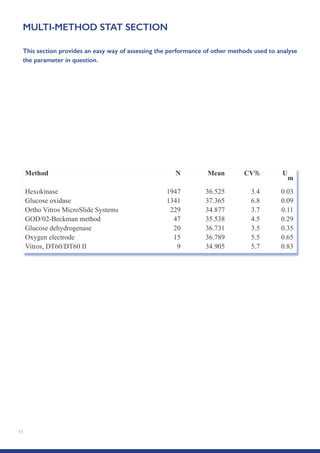
MULTI-METHOD STAT SECTION
This section provides an easy way of assessing the performance of other methods used to analyse
the parameter in question.
Method N Mean CV% U
m
Hexokinase 1947 36.525 3.4 0.03
Glucose oxidase 1341 37.365 6.8 0.09
Ortho Vitros MicroSlide Systems 229 34.877 3.7 0.11
GOD/02-Beckman method 47 35.538 4.5 0.29
Glucose dehydrogenase 20 36.731 3.5 0.35
Oxygen electrode 15 36.789 5.5 0.65
Vitros, DT60/DT60 II 9 34.905 5.7 0.83
14
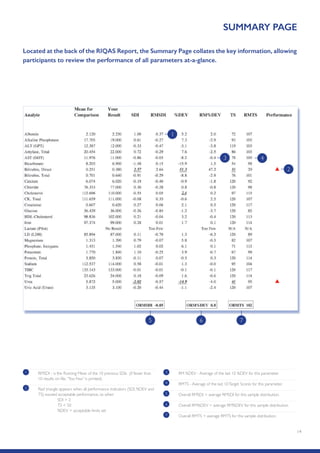
SUMMARY PAGE
3 RM %DEV - Average of the last 10 %DEV for this parameter.
4 RMTS - Average of the last 10Target Scores for this parameter.
5 Overall RMSDI = average RMSDI for this sample distribution.
6 Overall RM%DEV = average RM%DEV for this sample distribution.
7 Overall RMTS = average RMTS for this sample distribution.
1 RMSDI - is the Running Mean of the 10 previous SDIs (if fewer than
10 results on file,“Too Few” is printed).
2 Red triangle appears when all performance indicators (SDI, %DEV and
TS) exceed acceptable performance, i.e: when
	 SDI  2
	 TS  50
	 %DEV  acceptable limits set
5 6 7
1
2
43
2.4
Located at the back of the RIQAS Report, the Summary Page collates the key information, allowing
participants to review the performance of all parameters at-a-glance.
15
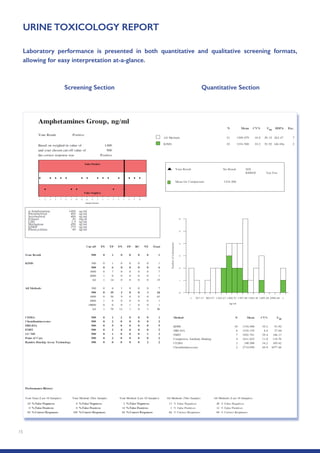
Quantitative SectionScreening Section
URINE TOXICOLOGY REPORT
Laboratory performance is presented in both quantitative and qualitative screening formats,
allowing for easy interpretation at-a-glance.
16
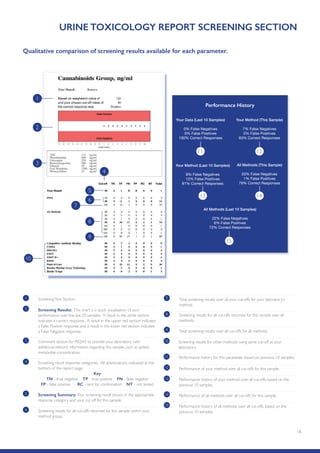
URINE TOXICOLOGY REPORT SCREENING SECTION
1 ScreeningText Section.
5 Screening Summary:Your screening result shown in the appropriate
response category and your cut off for this sample.
6 Screening results for all cut-offs returned for this sample within your
method group.
7 Total screening results over all your cut-offs for your laboratory’s
method.
8 Screening results for all cut-offs returned for this sample over all
methods.
9 Total screening results over all cut-offs for all methods.
10 Screening results for other methods using same cut-off as your
laboratory.
11 Performance history for this parameter, based on previous 10 samples.
12 Performance of your method over all cut-offs for this sample.
13 Performance history of your method over all cut-offs, based on the
previous 10 samples.
14 Performance of all methods over all cut-offs for this sample.
15 Performance history of all methods over all cut-offs, based on the
previous 10 samples.
2 Screening Results: This chart is a quick visualisation of your
performance over the last 20 samples. A result in the white section
indicates a correct response. A result in the upper red section indicates
a False Positive response, and a result in the lower red section indicates
a False Negative response.
3 Comment section for RIQAS to provide your laboratory with
additional relevant information regarding this sample, such as spiked
metabolite concentration.
4 Screening result response categories. All abbreviations indicated at the
bottom of the report page.
Key
TN - true negative TP - true positive FN - false negative
FP - false positive RC - sent for confirmation NT - not tested
Qualitative comparison of screening results available for each parameter.
11 12
13 14
15
1
2
4
6
7
8
9
10
5
Performance History
THC
Phenobarbital
Oxazepam
Benzoylecgonine
Ethanol
Free Morphine
Phencyclidine
125 ng/ml
600 ng/ml
250 ng/ml
500 ng/ml
20 ng/ml
1500 ng/ml
25 ng/ml
3
Your Data (Last 10 Samples)
0% False Negatives
0% False Positives
100% Correct Responses
Your Method (This Sample)
7% False Negatives
0% False Positives
93% Correct Responses
Your Method (Last 10 Samples)
8% False Negatives
12% False Positives
81% Correct Responses
All Methods (This Sample)
20% False Negatives
1% False Positives
79% Correct Responses
All Methods (Last 10 Samples)
22% False Negatives
6% False Positives
72% Correct Responses
17
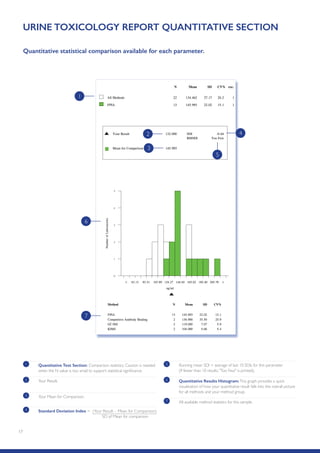
URINE TOXICOLOGY REPORT QUANTITATIVE SECTION
#NN /GVJQFU
(2+#
0 /GCP 5 %8 GZE
;QWT 4GUWNV 5+
4/5+
/GCP HQT %QORCTKUQP
6QQ (GY
PI ON
0WODGTQH.CDQTCVQTKGU
0 0 0 0 0 0 0 0 0 0 0
5CORNG 0WODGT
False Positive
False Negative
/GVJQF 0 /GCP 5 %8
(2+#
%QORGVKVKXG #PVKDQF[ $KPFKPI
)% /5
-+/5
; 2+.16 567; .#$14#614; 4'( 01 ) %;%.' 5#/2.'
True Negative
True Positive
FN False Negative
FP False Positive
RC Referred for Confirmation
NT Not Tested
n value of
t-off value of
e was
2QUKVKXG
2QUKVKXG
Cut-off TN TP FN FP RC NT Total
0 0
#NN
#NN
;QWT /GVJQF 6JKU 5CORNG ;QWT /GVJQF .CUV 5CORNGU
% False Negatives
% False Positives
% Correct Responses
% False Negatives
% False Positives
% Correct Responses
QKFU )TQWR PI ON
RIQAS
#NN /GVJQFU 6JKU 5CORNG #NN /GVJQFU .CUV 5CORNGU
% False Negatives
% False Positives
% Correct Responses
% False Negatives
% False Positives
% Correct Responses
1
2
6
7
3
4
5
1 Quantitative Text Section: Comparison statistics. Caution is needed
when the N value is too small to support statistical significance.
4 Standard Deviation Index = (Your Result – Mean for Comparison)
			 SD of Mean for comparison
5 Running mean SDI = average of last 10 SDIs for this parameter
(If fewer than 10 results, Too Few is printed).
6 Quantitative Results Histogram:This graph provides a quick
visualisation of how your quantitative result falls into the overall picture
for all methods and your method group.
7 All available method statistics for this sample.
2 Your Result.
3 Your Mean for Comparison.
Quantitative statistical comparison available for each parameter.
18
URINALYSIS REPORT
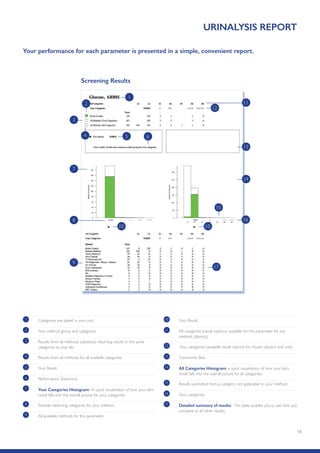
1 Categories are stated in your unit.
4 Results from all methods for all available categories.
5 Your Result.
6 Performance Statement.
8 Possible reporting categories for your method.
7 Your Categories Histogram: A quick visualisation of how your lab’s
result falls into the overall picture for your categories.
2 Your method group and categories.
3 Results from all methods (dipsticks) returning results in the same
categories as your lab.
9 All available methods for this parameter.
12 Your categories (available result options for chosen dipstick and unit).
13 Comments Box.
14 All Categories Histogram: a quick visualisation of how your lab’s
result falls into the overall picture for all categories.
16 Your categories.
17 Detailed summary of results: This table enables you to see how you
compare to all other results.
15 Results submitted from a category not applicable to your method.
10 Your Result.
11 All categories (result options) available for this parameter for any
method (dipstick).
Screening Results
2
15
4
3
9
7
5
12
13
14
17
16
10 10
1
8
11
6
Your performance for each parameter is presented in a simple, convenient report.
19
SEROLOGY: SCREENING (QUALITATIVE) REPORT
Your performance for multiple samples is presented in a convenient single report per quarterly
distribution.
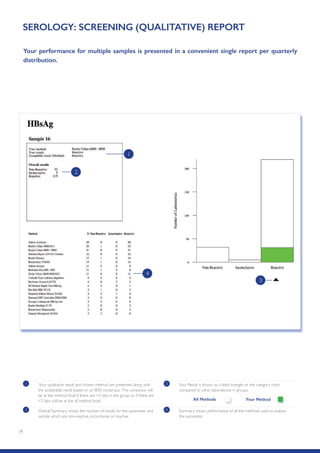
1 Your qualitative result and chosen method are presented along with
the acceptable result based on an 80% consensus. This consensus will
be at the method level if there are 5 labs in the group or if there are
5 labs, will be at the all method level.
2 Overall Summary shows the number of results for this parameter and
sample which are non-reactive, inconclusive or reactive.
4 Summary shows performance of all the methods used to analyse
the parameter.
3 Your Result is shown as a black triangle on the category chart
compared to other laboratories in groups:
Your MethodAll Methods
4
3
1
2
20
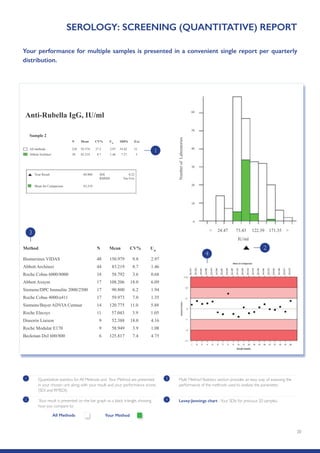
1 Quantitative statistics for All Methods and Your Method are presented
in your chosen unit along with your result and your performance scores
(SDI and RMSDI).
3 Multi Method Statistics section provides an easy way of assessing the
performance of the methods used to analyse the parameter.
4 Levey-Jennings chart -Your SDIs for previous 20 samples.2 Your result is presented on the bar graph as a black triangle, showing
how you compare to:
Your MethodAll Methods
SEROLOGY: SCREENING (QUANTITATIVE) REPORT
Your performance for multiple samples is presented in a convenient single report per quarterly
distribution.
3
1
Anti-Rubella IgG, IU/ml
Sample 2
	 N Mean CV% Um
SDPA Exc.
All methods 	 210 92.574 37.2 2.97 34.42 31
Abbott Architect 	 39 83.219 8.7 1.46 7.27 5
Method	 N Mean CV% Um
Biomerieux VIDAS	 48 150.979 9.8 2.97
Abbott Architect 	 44 83.219 8.7 1.46
Roche Cobas 6000/8000	 18 58.792 3.6 0.68
Abbott Axsym	 17 108.206 18.0 6.09
Siemens/DPC Immulite 2000/2500 	 17 90.800 6.2 1.94
Roche Cobas 4000/e411	 17 59.973 7.0 1.35
Siemens/Bayer ADVIA Centaur	 14 120.775 11.0 5.88
Roche Elecsys	 11 57.043 3.9 1.05
Diasorin Liaison	 9 52.388 18.0 4.16
Roche Modular E170	 9 58.949 3.9 1.08
Beckman DxI 600/800	 6 125.817 7.4 4.75
Your Result	 84.800	 SDI	 0.22
		 RMSDI	 Too Few
Mean for Comparison	 83.219
2
60
50
40
30
20
10
0
NumberofLaboratories
 24.47 73.43 122.39 171.35 
IU/ml
4
21
QUANTITATIVE END-OF-CYCLE REPORT
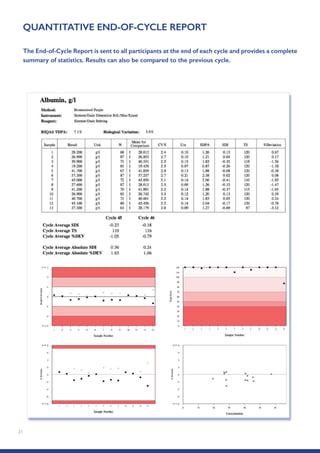
The End-of-Cycle Report is sent to all participants at the end of each cycle and provides a complete
summary of statistics. Results can also be compared to the previous cycle.
22
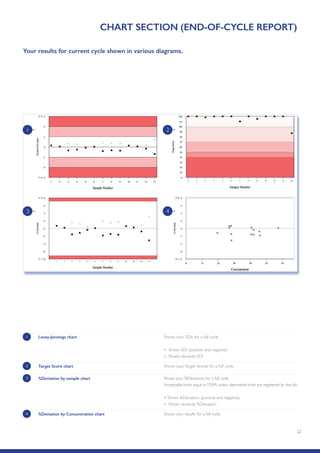
Your results for current cycle shown in various diagrams.
CHART SECTION (END-OF-CYCLE REPORT)
1 2
3 4
1 Levey-Jennings chart Shows your SDIs for a full cycle.
• Shows SDI (positive and negative)
x Shows absolute SDI
2 Target Score chart Shows your Target Scores for a full cycle.
4 %Deviation by Concentration chart Shows your results for a full cycle.
3 %Deviation by sample chart Shows your %Deviations for a full cycle.
Acceptable limits equal toTDPA unless alternative limits are registered by the lab.
• Shows %Deviation (positive and negative)
x Shows absolute %Deviation
23
TEXT SECTION (END-OF-CYCLE REPORT)
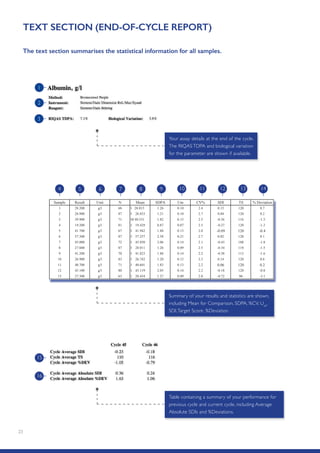
The text section summarises the statistical information for all samples.
Your assay details at the end of the cycle.
The RIQAS TDPA and biological variation
for the parameter are shown if available.
1
2
Table containing a summary of your performance for
previous cycle and current cycle, including Average
Absolute SDIs and %Deviations.
15
16
Summary of your results and statistics are shown,
including Mean for Comparison, SDPA, %CV, Um
,
SDI,Target Score, %Deviation
Sample Result Unit N Mean SDPA Um CV% SDI TS % Deviation
1 28.200 g/l 68 I 28.013 1.26 0.10 2.4 0.15 120 0.7
2 26.900 g/l 87 I 26.853 1.21 0.10 2.7 0.04 120 0.2
3 39.900 g/l 71 M 40.531 1.82 0.15 2.5 -0.36 116 -1.5
4 19.200 g/l 81 I 19.429 0.87 0.07 2.5 -0.27 120 -1.2
5 41.700 g/l 67 I 41.942 1.88 0.13 2.0 -0.09 120 -0.4
6 57.300 g/l 87 I 57.257 2.58 0.21 2.7 0.02 120 0.1
7 45.000 g/l 72 I 45.850 2.06 0.14 2.1 -0.43 108 -1.8
8 27.600 g/l 87 I 28.011 1.26 0.09 2.5 -0.34 118 -1.5
9 41.200 g/l 70 I 41.823 1.88 0.14 2.2 -0.38 113 -1.6
10 26.900 g/l 83 I 26.742 1.20 0.12 3.3 0.14 120 0.6
11 40.700 g/l 71 I 40.601 1.83 0.13 2.2 0.06 120 0.2
12 45.100 g/l 80 I 45.119 2.05 0.14 2.2 -0.18 120 -0.8
13 27.300 g/l 63 I 28.454 1.27 0.09 2.0 -0.72 86 -3.1
4 5 6 7 8 9 10 11 12 13 14
3
24
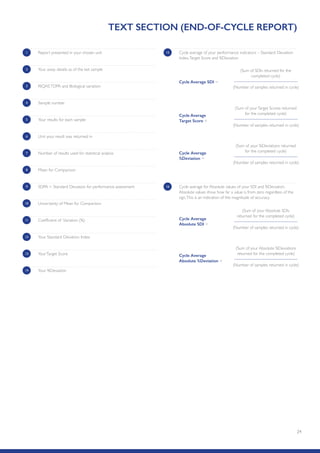
1 Report presented in your chosen unit
2 Your assay details as of the last sample
4 Sample number
3 RIQASTDPA and Biological variation
5 Your results for each sample
6 Unit your result was returned in
7 Number of results used for statistical analysis
8 Mean for Comparison
9 SDPA = Standard Deviation for performance assessment
10 Uncertainty of Mean for Comparison
11 Coefficient of Variation (%)
12 Your Standard Deviation Index
13 YourTarget Score
14 Your %Deviation
15 Cycle average of your performance indicators – Standard Deviation
Index,Target Score and %Deviation
Cycle Average SDI =
(Sum of SDIs returned for the
completed cycle)
(Number of samples returned in cycle)
Cycle Average
Target Score =
(Sum of yourTarget Scores returned
for the completed cycle)
Cycle Average
%Deviation =
(Sum of your %Deviations returned
for the completed cycle)
16 Cycle average for Absolute values of your SDI and %Deviation.
Absolute values show how far a value is from zero regardless of the
sign.This is an indication of the magnitude of accuracy.
Cycle Average
Absolute SDI =
(Sum of your Absolute SDIs
returned for the completed cycle)
Cycle Average
Absolute %Deviation =
(Sum of your Absolute %Deviations
returned for the completed cycle)
TEXT SECTION (END-OF-CYCLE REPORT)
(Number of samples returned in cycle)
25
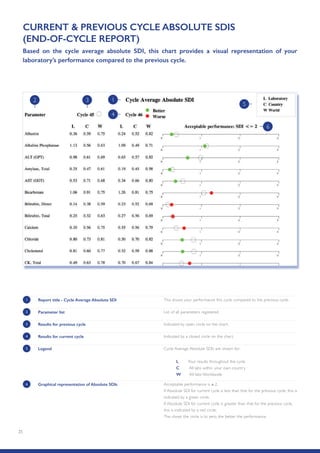
1 Report title - Cycle Average Absolute SDI This shows your performance this cycle compared to the previous cycle.
2 Parameter list List of all parameters registered.
3 Results for previous cycle Indicated by open circle on the chart.
6 Graphical representation of Absolute SDIs Acceptable performance is ≤ 2.
If Absolute SDI for current cycle is less than that for the previous cycle, this is
indicated by a green circle.
If Absolute SDI for current cycle is greater than that for the previous cycle,
this is indicated by a red circle.
The closer the circle is to zero, the better the performance.
4 Results for current cycle Indicated by a closed circle on the chart.
5 Legend Cycle Average Absolute SDIs are shown for:
L Your results throughout the cycle
C All labs within your own country
W All labs Worldwide
CURRENT  PREVIOUS CYCLE ABSOLUTE SDIS
(END-OF-CYCLE REPORT)
2 3 1
4
5
6
Based on the cycle average absolute SDI, this chart provides a visual representation of your
laboratory’s performance compared to the previous cycle.
26
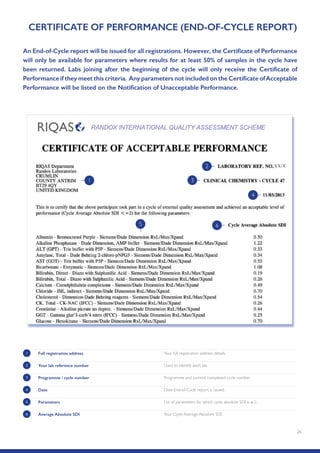
1 Full registration address Your full registration address details.
2 Your lab reference number Used to identify each lab.
3 Programme / cycle number Programme and current, completed cycle number.
4 Date Date End-of-Cycle report is issued.
5 Parameters List of parameters for which cycle absolute SDI is ≤ 2.
6 Average Absolute SDI Your Cycle Average Absolute SDI.
An End-of-Cycle report will be issued for all registrations. However, the Certificate of Performance
will only be available for parameters where results for at least 50% of samples in the cycle have
been returned. Labs joining after the beginning of the cycle will only receive the Certificate of
Performance if they meet this criteria. Any parameters not included on the Certificate ofAcceptable
Performance will be listed on the Notification of Unacceptable Performance.
CERTIFICATE OF PERFORMANCE (END-OF-CYCLE REPORT)
1
5
2
3
6
4
XX/X
27
MONITORING EQA PERFORMANCE
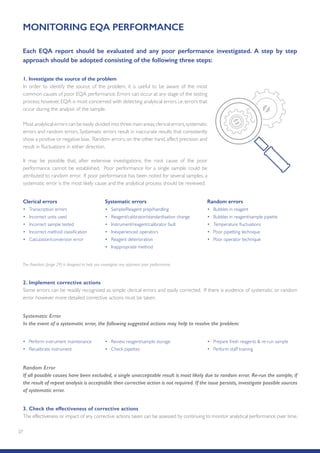
Each EQA report should be evaluated and any poor performance investigated. A step by step
approach should be adopted consisting of the following three steps:
Clerical errors
•	 Transcription errors
•	 Incorrect units used
•	 Incorrect sample tested
•	 Incorrect method classification
•	 Calculation/conversion error
Systematic errors
•	 Sample/Reagent prep/handling
•	 Reagent/calibrator/standardisation change
•	 Instrument/reagent/calibrator fault
•	 Inexperienced operators
•	 Reagent deterioration
•	 Inappropriate method
Random errors
•	 Bubbles in reagent
•	 Bubbles in reagent/sample pipette
•	 Temperature fluctuations
•	 Poor pipetting technique
•	 Poor operator technique
3. Check the effectiveness of corrective actions
The effectiveness or impact of any corrective actions taken can be assessed by continuing to monitor analytical performance over time.
2. Implement corrective actions
Some errors can be readily recognised as simple clerical errors and easily corrected. If there is evidence of systematic or random
error however more detailed corrective actions must be taken.
Random Error
If all possible causes have been excluded, a single unacceptable result is most likely due to random error. Re-run the sample; if
the result of repeat analysis is acceptable then corrective action is not required. If the issue persists, investigate possible sources
of systematic error.
Systematic Error
In the event of a systematic error, the following suggested actions may help to resolve the problem:
•	 Prepare fresh reagents  re-run sample
•	 Perform staff training
•	 Perform instrument maintenance
•	 Recalibrate instrument
•	 Review reagent/sample storage
•	 Check pipettes
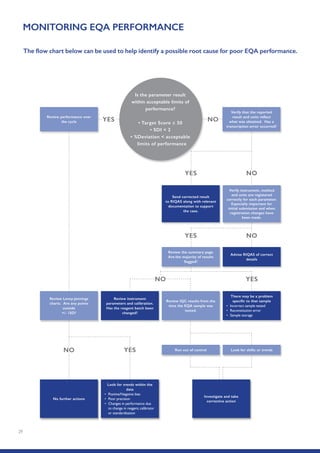
The flowchart (page 29) is designed to help you investigate any apparent poor performance.
1. Investigate the source of the problem
In order to identify the source of the problem, it is useful to be aware of the most
common causes of poor EQA performance. Errors can occur at any stage of the testing
process; however, EQA is most concerned with detecting analytical errors i.e. errors that
occur during the analysis of the sample.
Most analytical errors can be easily divided into three main areas;clerical errors,systematic
errors and random errors. Systematic errors result in inaccurate results that consistently
show a positive or negative bias. Random errors, on the other hand, affect precision and
result in fluctuations in either direction.
It may be possible that, after extensive investigations, the root cause of the poor
performance cannot be established. Poor performance for a single sample could be
attributed to random error. If poor performance has been noted for several samples, a
systematic error is the most likely cause and the analytical process should be reviewed.
28
MONITORING EQA PERFORMANCE
Lab Manager:			 Date: Lab Director:			 Date:
Conclusion: Remedial Action:
Laboratory:
Cycle Number:
Analysis Date:
Mean for Comparison:
Sample Number:
Analyte:
Lab Result:	 SDI:	 %Dev:
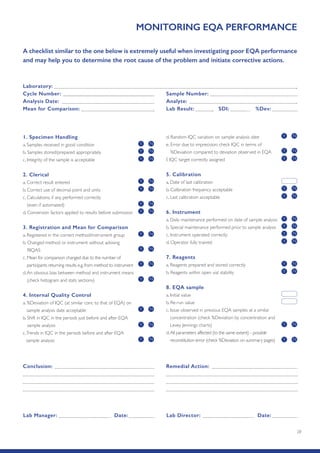
A checklist similar to the one below is extremely useful when investigating poor EQA performance
and may help you to determine the root cause of the problem and initiate corrective actions.
1. Specimen Handling
a. Samples received in good condition
b. Samples stored/prepared appropriately
c. Integrity of the sample is acceptable
2. Clerical
a. Correct result entered
b. Correct use of decimal point and units
c. Calculations, if any, performed correctly
(even if automated)
d. Conversion factors applied to results before submission
3. Registration and Mean for Comparison
a. Registered in the correct method/instrument group
b. Changed method or instrument without advising
RIQAS
c. Mean for comparison changed due to the number of
participants returning results e.g.from method to instrument
d.An obvious bias between method and instrument means
(check histogram and stats sections)
4. Internal Quality Control
a. %Deviation of IQC (at similar conc to that of EQA) on
sample analysis date acceptable
b. Shift in IQC in the periods just before and after EQA
sample analysis
c.Trends in IQC in the periods before and after EQA
sample analysis
d. Random IQC variation on sample analysis date
e. Error due to imprecision; check IQC in terms of
%Deviation compared to deviation observed in EQA
f. IQC target correctly assigned
5. Calibration
a. Date of last calibration
b. Calibration frequency acceptable
c. Last calibration acceptable
6. Instrument
a. Daily maintenance performed on date of sample analysis
b. Special maintenance performed prior to sample analysis
c. Instrument operated correctly
d. Operator fully trained
7. Reagents
a. Reagents prepared and stored correctly
b. Reagents within open vial stability
8. EQA sample
a. Initial value
b. Re-run value
c. Issue observed in previous EQA samples at a similar
concentration (check %Deviation by concentration and
Levey Jennings charts)
d.All parameters affected (to the same extent) - possible
reconstitution error (check %Deviation on summary pages)
Y
Y
Y
Y
Y
Y
Y
Y
Y
Y
Y
Y
Y
Y
Y
Y
Y
Y
Y
Y
Y
Y
Y
Y
Y
Y
N
N
N
N
N
N
N
N
N
N
N
N
N
N
N
N
N
N
N
N
N
N
N
N
N
N
Y N
29
MONITORING EQA PERFORMANCE
The flow chart below can be used to help identify a possible root cause for poor EQA performance.
Send corrected result
to RIQAS along with relevant
documentation to support
the case.
Verify instrument, method
and units are registered
correctly for each parameter.
Especially important for
initial submission and when
registration changes have
been made.
Run out of control Look for shifts or trends
Review Levey-Jennings
charts. Are any points
outside
+/- 1SD?
There may be a problem
specific to that sample
•	 Incorrect sample tested
•	 Reconstitution error
•	 Sample storage
Review IQC results from the
time the EQA sample was
tested.
Review instrument
parameters and calibration.
Has the reagent batch been
changed?
No further actions
Investigate and take
corrective action
Look for trends within the
data
•	 Positive/Negative bias
•	 Poor precision
•	 Changes in performance due
to change in reagent, calibrator
or standardisation
Review performance over
the cycle
Verify that the reported
result and units reflect
what was obtained. Has a
transcription error occurred?
Is the parameter result
within acceptable limits of
performance?
• Target Score  50
• SDI  2
• %Deviation  acceptable
limits of performance
Review the summary page.
Are the majority of results
flagged?
YES
YES
YES
YES
NO
NO
Advise RIQAS of correct
details
NO
NO
NO
YES
30
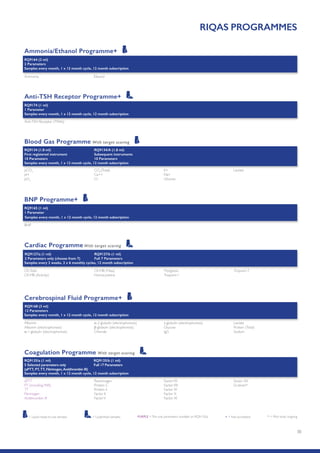
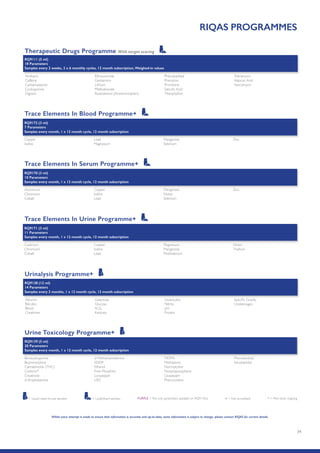
RIQAS PROGRAMMES
Ammonia/Ethanol Programme+
RQ9164 (2 ml)
2 Parameters
Samples every month, 1 x 12 month cycle, 12 month subscription
Ammonia Ethanol
Anti-TSH Receptor Programme+
RQ9174 (1 ml)
1 Parameter
Samples every month, 1 x 12 month cycle, 12 month subscription
Anti-TSH Receptor (TRAb)
pCO2
pH
pO2
CO2
(Total)
Ca++
Cl-
K+
Na+
Glucose
Lactate
Blood Gas Programme With target scoring
RQ9134 (1.8 ml)
First registered instrument
10 Parameters
RQ9134/A (1.8 ml)
Subsequent instruments
10 Parameters
Samples every month, 1 x 12 month cycle, 12 month subscription
BNP Programme+
RQ9165 (1 ml)
1 Parameter
BNP
Samples every month, 1 x 12 month cycle, 12 month subscription
Cerebrospinal Fluid Programme+
Albumin
Albumin (electrophoresis)
α-1-globulin (electrophoresis)
α-2-globulin (electrophoresis)
β-globulin (electrophoresis)
Chloride
γ-globulin (electrophoresis)
Glucose
IgG
Lactate
Protein (Total)
Sodium
RQ9168 (3 ml)
12 Parameters
Samples every month, 1 x 12 month cycle, 12 month subscription
Cardiac Programme With target scoring
CK,Total
CK-MB (Activity)
CK-MB (Mass)
Homocysteine
Myoglobin
Troponin I
TroponinT
RQ9127/a (1 ml)
2 Parameters only (choose from 7)
RQ9127/b (1 ml)
Full 7 Parameters
Samples every 2 weeks, 2 x 6 monthly cycles, 12 month subscription
aPTT
PT (including INR)
TT
Fibrinogen
Antithrombin III
Plasminogen
Protein C
Protein S
Factor II
FactorV
FactorVII
FactorVIII
Factor IX
Factor X
Factor XI
Factor XII
D-dimer*
Coagulation Programme With target scoring
RQ9135/a (1 ml)
5 Selected parameters only
(aPTT, PT,TT, Fibrinogen,Antithrombin III)
RQ9135/b (1 ml)
Full 17 Parameters
Samples every month, 1 x 12 month cycle, 12 month subscription
* = Pilot study ongoing+ = Not accreditedPURPLE =The only parameters available on RQ9135/a= Liquid ready-to-use samples = Lyophilised samples
31
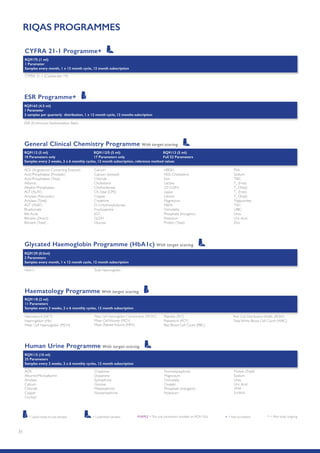
RIQAS PROGRAMMES
Haematocrit (HCT)
Haemoglobin (Hb)
Mean Cell Haemoglobin (MCH)
Mean Cell Haemoglobin Concentration (MCHC)
Mean CellVolume (MCV)
Mean PlateletVolume (MPV)
Platelets (PLT)
Plateletcrit (PCT)
Red Blood Cell Count (RBC)
Red Cell Distribution Width (RDW)
Total White Blood Cell Count (WBC)
Haematology Programme With target scoring
RQ9118 (2 ml)
11 Parameters
Samples every 2 weeks, 2 x 6 monthly cycles, 12 month subscription
ESR Programme+
RQ9163 (4.5 ml)
1 Parameter
2 samples per quarterly distribution, 1 x 12 month cycle, 12 months subcription
ESR (Erythrocyte Sedimentation Rate)
CYFRA 21-1 Programme+
RQ9175 (1 ml)
1 Parameter
Samples every month, 1 x 12 month cycle, 12 month subscription
CYFRA 21-1 (Cytokeratin 19)
ACE (Angiotensin Converting Enzyme)
Acid Phosphatase (Prostatic)
Acid Phosphatase (Total)
Albumin
Alkaline Phosphatase
ALT (ALAT)
Amylase (Pancreatic)
Amylase (Total)
AST (ASAT)
Bicarbonate
Bile Acids
Bilirubin (Direct)
Bilirubin (Total)
Calcium
Calcium (Ionised)
Chloride
Cholesterol
Cholinesterase
CK,Total (CPK)
Copper
Creatinine
D-3-Hydroxybutyrate
Fructosamine
γGT
GLDH
Glucose
HBDH
HDL-Cholesterol
Iron
Lactate
LD (LDH)
Lipase
Lithium
Magnesium
NEFA
Osmolality
Phosphate (Inorganic)
Potassium
Protein (Total)
PSA
Sodium
TIBC
T3
(Free)
T3
(Total)
T4
(Free)
T4
(Total)
Triglycerides
TSH
UIBC
Urea
Uric Acid
Zinc
General Clinical Chemistry Programme With target scoring
RQ9112 (5 ml)
10 Parameters only
RQ9112/S (5 ml)
17 Parameters only
RQ9113 (5 ml)
Full 52 Parameters
Samples every 2 weeks, 2 x 6 monthly cycles, 12 month subscription, reference method values
HbA1c Total Haemoglobin	 	
Glycated Haemoglobin Programme (HbA1c) With target scoring
RQ9129 (0.5ml)
2 Parameters
Samples every month, 1 x 12 month cycle, 12 month subscription
ACR
Albumin/Microalbumin
Amylase
Calcium
Chloride
Copper
Cortisol
Creatinine
Dopamine
Epinephrine
Glucose
Metanephrine
Norepinephrine
Normetanephrine
Magnesium
Osmolality
Oxalate
Phosphate (Inorganic)
Potassium
Protein (Total)
Sodium
Urea
Uric Acid
VMA
5-HIAA
Human Urine Programme With target scoring
RQ9115 (10 ml)
25 Parameters
Samples every 2 weeks, 2 x 6 monthly cycles, 12 month subscription
* = Pilot study ongoing+ = Not accreditedPURPLE =The only parameters available on RQ9135/a= Liquid ready-to-use samples = Lyophilised samples
32
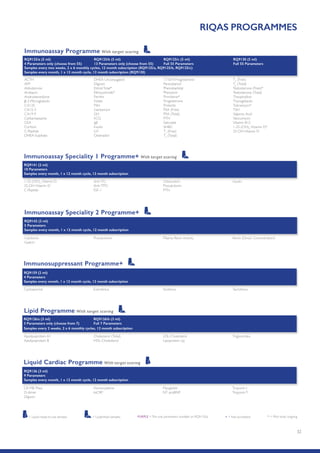
RIQAS PROGRAMMES
CK-MB Mass
D-dimer
Digoxin
Homocysteine
hsCRP
Myoglobin
NT proBNP
Troponin I
TroponinT
Liquid Cardiac Programme With target scoring
RQ9136 (3 ml)
9 Parameters
Samples every month, 1 x 12 month cycle, 12 month subscription
ACTH
AFP
Aldosterone
Amikacin
Androstenedione
β-2-Microglobulin
CA125
CA15-3
CA19-9
Carbamazepine
CEA
Cortisol
C-Peptide
DHEA-Sulphate
DHEA Unconjugated
Digoxin
EstriolTotal*
Ethosuximide*
Ferritin
Folate
FSH
Gentamicin
GH
hCG
IgE
Insulin
LH
Oestradiol
17-OH-Progesterone
Paracetamol
Phenobarbital
Phenytoin
Primidone*
Progesterone
Prolactin
PSA (Free)
PSA (Total)
PTH
Salicylate
SHBG
T3
(Free)
T3
(Total)
T4
(Free)
T4
(Total)
Testosterone (Free)*
Testosterone (Total)
Theophylline
Thyroglobulin
Tobramycin*
TSH
Valproic Acid
Vancomycin
Vitamin B12
1-25-(OH)2
-Vitamin D*
25-OH-Vitamin D
Immunoassay Programme With target scoring
RQ9125/a (5 ml)
4 Parameters only (choose from 55)
RQ9125/b (5 ml)
13 Parameters only (choose from 55)
RQ9125/c (5 ml)
Full 55 Parameters
RQ9130 (5 ml)
Full 55 Parameters
Samples every two weeks, 2 x 6 monthly cycles, 12 month subscription (RQ9125/a, RQ9125/b, RQ9125/c)
Samples every month, 1 x 12 month cycle, 12 month subscription (RQ9130)
Immunoassay Speciality 1 Programme+ With target scoring
RQ9141 (2 ml)
10 Parameters
Samples every month, 1 x 12 month cycle, 12 month subscription
1-25-(OH)2
-Vitamin D
25-OH-Vitamin D
C-Peptide
Anti-TG
Anti-TPO
IGF-1
Osteocalcin
Procalcitonin
PTH
Insulin
Immunoassay Speciality 2 Programme+
RQ9142 (2 ml)
5 Parameters
Samples every month, 1 x 12 month cycle, 12 month subscription
Calcitonin
Gastrin
Procalcitonin Plasma Renin Activity Renin (Direct Concentration)
Cyclosporine Everolimus Sirolimus Tacrolimus
Immunosuppressant Programme+
RQ9159 (2 ml)
4 Parameters
Samples every month, 1 x 12 month cycle, 12 month subscription
Apolipoprotein A1
Apolipoprotein B
Cholesterol (Total)
HDL-Cholesterol
LDL-Cholesterol
Lipoprotein (a)
Triglycerides
Lipid Programme With target scoring
RQ9126/a (3 ml)
3 Parameters only (choose from 7)
RQ9126/b (3 ml)
Full 7 Parameters
Samples every 2 weeks, 2 x 6 monthly cycles, 12 month subscription
* = Pilot study ongoing+ = Not accreditedPURPLE =The only parameters available on RQ9135/a= Liquid ready-to-use samples = Lyophilised samples
33
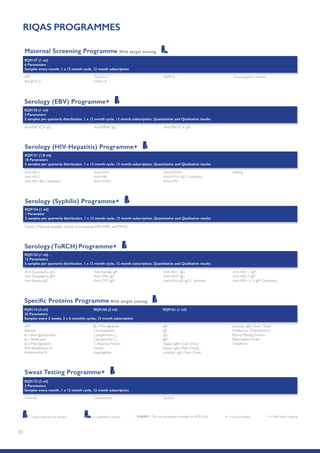
RIQAS PROGRAMMES
Serology (EBV) Programme+
RQ9153 (1 ml)
3 Parameters
3 samples per quarterly distribution, 1 x 12 month cycle, 12 month subscription, Quantitative and Qualitative results
Anti-EBVVCA IgG Anti-EBNA IgG			 Anti-EBVVCA IgM
Serology (HIV-Hepatitis) Programme+
RQ9151 (1.8 ml)
10 Parameters
5 samples per quarterly distribution, 1 x 12 month cycle, 12 month subscription, Quantitative and Qualitative results
Anti-HIV-1
Anti-HIV-2
Anti-HIV-12 Combined
Anti-HCV
Anti-HBc
Anti-HTLV-I
Anti-HTLV-II
Anti-HTLV-12 Combined
Anti-CMV
HBsAg
Serology (Syphilis) Programme+
RQ9154 (1 ml)
1 Parameter
3 samples per quarterly distribution, 1 x 12 month cycle, 12 month subscription, Quantitative and Qualitative results
Syphilis (Methods available include immunoassay RPR,VDRL andTPHA)
Serology (ToRCH) Programme+
RQ9152 (1 ml)
12 Parameters
5 samples per quarterly distribution, 1 x 12 month cycle, 12 month subscription, Quantitative and Qualitative results
Anti-Toxoplasma IgG
Anti-Toxoplasma IgM
Anti-Rubella IgG
Anti-Rubella IgM
Anti-CMV IgG
Anti-CMV IgM
Anti-HSV1 IgG
Anti-HSV2 IgG
Anti-HSV-12 IgG Combined
Anti-HSV 1 1gM
Anti-HSV 2 IgM
Anti-HSV I + 2 IgM Combined
AFP
Albumin
α-1-Acid glycoprotein
α-1-Antitrypsin
α-2-Macroglobulin
Anti Streptolysin O
Antithrombin III
β-2-Microglobulin
Ceruloplasmin
Complement C3
Complement C4
C-Reactive Protein
Ferritin
Haptoglobin
IgA
IgE
IgG
IgM
Kappa Light Chain (Free)
Kappa Light Chain (Total)
Lambda Light Chain (Free)
Lambda Light Chain (Total)
Prealbumin (Transthyretin)
Retinol Binding Protein
Rheumatoid Factor
Transferrin
Specific Proteins Programme With target scoring
RQ9114 (3 ml) RQ9160 (2 ml)		 RQ9161 (1 ml)
26 Parameters
Samples every 2 weeks, 2 x 6 monthly cycles, 12 month subscription
Chloride Conductivity Sodium
Sweat Testing Programme+
RQ9173 (2 ml)
3 Parameters
Samples every month, 1 x 12 month cycle, 12 month subscription
AFP
free β-hCG
Total hCG
Inhibin A
PAPP-A Unconjugated Oestriol
Maternal Screening Programme With target scoring
RQ9137 (1 ml)
6 Parameters
Samples every month, 1 x 12 month cycle, 12 month subscription
* = Pilot study ongoing+ = Not accreditedPURPLE =The only parameters available on RQ9135/a= Liquid ready-to-use samples = Lyophilised samples
34
* = Pilot study ongoing+ = Not accreditedPURPLE =The only parameters available on RQ9135/a= Liquid ready-to-use samples = Lyophilised samples
RIQAS PROGRAMMES
Whilst every attempt is made to ensure that information is accurate and up-to-date, some information is subject to change, please contact RIQAS for current details.
Albumin
Bilirubin
Blood
Creatinine
Galactose
Glucose
hCG
Ketones
Leukocytes
Nitrite
pH
Protein
Specific Gravity
Urobilinogen
Urinalysis Programme+
RQ9138 (12 ml)
14 Parameters
Samples every 2 months, 1 x 12 month cycle, 12 month subscription
Benzoylecgonine
Buprenorphine
Cannabinoids (THC)
Cotinine*
Creatinine
d-Amphetamine
d-Methamphetamine
EDDP
Ethanol
Free Morphine
Lorazepam
LSD
MDMA
Methadone
Nortriptyline
Norpropoxyphene
Oxazepam
Phencyclidine
Phenobarbital
Secobarbital
Urine Toxicology Programme+
RQ9139 (5 ml)
20 Parameters
Samples every month, 1 x 12 month cycle, 12 month subscription
Amikacin
Caffeine
Carbamazepine
Cyclosporine
Digoxin
Ethosuximide
Gentamicin
Lithium
Methotrexate
Paracetamol (Acetaminophen)
Phenobarbital
Phenytoin
Primidone
Salicylic Acid
Theophylline
Tobramycin
Valproic Acid
Vancomycin
Therapeutic Drugs Programme With target scoring
RQ9111 (5 ml)
18 Parameters
Samples every 2 weeks, 2 x 6 monthly cycles, 12 month subscription, Weighed-in values
Copper
Iodine
Lead
Magnesium
Manganese
Selenium
Zinc
Trace Elements In Blood Programme+
RQ9172 (3 ml)
7 Parameters
Samples every month, 1 x 12 month cycle, 12 month subscription
Aluminium
Chromium
Cobalt
Copper
Iodine
Lead
Manganese
Nickel
Selenium
Zinc
Trace Elements In Serum Programme+
RQ9170 (3 ml)
10 Parameters
Samples every month, 1 x 12 month cycle, 12 month subscription
Cadmium
Chromium
Cobalt
Copper
Iodine
Lead
Magnesium
Manganese
Molybdenum
Nickel
Thallium
Trace Elements In Urine Programme+
RQ9171 (3 ml)
11 Parameters
Samples every month, 1 x 12 month cycle, 12 month subscription
35
* = Pilot study ongoing
+ = Not accredited
PURPLE =The only parameters available on RQ9135/a
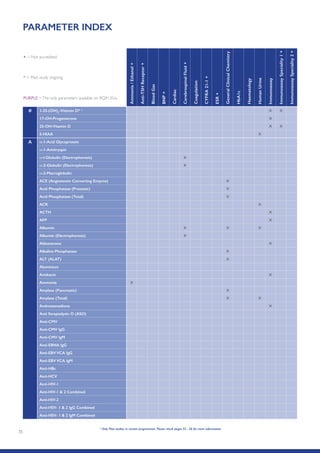
# 1-25-(OH)2
-Vitamin D* ∆
X X
17-OH-Progesterone X
25-OH-Vitamin D X X
5-HIAA X
A α-1-Acid Glycoprotein
α-1-Antitryspin
α-I-Globulin (Electrophoresis) X
α-2-Globulin (Electrophoresis) X
α-2-Macroglobulin
ACE (Angiotensin Converting Enzyme) X
Acid Phosphatase (Prostatic) X
Acid Phosphatase (Total) X
ACR X
ACTH X
AFP X
Albumin X X X
Albumin (Electrophoresis) X
Aldosterone X
Alkaline Phosphatase X
ALT (ALAT) X
Aluminium
Amikacin X
Ammonia X
Amylase (Pancreatic) X
Amylase (Total) X X
Androstenedione X
Anti Streptolysin O (ASO)
Anti-CMV
Anti-CMV IgG
Anti-CMV IgM
Anti-EBNA IgG
Anti-EBV VCA IgG
Anti-EBV VCA IgM
Anti-HBc
Anti-HCV
Anti-HIV-1
Anti-HIV-1  2 Combined
Anti-HIV-2
Anti-HSV- 1  2 IgG Combined
Anti-HSV- 1  2 IgM Combined
PARAMETER INDEX
Ammonia/Ethanol+
Anti-TSHReceptor+
BloodGas
BNP+
Cardiac
CerebrospinalFluid+
Coagulation
CYFRA21-1+
ESR+
GeneralClinicalChemistry
HbA1c
Haematology
HumanUrine
Immunoassay
ImmunoassaySpeciality1+
ImmunoassaySpeciality2+
∆
Only Pilot studies in certain programmes. Please check pages 32 - 36 for more information.
36
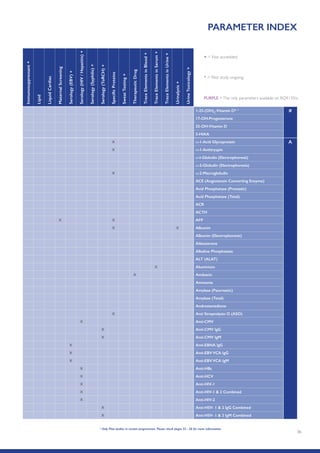
1-25-(OH)2
-Vitamin D* ∆
#
17-OH-Progesterone
25-OH-Vitamin D
5-HIAA
X α-1-Acid Glycoprotein A
X α-1-Antitryspin
α-I-Globulin (Electrophoresis)
α-2-Globulin (Electrophoresis)
X α-2-Macroglobulin
ACE (Angiotensin Converting Enzyme)
Acid Phosphatase (Prostatic)
Acid Phosphatase (Total)
ACR
ACTH
X X AFP
X X Albumin
Albumin (Electrophoresis)
Aldosterone
Alkaline Phosphatase
ALT (ALAT)
X Aluminium
X Amikacin
Ammonia
Amylase (Pancreatic)
Amylase (Total)
Androstenedione
X Anti Streptolysin O (ASO)
X Anti-CMV
X Anti-CMV IgG
X Anti-CMV IgM
X Anti-EBNA IgG
X Anti-EBV VCA IgG
X Anti-EBV VCA IgM
X Anti-HBc
X Anti-HCV
X Anti-HIV-1
X Anti-HIV-1  2 Combined
X Anti-HIV-2
X Anti-HSV- 1  2 IgG Combined
X Anti-HSV- 1  2 IgM Combined
PARAMETER INDEXImmunosuppressant+
Lipid
LiquidCardiac
MaternalScreening
Serology(EBV)+
Serology(HIV/Hepatitis)+
Serology(Syphilis)+
Serology(ToRCH)+
SpecificProteins
SweatTesting+
TherapeuticDrug
TraceElementsinBlood+
TraceElementsinSerum+
TraceElementsinUrine+
Urinalysis+
UrineToxicology+
* = Pilot study ongoing
+ = Not accredited
PURPLE =The only parameters available on RQ9135/a
∆
Only Pilot studies in certain programmes. Please check pages 32 - 36 for more information.
37
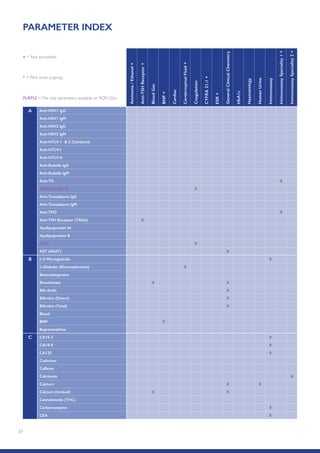
A Anti-HSV1 IgG
Anti-HSV1 IgM
Anti-HSV2 IgG
Anti-HSV2 IgM
Anti-HTLV-1  2 Combined
Anti-HTLV-I
Anti-HTLV-II
Anti-Rubella IgG
Anti-Rubella IgM
Anti-TG X
Antithrombin III X
Anti-Toxoplasma IgG
Anti-Toxoplasma IgM
Anti-TPO X
Anti-TSH Receptor (TRAb) X
Apolipoprotein AI
Apolipoprotein B
aPTT X
AST (ASAT) X
B β-2-Microglobulin X
β-Globulin (Electrophoresis) X
Benzoylecgonine
Bicarbonate X X
Bile Acids X
Bilirubin (Direct) X
Bilirubin (Total) X
Blood
BNP X
Buprenorphine
C CA15-3 X
CA19-9 X
CA125 X
Cadmium
Caffeine
Calcitonin X
Calcium X X
Calcium (Ionised) X X
Cannabinoids (THC)
Carbamazepine X
CEA X
PARAMETER INDEX
Ammonia/Ethanol+
Anti-TSHReceptor+
BloodGas
BNP+
Cardiac
CerebrospinalFluid+
Coagulation
CYFRA21-1+
ESR+
GeneralClinicalChemistry
HbA1c
Haematology
HumanUrine
Immunoassay
ImmunoassaySpeciality1+
ImmunoassaySpeciality2+
* = Pilot study ongoing
+ = Not accredited
PURPLE =The only parameters available on RQ9135/a
38
X Anti-HSV1 IgG A
X Anti-HSV1 IgM
X Anti-HSV2 IgG
X Anti-HSV2 IgM
X Anti-HTLV-1  2 Combined
X Anti-HTLV-I
X Anti-HTLV-II
X Anti-Rubella IgG
X Anti-Rubella IgM
Anti-TG
X Antithrombin III
X Anti-Toxoplasma IgG
X Anti-Toxoplasma IgM
Anti-TPO
Anti-TSH Receptor (TRAb)
X Apolipoprotein AI
X Apolipoprotein B
aPTT
AST (ASAT)
X β-2-Microglobulin B
β-Globulin (Electrophoresis)
X Benzoylecgonine
Bicarbonate
Bile Acids
Bilirubin (Direct)
X Bilirubin (Total)
X Blood
BNP
X Buprenorphine
CA15-3 C
CA19-9
CA125
X Cadmium
X Caffeine
Calcitonin
Calcium
Calcium (Ionised)
X Cannabinoids (THC)
X Carbamazepine
CEA
PARAMETER INDEXImmunosuppressant+
Lipid
LiquidCardiac
MaternalScreening
Serology(EBV)+
Serology(HIV/Hepatitis)+
Serology(Syphilis)+
Serology(ToRCH)+
SpecificProteins
SweatTesting+
TherapeuticDrug
TraceElementsinBlood+
TraceElementsinSerum+
TraceElementsinUrine+
Urinalysis+
UrineToxicology+
* = Pilot study ongoing
+ = Not accredited
PURPLE =The only parameters available on RQ9135/a
39
∆
Only Pilot studies in certain programmes. Please check pages 32 - 36 for more information.
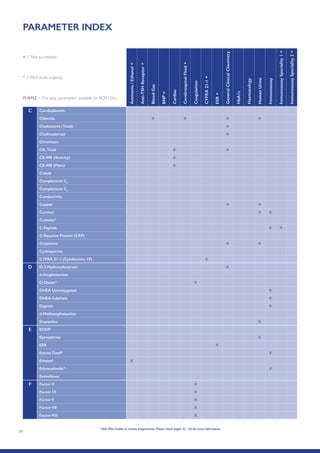
C Ceruloplasmin
Chloride X X X X
Cholesterol (Total) X
Cholinesterase X
Chromium
CK, Total X X
CK-MB (Activity) X
CK-MB (Mass) X
Cobalt
Complement C3
Complement C4
Conductivity
Copper X X
Cortisol X X
Cotinine*
C-Peptide X X
C-Reactive Protein (CRP)
Creatinine X X
Cyclosporine
CYFRA 21-1 (Cytokeratin 19) X
D D-3-Hydroxybutyrate X
d-Amphetamine
D-Dimer* ∆
X
DHEA Unconjugated X
DHEA-Sulphate X
Digoxin X
d-Methamphetamine
Dopamine X
E EDDP
Epinephrine X
ESR X
Estriol Total* X
Ethanol X
Ethosuximide* ∆
X
Everolimus
F Factor II X
Factor IX X
Factor V X
Factor VII X
Factor VIII X
PARAMETER INDEX
Ammonia/Ethanol+
Anti-TSHReceptor+
BloodGas
BNP+
Cardiac
CerebrospinalFluid+
Coagulation
CYFRA21-1+
ESR+
GeneralClinicalChemistry
HbA1c
Haematology
HumanUrine
Immunoassay
ImmunoassaySpeciality1+
ImmunoassaySpeciality2+
* = Pilot study ongoing
+ = Not accredited
PURPLE =The only parameters available on RQ9135/a
40
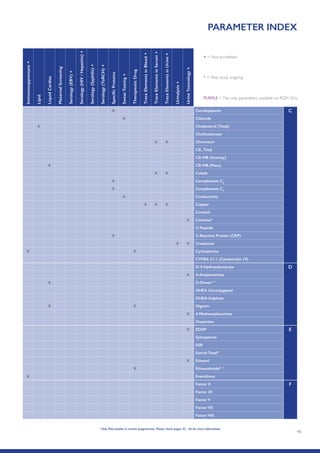
X Ceruloplasmin C
X Chloride
X Cholesterol (Total)
Cholinesterase
X X Chromium
CK, Total
CK-MB (Activity)
X CK-MB (Mass)
X X Cobalt
X Complement C3
X Complement C4
X Conductivity
X X X Copper
Cortisol
X Cotinine*
C-Peptide
X C-Reactive Protein (CRP)
X X Creatinine
X X Cyclosporine
CYFRA 21-1 (Cytokeratin 19)
D-3-Hydroxybutyrate D
X d-Amphetamine
X D-Dimer* ∆
DHEA Unconjugated
DHEA-Sulphate
X X Digoxin
X d-Methamphetamine
Dopamine
X EDDP E
Epinephrine
ESR
Estriol Total*
X Ethanol
X Ethosuximide* ∆
X Everolimus
Factor II F
Factor IX
Factor V
Factor VII
Factor VIII
PARAMETER INDEXImmunosuppressant+
Lipid
LiquidCardiac
MaternalScreening
Serology(EBV)+
Serology(HIV/Hepatitis)+
Serology(Syphilis)+
Serology(ToRCH)+
SpecificProteins
SweatTesting+
TherapeuticDrug
TraceElementsinBlood+
TraceElementsinSerum+
TraceElementsinUrine+
Urinalysis+
UrineToxicology+
* = Pilot study ongoing
+ = Not accredited
PURPLE =The only parameters available on RQ9135/a
∆
Only Pilot studies in certain programmes. Please check pages 32 - 36 for more information.
41
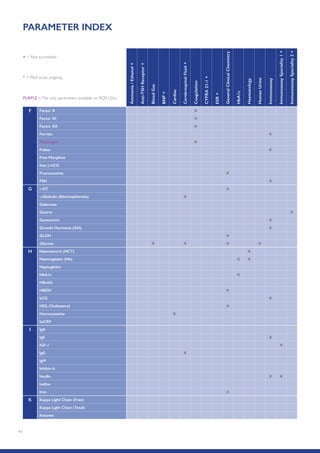
F Factor X X
Factor XI X
Factor XII X
Ferritin X
Fibrinogen X
Folate X
Free Morphine
free β-hCG
Fructosamine X
FSH X
G γ-GT X
γ-Globulin (Electrophoresis) X
Galactose
Gastrin X
Gentamicin X
Growth Hormone (GH) X
GLDH X
Glucose X X X X
H Haematocrit (HCT) X
Haemoglobin (Hb) X X
Haptoglobin
HbA1c X
HBsAG
HBDH X
hCG X
HDL-Cholesterol X
Homocysteine X
hsCRP
I IgA
IgE X
IGF-1 X
IgG X
IgM
Inhibin A
Insulin X X
Iodine
Iron X
K Kappa Light Chain (Free)
Kappa Light Chain (Total)
Ketones
PARAMETER INDEX
Ammonia/Ethanol+
Anti-TSHReceptor+
BloodGas
BNP+
Cardiac
CerebrospinalFluid+
Coagulation
CYFRA21-1+
ESR+
GeneralClinicalChemistry
HbA1c
Haematology
HumanUrine
Immunoassay
ImmunoassaySpeciality1+
ImmunoassaySpeciality2+
* = Pilot study ongoing
+ = Not accredited
PURPLE =The only parameters available on RQ9135/a
42
Factor X F
Factor XI
Factor XII
X Ferritin
Fibrinogen
Folate
X Free Morphine
X free β-hCG
Fructosamine
FSH
γ-GT G
γ-Globulin (Electrophoresis)
X Galactose
Gastrin
X Gentamicin
Growth Hormone (GH)
GLDH
X Glucose
Haematocrit (HCT) H
Haemoglobin (Hb)
X Haptoglobin
HbA1c
X HBsAG
HBDH
X hCG
X HDL-Cholesterol
X Homocysteine
X hsCRP
X IgA I
X IgE
IGF-1
X IgG
X IgM
X Inhibin A
Insulin
X X X Iodine
Iron
X Kappa Light Chain (Free) K
X Kappa Light Chain (Total)
X Ketones
PARAMETER INDEXImmunosuppressant+
Lipid
LiquidCardiac
MaternalScreening
Serology(EBV)+
Serology(HIV/Hepatitis)+
Serology(Syphilis)+
Serology(ToRCH)+
SpecificProteins
SweatTesting+
TherapeuticDrug
TraceElementsinBlood+
TraceElementsinSerum+
TraceElementsinUrine+
Urinalysis+
UrineToxicology+
* = Pilot study ongoing
+ = Not accredited
PURPLE =The only parameters available on RQ9135/a
43
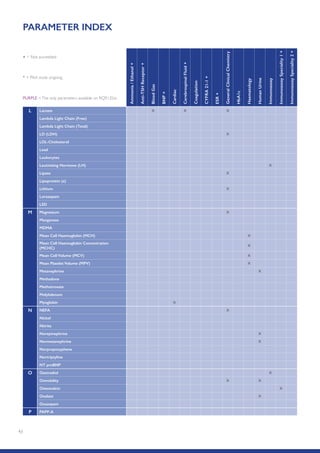
L Lactate X X X
Lambda Light Chain (Free)
Lambda Light Chain (Total)
LD (LDH) X
LDL-Cholesterol
Lead
Leukocytes
Leutinising Hormone (LH) X
Lipase X
Lipoprotein (a)
Lithium X
Lorazepam
LSD
M Magnesium X
Manganese
MDMA
Mean Cell Haemoglobin (MCH) X
Mean Cell Haemoglobin Concentration
(MCHC)
X
Mean Cell Volume (MCV) X
Mean Platelet Volume (MPV) X
Metanephrine X
Methadone
Methotrexate
Molybdenum
Myoglobin X
N NEFA X
Nickel
Nitrite
Norepinephrine X
Normetanephrine X
Norpropoxyphene
Nortriptyline
NT proBNP
O Oestradiol X
Osmolality X X
Osteocalcin X
Oxalate X
Oxazepam
P PAPP-A
PARAMETER INDEX
Ammonia/Ethanol+
Anti-TSHReceptor+
BloodGas
BNP+
Cardiac
CerebrospinalFluid+
Coagulation
CYFRA21-1+
ESR+
GeneralClinicalChemistry
HbA1c
Haematology
HumanUrine
Immunoassay
ImmunoassaySpeciality1+
ImmunoassaySpeciality2+
* = Pilot study ongoing
+ = Not accredited
PURPLE =The only parameters available on RQ9135/a
44
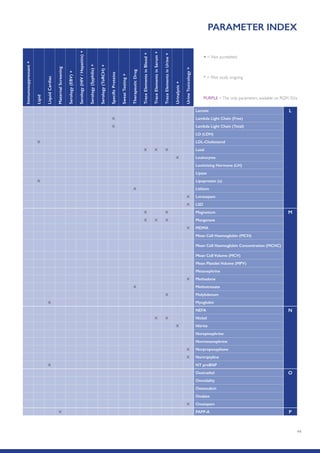
Lactate L
X Lambda Light Chain (Free)
X Lambda Light Chain (Total)
LD (LDH)
X LDL-Cholesterol
X X X Lead
X Leukocytes
Leutinising Hormone (LH)
Lipase
X Lipoprotein (a)
X Lithium
X Lorazepam
X LSD
X X Magnesium M
X X X Manganese
X MDMA
Mean Cell Haemoglobin (MCH)
Mean Cell Haemoglobin Concentration (MCHC)
Mean Cell Volume (MCV)
Mean Platelet Volume (MPV)
Metanephrine
X Methadone
X Methotrexate
X Molybdenum
X Myoglobin
NEFA N
X X Nickel
X Nitrite
Norepinephrine
Normetanephrine
X Norpropoxyphene
X Nortriptyline
X NT proBNP
Oestradiol O
Osmolality
Osteocalcin
Oxalate
X Oxazepam
X PAPP-A P
PARAMETER INDEXImmunosuppressant+
Lipid
LiquidCardiac
MaternalScreening
Serology(EBV)+
Serology(HIV/Hepatitis)+
Serology(Syphilis)+
Serology(ToRCH)+
SpecificProteins
SweatTesting+
TherapeuticDrug
TraceElementsinBlood+
TraceElementsinSerum+
TraceElementsinUrine+
Urinalysis+
UrineToxicology+
* = Pilot study ongoing
+ = Not accredited
PURPLE =The only parameters available on RQ9135/a
45
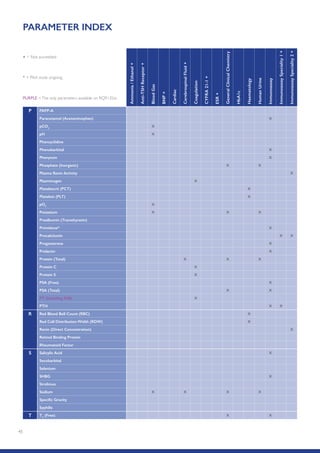
P PAPP-A
Paracetamol (Acetaminophen) X
pCO2
X
pH X
Phencyclidine
Phenobarbital X
Phenytoin X
Phosphate (Inorganic) X X
Plasma Renin Activity X
Plasminogen X
Plateletcrit (PCT) X
Platelets (PLT) X
pO2
X
Potassium X X X
Prealbumin (Transthyretin)
Primidone* X
Procalcitonin X X
Progesterone X
Prolactin X
Protein (Total) X X X
Protein C X
Protein S X
PSA (Free) X
PSA (Total) X X
PT (Including INR) X
PTH X X
R Red Blood Bell Count (RBC) X
Red Cell Distribution Width (RDW) X
Renin (Direct Concentration) X
Retinol Binding Protein
Rheumatoid Factor
S Salicylic Acid X
Secobarbital
Selenium
SHBG X
Sirolimus
Sodium X X X X
Specific Gravity
Syphilis
T T3
(Free) X X
PARAMETER INDEX
Ammonia/Ethanol+
Anti-TSHReceptor+
BloodGas
BNP+
Cardiac
CerebrospinalFluid+
Coagulation
CYFRA21-1+
ESR+
GeneralClinicalChemistry
HbA1c
Haematology
HumanUrine
Immunoassay
ImmunoassaySpeciality1+
ImmunoassaySpeciality2+
* = Pilot study ongoing
+ = Not accredited
PURPLE =The only parameters available on RQ9135/a
46
X PAPP-A P
X Paracetamol (Acetaminophen)
pCO2
X pH
X Phencyclidine
X X Phenobarbital
X Phenytoin
Phosphate (Inorganic)
Plasma Renin Activity
Plasminogen
Plateletcrit (PCT)
Platelets (PLT)
pO2
Potassium
X Prealbumin (Transthyretin)
X Primidone*
Procalcitonin
Progesterone
Prolactin
X Protein (Total)
Protein C
Protein S
PSA (Free)
PSA (Total)
PT (Including INR)
PTH
Red Blood Bell Count (RBC) R
Red Cell Distribution Width (RDW)
Renin (Direct Concentration)
X Retinol Binding Protein
X Rheumatoid Factor
X Salicylic Acid S
X Secobarbital
X X Selenium
SHBG
X Sirolimus
X Sodium
X Specific Gravity
X Syphilis
T3
(Free) T
PARAMETER INDEXImmunosuppressant+
Lipid
LiquidCardiac
MaternalScreening
Serology(EBV)+
Serology(HIV/Hepatitis)+
Serology(Syphilis)+
Serology(ToRCH)+
SpecificProteins
SweatTesting+
TherapeuticDrug
TraceElementsinBlood+
TraceElementsinSerum+
TraceElementsinUrine+
Urinalysis+
UrineToxicology+
* = Pilot study ongoing
+ = Not accredited
PURPLE =The only parameters available on RQ9135/a
47
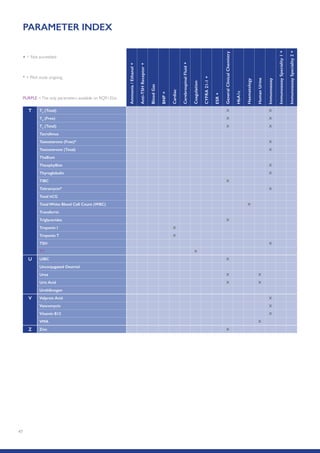
T T3
(Total) X X
T4
(Free) X X
T4
(Total) X X
Tacrolimus
Testosterone (Free)* X
Testosterone (Total) X
Thallium
Theophylline X
Thyroglobulin X
TIBC X
Tobramycin* X
Total hCG
Total White Blood Cell Count (WBC) X
Transferrin
Triglycerides X
Troponin I X
Troponin T X
TSH X
TT X
U UIBC X
Unconjugated Oestriol
Urea X X
Uric Acid X X
Urobilinogen
V Valproic Acid X
Vancomycin X
Vitamin B12 X
VMA X
Z Zinc X
PARAMETER INDEX
Ammonia/Ethanol+
Anti-TSHReceptor+
BloodGas
BNP+
Cardiac
CerebrospinalFluid+
Coagulation
CYFRA21-1+
ESR+
GeneralClinicalChemistry
HbA1c
Haematology
HumanUrine
Immunoassay
ImmunoassaySpeciality1+
ImmunoassaySpeciality2+
* = Pilot study ongoing
+ = Not accredited
PURPLE =The only parameters available on RQ9135/a
48
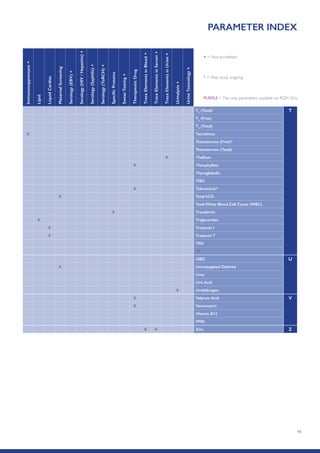
T3
(Total) T
T4
(Free)
T4
(Total)
X Tacrolimus
Testosterone (Free)*
Testosterone (Total)
X Thallium
X Theophylline
Thyroglobulin
TIBC
X Tobramycin*
X Total hCG
Total White Blood Cell Count (WBC)
X Transferrin
X Triglycerides
X Troponin I
X Troponin T
TSH
TT
UIBC U
X Unconjugated Oestriol
Urea
Uric Acid
X Urobilinogen
X Valproic Acid V
X Vancomycin
Vitamin B12
VMA
X X Zinc Z
PARAMETER INDEXImmunosuppressant+
Lipid
LiquidCardiac
MaternalScreening
Serology(EBV)+
Serology(HIV/Hepatitis)+
Serology(Syphilis)+
Serology(ToRCH)+
SpecificProteins
SweatTesting+
TherapeuticDrug
TraceElementsinBlood+
TraceElementsinSerum+
TraceElementsinUrine+
Urinalysis+
UrineToxicology+
* = Pilot study ongoing
+ = Not accredited
PURPLE =The only parameters available on RQ9135/a
49
As a world leading manufacturer of multi-analyte true third party controls, thousands of laboratories rely on Randox to
accurately assess test system performance and ultimately empower them with the confidence required to release patient
test results. With more than 390 analytes available, the number of individual controls required to cover your test menu is
significantly reduced while simultaneously reducing costs, time and storage space. A choice of formats is available, including
liquid or lyophilised, which ensures flexibility and suitability for laboratories of all sizes and budgets. Many features of the
Acusera range can help you to meet ISO 15189:2012 requirements:
• Designed to react to the test system in the same manner as a patient sample, helping to reduce inconvenient shifts in QC
results when reagent batch is changed and ultimately providing a true indication of laboratory performance.
• The presence of analytes at key decision levels ensures accurate instrument performance and eliminates the need for
additional low/high controls at extra expense.
• Manufactured independently from any instrument, the Acusera range delivers unbiased performance assessment with any
instrument or method, while eliminating the need for multiple instrument specific controls.
Product Portfolio
Antioxidants | Blood Gas | Cardiac Markers | Routine Chemistry | Coagulation | Haematology | Diabetes
Immunoassay | Immunology | Lipids | POCT | Therapeutic Drugs | Toxicology | Urine Chemistry
True third party quality controlsACUSERA
Uniquely combining more than 100 analytes conveniently in a single
control, laboratories can significantly reduce costs and consolidate
without compromising on quality. As true third party controls, unbiased
performance assessment with any instrument or method is guaranteed.
RELATED PRODUCTS
50
Interlaboratory Data ManagementACUSERA 24•7
Designed for use with the Acusera range of third party controls, the Acusera 24•7 software helps laboratories monitor and
interpret their QC data. Access to an impressive range of features, including interactive charts, the automatic calculation of
Measurement Uncertainty  Sigma Metrics and live peer group data generated from our extensive database of laboratory
participants, ensures Acusera 24•7 is the most comprehensive package available.
• Advanced statistical analysis with automatic calculation of performance metrics including; Sigma, UM,TE  %Bias.
• Instantly discover how you compare to your peers with peer group statistics updated live in real-time reducing time and
money spent troubleshooting.
• Interactive charts allowing you to add events and multiple data sets for quick and easy performance monitoring.
• Automated data import with bi-directional connection to LIMS (eliminating manual data entry).
Software Features
Dashboard | Result History | Interactive Levey-Jennings Charts | Interactive Histogram Charts
Performance Summary Charts | Statistical Analysis Report | Statistical Metrics Report
Uncertainty of Measurement Report | Exception Report | Peer Group Statistics | Acusera Advisor
Audit Trail Report
RELATED PRODUCTS
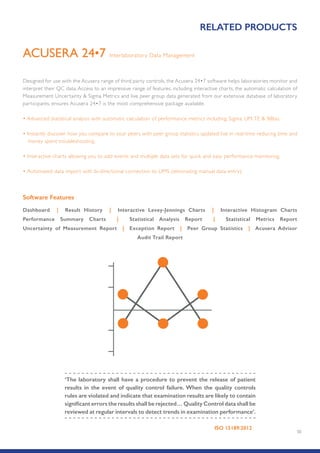
‘The laboratory shall have a procedure to prevent the release of patient
results in the event of quality control failure. When the quality controls
rules are violated and indicate that examination results are likely to contain
significant errors the results shall be rejected… Quality Control data shall be
reviewed at regular intervals to detect trends in examination performance’.
ISO 15189:2012
51
RANDOX - A GLOBAL DIAGNOSTIC SOLUTIONS PROVIDER
RX series of Clinical Analysers
The RX series combines robust hardware and intuitive software with the world leading RX series test menu, including
routine chemistries, specific proteins, lipids, therapeutic drugs, drugs of abuse, antioxidants and diabetes testing. Renowned
for quality and reliability, the RX series boasts one of the most extensive dedicated clinical chemistry test menus on the
market guaranteeing real cost savings through consolidation of routine and specialised tests onto a single platform. This
extensive dedicated test menu of high quality reagents guarantees excellence in patient care reducing costly test re-runs
or misdiagnosis and offers unrivalled precision and accuracy for results you can trust.
Biochemistry Reagents
Randox offers an extensive range of diagnostic reagents, giving biochemistry laboratories the opportunity to advance their
routine and niche testing.The Randox reagents range goes beyond routine chemistries. At Randox we re-invest significantly
in research and development to ensure we meet the ever changing needs of the laboratory. As a result, the esoteric
reagents range from Randox is extensive and includes sLDL, Lipoprotein(a), H-FABP, Cystatin C, TxBCardio, Adiponectin,
Bile Acids, Copper, D-3- Hydroxybutyrate, G-6-PDH, Non-Esterified Fatty Acids,Total Antioxidant Status and Zinc. Randox
Reagents provide a number of benefits for the laboratory: Cost savings through excellent stability, automated methods and
standards supplied with some kits; confidence in results with high performance methods, minimal interferences and wide
measuring ranges; convenience and choice with over applications for over 100 biochemistry analysers; liquid ready-to-use
reagents, a wide range of kit sizes and complementary controls and calibrators.
Biochip Array Technology
Biochip ArrayTechnology (BAT) is an innovative assay technology for multi-analyte screening of biological samples in a rapid,accurate
and easy to use format. BAT offers highly specific tests, coupled to highly sensitive chemiluminescent detection, providing quantitative
results in easy to interpret reports.Randox BAT assays offer diagnostic,prognostic and predictive solutions across a variety of disease
areas including sexually transmitted infection, cardiovascular disease (CVD), familial hypercholesterolemia (FH), colorectal cancer and
respiratory infection.
Randox has been supplying laboratories worldwide with revolutionary
diagnostic solutions for over 30 years. Our experience and expertise
allow us to create a leading product portfolio of high quality diagnostic
tools which offer reliable and rapid diagnosis. We believe that by providing
laboratories with the right tools, we can improve healthcare worldwide.
52
CONTACT US
For technical support contact:
technical.services@randox.com
Head Quarters
Randox Laboratories Ltd, 55 Diamond Road, Crumlin, County Antrim, BT29 4QY, United Kingdom
+44 (0) 28 9442 2413 marketing@randox.com randoxqc.com
Contact us for more information on any of our products and services:
PORTUGAL
Irlandox Laboratorios Quimica Analitica Ltda
Tel: +351 22 589 8320
PUERTO RICO
Clinical Diagnostics of Puerto Rico, LLC
Tel: +1 787 701 7000
POLAND
Randox Laboratories Polska Sp. z o.o.
Tel: +48 22 862 1080
ITALY
Randox Laboratories Ltd.
Tel: +39 06 9896 8954
INDIA
Randox Laboratories India Pvt Ltd.
Tel: +91 80 2802 5000
HONG KONG
Randox Laboratories Hong Kong Limited
Tel: +852 3595 0515
SLOVAKIA
Randox S.R.O.
Tel: +421 2 6381 3324
SOUTH AFRICA
Randox Laboratories SA (Pty) Ltd.
Tel: +27 (0) 11 312 3590
REPUBLIC OF IRELAND
RandoxTeoranta
Tel: +353 7495 22600
FRANCE
Laboratoires Randox
Tel: +33 (0) 130 18 96 80
GERMANY
Randox Laboratories GmbH
Tel: +49 (0) 215 1937 0611
CZECH REPUBLIC
Randox Laboratories S.R.O.
Tel: +420 2 1115 1661
SPAIN
Laboratorios Randox S.L.
Tel: +34 93 475 09 64
SWITZERLAND
Randox Laboratories Ltd. (Switzerland)
Tel: +41 41 810 48 89
SOUTH KOREA
Randox Korea
Tel: +82 (0) 31 478 3121
USA
Randox Laboratories-US, Ltd.
Tel: +1 304 728 2890
VIETNAM
Randox Laboratories Ltd.Vietnam
Tel: +84 (0) 8 3911 0904
UAE
Randox Medical EquipmentsTrading LLC
Tel: +971 55 474 9075
BRAZIL
Randox Brasil Ltda.
Tel: +55 11 5181-2024
CHINA
Randox Laboratories Ltd.
Tel: +86 021 6288 6240
AUSTRALIA
Randox (Australia) Pty Ltd.
Tel: +61 (0) 2 9615 4640
International Offices
LT033MAY17
Information correct at time of print.Randox Laboratories Ltd is a subsidiary of Randox Holdings Limited a company registered within Northern Ireland with company number N.I.614690. VAT Registered Number:GB 151
6827 08.Product availability may vary from country to country.Please contact your local Randox representative for information.Products may be for Research Use Only and not for use in diagnostic procedures in the USA.
abc

LT033 RIQAS Explained MAY17

  • 1.
    RANDOX INTERNATIONAL QUALITYASSESSMENT SCHEME RIQAS
  • 2.
    RIQAS The largest globalEQA scheme with over 45,000 lab participants
  • 3.
    RIQAS REPORTS 01 03 05 02 04 06 07 08 09 11 13 10 12 EQA WEB-BASED DATATRANSFER PARTICIPATION IN RIQAS STANDARD REPORT TEXT SECTION HISTOGRAM LEVEY-JENNINGS CHART TARGET SCORE CHART %DEVIATION BY SAMPLE CHART %DEVIATION BY CONCENTRATION CHART MULTI-METHOD STAT SECTION BENEFITS CONTACT US 16 17 18 19 20 21 22 URINE TOXICOLOGY REPORT SCREENING SECTION URINE TOXICOLOGY REPORT QUANTITATIVE SECTION URINALYSIS REPORT SEROLOGY: SCREENING (QUALITATIVE) REPORT SEROLOGY: SCREENING (QUANTITATIVE) REPORT QUANTITATIVE END-OF-CYCLE REPORT 23 CHART SECTION (END-OF-CYCLE REPORT) 25 CURRENT & PREVIOUS CYCLE ABSOLUTE SDIs (END-OF-CYCLE REPORT) 26 CERTIFICATE OF PERFORMANCE (END-OF-CYCLE REPORT) 27 MONITORING EQA PERFORMANCE 30 RIQAS PROGRAMMES 49 RELATED PRODUCTS 51 RANDOX - A GLOBAL DIAGNOSTIC SOLUTIONS PROVIDER 52 35 PARAMETER INDEX 14 15 SUMMARY PAGE URINE TOXICOLOGY REPORT TEXT SECTION (END-OF-CYCLE REPORT)
  • 4.
    1 BENEFITS Delivering a comprehensiveyet cost effective EQA solution, RIQAS will help meet regulatory requirements and increase confidence in test system accuracy. Large Database of Users • A high level of participation means peer group numbers are maximised whilst ensuring availability of data for a wide range of instruments and methods. High Quality Samples • Samples spanning clinically relevant levels allow identification of concentration related biases helping to ensure accurate instrument performance. • Human samples free from interfering preservatives increase confidence that EQA performance mirrors the performance of patient samples. • Reference method values are provided in the Clinical Chemistry programme for selected parameters and lots. User-friendly Reports • Simple,one page per parameter format,enables at-a-glance performance assessment,saving valuable laboratory time. • Complimentary multi-instrument and interlaboratory reports allow comparative performance assessment of all laboratory systems and multiple connected laboratories. • End-of-Cycle reports, summarising performance compared to the previous cycle, allow you to identify improvements in quality over time. Cost Effective • Our extensive range of multi-analyte programmes will reduce the number of individual programmes required to cover your test menu, saving both time and money. • Reduced parameter options for selected programmes offer greater flexibility, ensuring suitability for laboratories of all sizes and budgets. • Register up to five instruments per programme at no extra cost for comparative performance assessment. Frequency • Frequent reporting allows early identification of system errors and implementation of any necessary corrective actions with minimum disruption to the lab. • With a turnaround of less than 72 hours for most reports, corrective action can be implemented earlier, potentially reducing costly errors with patient results. Highly Accredited • Programmes accepted by National and International accreditation bodies worldwide. • Participant certificates provide evidence of participation in a reputable EQA scheme.
  • 5.
    2 RIQAS is thelargest international EQA scheme in the world. It is used by more than 45,000 laboratory participants in 133 countries. 32 programmes are currently available. Accreditation • RIQAS provides certificates as proof of EQA participation and performance for laboratory accreditation purposes. • RIQAS is a UKAS accredited Proficiency Testing Provider, No. 0010, and is accredited to ISO/IEC 17043:2010, 'Conformity Assessment- General Requirements for ProficiencyTesting'. • Accreditation to ISO/IEC 17043:2010 highlights the superior quality and excellence of RIQAS. Independent Advisory Panel RIQAS participants have access to an independent advisory panel consisting of scientific and clinical experts.This ensures professional and ethical conduct of the scheme and participant confidentiality. EQA RIQAS support staff are on hand to offer advice and troubleshoot technical queries. RIQAS Programmes • Ammonia/Ethanol • Anti-TSH Receptor • Blood Gas • BNP • Cardiac • Cerebrospinal Fluid (CSF) • Clinical Chemistry • Coagulation • CYFRA 21-1 • ESR • Glycated Haemoglobin (HbA1c) • Haematology • Human Urine • Immunoassay • Immunoassay Speciality 1 • Immunoassay Speciality 2 • Immunosuppressant Drugs • Lipid • Liquid Cardiac • Maternal Screening • Serology Epstein BarrVirus (EBV) • Serology (HIV/Hepatitis) • Serology (Syphilis) • Serology (ToRCH) • Specific Proteins • SweatTesting •Therapeutic Drugs •Trace Elements in Blood •Trace Elements in Serum •Trace Elements in Urine • Urinalysis • UrineToxicology UK Performance Surveillance • Recognised by the Joint Working Group on Quality Assurance (JWG QA). • Recognised by various National Quality Assurance Advisory Panels (NQAAP).
  • 6.
    3 RIQAS REPORTS RIQAS reportsare presented in a user-friendly, one page per parameter format. This allows easy interpretation of your analytical performance. Summary CSV files It is possible to receive an additional summary of your report statistics, acceptable limits and performance indicators as a .csv file for every sample. Multi-Instrument Reports Laboratories can register up to five instruments at no extra cost. Individual reports for each instrument plus a unique multi- instrument report are provided.The multi-instrument report plots the performance of each individual instrument on a single, colour coded Levey-Jennings chart, ensuring instant identification of any differences in instrument performance. Additional sample packs may be ordered as required. RIQAS Reports • Statistical breakdown by all methods, your method and, where applicable, your instrument, including running means for the last 10 samples. • Compare your instrument group, method group and all methods using the histogram. • Identify trends, biases and precision problems using the visual charts. • TheTarget Score chart grades your performance in a moving window over the last 20 samples, including the previous cycle. • At-a-glance summary page for all parameters in the programme. • Compare your result with statistically robust consensus means. • Identify acceptable and poor performance using fit-for-purpose performance indicators: - SD1 - %Deviation -Target Score Laboratory Group Reports The Group Reporting facility enables laboratory groups or chains to monitor the performance of satellite sites. Each affiliated laboratory will receive an individual report with the group supervisor also receiving a summary report comparing each laboratory in the network.
  • 7.
    4 WEB-BASED DATA TRANSFER RIQAS.Netoffers easy, direct access for the submission of results and retrieval of reports direct from the RIQAS host server. • Available in multiple languages. • Confidentiality and security is maintained through the use of password protected access. • Submit current, corrected and future results (normal policies apply), directly into the RIQAS database. Receipt of results is confirmed by e-mail. •Multi-lingual registration identifier provides simple identification of multiple registrations. • Additions and changes to assay details can be made quickly and easily online. • Requests for new method, instrument and reagent codes can be made online. • Reports are emailed in PDF format as soon as they are prepared. • Reports for the previous two cycles can be downloaded from the website. • View, print, store or distribute reports as you wish. • Update your laboratory's certificate of participation details in multiple languages. • All that is required is web access,Adobe Reader (for viewing reports) and a valid password to access the system. • No additional software required.
  • 8.
    5 PARTICIPATION IN RIQAS Participationin RIQAS follows these simple steps: REGISTER 1 36.000 mg/dl 84.800 IU/ml 132.000 ng/ml Certificate of Participation Stephen Doherty RIQAS Manager Randox International Quality Assessment Scheme Randox Laboratories Ltd., 55 Diamond Road, Crumlin, Co.Antrim, BT29 4QY, United Kingdom PR-281APR15 Name Laboratory/Hospital abc Register the instruments and methods used in your lab by completing the enrolment document. Enrolment documents are available from riqas.com and should be submitted 3 weeks before the cycle starts. Check RIQAS policies in method questionnaire. 1 Receive a set of numbered samples along with a username/password to access RIQAS.Net. 2 Analyse the sample on the recommended date, carefully following the instructions for use. 3 Enter your results via RIQAS.Net or on the return sheet and submit electronically, by fax or post before the final deadline. 4 Participant receives report by email or post and reviews to assess performance. 5 Receive an end-of-cycle report, a certificate of acceptable performance and a certificate of participation at the end of the cycle, provided that more than half results are returned. 6 Method changes and registration of additional parameters can be submitted via RIQAS.Net. 7
  • 9.
    6 STANDARD REPORT Performance datais presented in a one page format with up to seven sub-reports. 1 Text Section: Statistics for all methods, your method and instrument group (programme specific). 2 Histogram: Method and instrument comparison. 3 Multi-Method Stat Section: Enables assessment of the performance of each method. 4 Levey-Jennings Chart: Details features of your laboratory’s performance. 5 Target Score: This unique chart provides a numerical index of performance, allowing at-a-glance assessment. 6 %Deviation by Sample: Helps to identify trends and shifts in performance. 7 %Deviation by Concentration: Rapid assessment of concentration related biases. 1 2 3 4 5 6 7
  • 10.
    7 TEXT SECTION 1 Reportis presented in your chosen unit. 2 Number of returned results used to generate Mean for Comparison. 3 Average value of all laboratories’ results. 4 Coefficient of Variation. 5 Uncertainty associated with the Mean for Comparison. Um = 1.25 x SD √ n 7 After statistical reduction, some results are excluded. 8 Ideally this will be your instrument group mean. If N5 for instrument group, your method group Mean is selected as Mean for Comparison. 9 Standard Deviation Index = Your Result - Mean for Comparison SDPA adjusted 10 Running Mean average of the last 10 performance indicators is used to monitor performance over time and concentration range. 11 Target Score -The closer a value is to 120, the better the performance. %Deviation from the Mean for Comparison - the closer the value is to zero, the better the performance. 12 Biological Variation stated for information purposes only.13 Performance limit set for this parameter.14 6 SDPA = Standard Deviation for Performance Assessment, calculated from theTarget Deviation for Performance Assessment (TDPA) and the Mean for Comparison. SDPA = TDPA x Mean for Comparison t-value x 100 t-value = factor which represents the % of poor performers reflected in theTDPA (t-value ~ 1.645 when ~10% laboratories achieve poor performance) SDPA is combined with Um , where appropriate. If Um ( 0.3 x SDPA) then SDPAadjusted = √ ( Um 2 + SDPA2 ) and the reported value is suffixed with a If Um is less than ( 0.3 x SDPA) then SDPAadjusted = SDPA RIQAS performance indicators include SDI,Target Score and %Deviation. Acceptable performance criteria: SDI 2 Target score 50 %Deviation defined acceptable limits Performance statement appears here if performance indicators exceed limits 765432 8 10 10 10 11 9 12 13 14 1 The text section summarises the statistical information for each parameter.
  • 11.
    8 HISTOGRAM 1 Total of673 laboratories reported values between 35.96 and 36.63. 2 58 laboratories reported values between 33.29 and 33.96 in your method group. 3 Your result is indicated by the black triangle. 4 RIQAS reports show your unit of measurement. 5 25 laboratories reported values between 37.96 and 38.62 in your instrument group. The Bar Graph is intended as a quick visualisation of how your lab’s result compares to the method mean, instrument mean and all method mean. Your method groupAll methods Your instrument group (programme specific) 1 2 5 4 3
  • 12.
    9 LEVEY-JENNINGS CHART SDIs reflectlaboratory performance in relation to fit-for-purpose SDPAs and are useful to monitor performance over time. Acceptable performance is SDI 2. 1 Where a result has been returned, the Mean for Comparison for each sample is indicated at the top of the chart.This allows easy assessment of concentration related bias: I: Instrument mean M: Method mean A: All method mean 2 This line indicates a change in registration details for this parameter. 3 Your SDI (Standard Deviation Index). 4 N = No result returned from your laboratory. 5 Sample number. 6 C = Corrected results will be accepted for non-analytical errors. Corrected results will be accepted up to 4 weeks after the final submission deadline, on application, with evidence of analysis. Late results are only accepted if there has been a Randox error. R = Incorrect results can be removed retrospectively on request. 8 C 1 2 3 4 5 6
  • 13.
    10 TARGET SCORE CHART TheTarget Score (TS) allows participants to assess their performance at a glance. The TS relates the %Deviation of your result from the Mean to a Target Deviation for Performance Assessment (TDPA).TDPAs are set to encourage participants to achieve and maintain acceptable performance. TDPAs are fit-for-purpose performance criteria which are set taking guidance from ISO/IEC17043, ISO13528 and IUPAC. Target Deviations for Performance Assessment are also used to calculate the Standard Deviation for Performance Assessment (SDPA). 1 This is the upper deviation limit of performance for this parameter. TDPAs are reviewed regularly and deemed fit for purpose by the RIQAS Advisory Panel. 2 High scores 50 in the lighter shaded area represents acceptable, good or excellent performance. 3 Heavy shading for values 10 to 50 signifies poor performance. Excellent Good Acceptable Need for improvement Unacceptable 1 2 3
  • 14.
    11 %DEVIATION BY SAMPLECHART This chart helps to identify trends and shifts in performance. 1 %Deviation from Mean for Comparison. 2 Plot of Running Mean %Deviations (average of the last 10 %Deviations for the sample indicated). 3 Acceptable limits of performance.These are defaulted to RIQAS TDPAs but can be set to e.g. biological variation or regulatory requirement on request. 8 C 1 2 3 %Deviation = Your Result - Consensus Mean Consensus Mean x 100%
  • 15.
    12 %DEVIATION BY CONCENTRATIONCHART This chart enables rapid assessment of concentration related biases. Biases at low or high concentrations can be easily determined. 1 Current sample indicated by square. 2 %Deviation at specific concentration. 1 2
  • 16.
    13 MULTI-METHOD STAT SECTION Thissection provides an easy way of assessing the performance of other methods used to analyse the parameter in question. Method N Mean CV% U m Hexokinase 1947 36.525 3.4 0.03 Glucose oxidase 1341 37.365 6.8 0.09 Ortho Vitros MicroSlide Systems 229 34.877 3.7 0.11 GOD/02-Beckman method 47 35.538 4.5 0.29 Glucose dehydrogenase 20 36.731 3.5 0.35 Oxygen electrode 15 36.789 5.5 0.65 Vitros, DT60/DT60 II 9 34.905 5.7 0.83
  • 17.
    14 SUMMARY PAGE 3 RM%DEV - Average of the last 10 %DEV for this parameter. 4 RMTS - Average of the last 10Target Scores for this parameter. 5 Overall RMSDI = average RMSDI for this sample distribution. 6 Overall RM%DEV = average RM%DEV for this sample distribution. 7 Overall RMTS = average RMTS for this sample distribution. 1 RMSDI - is the Running Mean of the 10 previous SDIs (if fewer than 10 results on file,“Too Few” is printed). 2 Red triangle appears when all performance indicators (SDI, %DEV and TS) exceed acceptable performance, i.e: when SDI 2 TS 50 %DEV acceptable limits set 5 6 7 1 2 43 2.4 Located at the back of the RIQAS Report, the Summary Page collates the key information, allowing participants to review the performance of all parameters at-a-glance.
  • 18.
    15 Quantitative SectionScreening Section URINETOXICOLOGY REPORT Laboratory performance is presented in both quantitative and qualitative screening formats, allowing for easy interpretation at-a-glance.
  • 19.
    16 URINE TOXICOLOGY REPORTSCREENING SECTION 1 ScreeningText Section. 5 Screening Summary:Your screening result shown in the appropriate response category and your cut off for this sample. 6 Screening results for all cut-offs returned for this sample within your method group. 7 Total screening results over all your cut-offs for your laboratory’s method. 8 Screening results for all cut-offs returned for this sample over all methods. 9 Total screening results over all cut-offs for all methods. 10 Screening results for other methods using same cut-off as your laboratory. 11 Performance history for this parameter, based on previous 10 samples. 12 Performance of your method over all cut-offs for this sample. 13 Performance history of your method over all cut-offs, based on the previous 10 samples. 14 Performance of all methods over all cut-offs for this sample. 15 Performance history of all methods over all cut-offs, based on the previous 10 samples. 2 Screening Results: This chart is a quick visualisation of your performance over the last 20 samples. A result in the white section indicates a correct response. A result in the upper red section indicates a False Positive response, and a result in the lower red section indicates a False Negative response. 3 Comment section for RIQAS to provide your laboratory with additional relevant information regarding this sample, such as spiked metabolite concentration. 4 Screening result response categories. All abbreviations indicated at the bottom of the report page. Key TN - true negative TP - true positive FN - false negative FP - false positive RC - sent for confirmation NT - not tested Qualitative comparison of screening results available for each parameter. 11 12 13 14 15 1 2 4 6 7 8 9 10 5 Performance History THC Phenobarbital Oxazepam Benzoylecgonine Ethanol Free Morphine Phencyclidine 125 ng/ml 600 ng/ml 250 ng/ml 500 ng/ml 20 ng/ml 1500 ng/ml 25 ng/ml 3 Your Data (Last 10 Samples) 0% False Negatives 0% False Positives 100% Correct Responses Your Method (This Sample) 7% False Negatives 0% False Positives 93% Correct Responses Your Method (Last 10 Samples) 8% False Negatives 12% False Positives 81% Correct Responses All Methods (This Sample) 20% False Negatives 1% False Positives 79% Correct Responses All Methods (Last 10 Samples) 22% False Negatives 6% False Positives 72% Correct Responses
  • 20.
    17 URINE TOXICOLOGY REPORTQUANTITATIVE SECTION #NN /GVJQFU (2+# 0 /GCP 5 %8 GZE ;QWT 4GUWNV 5+ 4/5+ /GCP HQT %QORCTKUQP 6QQ (GY PI ON 0WODGTQH.CDQTCVQTKGU 0 0 0 0 0 0 0 0 0 0 0 5CORNG 0WODGT False Positive False Negative /GVJQF 0 /GCP 5 %8 (2+# %QORGVKVKXG #PVKDQF[ $KPFKPI )% /5 -+/5 ; 2+.16 567; .#$14#614; 4'( 01 ) %;%.' 5#/2.' True Negative True Positive FN False Negative FP False Positive RC Referred for Confirmation NT Not Tested n value of t-off value of e was 2QUKVKXG 2QUKVKXG Cut-off TN TP FN FP RC NT Total 0 0 #NN #NN ;QWT /GVJQF 6JKU 5CORNG ;QWT /GVJQF .CUV 5CORNGU % False Negatives % False Positives % Correct Responses % False Negatives % False Positives % Correct Responses QKFU )TQWR PI ON RIQAS #NN /GVJQFU 6JKU 5CORNG #NN /GVJQFU .CUV 5CORNGU % False Negatives % False Positives % Correct Responses % False Negatives % False Positives % Correct Responses 1 2 6 7 3 4 5 1 Quantitative Text Section: Comparison statistics. Caution is needed when the N value is too small to support statistical significance. 4 Standard Deviation Index = (Your Result – Mean for Comparison) SD of Mean for comparison 5 Running mean SDI = average of last 10 SDIs for this parameter (If fewer than 10 results, Too Few is printed). 6 Quantitative Results Histogram:This graph provides a quick visualisation of how your quantitative result falls into the overall picture for all methods and your method group. 7 All available method statistics for this sample. 2 Your Result. 3 Your Mean for Comparison. Quantitative statistical comparison available for each parameter.
  • 21.
    18 URINALYSIS REPORT 1 Categoriesare stated in your unit. 4 Results from all methods for all available categories. 5 Your Result. 6 Performance Statement. 8 Possible reporting categories for your method. 7 Your Categories Histogram: A quick visualisation of how your lab’s result falls into the overall picture for your categories. 2 Your method group and categories. 3 Results from all methods (dipsticks) returning results in the same categories as your lab. 9 All available methods for this parameter. 12 Your categories (available result options for chosen dipstick and unit). 13 Comments Box. 14 All Categories Histogram: a quick visualisation of how your lab’s result falls into the overall picture for all categories. 16 Your categories. 17 Detailed summary of results: This table enables you to see how you compare to all other results. 15 Results submitted from a category not applicable to your method. 10 Your Result. 11 All categories (result options) available for this parameter for any method (dipstick). Screening Results 2 15 4 3 9 7 5 12 13 14 17 16 10 10 1 8 11 6 Your performance for each parameter is presented in a simple, convenient report.
  • 22.
    19 SEROLOGY: SCREENING (QUALITATIVE)REPORT Your performance for multiple samples is presented in a convenient single report per quarterly distribution. 1 Your qualitative result and chosen method are presented along with the acceptable result based on an 80% consensus. This consensus will be at the method level if there are 5 labs in the group or if there are 5 labs, will be at the all method level. 2 Overall Summary shows the number of results for this parameter and sample which are non-reactive, inconclusive or reactive. 4 Summary shows performance of all the methods used to analyse the parameter. 3 Your Result is shown as a black triangle on the category chart compared to other laboratories in groups: Your MethodAll Methods 4 3 1 2
  • 23.
    20 1 Quantitative statisticsfor All Methods and Your Method are presented in your chosen unit along with your result and your performance scores (SDI and RMSDI). 3 Multi Method Statistics section provides an easy way of assessing the performance of the methods used to analyse the parameter. 4 Levey-Jennings chart -Your SDIs for previous 20 samples.2 Your result is presented on the bar graph as a black triangle, showing how you compare to: Your MethodAll Methods SEROLOGY: SCREENING (QUANTITATIVE) REPORT Your performance for multiple samples is presented in a convenient single report per quarterly distribution. 3 1 Anti-Rubella IgG, IU/ml Sample 2 N Mean CV% Um SDPA Exc. All methods 210 92.574 37.2 2.97 34.42 31 Abbott Architect 39 83.219 8.7 1.46 7.27 5 Method N Mean CV% Um Biomerieux VIDAS 48 150.979 9.8 2.97 Abbott Architect 44 83.219 8.7 1.46 Roche Cobas 6000/8000 18 58.792 3.6 0.68 Abbott Axsym 17 108.206 18.0 6.09 Siemens/DPC Immulite 2000/2500 17 90.800 6.2 1.94 Roche Cobas 4000/e411 17 59.973 7.0 1.35 Siemens/Bayer ADVIA Centaur 14 120.775 11.0 5.88 Roche Elecsys 11 57.043 3.9 1.05 Diasorin Liaison 9 52.388 18.0 4.16 Roche Modular E170 9 58.949 3.9 1.08 Beckman DxI 600/800 6 125.817 7.4 4.75 Your Result 84.800 SDI 0.22 RMSDI Too Few Mean for Comparison 83.219 2 60 50 40 30 20 10 0 NumberofLaboratories 24.47 73.43 122.39 171.35 IU/ml 4
  • 24.
    21 QUANTITATIVE END-OF-CYCLE REPORT TheEnd-of-Cycle Report is sent to all participants at the end of each cycle and provides a complete summary of statistics. Results can also be compared to the previous cycle.
  • 25.
    22 Your results forcurrent cycle shown in various diagrams. CHART SECTION (END-OF-CYCLE REPORT) 1 2 3 4 1 Levey-Jennings chart Shows your SDIs for a full cycle. • Shows SDI (positive and negative) x Shows absolute SDI 2 Target Score chart Shows your Target Scores for a full cycle. 4 %Deviation by Concentration chart Shows your results for a full cycle. 3 %Deviation by sample chart Shows your %Deviations for a full cycle. Acceptable limits equal toTDPA unless alternative limits are registered by the lab. • Shows %Deviation (positive and negative) x Shows absolute %Deviation
  • 26.
    23 TEXT SECTION (END-OF-CYCLEREPORT) The text section summarises the statistical information for all samples. Your assay details at the end of the cycle. The RIQAS TDPA and biological variation for the parameter are shown if available. 1 2 Table containing a summary of your performance for previous cycle and current cycle, including Average Absolute SDIs and %Deviations. 15 16 Summary of your results and statistics are shown, including Mean for Comparison, SDPA, %CV, Um , SDI,Target Score, %Deviation Sample Result Unit N Mean SDPA Um CV% SDI TS % Deviation 1 28.200 g/l 68 I 28.013 1.26 0.10 2.4 0.15 120 0.7 2 26.900 g/l 87 I 26.853 1.21 0.10 2.7 0.04 120 0.2 3 39.900 g/l 71 M 40.531 1.82 0.15 2.5 -0.36 116 -1.5 4 19.200 g/l 81 I 19.429 0.87 0.07 2.5 -0.27 120 -1.2 5 41.700 g/l 67 I 41.942 1.88 0.13 2.0 -0.09 120 -0.4 6 57.300 g/l 87 I 57.257 2.58 0.21 2.7 0.02 120 0.1 7 45.000 g/l 72 I 45.850 2.06 0.14 2.1 -0.43 108 -1.8 8 27.600 g/l 87 I 28.011 1.26 0.09 2.5 -0.34 118 -1.5 9 41.200 g/l 70 I 41.823 1.88 0.14 2.2 -0.38 113 -1.6 10 26.900 g/l 83 I 26.742 1.20 0.12 3.3 0.14 120 0.6 11 40.700 g/l 71 I 40.601 1.83 0.13 2.2 0.06 120 0.2 12 45.100 g/l 80 I 45.119 2.05 0.14 2.2 -0.18 120 -0.8 13 27.300 g/l 63 I 28.454 1.27 0.09 2.0 -0.72 86 -3.1 4 5 6 7 8 9 10 11 12 13 14 3
  • 27.
    24 1 Report presentedin your chosen unit 2 Your assay details as of the last sample 4 Sample number 3 RIQASTDPA and Biological variation 5 Your results for each sample 6 Unit your result was returned in 7 Number of results used for statistical analysis 8 Mean for Comparison 9 SDPA = Standard Deviation for performance assessment 10 Uncertainty of Mean for Comparison 11 Coefficient of Variation (%) 12 Your Standard Deviation Index 13 YourTarget Score 14 Your %Deviation 15 Cycle average of your performance indicators – Standard Deviation Index,Target Score and %Deviation Cycle Average SDI = (Sum of SDIs returned for the completed cycle) (Number of samples returned in cycle) Cycle Average Target Score = (Sum of yourTarget Scores returned for the completed cycle) Cycle Average %Deviation = (Sum of your %Deviations returned for the completed cycle) 16 Cycle average for Absolute values of your SDI and %Deviation. Absolute values show how far a value is from zero regardless of the sign.This is an indication of the magnitude of accuracy. Cycle Average Absolute SDI = (Sum of your Absolute SDIs returned for the completed cycle) Cycle Average Absolute %Deviation = (Sum of your Absolute %Deviations returned for the completed cycle) TEXT SECTION (END-OF-CYCLE REPORT) (Number of samples returned in cycle) (Number of samples returned in cycle) (Number of samples returned in cycle) (Number of samples returned in cycle)
  • 28.
    25 1 Report title- Cycle Average Absolute SDI This shows your performance this cycle compared to the previous cycle. 2 Parameter list List of all parameters registered. 3 Results for previous cycle Indicated by open circle on the chart. 6 Graphical representation of Absolute SDIs Acceptable performance is ≤ 2. If Absolute SDI for current cycle is less than that for the previous cycle, this is indicated by a green circle. If Absolute SDI for current cycle is greater than that for the previous cycle, this is indicated by a red circle. The closer the circle is to zero, the better the performance. 4 Results for current cycle Indicated by a closed circle on the chart. 5 Legend Cycle Average Absolute SDIs are shown for: L Your results throughout the cycle C All labs within your own country W All labs Worldwide CURRENT PREVIOUS CYCLE ABSOLUTE SDIS (END-OF-CYCLE REPORT) 2 3 1 4 5 6 Based on the cycle average absolute SDI, this chart provides a visual representation of your laboratory’s performance compared to the previous cycle.
  • 29.
    26 1 Full registrationaddress Your full registration address details. 2 Your lab reference number Used to identify each lab. 3 Programme / cycle number Programme and current, completed cycle number. 4 Date Date End-of-Cycle report is issued. 5 Parameters List of parameters for which cycle absolute SDI is ≤ 2. 6 Average Absolute SDI Your Cycle Average Absolute SDI. An End-of-Cycle report will be issued for all registrations. However, the Certificate of Performance will only be available for parameters where results for at least 50% of samples in the cycle have been returned. Labs joining after the beginning of the cycle will only receive the Certificate of Performance if they meet this criteria. Any parameters not included on the Certificate ofAcceptable Performance will be listed on the Notification of Unacceptable Performance. CERTIFICATE OF PERFORMANCE (END-OF-CYCLE REPORT) 1 5 2 3 6 4 XX/X
  • 30.
    27 MONITORING EQA PERFORMANCE EachEQA report should be evaluated and any poor performance investigated. A step by step approach should be adopted consisting of the following three steps: Clerical errors • Transcription errors • Incorrect units used • Incorrect sample tested • Incorrect method classification • Calculation/conversion error Systematic errors • Sample/Reagent prep/handling • Reagent/calibrator/standardisation change • Instrument/reagent/calibrator fault • Inexperienced operators • Reagent deterioration • Inappropriate method Random errors • Bubbles in reagent • Bubbles in reagent/sample pipette • Temperature fluctuations • Poor pipetting technique • Poor operator technique 3. Check the effectiveness of corrective actions The effectiveness or impact of any corrective actions taken can be assessed by continuing to monitor analytical performance over time. 2. Implement corrective actions Some errors can be readily recognised as simple clerical errors and easily corrected. If there is evidence of systematic or random error however more detailed corrective actions must be taken. Random Error If all possible causes have been excluded, a single unacceptable result is most likely due to random error. Re-run the sample; if the result of repeat analysis is acceptable then corrective action is not required. If the issue persists, investigate possible sources of systematic error. Systematic Error In the event of a systematic error, the following suggested actions may help to resolve the problem: • Prepare fresh reagents re-run sample • Perform staff training • Perform instrument maintenance • Recalibrate instrument • Review reagent/sample storage • Check pipettes The flowchart (page 29) is designed to help you investigate any apparent poor performance. 1. Investigate the source of the problem In order to identify the source of the problem, it is useful to be aware of the most common causes of poor EQA performance. Errors can occur at any stage of the testing process; however, EQA is most concerned with detecting analytical errors i.e. errors that occur during the analysis of the sample. Most analytical errors can be easily divided into three main areas;clerical errors,systematic errors and random errors. Systematic errors result in inaccurate results that consistently show a positive or negative bias. Random errors, on the other hand, affect precision and result in fluctuations in either direction. It may be possible that, after extensive investigations, the root cause of the poor performance cannot be established. Poor performance for a single sample could be attributed to random error. If poor performance has been noted for several samples, a systematic error is the most likely cause and the analytical process should be reviewed.
  • 31.
    28 MONITORING EQA PERFORMANCE LabManager: Date: Lab Director: Date: Conclusion: Remedial Action: Laboratory: Cycle Number: Analysis Date: Mean for Comparison: Sample Number: Analyte: Lab Result: SDI: %Dev: A checklist similar to the one below is extremely useful when investigating poor EQA performance and may help you to determine the root cause of the problem and initiate corrective actions. 1. Specimen Handling a. Samples received in good condition b. Samples stored/prepared appropriately c. Integrity of the sample is acceptable 2. Clerical a. Correct result entered b. Correct use of decimal point and units c. Calculations, if any, performed correctly (even if automated) d. Conversion factors applied to results before submission 3. Registration and Mean for Comparison a. Registered in the correct method/instrument group b. Changed method or instrument without advising RIQAS c. Mean for comparison changed due to the number of participants returning results e.g.from method to instrument d.An obvious bias between method and instrument means (check histogram and stats sections) 4. Internal Quality Control a. %Deviation of IQC (at similar conc to that of EQA) on sample analysis date acceptable b. Shift in IQC in the periods just before and after EQA sample analysis c.Trends in IQC in the periods before and after EQA sample analysis d. Random IQC variation on sample analysis date e. Error due to imprecision; check IQC in terms of %Deviation compared to deviation observed in EQA f. IQC target correctly assigned 5. Calibration a. Date of last calibration b. Calibration frequency acceptable c. Last calibration acceptable 6. Instrument a. Daily maintenance performed on date of sample analysis b. Special maintenance performed prior to sample analysis c. Instrument operated correctly d. Operator fully trained 7. Reagents a. Reagents prepared and stored correctly b. Reagents within open vial stability 8. EQA sample a. Initial value b. Re-run value c. Issue observed in previous EQA samples at a similar concentration (check %Deviation by concentration and Levey Jennings charts) d.All parameters affected (to the same extent) - possible reconstitution error (check %Deviation on summary pages) Y Y Y Y Y Y Y Y Y Y Y Y Y Y Y Y Y Y Y Y Y Y Y Y Y Y N N N N N N N N N N N N N N N N N N N N N N N N N N Y N
  • 32.
    29 MONITORING EQA PERFORMANCE Theflow chart below can be used to help identify a possible root cause for poor EQA performance. Send corrected result to RIQAS along with relevant documentation to support the case. Verify instrument, method and units are registered correctly for each parameter. Especially important for initial submission and when registration changes have been made. Run out of control Look for shifts or trends Review Levey-Jennings charts. Are any points outside +/- 1SD? There may be a problem specific to that sample • Incorrect sample tested • Reconstitution error • Sample storage Review IQC results from the time the EQA sample was tested. Review instrument parameters and calibration. Has the reagent batch been changed? No further actions Investigate and take corrective action Look for trends within the data • Positive/Negative bias • Poor precision • Changes in performance due to change in reagent, calibrator or standardisation Review performance over the cycle Verify that the reported result and units reflect what was obtained. Has a transcription error occurred? Is the parameter result within acceptable limits of performance? • Target Score 50 • SDI 2 • %Deviation acceptable limits of performance Review the summary page. Are the majority of results flagged? YES YES YES YES NO NO Advise RIQAS of correct details NO NO NO YES
  • 33.
    30 RIQAS PROGRAMMES Ammonia/Ethanol Programme+ RQ9164(2 ml) 2 Parameters Samples every month, 1 x 12 month cycle, 12 month subscription Ammonia Ethanol Anti-TSH Receptor Programme+ RQ9174 (1 ml) 1 Parameter Samples every month, 1 x 12 month cycle, 12 month subscription Anti-TSH Receptor (TRAb) pCO2 pH pO2 CO2 (Total) Ca++ Cl- K+ Na+ Glucose Lactate Blood Gas Programme With target scoring RQ9134 (1.8 ml) First registered instrument 10 Parameters RQ9134/A (1.8 ml) Subsequent instruments 10 Parameters Samples every month, 1 x 12 month cycle, 12 month subscription BNP Programme+ RQ9165 (1 ml) 1 Parameter BNP Samples every month, 1 x 12 month cycle, 12 month subscription Cerebrospinal Fluid Programme+ Albumin Albumin (electrophoresis) α-1-globulin (electrophoresis) α-2-globulin (electrophoresis) β-globulin (electrophoresis) Chloride γ-globulin (electrophoresis) Glucose IgG Lactate Protein (Total) Sodium RQ9168 (3 ml) 12 Parameters Samples every month, 1 x 12 month cycle, 12 month subscription Cardiac Programme With target scoring CK,Total CK-MB (Activity) CK-MB (Mass) Homocysteine Myoglobin Troponin I TroponinT RQ9127/a (1 ml) 2 Parameters only (choose from 7) RQ9127/b (1 ml) Full 7 Parameters Samples every 2 weeks, 2 x 6 monthly cycles, 12 month subscription aPTT PT (including INR) TT Fibrinogen Antithrombin III Plasminogen Protein C Protein S Factor II FactorV FactorVII FactorVIII Factor IX Factor X Factor XI Factor XII D-dimer* Coagulation Programme With target scoring RQ9135/a (1 ml) 5 Selected parameters only (aPTT, PT,TT, Fibrinogen,Antithrombin III) RQ9135/b (1 ml) Full 17 Parameters Samples every month, 1 x 12 month cycle, 12 month subscription * = Pilot study ongoing+ = Not accreditedPURPLE =The only parameters available on RQ9135/a= Liquid ready-to-use samples = Lyophilised samples
  • 34.
    31 RIQAS PROGRAMMES Haematocrit (HCT) Haemoglobin(Hb) Mean Cell Haemoglobin (MCH) Mean Cell Haemoglobin Concentration (MCHC) Mean CellVolume (MCV) Mean PlateletVolume (MPV) Platelets (PLT) Plateletcrit (PCT) Red Blood Cell Count (RBC) Red Cell Distribution Width (RDW) Total White Blood Cell Count (WBC) Haematology Programme With target scoring RQ9118 (2 ml) 11 Parameters Samples every 2 weeks, 2 x 6 monthly cycles, 12 month subscription ESR Programme+ RQ9163 (4.5 ml) 1 Parameter 2 samples per quarterly distribution, 1 x 12 month cycle, 12 months subcription ESR (Erythrocyte Sedimentation Rate) CYFRA 21-1 Programme+ RQ9175 (1 ml) 1 Parameter Samples every month, 1 x 12 month cycle, 12 month subscription CYFRA 21-1 (Cytokeratin 19) ACE (Angiotensin Converting Enzyme) Acid Phosphatase (Prostatic) Acid Phosphatase (Total) Albumin Alkaline Phosphatase ALT (ALAT) Amylase (Pancreatic) Amylase (Total) AST (ASAT) Bicarbonate Bile Acids Bilirubin (Direct) Bilirubin (Total) Calcium Calcium (Ionised) Chloride Cholesterol Cholinesterase CK,Total (CPK) Copper Creatinine D-3-Hydroxybutyrate Fructosamine γGT GLDH Glucose HBDH HDL-Cholesterol Iron Lactate LD (LDH) Lipase Lithium Magnesium NEFA Osmolality Phosphate (Inorganic) Potassium Protein (Total) PSA Sodium TIBC T3 (Free) T3 (Total) T4 (Free) T4 (Total) Triglycerides TSH UIBC Urea Uric Acid Zinc General Clinical Chemistry Programme With target scoring RQ9112 (5 ml) 10 Parameters only RQ9112/S (5 ml) 17 Parameters only RQ9113 (5 ml) Full 52 Parameters Samples every 2 weeks, 2 x 6 monthly cycles, 12 month subscription, reference method values HbA1c Total Haemoglobin Glycated Haemoglobin Programme (HbA1c) With target scoring RQ9129 (0.5ml) 2 Parameters Samples every month, 1 x 12 month cycle, 12 month subscription ACR Albumin/Microalbumin Amylase Calcium Chloride Copper Cortisol Creatinine Dopamine Epinephrine Glucose Metanephrine Norepinephrine Normetanephrine Magnesium Osmolality Oxalate Phosphate (Inorganic) Potassium Protein (Total) Sodium Urea Uric Acid VMA 5-HIAA Human Urine Programme With target scoring RQ9115 (10 ml) 25 Parameters Samples every 2 weeks, 2 x 6 monthly cycles, 12 month subscription * = Pilot study ongoing+ = Not accreditedPURPLE =The only parameters available on RQ9135/a= Liquid ready-to-use samples = Lyophilised samples
  • 35.
    32 RIQAS PROGRAMMES CK-MB Mass D-dimer Digoxin Homocysteine hsCRP Myoglobin NTproBNP Troponin I TroponinT Liquid Cardiac Programme With target scoring RQ9136 (3 ml) 9 Parameters Samples every month, 1 x 12 month cycle, 12 month subscription ACTH AFP Aldosterone Amikacin Androstenedione β-2-Microglobulin CA125 CA15-3 CA19-9 Carbamazepine CEA Cortisol C-Peptide DHEA-Sulphate DHEA Unconjugated Digoxin EstriolTotal* Ethosuximide* Ferritin Folate FSH Gentamicin GH hCG IgE Insulin LH Oestradiol 17-OH-Progesterone Paracetamol Phenobarbital Phenytoin Primidone* Progesterone Prolactin PSA (Free) PSA (Total) PTH Salicylate SHBG T3 (Free) T3 (Total) T4 (Free) T4 (Total) Testosterone (Free)* Testosterone (Total) Theophylline Thyroglobulin Tobramycin* TSH Valproic Acid Vancomycin Vitamin B12 1-25-(OH)2 -Vitamin D* 25-OH-Vitamin D Immunoassay Programme With target scoring RQ9125/a (5 ml) 4 Parameters only (choose from 55) RQ9125/b (5 ml) 13 Parameters only (choose from 55) RQ9125/c (5 ml) Full 55 Parameters RQ9130 (5 ml) Full 55 Parameters Samples every two weeks, 2 x 6 monthly cycles, 12 month subscription (RQ9125/a, RQ9125/b, RQ9125/c) Samples every month, 1 x 12 month cycle, 12 month subscription (RQ9130) Immunoassay Speciality 1 Programme+ With target scoring RQ9141 (2 ml) 10 Parameters Samples every month, 1 x 12 month cycle, 12 month subscription 1-25-(OH)2 -Vitamin D 25-OH-Vitamin D C-Peptide Anti-TG Anti-TPO IGF-1 Osteocalcin Procalcitonin PTH Insulin Immunoassay Speciality 2 Programme+ RQ9142 (2 ml) 5 Parameters Samples every month, 1 x 12 month cycle, 12 month subscription Calcitonin Gastrin Procalcitonin Plasma Renin Activity Renin (Direct Concentration) Cyclosporine Everolimus Sirolimus Tacrolimus Immunosuppressant Programme+ RQ9159 (2 ml) 4 Parameters Samples every month, 1 x 12 month cycle, 12 month subscription Apolipoprotein A1 Apolipoprotein B Cholesterol (Total) HDL-Cholesterol LDL-Cholesterol Lipoprotein (a) Triglycerides Lipid Programme With target scoring RQ9126/a (3 ml) 3 Parameters only (choose from 7) RQ9126/b (3 ml) Full 7 Parameters Samples every 2 weeks, 2 x 6 monthly cycles, 12 month subscription * = Pilot study ongoing+ = Not accreditedPURPLE =The only parameters available on RQ9135/a= Liquid ready-to-use samples = Lyophilised samples
  • 36.
    33 RIQAS PROGRAMMES Serology (EBV)Programme+ RQ9153 (1 ml) 3 Parameters 3 samples per quarterly distribution, 1 x 12 month cycle, 12 month subscription, Quantitative and Qualitative results Anti-EBVVCA IgG Anti-EBNA IgG Anti-EBVVCA IgM Serology (HIV-Hepatitis) Programme+ RQ9151 (1.8 ml) 10 Parameters 5 samples per quarterly distribution, 1 x 12 month cycle, 12 month subscription, Quantitative and Qualitative results Anti-HIV-1 Anti-HIV-2 Anti-HIV-12 Combined Anti-HCV Anti-HBc Anti-HTLV-I Anti-HTLV-II Anti-HTLV-12 Combined Anti-CMV HBsAg Serology (Syphilis) Programme+ RQ9154 (1 ml) 1 Parameter 3 samples per quarterly distribution, 1 x 12 month cycle, 12 month subscription, Quantitative and Qualitative results Syphilis (Methods available include immunoassay RPR,VDRL andTPHA) Serology (ToRCH) Programme+ RQ9152 (1 ml) 12 Parameters 5 samples per quarterly distribution, 1 x 12 month cycle, 12 month subscription, Quantitative and Qualitative results Anti-Toxoplasma IgG Anti-Toxoplasma IgM Anti-Rubella IgG Anti-Rubella IgM Anti-CMV IgG Anti-CMV IgM Anti-HSV1 IgG Anti-HSV2 IgG Anti-HSV-12 IgG Combined Anti-HSV 1 1gM Anti-HSV 2 IgM Anti-HSV I + 2 IgM Combined AFP Albumin α-1-Acid glycoprotein α-1-Antitrypsin α-2-Macroglobulin Anti Streptolysin O Antithrombin III β-2-Microglobulin Ceruloplasmin Complement C3 Complement C4 C-Reactive Protein Ferritin Haptoglobin IgA IgE IgG IgM Kappa Light Chain (Free) Kappa Light Chain (Total) Lambda Light Chain (Free) Lambda Light Chain (Total) Prealbumin (Transthyretin) Retinol Binding Protein Rheumatoid Factor Transferrin Specific Proteins Programme With target scoring RQ9114 (3 ml) RQ9160 (2 ml) RQ9161 (1 ml) 26 Parameters Samples every 2 weeks, 2 x 6 monthly cycles, 12 month subscription Chloride Conductivity Sodium Sweat Testing Programme+ RQ9173 (2 ml) 3 Parameters Samples every month, 1 x 12 month cycle, 12 month subscription AFP free β-hCG Total hCG Inhibin A PAPP-A Unconjugated Oestriol Maternal Screening Programme With target scoring RQ9137 (1 ml) 6 Parameters Samples every month, 1 x 12 month cycle, 12 month subscription * = Pilot study ongoing+ = Not accreditedPURPLE =The only parameters available on RQ9135/a= Liquid ready-to-use samples = Lyophilised samples
  • 37.
    34 * = Pilotstudy ongoing+ = Not accreditedPURPLE =The only parameters available on RQ9135/a= Liquid ready-to-use samples = Lyophilised samples RIQAS PROGRAMMES Whilst every attempt is made to ensure that information is accurate and up-to-date, some information is subject to change, please contact RIQAS for current details. Albumin Bilirubin Blood Creatinine Galactose Glucose hCG Ketones Leukocytes Nitrite pH Protein Specific Gravity Urobilinogen Urinalysis Programme+ RQ9138 (12 ml) 14 Parameters Samples every 2 months, 1 x 12 month cycle, 12 month subscription Benzoylecgonine Buprenorphine Cannabinoids (THC) Cotinine* Creatinine d-Amphetamine d-Methamphetamine EDDP Ethanol Free Morphine Lorazepam LSD MDMA Methadone Nortriptyline Norpropoxyphene Oxazepam Phencyclidine Phenobarbital Secobarbital Urine Toxicology Programme+ RQ9139 (5 ml) 20 Parameters Samples every month, 1 x 12 month cycle, 12 month subscription Amikacin Caffeine Carbamazepine Cyclosporine Digoxin Ethosuximide Gentamicin Lithium Methotrexate Paracetamol (Acetaminophen) Phenobarbital Phenytoin Primidone Salicylic Acid Theophylline Tobramycin Valproic Acid Vancomycin Therapeutic Drugs Programme With target scoring RQ9111 (5 ml) 18 Parameters Samples every 2 weeks, 2 x 6 monthly cycles, 12 month subscription, Weighed-in values Copper Iodine Lead Magnesium Manganese Selenium Zinc Trace Elements In Blood Programme+ RQ9172 (3 ml) 7 Parameters Samples every month, 1 x 12 month cycle, 12 month subscription Aluminium Chromium Cobalt Copper Iodine Lead Manganese Nickel Selenium Zinc Trace Elements In Serum Programme+ RQ9170 (3 ml) 10 Parameters Samples every month, 1 x 12 month cycle, 12 month subscription Cadmium Chromium Cobalt Copper Iodine Lead Magnesium Manganese Molybdenum Nickel Thallium Trace Elements In Urine Programme+ RQ9171 (3 ml) 11 Parameters Samples every month, 1 x 12 month cycle, 12 month subscription
  • 38.
    35 * = Pilotstudy ongoing + = Not accredited PURPLE =The only parameters available on RQ9135/a # 1-25-(OH)2 -Vitamin D* ∆ X X 17-OH-Progesterone X 25-OH-Vitamin D X X 5-HIAA X A α-1-Acid Glycoprotein α-1-Antitryspin α-I-Globulin (Electrophoresis) X α-2-Globulin (Electrophoresis) X α-2-Macroglobulin ACE (Angiotensin Converting Enzyme) X Acid Phosphatase (Prostatic) X Acid Phosphatase (Total) X ACR X ACTH X AFP X Albumin X X X Albumin (Electrophoresis) X Aldosterone X Alkaline Phosphatase X ALT (ALAT) X Aluminium Amikacin X Ammonia X Amylase (Pancreatic) X Amylase (Total) X X Androstenedione X Anti Streptolysin O (ASO) Anti-CMV Anti-CMV IgG Anti-CMV IgM Anti-EBNA IgG Anti-EBV VCA IgG Anti-EBV VCA IgM Anti-HBc Anti-HCV Anti-HIV-1 Anti-HIV-1 2 Combined Anti-HIV-2 Anti-HSV- 1 2 IgG Combined Anti-HSV- 1 2 IgM Combined PARAMETER INDEX Ammonia/Ethanol+ Anti-TSHReceptor+ BloodGas BNP+ Cardiac CerebrospinalFluid+ Coagulation CYFRA21-1+ ESR+ GeneralClinicalChemistry HbA1c Haematology HumanUrine Immunoassay ImmunoassaySpeciality1+ ImmunoassaySpeciality2+ ∆ Only Pilot studies in certain programmes. Please check pages 32 - 36 for more information.
  • 39.
    36 1-25-(OH)2 -Vitamin D* ∆ # 17-OH-Progesterone 25-OH-VitaminD 5-HIAA X α-1-Acid Glycoprotein A X α-1-Antitryspin α-I-Globulin (Electrophoresis) α-2-Globulin (Electrophoresis) X α-2-Macroglobulin ACE (Angiotensin Converting Enzyme) Acid Phosphatase (Prostatic) Acid Phosphatase (Total) ACR ACTH X X AFP X X Albumin Albumin (Electrophoresis) Aldosterone Alkaline Phosphatase ALT (ALAT) X Aluminium X Amikacin Ammonia Amylase (Pancreatic) Amylase (Total) Androstenedione X Anti Streptolysin O (ASO) X Anti-CMV X Anti-CMV IgG X Anti-CMV IgM X Anti-EBNA IgG X Anti-EBV VCA IgG X Anti-EBV VCA IgM X Anti-HBc X Anti-HCV X Anti-HIV-1 X Anti-HIV-1 2 Combined X Anti-HIV-2 X Anti-HSV- 1 2 IgG Combined X Anti-HSV- 1 2 IgM Combined PARAMETER INDEXImmunosuppressant+ Lipid LiquidCardiac MaternalScreening Serology(EBV)+ Serology(HIV/Hepatitis)+ Serology(Syphilis)+ Serology(ToRCH)+ SpecificProteins SweatTesting+ TherapeuticDrug TraceElementsinBlood+ TraceElementsinSerum+ TraceElementsinUrine+ Urinalysis+ UrineToxicology+ * = Pilot study ongoing + = Not accredited PURPLE =The only parameters available on RQ9135/a ∆ Only Pilot studies in certain programmes. Please check pages 32 - 36 for more information.
  • 40.
    37 A Anti-HSV1 IgG Anti-HSV1IgM Anti-HSV2 IgG Anti-HSV2 IgM Anti-HTLV-1 2 Combined Anti-HTLV-I Anti-HTLV-II Anti-Rubella IgG Anti-Rubella IgM Anti-TG X Antithrombin III X Anti-Toxoplasma IgG Anti-Toxoplasma IgM Anti-TPO X Anti-TSH Receptor (TRAb) X Apolipoprotein AI Apolipoprotein B aPTT X AST (ASAT) X B β-2-Microglobulin X β-Globulin (Electrophoresis) X Benzoylecgonine Bicarbonate X X Bile Acids X Bilirubin (Direct) X Bilirubin (Total) X Blood BNP X Buprenorphine C CA15-3 X CA19-9 X CA125 X Cadmium Caffeine Calcitonin X Calcium X X Calcium (Ionised) X X Cannabinoids (THC) Carbamazepine X CEA X PARAMETER INDEX Ammonia/Ethanol+ Anti-TSHReceptor+ BloodGas BNP+ Cardiac CerebrospinalFluid+ Coagulation CYFRA21-1+ ESR+ GeneralClinicalChemistry HbA1c Haematology HumanUrine Immunoassay ImmunoassaySpeciality1+ ImmunoassaySpeciality2+ * = Pilot study ongoing + = Not accredited PURPLE =The only parameters available on RQ9135/a
  • 41.
    38 X Anti-HSV1 IgGA X Anti-HSV1 IgM X Anti-HSV2 IgG X Anti-HSV2 IgM X Anti-HTLV-1 2 Combined X Anti-HTLV-I X Anti-HTLV-II X Anti-Rubella IgG X Anti-Rubella IgM Anti-TG X Antithrombin III X Anti-Toxoplasma IgG X Anti-Toxoplasma IgM Anti-TPO Anti-TSH Receptor (TRAb) X Apolipoprotein AI X Apolipoprotein B aPTT AST (ASAT) X β-2-Microglobulin B β-Globulin (Electrophoresis) X Benzoylecgonine Bicarbonate Bile Acids Bilirubin (Direct) X Bilirubin (Total) X Blood BNP X Buprenorphine CA15-3 C CA19-9 CA125 X Cadmium X Caffeine Calcitonin Calcium Calcium (Ionised) X Cannabinoids (THC) X Carbamazepine CEA PARAMETER INDEXImmunosuppressant+ Lipid LiquidCardiac MaternalScreening Serology(EBV)+ Serology(HIV/Hepatitis)+ Serology(Syphilis)+ Serology(ToRCH)+ SpecificProteins SweatTesting+ TherapeuticDrug TraceElementsinBlood+ TraceElementsinSerum+ TraceElementsinUrine+ Urinalysis+ UrineToxicology+ * = Pilot study ongoing + = Not accredited PURPLE =The only parameters available on RQ9135/a
  • 42.
    39 ∆ Only Pilot studiesin certain programmes. Please check pages 32 - 36 for more information. C Ceruloplasmin Chloride X X X X Cholesterol (Total) X Cholinesterase X Chromium CK, Total X X CK-MB (Activity) X CK-MB (Mass) X Cobalt Complement C3 Complement C4 Conductivity Copper X X Cortisol X X Cotinine* C-Peptide X X C-Reactive Protein (CRP) Creatinine X X Cyclosporine CYFRA 21-1 (Cytokeratin 19) X D D-3-Hydroxybutyrate X d-Amphetamine D-Dimer* ∆ X DHEA Unconjugated X DHEA-Sulphate X Digoxin X d-Methamphetamine Dopamine X E EDDP Epinephrine X ESR X Estriol Total* X Ethanol X Ethosuximide* ∆ X Everolimus F Factor II X Factor IX X Factor V X Factor VII X Factor VIII X PARAMETER INDEX Ammonia/Ethanol+ Anti-TSHReceptor+ BloodGas BNP+ Cardiac CerebrospinalFluid+ Coagulation CYFRA21-1+ ESR+ GeneralClinicalChemistry HbA1c Haematology HumanUrine Immunoassay ImmunoassaySpeciality1+ ImmunoassaySpeciality2+ * = Pilot study ongoing + = Not accredited PURPLE =The only parameters available on RQ9135/a
  • 43.
    40 X Ceruloplasmin C XChloride X Cholesterol (Total) Cholinesterase X X Chromium CK, Total CK-MB (Activity) X CK-MB (Mass) X X Cobalt X Complement C3 X Complement C4 X Conductivity X X X Copper Cortisol X Cotinine* C-Peptide X C-Reactive Protein (CRP) X X Creatinine X X Cyclosporine CYFRA 21-1 (Cytokeratin 19) D-3-Hydroxybutyrate D X d-Amphetamine X D-Dimer* ∆ DHEA Unconjugated DHEA-Sulphate X X Digoxin X d-Methamphetamine Dopamine X EDDP E Epinephrine ESR Estriol Total* X Ethanol X Ethosuximide* ∆ X Everolimus Factor II F Factor IX Factor V Factor VII Factor VIII PARAMETER INDEXImmunosuppressant+ Lipid LiquidCardiac MaternalScreening Serology(EBV)+ Serology(HIV/Hepatitis)+ Serology(Syphilis)+ Serology(ToRCH)+ SpecificProteins SweatTesting+ TherapeuticDrug TraceElementsinBlood+ TraceElementsinSerum+ TraceElementsinUrine+ Urinalysis+ UrineToxicology+ * = Pilot study ongoing + = Not accredited PURPLE =The only parameters available on RQ9135/a ∆ Only Pilot studies in certain programmes. Please check pages 32 - 36 for more information.
  • 44.
    41 F Factor XX Factor XI X Factor XII X Ferritin X Fibrinogen X Folate X Free Morphine free β-hCG Fructosamine X FSH X G γ-GT X γ-Globulin (Electrophoresis) X Galactose Gastrin X Gentamicin X Growth Hormone (GH) X GLDH X Glucose X X X X H Haematocrit (HCT) X Haemoglobin (Hb) X X Haptoglobin HbA1c X HBsAG HBDH X hCG X HDL-Cholesterol X Homocysteine X hsCRP I IgA IgE X IGF-1 X IgG X IgM Inhibin A Insulin X X Iodine Iron X K Kappa Light Chain (Free) Kappa Light Chain (Total) Ketones PARAMETER INDEX Ammonia/Ethanol+ Anti-TSHReceptor+ BloodGas BNP+ Cardiac CerebrospinalFluid+ Coagulation CYFRA21-1+ ESR+ GeneralClinicalChemistry HbA1c Haematology HumanUrine Immunoassay ImmunoassaySpeciality1+ ImmunoassaySpeciality2+ * = Pilot study ongoing + = Not accredited PURPLE =The only parameters available on RQ9135/a
  • 45.
    42 Factor X F FactorXI Factor XII X Ferritin Fibrinogen Folate X Free Morphine X free β-hCG Fructosamine FSH γ-GT G γ-Globulin (Electrophoresis) X Galactose Gastrin X Gentamicin Growth Hormone (GH) GLDH X Glucose Haematocrit (HCT) H Haemoglobin (Hb) X Haptoglobin HbA1c X HBsAG HBDH X hCG X HDL-Cholesterol X Homocysteine X hsCRP X IgA I X IgE IGF-1 X IgG X IgM X Inhibin A Insulin X X X Iodine Iron X Kappa Light Chain (Free) K X Kappa Light Chain (Total) X Ketones PARAMETER INDEXImmunosuppressant+ Lipid LiquidCardiac MaternalScreening Serology(EBV)+ Serology(HIV/Hepatitis)+ Serology(Syphilis)+ Serology(ToRCH)+ SpecificProteins SweatTesting+ TherapeuticDrug TraceElementsinBlood+ TraceElementsinSerum+ TraceElementsinUrine+ Urinalysis+ UrineToxicology+ * = Pilot study ongoing + = Not accredited PURPLE =The only parameters available on RQ9135/a
  • 46.
    43 L Lactate XX X Lambda Light Chain (Free) Lambda Light Chain (Total) LD (LDH) X LDL-Cholesterol Lead Leukocytes Leutinising Hormone (LH) X Lipase X Lipoprotein (a) Lithium X Lorazepam LSD M Magnesium X Manganese MDMA Mean Cell Haemoglobin (MCH) X Mean Cell Haemoglobin Concentration (MCHC) X Mean Cell Volume (MCV) X Mean Platelet Volume (MPV) X Metanephrine X Methadone Methotrexate Molybdenum Myoglobin X N NEFA X Nickel Nitrite Norepinephrine X Normetanephrine X Norpropoxyphene Nortriptyline NT proBNP O Oestradiol X Osmolality X X Osteocalcin X Oxalate X Oxazepam P PAPP-A PARAMETER INDEX Ammonia/Ethanol+ Anti-TSHReceptor+ BloodGas BNP+ Cardiac CerebrospinalFluid+ Coagulation CYFRA21-1+ ESR+ GeneralClinicalChemistry HbA1c Haematology HumanUrine Immunoassay ImmunoassaySpeciality1+ ImmunoassaySpeciality2+ * = Pilot study ongoing + = Not accredited PURPLE =The only parameters available on RQ9135/a
  • 47.
    44 Lactate L X LambdaLight Chain (Free) X Lambda Light Chain (Total) LD (LDH) X LDL-Cholesterol X X X Lead X Leukocytes Leutinising Hormone (LH) Lipase X Lipoprotein (a) X Lithium X Lorazepam X LSD X X Magnesium M X X X Manganese X MDMA Mean Cell Haemoglobin (MCH) Mean Cell Haemoglobin Concentration (MCHC) Mean Cell Volume (MCV) Mean Platelet Volume (MPV) Metanephrine X Methadone X Methotrexate X Molybdenum X Myoglobin NEFA N X X Nickel X Nitrite Norepinephrine Normetanephrine X Norpropoxyphene X Nortriptyline X NT proBNP Oestradiol O Osmolality Osteocalcin Oxalate X Oxazepam X PAPP-A P PARAMETER INDEXImmunosuppressant+ Lipid LiquidCardiac MaternalScreening Serology(EBV)+ Serology(HIV/Hepatitis)+ Serology(Syphilis)+ Serology(ToRCH)+ SpecificProteins SweatTesting+ TherapeuticDrug TraceElementsinBlood+ TraceElementsinSerum+ TraceElementsinUrine+ Urinalysis+ UrineToxicology+ * = Pilot study ongoing + = Not accredited PURPLE =The only parameters available on RQ9135/a
  • 48.
    45 P PAPP-A Paracetamol (Acetaminophen)X pCO2 X pH X Phencyclidine Phenobarbital X Phenytoin X Phosphate (Inorganic) X X Plasma Renin Activity X Plasminogen X Plateletcrit (PCT) X Platelets (PLT) X pO2 X Potassium X X X Prealbumin (Transthyretin) Primidone* X Procalcitonin X X Progesterone X Prolactin X Protein (Total) X X X Protein C X Protein S X PSA (Free) X PSA (Total) X X PT (Including INR) X PTH X X R Red Blood Bell Count (RBC) X Red Cell Distribution Width (RDW) X Renin (Direct Concentration) X Retinol Binding Protein Rheumatoid Factor S Salicylic Acid X Secobarbital Selenium SHBG X Sirolimus Sodium X X X X Specific Gravity Syphilis T T3 (Free) X X PARAMETER INDEX Ammonia/Ethanol+ Anti-TSHReceptor+ BloodGas BNP+ Cardiac CerebrospinalFluid+ Coagulation CYFRA21-1+ ESR+ GeneralClinicalChemistry HbA1c Haematology HumanUrine Immunoassay ImmunoassaySpeciality1+ ImmunoassaySpeciality2+ * = Pilot study ongoing + = Not accredited PURPLE =The only parameters available on RQ9135/a
  • 49.
    46 X PAPP-A P XParacetamol (Acetaminophen) pCO2 X pH X Phencyclidine X X Phenobarbital X Phenytoin Phosphate (Inorganic) Plasma Renin Activity Plasminogen Plateletcrit (PCT) Platelets (PLT) pO2 Potassium X Prealbumin (Transthyretin) X Primidone* Procalcitonin Progesterone Prolactin X Protein (Total) Protein C Protein S PSA (Free) PSA (Total) PT (Including INR) PTH Red Blood Bell Count (RBC) R Red Cell Distribution Width (RDW) Renin (Direct Concentration) X Retinol Binding Protein X Rheumatoid Factor X Salicylic Acid S X Secobarbital X X Selenium SHBG X Sirolimus X Sodium X Specific Gravity X Syphilis T3 (Free) T PARAMETER INDEXImmunosuppressant+ Lipid LiquidCardiac MaternalScreening Serology(EBV)+ Serology(HIV/Hepatitis)+ Serology(Syphilis)+ Serology(ToRCH)+ SpecificProteins SweatTesting+ TherapeuticDrug TraceElementsinBlood+ TraceElementsinSerum+ TraceElementsinUrine+ Urinalysis+ UrineToxicology+ * = Pilot study ongoing + = Not accredited PURPLE =The only parameters available on RQ9135/a
  • 50.
    47 T T3 (Total) XX T4 (Free) X X T4 (Total) X X Tacrolimus Testosterone (Free)* X Testosterone (Total) X Thallium Theophylline X Thyroglobulin X TIBC X Tobramycin* X Total hCG Total White Blood Cell Count (WBC) X Transferrin Triglycerides X Troponin I X Troponin T X TSH X TT X U UIBC X Unconjugated Oestriol Urea X X Uric Acid X X Urobilinogen V Valproic Acid X Vancomycin X Vitamin B12 X VMA X Z Zinc X PARAMETER INDEX Ammonia/Ethanol+ Anti-TSHReceptor+ BloodGas BNP+ Cardiac CerebrospinalFluid+ Coagulation CYFRA21-1+ ESR+ GeneralClinicalChemistry HbA1c Haematology HumanUrine Immunoassay ImmunoassaySpeciality1+ ImmunoassaySpeciality2+ * = Pilot study ongoing + = Not accredited PURPLE =The only parameters available on RQ9135/a
  • 51.
    48 T3 (Total) T T4 (Free) T4 (Total) X Tacrolimus Testosterone(Free)* Testosterone (Total) X Thallium X Theophylline Thyroglobulin TIBC X Tobramycin* X Total hCG Total White Blood Cell Count (WBC) X Transferrin X Triglycerides X Troponin I X Troponin T TSH TT UIBC U X Unconjugated Oestriol Urea Uric Acid X Urobilinogen X Valproic Acid V X Vancomycin Vitamin B12 VMA X X Zinc Z PARAMETER INDEXImmunosuppressant+ Lipid LiquidCardiac MaternalScreening Serology(EBV)+ Serology(HIV/Hepatitis)+ Serology(Syphilis)+ Serology(ToRCH)+ SpecificProteins SweatTesting+ TherapeuticDrug TraceElementsinBlood+ TraceElementsinSerum+ TraceElementsinUrine+ Urinalysis+ UrineToxicology+ * = Pilot study ongoing + = Not accredited PURPLE =The only parameters available on RQ9135/a
  • 52.
    49 As a worldleading manufacturer of multi-analyte true third party controls, thousands of laboratories rely on Randox to accurately assess test system performance and ultimately empower them with the confidence required to release patient test results. With more than 390 analytes available, the number of individual controls required to cover your test menu is significantly reduced while simultaneously reducing costs, time and storage space. A choice of formats is available, including liquid or lyophilised, which ensures flexibility and suitability for laboratories of all sizes and budgets. Many features of the Acusera range can help you to meet ISO 15189:2012 requirements: • Designed to react to the test system in the same manner as a patient sample, helping to reduce inconvenient shifts in QC results when reagent batch is changed and ultimately providing a true indication of laboratory performance. • The presence of analytes at key decision levels ensures accurate instrument performance and eliminates the need for additional low/high controls at extra expense. • Manufactured independently from any instrument, the Acusera range delivers unbiased performance assessment with any instrument or method, while eliminating the need for multiple instrument specific controls. Product Portfolio Antioxidants | Blood Gas | Cardiac Markers | Routine Chemistry | Coagulation | Haematology | Diabetes Immunoassay | Immunology | Lipids | POCT | Therapeutic Drugs | Toxicology | Urine Chemistry True third party quality controlsACUSERA Uniquely combining more than 100 analytes conveniently in a single control, laboratories can significantly reduce costs and consolidate without compromising on quality. As true third party controls, unbiased performance assessment with any instrument or method is guaranteed. RELATED PRODUCTS
  • 53.
    50 Interlaboratory Data ManagementACUSERA24•7 Designed for use with the Acusera range of third party controls, the Acusera 24•7 software helps laboratories monitor and interpret their QC data. Access to an impressive range of features, including interactive charts, the automatic calculation of Measurement Uncertainty Sigma Metrics and live peer group data generated from our extensive database of laboratory participants, ensures Acusera 24•7 is the most comprehensive package available. • Advanced statistical analysis with automatic calculation of performance metrics including; Sigma, UM,TE %Bias. • Instantly discover how you compare to your peers with peer group statistics updated live in real-time reducing time and money spent troubleshooting. • Interactive charts allowing you to add events and multiple data sets for quick and easy performance monitoring. • Automated data import with bi-directional connection to LIMS (eliminating manual data entry). Software Features Dashboard | Result History | Interactive Levey-Jennings Charts | Interactive Histogram Charts Performance Summary Charts | Statistical Analysis Report | Statistical Metrics Report Uncertainty of Measurement Report | Exception Report | Peer Group Statistics | Acusera Advisor Audit Trail Report RELATED PRODUCTS ‘The laboratory shall have a procedure to prevent the release of patient results in the event of quality control failure. When the quality controls rules are violated and indicate that examination results are likely to contain significant errors the results shall be rejected… Quality Control data shall be reviewed at regular intervals to detect trends in examination performance’. ISO 15189:2012
  • 54.
    51 RANDOX - AGLOBAL DIAGNOSTIC SOLUTIONS PROVIDER RX series of Clinical Analysers The RX series combines robust hardware and intuitive software with the world leading RX series test menu, including routine chemistries, specific proteins, lipids, therapeutic drugs, drugs of abuse, antioxidants and diabetes testing. Renowned for quality and reliability, the RX series boasts one of the most extensive dedicated clinical chemistry test menus on the market guaranteeing real cost savings through consolidation of routine and specialised tests onto a single platform. This extensive dedicated test menu of high quality reagents guarantees excellence in patient care reducing costly test re-runs or misdiagnosis and offers unrivalled precision and accuracy for results you can trust. Biochemistry Reagents Randox offers an extensive range of diagnostic reagents, giving biochemistry laboratories the opportunity to advance their routine and niche testing.The Randox reagents range goes beyond routine chemistries. At Randox we re-invest significantly in research and development to ensure we meet the ever changing needs of the laboratory. As a result, the esoteric reagents range from Randox is extensive and includes sLDL, Lipoprotein(a), H-FABP, Cystatin C, TxBCardio, Adiponectin, Bile Acids, Copper, D-3- Hydroxybutyrate, G-6-PDH, Non-Esterified Fatty Acids,Total Antioxidant Status and Zinc. Randox Reagents provide a number of benefits for the laboratory: Cost savings through excellent stability, automated methods and standards supplied with some kits; confidence in results with high performance methods, minimal interferences and wide measuring ranges; convenience and choice with over applications for over 100 biochemistry analysers; liquid ready-to-use reagents, a wide range of kit sizes and complementary controls and calibrators. Biochip Array Technology Biochip ArrayTechnology (BAT) is an innovative assay technology for multi-analyte screening of biological samples in a rapid,accurate and easy to use format. BAT offers highly specific tests, coupled to highly sensitive chemiluminescent detection, providing quantitative results in easy to interpret reports.Randox BAT assays offer diagnostic,prognostic and predictive solutions across a variety of disease areas including sexually transmitted infection, cardiovascular disease (CVD), familial hypercholesterolemia (FH), colorectal cancer and respiratory infection. Randox has been supplying laboratories worldwide with revolutionary diagnostic solutions for over 30 years. Our experience and expertise allow us to create a leading product portfolio of high quality diagnostic tools which offer reliable and rapid diagnosis. We believe that by providing laboratories with the right tools, we can improve healthcare worldwide.
  • 55.
    52 CONTACT US For technicalsupport contact: technical.services@randox.com Head Quarters Randox Laboratories Ltd, 55 Diamond Road, Crumlin, County Antrim, BT29 4QY, United Kingdom +44 (0) 28 9442 2413 marketing@randox.com randoxqc.com Contact us for more information on any of our products and services: PORTUGAL Irlandox Laboratorios Quimica Analitica Ltda Tel: +351 22 589 8320 PUERTO RICO Clinical Diagnostics of Puerto Rico, LLC Tel: +1 787 701 7000 POLAND Randox Laboratories Polska Sp. z o.o. Tel: +48 22 862 1080 ITALY Randox Laboratories Ltd. Tel: +39 06 9896 8954 INDIA Randox Laboratories India Pvt Ltd. Tel: +91 80 2802 5000 HONG KONG Randox Laboratories Hong Kong Limited Tel: +852 3595 0515 SLOVAKIA Randox S.R.O. Tel: +421 2 6381 3324 SOUTH AFRICA Randox Laboratories SA (Pty) Ltd. Tel: +27 (0) 11 312 3590 REPUBLIC OF IRELAND RandoxTeoranta Tel: +353 7495 22600 FRANCE Laboratoires Randox Tel: +33 (0) 130 18 96 80 GERMANY Randox Laboratories GmbH Tel: +49 (0) 215 1937 0611 CZECH REPUBLIC Randox Laboratories S.R.O. Tel: +420 2 1115 1661 SPAIN Laboratorios Randox S.L. Tel: +34 93 475 09 64 SWITZERLAND Randox Laboratories Ltd. (Switzerland) Tel: +41 41 810 48 89 SOUTH KOREA Randox Korea Tel: +82 (0) 31 478 3121 USA Randox Laboratories-US, Ltd. Tel: +1 304 728 2890 VIETNAM Randox Laboratories Ltd.Vietnam Tel: +84 (0) 8 3911 0904 UAE Randox Medical EquipmentsTrading LLC Tel: +971 55 474 9075 BRAZIL Randox Brasil Ltda. Tel: +55 11 5181-2024 CHINA Randox Laboratories Ltd. Tel: +86 021 6288 6240 AUSTRALIA Randox (Australia) Pty Ltd. Tel: +61 (0) 2 9615 4640 International Offices
  • 56.
    LT033MAY17 Information correct attime of print.Randox Laboratories Ltd is a subsidiary of Randox Holdings Limited a company registered within Northern Ireland with company number N.I.614690. VAT Registered Number:GB 151 6827 08.Product availability may vary from country to country.Please contact your local Randox representative for information.Products may be for Research Use Only and not for use in diagnostic procedures in the USA. abc