US Physics (9)
Dr. Kamal Sayed MSc US UAA
range equation/scan lines/resolution
•
What is ultrasound range formula?
•
Range equation – since ultrasound systems measure the time
of flight and the average speed of ultrasound in soft tissue is
known (1540 m/s), then we can calculate the distance of the
object location. Distance to boundary (mm) = go-return time
(microsecond) x speed
•
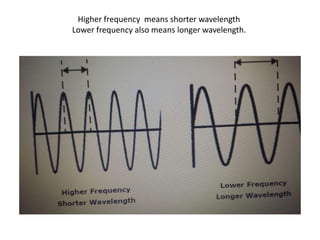
Higher frequency means shorter wavelength
•
Lower frequency also means longer wavelength.
•
In soft tissue, sound with a frequency of 1MHz has a
•
wavelength of 1.54mm.
•
Rule In soft tissue, divide 1.54mm by the frequency in MHz.
•
Wavelength (mm) = 1.54 / frequency (MHz)
•
See slide (4)
Higher frequency means shorter wavelength
Lower frequency also means longer wavelength.
•
Propagation Speed
•
Is defined as the rate that sound travels through a medium.
•
Units meters per second, mm/micros
•
Determined By Medium only (Density and stiffness)
•
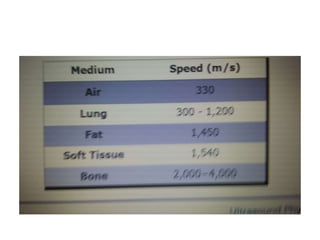
Typical medical diagnostic US values : Average speed of all
sound (regardless of frequency) in
•
biologic or “soft tissue:”
•
1.54km/s = 1,540m/s = 1.54mm/micros
•
See slide (6 )
•
•
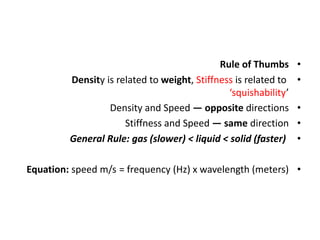
Rule of Thumbs
•
Density is related to weight, Stiffness is related to
‘squishability’
•
Density and Speed — opposite directions
•
Stiffness and Speed — same direction
•
General Rule: gas (slower) < liquid < solid (faster)
•
= frequency (Hz) x wavelength (meters)
Equation: speed m/s
•
All sound, regardless of the frequency, travels at the same
•
speed through any specific medium.
•
This means that
•
sound with a frequency of 5MHz and sound with a
•
frequency of 3MHz travel at the same propagation speed
•
if they are traveling through the same medium.
•
•
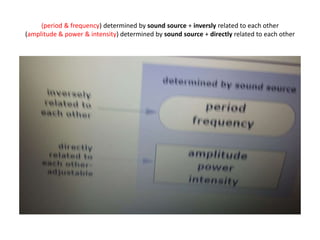
(period & frequency) determined by sound source + inversly
related to each other
•
(amplitude & power & intensity) determined by sound
source + directly related to each other
•
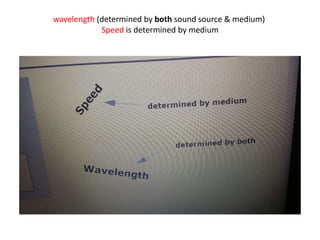
wavelength (determined by both sound source & medium)
•
Speed is determined by medium
•
See slides (10/11)
•
(period & frequency) determined by sound source + inversly related to each other
(amplitude & power & intensity) determined by sound source + directly related to each other
wavelength (determined by both sound source & medium)
Speed is determined by medium
•
Probe position to measue Gestational sac
•
Gestational sac - (GS) size formed initially by the chorionic
cavity, after the embryonic period (week 8, GA W10) the
amniotic cavity expands and fuses with the chorion.
Measured by mean gestation sac diameter.
•
Where do you place the ultrasound transducer?
•
For reliable FHR measurements it is required that the fetal
heart is located within the US beam. In clinical practice,
clinicians palpate the maternal abdomen to identify the fetal
presentation and then the US TXR is fixated on the maternal
abdomen where the best FHR signal can be obtained.
•
lateral resolution is defined as the ability of the system to
distinguish two points in the direction perpendicular to the
direction of the ultrasound beam.
•
Elevational (azimuthal) resolution represents the extent to
which an ultrasound system is able to resolve objects within
an axis perpendicular to the plane formed by the axial and
lateral dimensions.
•
Temporal resolution is the time from the beginning of one
frame to the next; it represents the ability of the US system to
distinguish between instantaneous events of rapidly moving
structures, for example, during the cardiac cycle.
•
Axial (also called longitudinal) resolution is the minimum
distance that can be differentiated between two reflectors
located parallel to the direction of ultrasound beam.
Mathematically, it is equal to half the spatial pulse
length. Axial resolution is high when the spatial pulse length is
short.
•
Axial resolution is generally around four times better than
lateral resolution. Axial resolution is defined by the
equation: axial resolution = ½ ⨉ spatial pulse length. The
spatial pulse length is determined by the wavelength of the
beam and the number of cycles (periods) within a pulse.
•
Diagnostic ultrasound TXR often have
better axial resolution than lateral resolution, although the
two may be comparable in the focal region if strongly focused.
•
spatial resolution refers to the number of pixels utilized in
construction of the image.
•
Images having higher spatial resolution are composed with a
greater number of pixels than those of lower spatial
resolution.
•
•
Spatial resolution influences how sharply we
see objects. The key parameter is not simply
the number of pixels in each row or column of
the display, but the angle subtended, , by each
of these pixels on the viewer's retina.
•
An ultrasound transducer, also called a probe, is a device that
produces sound waves that bounce off body tissues and make
echoes. The TXR also receives the echoes and sends them to a
computer that uses them to create an image called sonogram.
•
TXR frequency is inversely proportional to depth of
penetration of the ultrasound signal into the body and
directly proportional to image resolution. The
common transducer frequencies for pelvic imaging range
from 3.5 to 7.5 MHz
•
Focusing
•
Results in: 1. a narrower “waist” in the US beam.
•
2. a decrease in focal depth (the focus is shallower).
•
3. a reduction in the size of the focal zone.
•
Effective mainly in the near field and the focal zone.
•
Electronic Focusing Phased array technology provides
dynamic, variable (adjustable)focusing or multifocusing
•
•
Scan line & line density
•
Scan line allows the ultrasound transducer to see from
multiple lines of site at different angles, as opposed to the
standard line-of-site that's perpendicular to the transducer
lens. Slide (20)
•
Line density in a sector image is the number of scan lines per
•
degree of sector.
•
Line density in a rectangular image is the number of scan lines
per centimeter.
•
When the line density is low, temporal resolution is high.
•
•
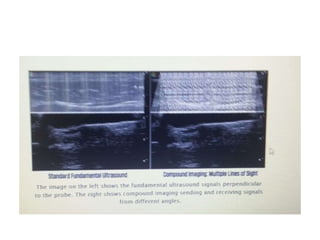
Traditionally, transducers send ultrasound signals in a single
“line of sight.”
•
This means it sends a sound signal perpendicular to the probe
head, then listens for the echo.
•
With compound imaging, the ultrasound sends signals at
multiple angles, allowing it to “see” tissue from multiple
angles and eliminate artifact.
•
The following image best represents what’s really happening
•
Slide (42)
•
Traditionally, transducers send ultrasound signals in a single
“line of sight.”
•
This means it sends a sound signal perpendicular to the probe
head, then listens for the echo.
•
With compound imaging, the ultrasound sends signals at
multiple angles, allowing it to “see” tissue from multiple
angles and eliminate artifact.
•
The following image best represents what’s really happening
•
Slide (23)
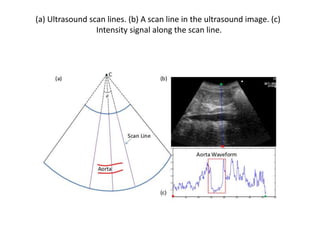
(a) Ultrasound scan lines. (b) A scan line in the ultrasound image. (c)
Intensity signal along the scan line.
•
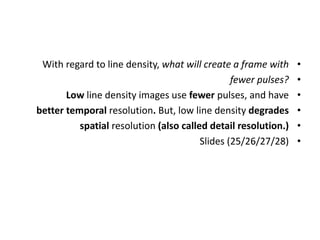
With regard to line density, what will create a frame with
•
fewer pulses?
•
Low line density images use fewer pulses, and have
•
better temporal resolution. But, low line density degrades
•
spatial resolution (also called detail resolution.)
•
Slides (25/26/27/28)
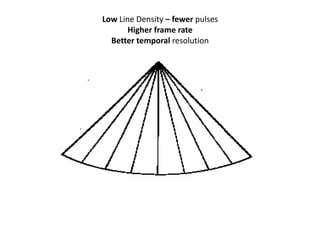
Low Line Density – fewer pulses
Higher frame rate
Better temporal resolution
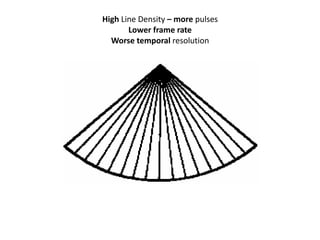
High Line Density – more pulses
Lower frame rate
Worse temporal resolution
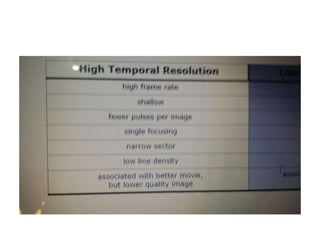
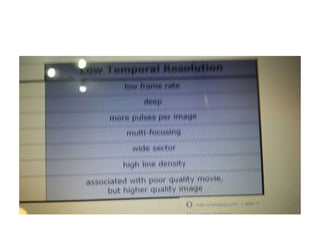
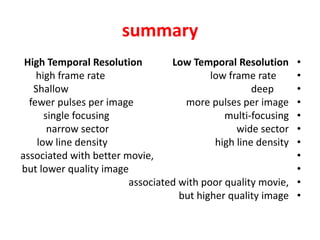
summary
•
High Temporal Resolution Low Temporal Resolution
•
high frame rate low frame rate
•
Shallow deep
•
fewer pulses per image more pulses per image
•
single focusing multi-focusing
•
narrow sector wide sector
•
low line density high line density
•
associated with better movie,
•
but lower quality image
•
associated with poor quality movie,
•
but higher quality image
•
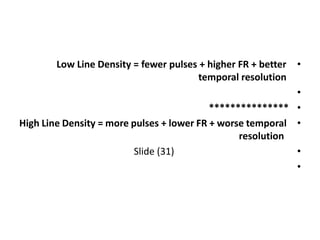
Low Line Density = fewer pulses + higher FR + better
temporal resolution
•
•
***************
•
High Line Density = more pulses + lower FR + worse temporal
resolution
•
Slide (31)
•
High line density (upper image) /low line density (lower image)
Us physics (9)

Us physics (9)

  • 1.
    US Physics (9) Dr.Kamal Sayed MSc US UAA range equation/scan lines/resolution
  • 2.
    • What is ultrasoundrange formula? • Range equation – since ultrasound systems measure the time of flight and the average speed of ultrasound in soft tissue is known (1540 m/s), then we can calculate the distance of the object location. Distance to boundary (mm) = go-return time (microsecond) x speed
  • 3.
    • Higher frequency meansshorter wavelength • Lower frequency also means longer wavelength. • In soft tissue, sound with a frequency of 1MHz has a • wavelength of 1.54mm. • Rule In soft tissue, divide 1.54mm by the frequency in MHz. • Wavelength (mm) = 1.54 / frequency (MHz) • See slide (4)
  • 4.
    Higher frequency meansshorter wavelength Lower frequency also means longer wavelength.
  • 5.
    • Propagation Speed • Is definedas the rate that sound travels through a medium. • Units meters per second, mm/micros • Determined By Medium only (Density and stiffness) • Typical medical diagnostic US values : Average speed of all sound (regardless of frequency) in • biologic or “soft tissue:” • 1.54km/s = 1,540m/s = 1.54mm/micros • See slide (6 ) •
  • 7.
    • Rule of Thumbs • Densityis related to weight, Stiffness is related to ‘squishability’ • Density and Speed — opposite directions • Stiffness and Speed — same direction • General Rule: gas (slower) < liquid < solid (faster) • = frequency (Hz) x wavelength (meters) Equation: speed m/s
  • 8.
    • All sound, regardlessof the frequency, travels at the same • speed through any specific medium. • This means that • sound with a frequency of 5MHz and sound with a • frequency of 3MHz travel at the same propagation speed • if they are traveling through the same medium.
  • 9.
    • • (period & frequency)determined by sound source + inversly related to each other • (amplitude & power & intensity) determined by sound source + directly related to each other • wavelength (determined by both sound source & medium) • Speed is determined by medium • See slides (10/11) •
  • 10.
    (period & frequency)determined by sound source + inversly related to each other (amplitude & power & intensity) determined by sound source + directly related to each other
  • 11.
    wavelength (determined byboth sound source & medium) Speed is determined by medium
  • 12.
    • Probe position tomeasue Gestational sac • Gestational sac - (GS) size formed initially by the chorionic cavity, after the embryonic period (week 8, GA W10) the amniotic cavity expands and fuses with the chorion. Measured by mean gestation sac diameter. • Where do you place the ultrasound transducer? • For reliable FHR measurements it is required that the fetal heart is located within the US beam. In clinical practice, clinicians palpate the maternal abdomen to identify the fetal presentation and then the US TXR is fixated on the maternal abdomen where the best FHR signal can be obtained.
  • 13.
    • lateral resolution isdefined as the ability of the system to distinguish two points in the direction perpendicular to the direction of the ultrasound beam. • Elevational (azimuthal) resolution represents the extent to which an ultrasound system is able to resolve objects within an axis perpendicular to the plane formed by the axial and lateral dimensions. • Temporal resolution is the time from the beginning of one frame to the next; it represents the ability of the US system to distinguish between instantaneous events of rapidly moving structures, for example, during the cardiac cycle.
  • 14.
    • Axial (also calledlongitudinal) resolution is the minimum distance that can be differentiated between two reflectors located parallel to the direction of ultrasound beam. Mathematically, it is equal to half the spatial pulse length. Axial resolution is high when the spatial pulse length is short. • Axial resolution is generally around four times better than lateral resolution. Axial resolution is defined by the equation: axial resolution = ½ ⨉ spatial pulse length. The spatial pulse length is determined by the wavelength of the beam and the number of cycles (periods) within a pulse.
  • 15.
    • Diagnostic ultrasound TXRoften have better axial resolution than lateral resolution, although the two may be comparable in the focal region if strongly focused. • spatial resolution refers to the number of pixels utilized in construction of the image. • Images having higher spatial resolution are composed with a greater number of pixels than those of lower spatial resolution. •

  • 16.
    • Spatial resolution influenceshow sharply we see objects. The key parameter is not simply the number of pixels in each row or column of the display, but the angle subtended, , by each of these pixels on the viewer's retina.
  • 17.
    • An ultrasound transducer,also called a probe, is a device that produces sound waves that bounce off body tissues and make echoes. The TXR also receives the echoes and sends them to a computer that uses them to create an image called sonogram. • TXR frequency is inversely proportional to depth of penetration of the ultrasound signal into the body and directly proportional to image resolution. The common transducer frequencies for pelvic imaging range from 3.5 to 7.5 MHz
  • 18.
    • Focusing • Results in: 1.a narrower “waist” in the US beam. • 2. a decrease in focal depth (the focus is shallower). • 3. a reduction in the size of the focal zone. • Effective mainly in the near field and the focal zone. • Electronic Focusing Phased array technology provides dynamic, variable (adjustable)focusing or multifocusing •
  • 19.
    • Scan line &line density • Scan line allows the ultrasound transducer to see from multiple lines of site at different angles, as opposed to the standard line-of-site that's perpendicular to the transducer lens. Slide (20) • Line density in a sector image is the number of scan lines per • degree of sector. • Line density in a rectangular image is the number of scan lines per centimeter. • When the line density is low, temporal resolution is high. •
  • 21.
    • Traditionally, transducers sendultrasound signals in a single “line of sight.” • This means it sends a sound signal perpendicular to the probe head, then listens for the echo. • With compound imaging, the ultrasound sends signals at multiple angles, allowing it to “see” tissue from multiple angles and eliminate artifact. • The following image best represents what’s really happening • Slide (42)
  • 22.
    • Traditionally, transducers sendultrasound signals in a single “line of sight.” • This means it sends a sound signal perpendicular to the probe head, then listens for the echo. • With compound imaging, the ultrasound sends signals at multiple angles, allowing it to “see” tissue from multiple angles and eliminate artifact. • The following image best represents what’s really happening • Slide (23)
  • 23.
    (a) Ultrasound scanlines. (b) A scan line in the ultrasound image. (c) Intensity signal along the scan line.
  • 24.
    • With regard toline density, what will create a frame with • fewer pulses? • Low line density images use fewer pulses, and have • better temporal resolution. But, low line density degrades • spatial resolution (also called detail resolution.) • Slides (25/26/27/28)
  • 25.
    Low Line Density– fewer pulses Higher frame rate Better temporal resolution
  • 26.
    High Line Density– more pulses Lower frame rate Worse temporal resolution
  • 29.
    summary • High Temporal ResolutionLow Temporal Resolution • high frame rate low frame rate • Shallow deep • fewer pulses per image more pulses per image • single focusing multi-focusing • narrow sector wide sector • low line density high line density • associated with better movie, • but lower quality image • associated with poor quality movie, • but higher quality image
  • 30.
    • Low Line Density= fewer pulses + higher FR + better temporal resolution • • *************** • High Line Density = more pulses + lower FR + worse temporal resolution • Slide (31) •
  • 31.
    High line density(upper image) /low line density (lower image)