Lectures on Medical Biophysics Dept. Biophysics, Medical faculty,  Masaryk University in Brno
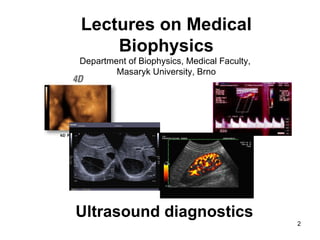
Ultrasound diagnostics Lectures on Medical Biophysics Department of Biophysics, Medical Faculty,  Masaryk University, Brno
Lecture outline Physical properties of ultrasound and acoustic parameters of medium Ultrasonography Impulse reflection method A-mode – one-dimensional B-mode – two-dimensional M-mode Basic characteristics of US images Interventional sonography Echocontrast agents  Harmonic imaging Principle of 3D imaging Doppler flow measurement Principle of Doppler effect Principle of blood flow measurement CW Doppler system Systems with pulsed wave – PW  Doppler Duplex and Triplex methods P ower  D oppler  method Tissue Doppler Imaging  (TDI) Ultrasonic densitometry Patient Safety: reducing Ultrasound ‘Doses’
Ultrasound diagnostics Ultrasound diagnostics started to develop in early 50‘ of 20th century. It allows to obtain cross-sectional images of the human body which can also include substantial information about its physiology and pathology.  Ultrasound diagnostics is based mainly on reflection of ultrasound waves at acoustical interfaces We can distinguish: Ultrasonography (A, B and M mode, 3D and 4D imaging) Doppler flow measurement, including Duplex and Triplex methods (Duplex, Colour, Triplex, Power) Tissue Doppler imaging Ultrasound densitometry
Physical properties of ultrasound Before we will deal with diagnostic devices, we need to understand what is ultrasound and what are the main acoustical properties of medium. Ultrasound (US) is  mechanical oscillations  with frequency above 20 kHz which propagate through an elastic medium. In liquids and gases, US propagates as longitudinal waves. In solids, US propagates also as transversal waves.
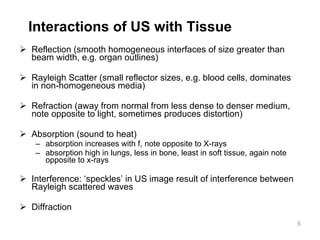
Interactions of US with Tissue Reflection (smooth homogeneous interfaces of size greater than beam width ,  e.g. organ outlines) Rayleigh Scatter (small reflector sizes, e.g. blood cells, dominates in non-homogeneous media) Refraction (away from normal from less dense to denser medium, note opposite to light, sometimes produces distortion) Absorption (sound to heat) absorption increases with f, note opposite to X-rays absorption high in lungs, less in bone, least in soft tissue, again note opposite to x-rays Interference: ‘speckle s ’ in US  image  result of interference between Rayleigh scattered waves Diffraction
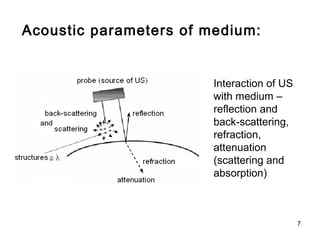
Acoustic parameters of medium :  Interaction of US with medium – reflection and back-scattering, refraction, attenuation (scattering and absorption)
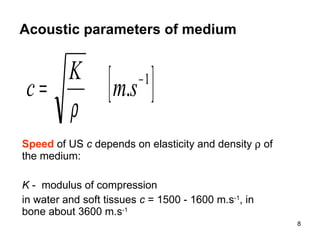
Acoustic parameters of medium Speed  of US  c  depends on elasticity and density    of the medium:  K  -  modulus of compression in water and soft tissues  c  = 1500 - 1600 m.s -1 , in bone about 3600 m.s -1
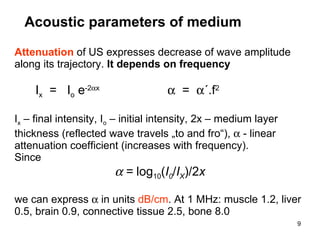
Acoustic parameters of medium Attenuation   of US expresses decrease of wave amplitude along its trajectory.  It depends on frequency I x   =  I o  e -2  x      =   ´.f 2 I x  – final intensity, I o  – initial intensity, 2x – medium layer thickness (reflected wave travels  „ to and fro “ ),    - linear attenuation coefficient (increases with frequency) . Since  =  log 10 ( I 0 / I X )/2 x we can express    in units  dB/cm . At 1 MHz: muscle 1.2, liver 0.5, brain 0.9, connective tissue 2.5, bone 8.0
Acoustic parameters of medium Attenuation of ultrasound  When expressing intensity of ultrasound in decibels, we can see the amplitudes of echoes to decrease linearly . depth   [cm] I or P [dB] attenuation
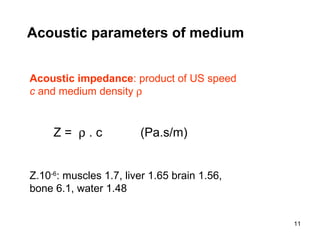
Acoustic impedance :  product of US speed  c  and medium density   Z =    . c  (Pa.s/m)  Z.10 -6 : muscles 1.7, liver 1.65 brain 1.56, bone 6.1, water 1.48 Acoustic parameters of medium
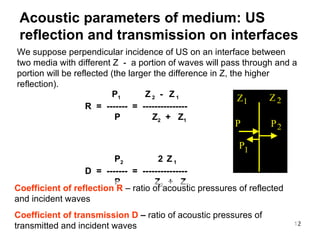
We suppose perpendicular incidence of US on an interface between two media with different Z  -  a portion of waves will pass through and a portion will be reflected (the larger the difference in Z, the higher reflection ). Acoustic parameters of medium :   US reflection and transmission on interfaces P 1  Z  2   -  Z  1 R  =  -------  =  --------------- P  Z 2   +  Z 1 P 2  2  Z  1 D  =  -------  =  --------------- P  Z 2   +  Z 1 Coefficient of reflection R  – ratio of acoustic pressures of reflected and incident waves Coefficient of transmission D  –  ratio of acoustic pressures of transmitted and incident waves
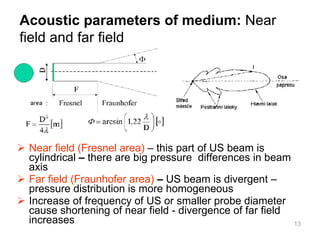
Near field (Fresnel area)  – this part of US beam is cylindrical  –  there are big pressure  differences in beam axis  Far field (Fraunhofer area)   –  US beam is divergent – pressure distribution is more homogeneous Increase of frequency of US or smaller probe diameter cause shortening of near field - divergence of far field increases Acoustic parameters of medium :   Near field and far field
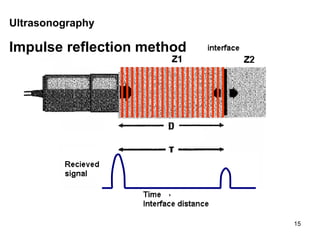
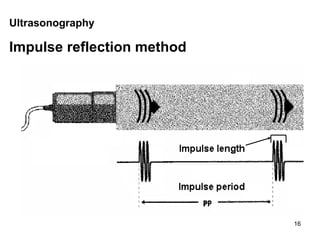
Ultrasonography Passive US  – low intensity waves which  cannot  cause substantial changes of medium.  In US diagnostics   (ultrasonography  = sonography = echography )  -  frequencies used are 2 - 40 MHz with  (temporal average, spatial peak)  intensity of about 1 kW/m 2   Impulse reflection method:  a probe with one transducer which is  source as well as detector  of US impulses. A portion of emitted US energy is  reflected  on the acoustic interfaces and the same probe then receives reflected signal. After processing, the signal is displayed on a screen.
Ultrasonography Impulse reflection method
Ultrasonography   Impulse reflection method Main parts of the US apparatus: Common  to  diagnostics and therapy  probe with electroacoustic transducer (transducers) generator of electric oscillations (continuous, pulse d ) Special parts of diagnostic apparatus electronic circuits for processing of reflected signal display unit recording unit
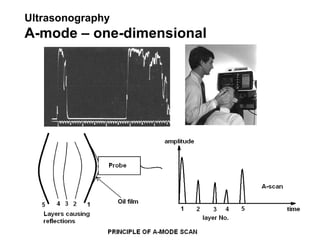
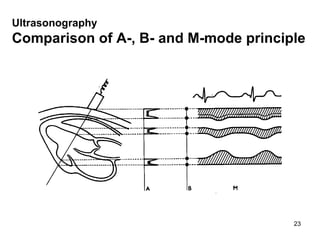
Ultrasonography   A- mode  – one-dimensional Distances  between reflecting interfaces and the probe are shown.  Reflections  from individual interfaces (boundaries of media with different acoustic impedances) are represented by   vertical deflections   of base line,  i.e.  the  echoes .   Echo amplitude is proportional to the  intensity of reflected waves   ( amplitude modulation ) Distance between echoes shown on the screen is proportional to real distance between tissue interfaces. Today used mainly in ophthalmology.
Ultrasonography   A- mode  – one-dimensional
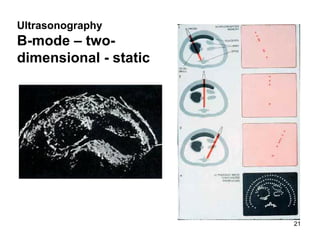
A  tomogram  is depicted. Brightness of points on the screen represent s  intensity of reflected US waves ( brightness modulation ).  Static B-scan : a cross-section image of examined area in the plane given by the beam axis and direction of  manual  movement of the probe on body surface .  The method was used in 50‘ and 60‘ of 20th century Ultrasonography   B- mode  – two-dimensional
Ultrasonography   B- mode  – two-dimensional  - static
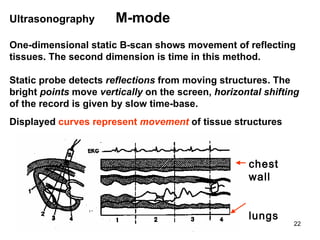
Ultrasonography  M-mode  One-dimensional static B-scan show s  movement of reflecting tissues. The second dimension is time in this method. Static probe detects  reflections  from moving structures. The bright  points  move  vertically  on the screen,  horizontal shifting  of the record is given by slow time-base. Displayed  curves represent  movement  of tissue structures chest wall lungs
Ultrason ography   Comparison of A-, B- and M-mode principle
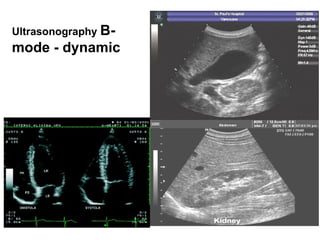
Repetitive formation of B-mode images of examined area by  fast deflection of US beam  mechanically (in the past) or electronically „in real time“ today.  Electronic probes consist of many piezoelectric transducers which are gradually activated. Ultrasonography   B-mode - dynamic
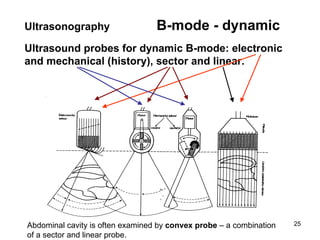
Ultrasound probes for dynamic B-mode: electronic and mechanical  (history) , sector and linear .  Ultrasonography   B-mode - dynamic Abdominal cavity is often examined by  convex probe  – a combination of a sector and linear probe.
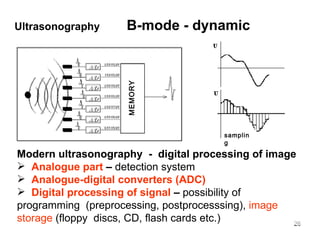
Modern ultrasonography  -  digital processing of image Analogue part  –  detection system Analogue-digital converters (ADC) Digital processing of signal  –  possibility of  programming  (preprocessing, postprocesssing),  image storage  (floppy  discs, CD, flash cards etc.) Ultrasonography   B-mode - dynamic MEMORY sampling
Ultrasonography   B-mode - dynamic
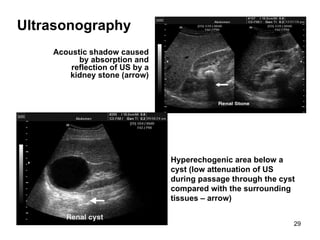
Degree of reflectivity – echogenity.  The images of cystic (liquid-filled) and solid structures are different. According to the intensity of reflection we can distinguish structures:  hyperechogenic, izoechogenic, hypoechogenic, anechogenic. Solid structures – acoustic shadow  (caused by absorption and reflection of US) Air bubbles and other strongly reflecting interfaces cause repeating reflections  (reverberation, „comet tail“).  Ultrasonography   Basic characteristics of US images
Acoustic shadow caused by absorption and reflection of US by a kidney stone  (arrow) Hyperechogenic area below a cyst (low attenuation of US during passage through the cyst compared with the surrounding tissues  – arrow) Ultrasonography
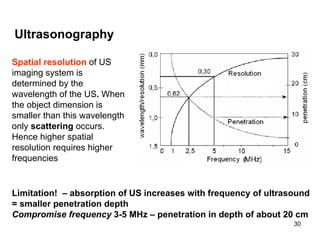
L imitation!  – absorption of US increases with frequency of ultrasound =  smaller penetration depth Compromise frequency  3-5 MHz – penetration in depth  of  about 20 cm Ultrasonography Spatial resolution   of US imaging system is determined by the wavelength of the US .  When the object dimension is smaller than this wavelength only  scattering  occurs. Hence higher spatial resolution requires higher frequencies
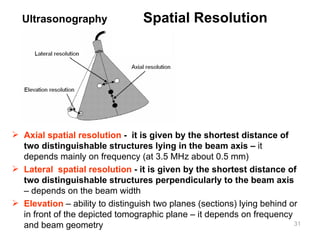
Axial spatial resolution  -  it is given by the shortest distance of two distinguishable structures lying in the beam axis –  it depends mainly on frequency (at 3.5 MHz about 0.5 mm) Lateral  spatial resolution  - it is given by the shortest distance of two distinguishable structures perpendicularly to the beam axis  – depends on the beam width Elevation  – ability to distinguish two planes (sections) lying behind or in front of the depicted tomographic plane – it depends on frequency and beam geometry Ultrasonography   Spatial Resolution
The best resolving power can be found in the narrowest part of the US beam profile.  Focusing  –  US beam is  converged  at the examined structure by means of acoustic lenses (shapes of the layer covering the transducer) or electronically .   The probes can be universal or specially designed  for different purposes with different focuses . The position of focus can be changed  in most sector probes) .   Ultrasonography  Spatial Resolution
Ultrasonography Interventional sonography   Interventional sonography is used mainly for guiding punctures diagnostic  –  thin needle punctures to take tissue samples for histology therapeutic  –  for aspiration of a cyst or an abscess content or an exudate etc.   Puncture can be done by „free hand“ – the probe is next to the puncture site – or the puncture needle is guided by a special probe attachment.
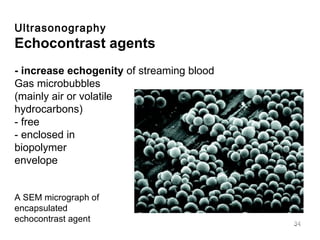
Ultrasonography Echocontrast agents  - increase echogenity  of streaming blood Gas microbubbles (mainly air or volatile  hydrocarbons)  - free - enclosed in  biopolymer envelope A SEM micrograph of encapsulated  echocontrast agent
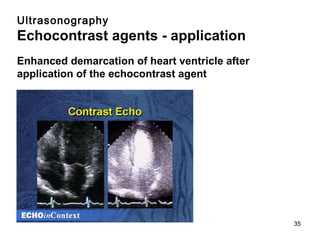
Ultrasonography Echocontrast agents - application Enhanced demarcation of heart ventricle after application of the echocontrast agent
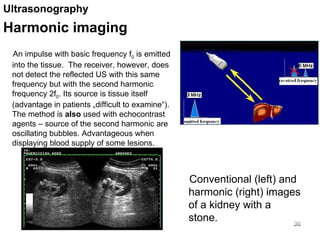
An impulse with basic frequency f 0  is emitted into the tissue.  The receiver, however, does not detect the reflected US with this same frequency but with the second harmonic frequency 2f 0 . Its source is tissue itself (advantage in patients „difficult to examine“). The method is  also  used with echocontrast agents – source of the second harmonic are oscillating bubbles. Advantageous when displaying blood supply of some lesions. Conventional (left) and harmonic (right) images of a kidney with a stone.  Ultrasonography  Harmonic imaging
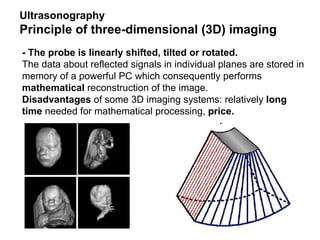
- The probe is linearly shifted, tilted or rotated. The data about reflected signals in individual planes are stored in memory of a powerful PC which consequently performs  mathematical  reconstruction of the image.  Disadvantages  of some 3D imaging systems: relatively  long time  needed for mathematical processing,  price . Ultrasonography  Principle of three-dimensional (3D) imaging
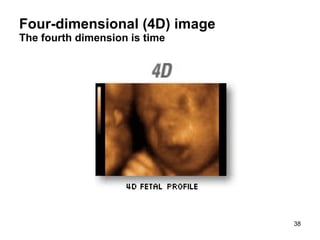
Four-dimensional (4D) image The fourth dimension is time
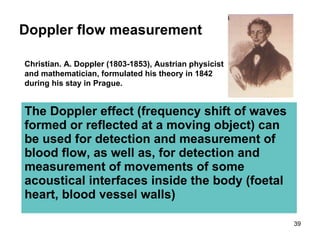
Doppler flow measurement The Doppler effect (frequency shift of waves formed or reflected at a moving object )  can be used for detection and measurement of blood flow, as well as, for detection and measurement of movements of some acoustical interfaces inside the body (foetal heart, blood vessel walls) Christian. A. Doppler (1803-1853), Austrian physicist  and mathematician, formulated his theory in   1842 during his stay in Prague.
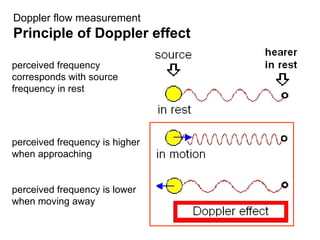
perceived frequency corresponds with source frequency in rest perceived frequency is higher when approaching perceived frequency is lower when moving away Doppler flow measurement Principle of Doppler effect
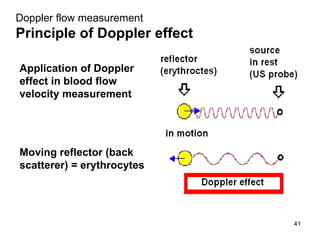
Application of Doppler effect in blood flow velocity measurement Moving reflector (back scatterer )  = erythrocytes  Doppler flow measurement Principle of Doppler effect
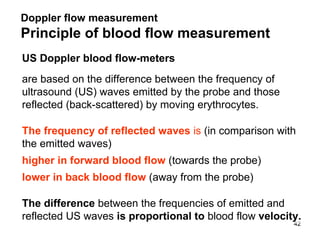
US Doppler blood flow-meters   are based on the difference between the frequency of ultrasound (US) waves emitted by the probe and those reflected (back-scattered) by moving erythrocytes.   The frequency of reflected waves  is  (in comparison with the emitted waves) higher in forward blood flow   (towards the probe)   lower in back blood flow   (away from the probe) The difference  between the frequencies of emitted and reflected US waves  is proportional to  blood flow  velocity. Doppler flow measurement Principle of blood flow measurement
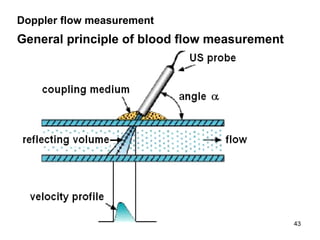
Doppler flow measurement   General principle of blood flow measurement
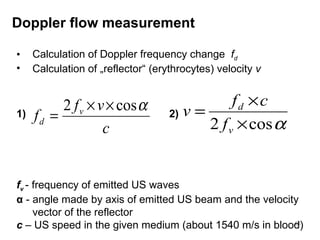
Calculation of Doppler frequency change  f d Calculation of  „ reflector “  (erythrocytes) velocity  v 1)  2)  f v   - frequency of emitted US waves α   - angle made by axis of emitted US beam and the velocity vector of the reflector c   – US speed in the given medium (about 1540 m/s in blood) Doppler flow measurement
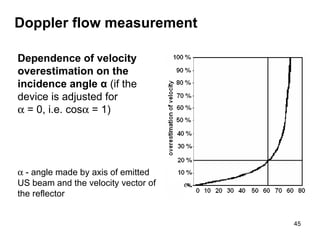
Dependence of velocity overestimation on the incidence angle  α   (if the device is adjusted for    = 0, i.e. cos   = 1)    - angle made by axis of emitted US beam and the velocity vector of the reflector Doppler flow measurement
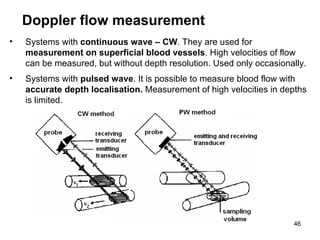
Systems with  continuous wave – CW . They are used for  measurement on superficial blood vessels . High velocities of flow can be measured, but without depth resolution. Used only occasionally. Systems with  pulsed wave . It is possible to measure blood flow with  accurate depth localisation.  Measurement of high velocities in depths is limited.   Doppler flow measurement
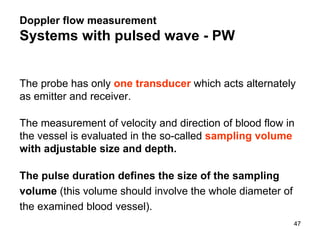
The probe has only   one transducer   which acts alternately as emitter and receiver.  The measurement of velocity and direction of blood flow in the vessel is evaluated in the so-called   sampling volume  with adjustable size and depth. The pulse duration defines the size of the sampling volume  (this volume should involve the whole diameter of the examined blood vessel). Doppler flow measurement Systems with pulsed wave - PW
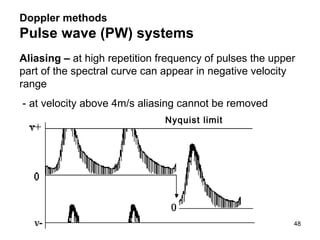
Aliasing –  at high repetition frequency of pulses the upper part of the spectral curve can appear in negative velocity range - at velocity above 4m/s aliasing cannot be removed Doppler  methods   Pulse wave (PW) systems Nyquist limit
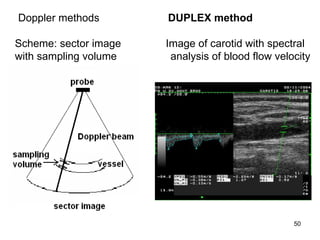
DUPLEX method  is a combination   of dynamic B-mode imaging  (the morphology of examined area with blood vessels is depicted)  and the PW Doppler system  (measurement of velocity spectrum of blood flow). It allows to examine blood flow inside heart or in deep blood vessels (flow velocity, direction and character) D oppler  methods
D oppler  methods   DUPLEX method  Scheme :  sector image  Image of carotid with spectral  with sampling volume  analysis of blood flow velocity
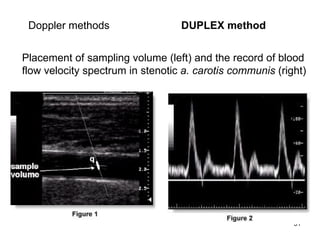
D oppler  methods   DUPLEX method  Placement of sampling volume (left) and the record of blood flow velocity spectrum in  stenotic  a. carotis communis  (right)
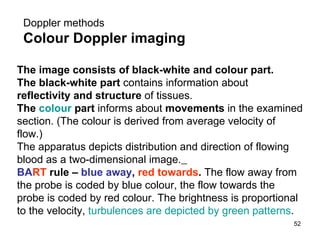
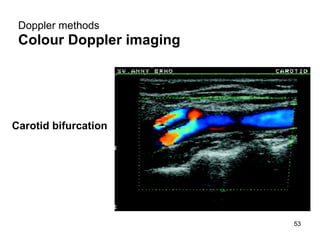
D oppler  methods Colour Doppler imaging The image consists of black-white and colour part. The black-white part  contains information about  reflectivity and structure  of tissues. The  colour  part  informs about  movements  in the examined section. (The colour is derived from average velocity of flow.) The apparatus depicts distribution and direction of flowing blood as a two-dimensional image.   BA RT   rule  –  blue away ,  red towards .  The flow away from the probe is coded by blue colour, the flow towards the probe is coded by red colour.   The brightness is proportional to the velocity,  turbulences are depicted by green patterns .
D oppler  methods Colour Doppler imaging   Carotid bifurcation
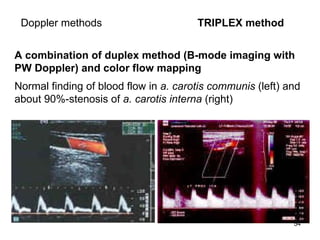
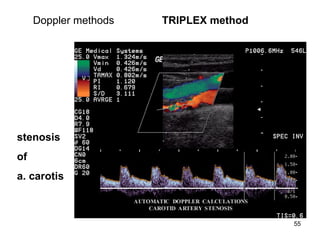
D oppler  methods   TRIPLEX method A combination of duplex method  (B-mode imaging with PW Doppler)  and  color flow mapping   Normal finding of blood flow in  a. carotis communis  (left) and about 90%-stenosis of  a. carotis interna  (right)
D oppler  methods   TRIPLEX method stenosis  of a. carotis
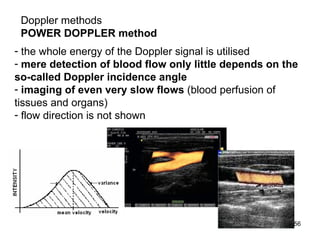
D oppler  methods POWER DOPPLER method the whole energy of the Doppler signal is utilised   mere detection of blood flow only little depends on the  so-called Doppler incidence angle imaging of even very slow flows  (blood perfusion of tissues and organs) flow direction is not shown
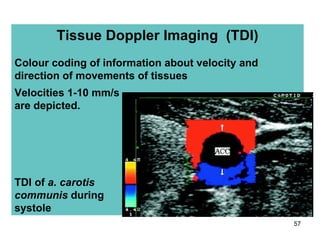
Tissue Doppler Imaging  (TDI) Colour coding of information about velocity and direction of movements of tissues Velocities 1-10   mm/s are depicted. TDI of  a. carotis communis   during systole
Ultrasonic densitometry It  is  based on both the measurement of speed of ultrasound in bone and the estimation of ultrasound attenuation in bone. In contrast to X-ray methods, ultrasound densitometry also provides information on the structure of bone and its elastic properties. T he speed of ultrasound depends on the density and elasticity of the measured medium. The anterior area of the tibia and the posterior area of the calcaneus are frequently used as places of measurement. The speed of ultrasound is given by the quotient of measured distance and the transmission time. Ultrasound attenuation depends on the physical properties of the given medium and the frequency of the ultrasound applied. For the frequency range 0.1 - 1 MHz the frequency dependence is nearly linear. Attenuation is currently expressed in dB/MHz/cm. Clinical importance: diagnostics of osteoporosis
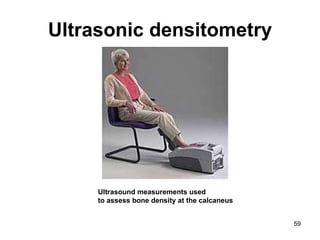
Ultrasonic densitometry Ultrasound measurements used  to assess bone density at the calcaneus
Patient Safety: reducing Ultrasound ‘Doses’
Prudent use of Ultrasound US is non-ionising BUT since many bioeffects of ultrasound have not yet been studied fully, ‘prudent’ use is recommended ALARA – as low as reasonably achievable (exposure) In practice ‘prudent’ = justification + optimisation
Biological Effects Possible bioeffects: inactivation of enzymes, altered cell morphology, internal  haemorrhage, free radical formation …  Mechanisms of bioeffects: Mechanical effects Displacement and acceleration of biomolecules Gas bubble  cavitation  (stable and transient) – see the lecture on biological effects of ultrasound Elevated tissue temperatures (absorption of ultrasound and therefore increase in temp erature  high in lungs, less in bone, least in soft tissue) All bioeffects are deterministic with a threshold (cavitation) or without it (heating).
Output Power from Transducer varies from one machine to another Increases as one moves from real-time imaging to colour flow Doppler  M-mode output intensity is low but dose to tissue is high because beam is stationary
Risk Indicators   To avoid potentially dangerous exposures, two indices were introduced. Their values (different for different organs) are often displayed on device screens and should not be exceeded. Thermal Index (TI): TI = possible tissue temperature rise if transducer is kept stationary TIS: soft tissue path TIB: bone near focus of beam TIC: Cranium (near surface bone) Mechanical Index (MI): measure of possible mechanical bioeffects
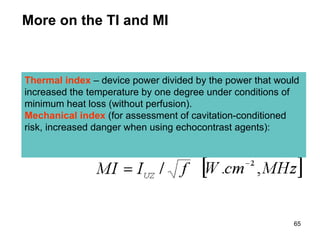
More on the TI and MI Thermal index  – device power divided by the power that would increased the temperature by one degree under conditions of minimum heat loss (without perfusion). Mechanical index   (for assessment of cavitation-conditioned risk, increased danger when using echocontrast agents):
Justification No commercial demos on human subjects No training on students No ‘see baby just for fun’ or excessive screening in obstetrics
Optimisation of ‘Dose’ 1 Minimise TI  and MI and use appropriate index (TIS, TIB, TIC), care in cases when these underestimate Check acoustic power outputs on manual Use high receiver gain when possible as opposed to high transmit power Start scan with low transmit power and increase gradually
Optimisation of ‘Dose’ 2 Avoid repeat scans and reduce exposure time Do not hold transducer stationary Greater care when using contrast agents as these increase the possibility of cavitation Exceptional care must be taken in applying pulsed Doppler in obstetrics Regular quality control of the ultrasound device
Authors:  Vojtěch Mornstein , Ivo Hrazdira,  Pavel Grec     Content collaboration and language revision :  Carmel J. Caruana Graphical design:  Lucie Mornsteinová Last revision:  June  200 9 http://www.freehotgame.com

Ultrasound diagnostics fin

  • 1.
    Lectures on MedicalBiophysics Dept. Biophysics, Medical faculty, Masaryk University in Brno
  • 2.
    Ultrasound diagnostics Lectureson Medical Biophysics Department of Biophysics, Medical Faculty, Masaryk University, Brno
  • 3.
    Lecture outline Physicalproperties of ultrasound and acoustic parameters of medium Ultrasonography Impulse reflection method A-mode – one-dimensional B-mode – two-dimensional M-mode Basic characteristics of US images Interventional sonography Echocontrast agents Harmonic imaging Principle of 3D imaging Doppler flow measurement Principle of Doppler effect Principle of blood flow measurement CW Doppler system Systems with pulsed wave – PW Doppler Duplex and Triplex methods P ower D oppler method Tissue Doppler Imaging (TDI) Ultrasonic densitometry Patient Safety: reducing Ultrasound ‘Doses’
  • 4.
    Ultrasound diagnostics Ultrasounddiagnostics started to develop in early 50‘ of 20th century. It allows to obtain cross-sectional images of the human body which can also include substantial information about its physiology and pathology. Ultrasound diagnostics is based mainly on reflection of ultrasound waves at acoustical interfaces We can distinguish: Ultrasonography (A, B and M mode, 3D and 4D imaging) Doppler flow measurement, including Duplex and Triplex methods (Duplex, Colour, Triplex, Power) Tissue Doppler imaging Ultrasound densitometry
  • 5.
    Physical properties ofultrasound Before we will deal with diagnostic devices, we need to understand what is ultrasound and what are the main acoustical properties of medium. Ultrasound (US) is mechanical oscillations with frequency above 20 kHz which propagate through an elastic medium. In liquids and gases, US propagates as longitudinal waves. In solids, US propagates also as transversal waves.
  • 6.
    Interactions of USwith Tissue Reflection (smooth homogeneous interfaces of size greater than beam width , e.g. organ outlines) Rayleigh Scatter (small reflector sizes, e.g. blood cells, dominates in non-homogeneous media) Refraction (away from normal from less dense to denser medium, note opposite to light, sometimes produces distortion) Absorption (sound to heat) absorption increases with f, note opposite to X-rays absorption high in lungs, less in bone, least in soft tissue, again note opposite to x-rays Interference: ‘speckle s ’ in US image result of interference between Rayleigh scattered waves Diffraction
  • 7.
    Acoustic parameters ofmedium : Interaction of US with medium – reflection and back-scattering, refraction, attenuation (scattering and absorption)
  • 8.
    Acoustic parameters ofmedium Speed of US c depends on elasticity and density  of the medium: K - modulus of compression in water and soft tissues c = 1500 - 1600 m.s -1 , in bone about 3600 m.s -1
  • 9.
    Acoustic parameters ofmedium Attenuation of US expresses decrease of wave amplitude along its trajectory. It depends on frequency I x = I o e -2  x  =  ´.f 2 I x – final intensity, I o – initial intensity, 2x – medium layer thickness (reflected wave travels „ to and fro “ ),  - linear attenuation coefficient (increases with frequency) . Since  = log 10 ( I 0 / I X )/2 x we can express  in units dB/cm . At 1 MHz: muscle 1.2, liver 0.5, brain 0.9, connective tissue 2.5, bone 8.0
  • 10.
    Acoustic parameters ofmedium Attenuation of ultrasound When expressing intensity of ultrasound in decibels, we can see the amplitudes of echoes to decrease linearly . depth [cm] I or P [dB] attenuation
  • 11.
    Acoustic impedance : product of US speed c and medium density  Z =  . c (Pa.s/m) Z.10 -6 : muscles 1.7, liver 1.65 brain 1.56, bone 6.1, water 1.48 Acoustic parameters of medium
  • 12.
    We suppose perpendicularincidence of US on an interface between two media with different Z - a portion of waves will pass through and a portion will be reflected (the larger the difference in Z, the higher reflection ). Acoustic parameters of medium : US reflection and transmission on interfaces P 1 Z 2 - Z 1 R = ------- = --------------- P Z 2 + Z 1 P 2 2 Z 1 D = ------- = --------------- P Z 2 + Z 1 Coefficient of reflection R – ratio of acoustic pressures of reflected and incident waves Coefficient of transmission D – ratio of acoustic pressures of transmitted and incident waves
  • 13.
    Near field (Fresnelarea) – this part of US beam is cylindrical – there are big pressure differences in beam axis Far field (Fraunhofer area) – US beam is divergent – pressure distribution is more homogeneous Increase of frequency of US or smaller probe diameter cause shortening of near field - divergence of far field increases Acoustic parameters of medium : Near field and far field
  • 14.
    Ultrasonography Passive US – low intensity waves which cannot cause substantial changes of medium. In US diagnostics (ultrasonography = sonography = echography ) - frequencies used are 2 - 40 MHz with (temporal average, spatial peak) intensity of about 1 kW/m 2 Impulse reflection method: a probe with one transducer which is source as well as detector of US impulses. A portion of emitted US energy is reflected on the acoustic interfaces and the same probe then receives reflected signal. After processing, the signal is displayed on a screen.
  • 15.
  • 16.
  • 17.
    Ultrasonography Impulse reflection method Main parts of the US apparatus: Common to diagnostics and therapy probe with electroacoustic transducer (transducers) generator of electric oscillations (continuous, pulse d ) Special parts of diagnostic apparatus electronic circuits for processing of reflected signal display unit recording unit
  • 18.
    Ultrasonography A- mode – one-dimensional Distances between reflecting interfaces and the probe are shown. Reflections from individual interfaces (boundaries of media with different acoustic impedances) are represented by vertical deflections of base line, i.e. the echoes . Echo amplitude is proportional to the intensity of reflected waves ( amplitude modulation ) Distance between echoes shown on the screen is proportional to real distance between tissue interfaces. Today used mainly in ophthalmology.
  • 19.
    Ultrasonography A- mode – one-dimensional
  • 20.
    A tomogram is depicted. Brightness of points on the screen represent s intensity of reflected US waves ( brightness modulation ). Static B-scan : a cross-section image of examined area in the plane given by the beam axis and direction of manual movement of the probe on body surface . The method was used in 50‘ and 60‘ of 20th century Ultrasonography B- mode – two-dimensional
  • 21.
    Ultrasonography B- mode – two-dimensional - static
  • 22.
    Ultrasonography M-mode One-dimensional static B-scan show s movement of reflecting tissues. The second dimension is time in this method. Static probe detects reflections from moving structures. The bright points move vertically on the screen, horizontal shifting of the record is given by slow time-base. Displayed curves represent movement of tissue structures chest wall lungs
  • 23.
    Ultrason ography Comparison of A-, B- and M-mode principle
  • 24.
    Repetitive formation ofB-mode images of examined area by fast deflection of US beam mechanically (in the past) or electronically „in real time“ today. Electronic probes consist of many piezoelectric transducers which are gradually activated. Ultrasonography B-mode - dynamic
  • 25.
    Ultrasound probes fordynamic B-mode: electronic and mechanical (history) , sector and linear . Ultrasonography B-mode - dynamic Abdominal cavity is often examined by convex probe – a combination of a sector and linear probe.
  • 26.
    Modern ultrasonography - digital processing of image Analogue part – detection system Analogue-digital converters (ADC) Digital processing of signal – possibility of programming (preprocessing, postprocesssing), image storage (floppy discs, CD, flash cards etc.) Ultrasonography B-mode - dynamic MEMORY sampling
  • 27.
    Ultrasonography B-mode - dynamic
  • 28.
    Degree of reflectivity– echogenity. The images of cystic (liquid-filled) and solid structures are different. According to the intensity of reflection we can distinguish structures: hyperechogenic, izoechogenic, hypoechogenic, anechogenic. Solid structures – acoustic shadow (caused by absorption and reflection of US) Air bubbles and other strongly reflecting interfaces cause repeating reflections (reverberation, „comet tail“). Ultrasonography Basic characteristics of US images
  • 29.
    Acoustic shadow causedby absorption and reflection of US by a kidney stone (arrow) Hyperechogenic area below a cyst (low attenuation of US during passage through the cyst compared with the surrounding tissues – arrow) Ultrasonography
  • 30.
    L imitation! – absorption of US increases with frequency of ultrasound = smaller penetration depth Compromise frequency 3-5 MHz – penetration in depth of about 20 cm Ultrasonography Spatial resolution of US imaging system is determined by the wavelength of the US . When the object dimension is smaller than this wavelength only scattering occurs. Hence higher spatial resolution requires higher frequencies
  • 31.
    Axial spatial resolution - it is given by the shortest distance of two distinguishable structures lying in the beam axis – it depends mainly on frequency (at 3.5 MHz about 0.5 mm) Lateral spatial resolution - it is given by the shortest distance of two distinguishable structures perpendicularly to the beam axis – depends on the beam width Elevation – ability to distinguish two planes (sections) lying behind or in front of the depicted tomographic plane – it depends on frequency and beam geometry Ultrasonography Spatial Resolution
  • 32.
    The best resolvingpower can be found in the narrowest part of the US beam profile. Focusing – US beam is converged at the examined structure by means of acoustic lenses (shapes of the layer covering the transducer) or electronically . The probes can be universal or specially designed for different purposes with different focuses . The position of focus can be changed in most sector probes) . Ultrasonography Spatial Resolution
  • 33.
    Ultrasonography Interventional sonography Interventional sonography is used mainly for guiding punctures diagnostic – thin needle punctures to take tissue samples for histology therapeutic – for aspiration of a cyst or an abscess content or an exudate etc. Puncture can be done by „free hand“ – the probe is next to the puncture site – or the puncture needle is guided by a special probe attachment.
  • 34.
    Ultrasonography Echocontrast agents - increase echogenity of streaming blood Gas microbubbles (mainly air or volatile hydrocarbons) - free - enclosed in biopolymer envelope A SEM micrograph of encapsulated echocontrast agent
  • 35.
    Ultrasonography Echocontrast agents- application Enhanced demarcation of heart ventricle after application of the echocontrast agent
  • 36.
    An impulse withbasic frequency f 0 is emitted into the tissue. The receiver, however, does not detect the reflected US with this same frequency but with the second harmonic frequency 2f 0 . Its source is tissue itself (advantage in patients „difficult to examine“). The method is also used with echocontrast agents – source of the second harmonic are oscillating bubbles. Advantageous when displaying blood supply of some lesions. Conventional (left) and harmonic (right) images of a kidney with a stone. Ultrasonography Harmonic imaging
  • 37.
    - The probeis linearly shifted, tilted or rotated. The data about reflected signals in individual planes are stored in memory of a powerful PC which consequently performs mathematical reconstruction of the image. Disadvantages of some 3D imaging systems: relatively long time needed for mathematical processing, price . Ultrasonography Principle of three-dimensional (3D) imaging
  • 38.
    Four-dimensional (4D) imageThe fourth dimension is time
  • 39.
    Doppler flow measurementThe Doppler effect (frequency shift of waves formed or reflected at a moving object ) can be used for detection and measurement of blood flow, as well as, for detection and measurement of movements of some acoustical interfaces inside the body (foetal heart, blood vessel walls) Christian. A. Doppler (1803-1853), Austrian physicist and mathematician, formulated his theory in 1842 during his stay in Prague.
  • 40.
    perceived frequency correspondswith source frequency in rest perceived frequency is higher when approaching perceived frequency is lower when moving away Doppler flow measurement Principle of Doppler effect
  • 41.
    Application of Dopplereffect in blood flow velocity measurement Moving reflector (back scatterer ) = erythrocytes Doppler flow measurement Principle of Doppler effect
  • 42.
    US Doppler bloodflow-meters are based on the difference between the frequency of ultrasound (US) waves emitted by the probe and those reflected (back-scattered) by moving erythrocytes. The frequency of reflected waves is (in comparison with the emitted waves) higher in forward blood flow (towards the probe) lower in back blood flow (away from the probe) The difference between the frequencies of emitted and reflected US waves is proportional to blood flow velocity. Doppler flow measurement Principle of blood flow measurement
  • 43.
    Doppler flow measurement General principle of blood flow measurement
  • 44.
    Calculation of Dopplerfrequency change f d Calculation of „ reflector “ (erythrocytes) velocity v 1) 2) f v - frequency of emitted US waves α - angle made by axis of emitted US beam and the velocity vector of the reflector c – US speed in the given medium (about 1540 m/s in blood) Doppler flow measurement
  • 45.
    Dependence of velocityoverestimation on the incidence angle α (if the device is adjusted for  = 0, i.e. cos  = 1)  - angle made by axis of emitted US beam and the velocity vector of the reflector Doppler flow measurement
  • 46.
    Systems with continuous wave – CW . They are used for measurement on superficial blood vessels . High velocities of flow can be measured, but without depth resolution. Used only occasionally. Systems with pulsed wave . It is possible to measure blood flow with accurate depth localisation. Measurement of high velocities in depths is limited. Doppler flow measurement
  • 47.
    The probe hasonly one transducer which acts alternately as emitter and receiver. The measurement of velocity and direction of blood flow in the vessel is evaluated in the so-called sampling volume with adjustable size and depth. The pulse duration defines the size of the sampling volume (this volume should involve the whole diameter of the examined blood vessel). Doppler flow measurement Systems with pulsed wave - PW
  • 48.
    Aliasing – at high repetition frequency of pulses the upper part of the spectral curve can appear in negative velocity range - at velocity above 4m/s aliasing cannot be removed Doppler methods Pulse wave (PW) systems Nyquist limit
  • 49.
    DUPLEX method is a combination of dynamic B-mode imaging (the morphology of examined area with blood vessels is depicted) and the PW Doppler system (measurement of velocity spectrum of blood flow). It allows to examine blood flow inside heart or in deep blood vessels (flow velocity, direction and character) D oppler methods
  • 50.
    D oppler methods DUPLEX method Scheme : sector image Image of carotid with spectral with sampling volume analysis of blood flow velocity
  • 51.
    D oppler methods DUPLEX method Placement of sampling volume (left) and the record of blood flow velocity spectrum in stenotic a. carotis communis (right)
  • 52.
    D oppler methods Colour Doppler imaging The image consists of black-white and colour part. The black-white part contains information about reflectivity and structure of tissues. The colour part informs about movements in the examined section. (The colour is derived from average velocity of flow.) The apparatus depicts distribution and direction of flowing blood as a two-dimensional image. BA RT rule – blue away , red towards . The flow away from the probe is coded by blue colour, the flow towards the probe is coded by red colour. The brightness is proportional to the velocity, turbulences are depicted by green patterns .
  • 53.
    D oppler methods Colour Doppler imaging Carotid bifurcation
  • 54.
    D oppler methods TRIPLEX method A combination of duplex method (B-mode imaging with PW Doppler) and color flow mapping Normal finding of blood flow in a. carotis communis (left) and about 90%-stenosis of a. carotis interna (right)
  • 55.
    D oppler methods TRIPLEX method stenosis of a. carotis
  • 56.
    D oppler methods POWER DOPPLER method the whole energy of the Doppler signal is utilised mere detection of blood flow only little depends on the so-called Doppler incidence angle imaging of even very slow flows (blood perfusion of tissues and organs) flow direction is not shown
  • 57.
    Tissue Doppler Imaging (TDI) Colour coding of information about velocity and direction of movements of tissues Velocities 1-10 mm/s are depicted. TDI of a. carotis communis during systole
  • 58.
    Ultrasonic densitometry It is based on both the measurement of speed of ultrasound in bone and the estimation of ultrasound attenuation in bone. In contrast to X-ray methods, ultrasound densitometry also provides information on the structure of bone and its elastic properties. T he speed of ultrasound depends on the density and elasticity of the measured medium. The anterior area of the tibia and the posterior area of the calcaneus are frequently used as places of measurement. The speed of ultrasound is given by the quotient of measured distance and the transmission time. Ultrasound attenuation depends on the physical properties of the given medium and the frequency of the ultrasound applied. For the frequency range 0.1 - 1 MHz the frequency dependence is nearly linear. Attenuation is currently expressed in dB/MHz/cm. Clinical importance: diagnostics of osteoporosis
  • 59.
    Ultrasonic densitometry Ultrasoundmeasurements used to assess bone density at the calcaneus
  • 60.
    Patient Safety: reducingUltrasound ‘Doses’
  • 61.
    Prudent use ofUltrasound US is non-ionising BUT since many bioeffects of ultrasound have not yet been studied fully, ‘prudent’ use is recommended ALARA – as low as reasonably achievable (exposure) In practice ‘prudent’ = justification + optimisation
  • 62.
    Biological Effects Possiblebioeffects: inactivation of enzymes, altered cell morphology, internal haemorrhage, free radical formation … Mechanisms of bioeffects: Mechanical effects Displacement and acceleration of biomolecules Gas bubble cavitation (stable and transient) – see the lecture on biological effects of ultrasound Elevated tissue temperatures (absorption of ultrasound and therefore increase in temp erature high in lungs, less in bone, least in soft tissue) All bioeffects are deterministic with a threshold (cavitation) or without it (heating).
  • 63.
    Output Power fromTransducer varies from one machine to another Increases as one moves from real-time imaging to colour flow Doppler M-mode output intensity is low but dose to tissue is high because beam is stationary
  • 64.
    Risk Indicators To avoid potentially dangerous exposures, two indices were introduced. Their values (different for different organs) are often displayed on device screens and should not be exceeded. Thermal Index (TI): TI = possible tissue temperature rise if transducer is kept stationary TIS: soft tissue path TIB: bone near focus of beam TIC: Cranium (near surface bone) Mechanical Index (MI): measure of possible mechanical bioeffects
  • 65.
    More on theTI and MI Thermal index – device power divided by the power that would increased the temperature by one degree under conditions of minimum heat loss (without perfusion). Mechanical index (for assessment of cavitation-conditioned risk, increased danger when using echocontrast agents):
  • 66.
    Justification No commercialdemos on human subjects No training on students No ‘see baby just for fun’ or excessive screening in obstetrics
  • 67.
    Optimisation of ‘Dose’1 Minimise TI and MI and use appropriate index (TIS, TIB, TIC), care in cases when these underestimate Check acoustic power outputs on manual Use high receiver gain when possible as opposed to high transmit power Start scan with low transmit power and increase gradually
  • 68.
    Optimisation of ‘Dose’2 Avoid repeat scans and reduce exposure time Do not hold transducer stationary Greater care when using contrast agents as these increase the possibility of cavitation Exceptional care must be taken in applying pulsed Doppler in obstetrics Regular quality control of the ultrasound device
  • 69.
    Authors: VojtěchMornstein , Ivo Hrazdira, Pavel Grec Content collaboration and language revision : Carmel J. Caruana Graphical design: Lucie Mornsteinová Last revision: June 200 9 http://www.freehotgame.com