Doppler ultrasound (4)
Dr. Kamal Sayed MSc US UAA
color flow factors/CFD guidelines/PW spectral/
blood flow measurements
•
Factors affecting color flow image
•
Main factors
•
Power: transmitted power into tissue*
•
Gain: overall sensitivity to flow signals.
•
Frequency: trades penetration for sensitivity and resolution*
•
Pulse repetition frequency (also called scale):
•
low pulse repetition frequency to look at low velocities, high
pulse repetition frequency reduces aliasing*
•
Area of investigation: larger area reduces frame rate*
•
Focus: color flow image optimized at focal zone*
•
1) Power and gain : Color flow (CFD) uses higher-intensity
power than B-mode.
•
Attention should be paid to safety indices.
•
Power and gain should be set to : @ obtain good signal for
flow @ and to minimize the signals from surrounding tissue.
–
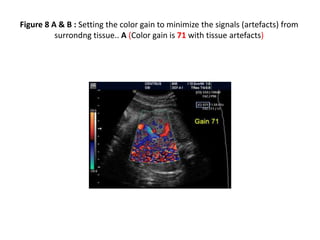
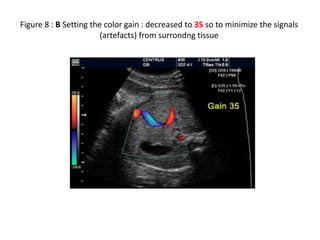
Figure 8 slides (4/5)
Figure 8 A & B : Setting the color gain to minimize the signals (artefacts) from
surrondng tissue.. A (Color gain is 71 with tissue artefacts)
Figure 8 : B Setting the color gain : decreased to 35 so to minimize the signals
(artefacts) from surrondng tissue
•
2) Frequency selection : Many scanner/transducer
combinations permit changes of frequency. High frequencies
give better sensitivity to low flow and have better spatial
resolution. Low frequencies have better penetration and are
less susceptible to aliasing at high velocities.
•
Figure (4 & 5) slides (7/8)
•
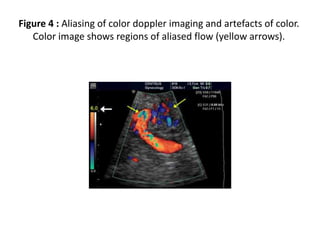
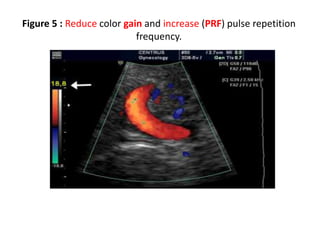
Figure 4 : Aliasing of color doppler imaging and artefacts of color.
Color image shows regions of aliased flow (yellow arrows).
Figure 5 : Reduce color gain and increase (PRF) pulse repetition
frequency.
•
3) Velocity scale/pulse repetition frequency:
•
Low (PRF) pulse
•
repetition frequencies should be used to examine low
velocities but aliasing may occur if high velocities are
encountered (Figura 7a,b) slides (10/11) .
•
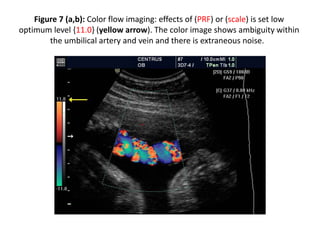
Figure 7 (a,b): Color flow imaging: effects of (PRF) or (scale) is set low
optimum level {11.0} (yellow arrow). The color image shows ambiguity within
the umbilical artery and vein and there is extraneous noise.
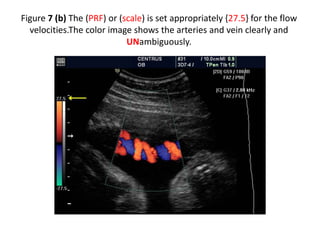
Figure 7 (b) The (PRF) or (scale) is set appropriately {27.5} for the flow
velocities.The color image shows the arteries and vein clearly and
UNambiguously.
•
4) Region of interest: Because more pulses are needed to
look at flow than for the B-mode image, : @ reducing the
width @ and maximum depth of the {color flow area under
investigation}; will usually : @ improve frame rate @ and
may allow a higher color scan line density @ with improved
spatial resolution
•
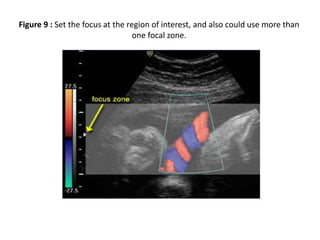
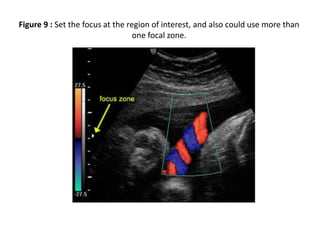
5) Focus: The focus should be at the level of the area of
interest. This can make a significant difference to the
appearance and accuracy of the image
•
(Figure 9) slides (13/14).
Figure 9 : Set the focus at the region of interest, and also could use more than
one focal zone.
Figure 9 : Set the focus at the region of interest, and also could use more than
one focal zone.
•
Other factors
•
1- Triplex color: PRF and FR reduced by need for B-
mode/spectral pulses
•
2- Persistence: (Persistence - is a type of temporal smoothing
used in both gray scale and color Doppler imaging.
•
Successive frames are averaged as they are displayed to
reduce the variations in the image between frames, hence
lowering the temporal resolution of the image.)
•
high persistence produces smoother image but reduces
temporal resolution*
•
3- Pre-processing: trades resolution against frame rate*
•
4- Filter: high filter :
•
@ cuts out more noise but @ also more of flow signal
•
5- Post-processing : @ assigns color map/variance .
•
@ Settings appropriate for specific examinations assigned by
set-up/application keys
•
In practice, the operator will make many changes to the
controls and will try different probe positions to optimize the
image.
•
Practical guidelines for CFD imaging
•
(1) Select the appropriate applications/set-up key. This
optimizes parameters for specific examinations
•
(2) Set power to within fetal study limits. Adjust color gain.
Ensure focus is at the region of interest and adjust gain to
optimize color signal
•
(3) Use probe positioning/beam steering to obtain satisfactory
beam/vessel angle
•
•
(4) Adjust pulse repetition frequency/scale to suit the flow
conditions. Low pulse repetition frequencies are more
sensitive to low flows/velocities but may produce aliasing.
High pulse repetition frequencies reduce aliasing but are less
sensitive to low velocities
•
(5) Set the color flow region to appropriate size.
•
A smaller color flow ‘box’ may lead to a better frame rate
and better color resolution/sensitivity
•
SPECTRAL OR PULSED WAVE DOPPLER
•
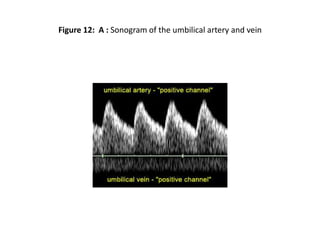
Pulsed wave Doppler (PWD)ultrasound is used to provide a
sonogram of the artery or vein under investigation
•
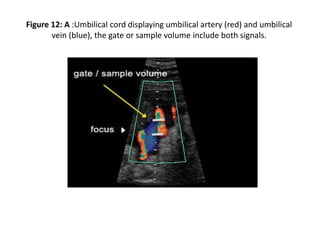
(Figure 12) slide (20/21).
•
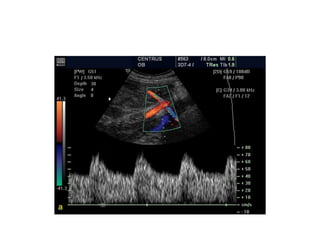
Doppler spectra of uterine artery flow.
•
(a) The color flow image allows beam/flow angle visualization. The
sonogram shows high velocities throughout the cardiac cycle,
indicating low distal resistance.
•
Figure 10 (a,b): slides (24)
•
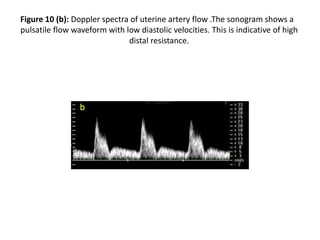
(b) The sonogram shows a pulsatile flow waveform with low
diastolic velocities. This is indicative of high distal resistance.
•
Slide (25)
Figure 12: A :Umbilical cord displaying umbilical artery (red) and umbilical
vein (blue), the gate or sample volume include both signals.
Figure 12: A : Sonogram of the umbilical artery and vein
•
The best resolution of the sonogram occurs when the B-mode
image and color image are frozen, allowing all the time to be
employed for spectral Doppler.
•
If concurrent imaging is used (real-time duplex or triplex
imaging), the temporal resolution of the sonogram is
compromised.
•
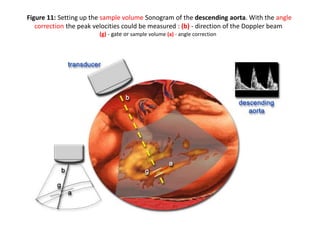
The sonogram provides a measure of the changing velocity
throughout the cardiac cycle and the distribution of velocities
in the sample volume (or gate)
•
(Figure 11) slide (23).
•
If an accurate angle correction is made, then absolute
velocities can be measured.
Figure 11: Setting up the sample volume Sonogram of the descending aorta. With the angle
correction the peak velocities could be measured : (b) - direction of the Doppler beam
(g) - gate or sample volume (a) - angle correction
Figure 10 (b): Doppler spectra of uterine artery flow .The sonogram shows a
pulsatile flow waveform with low diastolic velocities. This is indicative of high
distal resistance.
•
BLOOD FLOW MEASUREMENTS
•
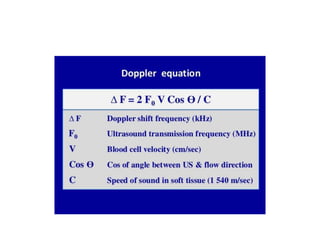
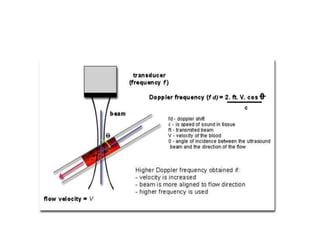
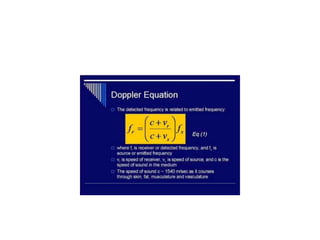
Velocity measurement
Theoretically, once the beam/flow angle is known, velocities
can be calculated from the Doppler spectrum as shown in the
Doppler equation
•
Slides
•
•
BLOOD FLOW MEASUREMENTS
•
Velocity measurement
Theoretically, once the beam/flow angle is known, velocities
can be calculated from the Doppler spectrum as shown in the
Doppler equation
•
slide (28/29/30)
•
. However, errors in the measured velocity may still occur .
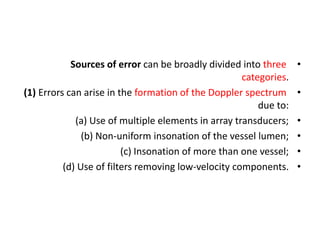
Sources of error can be broadly divided into three categories.
•
Sources of error can be broadly divided into three
categories.
•
(1) Errors can arise in the formation of the Doppler spectrum
due to:
•
(a) Use of multiple elements in array transducers;
•
(b) Non-uniform insonation of the vessel lumen;
•
(c) Insonation of more than one vessel;
•
(d) Use of filters removing low-velocity components.
•
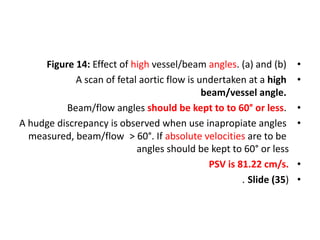
(2) Errors can arise in the measurement of the ultrasound
beam/flow velocity angle.
•
(a) Use of high angles (q > 60o) may give rise to error because
of the comparatively large changes in the cosine of the angle
which occur with small changes of angle
•
(Figure 14) slides (34/36) .
•
(b) The velocity vector may not be in the direction of the
vessel axis.
•
Figure 14: Effect of high vessel/beam angles. (a) and (b)
•
A scan of fetal aortic flow is undertaken at a high
beam/vessel angle.
•
Beam/flow angles should be kept to to 60° or less.
•
A hudge discrepancy is observed when use inapropiate angles
> 60°. If absolute velocities are to be
measured, beam/flow
angles should be kept to 60° or less
•
PSV is 81.22 cm/s.
•
Slide (35)
.
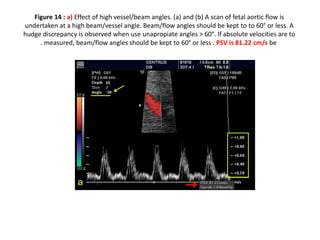
Figure 14 : a) Effect of high vessel/beam angles. (a) and (b) A scan of fetal aortic flow is
undertaken at a high beam/vessel angle. Beam/flow angles should be kept to to 60° or less. A
hudge discrepancy is observed when use unapropiate angles > 60°. If absolute velocities are to
be
measured, beam/flow angles should be kept to 60° or less . PSV is 81.22 cm/s
.
•
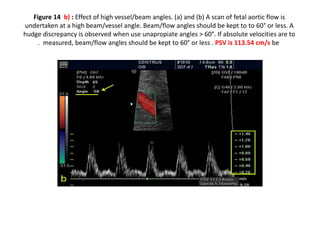
Figure 14 b) : Effect of high vessel/beam angles. (a) and (b)
•
A scan of fetal aortic flow is undertaken at a high beam/vessel
angle.
•
Beam/flow angles should be kept to to 60° or less.
•
A hudge discrepancy is observed when use unapropiate
angles > 60°. If absolute velocities are to be
measured,
beam/flow angles should be kept to 60° or less .
•
PSV is 113.54 cm/s
•
Slide (36)
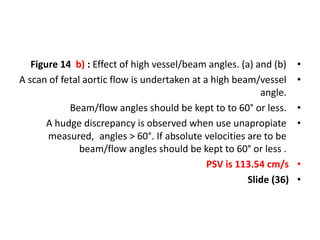
Figure 14 b) : Effect of high vessel/beam angles. (a) and (b) A scan of fetal aortic flow is
undertaken at a high beam/vessel angle. Beam/flow angles should be kept to to 60° or less. A
hudge discrepancy is observed when use unapropiate angles > 60°. If absolute velocities are to
be
measured, beam/flow angles should be kept to 60° or less . PSV is 113.54 cm/s
.
•
Velocity measurement
1)
Theoretically, once the beam/flow angle is known, velocities
can be calculated from the Doppler spectrum as shown in the
Doppler equation
•
2) Calculation of absolute flow
Total flow measurement using color or duplex Doppler
ultrasound is fraught with difficulties, even under ideal
conditions .
•
•
3) Flow waveform analysis
Non-dimensional analysis of the flow waveform shape and
spectrum has proved to be a useful technique in the
investigation of many vascular beds.
•
It has the advantage that derived indices are independent of
the beam/flow angle.
•
Changes in flow waveform shape have been used to
investigate both proximal disease (e.g. in the adult peripheral
arterial circulation) and distal changes (in the fetal circulation
and uterine arteries).
•
While the breadth of possible uses shows the technique to be
versatile, it also serves as a reminder of the range of factors
which cause changes to the local Doppler spectrum.
•
If waveform analysis is to be used to observe changes in one
component of the proximal or distal vasculature,
consideration must be given to what effects other
components may have on the waveform.
•
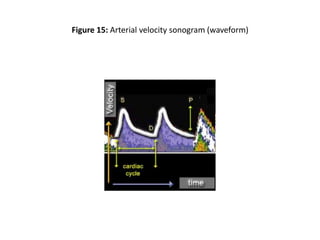
4) Flow waveform shape: indices of measurement
Many different indices have been used to describe the shape
of flow waveforms 1 .
•
Techniques range from simple indices of systolic to diastolic
flow to feature extraction methods such as principal
component analysis.
•
All are designed to describe the waveform in a quantitative
way, usually as a guide to some kind of classification. In
general, they are a compromise between simplicity and the
amount of information obtained.
•
Figure 15: Arterial velocity sonogram (waveform)
•
The relative merits of indices used in uterine arteries have
been discussed elsewhere. 6,7 .Commonly used indices
available on most commercial scanners are:
•
(1) Resistance index (RI) (also called resistive index or
Pourcelot’s index);
•
(2) Systolic/diastolic (S/D) ratio, sometimes called the A/B
ratio;
•
(3) Pulsatility index (PI) 8.
•
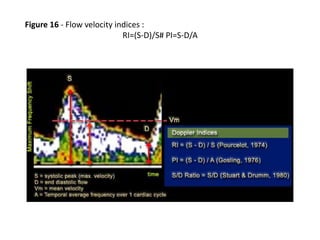
These indices are all based on the maximum Doppler shift
waveform and their calculation is described in Figure 12. The
PI takes slightly longer to calculate than the RI or S/D ratio
because of the need to measure the mean height of the
waveform. It does, however, give a broader range of values,
for instance in describing a range of waveform shapes when
there is no end-diastolic flow.
Figure 16 - Flow velocity indices :
RI=(S-D)/S# PI=S-D/A
•
In addition to these indices, the flow waveform may be
described or categorized by the presence or absence of a
particular feature, for example the absence of end-diastolic
flow and the presence of a post-systolic notch.
•
Generally, a low pulsatility waveform is indicative of low distal
resistance and high pulsatility waveforms occur in high-
resistance vascular beds (Figure 8), although the presence of
proximal stenosis, vascular steal or arteriovenous fistulas can
modify waveform shape.
•
Care should be taken when trying to interpret indices
as absolute measurements of either upstream or
downstream factors.
•
For example, alterations in heart rate can alter the
flow waveform shape and cause significant changes
in the value of indices.
Doppler ultrasound (4)

Doppler ultrasound (4)

  • 1.
    Doppler ultrasound (4) Dr.Kamal Sayed MSc US UAA color flow factors/CFD guidelines/PW spectral/ blood flow measurements
  • 2.
    • Factors affecting colorflow image • Main factors • Power: transmitted power into tissue* • Gain: overall sensitivity to flow signals. • Frequency: trades penetration for sensitivity and resolution* • Pulse repetition frequency (also called scale): • low pulse repetition frequency to look at low velocities, high pulse repetition frequency reduces aliasing* • Area of investigation: larger area reduces frame rate* • Focus: color flow image optimized at focal zone*
  • 3.
    • 1) Power andgain : Color flow (CFD) uses higher-intensity power than B-mode. • Attention should be paid to safety indices. • Power and gain should be set to : @ obtain good signal for flow @ and to minimize the signals from surrounding tissue. – Figure 8 slides (4/5)
  • 4.
    Figure 8 A& B : Setting the color gain to minimize the signals (artefacts) from surrondng tissue.. A (Color gain is 71 with tissue artefacts)
  • 5.
    Figure 8 :B Setting the color gain : decreased to 35 so to minimize the signals (artefacts) from surrondng tissue
  • 6.
    • 2) Frequency selection: Many scanner/transducer combinations permit changes of frequency. High frequencies give better sensitivity to low flow and have better spatial resolution. Low frequencies have better penetration and are less susceptible to aliasing at high velocities. • Figure (4 & 5) slides (7/8) •
  • 7.
    Figure 4 :Aliasing of color doppler imaging and artefacts of color. Color image shows regions of aliased flow (yellow arrows).
  • 8.
    Figure 5 :Reduce color gain and increase (PRF) pulse repetition frequency.
  • 9.
    • 3) Velocity scale/pulserepetition frequency: • Low (PRF) pulse • repetition frequencies should be used to examine low velocities but aliasing may occur if high velocities are encountered (Figura 7a,b) slides (10/11) . •
  • 10.
    Figure 7 (a,b):Color flow imaging: effects of (PRF) or (scale) is set low optimum level {11.0} (yellow arrow). The color image shows ambiguity within the umbilical artery and vein and there is extraneous noise.
  • 11.
    Figure 7 (b)The (PRF) or (scale) is set appropriately {27.5} for the flow velocities.The color image shows the arteries and vein clearly and UNambiguously.
  • 12.
    • 4) Region ofinterest: Because more pulses are needed to look at flow than for the B-mode image, : @ reducing the width @ and maximum depth of the {color flow area under investigation}; will usually : @ improve frame rate @ and may allow a higher color scan line density @ with improved spatial resolution • 5) Focus: The focus should be at the level of the area of interest. This can make a significant difference to the appearance and accuracy of the image • (Figure 9) slides (13/14).
  • 13.
    Figure 9 :Set the focus at the region of interest, and also could use more than one focal zone.
  • 14.
    Figure 9 :Set the focus at the region of interest, and also could use more than one focal zone.
  • 15.
    • Other factors • 1- Triplexcolor: PRF and FR reduced by need for B- mode/spectral pulses • 2- Persistence: (Persistence - is a type of temporal smoothing used in both gray scale and color Doppler imaging. • Successive frames are averaged as they are displayed to reduce the variations in the image between frames, hence lowering the temporal resolution of the image.) • high persistence produces smoother image but reduces temporal resolution*
  • 16.
    • 3- Pre-processing: tradesresolution against frame rate* • 4- Filter: high filter : • @ cuts out more noise but @ also more of flow signal • 5- Post-processing : @ assigns color map/variance . • @ Settings appropriate for specific examinations assigned by set-up/application keys
  • 17.
    • In practice, theoperator will make many changes to the controls and will try different probe positions to optimize the image. • Practical guidelines for CFD imaging • (1) Select the appropriate applications/set-up key. This optimizes parameters for specific examinations • (2) Set power to within fetal study limits. Adjust color gain. Ensure focus is at the region of interest and adjust gain to optimize color signal • (3) Use probe positioning/beam steering to obtain satisfactory beam/vessel angle •
  • 18.
    • (4) Adjust pulserepetition frequency/scale to suit the flow conditions. Low pulse repetition frequencies are more sensitive to low flows/velocities but may produce aliasing. High pulse repetition frequencies reduce aliasing but are less sensitive to low velocities • (5) Set the color flow region to appropriate size. • A smaller color flow ‘box’ may lead to a better frame rate and better color resolution/sensitivity
  • 19.
    • SPECTRAL OR PULSEDWAVE DOPPLER • Pulsed wave Doppler (PWD)ultrasound is used to provide a sonogram of the artery or vein under investigation • (Figure 12) slide (20/21). • Doppler spectra of uterine artery flow. • (a) The color flow image allows beam/flow angle visualization. The sonogram shows high velocities throughout the cardiac cycle, indicating low distal resistance. • Figure 10 (a,b): slides (24) • (b) The sonogram shows a pulsatile flow waveform with low diastolic velocities. This is indicative of high distal resistance. • Slide (25)
  • 20.
    Figure 12: A:Umbilical cord displaying umbilical artery (red) and umbilical vein (blue), the gate or sample volume include both signals.
  • 21.
    Figure 12: A: Sonogram of the umbilical artery and vein
  • 22.
    • The best resolutionof the sonogram occurs when the B-mode image and color image are frozen, allowing all the time to be employed for spectral Doppler. • If concurrent imaging is used (real-time duplex or triplex imaging), the temporal resolution of the sonogram is compromised. • The sonogram provides a measure of the changing velocity throughout the cardiac cycle and the distribution of velocities in the sample volume (or gate) • (Figure 11) slide (23). • If an accurate angle correction is made, then absolute velocities can be measured.
  • 23.
    Figure 11: Settingup the sample volume Sonogram of the descending aorta. With the angle correction the peak velocities could be measured : (b) - direction of the Doppler beam (g) - gate or sample volume (a) - angle correction
  • 25.
    Figure 10 (b):Doppler spectra of uterine artery flow .The sonogram shows a pulsatile flow waveform with low diastolic velocities. This is indicative of high distal resistance.
  • 26.
    • BLOOD FLOW MEASUREMENTS • Velocitymeasurement Theoretically, once the beam/flow angle is known, velocities can be calculated from the Doppler spectrum as shown in the Doppler equation • Slides •
  • 27.
    • BLOOD FLOW MEASUREMENTS • Velocitymeasurement Theoretically, once the beam/flow angle is known, velocities can be calculated from the Doppler spectrum as shown in the Doppler equation • slide (28/29/30) • . However, errors in the measured velocity may still occur . Sources of error can be broadly divided into three categories.
  • 31.
    • Sources of errorcan be broadly divided into three categories. • (1) Errors can arise in the formation of the Doppler spectrum due to: • (a) Use of multiple elements in array transducers; • (b) Non-uniform insonation of the vessel lumen; • (c) Insonation of more than one vessel; • (d) Use of filters removing low-velocity components.
  • 32.
    • (2) Errors canarise in the measurement of the ultrasound beam/flow velocity angle. • (a) Use of high angles (q > 60o) may give rise to error because of the comparatively large changes in the cosine of the angle which occur with small changes of angle • (Figure 14) slides (34/36) . • (b) The velocity vector may not be in the direction of the vessel axis.
  • 33.
    • Figure 14: Effectof high vessel/beam angles. (a) and (b) • A scan of fetal aortic flow is undertaken at a high beam/vessel angle. • Beam/flow angles should be kept to to 60° or less. • A hudge discrepancy is observed when use inapropiate angles > 60°. If absolute velocities are to be measured, beam/flow angles should be kept to 60° or less • PSV is 81.22 cm/s. • Slide (35) .
  • 34.
    Figure 14 :a) Effect of high vessel/beam angles. (a) and (b) A scan of fetal aortic flow is undertaken at a high beam/vessel angle. Beam/flow angles should be kept to to 60° or less. A hudge discrepancy is observed when use unapropiate angles > 60°. If absolute velocities are to be measured, beam/flow angles should be kept to 60° or less . PSV is 81.22 cm/s .
  • 35.
    • Figure 14 b): Effect of high vessel/beam angles. (a) and (b) • A scan of fetal aortic flow is undertaken at a high beam/vessel angle. • Beam/flow angles should be kept to to 60° or less. • A hudge discrepancy is observed when use unapropiate angles > 60°. If absolute velocities are to be measured, beam/flow angles should be kept to 60° or less . • PSV is 113.54 cm/s • Slide (36)
  • 36.
    Figure 14 b): Effect of high vessel/beam angles. (a) and (b) A scan of fetal aortic flow is undertaken at a high beam/vessel angle. Beam/flow angles should be kept to to 60° or less. A hudge discrepancy is observed when use unapropiate angles > 60°. If absolute velocities are to be measured, beam/flow angles should be kept to 60° or less . PSV is 113.54 cm/s .
  • 37.
    • Velocity measurement 1) Theoretically, oncethe beam/flow angle is known, velocities can be calculated from the Doppler spectrum as shown in the Doppler equation • 2) Calculation of absolute flow Total flow measurement using color or duplex Doppler ultrasound is fraught with difficulties, even under ideal conditions . •
  • 38.
    • 3) Flow waveformanalysis Non-dimensional analysis of the flow waveform shape and spectrum has proved to be a useful technique in the investigation of many vascular beds. • It has the advantage that derived indices are independent of the beam/flow angle. • Changes in flow waveform shape have been used to investigate both proximal disease (e.g. in the adult peripheral arterial circulation) and distal changes (in the fetal circulation and uterine arteries).
  • 39.
    • While the breadthof possible uses shows the technique to be versatile, it also serves as a reminder of the range of factors which cause changes to the local Doppler spectrum. • If waveform analysis is to be used to observe changes in one component of the proximal or distal vasculature, consideration must be given to what effects other components may have on the waveform.
  • 40.
    • 4) Flow waveformshape: indices of measurement Many different indices have been used to describe the shape of flow waveforms 1 . • Techniques range from simple indices of systolic to diastolic flow to feature extraction methods such as principal component analysis. • All are designed to describe the waveform in a quantitative way, usually as a guide to some kind of classification. In general, they are a compromise between simplicity and the amount of information obtained. •
  • 41.
    Figure 15: Arterialvelocity sonogram (waveform)
  • 42.
    • The relative meritsof indices used in uterine arteries have been discussed elsewhere. 6,7 .Commonly used indices available on most commercial scanners are: • (1) Resistance index (RI) (also called resistive index or Pourcelot’s index); • (2) Systolic/diastolic (S/D) ratio, sometimes called the A/B ratio; • (3) Pulsatility index (PI) 8.
  • 43.
    • These indices areall based on the maximum Doppler shift waveform and their calculation is described in Figure 12. The PI takes slightly longer to calculate than the RI or S/D ratio because of the need to measure the mean height of the waveform. It does, however, give a broader range of values, for instance in describing a range of waveform shapes when there is no end-diastolic flow.
  • 44.
    Figure 16 -Flow velocity indices : RI=(S-D)/S# PI=S-D/A
  • 45.
    • In addition tothese indices, the flow waveform may be described or categorized by the presence or absence of a particular feature, for example the absence of end-diastolic flow and the presence of a post-systolic notch. • Generally, a low pulsatility waveform is indicative of low distal resistance and high pulsatility waveforms occur in high- resistance vascular beds (Figure 8), although the presence of proximal stenosis, vascular steal or arteriovenous fistulas can modify waveform shape.
  • 46.
    • Care should betaken when trying to interpret indices as absolute measurements of either upstream or downstream factors. • For example, alterations in heart rate can alter the flow waveform shape and cause significant changes in the value of indices.