MFM cmu 2010
Physics & Principles
Basic Ultrasound
20 October 2010
MFM cmu 2010
Physics & Principles
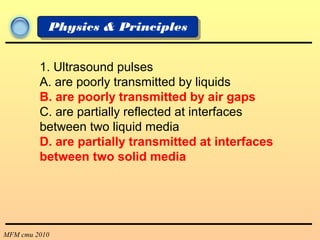
1. Ultrasound pulses
A. are poorly transmitted by liquids
B. are poorly transmitted by air gaps
C. are partially reflected at interfaces
between two liquid media
D. are partially transmitted at interfaces
between two solid media
MFM cmu 2010
Physics & Principles
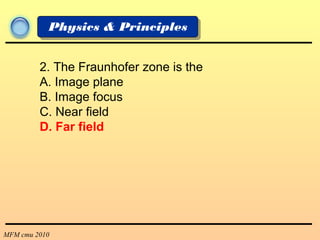
2. The Fraunhofer zone is the
A. Image plane
B. Image focus
C. Near field
D. Far field
MFM cmu 2010
Physics & Principles
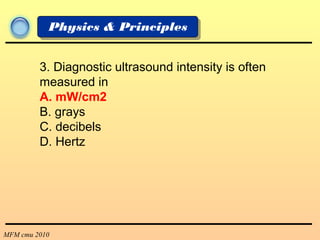
3. Diagnostic ultrasound intensity is often
measured in
A. mW/cm2
B. grays
C. decibels
D. Hertz
MFM cmu 2010
Physics & Principles
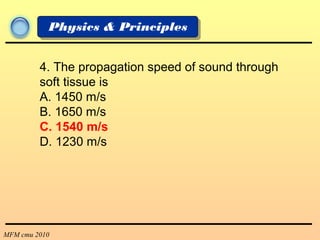
4. The propagation speed of sound through
soft tissue is
A. 1450 m/s
B. 1650 m/s
C. 1540 m/s
D. 1230 m/s
MFM cmu 2010
Physics & Principles
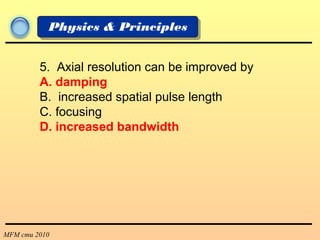
5. Axial resolution can be improved by
A. damping
B. increased spatial pulse length
C. focusing
D. increased bandwidth
MFM cmu 2010
Physics & Principles
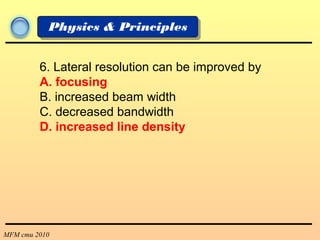
6. Lateral resolution can be improved by
A. focusing
B. increased beam width
C. decreased bandwidth
D. increased line density
MFM cmu 2010
Physics & Principles
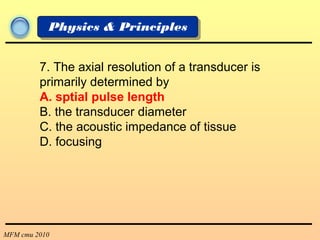
7. The axial resolution of a transducer is
primarily determined by
A. sptial pulse length
B. the transducer diameter
C. the acoustic impedance of tissue
D. focusing
MFM cmu 2010
Physics & Principles
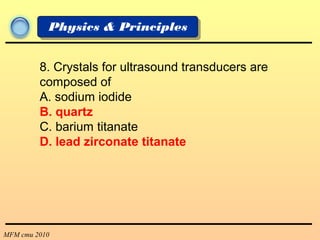
8. Crystals for ultrasound transducers are
composed of
A. sodium iodide
B. quartz
C. barium titanate
D. lead zirconate titanate
MFM cmu 2010
Physics & Principles
9. The TGC control compensates for
A. focusing
B. machine instability
C. scan line density
D. attenuation
MFM cmu 2010
Physics & Principles
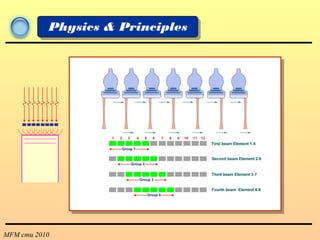
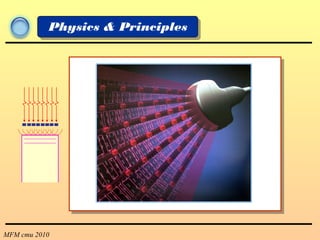
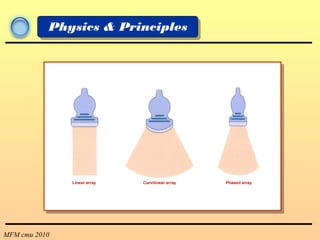
10. Phased array transducers
A. have elements which emit ultrasound
independently
B. may be used to alter the beam direction
C. are used only on real-time scanners
D. have a variable frequency
MFM cmu 2010
Physics & Principles
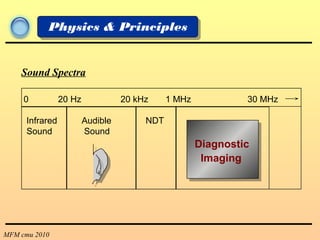
 Audible: 20 to 20,000 Hz
 Ultrasound: 1 to 30 MHz
 Hertz: 1 cycle per second
 Megahertz: 1,000,000 Hz
MFM cmu 2010
Physics & Principles
Diagnostic
Imaging
0 20 Hz 20 kHz 1 MHz 30 MHz
Infrared Audible NDT
Sound Sound
Sound Spectra
MFM cmu 2010
Physics & Principles
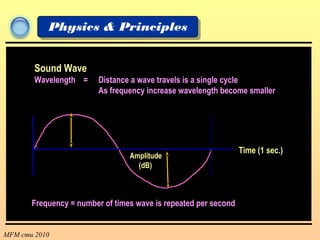
Time (1 sec.)
Sound Wave
Wavelength = Distance a wave travels is a single cycle
As frequency increase wavelength become smaller
Amplitude
(dB)
Frequency = number of times wave is repeated per second
MFM cmu 2010
Physics & Principles
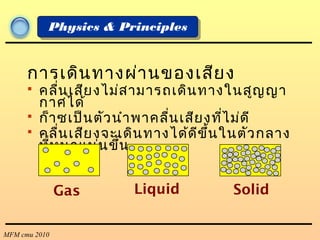
การเดินทางผ่านของเสียง
 คลื่นเสียงไม่สามารถเดินทางในสูญญา
กาศได้
 ก็าซเป็นตัวนำาพาคลื่นเสียงที่ไม่ดี
 คลื่นเสียงจะเดินทางได้ดีขึ้นในตัวกลาง
ที่หนาแน่นขึ้น
Gas Liquid Solid
MFM cmu 2010
Physics & Principles
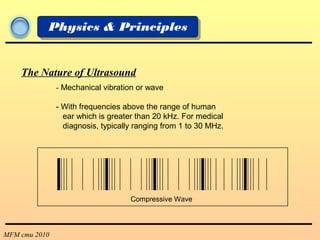
- Mechanical vibration or wave
- With frequencies above the range of human
ear which is greater than 20 kHz. For medical
diagnosis, typically ranging from 1 to 30 MHz.
The Nature of Ultrasound
Compressive Wave
MFM cmu 2010
Physics & Principles
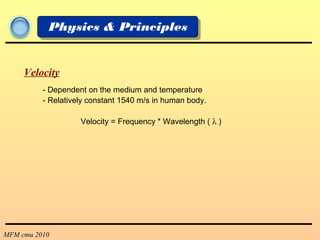
Velocity
- Dependent on the medium and temperature
- Relatively constant 1540 m/s in human body.
Velocity = Frequency * Wavelength ( λ )
MFM cmu 2010
Physics & Principles
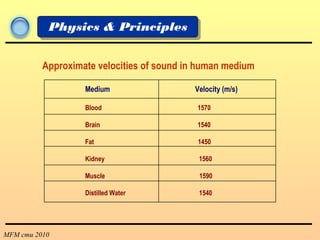
Approximate velocities of sound in human medium
Medium Velocity (m/s)
Blood 1570
Brain 1540
Fat 1450
Kidney 1560
Muscle 1590
Distilled Water 1540
MFM cmu 2010
Physics & Principles
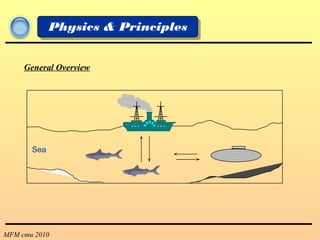
General Overview
Sea
MFM cmu 2010
Physics & Principles
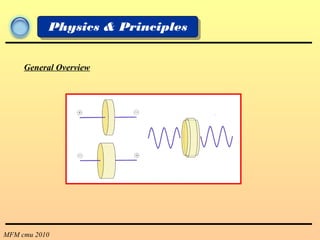
General Overview
MFM cmu 2010
Physics & Principles
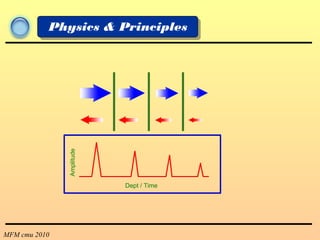
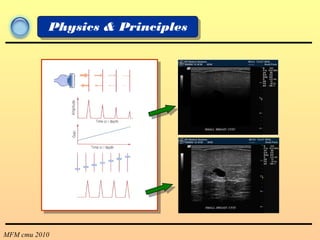
Amplitude
Dept / Time
MFM cmu 2010
Physics & Principles
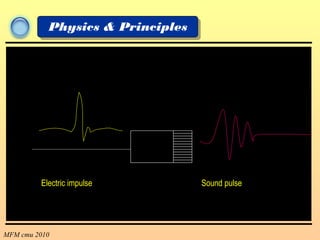
Electric impulse Sound pulse
MFM cmu 2010
Physics & Principles
MFM cmu 2010
Physics & Principles
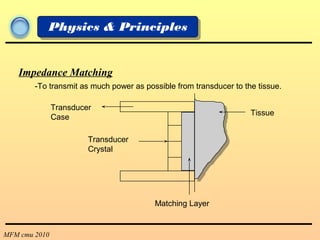
Matching Layer
Transducer
Crystal
Tissue
Impedance Matching
Transducer
Case
-To transmit as much power as possible from transducer to the tissue.
MFM cmu 2010
Physics & Principles
Acoustic Output
 Acoustic Output increases or decreases the system
power during transmit. Always adjust gain before
adjusting acoustic output.
 Acoustic Output optimizes the image quality thereby
minimizing exposure time to the patient while
maximizing the penetration and echo return.
MFM cmu 2010
Physics & Principles
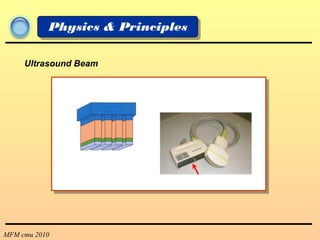
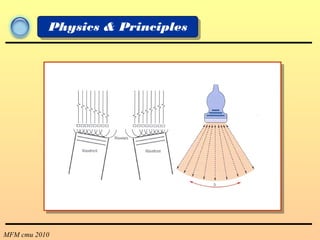
Ultrasound Beam
MFM cmu 2010
Physics & Principles
MFM cmu 2010
Physics & Principles
MFM cmu 2010
Physics & Principles
MFM cmu 2010
Physics & Principles
MFM cmu 2010
Physics & Principles
MFM cmu 2010
Physics & Principles
Attenuation
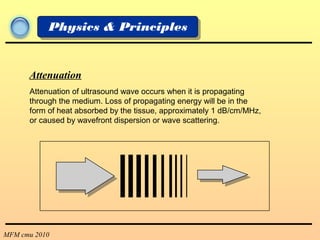
Attenuation of ultrasound wave occurs when it is propagating
through the medium. Loss of propagating energy will be in the
form of heat absorbed by the tissue, approximately 1 dB/cm/MHz,
or caused by wavefront dispersion or wave scattering.
MFM cmu 2010
Physics & Principles
MFM cmu 2010
Physics & Principles
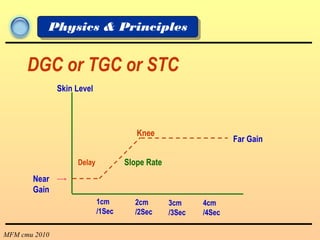
Skin Level
Near
Gain
Delay
Far Gain
Knee
Slope Rate
1cm
/1Sec
2cm
/2Sec
3cm
/3Sec
4cm
/4Sec
DGC or TGC or STC
MFM cmu 2010
Physics & Principles
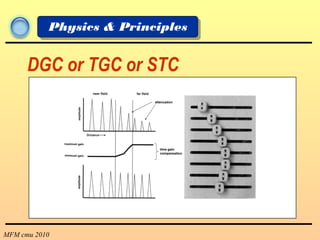
DGC or TGC or STC
MFM cmu 2010
Physics & Principles
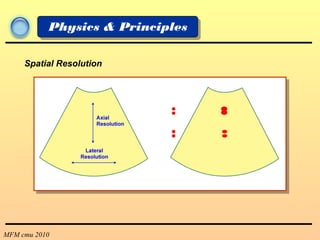
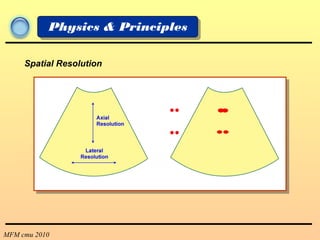
Spatial Resolution
MFM cmu 2010
Physics & Principles
Spatial Resolution
MFM cmu 2010
Physics & Principles
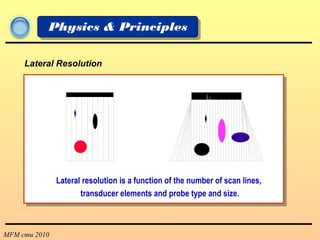
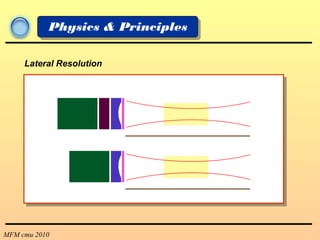
Lateral Resolution
MFM cmu 2010
Physics & Principles
Lateral resolution is a function of the number of scan lines,
transducer elements and probe type and size.
Lateral Resolution
MFM cmu 2010
Physics & Principles
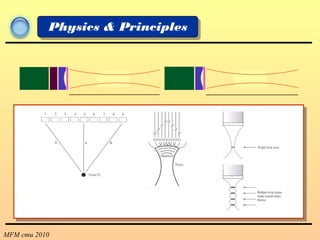
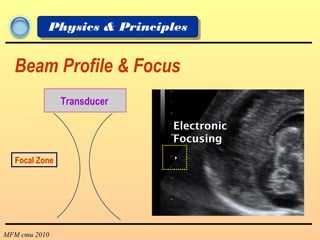
Beam Profile & Focus
Focal Zone
Transducer
Electronic
Focusing
MFM cmu 2010
Physics & Principles
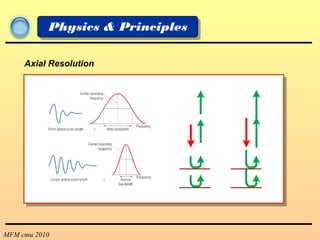
Axial Resolution
MFM cmu 2010
Physics & Principles
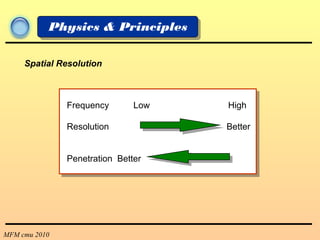
Spatial Resolution
Frequency Low High
Resolution Better
Penetration Better
MFM cmu 2010
Physics & Principles
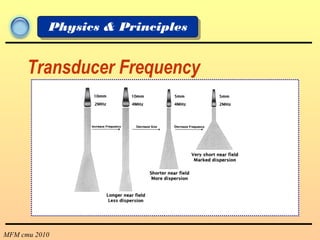
Transducer Frequency
MFM cmu 2010
Physics & Principles
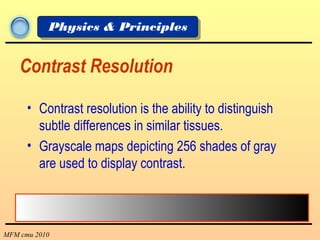
Contrast Resolution
• Contrast resolution is the ability to distinguish
subtle differences in similar tissues.
• Grayscale maps depicting 256 shades of gray
are used to display contrast.
MFM cmu 2010
Physics & Principles
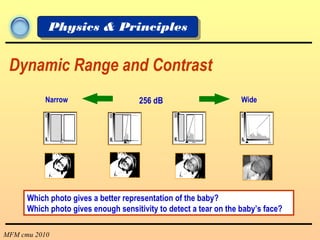
Dynamic Range and Contrast
256 dBNarrow Wide
Which photo gives a better representation of the baby?
Which photo gives enough sensitivity to detect a tear on the baby’s face?
MFM cmu 2010
Physics & Principles
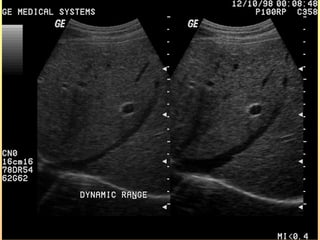
Dynamic Range
 Dynamic Range controls how echo intensities are
converted to shades of gray, thereby creating a range of
gray scale that can be adjusted.
 Dynamic Range is useful for optimizing tissue texture to
differentiate between echo levels that are close
together.
MFM cmu 2010
Physics & Principles
MFM cmu 2010
Physics & Principles
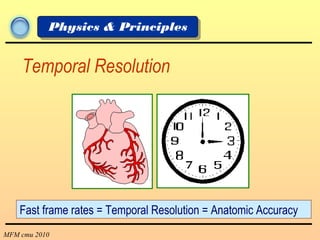
Temporal Resolution
Fast frame rates = Temporal Resolution = Anatomic Accuracy
MFM cmu 2010
Physics & Principles
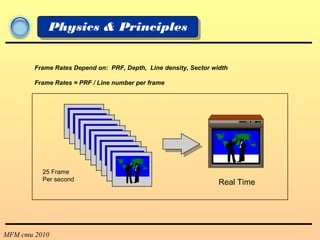
Frame Rates Depend on: PRF, Depth, Line density, Sector width
Frame Rates = PRF / Line number per frame
25 Frame
Per second
Real Time
MFM cmu 2010
Physics & Principles
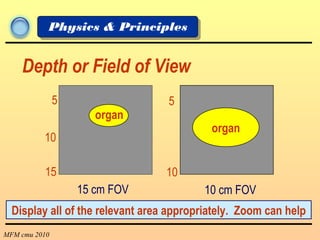
Depth or Field of View
organ
15 cm FOV
5
10
15
organ
10 cm FOV
5
10
Display all of the relevant area appropriately. Zoom can help
MFM cmu 2010
Physics & Principles
1. Ultrasound pulses
A. are poorly transmitted by liquids
B. are poorly transmitted by air gaps
C. are partially reflected at interfaces
between two liquid media
D. are partially transmitted at interfaces
between two solid media
MFM cmu 2010
Physics & Principles
2. The Fraunhofer zone is the
A. Image plane
B. Image focus
C. Near field
D. Far field
MFM cmu 2010
Physics & Principles
3. Diagnostic ultrasound intensity is often
measured in
A. mW/cm2
B. grays
C. decibels
D. Hertz
MFM cmu 2010
Physics & Principles
4. The propagation speed of sound through
soft tissue is
A. 1450 m/s
B. 1650 m/s
C. 1540 m/s
D. 1230 m/s
MFM cmu 2010
Physics & Principles
5. Axial resolution can be improved by
A. damping
B. increased spatial pulse length
C. focusing
D. increased bandwidth
MFM cmu 2010
Physics & Principles
6. Lateral resolution can be improved by
A. focusing
B. increased beam width
C. decreased bandwidth
D. increased line density
MFM cmu 2010
Physics & Principles
7. The axial resolution of a transducer is
primarily determined by
A. sptial pulse length
B. the transducer diameter
C. the acoustic impedance of tissue
D. focusing
MFM cmu 2010
Physics & Principles
8. Crystals for ultrasound transducers are
composed of
A. sodium iodide
B. quartz
C. barium titanate
D. lead zirconate titanate
MFM cmu 2010
Physics & Principles
9. The TGC control compensates for
A. focusing
B. machine instability
C. scan line density
D. attenuation
MFM cmu 2010
Physics & Principles
10. Phased array transducers
A. have elements which emit ultrasound
independently
B. may be used to alter the beam
direction
C. are used only on real-time scanners
D. have a variable frequency

Physics us2010

  • 1.
    MFM cmu 2010 Physics& Principles Basic Ultrasound 20 October 2010
  • 2.
    MFM cmu 2010 Physics& Principles 1. Ultrasound pulses A. are poorly transmitted by liquids B. are poorly transmitted by air gaps C. are partially reflected at interfaces between two liquid media D. are partially transmitted at interfaces between two solid media
  • 3.
    MFM cmu 2010 Physics& Principles 2. The Fraunhofer zone is the A. Image plane B. Image focus C. Near field D. Far field
  • 4.
    MFM cmu 2010 Physics& Principles 3. Diagnostic ultrasound intensity is often measured in A. mW/cm2 B. grays C. decibels D. Hertz
  • 5.
    MFM cmu 2010 Physics& Principles 4. The propagation speed of sound through soft tissue is A. 1450 m/s B. 1650 m/s C. 1540 m/s D. 1230 m/s
  • 6.
    MFM cmu 2010 Physics& Principles 5. Axial resolution can be improved by A. damping B. increased spatial pulse length C. focusing D. increased bandwidth
  • 7.
    MFM cmu 2010 Physics& Principles 6. Lateral resolution can be improved by A. focusing B. increased beam width C. decreased bandwidth D. increased line density
  • 8.
    MFM cmu 2010 Physics& Principles 7. The axial resolution of a transducer is primarily determined by A. sptial pulse length B. the transducer diameter C. the acoustic impedance of tissue D. focusing
  • 9.
    MFM cmu 2010 Physics& Principles 8. Crystals for ultrasound transducers are composed of A. sodium iodide B. quartz C. barium titanate D. lead zirconate titanate
  • 10.
    MFM cmu 2010 Physics& Principles 9. The TGC control compensates for A. focusing B. machine instability C. scan line density D. attenuation
  • 11.
    MFM cmu 2010 Physics& Principles 10. Phased array transducers A. have elements which emit ultrasound independently B. may be used to alter the beam direction C. are used only on real-time scanners D. have a variable frequency
  • 12.
    MFM cmu 2010 Physics& Principles  Audible: 20 to 20,000 Hz  Ultrasound: 1 to 30 MHz  Hertz: 1 cycle per second  Megahertz: 1,000,000 Hz
  • 13.
    MFM cmu 2010 Physics& Principles Diagnostic Imaging 0 20 Hz 20 kHz 1 MHz 30 MHz Infrared Audible NDT Sound Sound Sound Spectra
  • 14.
    MFM cmu 2010 Physics& Principles Time (1 sec.) Sound Wave Wavelength = Distance a wave travels is a single cycle As frequency increase wavelength become smaller Amplitude (dB) Frequency = number of times wave is repeated per second
  • 15.
    MFM cmu 2010 Physics& Principles การเดินทางผ่านของเสียง  คลื่นเสียงไม่สามารถเดินทางในสูญญา กาศได้  ก็าซเป็นตัวนำาพาคลื่นเสียงที่ไม่ดี  คลื่นเสียงจะเดินทางได้ดีขึ้นในตัวกลาง ที่หนาแน่นขึ้น Gas Liquid Solid
  • 16.
    MFM cmu 2010 Physics& Principles - Mechanical vibration or wave - With frequencies above the range of human ear which is greater than 20 kHz. For medical diagnosis, typically ranging from 1 to 30 MHz. The Nature of Ultrasound Compressive Wave
  • 17.
    MFM cmu 2010 Physics& Principles Velocity - Dependent on the medium and temperature - Relatively constant 1540 m/s in human body. Velocity = Frequency * Wavelength ( λ )
  • 18.
    MFM cmu 2010 Physics& Principles Approximate velocities of sound in human medium Medium Velocity (m/s) Blood 1570 Brain 1540 Fat 1450 Kidney 1560 Muscle 1590 Distilled Water 1540
  • 19.
    MFM cmu 2010 Physics& Principles General Overview Sea
  • 20.
    MFM cmu 2010 Physics& Principles General Overview
  • 21.
    MFM cmu 2010 Physics& Principles Amplitude Dept / Time
  • 22.
    MFM cmu 2010 Physics& Principles Electric impulse Sound pulse
  • 23.
  • 24.
    MFM cmu 2010 Physics& Principles Matching Layer Transducer Crystal Tissue Impedance Matching Transducer Case -To transmit as much power as possible from transducer to the tissue.
  • 25.
    MFM cmu 2010 Physics& Principles Acoustic Output  Acoustic Output increases or decreases the system power during transmit. Always adjust gain before adjusting acoustic output.  Acoustic Output optimizes the image quality thereby minimizing exposure time to the patient while maximizing the penetration and echo return.
  • 26.
    MFM cmu 2010 Physics& Principles Ultrasound Beam
  • 27.
  • 28.
  • 29.
  • 30.
  • 31.
  • 32.
    MFM cmu 2010 Physics& Principles Attenuation Attenuation of ultrasound wave occurs when it is propagating through the medium. Loss of propagating energy will be in the form of heat absorbed by the tissue, approximately 1 dB/cm/MHz, or caused by wavefront dispersion or wave scattering.
  • 33.
  • 34.
    MFM cmu 2010 Physics& Principles Skin Level Near Gain Delay Far Gain Knee Slope Rate 1cm /1Sec 2cm /2Sec 3cm /3Sec 4cm /4Sec DGC or TGC or STC
  • 35.
    MFM cmu 2010 Physics& Principles DGC or TGC or STC
  • 36.
    MFM cmu 2010 Physics& Principles Spatial Resolution
  • 37.
    MFM cmu 2010 Physics& Principles Spatial Resolution
  • 38.
    MFM cmu 2010 Physics& Principles Lateral Resolution
  • 39.
    MFM cmu 2010 Physics& Principles Lateral resolution is a function of the number of scan lines, transducer elements and probe type and size. Lateral Resolution
  • 40.
    MFM cmu 2010 Physics& Principles Beam Profile & Focus Focal Zone Transducer Electronic Focusing
  • 41.
    MFM cmu 2010 Physics& Principles Axial Resolution
  • 42.
    MFM cmu 2010 Physics& Principles Spatial Resolution Frequency Low High Resolution Better Penetration Better
  • 43.
    MFM cmu 2010 Physics& Principles Transducer Frequency
  • 44.
    MFM cmu 2010 Physics& Principles Contrast Resolution • Contrast resolution is the ability to distinguish subtle differences in similar tissues. • Grayscale maps depicting 256 shades of gray are used to display contrast.
  • 45.
    MFM cmu 2010 Physics& Principles Dynamic Range and Contrast 256 dBNarrow Wide Which photo gives a better representation of the baby? Which photo gives enough sensitivity to detect a tear on the baby’s face?
  • 46.
    MFM cmu 2010 Physics& Principles Dynamic Range  Dynamic Range controls how echo intensities are converted to shades of gray, thereby creating a range of gray scale that can be adjusted.  Dynamic Range is useful for optimizing tissue texture to differentiate between echo levels that are close together.
  • 47.
  • 48.
    MFM cmu 2010 Physics& Principles Temporal Resolution Fast frame rates = Temporal Resolution = Anatomic Accuracy
  • 49.
    MFM cmu 2010 Physics& Principles Frame Rates Depend on: PRF, Depth, Line density, Sector width Frame Rates = PRF / Line number per frame 25 Frame Per second Real Time
  • 50.
    MFM cmu 2010 Physics& Principles Depth or Field of View organ 15 cm FOV 5 10 15 organ 10 cm FOV 5 10 Display all of the relevant area appropriately. Zoom can help
  • 51.
    MFM cmu 2010 Physics& Principles 1. Ultrasound pulses A. are poorly transmitted by liquids B. are poorly transmitted by air gaps C. are partially reflected at interfaces between two liquid media D. are partially transmitted at interfaces between two solid media
  • 52.
    MFM cmu 2010 Physics& Principles 2. The Fraunhofer zone is the A. Image plane B. Image focus C. Near field D. Far field
  • 53.
    MFM cmu 2010 Physics& Principles 3. Diagnostic ultrasound intensity is often measured in A. mW/cm2 B. grays C. decibels D. Hertz
  • 54.
    MFM cmu 2010 Physics& Principles 4. The propagation speed of sound through soft tissue is A. 1450 m/s B. 1650 m/s C. 1540 m/s D. 1230 m/s
  • 55.
    MFM cmu 2010 Physics& Principles 5. Axial resolution can be improved by A. damping B. increased spatial pulse length C. focusing D. increased bandwidth
  • 56.
    MFM cmu 2010 Physics& Principles 6. Lateral resolution can be improved by A. focusing B. increased beam width C. decreased bandwidth D. increased line density
  • 57.
    MFM cmu 2010 Physics& Principles 7. The axial resolution of a transducer is primarily determined by A. sptial pulse length B. the transducer diameter C. the acoustic impedance of tissue D. focusing
  • 58.
    MFM cmu 2010 Physics& Principles 8. Crystals for ultrasound transducers are composed of A. sodium iodide B. quartz C. barium titanate D. lead zirconate titanate
  • 59.
    MFM cmu 2010 Physics& Principles 9. The TGC control compensates for A. focusing B. machine instability C. scan line density D. attenuation
  • 60.
    MFM cmu 2010 Physics& Principles 10. Phased array transducers A. have elements which emit ultrasound independently B. may be used to alter the beam direction C. are used only on real-time scanners D. have a variable frequency