




Chapter 13: North and SouthMagister RicardUS History
The North’s EconomyChapter 13.1
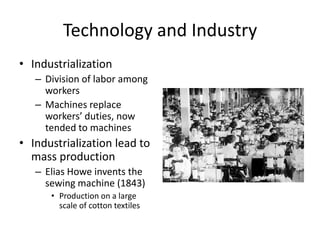
Technology and IndustryIndustrialization Division of labor among workersMachines replace workers’ duties, now tended to machinesIndustrialization lead to mass productionElias Howe invents the sewing machine (1843)Production on a large scale of cotton textiles
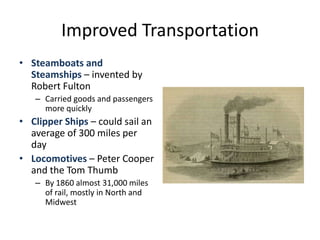
Improved TransportationSteamboats and Steamships – invented by Robert FultonCarried goods and passengers more quicklyClipper Ships – could sail an average of 300 miles per dayLocomotives – Peter Cooper and the Tom ThumbBy 1860 almost 31,000 miles of rail, mostly in North and Midwest
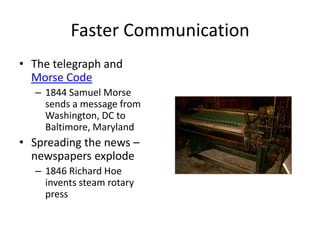
Faster CommunicationThe telegraph and Morse Code1844 Samuel Morse sends a message from Washington, DC to Baltimore, MarylandSpreading the news – newspapers explode1846 Richard Hoe invents steam rotary press
Revolution in Agriculture1837 John Deere’s steel-tipped plow allows for pioneers in Great Plains to farm1834 Cyrus McCormick mechanizes the reaper, used to harvest wheat which would become a staple crop of Midwest
The North’s PeopleChapter 13.2
Northern FactoriesBetween 1820s and 1860s, industrialization increasedWork was dangerous, conditions brutalWorkers were tending to machines with little protectionOwners cared more about profits than people – no laws existed to protect workersWorkers started forming trade unions, would strike for better conditions
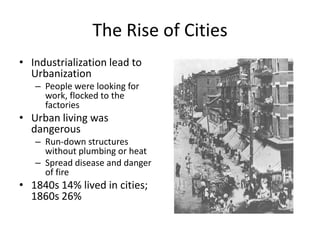
The Rise of CitiesIndustrialization lead to UrbanizationPeople were looking for work, flocked to the factoriesUrban living was dangerousRun-down structures without plumbing or heatSpread disease and danger of fire1840s 14% lived in cities; 1860s 26%
ImmigrationBetween 1846-1860 1.5 million Irish immigrated to US due to potato famineBy 1850 1/3 of workers in Boston were IrishBetween 1848-1860 1 million German immigrants came to USImmigrants brought their languages, customs, cultures which were melted into American cultureImmigrants remind us of what we take for granted
ImmigrationImmigration leads to prejudiceKnow-Nothing Party – a political party formed by nativists who claimed to “know nothing”Called for stricter citizenship laws; prohibit foreigners from holding officeBy mid-1850s would split into Northern and Southern branches over question of slavery
Southern Cotton KingdomChapter 13.3
Rise of the Cotton KingdomSlavery was disappearing in the North by 1820s; grew stronger in the SouthTobacco and rice were former cash cropsSugarcane was too costly to produceUpper South produces tobacco; Deep South produces rice, sugarcane, and cotton1793 Eli Whitney invents the Cotton Gin – removed seeds from cotton fibersIncrease in slave labor and need for land
Industry’s Limited Role in the SouthNorth = industryNorth lacked good land, forced to innovateSouth = agricultureLack of capital – money used to invest in businessLack of vision in future marketsNorth used immigrant labor force, South slave labor forceLack of industry and railroads would plague South in Civil War
The South’s PeopleChapter 13.4
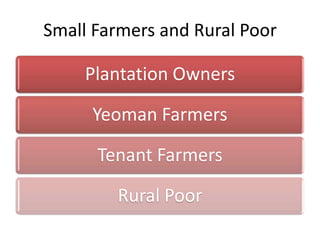
Small Farmers and Rural Poor
Small Farmers and Rural PoorYeomen farmers made up largest group of Southern white farmers – no slavesRanged from 50-200 acresSome rented land or were tenant farmers worked on landlord estatesRural poor sustenance farming, proud to be self-sufficient
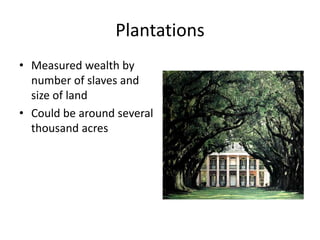
PlantationsMeasured wealth by number of slaves and size of landCould be around several thousand acres
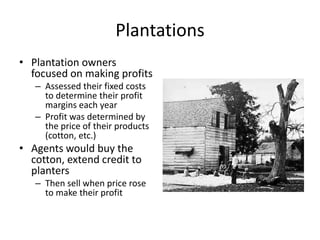
PlantationsPlantation owners focused on making profitsAssessed their fixed costs to determine their profit margins each yearProfit was determined by the price of their products (cotton, etc.)Agents would buy the cotton, extend credit to planters Then sell when price rose to make their profit
PlantationsPlantation wives watched over slaves who worked in the home, tended to them when sick, supervised construction, kept recordsDomestic slaves worked indoorsOthers were skilled laborers (blacksmiths, carpenters, etc.)Most slaves were field hands – supervised by an overseer
Life Under SlaveryWorked hard, earned no money, little hope of freedomFeared being resold, separated from familyFormed networks of extended families to cope and give stabilityMarriage was not honored by law, but did occurHeld on to their customs, but turned to Christianity for hopeDeveloped spirituals, or religious folk songs
Life Under SlaverySlave Codes – series of laws passed between 1830-1860Slaves were not allowed to gather in large numbersSlaves were not allowed to leave property without authorizationIt was a crime to teach slaves how to read and write
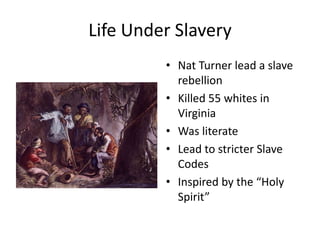
Life Under SlaveryNat Turner lead a slave rebellionKilled 55 whites in VirginiaWas literateLead to stricter Slave CodesInspired by the “Holy Spirit”
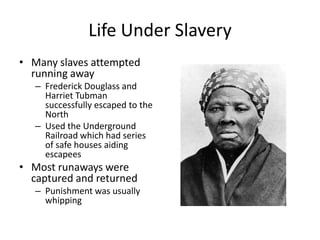
Life Under SlaveryMany slaves attempted running awayFrederick Douglass and Harriet Tubman successfully escaped to the NorthUsed the Underground Railroad which had series of safe houses aiding escapeesMost runaways were captured and returnedPunishment was usually whipping

US History Chapter 13

  • 1.
    Chapter 13: Northand SouthMagister RicardUS History
  • 2.
  • 3.
    Technology and IndustryIndustrializationDivision of labor among workersMachines replace workers’ duties, now tended to machinesIndustrialization lead to mass productionElias Howe invents the sewing machine (1843)Production on a large scale of cotton textiles
  • 4.
    Improved TransportationSteamboats andSteamships – invented by Robert FultonCarried goods and passengers more quicklyClipper Ships – could sail an average of 300 miles per dayLocomotives – Peter Cooper and the Tom ThumbBy 1860 almost 31,000 miles of rail, mostly in North and Midwest
  • 5.
    Faster CommunicationThe telegraphand Morse Code1844 Samuel Morse sends a message from Washington, DC to Baltimore, MarylandSpreading the news – newspapers explode1846 Richard Hoe invents steam rotary press
  • 6.
    Revolution in Agriculture1837John Deere’s steel-tipped plow allows for pioneers in Great Plains to farm1834 Cyrus McCormick mechanizes the reaper, used to harvest wheat which would become a staple crop of Midwest
  • 7.
  • 8.
    Northern FactoriesBetween 1820sand 1860s, industrialization increasedWork was dangerous, conditions brutalWorkers were tending to machines with little protectionOwners cared more about profits than people – no laws existed to protect workersWorkers started forming trade unions, would strike for better conditions
  • 9.
    The Rise ofCitiesIndustrialization lead to UrbanizationPeople were looking for work, flocked to the factoriesUrban living was dangerousRun-down structures without plumbing or heatSpread disease and danger of fire1840s 14% lived in cities; 1860s 26%
  • 10.
    ImmigrationBetween 1846-1860 1.5million Irish immigrated to US due to potato famineBy 1850 1/3 of workers in Boston were IrishBetween 1848-1860 1 million German immigrants came to USImmigrants brought their languages, customs, cultures which were melted into American cultureImmigrants remind us of what we take for granted
  • 11.
    ImmigrationImmigration leads toprejudiceKnow-Nothing Party – a political party formed by nativists who claimed to “know nothing”Called for stricter citizenship laws; prohibit foreigners from holding officeBy mid-1850s would split into Northern and Southern branches over question of slavery
  • 12.
  • 13.
    Rise of theCotton KingdomSlavery was disappearing in the North by 1820s; grew stronger in the SouthTobacco and rice were former cash cropsSugarcane was too costly to produceUpper South produces tobacco; Deep South produces rice, sugarcane, and cotton1793 Eli Whitney invents the Cotton Gin – removed seeds from cotton fibersIncrease in slave labor and need for land
  • 14.
    Industry’s Limited Rolein the SouthNorth = industryNorth lacked good land, forced to innovateSouth = agricultureLack of capital – money used to invest in businessLack of vision in future marketsNorth used immigrant labor force, South slave labor forceLack of industry and railroads would plague South in Civil War
  • 15.
  • 16.
  • 17.
    Small Farmers andRural PoorYeomen farmers made up largest group of Southern white farmers – no slavesRanged from 50-200 acresSome rented land or were tenant farmers worked on landlord estatesRural poor sustenance farming, proud to be self-sufficient
  • 18.
    PlantationsMeasured wealth bynumber of slaves and size of landCould be around several thousand acres
  • 19.
    PlantationsPlantation owners focusedon making profitsAssessed their fixed costs to determine their profit margins each yearProfit was determined by the price of their products (cotton, etc.)Agents would buy the cotton, extend credit to planters Then sell when price rose to make their profit
  • 20.
    PlantationsPlantation wives watchedover slaves who worked in the home, tended to them when sick, supervised construction, kept recordsDomestic slaves worked indoorsOthers were skilled laborers (blacksmiths, carpenters, etc.)Most slaves were field hands – supervised by an overseer
  • 21.
    Life Under SlaveryWorkedhard, earned no money, little hope of freedomFeared being resold, separated from familyFormed networks of extended families to cope and give stabilityMarriage was not honored by law, but did occurHeld on to their customs, but turned to Christianity for hopeDeveloped spirituals, or religious folk songs
  • 22.
    Life Under SlaverySlaveCodes – series of laws passed between 1830-1860Slaves were not allowed to gather in large numbersSlaves were not allowed to leave property without authorizationIt was a crime to teach slaves how to read and write
  • 23.
    Life Under SlaveryNatTurner lead a slave rebellionKilled 55 whites in VirginiaWas literateLead to stricter Slave CodesInspired by the “Holy Spirit”
  • 24.
    Life Under SlaveryManyslaves attempted running awayFrederick Douglass and Harriet Tubman successfully escaped to the NorthUsed the Underground Railroad which had series of safe houses aiding escapeesMost runaways were captured and returnedPunishment was usually whipping

Editor's Notes

  • #5 Before clipper ships and steamboats – trans-Atlantic trip took 21-28 days. Now, in half the time.Locomotives started out connecting mines to rivers. By 1840, 10 years after Tom Thumb, they would be hauling trains of cargo. Rails were needed for the locomotives, and in 1840 3000 miles was laid. By 1860 that would grow to over 31,000 miles, connecting railways across the nation. This connected Midwest with East through the Erie Canal and the rail network. Goods became cheaper and easier to sell. Increases population in Midwest as people spread for new opportunities.
  • #6 Congress, in 1843, had purchased an experimental telegraph line for $30,000 but needed a way to transmit messages. Samuel Morse tapped the message, using a series of dashes and dots, “What hath God wrought!”. The success means that the use of the telegraph would instantly communicate news across vast areas – shrinking the US. Would be used by North to help them win the war.
  • #7 Despite the increase in agricultural production, the North’s economy stayed based on industry. Utilizing technology, America was able to produce crops in areas that would yield very littler before the innovations. This is an American trait and result of a capitalist economy.
  • #9 Originally striking was illegal. In 1842 a Massachusetts court ruled that workers did have the right to strike for better working conditions and pay.
  • #11 Previously, most immigrants were Protestants from England or African slaves – now immigrants from Ireland and ½ Germany were Roman Catholics. Highlights religious freedom and tolerance that is hallmark of American society.
  • #12 This is not to say that the US was without prejudice. The American Party was formed to help support the nativists’ agenda – people who felt immigrants threatened the future of native-born American citizens.
  • #14 Tobacco ruined land, depended on foreign demand. Rice needed wet climates. Sugarcane needed irrigation and machinery; known as “rich man’s crop”.There was huge demand for cotton textiles, but it was difficult to produce. Eli Whitney created the “gin” short for engine, to remove the seeds from cotton fibers. Increased productivity of harvest – worker could yield 50 pounds per day as opposed to 1 pound per day. Leads to demand for more cotton, more slaves. Pushed Native Americans off their land to make way for expanding cotton growth.
  • #15 Why was the divide between the economy of the North and South so wide? What was the difference? The South was rural, based on agricultural production – most of their money was tied into buying assets (slaves and land) for production. They were rigid in their belief that the cotton industry would continue to boom. This made Southerners more and more tied to a system of slavery and agriculture, whereas the North was forced to find other ways to compete economically since they lacked good land for agricultural production. Besides, South produced wealth and could buy what they wanted rather than build industry. A lack of industry and a lack of development of the railway network would come back to haunt the South in the Civil War.
  • #18 Rural poor were looked down on by other whites, but were fiercely independent and prided themselves on being self sufficient – they did not work another man’s land because they did not want to appear to be slaves.
  • #22 Slaves worked from sunrise to sunset, from youth to old age. Did heavy labor, were always kept busy. Older slaves were given lighter chores.
  • #23 What do you think is the purpose of the Slave Codes?
  • #24 Why did the Southerners claim that slavery was a means to Christianize the heathen but then not offer them the ability to read the Bible? Why were slaves who converted not freed because they had undergone the change to a “new creature”? Nat Turner, who was literate, claimed he had seen a vision by the Holy Spirit to rebel. This was not the first slave rebellion, nor would it be the last. The South became a virtual police state, censoring Northern abolition writing in favor of the South proslavery propaganda. The Bible, “Curse of Ham” was used to support slavery in the South. The North claimed that rights of free speech were being violated in the South.