
U.S. Chapter 7A More Perfect Union1777-1790
Questions to ConsiderHow does American distrust in central government shape their new form of government?How did the Articles of Confederation create instability in the new US government?Is the Constitution a legal document?Would you be a Federalist or an Anti-Federalist? Explain.
The Articles of ConfederationSection 7.1
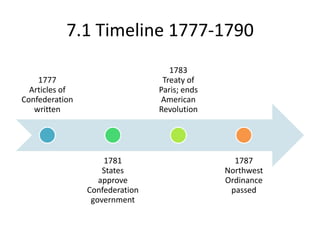
7.1 Timeline 1777-1790
England’s DisrespectIgnore the Treaty of ParisTroops on the frontierNo representative sent to US from BritainBritish felt new American government was weak and ineffective
Thirteen Independent StatesEach state required to create a state constitutionLess central government powerSome states limited power of governorsSeparation of PowerBicameral legislaturesDivision of governmental powers and dutiesFrequent elections; popularly elected
Forming a RepublicSeparate state governments allied to create national governmentSingle national government should be a republicCitizens rule through elected representativesWould the central government be strong or weak?
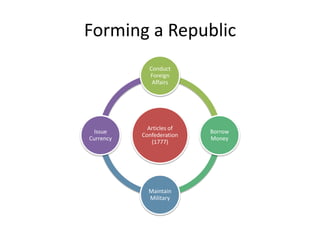
Forming a Republic
Forming a RepublicProblems with Articles of ConfederationLittle federal power (states retained their power)No taxing powerNo commerce (trade) powerInability to raise troopsNo Chief Executive or CourtDifficult to pass laws (9 of 13 needed)Approving the ArticlesUnanimous consent needed (all 13 states needed)
New Land PoliciesFew settlers lived west of Appalachians13 States were making claims to these lands (p. 191)Claims were abandoned, national government took control (1780s -1790s)Territories, based on population, were allowed to petition for statehoodNorthwest Ordinance (1787) created single Northwest Territory (p. 193)No slavery or involuntary servitude allowedOriginally proposed by Thomas JeffersonNew states would be on “equal footing” with 13 originals
Trouble on Two FrontsNew currency depreciatedInflation of goods resultedWar left Confederation Congress in debtCould not tax, could not pay back debtStates did not contribute much moneyRobert Morris proposes 5% import tax, but failed to be ratifiedForeign problems; England and SpainExposed need for stronger central government
Convention and CompromiseSection 7.2
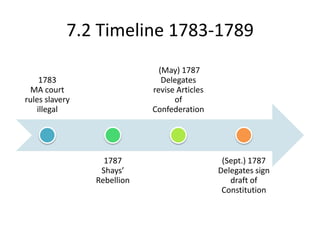
7.2 Timeline 1783-1789
Economic DepressionDepression: economic activity slows and unemployment increasesFarmers could not sell their goods or pay taxesShays’ Rebellion1,000 farmers revolt in MA led by Daniel ShaysPrivate militia hired, no federal helpIssue of SlaverySome states free, others notDivided the new country
A Call for ChangeRevolution created a union of 13 states, not a nationFederalists – supported weak national governmentNationalists – supported stronger national governmentShays’ Rebellion highlighted the need for stronger federal governmentWashington now supports need for revising Articles of ConfederationJames Madison (Virginia) Alexander Hamilton (New York)
The Constitutional ConventionMeeting in Philadelphia in May 1787Purpose: To revise the Articles of Confederation55 delegates, highly educated, “achievers”George Washington presidesNot publicized, highly secretEdmund Randolph proposed Virginia Plan (stronger national government)Mostly written by James MadisonCalled for a vote to start a new document
The Constitutional ConventionThe Virginia PlanEnd state sovereignty Bicameral (proportional representation)Executive and Judicial BranchThe New Jersey PlanUnicameral (equal representation)The Great Compromise (Connecticut Plan)Bicameral, Senate equal, House proportional
Compromise Wins OutHouse of Representatives Proportional representation; elected every 2 yearsSenate Equal representation; elected every 6 yearsThe Three-Fifths CompromiseSlaves counted for tax and representationSlave TradeNo interference until 1808Bill of RightsGeorge Mason’s plan defeated, refused to sign ConstitutionApproving the Constitution9 of 13 needed by the states
A New Plan of GovernmentSection 7.3
Roots of the ConstitutionGreece (Aristotle)European Philosophers (Thomas Hobbes, Enlightenment ideas)John Locke: “Natural rights”Baron de Montesquieu: Separation of powers, limited governmentBritish ideasMagna Carta: limited powerEnglish Bill of Rights (1689)
The Federal SystemShared powersFederalism is shared powers between federal and state governmentsConstitution gained power to tax, regulate trade, control currency, raise an army, declare warConstitution: The Supreme Law of the LandStates could not make laws which contradict ConstitutionConstitution was final authority
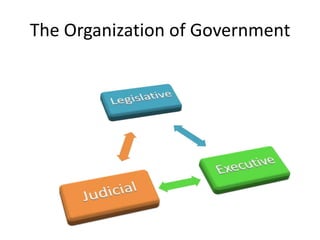
The Organization of GovernmentThree BranchesLegislative: makes laws, collects taxes, regulates trade, issues currency (Article I)Executive: enforces laws, diplomacy, commander in chief (Article II)Judicial: interprets laws and actions (Article III)
The Organization of Government
A New Plan of GovernmentSystem of Checks and BalancesNo one branch gaining too much powerThe world watched and wondered would we fail
Ratifying the ConstitutionSection 7.4
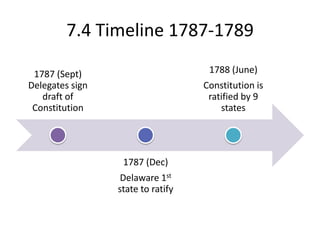
7.4 Timeline 1787-1789
Compromise Wins OutIn order to revise the Articles of Confederation, 13 out of 13 had to agreeThe meeting in Philadelphia was with intention to reviseRhode Island did not send delegates, which meant revision was impossibleMeeting was held anywayConfederation Congress with 55 delegates approved ConstitutionChanged unanimous to 9 of 13 votes needed for approval
The Constitutional DebateFederalists [Nationalists] versus Anti-Federalists [Federalists] (1787 – 1793)Federalists supported stronger, central government (and Constitution)Federalist papers (Madison, Hamilton, and Jay) published to explain ConstitutionAnti-Federalists feared losing state rights would destroy what they fought forCalled for Bill of Rights
Questions to ConsiderHow does American distrust in central government shape their new form of government?How did the Articles of Confederation create instability in the new US government?Is the Constitution a legal document?Would you be a Federalist or an Anti-Federalist? Explain.

US History Chapter 7

  • 1.
    U.S. Chapter 7AMore Perfect Union1777-1790
  • 2.
    Questions to ConsiderHowdoes American distrust in central government shape their new form of government?How did the Articles of Confederation create instability in the new US government?Is the Constitution a legal document?Would you be a Federalist or an Anti-Federalist? Explain.
  • 3.
    The Articles ofConfederationSection 7.1
  • 4.
  • 5.
    England’s DisrespectIgnore theTreaty of ParisTroops on the frontierNo representative sent to US from BritainBritish felt new American government was weak and ineffective
  • 6.
    Thirteen Independent StatesEachstate required to create a state constitutionLess central government powerSome states limited power of governorsSeparation of PowerBicameral legislaturesDivision of governmental powers and dutiesFrequent elections; popularly elected
  • 7.
    Forming a RepublicSeparatestate governments allied to create national governmentSingle national government should be a republicCitizens rule through elected representativesWould the central government be strong or weak?
  • 8.
  • 9.
    Forming a RepublicProblemswith Articles of ConfederationLittle federal power (states retained their power)No taxing powerNo commerce (trade) powerInability to raise troopsNo Chief Executive or CourtDifficult to pass laws (9 of 13 needed)Approving the ArticlesUnanimous consent needed (all 13 states needed)
  • 10.
    New Land PoliciesFewsettlers lived west of Appalachians13 States were making claims to these lands (p. 191)Claims were abandoned, national government took control (1780s -1790s)Territories, based on population, were allowed to petition for statehoodNorthwest Ordinance (1787) created single Northwest Territory (p. 193)No slavery or involuntary servitude allowedOriginally proposed by Thomas JeffersonNew states would be on “equal footing” with 13 originals
  • 11.
    Trouble on TwoFrontsNew currency depreciatedInflation of goods resultedWar left Confederation Congress in debtCould not tax, could not pay back debtStates did not contribute much moneyRobert Morris proposes 5% import tax, but failed to be ratifiedForeign problems; England and SpainExposed need for stronger central government
  • 12.
  • 13.
  • 14.
    Economic DepressionDepression: economicactivity slows and unemployment increasesFarmers could not sell their goods or pay taxesShays’ Rebellion1,000 farmers revolt in MA led by Daniel ShaysPrivate militia hired, no federal helpIssue of SlaverySome states free, others notDivided the new country
  • 15.
    A Call forChangeRevolution created a union of 13 states, not a nationFederalists – supported weak national governmentNationalists – supported stronger national governmentShays’ Rebellion highlighted the need for stronger federal governmentWashington now supports need for revising Articles of ConfederationJames Madison (Virginia) Alexander Hamilton (New York)
  • 16.
    The Constitutional ConventionMeetingin Philadelphia in May 1787Purpose: To revise the Articles of Confederation55 delegates, highly educated, “achievers”George Washington presidesNot publicized, highly secretEdmund Randolph proposed Virginia Plan (stronger national government)Mostly written by James MadisonCalled for a vote to start a new document
  • 17.
    The Constitutional ConventionTheVirginia PlanEnd state sovereignty Bicameral (proportional representation)Executive and Judicial BranchThe New Jersey PlanUnicameral (equal representation)The Great Compromise (Connecticut Plan)Bicameral, Senate equal, House proportional
  • 18.
    Compromise Wins OutHouseof Representatives Proportional representation; elected every 2 yearsSenate Equal representation; elected every 6 yearsThe Three-Fifths CompromiseSlaves counted for tax and representationSlave TradeNo interference until 1808Bill of RightsGeorge Mason’s plan defeated, refused to sign ConstitutionApproving the Constitution9 of 13 needed by the states
  • 19.
    A New Planof GovernmentSection 7.3
  • 20.
    Roots of theConstitutionGreece (Aristotle)European Philosophers (Thomas Hobbes, Enlightenment ideas)John Locke: “Natural rights”Baron de Montesquieu: Separation of powers, limited governmentBritish ideasMagna Carta: limited powerEnglish Bill of Rights (1689)
  • 21.
    The Federal SystemSharedpowersFederalism is shared powers between federal and state governmentsConstitution gained power to tax, regulate trade, control currency, raise an army, declare warConstitution: The Supreme Law of the LandStates could not make laws which contradict ConstitutionConstitution was final authority
  • 22.
    The Organization ofGovernmentThree BranchesLegislative: makes laws, collects taxes, regulates trade, issues currency (Article I)Executive: enforces laws, diplomacy, commander in chief (Article II)Judicial: interprets laws and actions (Article III)
  • 23.
  • 24.
    A New Planof GovernmentSystem of Checks and BalancesNo one branch gaining too much powerThe world watched and wondered would we fail
  • 25.
  • 26.
  • 27.
    Compromise Wins OutInorder to revise the Articles of Confederation, 13 out of 13 had to agreeThe meeting in Philadelphia was with intention to reviseRhode Island did not send delegates, which meant revision was impossibleMeeting was held anywayConfederation Congress with 55 delegates approved ConstitutionChanged unanimous to 9 of 13 votes needed for approval
  • 28.
    The Constitutional DebateFederalists[Nationalists] versus Anti-Federalists [Federalists] (1787 – 1793)Federalists supported stronger, central government (and Constitution)Federalist papers (Madison, Hamilton, and Jay) published to explain ConstitutionAnti-Federalists feared losing state rights would destroy what they fought forCalled for Bill of Rights
  • 29.
    Questions to ConsiderHowdoes American distrust in central government shape their new form of government?How did the Articles of Confederation create instability in the new US government?Is the Constitution a legal document?Would you be a Federalist or an Anti-Federalist? Explain.