Section 3 Southern Cotton Kingdom
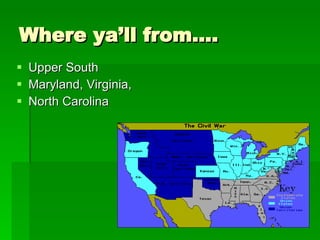
Where ya’ll from…. Upper South Maryland, Virginia, North Carolina
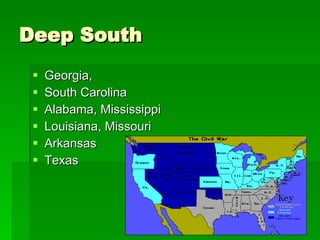
Deep South Georgia,  South Carolina Alabama, Mississippi Louisiana, Missouri  Arkansas Texas
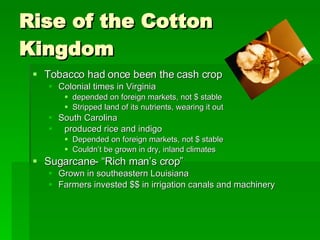
Rise of the Cotton Kingdom Tobacco had once been the cash crop Colonial times in Virginia depended on foreign markets, not $ stable Stripped land of its nutrients, wearing it out South Carolina produced rice and indigo Depended on foreign markets, not $ stable Couldn’t be grown in dry, inland climates Sugarcane- “Rich man’s crop” Grown in southeastern Louisiana Farmers invested $$ in irrigation canals and machinery
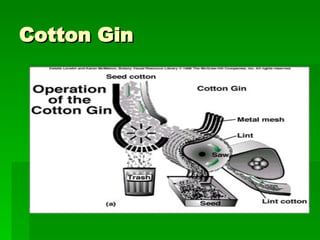
The Cotton Gin Cotton demand was increasing It is difficult to process Workers must separate plants “sticky” seeds from cotton fibers.
Cotton Gin
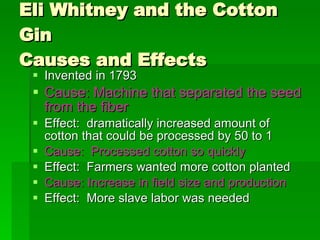
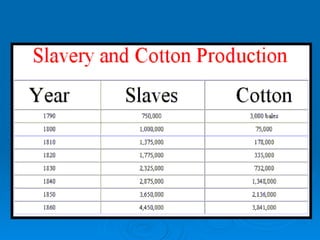
Eli Whitney and the Cotton Gin Causes and Effects Invented in 1793 Cause: Machine that separated the seed from the fiber Effect:  dramatically increased amount of cotton that could be processed by 50 to 1 Cause:  Processed cotton so quickly Effect:  Farmers wanted more cotton planted Cause: Increase in field size and production Effect:  More slave labor was needed
New land for cotton Because of the Native American Removal Act, cotton production expanded in deep south Alabama, Mississippi Climate was good for cotton Smaller farmers could make $  Didn’t have to own a gin, could rent it Could rent slaves from slaveholders Larger plantations made money too Slavery was a big part of plantation life
http://www.youtube.com/watch?v=dS4OxoebcSQ
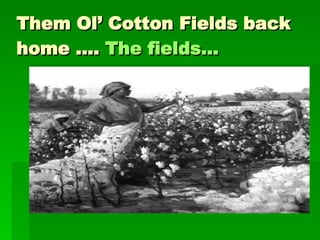
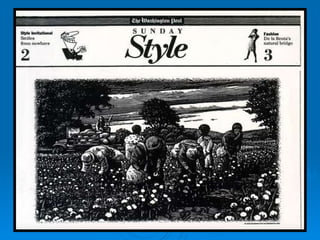
Them Ol’ Cotton Fields back home ….  The fields...
Cotton Rules the Deep South Large demand for cotton in Great Britain Kept prices up Upper South and Deep South were economically different Both still agricultural Upper south produces tobacco,hemp,wheat and veggies Became the center for the sale and transport of enslaved people Deep South produces cotton and some rice and sugarcane Enslaved people played a key role in the cotton producing business
Industry’s Leading Role South prospered economically from 1820-1860 Stayed rural, not like the North Manufactured very little compared to North Produced fewer goods then entire state of Massachusetts
Why just cotton? Cotton was booming!  “ If it ain’t broke, don’t fix it” Lack of capital (money to invest in business) $ tied up in land and slaves Would have to sell slaves to start business Not willing to do it Market for manufactured goods low in South compared to the North Large population in South were slaves with no money who could not buy goods They really didn’t want business there
Southern Factories Some southerners wanted develop industry in the South Thought they relied too much on the North for manufactured goods Said factories would revive upper South economy which was lagging William Gregg-Merchant from Charleston, S. Carolina;opened a textile mill there, modeling those from New England Joseph Reid Anderson turned Tredegar Iron Works into nation’s leading producers of iron During the war he supplied artillery and other iron products to the Southern forces
Southern Transportation Natural waterways were primary means for transporting goods most towns located on waterways:seacoast or rivers Few canals Roads were poor Did not experience the RR boom like the North Connections were short; no real network established Southern cities grew slower than their Northern counterpart because of this 1/3 of the nation’s RR was located in the South This would have a negative effect during the war
Section 4 The South’s People
Terms to Know Yeoman Tenant farmer Fixed cost Credit Overseer Spiritual Slave code
The “Glorious South” Novels and films glamorized the “deep South” Rich, white slaveholders Stately mansions Reality Small farmers without slaves Planters with a few slaves Handful of planters had several slaves and fancy “mansions”
Categories of Southerners Yeomen Tenant farmers The rural poor Plantation owners
Tenant farmers Rented land on other’s estates Rural Poor Lived in crude cabins in wooded areas Grew gardens, kept a few farm animals Hunted and fished for food All of the poor in the South were independent Refused to take any job that resembled slave work Rural poor were proud of being self-sufficient Looked down upon by other Whites
Yeomen Largest group of whites in the South Owned land Mainly lived in upper South/hilly rural areas of deep South 50-200 acre farms Crops were for self and sale Traded crops to locals for goods/services
Plantations Cover several thousand acres Lived in comfortable, not luxurious farmhouses Measured wealth by the number of slaves owned and possessions like homes, clothes, furniture etc. 12% of plantation owners held more than ½ of all the slaves ½ of planters held fewer than 5 slaves
Life on a Plantation   The Movie “ Oh, Rhett, Rhett, I’ll just think about it tomorrow”—Gone with the Wind
Main goal Earn money/profits Fixed costs-regular expenses- stayed same Housing Feeding workers Maintaining gin, machinery
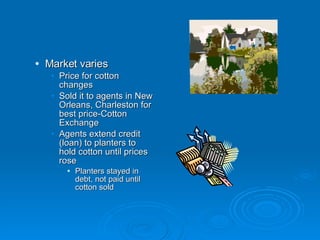
Market varies Price for cotton changes Sold it to agents in New Orleans, Charleston for best price-Cotton Exchange Agents extend credit  (loan) to planters to hold cotton until prices rose Planters stayed in debt, not paid until cotton sold
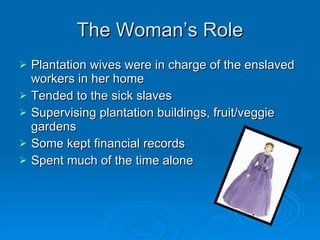
The Woman’s Role Plantation wives were in charge of the enslaved workers in her home Tended to the sick slaves Supervising plantation buildings, fruit/veggie gardens Some kept financial records Spent much of the time alone
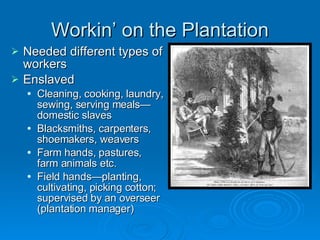
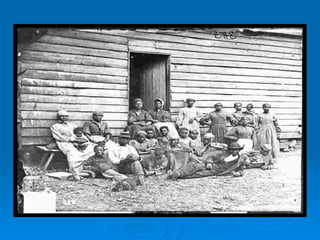
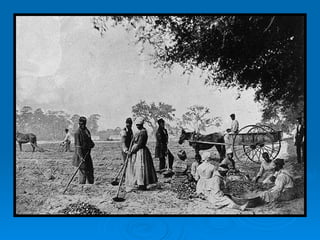
Workin’ on the Plantation Needed different types of workers Enslaved Cleaning, cooking, laundry, sewing, serving meals—domestic slaves Blacksmiths, carpenters, shoemakers, weavers Farm hands, pastures, farm animals etc. Field hands—planting, cultivating, picking cotton; supervised by an overseer (plantation manager)
 
 
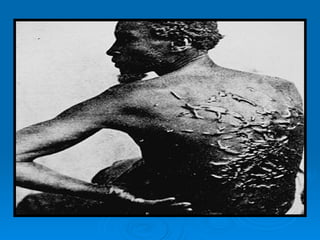
Life Under Slavery Worked hard, earned no money, little hope of freedom What do you think was their biggest fear? Being sold to another planter and being separated from family Tried to make what they could of a family life Looked forward to the day they would be free
 
Enslaved Workers Up before dawn, back after the sun came down Men as well as women did heavy work Children carried water to the fields At age 10, they began work in the fields At age 60, they were given lighter work or cared for the kids
 
 
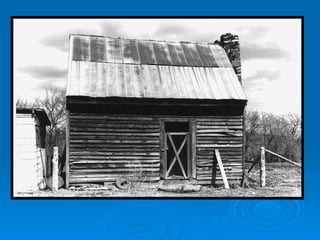
Home, Sweet, Home Life in the Slave Cabins “ We lodged in log huts and on the bare ground.  Wooden floors were an unknown luxury.  In a single room were huddled, like cattle, ten or a dozen person, men, women, and children . . . Our beds were collections of straw and old rags, thrown down in the corners and boxed in with boards, a single blanket the only covering . . . The wind whistled and the rain and snow blew in through the cracks, and the damp earth soaked in the moisture till the floor was [filthy] as a pigsty”—Josiah Henson, escaped slave
 
Pass the steak please, don’t think so! Diet consisted of cornmeal, pork fat and molasses Did have their own gardens Grew yams and greens Did not have a balanced diet
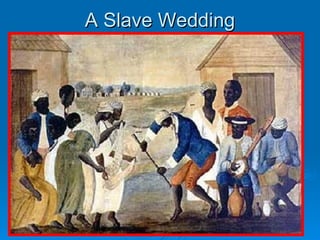
Family Life as a Slave No laws protecting slaves Husband or wife could be sold at any time Death of slaveholder could split up a family Marriage not recognized by law, married anyway Marriage vow included “till death or separation do us part” Established networks of relatives/friends Care for each other’s children in case of separation
A Slave Wedding
Imagine How would your life change if you were forced to move to say … India?
African American Culture Had to fuse their African culture with American culture to make a new culture Growth of African American Culture came from children 1808 slave trade was banned Slavery still legal in South By 1860 almost all slaves had been born in America
Audio interview with a former slave http://memory.loc.gov/service/afc/afc9999001/5091b.mp3 Alice Gaston
American born slaves retained African customs Practiced African music and dance Passed folk stories to children Some accepted Christianity Some kept to their ancestors beliefs Wrapped their heads in colorful cloths in African style


African American Christianity Christianity became their hope Prayed for the day they would be free Expressed themselves through “spirituals” Combined Christian faith with laments about suffering Also allowed them to communicate with one another
http://youtube.com/watch?v=bfaAsU7J81k Swing low, sweet chariot, Coming for to carry me home, Swing low, sweet chariot, Coming for to carry me home. I looked over Jordan, and what did I see? Coming for to carry me home, A band of angels coming after me, Coming for to carry me home. Refrain If you get there before I do, Coming for to carry me home, Tell all my friends I’m coming, too. Coming for to carry me home.
Slave Codes Laws that controlled the slaves 1830-1860 laws became more severe Owners were afraid of slave rebellion Prohibited slaves from gathering in large groups Could not leave their master’s property without a written pass Crime to teach a slave to read and write Thought they were less likely to rebel if illiterate
 
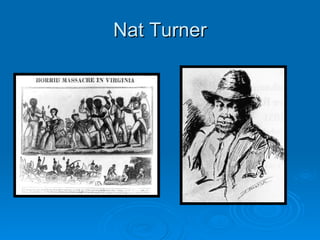
Resistance to Slavery Some rebelled openly to their masters Nat Turner—Religious leader Self-taught reader and writer 1831 led group of followers on deadly rampage; Southampton County, VA Killed 55 whites Turner was hung Scared white Southerners, led to stricter codes
Nat Turner
Other ways to resist slavery Working slowly Pretending to be ill Setting fire to a plantation building Breaking tools Did this to endure their lives Way of striking back that whites would prevent
 
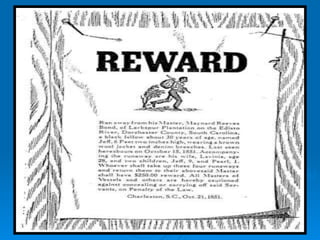
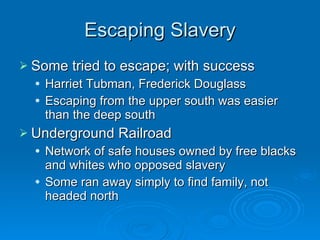
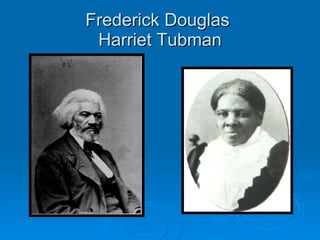
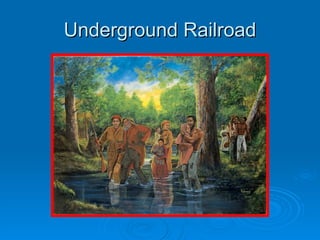
Escaping Slavery Some tried to escape; with success Harriet Tubman, Frederick Douglass Escaping from the upper south was easier than the deep south Underground Railroad Network of safe houses owned by free blacks and whites who opposed slavery Some ran away simply to find family, not headed north
Frederick Douglas  Harriet Tubman
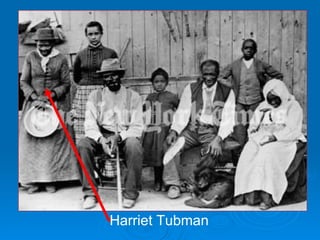
Harriet Tubman
Underground Railroad
Review

Section 3 And 4 Chap 13

  • 1.
    Section 3 SouthernCotton Kingdom
  • 2.
    Where ya’ll from….Upper South Maryland, Virginia, North Carolina
  • 3.
    Deep South Georgia, South Carolina Alabama, Mississippi Louisiana, Missouri Arkansas Texas
  • 4.
    Rise of theCotton Kingdom Tobacco had once been the cash crop Colonial times in Virginia depended on foreign markets, not $ stable Stripped land of its nutrients, wearing it out South Carolina produced rice and indigo Depended on foreign markets, not $ stable Couldn’t be grown in dry, inland climates Sugarcane- “Rich man’s crop” Grown in southeastern Louisiana Farmers invested $$ in irrigation canals and machinery
  • 5.
    The Cotton GinCotton demand was increasing It is difficult to process Workers must separate plants “sticky” seeds from cotton fibers.
  • 6.
  • 7.
    Eli Whitney andthe Cotton Gin Causes and Effects Invented in 1793 Cause: Machine that separated the seed from the fiber Effect: dramatically increased amount of cotton that could be processed by 50 to 1 Cause: Processed cotton so quickly Effect: Farmers wanted more cotton planted Cause: Increase in field size and production Effect: More slave labor was needed
  • 8.
    New land forcotton Because of the Native American Removal Act, cotton production expanded in deep south Alabama, Mississippi Climate was good for cotton Smaller farmers could make $ Didn’t have to own a gin, could rent it Could rent slaves from slaveholders Larger plantations made money too Slavery was a big part of plantation life
  • 9.
  • 10.
    Them Ol’ CottonFields back home …. The fields...
  • 11.
    Cotton Rules theDeep South Large demand for cotton in Great Britain Kept prices up Upper South and Deep South were economically different Both still agricultural Upper south produces tobacco,hemp,wheat and veggies Became the center for the sale and transport of enslaved people Deep South produces cotton and some rice and sugarcane Enslaved people played a key role in the cotton producing business
  • 12.
    Industry’s Leading RoleSouth prospered economically from 1820-1860 Stayed rural, not like the North Manufactured very little compared to North Produced fewer goods then entire state of Massachusetts
  • 13.
    Why just cotton?Cotton was booming! “ If it ain’t broke, don’t fix it” Lack of capital (money to invest in business) $ tied up in land and slaves Would have to sell slaves to start business Not willing to do it Market for manufactured goods low in South compared to the North Large population in South were slaves with no money who could not buy goods They really didn’t want business there
  • 14.
    Southern Factories Somesoutherners wanted develop industry in the South Thought they relied too much on the North for manufactured goods Said factories would revive upper South economy which was lagging William Gregg-Merchant from Charleston, S. Carolina;opened a textile mill there, modeling those from New England Joseph Reid Anderson turned Tredegar Iron Works into nation’s leading producers of iron During the war he supplied artillery and other iron products to the Southern forces
  • 15.
    Southern Transportation Naturalwaterways were primary means for transporting goods most towns located on waterways:seacoast or rivers Few canals Roads were poor Did not experience the RR boom like the North Connections were short; no real network established Southern cities grew slower than their Northern counterpart because of this 1/3 of the nation’s RR was located in the South This would have a negative effect during the war
  • 16.
    Section 4 TheSouth’s People
  • 17.
    Terms to KnowYeoman Tenant farmer Fixed cost Credit Overseer Spiritual Slave code
  • 18.
    The “Glorious South”Novels and films glamorized the “deep South” Rich, white slaveholders Stately mansions Reality Small farmers without slaves Planters with a few slaves Handful of planters had several slaves and fancy “mansions”
  • 19.
    Categories of SouthernersYeomen Tenant farmers The rural poor Plantation owners
  • 20.
    Tenant farmers Rentedland on other’s estates Rural Poor Lived in crude cabins in wooded areas Grew gardens, kept a few farm animals Hunted and fished for food All of the poor in the South were independent Refused to take any job that resembled slave work Rural poor were proud of being self-sufficient Looked down upon by other Whites
  • 21.
    Yeomen Largest groupof whites in the South Owned land Mainly lived in upper South/hilly rural areas of deep South 50-200 acre farms Crops were for self and sale Traded crops to locals for goods/services
  • 22.
    Plantations Cover severalthousand acres Lived in comfortable, not luxurious farmhouses Measured wealth by the number of slaves owned and possessions like homes, clothes, furniture etc. 12% of plantation owners held more than ½ of all the slaves ½ of planters held fewer than 5 slaves
  • 23.
    Life on aPlantation The Movie “ Oh, Rhett, Rhett, I’ll just think about it tomorrow”—Gone with the Wind
  • 24.
    Main goal Earnmoney/profits Fixed costs-regular expenses- stayed same Housing Feeding workers Maintaining gin, machinery
  • 25.
    Market varies Pricefor cotton changes Sold it to agents in New Orleans, Charleston for best price-Cotton Exchange Agents extend credit (loan) to planters to hold cotton until prices rose Planters stayed in debt, not paid until cotton sold
  • 26.
    The Woman’s RolePlantation wives were in charge of the enslaved workers in her home Tended to the sick slaves Supervising plantation buildings, fruit/veggie gardens Some kept financial records Spent much of the time alone
  • 27.
    Workin’ on thePlantation Needed different types of workers Enslaved Cleaning, cooking, laundry, sewing, serving meals—domestic slaves Blacksmiths, carpenters, shoemakers, weavers Farm hands, pastures, farm animals etc. Field hands—planting, cultivating, picking cotton; supervised by an overseer (plantation manager)
  • 28.
  • 29.
  • 30.
    Life Under SlaveryWorked hard, earned no money, little hope of freedom What do you think was their biggest fear? Being sold to another planter and being separated from family Tried to make what they could of a family life Looked forward to the day they would be free
  • 31.
  • 32.
    Enslaved Workers Upbefore dawn, back after the sun came down Men as well as women did heavy work Children carried water to the fields At age 10, they began work in the fields At age 60, they were given lighter work or cared for the kids
  • 33.
  • 34.
  • 35.
    Home, Sweet, HomeLife in the Slave Cabins “ We lodged in log huts and on the bare ground. Wooden floors were an unknown luxury. In a single room were huddled, like cattle, ten or a dozen person, men, women, and children . . . Our beds were collections of straw and old rags, thrown down in the corners and boxed in with boards, a single blanket the only covering . . . The wind whistled and the rain and snow blew in through the cracks, and the damp earth soaked in the moisture till the floor was [filthy] as a pigsty”—Josiah Henson, escaped slave
  • 36.
  • 37.
    Pass the steakplease, don’t think so! Diet consisted of cornmeal, pork fat and molasses Did have their own gardens Grew yams and greens Did not have a balanced diet
  • 38.
    Family Life asa Slave No laws protecting slaves Husband or wife could be sold at any time Death of slaveholder could split up a family Marriage not recognized by law, married anyway Marriage vow included “till death or separation do us part” Established networks of relatives/friends Care for each other’s children in case of separation
  • 39.
  • 40.
    Imagine How wouldyour life change if you were forced to move to say … India?
  • 41.
    African American CultureHad to fuse their African culture with American culture to make a new culture Growth of African American Culture came from children 1808 slave trade was banned Slavery still legal in South By 1860 almost all slaves had been born in America
  • 42.
    Audio interview witha former slave http://memory.loc.gov/service/afc/afc9999001/5091b.mp3 Alice Gaston
  • 43.
    American born slavesretained African customs Practiced African music and dance Passed folk stories to children Some accepted Christianity Some kept to their ancestors beliefs Wrapped their heads in colorful cloths in African style
  • 44.
  • 45.
  • 46.
  • 47.
    African American ChristianityChristianity became their hope Prayed for the day they would be free Expressed themselves through “spirituals” Combined Christian faith with laments about suffering Also allowed them to communicate with one another
  • 48.
    http://youtube.com/watch?v=bfaAsU7J81k Swing low,sweet chariot, Coming for to carry me home, Swing low, sweet chariot, Coming for to carry me home. I looked over Jordan, and what did I see? Coming for to carry me home, A band of angels coming after me, Coming for to carry me home. Refrain If you get there before I do, Coming for to carry me home, Tell all my friends I’m coming, too. Coming for to carry me home.
  • 49.
    Slave Codes Lawsthat controlled the slaves 1830-1860 laws became more severe Owners were afraid of slave rebellion Prohibited slaves from gathering in large groups Could not leave their master’s property without a written pass Crime to teach a slave to read and write Thought they were less likely to rebel if illiterate
  • 50.
  • 51.
    Resistance to SlaverySome rebelled openly to their masters Nat Turner—Religious leader Self-taught reader and writer 1831 led group of followers on deadly rampage; Southampton County, VA Killed 55 whites Turner was hung Scared white Southerners, led to stricter codes
  • 52.
  • 53.
    Other ways toresist slavery Working slowly Pretending to be ill Setting fire to a plantation building Breaking tools Did this to endure their lives Way of striking back that whites would prevent
  • 54.
  • 55.
    Escaping Slavery Sometried to escape; with success Harriet Tubman, Frederick Douglass Escaping from the upper south was easier than the deep south Underground Railroad Network of safe houses owned by free blacks and whites who opposed slavery Some ran away simply to find family, not headed north
  • 56.
    Frederick Douglas Harriet Tubman
  • 57.
  • 58.
  • 59.