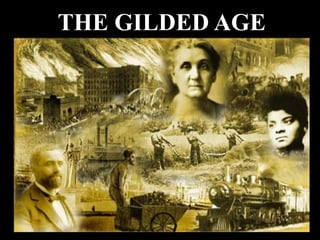
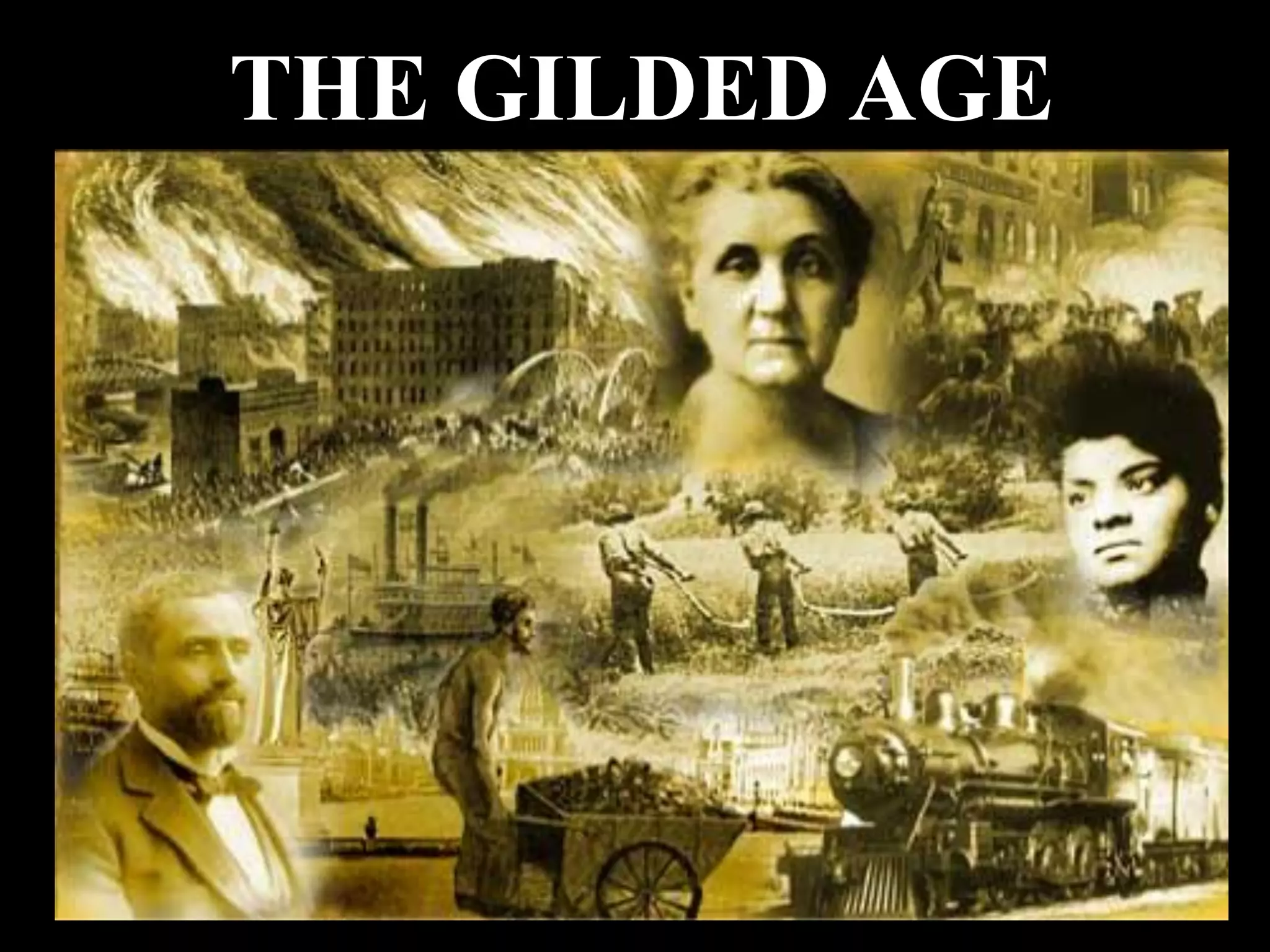
THE GILDED AGE
Gilded Age
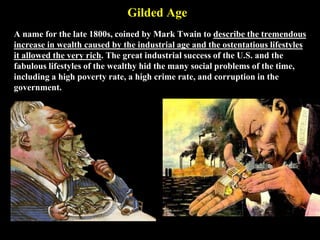
A name for the late 1800s, coined by Mark Twain to describe the tremendous
increase in wealth caused by the industrial age and the ostentatious lifestyles
it allowed the very rich. The great industrial success of the U.S. and the
fabulous lifestyles of the wealthy hid the many social problems of the time,
including a high poverty rate, a high crime rate, and corruption in the
government.
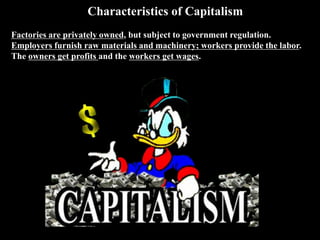
Characteristics of Capitalism
Factories are privately owned, but subject to government regulation.
Employers furnish raw materials and machinery; workers provide the labor.
The owners get profits and the workers get wages.
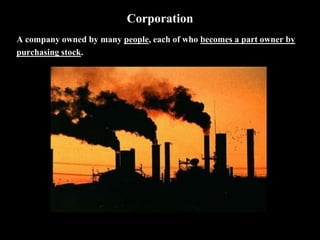
Corporation
A company owned by many people, each of who becomes a part owner by
purchasing stock.
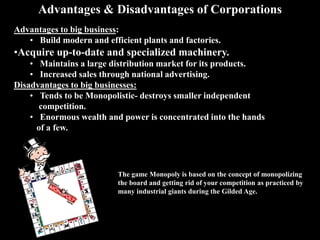
Advantages & Disadvantages of Corporations
Advantages to big business:
• Build modern and efficient plants and factories.
•Acquire up-to-date and specialized machinery.
• Maintains a large distribution market for its products.
• Increased sales through national advertising.
Disadvantages to big businesses:
• Tends to be Monopolistic- destroys smaller independent
competition.
• Enormous wealth and power is concentrated into the hands
of a few.
The game Monopoly is based on the concept of monopolizing
the board and getting rid of your competition as practiced by
many industrial giants during the Gilded Age.
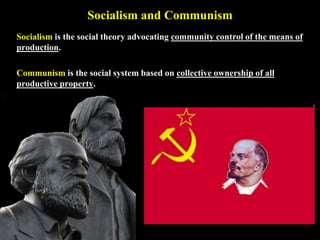
Socialism and Communism
Socialism is the social theory advocating community control of the means of
production.
Communism is the social system based on collective ownership of all
productive property.
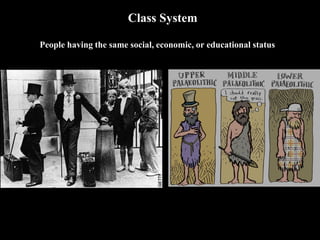
Class System
People having the same social, economic, or educational status
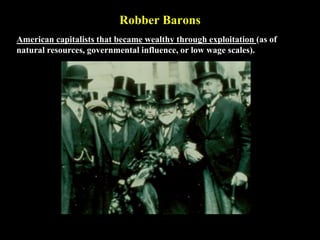
Robber Barons
American capitalists that became wealthy through exploitation (as of
natural resources, governmental influence, or low wage scales).
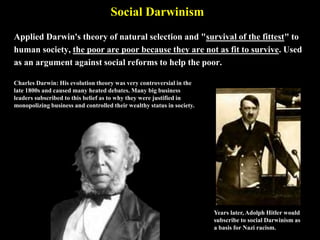
Social Darwinism
Applied Darwin's theory of natural selection and "survival of the fittest" to
human society, the poor are poor because they are not as fit to survive. Used
as an argument against social reforms to help the poor.
Years later, Adolph Hitler would
subscribe to social Darwinism as
a basis for Nazi racism.
Charles Darwin: His evolution theory was very controversial in the
late 1800s and caused many heated debates. Many big business
leaders subscribed to this belief as to why they were justified in
monopolizing business and controlled their wealthy status in society.
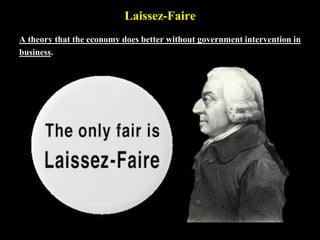
Laissez-Faire
A theory that the economy does better without government intervention in
business.
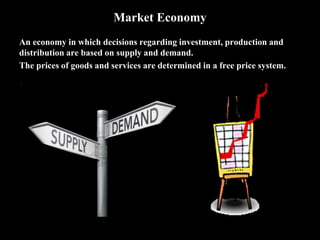
Market Economy
An economy in which decisions regarding investment, production and
distribution are based on supply and demand.
The prices of goods and services are determined in a free price system.
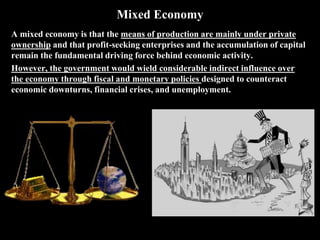
Mixed Economy
A mixed economy is that the means of production are mainly under private
ownership and that profit-seeking enterprises and the accumulation of capital
remain the fundamental driving force behind economic activity.
However, the government would wield considerable indirect influence over
the economy through fiscal and monetary policies designed to counteract
economic downturns, financial crises, and unemployment.
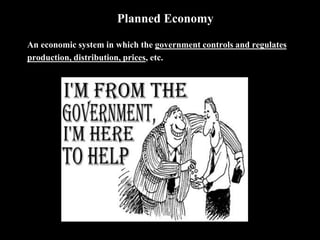
Planned Economy
An economic system in which the government controls and regulates
production, distribution, prices, etc.
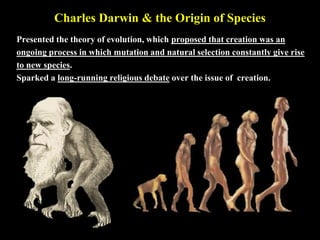
Charles Darwin & the Origin of Species
Presented the theory of evolution, which proposed that creation was an
ongoing process in which mutation and natural selection constantly give rise
to new species.
Sparked a long-running religious debate over the issue of creation.
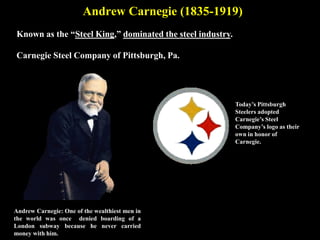
Andrew Carnegie (1835-1919)
Known as the “Steel King,” dominated the steel industry.
Carnegie Steel Company of Pittsburgh, Pa.
Andrew Carnegie: One of the wealthiest men in
the world was once denied boarding of a
London subway because he never carried
money with him.
Today’s Pittsburgh
Steelers adopted
Carnegie’s Steel
Company’s logo as their
own in honor of
Carnegie.
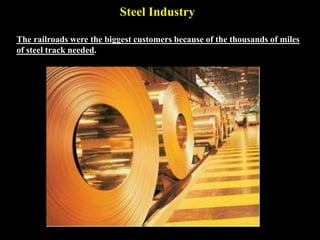
Steel Industry
The railroads were the biggest customers because of the thousands of miles
of steel track needed.
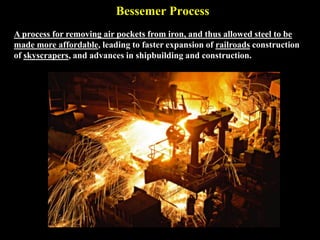
Bessemer Process
A process for removing air pockets from iron, and thus allowed steel to be
made more affordable, leading to faster expansion of railroads construction
of skyscrapers, and advances in shipbuilding and construction.
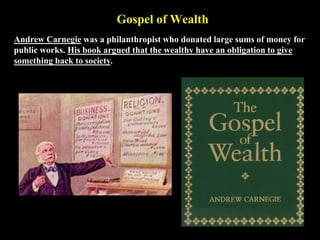
Gospel of Wealth
Andrew Carnegie was a philanthropist who donated large sums of money for
public works. His book argued that the wealthy have an obligation to give
something back to society.
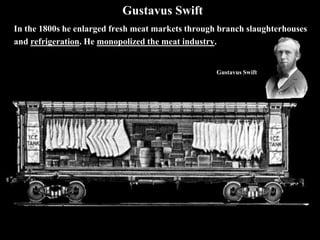
Gustavus Swift
In the 1800s he enlarged fresh meat markets through branch slaughterhouses
and refrigeration. He monopolized the meat industry.
Gustavus Swift
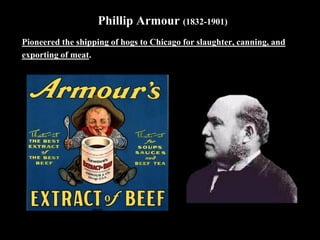
Phillip Armour (1832-1901)
Pioneered the shipping of hogs to Chicago for slaughter, canning, and
exporting of meat.
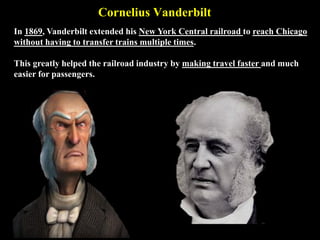
Cornelius Vanderbilt
In 1869, Vanderbilt extended his New York Central railroad to reach Chicago
without having to transfer trains multiple times.
This greatly helped the railroad industry by making travel faster and much
easier for passengers.
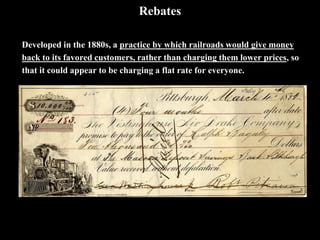
Rebates
Developed in the 1880s, a practice by which railroads would give money
back to its favored customers, rather than charging them lower prices, so
that it could appear to be charging a flat rate for everyone.
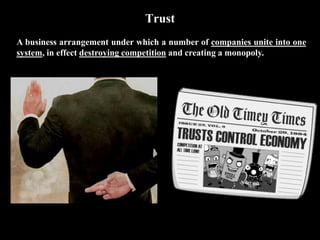
Trust
A business arrangement under which a number of companies unite into one
system, in effect destroying competition and creating a monopoly.
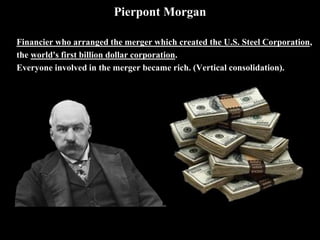
Pierpont Morgan
Financier who arranged the merger which created the U.S. Steel Corporation,
the world's first billion dollar corporation.
Everyone involved in the merger became rich. (Vertical consolidation).
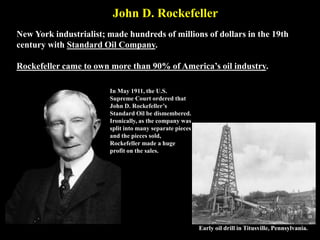
John D. Rockefeller
New York industrialist; made hundreds of millions of dollars in the 19th
century with Standard Oil Company.
Rockefeller came to own more than 90% of America’s oil industry.
Early oil drill in Titusville, Pennsylvania.
In May 1911, the U.S.
Supreme Court ordered that
John D. Rockefeller’s
Standard Oil be dismembered.
Ironically, as the company was
split into many separate pieces
and the pieces sold,
Rockefeller made a huge
profit on the sales.
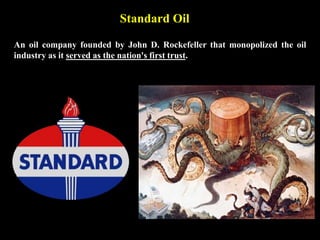
Standard Oil
An oil company founded by John D. Rockefeller that monopolized the oil
industry as it served as the nation's first trust.
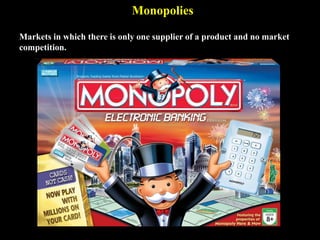
Monopolies
Markets in which there is only one supplier of a product and no market
competition.
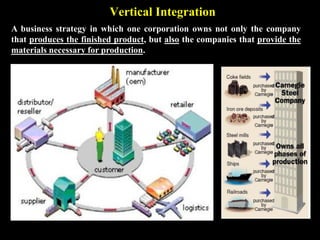
Vertical Integration
A business strategy in which one corporation owns not only the company
that produces the finished product, but also the companies that provide the
materials necessary for production.
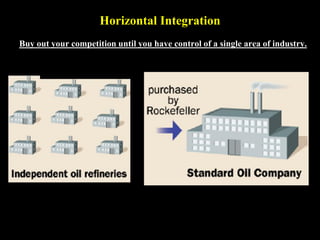
Horizontal Integration
Buy out your competition until you have control of a single area of industry.
Holding Companies
A company that buys controlling amounts of stock in related companies, thus
becoming the majority shareholder, and holding considerable say over each
company's business operations.
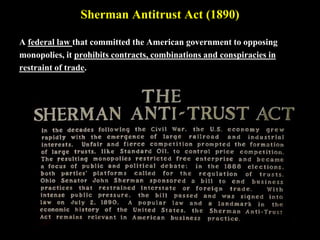
Sherman Antitrust Act (1890)
A federal law that committed the American government to opposing
monopolies, it prohibits contracts, combinations and conspiracies in
restraint of trade.
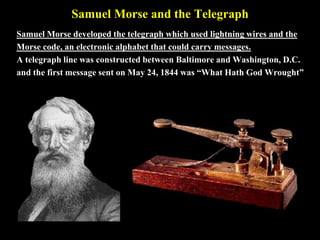
Samuel Morse and the Telegraph
Samuel Morse developed the telegraph which used lightning wires and the
Morse code, an electronic alphabet that could carry messages.
A telegraph line was constructed between Baltimore and Washington, D.C.
and the first message sent on May 24, 1844 was “What Hath God Wrought”
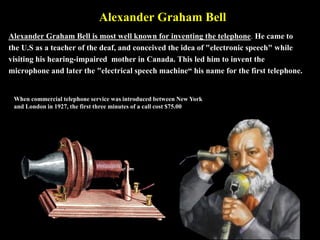
Alexander Graham Bell
Alexander Graham Bell is most well known for inventing the telephone. He came to
the U.S as a teacher of the deaf, and conceived the idea of "electronic speech" while
visiting his hearing-impaired mother in Canada. This led him to invent the
microphone and later the "electrical speech machine“ his name for the first telephone.
When commercial telephone service was introduced between New York
and London in 1927, the first three minutes of a call cost $75.00
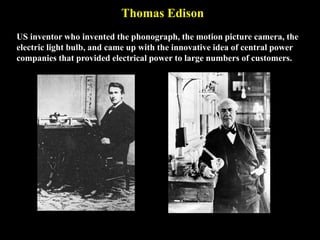
Thomas Edison
US inventor who invented the phonograph, the motion picture camera, the
electric light bulb, and came up with the innovative idea of central power
companies that provided electrical power to large numbers of customers.
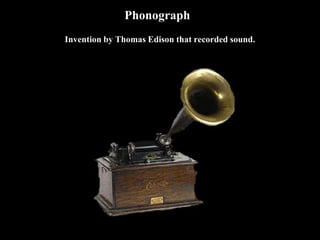
Phonograph
Invention by Thomas Edison that recorded sound.
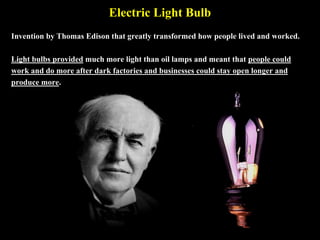
Electric Light Bulb
Invention by Thomas Edison that greatly transformed how people lived and worked.
Light bulbs provided much more light than oil lamps and meant that people could
work and do more after dark factories and businesses could stay open longer and
produce more.
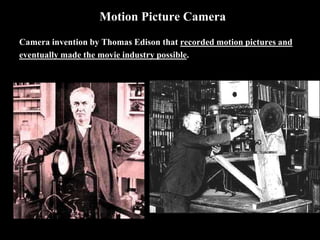
Motion Picture Camera
Camera invention by Thomas Edison that recorded motion pictures and
eventually made the movie industry possible.

Hogan's History- Gilded Age

  • 1.
  • 2.
    Gilded Age A namefor the late 1800s, coined by Mark Twain to describe the tremendous increase in wealth caused by the industrial age and the ostentatious lifestyles it allowed the very rich. The great industrial success of the U.S. and the fabulous lifestyles of the wealthy hid the many social problems of the time, including a high poverty rate, a high crime rate, and corruption in the government.
  • 3.
    Characteristics of Capitalism Factoriesare privately owned, but subject to government regulation. Employers furnish raw materials and machinery; workers provide the labor. The owners get profits and the workers get wages.
  • 4.
    Corporation A company ownedby many people, each of who becomes a part owner by purchasing stock.
  • 5.
    Advantages & Disadvantagesof Corporations Advantages to big business: • Build modern and efficient plants and factories. •Acquire up-to-date and specialized machinery. • Maintains a large distribution market for its products. • Increased sales through national advertising. Disadvantages to big businesses: • Tends to be Monopolistic- destroys smaller independent competition. • Enormous wealth and power is concentrated into the hands of a few. The game Monopoly is based on the concept of monopolizing the board and getting rid of your competition as practiced by many industrial giants during the Gilded Age.
  • 6.
    Socialism and Communism Socialismis the social theory advocating community control of the means of production. Communism is the social system based on collective ownership of all productive property.
  • 7.
    Class System People havingthe same social, economic, or educational status
  • 8.
    Robber Barons American capitaliststhat became wealthy through exploitation (as of natural resources, governmental influence, or low wage scales).
  • 9.
    Social Darwinism Applied Darwin'stheory of natural selection and "survival of the fittest" to human society, the poor are poor because they are not as fit to survive. Used as an argument against social reforms to help the poor. Years later, Adolph Hitler would subscribe to social Darwinism as a basis for Nazi racism. Charles Darwin: His evolution theory was very controversial in the late 1800s and caused many heated debates. Many big business leaders subscribed to this belief as to why they were justified in monopolizing business and controlled their wealthy status in society.
  • 10.
    Laissez-Faire A theory thatthe economy does better without government intervention in business.
  • 11.
    Market Economy An economyin which decisions regarding investment, production and distribution are based on supply and demand. The prices of goods and services are determined in a free price system.
  • 12.
    Mixed Economy A mixedeconomy is that the means of production are mainly under private ownership and that profit-seeking enterprises and the accumulation of capital remain the fundamental driving force behind economic activity. However, the government would wield considerable indirect influence over the economy through fiscal and monetary policies designed to counteract economic downturns, financial crises, and unemployment.
  • 13.
    Planned Economy An economicsystem in which the government controls and regulates production, distribution, prices, etc.
  • 14.
    Charles Darwin &the Origin of Species Presented the theory of evolution, which proposed that creation was an ongoing process in which mutation and natural selection constantly give rise to new species. Sparked a long-running religious debate over the issue of creation.
  • 15.
    Andrew Carnegie (1835-1919) Knownas the “Steel King,” dominated the steel industry. Carnegie Steel Company of Pittsburgh, Pa. Andrew Carnegie: One of the wealthiest men in the world was once denied boarding of a London subway because he never carried money with him. Today’s Pittsburgh Steelers adopted Carnegie’s Steel Company’s logo as their own in honor of Carnegie.
  • 16.
    Steel Industry The railroadswere the biggest customers because of the thousands of miles of steel track needed.
  • 17.
    Bessemer Process A processfor removing air pockets from iron, and thus allowed steel to be made more affordable, leading to faster expansion of railroads construction of skyscrapers, and advances in shipbuilding and construction.
  • 18.
    Gospel of Wealth AndrewCarnegie was a philanthropist who donated large sums of money for public works. His book argued that the wealthy have an obligation to give something back to society.
  • 19.
    Gustavus Swift In the1800s he enlarged fresh meat markets through branch slaughterhouses and refrigeration. He monopolized the meat industry. Gustavus Swift
  • 20.
    Phillip Armour (1832-1901) Pioneeredthe shipping of hogs to Chicago for slaughter, canning, and exporting of meat.
  • 21.
    Cornelius Vanderbilt In 1869,Vanderbilt extended his New York Central railroad to reach Chicago without having to transfer trains multiple times. This greatly helped the railroad industry by making travel faster and much easier for passengers.
  • 22.
    Rebates Developed in the1880s, a practice by which railroads would give money back to its favored customers, rather than charging them lower prices, so that it could appear to be charging a flat rate for everyone.
  • 23.
    Trust A business arrangementunder which a number of companies unite into one system, in effect destroying competition and creating a monopoly.
  • 24.
    Pierpont Morgan Financier whoarranged the merger which created the U.S. Steel Corporation, the world's first billion dollar corporation. Everyone involved in the merger became rich. (Vertical consolidation).
  • 25.
    John D. Rockefeller NewYork industrialist; made hundreds of millions of dollars in the 19th century with Standard Oil Company. Rockefeller came to own more than 90% of America’s oil industry. Early oil drill in Titusville, Pennsylvania. In May 1911, the U.S. Supreme Court ordered that John D. Rockefeller’s Standard Oil be dismembered. Ironically, as the company was split into many separate pieces and the pieces sold, Rockefeller made a huge profit on the sales.
  • 26.
    Standard Oil An oilcompany founded by John D. Rockefeller that monopolized the oil industry as it served as the nation's first trust.
  • 27.
    Monopolies Markets in whichthere is only one supplier of a product and no market competition.
  • 28.
    Vertical Integration A businessstrategy in which one corporation owns not only the company that produces the finished product, but also the companies that provide the materials necessary for production.
  • 29.
    Horizontal Integration Buy outyour competition until you have control of a single area of industry.
  • 30.
    Holding Companies A companythat buys controlling amounts of stock in related companies, thus becoming the majority shareholder, and holding considerable say over each company's business operations.
  • 31.
    Sherman Antitrust Act(1890) A federal law that committed the American government to opposing monopolies, it prohibits contracts, combinations and conspiracies in restraint of trade.
  • 32.
    Samuel Morse andthe Telegraph Samuel Morse developed the telegraph which used lightning wires and the Morse code, an electronic alphabet that could carry messages. A telegraph line was constructed between Baltimore and Washington, D.C. and the first message sent on May 24, 1844 was “What Hath God Wrought”
  • 33.
    Alexander Graham Bell AlexanderGraham Bell is most well known for inventing the telephone. He came to the U.S as a teacher of the deaf, and conceived the idea of "electronic speech" while visiting his hearing-impaired mother in Canada. This led him to invent the microphone and later the "electrical speech machine“ his name for the first telephone. When commercial telephone service was introduced between New York and London in 1927, the first three minutes of a call cost $75.00
  • 34.
    Thomas Edison US inventorwho invented the phonograph, the motion picture camera, the electric light bulb, and came up with the innovative idea of central power companies that provided electrical power to large numbers of customers.
  • 35.
    Phonograph Invention by ThomasEdison that recorded sound.
  • 36.
    Electric Light Bulb Inventionby Thomas Edison that greatly transformed how people lived and worked. Light bulbs provided much more light than oil lamps and meant that people could work and do more after dark factories and businesses could stay open longer and produce more.
  • 37.
    Motion Picture Camera Camerainvention by Thomas Edison that recorded motion pictures and eventually made the movie industry possible.