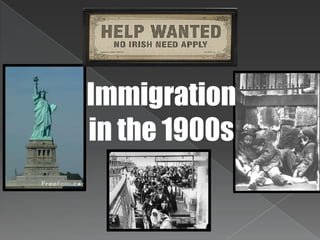
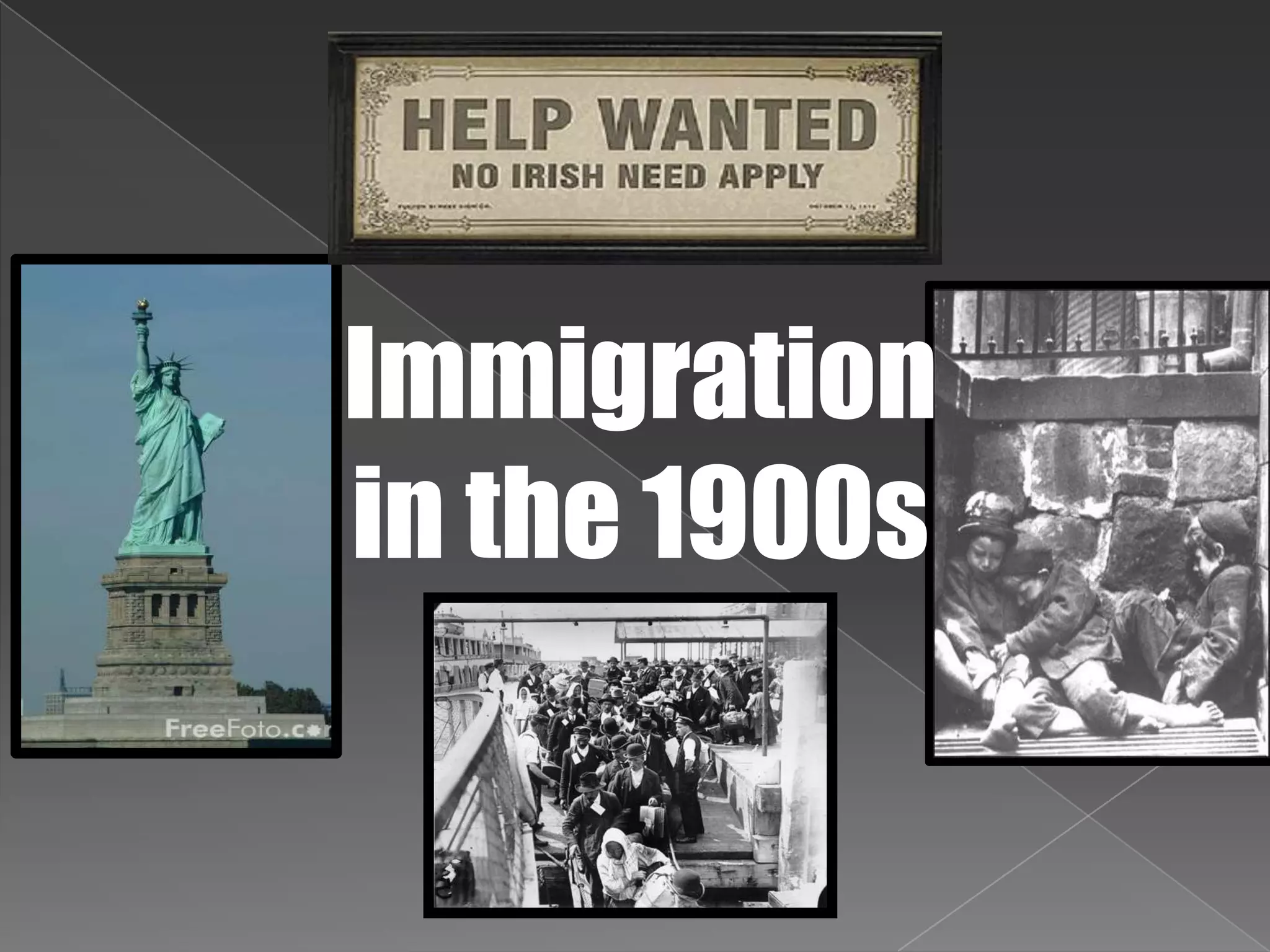
Immigrationin the 1900s
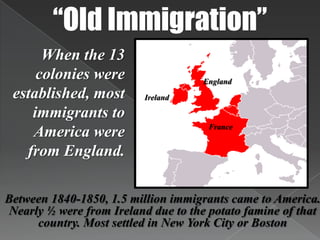
“Old Immigration”When the 13 colonies were established, most immigrants to America were from England. EnglandIrelandFranceBetween 1840-1850, 1.5 million immigrants came to America. Nearly ½ were from Ireland due to the potato famine of that country. Most settled in New York City or Boston
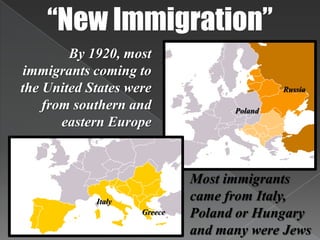
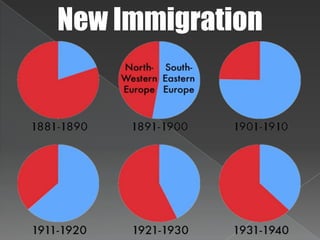
“New Immigration”By 1920, most immigrants coming to the United States were from southern and eastern EuropeRussiaPolandMost immigrants came from Italy, Poland or Hungary and many were JewsItalyGreece
New Immigration
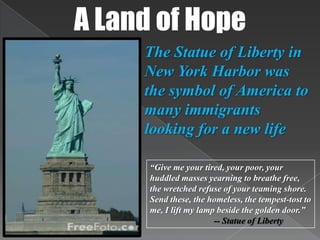
A Land of HopeThe Statue of Liberty in New York Harbor was the symbol of America to many immigrants looking for a new life“Give me your tired, your poor, your huddled masses yearning to breathe free, the wretched refuse of your teaming shore. Send these, the homeless, the tempest-tost to me, I lift my lamp beside the golden door.” -- Statue of Liberty
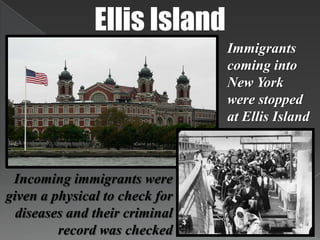
Ellis IslandImmigrants coming into New York were stopped at Ellis IslandIncoming immigrants were given a physical to check for diseases and their criminal record was checked
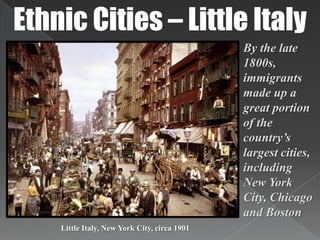
Ethnic Cities – Little ItalyBy the late 1800s, immigrants made up a great portion of the country’s largest cities, including New York City, Chicago and BostonLittle Italy, New York City, circa 1901
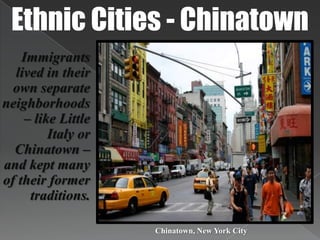
Ethnic Cities - ChinatownImmigrants lived in their own separate neighborhoods – like Little Italy or Chinatown –  and kept many of their former traditions. Chinatown, New York City
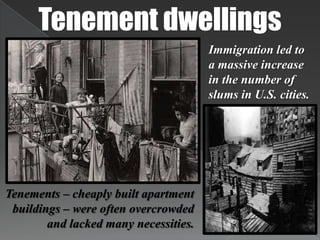
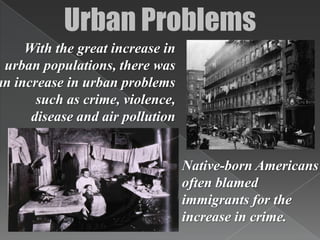
Tenement dwellingsImmigration led to a massive increase in the number of slums in U.S. cities.Tenements – cheaply built apartment buildings – were often overcrowded and lacked many necessities.
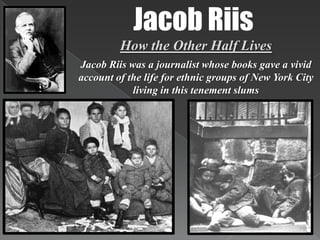
Jacob RiisHow the Other Half LivesJacob Riis was a journalist whose books gave a vivid account of the life for ethnic groups of New York City living in this tenement slums
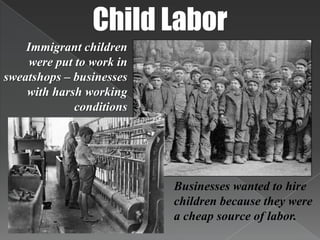
Child LaborImmigrant children were put to work in sweatshops – businesses with harsh working conditionsBusinesses wanted to hire children because they were a cheap source of labor.
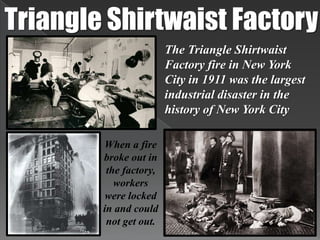
Triangle Shirtwaist FactoryThe Triangle Shirtwaist Factory fire in New York City in 1911 was the largest industrial disaster in the history of New York CityWhen a fire broke out in the factory, workers were locked in and could not get out.
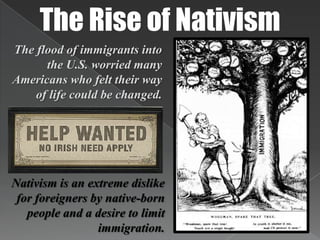
The Rise of NativismThe flood of immigrants into the U.S. worried many Americans who felt their way of life could be changed.Nativism is an extreme dislike for foreigners by native-born people and a desire to limit immigration.
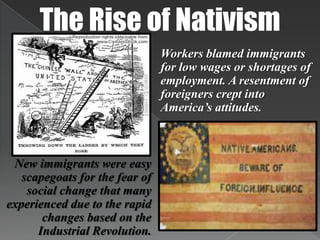
The Rise of NativismWorkers blamed immigrants for low wages or shortages of employment. A resentment of foreigners crept into America’s attitudes. New immigrants were easy scapegoats for the fear of social change that many experienced due to the rapid changes based on the Industrial Revolution.
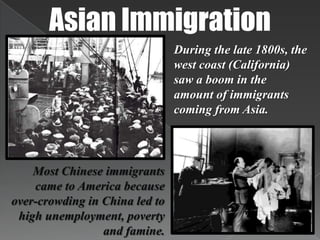
Asian ImmigrationDuring the late 1800s, the west coast (California) saw a boom in the amount of immigrants coming from Asia.Most Chinese immigrants came to America because over-crowding in China led to high unemployment, poverty and famine.
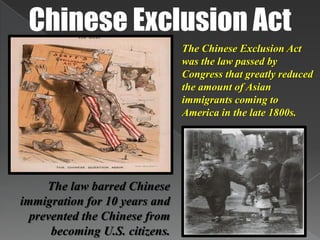
Chinese Exclusion ActThe Chinese Exclusion Act was the law passed by Congress that greatly reduced the amount of Asian immigrants coming to America in the late 1800s.The law barred Chinese immigration for 10 years and prevented the Chinese from becoming U.S. citizens.
SummaryBeginning in the late 1800s, most immigrants coming to the U.S. were from southern and eastern Europe
Immigrants lived in their own separate neighborhoods and kept many of their former traditions.
Immigration led to a massive increase in the number of slums and tenement buildings in U.S. cities.
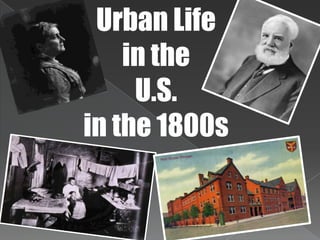
Workers blamed immigrants for low wages or shortages of employment. A resentment of foreigners crept into America’s attitudes.Urban Lifein theU.S.in the 1800s
Urban ProblemsWith the great increase in urban populations, there was an increase in urban problems such as crime, violence, disease and air pollutionNative-born Americans often blamed immigrants for the increase in crime.
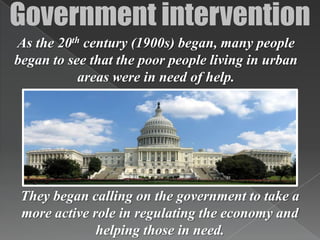
Government interventionAs the 20th century (1900s) began, many people began to see that the poor people living in urban areas were in need of help. They began calling on the government to take a more active role in regulating the economy and helping those in need.
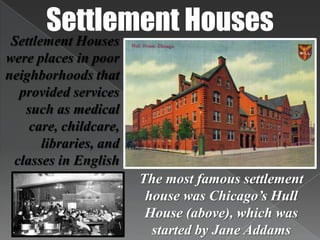
Settlement HousesSettlement Houses were places in poor neighborhoods that provided services such as medical care, childcare, libraries, and classes in EnglishThe most famous settlement house was Chicago’s Hull House (above), which was started by Jane Addams
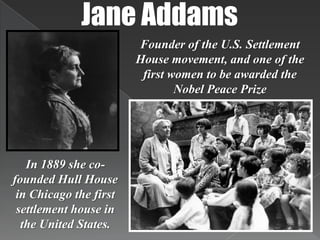
Jane AddamsFounder of the U.S. Settlement House movement, and one of the first women to be awarded the Nobel Peace PrizeIn 1889 she co-founded Hull House in Chicago the first settlement house in the United States.
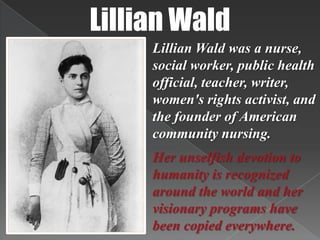
Lillian WaldLillian Wald was a nurse, social worker, public health official, teacher, writer, women's rights activist, and the founder of American community nursing. Her unselfish devotion to humanity is recognized around the world and her visionary programs have been copied everywhere.
Urban ReformsReform efforts gave rise to the Salvation Army beginning in 1878. It offered a practical aid and religious counseling to the urban poor. The YMCA tried to help organized Bible studies, prayer meetings, citizenship training and group activities.
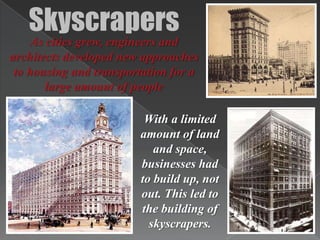
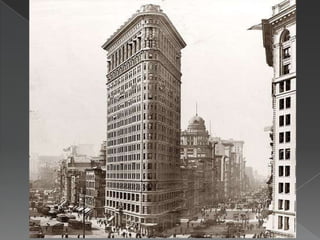
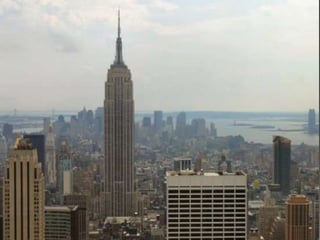
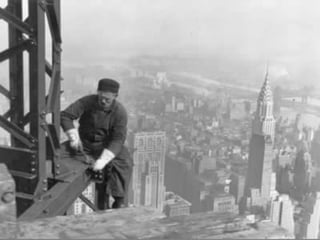
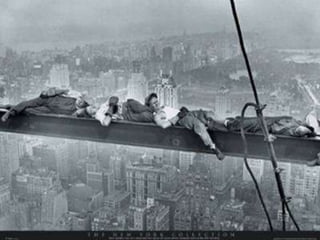
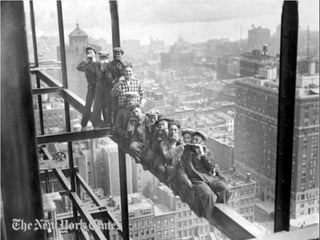
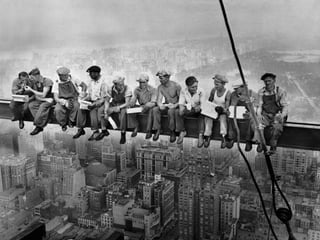
SkyscrapersAs cities grew, engineers and architects developed new approaches to housing and transportation for a large amount of peopleWith a limited amount of land and space, businesses had to build up, not out. This led to the building of skyscrapers.
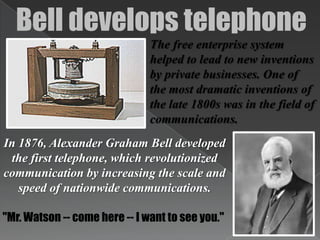
Bell develops telephoneThe free enterprise system helped to lead to new inventions by private businesses. One of the most dramatic inventions of the late 1800s was in the field of communications.In 1876, Alexander Graham Bell developed the first telephone, which revolutionized communication by increasing the scale and speed of nationwide communications."Mr. Watson -- come here -- I want to see you."
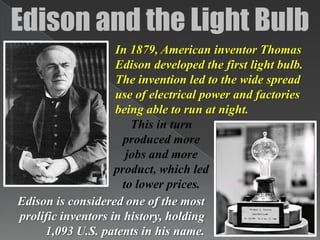
Edison and the Light BulbIn 1879, American inventor Thomas Edison developed the first light bulb. The invention led to the wide spread use of electrical power and factories being able to run at night.This in turn produced more jobs and more product, which led to lower prices.Edison is considered one of the most prolific inventors in history, holding 1,093 U.S. patents in his name.
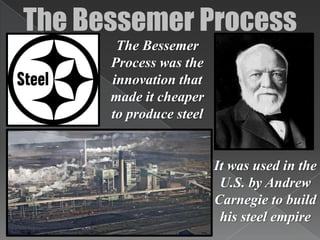
The Bessemer ProcessThe Bessemer Process was the innovation that made it cheaper to produce steelIt was used in the U.S. by Andrew Carnegie to build his steel empire
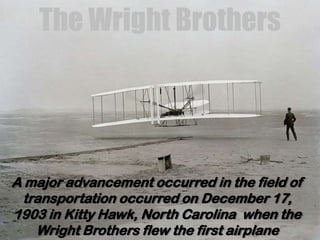
The Wright BrothersA major advancement occurred in the field of transportation occurred on December 17, 1903 in Kitty Hawk, North Carolina  when the Wright Brothers flew the first airplane
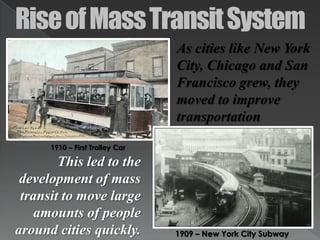
Rise of Mass Transit SystemAs cities like New York City, Chicago and San Francisco grew, they moved to improve transportation1910 – First Trolley Car  This led to the development of mass transit to move large amounts of people around cities quickly. 1909 – New York City Subway
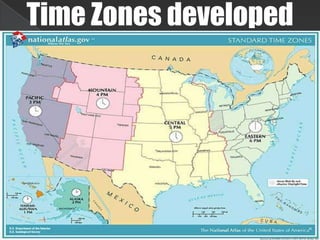
Time Zones developed
SummaryWith the great increase in urban populations, there was an increase in urban problems such as crime, violence, disease and air pollution
With a limited amount of land and space, businesses began to build skyscrapers.
Settlement houses were places located in poor neighborhoods that provided numerous community services for immigrants coming into the country
New inventions such as the light bulb, the telegraph, the telephone, the trolley car and railroads helped to increase the nation’s productive capacity and improve communication and transportationThe Birthof Unions
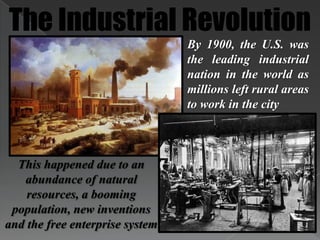
The Industrial RevolutionBy 1900, the U.S. was the leading industrial nation in the world as millions left rural areas to work in the cityThis happened due to an abundance of natural resources, a booming population, new inventions and the free enterprise system
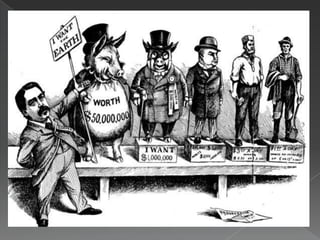
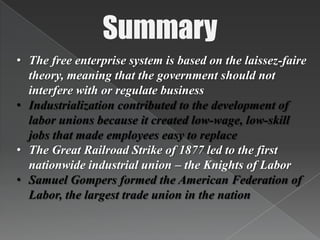
Free Enterprise SystemThe free enterprise system is the economic system in which the citizens of a nation are free to run a business (or enterprise) the way they wantThe system is based on the laissez-faire theory, meaning a business will succeed or fail and the government will not interfere
Early UnionsThe free enterprise system meant that businesses made their own rulesWithout government interference, business owners could pay their workers what they wanted and make them work as long as they wantedIndustrialization during the late 1800s contributed to the development of organized labor because it created low-wage, low-skill jobs that made employees easy to replace.
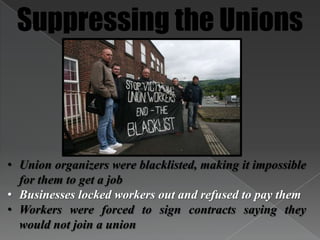
Suppressing the UnionsUnion organizers were blacklisted, making it impossible for them to get a job
Businesses locked workers out and refused to pay them
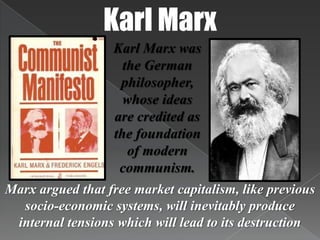
Workers were forced to sign contracts saying they would not join a unionKarl MarxKarl Marx was the German philosopher, whose ideas are credited as the foundation of modern communism.Marx argued that free market capitalism, like previous socio-economic systems, will inevitably produce internal tensions which will lead to its destruction
MarxismMarx believed that workers would eventually revolt, take control of factories, and overthrow the government. Once the workers did this, the new workers-led government would take all private property and distribute wealth evenly among every citizen. Marxism greatly influenced European unions and led to numerous revolutions in Europe in the mid-1800s. When immigrants came to the U.S. from Europe, many feared they would bring their ideas of workers revolutions with them, leading to a distrust of many Americans of immigrant workers.
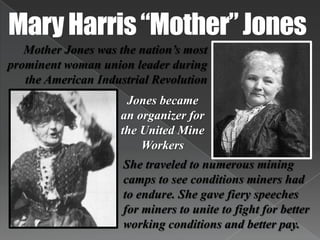
Mary Harris “Mother” JonesMother Jones was the nation’s most prominent woman union leader during the American Industrial RevolutionJones became an organizer for the United Mine WorkersShe traveled to numerous mining camps to see conditions miners had to endure. She gave fiery speeches for miners to unite to fight for better working conditions and better pay.
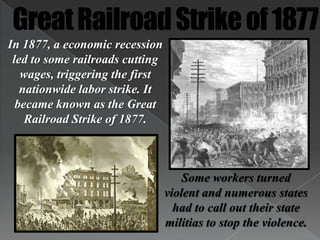
Great Railroad Strike of 1877In 1877, a economic recession led to some railroads cutting wages, triggering the first nationwide labor strike. It became known as the Great Railroad Strike of 1877.Some workers turned violent and numerous states had to call out their state militias to stop the violence.
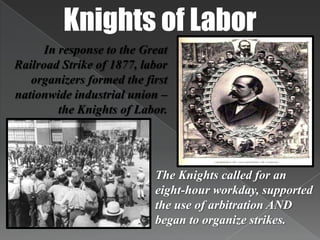
Knights of LaborIn response to the Great Railroad Strike of 1877, labor organizers formed the first nationwide industrial union – the Knights of Labor. The Knights called for an eight-hour workday, supported the use of arbitration AND began to organize strikes.
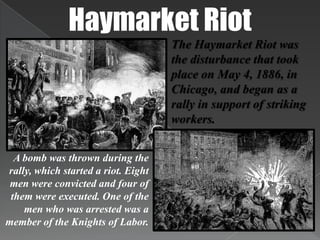
Haymarket RiotThe Haymarket Riot was the disturbance that took place on May 4, 1886, in Chicago, and began as a rally in support of striking workers. A bomb was thrown during the rally, which started a riot. Eight men were convicted and four of them were executed. One of the men who was arrested was a member of the Knights of Labor.
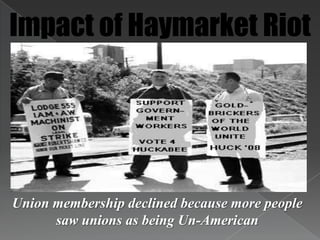
Impact of Haymarket RiotUnion membership declined because more people saw unions as being Un-American
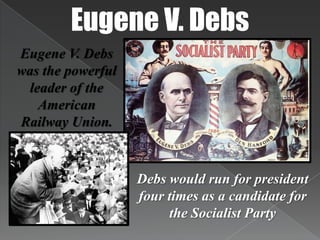
Eugene V. DebsEugene V. Debs was the powerful leader of the American Railway Union.Debs would run for president four times as a candidate for the Socialist Party
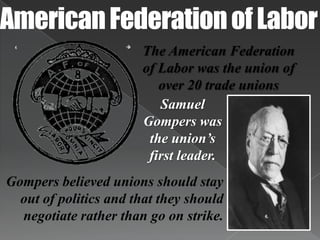
American Federation of LaborThe American Federation of Labor was the union of over 20 trade unionsSamuel Gompers was the union’s first leader. Gompers believed unions should stay out of politics and that they should negotiate rather than go on strike.
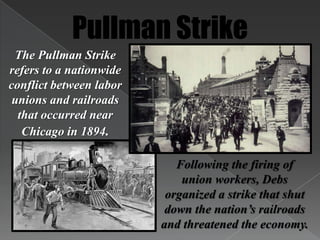
Pullman StrikeThe Pullman Strike refers to a nationwide conflict between labor unions and railroads that occurred near Chicago in 1894. Following the firing of union workers, Debs organized a strike that shut down the nation’s railroads and threatened the economy.

Unit 2 powerpoint (Immigration and Industrialization)

  • 1.
  • 2.
    “Old Immigration”When the13 colonies were established, most immigrants to America were from England. EnglandIrelandFranceBetween 1840-1850, 1.5 million immigrants came to America. Nearly ½ were from Ireland due to the potato famine of that country. Most settled in New York City or Boston
  • 3.
    “New Immigration”By 1920,most immigrants coming to the United States were from southern and eastern EuropeRussiaPolandMost immigrants came from Italy, Poland or Hungary and many were JewsItalyGreece
  • 4.
  • 5.
    A Land ofHopeThe Statue of Liberty in New York Harbor was the symbol of America to many immigrants looking for a new life“Give me your tired, your poor, your huddled masses yearning to breathe free, the wretched refuse of your teaming shore. Send these, the homeless, the tempest-tost to me, I lift my lamp beside the golden door.” -- Statue of Liberty
  • 6.
    Ellis IslandImmigrants cominginto New York were stopped at Ellis IslandIncoming immigrants were given a physical to check for diseases and their criminal record was checked
  • 7.
    Ethnic Cities –Little ItalyBy the late 1800s, immigrants made up a great portion of the country’s largest cities, including New York City, Chicago and BostonLittle Italy, New York City, circa 1901
  • 8.
    Ethnic Cities -ChinatownImmigrants lived in their own separate neighborhoods – like Little Italy or Chinatown – and kept many of their former traditions. Chinatown, New York City
  • 9.
    Tenement dwellingsImmigration ledto a massive increase in the number of slums in U.S. cities.Tenements – cheaply built apartment buildings – were often overcrowded and lacked many necessities.
  • 10.
    Jacob RiisHow theOther Half LivesJacob Riis was a journalist whose books gave a vivid account of the life for ethnic groups of New York City living in this tenement slums
  • 11.
    Child LaborImmigrant childrenwere put to work in sweatshops – businesses with harsh working conditionsBusinesses wanted to hire children because they were a cheap source of labor.
  • 12.
    Triangle Shirtwaist FactoryTheTriangle Shirtwaist Factory fire in New York City in 1911 was the largest industrial disaster in the history of New York CityWhen a fire broke out in the factory, workers were locked in and could not get out.
  • 13.
    The Rise ofNativismThe flood of immigrants into the U.S. worried many Americans who felt their way of life could be changed.Nativism is an extreme dislike for foreigners by native-born people and a desire to limit immigration.
  • 14.
    The Rise ofNativismWorkers blamed immigrants for low wages or shortages of employment. A resentment of foreigners crept into America’s attitudes. New immigrants were easy scapegoats for the fear of social change that many experienced due to the rapid changes based on the Industrial Revolution.
  • 15.
    Asian ImmigrationDuring thelate 1800s, the west coast (California) saw a boom in the amount of immigrants coming from Asia.Most Chinese immigrants came to America because over-crowding in China led to high unemployment, poverty and famine.
  • 16.
    Chinese Exclusion ActTheChinese Exclusion Act was the law passed by Congress that greatly reduced the amount of Asian immigrants coming to America in the late 1800s.The law barred Chinese immigration for 10 years and prevented the Chinese from becoming U.S. citizens.
  • 17.
    SummaryBeginning in thelate 1800s, most immigrants coming to the U.S. were from southern and eastern Europe
  • 18.
    Immigrants lived intheir own separate neighborhoods and kept many of their former traditions.
  • 19.
    Immigration led toa massive increase in the number of slums and tenement buildings in U.S. cities.
  • 20.
    Workers blamed immigrantsfor low wages or shortages of employment. A resentment of foreigners crept into America’s attitudes.Urban Lifein theU.S.in the 1800s
  • 22.
    Urban ProblemsWith thegreat increase in urban populations, there was an increase in urban problems such as crime, violence, disease and air pollutionNative-born Americans often blamed immigrants for the increase in crime.
  • 23.
    Government interventionAs the20th century (1900s) began, many people began to see that the poor people living in urban areas were in need of help. They began calling on the government to take a more active role in regulating the economy and helping those in need.
  • 24.
    Settlement HousesSettlement Houseswere places in poor neighborhoods that provided services such as medical care, childcare, libraries, and classes in EnglishThe most famous settlement house was Chicago’s Hull House (above), which was started by Jane Addams
  • 25.
    Jane AddamsFounder ofthe U.S. Settlement House movement, and one of the first women to be awarded the Nobel Peace PrizeIn 1889 she co-founded Hull House in Chicago the first settlement house in the United States.
  • 26.
    Lillian WaldLillian Waldwas a nurse, social worker, public health official, teacher, writer, women's rights activist, and the founder of American community nursing. Her unselfish devotion to humanity is recognized around the world and her visionary programs have been copied everywhere.
  • 27.
    Urban ReformsReform effortsgave rise to the Salvation Army beginning in 1878. It offered a practical aid and religious counseling to the urban poor. The YMCA tried to help organized Bible studies, prayer meetings, citizenship training and group activities.
  • 28.
    SkyscrapersAs cities grew,engineers and architects developed new approaches to housing and transportation for a large amount of peopleWith a limited amount of land and space, businesses had to build up, not out. This led to the building of skyscrapers.
  • 35.
    Bell develops telephoneThefree enterprise system helped to lead to new inventions by private businesses. One of the most dramatic inventions of the late 1800s was in the field of communications.In 1876, Alexander Graham Bell developed the first telephone, which revolutionized communication by increasing the scale and speed of nationwide communications."Mr. Watson -- come here -- I want to see you."
  • 36.
    Edison and theLight BulbIn 1879, American inventor Thomas Edison developed the first light bulb. The invention led to the wide spread use of electrical power and factories being able to run at night.This in turn produced more jobs and more product, which led to lower prices.Edison is considered one of the most prolific inventors in history, holding 1,093 U.S. patents in his name.
  • 37.
    The Bessemer ProcessTheBessemer Process was the innovation that made it cheaper to produce steelIt was used in the U.S. by Andrew Carnegie to build his steel empire
  • 38.
    The Wright BrothersAmajor advancement occurred in the field of transportation occurred on December 17, 1903 in Kitty Hawk, North Carolina when the Wright Brothers flew the first airplane
  • 39.
    Rise of MassTransit SystemAs cities like New York City, Chicago and San Francisco grew, they moved to improve transportation1910 – First Trolley Car This led to the development of mass transit to move large amounts of people around cities quickly. 1909 – New York City Subway
  • 40.
  • 41.
    SummaryWith the greatincrease in urban populations, there was an increase in urban problems such as crime, violence, disease and air pollution
  • 42.
    With a limitedamount of land and space, businesses began to build skyscrapers.
  • 43.
    Settlement houses wereplaces located in poor neighborhoods that provided numerous community services for immigrants coming into the country
  • 44.
    New inventions suchas the light bulb, the telegraph, the telephone, the trolley car and railroads helped to increase the nation’s productive capacity and improve communication and transportationThe Birthof Unions
  • 45.
    The Industrial RevolutionBy1900, the U.S. was the leading industrial nation in the world as millions left rural areas to work in the cityThis happened due to an abundance of natural resources, a booming population, new inventions and the free enterprise system
  • 46.
    Free Enterprise SystemThefree enterprise system is the economic system in which the citizens of a nation are free to run a business (or enterprise) the way they wantThe system is based on the laissez-faire theory, meaning a business will succeed or fail and the government will not interfere
  • 47.
    Early UnionsThe freeenterprise system meant that businesses made their own rulesWithout government interference, business owners could pay their workers what they wanted and make them work as long as they wantedIndustrialization during the late 1800s contributed to the development of organized labor because it created low-wage, low-skill jobs that made employees easy to replace.
  • 48.
    Suppressing the UnionsUnionorganizers were blacklisted, making it impossible for them to get a job
  • 49.
    Businesses locked workersout and refused to pay them
  • 50.
    Workers were forcedto sign contracts saying they would not join a unionKarl MarxKarl Marx was the German philosopher, whose ideas are credited as the foundation of modern communism.Marx argued that free market capitalism, like previous socio-economic systems, will inevitably produce internal tensions which will lead to its destruction
  • 51.
    MarxismMarx believed thatworkers would eventually revolt, take control of factories, and overthrow the government. Once the workers did this, the new workers-led government would take all private property and distribute wealth evenly among every citizen. Marxism greatly influenced European unions and led to numerous revolutions in Europe in the mid-1800s. When immigrants came to the U.S. from Europe, many feared they would bring their ideas of workers revolutions with them, leading to a distrust of many Americans of immigrant workers.
  • 52.
    Mary Harris “Mother”JonesMother Jones was the nation’s most prominent woman union leader during the American Industrial RevolutionJones became an organizer for the United Mine WorkersShe traveled to numerous mining camps to see conditions miners had to endure. She gave fiery speeches for miners to unite to fight for better working conditions and better pay.
  • 53.
    Great Railroad Strikeof 1877In 1877, a economic recession led to some railroads cutting wages, triggering the first nationwide labor strike. It became known as the Great Railroad Strike of 1877.Some workers turned violent and numerous states had to call out their state militias to stop the violence.
  • 54.
    Knights of LaborInresponse to the Great Railroad Strike of 1877, labor organizers formed the first nationwide industrial union – the Knights of Labor. The Knights called for an eight-hour workday, supported the use of arbitration AND began to organize strikes.
  • 55.
    Haymarket RiotThe HaymarketRiot was the disturbance that took place on May 4, 1886, in Chicago, and began as a rally in support of striking workers. A bomb was thrown during the rally, which started a riot. Eight men were convicted and four of them were executed. One of the men who was arrested was a member of the Knights of Labor.
  • 56.
    Impact of HaymarketRiotUnion membership declined because more people saw unions as being Un-American
  • 57.
    Eugene V. DebsEugeneV. Debs was the powerful leader of the American Railway Union.Debs would run for president four times as a candidate for the Socialist Party
  • 58.
    American Federation ofLaborThe American Federation of Labor was the union of over 20 trade unionsSamuel Gompers was the union’s first leader. Gompers believed unions should stay out of politics and that they should negotiate rather than go on strike.
  • 59.
    Pullman StrikeThe PullmanStrike refers to a nationwide conflict between labor unions and railroads that occurred near Chicago in 1894. Following the firing of union workers, Debs organized a strike that shut down the nation’s railroads and threatened the economy.