Chapter 13 – North and South 1820-1860 Section 1 The North’s Economy
TECHNOLOGY AND INDUSTRY Developed in 3 phases 1-manufacturers made products by dividing the work up among workers 1 would spin thread, 1 would weave etc. 2-manufacturers built factories bringing specialized workers together Products could be put together faster this way -used machinery to do some of the work 3-Power driven looms (more products in less time)
Mass production -began in New England -Elias Howe invented sewing machine in 1846 -by 1860 Northeast’s 74000 factories produces 2/3 of the countries  manufactured goods (a lot in one place)
Elias Howe’s Sewing Machine
IMPROVED TRANSPORTATION Construction crews built thousands of miles of new roads and canals between 1800-1850.  This allowed new shipping routes by connecting rivers and lakes Railroads growth another way to transport goods
Steamboats and Steamships Robert Fulton-1807 inventor of the  steamboat .  Carried goods and people cheaply along inland waterways Canal builders widened and deepened channel and canals, sparked development of cities like Cincinnati, Buffalo, Chicago
Steamboats
Steam also used as a power source for ships to travel across the ocean.  “The Great Western” sailed from US to Britain in 1838 (took sails in case it broke down!)
Steam Powered Ocean Liner The “Great Western”
Clipper Ships   - improved sailing ships sleek hulls, tall sails, 300 miles per day, they “clipped” time from long journeys. Cut sailing times in almost half.  Famous ships “Flying Cloud” Sea Witch, Cutty Sark, Champion of the Seas
Clipper Ships Flying Cloud  Cutty Sark
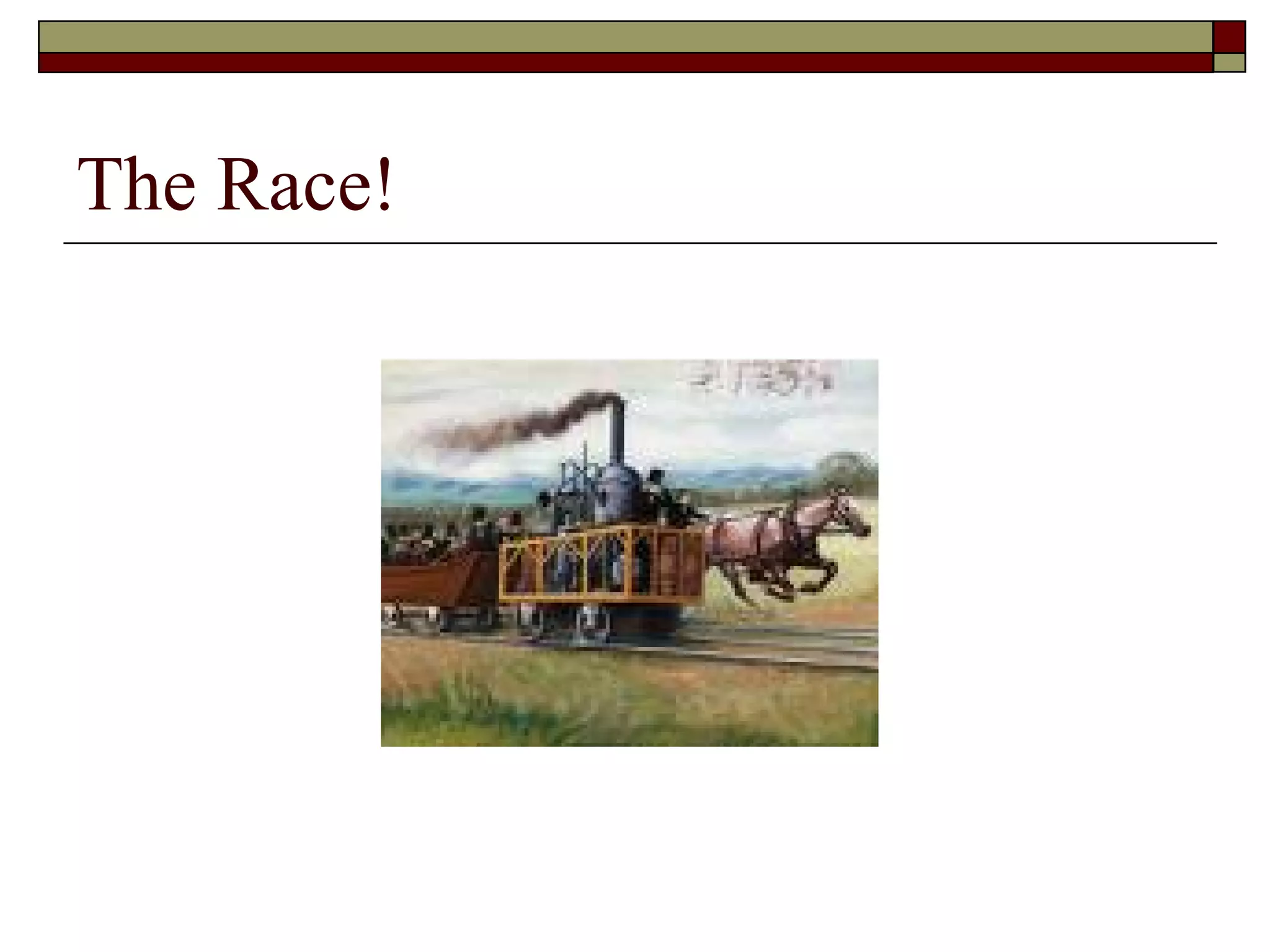
Locomotives   Early trains were drawn by horses instead of engines (horsepower gets its name) The “Rocket” was first steam powered train 1829 in England Peter Cooper designed and built first American steam locomotive in 1830- “Tom Thumb” Raced a horse drawn train and lost due to engine failure. Steam powered engines improved over the next 10 years
The Race!
Tracks -  1840/3000 of track  1860/31,000 of track  mainly in north and Midwest.  Links  New York City/Buffalo  Philadelphia/Pittsburg  Baltimore/Wheeling Virginia
Moving Goods and People past, Mississippi River only route to ship goods to other countries or to east coast -then, east/west canals and RR allowed products like grain, live stock, dairy to move directly from Midwest to east, Cheaper way to transport -since cheaper to transport, could sell cheaper -populations grew in Midwest because of train transportation (cause) Industries developed (effect)
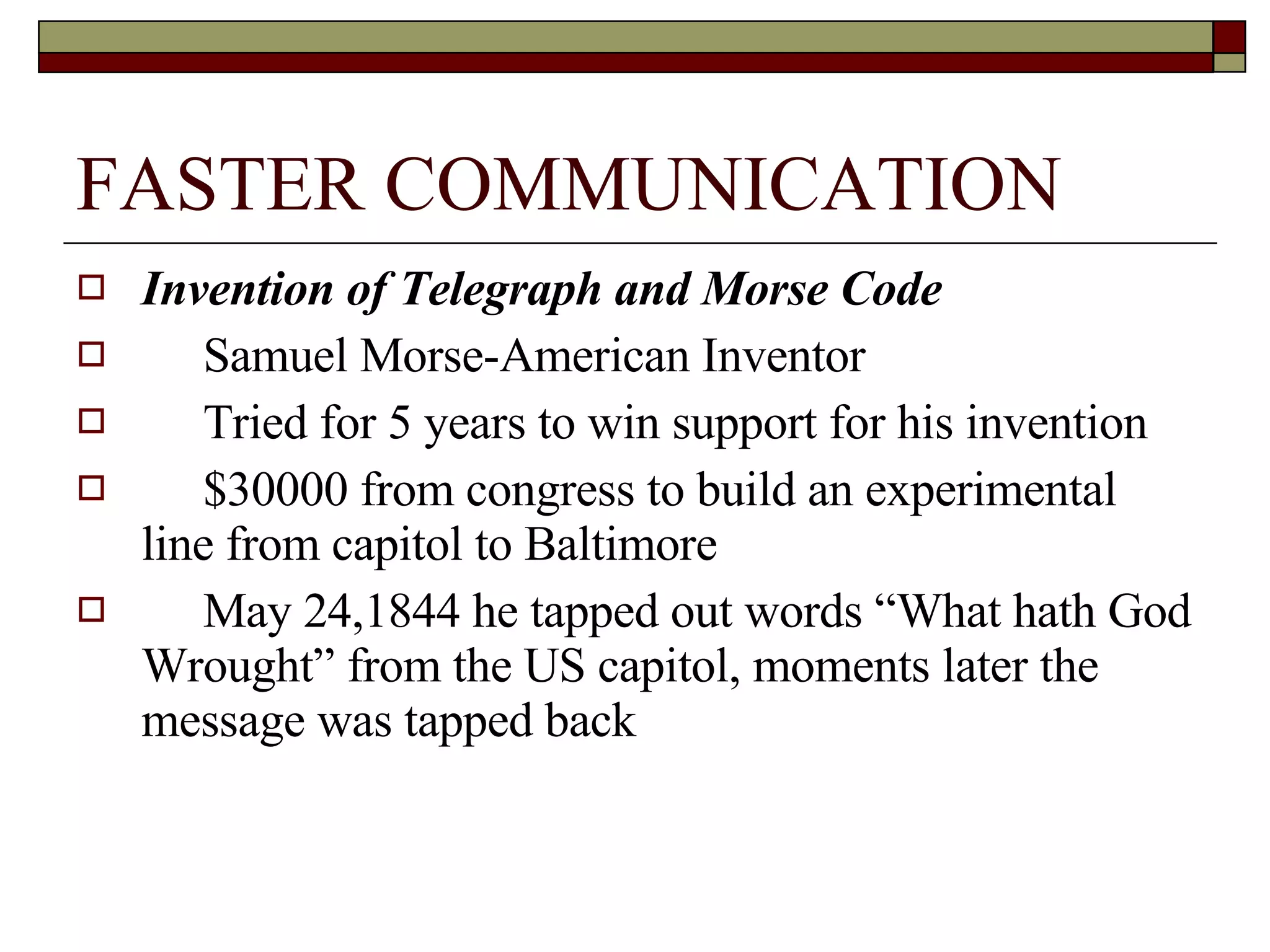
FASTER COMMUNICATION  Invention of Telegraph and Morse Code Samuel Morse-American Inventor Tried for 5 years to win support for his invention $30000 from congress to build an experimental line from capitol to Baltimore May 24,1844 he tapped out words “What hath God Wrought” from the US capitol, moments later the message was tapped back
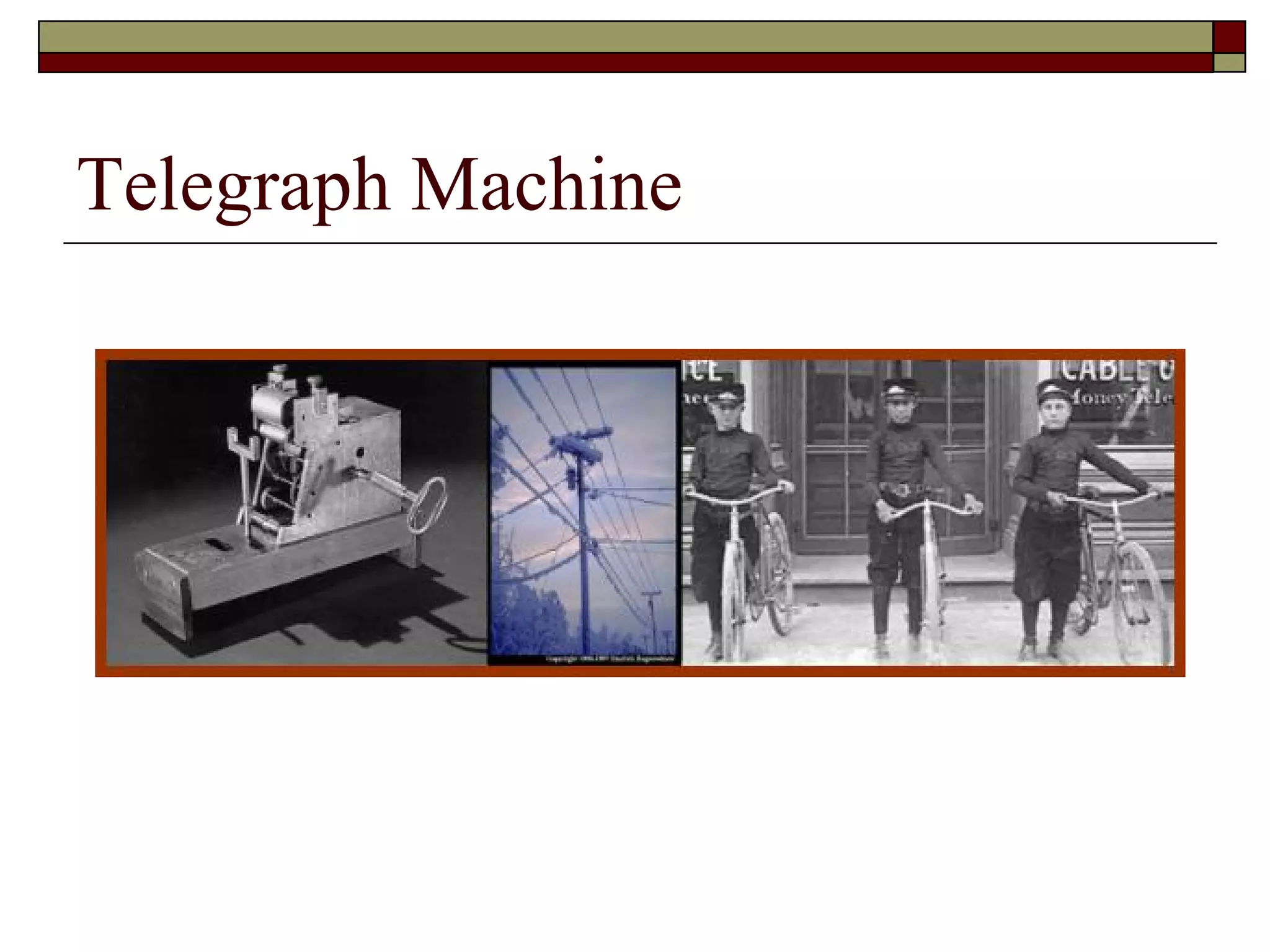
Telegraph Machine
Morse code – a series of dots and dashes representing letters and numbers By 1860 more than 50,000 miles of telegraph line strung
 
 
Invention of the Printing Press 1846 steam cylinder printing press invented by Richard Hoe.  (Cause) Many newspapers began. (effect)
Richard Hoe Steam Cylinder Rotary Press
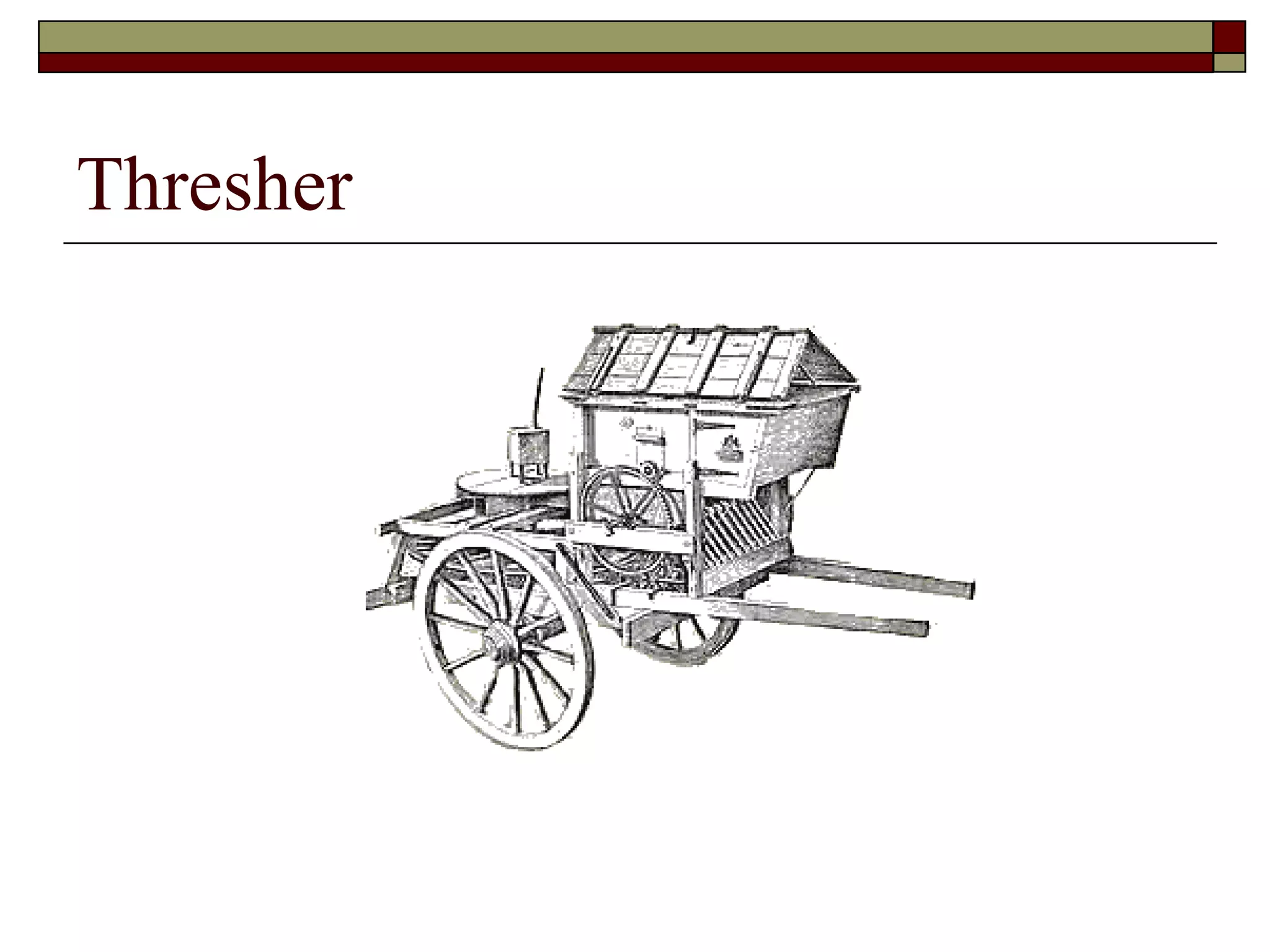
REVOLUTION IN AGRICULTURE Technology in Farming Areas west of Mississippi created challenges in farming, prairie soil, matted soil, rocky soil, etc. 3 inventions  1- steel-tipped plow from John Deere in 1837 (wooden plows used before that) 2- mechanical reaper – sped up harvesting of wheat-1834 Cyrus McCormick (used handheld reapers before that) 3- thresher – separated grain from the stalk
John Deere  Steel-tipped Plow
Cyrus McCormick Mechanical reaper
Thresher
Cash Crops Midwest – wheat in large quantities Northeast and middle Atlantic – fruits and vegetables (grew well in those soils) North turned more to industry.
Section 2 The North’s People
Northern Factories Early 1800’s mills established in  Lowell,  Massachusetts Entire production process under one roof “the factory system” Produced items like textiles, shoes, watches, sewing machines, guns
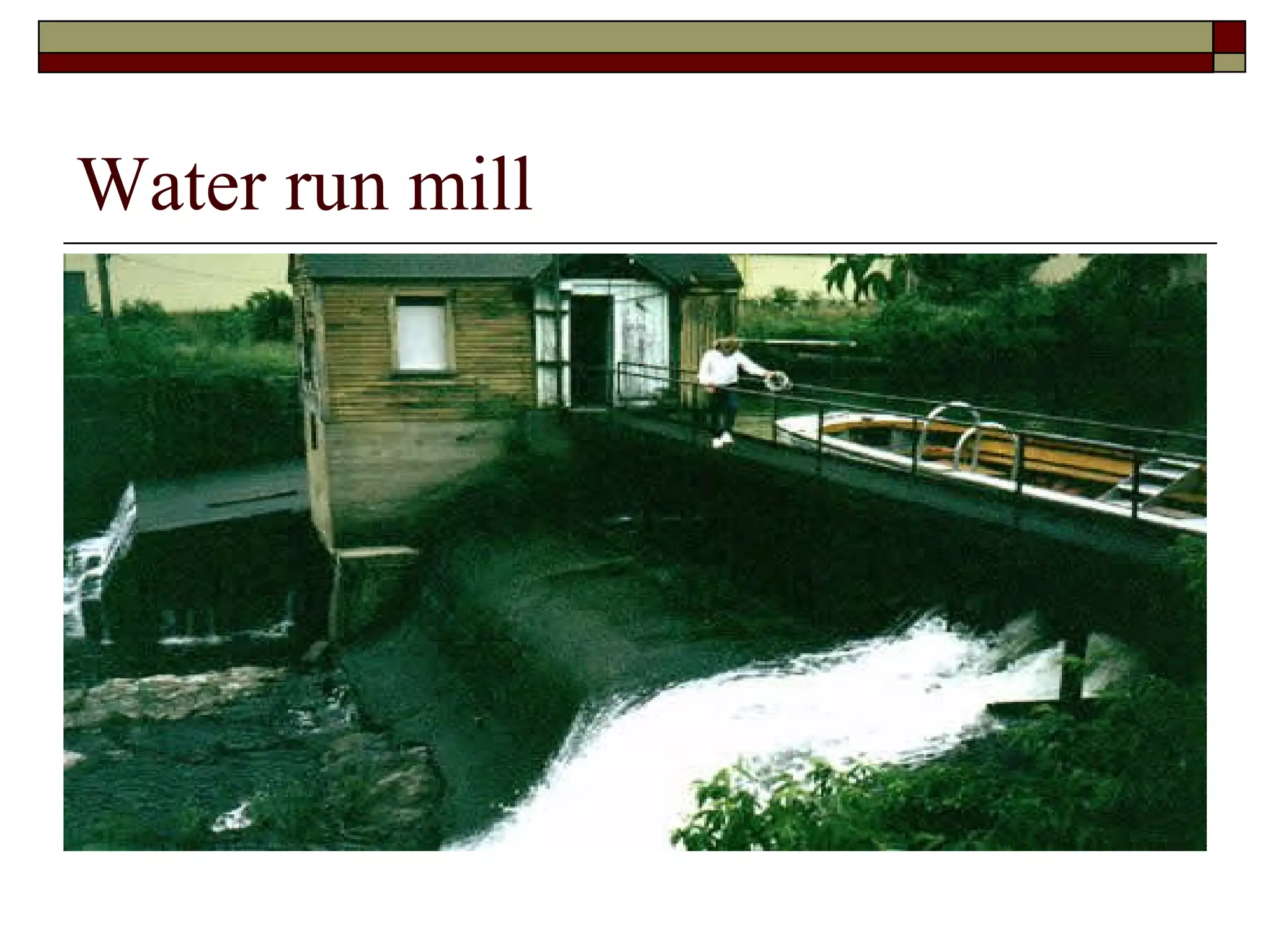
Water run mill
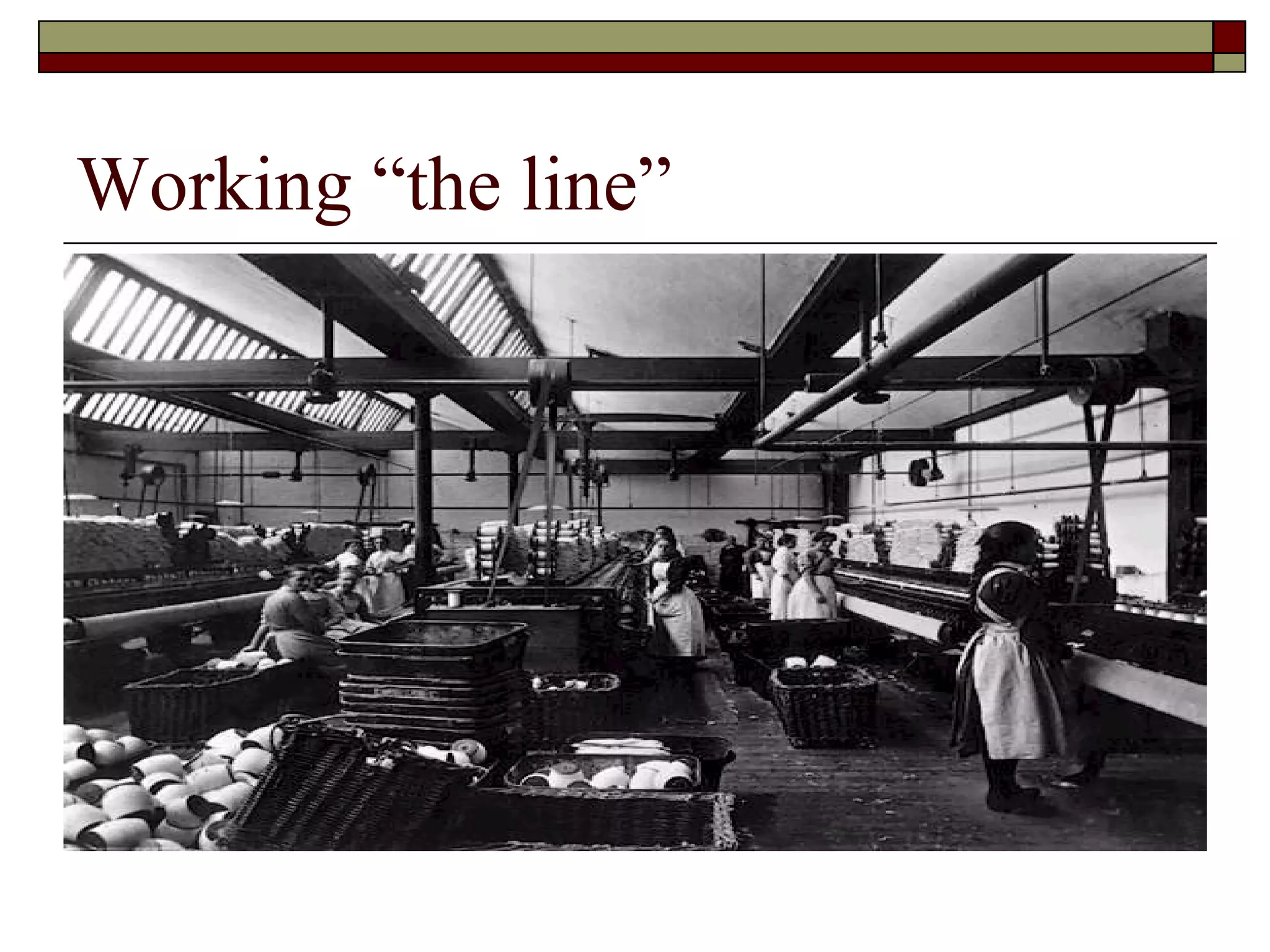
Working Conditions System worsened as it developed Owners wanted longer hours from workers to produce more goods Average work day was 11.4 hours O-T-J accidents increased Machinery did not have safety, protective gear around it  Losing fingers, broken bones, kids especially
Working Conditions cont’ Hot and stifling in summer Air conditioning not invented, machines emitted a lot of heat Cold  in the winter No heat in the factories Profits over worker comforts $$$ Jobs were few and far between An unhappy worker was easily replaced No laws existed to protect workers
Working “the line”
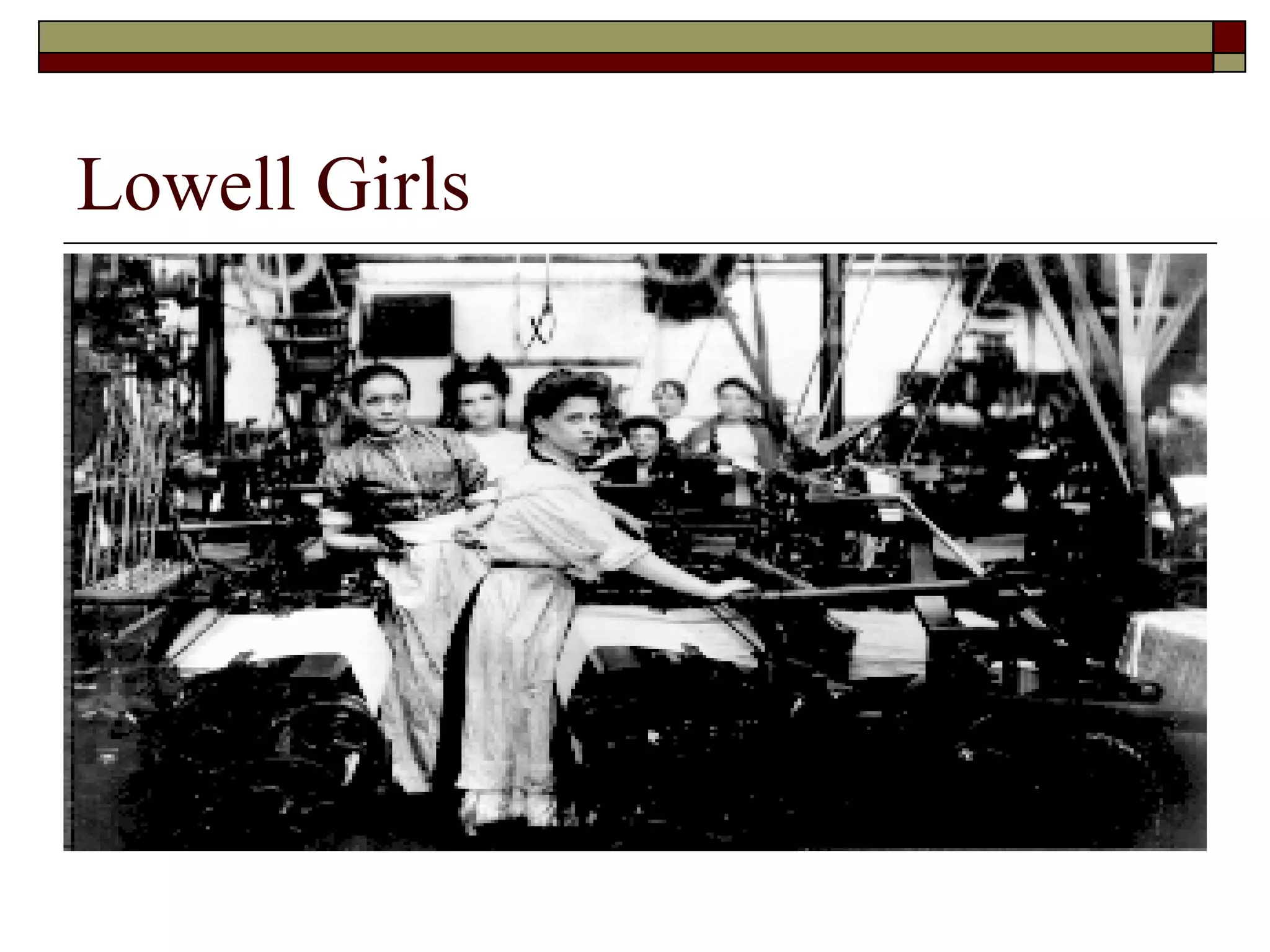
Lowell Mills Built clean, simple lodging for employees Tried to attract young, women workers to the factory By 1840, practice ended Wages were so low, many forced to live in slums near the factory
Lowell Girls
Attempts to Organize 1830’s workers began to “organize”  Wanted improved working conditions Skilled workers formed trade unions Organizations of workers with some trade or skill Unskilled workers formed unions as well Mid 1830’s skilled workers strike Refusing to work to put pressure on employees Wanted higher wages 10 hour work days Formed the General Trades Union of New York
The Right to Strike Early 1800’s striking was illegal Punishable by the law or loss of job 1842 Massachusetts court ruled workers had the right to strike
African American Workers Slavery disappeared from the North by 1820 Didn’t mean everything was “pie in the sky” Faced Racial prejudice & Discrimination An unfair opinion on based on facts Unfair treatment of a group 1821 white, non-landowning males could vote African American males could not African Americans could not attend public school Barred from public facilities Forced into separate, segregated schools and hospitals Had to take the lowest paying jobs
Success Stories for African Americans Successful Businessmen Henry Boyd – Owned a furniture Co. in Cincinnati John B. Russworm-founded  Freedom’s Journal 1 st  African American newspaper Macon B. Allen – 1 st  lawyer Most African Americans were extremely poor Better off than been enslaved in the South Suffered cruel and lasting effects of discrimination
Women Workers Played a major role in development of mill and factory system Were discriminated against Paid less then men When unions were formed, women were excluded Men wanted women out of the workplace to provide more jobs for men Females attempted to organize in 1830’s & 40’s Lowell Female Labor Reform Organization founded by Sarah G. Bagley wanted 10 hour days legislature ignored because petition signed by women Paved the way for future women’s movements
The Rise of Cities People flocked to cities were factories were located 1840, 14% of North’s population lived in cities 1860, 26% of North’s population lived in cities Population of cities in 1860 New York City – 1,000,000 Philadelphia- 500,000
Lots of people, Lots of problems Low paying jobs = unaffordable housing=living in crowded, run-down buildings with no plumbing or heat=unsanitary living conditions=spread of disease and sickness, and=increase in fires because of closely spaced wooden buildings.
Immigration Movement of people into a country Do you know where you came from?
Immigration Cont’ Immigration increased between 1840-60 Welcomed by manufacturers Work long hours for little pay Irish Immigrants Largest group to USA; 1.5 million Settled mostly in Northeast Migrated because of potato famine An extreme shortage of food Potatoes are eaten at each meal Potato blight (disease) destroyed crop in 1840’s Starvation ensued, more than 1 Million died Unable to buy land or farm Worked in factories for low pay Performed manual labor Women became servants and factory workers By 1850, 1/3 of all workers in Boston were Irish
Immigration Cont’ German Immigrants 2 nd  largest group  Left Germany because of breakdown in democracy and for work and future opportunity 1848-1860 1 million, mostly men Had $ to buy farms or start businesses Prospered, founding their own communities (Germantowns) etc. Settled in New York, Pennsylvania, Midwest, western territories
Impact of Immigration Immigrants changed the character of the country Brought their language Customs Religions Unique ways Filters into American way of life
Religion Beginning  of  Immigration Mainly only Protestants from Great Britain Most Catholics lived near Baltimore, New Orleans, St. Augustine Most of the Irish and ½ of the Germans were Catholic Church was source of spiritual guidance, center of community Germans bring language and religion; use in their communities; establish German publications and musical societies
Prejudice for Immigrants “ native” Americans feared the change in character People opposed to immigration: nativists Thought immigrants threatened the future of the  native  (?) huh Accused immigrants of taking jobs from “real” Americans Accused of bringing disease and crime to America because many lived in slum areas
A new political party The Know Nothing Party Formed by Nativists Secret, anti Catholic society Answered questions about their society by saying “I know nothing” Urged Americans to fight the alien menace Wanted stricter citizenship laws  Extending the waiting period from 5 years to 14 years Foreign born citizens could not hold office Supported Millard Fillmore for President although he lost to James Buchanan Mid 1850’s split into two branches- North and South over slavery issue
 

Chapter 13 Slide Show North And South

  • 1.
    Chapter 13 –North and South 1820-1860 Section 1 The North’s Economy
  • 2.
    TECHNOLOGY AND INDUSTRYDeveloped in 3 phases 1-manufacturers made products by dividing the work up among workers 1 would spin thread, 1 would weave etc. 2-manufacturers built factories bringing specialized workers together Products could be put together faster this way -used machinery to do some of the work 3-Power driven looms (more products in less time)
  • 3.
    Mass production -beganin New England -Elias Howe invented sewing machine in 1846 -by 1860 Northeast’s 74000 factories produces 2/3 of the countries manufactured goods (a lot in one place)
  • 4.
  • 5.
    IMPROVED TRANSPORTATION Constructioncrews built thousands of miles of new roads and canals between 1800-1850. This allowed new shipping routes by connecting rivers and lakes Railroads growth another way to transport goods
  • 6.
    Steamboats and SteamshipsRobert Fulton-1807 inventor of the steamboat . Carried goods and people cheaply along inland waterways Canal builders widened and deepened channel and canals, sparked development of cities like Cincinnati, Buffalo, Chicago
  • 7.
  • 8.
    Steam also usedas a power source for ships to travel across the ocean. “The Great Western” sailed from US to Britain in 1838 (took sails in case it broke down!)
  • 9.
    Steam Powered OceanLiner The “Great Western”
  • 10.
    Clipper Ships - improved sailing ships sleek hulls, tall sails, 300 miles per day, they “clipped” time from long journeys. Cut sailing times in almost half. Famous ships “Flying Cloud” Sea Witch, Cutty Sark, Champion of the Seas
  • 11.
    Clipper Ships FlyingCloud Cutty Sark
  • 12.
    Locomotives Early trains were drawn by horses instead of engines (horsepower gets its name) The “Rocket” was first steam powered train 1829 in England Peter Cooper designed and built first American steam locomotive in 1830- “Tom Thumb” Raced a horse drawn train and lost due to engine failure. Steam powered engines improved over the next 10 years
  • 13.
  • 14.
    Tracks - 1840/3000 of track 1860/31,000 of track mainly in north and Midwest. Links New York City/Buffalo Philadelphia/Pittsburg Baltimore/Wheeling Virginia
  • 15.
    Moving Goods andPeople past, Mississippi River only route to ship goods to other countries or to east coast -then, east/west canals and RR allowed products like grain, live stock, dairy to move directly from Midwest to east, Cheaper way to transport -since cheaper to transport, could sell cheaper -populations grew in Midwest because of train transportation (cause) Industries developed (effect)
  • 16.
    FASTER COMMUNICATION Invention of Telegraph and Morse Code Samuel Morse-American Inventor Tried for 5 years to win support for his invention $30000 from congress to build an experimental line from capitol to Baltimore May 24,1844 he tapped out words “What hath God Wrought” from the US capitol, moments later the message was tapped back
  • 17.
  • 18.
    Morse code –a series of dots and dashes representing letters and numbers By 1860 more than 50,000 miles of telegraph line strung
  • 19.
  • 20.
  • 21.
    Invention of thePrinting Press 1846 steam cylinder printing press invented by Richard Hoe. (Cause) Many newspapers began. (effect)
  • 22.
    Richard Hoe SteamCylinder Rotary Press
  • 23.
    REVOLUTION IN AGRICULTURETechnology in Farming Areas west of Mississippi created challenges in farming, prairie soil, matted soil, rocky soil, etc. 3 inventions 1- steel-tipped plow from John Deere in 1837 (wooden plows used before that) 2- mechanical reaper – sped up harvesting of wheat-1834 Cyrus McCormick (used handheld reapers before that) 3- thresher – separated grain from the stalk
  • 24.
    John Deere Steel-tipped Plow
  • 25.
  • 26.
  • 27.
    Cash Crops Midwest– wheat in large quantities Northeast and middle Atlantic – fruits and vegetables (grew well in those soils) North turned more to industry.
  • 28.
    Section 2 TheNorth’s People
  • 29.
    Northern Factories Early1800’s mills established in Lowell, Massachusetts Entire production process under one roof “the factory system” Produced items like textiles, shoes, watches, sewing machines, guns
  • 30.
  • 31.
    Working Conditions Systemworsened as it developed Owners wanted longer hours from workers to produce more goods Average work day was 11.4 hours O-T-J accidents increased Machinery did not have safety, protective gear around it Losing fingers, broken bones, kids especially
  • 32.
    Working Conditions cont’Hot and stifling in summer Air conditioning not invented, machines emitted a lot of heat Cold in the winter No heat in the factories Profits over worker comforts $$$ Jobs were few and far between An unhappy worker was easily replaced No laws existed to protect workers
  • 33.
  • 34.
    Lowell Mills Builtclean, simple lodging for employees Tried to attract young, women workers to the factory By 1840, practice ended Wages were so low, many forced to live in slums near the factory
  • 35.
  • 36.
    Attempts to Organize1830’s workers began to “organize” Wanted improved working conditions Skilled workers formed trade unions Organizations of workers with some trade or skill Unskilled workers formed unions as well Mid 1830’s skilled workers strike Refusing to work to put pressure on employees Wanted higher wages 10 hour work days Formed the General Trades Union of New York
  • 37.
    The Right toStrike Early 1800’s striking was illegal Punishable by the law or loss of job 1842 Massachusetts court ruled workers had the right to strike
  • 38.
    African American WorkersSlavery disappeared from the North by 1820 Didn’t mean everything was “pie in the sky” Faced Racial prejudice & Discrimination An unfair opinion on based on facts Unfair treatment of a group 1821 white, non-landowning males could vote African American males could not African Americans could not attend public school Barred from public facilities Forced into separate, segregated schools and hospitals Had to take the lowest paying jobs
  • 39.
    Success Stories forAfrican Americans Successful Businessmen Henry Boyd – Owned a furniture Co. in Cincinnati John B. Russworm-founded Freedom’s Journal 1 st African American newspaper Macon B. Allen – 1 st lawyer Most African Americans were extremely poor Better off than been enslaved in the South Suffered cruel and lasting effects of discrimination
  • 40.
    Women Workers Playeda major role in development of mill and factory system Were discriminated against Paid less then men When unions were formed, women were excluded Men wanted women out of the workplace to provide more jobs for men Females attempted to organize in 1830’s & 40’s Lowell Female Labor Reform Organization founded by Sarah G. Bagley wanted 10 hour days legislature ignored because petition signed by women Paved the way for future women’s movements
  • 41.
    The Rise ofCities People flocked to cities were factories were located 1840, 14% of North’s population lived in cities 1860, 26% of North’s population lived in cities Population of cities in 1860 New York City – 1,000,000 Philadelphia- 500,000
  • 42.
    Lots of people,Lots of problems Low paying jobs = unaffordable housing=living in crowded, run-down buildings with no plumbing or heat=unsanitary living conditions=spread of disease and sickness, and=increase in fires because of closely spaced wooden buildings.
  • 43.
    Immigration Movement ofpeople into a country Do you know where you came from?
  • 44.
    Immigration Cont’ Immigrationincreased between 1840-60 Welcomed by manufacturers Work long hours for little pay Irish Immigrants Largest group to USA; 1.5 million Settled mostly in Northeast Migrated because of potato famine An extreme shortage of food Potatoes are eaten at each meal Potato blight (disease) destroyed crop in 1840’s Starvation ensued, more than 1 Million died Unable to buy land or farm Worked in factories for low pay Performed manual labor Women became servants and factory workers By 1850, 1/3 of all workers in Boston were Irish
  • 45.
    Immigration Cont’ GermanImmigrants 2 nd largest group Left Germany because of breakdown in democracy and for work and future opportunity 1848-1860 1 million, mostly men Had $ to buy farms or start businesses Prospered, founding their own communities (Germantowns) etc. Settled in New York, Pennsylvania, Midwest, western territories
  • 46.
    Impact of ImmigrationImmigrants changed the character of the country Brought their language Customs Religions Unique ways Filters into American way of life
  • 47.
    Religion Beginning of Immigration Mainly only Protestants from Great Britain Most Catholics lived near Baltimore, New Orleans, St. Augustine Most of the Irish and ½ of the Germans were Catholic Church was source of spiritual guidance, center of community Germans bring language and religion; use in their communities; establish German publications and musical societies
  • 48.
    Prejudice for Immigrants“ native” Americans feared the change in character People opposed to immigration: nativists Thought immigrants threatened the future of the native (?) huh Accused immigrants of taking jobs from “real” Americans Accused of bringing disease and crime to America because many lived in slum areas
  • 49.
    A new politicalparty The Know Nothing Party Formed by Nativists Secret, anti Catholic society Answered questions about their society by saying “I know nothing” Urged Americans to fight the alien menace Wanted stricter citizenship laws Extending the waiting period from 5 years to 14 years Foreign born citizens could not hold office Supported Millard Fillmore for President although he lost to James Buchanan Mid 1850’s split into two branches- North and South over slavery issue
  • 50.