Chapter 15 – Road to Civil WarMagister RicardUS History
Questions to ConsiderHow was the admission of new states and the issue of slavery related?What were some of the effects of the John Brown Raid on the nation?How did the election of 1860 lead to the breakup of the Union?Was the Civil War necessary?
Slavery and the WestChapter 15.1
The Missouri CompromiseMissouri Territory was seeking statehood in 1819Settlers had brought slaves11 states permitted slavery, 11 prohibitedSectionalism grew as North and South competed for western landsHenry Clay proposes compromise (1820)Prohibited slavery in Great Plains territories north of Missouri
New Western LandsTexas (1845), New Mexico, and California (1848) looking to become statesShould they be allowed slaves?Wilmot Proviso vs. Calhoun ProposalFree Soil Party supports antislaveryPresident Zachary Taylor urges CA and NMTheir citizens would decide on slaverySoutherners feared CA entering as free state; talks of secession begins
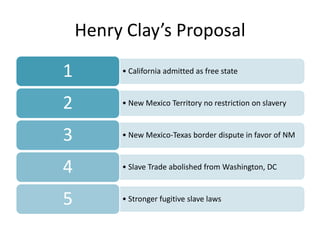
Henry Clay’s Proposal
A New CompromiseClay’s proposal launched debateJohn Calhoun (SC) opposedDaniel Webster (MA) supportedTaylor dies; Millard Fillmore takes overStephen A. Douglas divides plan into parts to be voted onClay’s plan became Compromise of 1850
A Nation DividingChapter 15.2
The Fugitive Slave ActPassed in 1850Anyone who aided a fugitive could be fined or imprisonedEnforcement of the law turned more people away from slaveryUnderground Railroad appearsUncle Tom’s Cabin (1852) by Harriet Beecher Stowe
The Kansas-Nebraska ActProposed by Stephen A. Douglas, reopens slavery debateCalled for repeal of Missouri CompromisePopular sovereignty – states would decide on slaveryPassed in 1854
Conflict in KansasProslavery and Antislavery groups rushed to settle KansasProslavery legislature was elected in 1855Border ruffians assured proslavery supportViolence escalatesLawrence sacked by proslavery forces (1856)John Brown kills five slavery supportersSumner beating by Brooks – violence in Senate
Challenges to SlaveryChapter 15.3
The Republican PartyIn 1854, antislavery Whigs and Democrats join Free-Soilers to create Republican PartyMission to end slaveryWin control of House of RepresentativesStrong support in North, virtually none in SouthJames Buchanan, Democrat, wins presidential election
The Dred Scott DecisionSlave from MissouriMoved to Illinois (free state) and Wisconsin Territory (NW Ordinance 1787)Returns to Missouri, master dies (1846) and sues for freedomSupreme Court rules as a slave, cannot sueEnslaved person is property, 5th Amendment prohibits Congress taking away propertyAny prohibition of slavery is unconstitutional
Lincoln and Douglas DebateStephen A. Douglas – felt that slavery would interfere with nation’s growthAbraham Lincoln – slavery was wrong, but no easy answerPublicly debate issue of slavery Douglas angers southern voters with Freeport DoctrineLincoln loses Senate race, but becomes Republican leader
Raid on Harpers FerryOctober 16, 1859, John Brown leads raid Target was an arsenal to lead an armed insurrectionFinanced by abolitionistsPlan failed; no slaves rebelled and Brown and his rebels were capturedCaptured by Colonel Robert E. LeeKilled 6 civilians, 1 marine, and 2 slavesBrown was tried for treason and hung; becomes martyr
Secession and WarChapter 15.4
The Election of 1860Southerners feared a Republican victory would yield more John BrownsDouglas pushed for moderationLincoln wins, victory is short-lived as nation divides
The South SecedesLincoln promised not to disturb slavery, but to keep it from spreadingDecember 1860 SC votes to secedeAttempts at compromise failConfederacy – Florida, Texas, Louisiana, Mississippi, Alabama, and Georgia join South Carolina in 1861
The South SecedesConfederate States of AmericaChoose Jefferson Davis as PresidentArgued based on states’ rightsMixed reactionsLincoln warned no state can legally secede Inaugural speech calls for reconciliation
Fort SumterSoutherners objected to Lincoln’s claim of federal property in the SouthFort Sumter was low on suppliesLincoln sends unarmed men to resupplyConfederates attack before supplies arriveApril 14th, 1861 fort is surrendered
Questions to ConsiderHow was the admission of new states and the issue of slavery related?What were some of the effects of the John Brown Raid on the nation?How did the election of 1860 lead to the breakup of the Union?Was the Civil War necessary?

US History Chapter 15

  • 1.
    Chapter 15 –Road to Civil WarMagister RicardUS History
  • 2.
    Questions to ConsiderHowwas the admission of new states and the issue of slavery related?What were some of the effects of the John Brown Raid on the nation?How did the election of 1860 lead to the breakup of the Union?Was the Civil War necessary?
  • 3.
    Slavery and theWestChapter 15.1
  • 4.
    The Missouri CompromiseMissouriTerritory was seeking statehood in 1819Settlers had brought slaves11 states permitted slavery, 11 prohibitedSectionalism grew as North and South competed for western landsHenry Clay proposes compromise (1820)Prohibited slavery in Great Plains territories north of Missouri
  • 5.
    New Western LandsTexas(1845), New Mexico, and California (1848) looking to become statesShould they be allowed slaves?Wilmot Proviso vs. Calhoun ProposalFree Soil Party supports antislaveryPresident Zachary Taylor urges CA and NMTheir citizens would decide on slaverySoutherners feared CA entering as free state; talks of secession begins
  • 6.
  • 7.
    A New CompromiseClay’sproposal launched debateJohn Calhoun (SC) opposedDaniel Webster (MA) supportedTaylor dies; Millard Fillmore takes overStephen A. Douglas divides plan into parts to be voted onClay’s plan became Compromise of 1850
  • 8.
  • 9.
    The Fugitive SlaveActPassed in 1850Anyone who aided a fugitive could be fined or imprisonedEnforcement of the law turned more people away from slaveryUnderground Railroad appearsUncle Tom’s Cabin (1852) by Harriet Beecher Stowe
  • 10.
    The Kansas-Nebraska ActProposedby Stephen A. Douglas, reopens slavery debateCalled for repeal of Missouri CompromisePopular sovereignty – states would decide on slaveryPassed in 1854
  • 11.
    Conflict in KansasProslaveryand Antislavery groups rushed to settle KansasProslavery legislature was elected in 1855Border ruffians assured proslavery supportViolence escalatesLawrence sacked by proslavery forces (1856)John Brown kills five slavery supportersSumner beating by Brooks – violence in Senate
  • 12.
  • 13.
    The Republican PartyIn1854, antislavery Whigs and Democrats join Free-Soilers to create Republican PartyMission to end slaveryWin control of House of RepresentativesStrong support in North, virtually none in SouthJames Buchanan, Democrat, wins presidential election
  • 14.
    The Dred ScottDecisionSlave from MissouriMoved to Illinois (free state) and Wisconsin Territory (NW Ordinance 1787)Returns to Missouri, master dies (1846) and sues for freedomSupreme Court rules as a slave, cannot sueEnslaved person is property, 5th Amendment prohibits Congress taking away propertyAny prohibition of slavery is unconstitutional
  • 15.
    Lincoln and DouglasDebateStephen A. Douglas – felt that slavery would interfere with nation’s growthAbraham Lincoln – slavery was wrong, but no easy answerPublicly debate issue of slavery Douglas angers southern voters with Freeport DoctrineLincoln loses Senate race, but becomes Republican leader
  • 16.
    Raid on HarpersFerryOctober 16, 1859, John Brown leads raid Target was an arsenal to lead an armed insurrectionFinanced by abolitionistsPlan failed; no slaves rebelled and Brown and his rebels were capturedCaptured by Colonel Robert E. LeeKilled 6 civilians, 1 marine, and 2 slavesBrown was tried for treason and hung; becomes martyr
  • 17.
  • 18.
    The Election of1860Southerners feared a Republican victory would yield more John BrownsDouglas pushed for moderationLincoln wins, victory is short-lived as nation divides
  • 19.
    The South SecedesLincolnpromised not to disturb slavery, but to keep it from spreadingDecember 1860 SC votes to secedeAttempts at compromise failConfederacy – Florida, Texas, Louisiana, Mississippi, Alabama, and Georgia join South Carolina in 1861
  • 20.
    The South SecedesConfederateStates of AmericaChoose Jefferson Davis as PresidentArgued based on states’ rightsMixed reactionsLincoln warned no state can legally secede Inaugural speech calls for reconciliation
  • 21.
    Fort SumterSoutherners objectedto Lincoln’s claim of federal property in the SouthFort Sumter was low on suppliesLincoln sends unarmed men to resupplyConfederates attack before supplies arriveApril 14th, 1861 fort is surrendered
  • 22.
    Questions to ConsiderHowwas the admission of new states and the issue of slavery related?What were some of the effects of the John Brown Raid on the nation?How did the election of 1860 lead to the breakup of the Union?Was the Civil War necessary?

Editor's Notes

  • #5 36”30’ no slavery north of this line (Missouri).
  • #6 Wilmot Proviso forbids any slavery in land acquired from Mexico (during Mexico-American War 1846-1848). Calhoun Proposal would not allow Congress or territorial authority to rule on issue of slavery. Neither was accepted.In 1849, there were 15 slave states and 15 free states.
  • #8 Compromise of 1850 did not resolve the North/South debate despite its attention to do so.
  • #10 Proslavery writings in the South tried to trump antislavery publications. Often the argument was that slaves in the South lived better than free factory workers in the North.
  • #11 This bill, in some ways, anticipated that Kansas would be settled mostly by slave owners from Missouri. This meant that Southerners supported this bill and would not fear losing slave state control in the area – but also would gain possible expansion where they were previously locked out. Territories become states. In 1850, Minnesota Territory and Oregon Territory were split by “unorganized territory”. This would be the proposed area for Kansas (south) and Nebraska (north) territories. Since Missouri bordered Kansas Territory, slave owners were more likely to settle in 1854.
  • #12 The city of Lawrence was sacked – a hotel and the home of the governor was burned to the ground by 800 proslavery forces. John Brown, with his six sons, believed he was sent by God to end slavery. He pushed for violent reaction against slavery.Meanwhile, debates rage in the political arena. Charles Sumner lashes out against proslavery forces in Kansas but Preston Brooks, a distant relative, beats Sumner with a cane in the Senate chamber until he was unconscious.
  • #14 Republican Party was formed to end slavery. It was comprised of antislavery supporters from Whig and Democratic parties as well as the Free Soil party. In 1856, the party was strong enough to push a presidential candidate into the limelight, but the Democrats witnessed their nominee, Buchanan, win the election. Originally, Franklin Pierce was slated as the Democratic candidate, but his involvement in Kansas would have hurt.
  • #15 Crucial ruling that may have been the final straw over the issue of slavery. Ruling was that Constitution could not remove property – and that slavery was an institution of property. Slaves were assets, and the government had no right to take property. What problems could result if the ruling was made that the government could remove property? Has that been the decision?
  • #16 The Freeport Doctrine was named so because Douglas establishes at Freeport, during a debate, that voters of a state could exclude slavery by refusing to pass laws protecting slave holders’ rights.This is important in showing how the issue of slavery is affecting politics and how the Republican party, by opposing slavery openly, is gaining ground and showing popular support for antislavery movement.
  • #17 Very controversial figure. What was behind his intentions? Is his use of violence appropriate? He was denounced by some Republicans for using force. His trial and execution created an uproar in the North. Connections to abolitionists confirmed Southern fear of a Northern conspiracy.