U.S. Chapter 8A New Nation1789-1800
Questions to ConsiderWhy do you think the US stayed neutral in regards to the war between England and France?Do you think the development of political parties was necessary? Explain.How did President John Adams reluctance to go to war with France help Thomas Jefferson win the presidential election of 1800?
The First PresidentSection 8.1
8.1 Timeline (1789-1792)
President WashingtonGeorge Washington becomes first presidentJohn Adams first vice-presidentInauguration- sworn into officeSet precedents- traditionsAddressed as Mr. PresidentTwo terms in officeAdded “so help me God” to oath
President WashingtonWashington’s CabinetState Department: relations with other nationsTreasury Department: financial mattersWar Department: nation’s defenseAttorney General: legal department
Washington’s Cabinet
The First CongressJudiciary Act of 1789Establishes federal court systemFederal courts overturn state lawsSupreme court the final authority13 district courts 3 circuit courts 1 supreme court John Jay: 1st Chief Justice
The First CongressThe Bill of Rights1st ten amendmentsGuarantees and protects personal libertiesEnsure States Rights (10th amendment)Madison studied hundreds of proposals, broke down to 12States ratified 10; added in December, 1791
Financial ProblemsNational Debt High (amount we owed)Alexander Hamilton’s PlanPay debt to foreign nations and citizensWould increase their stake in the new nationPayback bonds bought during the war at face valueOpposition to the PlanSpeculators, risk money to make moreBought bonds cheapShould not be paid in full
Financial ProblemsCompromise, Washington DC in the SouthSoutherners support payment of debtBuilding the Economy (Hamilton’s Plan)National bank createdProtective tariff, tax on importsProtect American goods and industryLow tariffs, raised 90% of government’s incomeCreation of new taxes (whiskey)
Early ChallengesSection 8.2
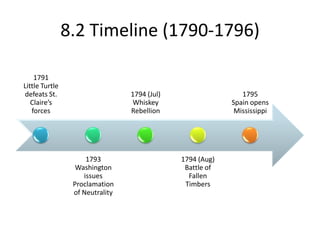
8.2 Timeline (1790-1796)
The Whiskey RebellionJuly 1794500 protested, attacked tax collectors, western PAWashington led 13,000 troopsQuickly put downLaws had to be changed peacefully, following the Constitution
Struggle Over the WestSpanish, English, Indian problemsNative Americans did not recognize US claimsAmerican settlers continued to move into area, threatening Native American settlementsFighting broke outAmerican troops defeated by Little Turtle in November 1791Many Americans wanted an alliance with France
Struggle Over the WestWashington sends John Jay to halt possible war with BritainGeneral Anthony Wayne wins Battle of Fallen Timbers (August 1794)Delayed attackIndians weakened by tradition of fastingTreaty of Greenville12 Indian nations signOpens Ohio to settlement
The French RevolutionIn 1789 French rebelled against Louis XVIInitially supported by AmericaViolence escalates in 1793 Rebellion kills King and QueenThousands of civilians killed, less supportEngland and France at war 1793Washington proclaims neutrality (April 22, 1793)No French or British war ships allowedBritish impressment, American merchant sailors forced into British Navy
The French RevolutionA Controversial TreatyJay’s TreatyBritish pull out of westPay damages to shipsAllows trade with CarribeanConsidered dishonorable by someDid not address impressment and blocked tradeSuccess with SpainPinckney’s TreatyUnrestricted access to the Mississippi River No more forts
Washington’s FarewellAnnounces he would not serve a third term in 1796Establishes precedentFarewell address warned against evils of political parties and foreign affairsStill read aloud to this day on his birthday
The First Political PartiesSection 8.3
Opposing ViewsWashington, parties would divide the nationHamilton and Jefferson disagree on economics, foreign relations, power of federal governmentPartisan, favoring one sideFederalist party (supports Constitution)Democratic-Republicans (opposed Hamilton’s views)
Opposing Views
Opposing Views1793, Jefferson and Hamilton resign from Washington’s cabinetElection of 1796Candidates run under partiesCaucus: members of a party choose candidatesFederalists nominate John AdamsRepublican-Democrats nominate Thomas JeffersonAdams wins electoral college (71 votes)Jefferson, 2nd place, named vice president
President John AdamsSection 8.4
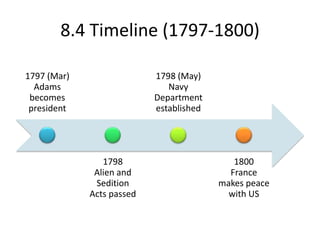
8.4 Timeline (1797-1800)
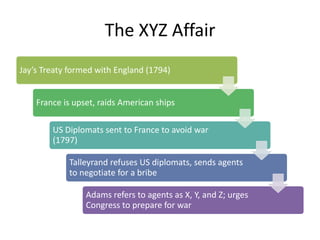
The XYZ Affair
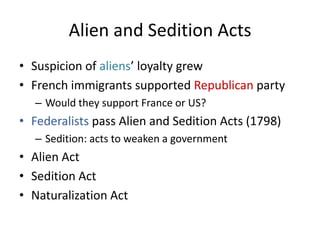
Alien and Sedition ActsSuspicion of aliens’ loyalty grewFrench immigrants supported Republican partyWould they support France or US?Federalists pass Alien and Sedition Acts (1798)Sedition: acts to weaken a governmentAlien ActSedition ActNaturalization Act
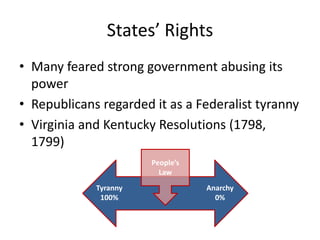
States’ RightsMany feared strong government abusing its powerRepublicans regarded it as a Federalist tyrannyVirginia and Kentucky Resolutions (1798, 1799)People’s LawTyranny100%Anarchy0%
Peace With FranceAdams (Federalist) sought peaceFederalists opposed, wanted war with FrancePeace achieved with FranceFederalist party split leads to Jefferson’s (Republican) victory in 1800 election
Questions to ConsiderWhy do you think the US stayed neutral in regards to the war between England and France?Do you think the development of political parties was necessary? Explain.How did President John Adams reluctance to go to war with France help Thomas Jefferson win the presidential election of 1800?

US History chapter 8

  • 1.
    U.S. Chapter 8ANew Nation1789-1800
  • 2.
    Questions to ConsiderWhydo you think the US stayed neutral in regards to the war between England and France?Do you think the development of political parties was necessary? Explain.How did President John Adams reluctance to go to war with France help Thomas Jefferson win the presidential election of 1800?
  • 3.
  • 4.
  • 5.
    President WashingtonGeorge Washingtonbecomes first presidentJohn Adams first vice-presidentInauguration- sworn into officeSet precedents- traditionsAddressed as Mr. PresidentTwo terms in officeAdded “so help me God” to oath
  • 6.
    President WashingtonWashington’s CabinetStateDepartment: relations with other nationsTreasury Department: financial mattersWar Department: nation’s defenseAttorney General: legal department
  • 7.
  • 8.
    The First CongressJudiciaryAct of 1789Establishes federal court systemFederal courts overturn state lawsSupreme court the final authority13 district courts 3 circuit courts 1 supreme court John Jay: 1st Chief Justice
  • 9.
    The First CongressTheBill of Rights1st ten amendmentsGuarantees and protects personal libertiesEnsure States Rights (10th amendment)Madison studied hundreds of proposals, broke down to 12States ratified 10; added in December, 1791
  • 10.
    Financial ProblemsNational DebtHigh (amount we owed)Alexander Hamilton’s PlanPay debt to foreign nations and citizensWould increase their stake in the new nationPayback bonds bought during the war at face valueOpposition to the PlanSpeculators, risk money to make moreBought bonds cheapShould not be paid in full
  • 11.
    Financial ProblemsCompromise, WashingtonDC in the SouthSoutherners support payment of debtBuilding the Economy (Hamilton’s Plan)National bank createdProtective tariff, tax on importsProtect American goods and industryLow tariffs, raised 90% of government’s incomeCreation of new taxes (whiskey)
  • 12.
  • 13.
  • 14.
    The Whiskey RebellionJuly1794500 protested, attacked tax collectors, western PAWashington led 13,000 troopsQuickly put downLaws had to be changed peacefully, following the Constitution
  • 15.
    Struggle Over theWestSpanish, English, Indian problemsNative Americans did not recognize US claimsAmerican settlers continued to move into area, threatening Native American settlementsFighting broke outAmerican troops defeated by Little Turtle in November 1791Many Americans wanted an alliance with France
  • 16.
    Struggle Over theWestWashington sends John Jay to halt possible war with BritainGeneral Anthony Wayne wins Battle of Fallen Timbers (August 1794)Delayed attackIndians weakened by tradition of fastingTreaty of Greenville12 Indian nations signOpens Ohio to settlement
  • 17.
    The French RevolutionIn1789 French rebelled against Louis XVIInitially supported by AmericaViolence escalates in 1793 Rebellion kills King and QueenThousands of civilians killed, less supportEngland and France at war 1793Washington proclaims neutrality (April 22, 1793)No French or British war ships allowedBritish impressment, American merchant sailors forced into British Navy
  • 18.
    The French RevolutionAControversial TreatyJay’s TreatyBritish pull out of westPay damages to shipsAllows trade with CarribeanConsidered dishonorable by someDid not address impressment and blocked tradeSuccess with SpainPinckney’s TreatyUnrestricted access to the Mississippi River No more forts
  • 19.
    Washington’s FarewellAnnounces hewould not serve a third term in 1796Establishes precedentFarewell address warned against evils of political parties and foreign affairsStill read aloud to this day on his birthday
  • 20.
    The First PoliticalPartiesSection 8.3
  • 21.
    Opposing ViewsWashington, partieswould divide the nationHamilton and Jefferson disagree on economics, foreign relations, power of federal governmentPartisan, favoring one sideFederalist party (supports Constitution)Democratic-Republicans (opposed Hamilton’s views)
  • 22.
  • 23.
    Opposing Views1793, Jeffersonand Hamilton resign from Washington’s cabinetElection of 1796Candidates run under partiesCaucus: members of a party choose candidatesFederalists nominate John AdamsRepublican-Democrats nominate Thomas JeffersonAdams wins electoral college (71 votes)Jefferson, 2nd place, named vice president
  • 24.
  • 25.
  • 26.
  • 27.
    Alien and SeditionActsSuspicion of aliens’ loyalty grewFrench immigrants supported Republican partyWould they support France or US?Federalists pass Alien and Sedition Acts (1798)Sedition: acts to weaken a governmentAlien ActSedition ActNaturalization Act
  • 28.
    States’ RightsMany fearedstrong government abusing its powerRepublicans regarded it as a Federalist tyrannyVirginia and Kentucky Resolutions (1798, 1799)People’s LawTyranny100%Anarchy0%
  • 29.
    Peace With FranceAdams(Federalist) sought peaceFederalists opposed, wanted war with FrancePeace achieved with FranceFederalist party split leads to Jefferson’s (Republican) victory in 1800 election
  • 30.
    Questions to ConsiderWhydo you think the US stayed neutral in regards to the war between England and France?Do you think the development of political parties was necessary? Explain.How did President John Adams reluctance to go to war with France help Thomas Jefferson win the presidential election of 1800?

Editor's Notes

  • #27 Jay’s Treaty, signed in 1794 with England, upset the French and they begin seizing American ships with cargo bound for England. Adams wanted to avoid war, sends diplomats to France but they are not heard. Instead, Talleyrand sends three agents to ask for a bribe from the US. This infuriated Adams, refers to agents as X, Y, and Z. “Not a sixpence!”Congress builds up armed forces, establishes Navy Department in May 1798. Between 1798 and 1800, American and French naval forces waged undeclared war. Americans seized more than 90 ships from France. Republican party, aligned with France, gets voted out as outrage over France’s actions.
  • #28 Aliens = immigrants living in a country, have different country of origin and are not citizens. Many immigrants were supporters of French Revolution, supported Republican party, which made Americans question whether aliens would be loyal to France or US. As Republicans fell out of favor due to the X,Y,Z affair, and French naval action, many supported Federalists political ideas.Federalists came up with Alien and Sedition acts to address these fears. Sedition act, or acts to weaken government, made it a crime to criticize the government. No one was deported under this act and it expired in 1802. The Sedition Act was used as a political tool to silence opposition or partisans. Matthew Lyon, a Republican from Vermont, was jailed for criticizing President Adams. 25 people arrested, 10 jailed.Naturalization Act made it difficult to apply for citizenship (14 years instead of 5 years residence). Federalists wanted to limit the Republicans’ support from foreigners. Africans or freed slaves could not apply.
  • #29 Americans feared the growing central government. Feared the loss of State’s rights and the control of central government. (Think back to Tyranny/Anarchy dichotomy.) Republicans supported state sovereignty, characterized as a Federalist tyranny. James Madison and Thomas Jefferson wrote resolutions for rights of states; endorsed by Virginia (both Madison and Jefferson were from Virginia) and Kentucky supported these.According to these resolutions, the states had the right to judge the constitutionality of federal laws. Kentucky Resolution could even nullify federal laws. Directly challenges authority of constitution; sets precedent for state’s questioning federal authority; would be an issue that would divide the nation.
  • #30 John Adams did not want to hastily put his young nation into a war with France, a former ally during the Revolution. The Federalists wanted war with France, as they not only favored an alliance with England but also wanted to defeat their political rivals, the Republicans, who leaned towards France. In fact, war would have helped Adams politically, yet this causes a schism in the party. Alexander Hamilton openly opposes Adams, who formed a commission to get a treaty with France. In 1800, France would sign a treaty and stopped attacking US ships. As it divided the Federalist party, it allowed for the Republicans to reclaim political clout via the presidency with Thomas Jefferson.