God, Gold, & GloryAn Introduction to European Exploration & Expansion
MotivesThe 3 G’sGodreligious fervor convert nativesGoldexpand trade - esp. spices & precious metalsprofitGloryadventurepowernational pride
MeansMid-1400sEuropean monarchs had MORE:PowerResourcesAdvanced technologyPair/Share: Based on our last unit, why do you think the above is true?
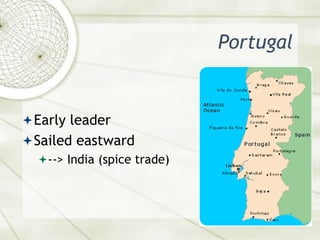
PortugalEarly leaderSailed eastward--> India (spice trade)
The PortugueseMotives:Set up trading posts for purchase of gold and slaves along W. African coastExtent: Diaz (Cape of Good Hope - 1487), da Gama (India - 1498)Colonization: 1493-1494 Line of Demarcation (drawn by the Pope) split up the New World and Treaty of Tordesillas (with Spain) gave Portugal title to Eastern South America (Brazil)
Vasco da GamaCape of Good HopeSecured control of spice tradeTook from MuslimsHUGE $$$
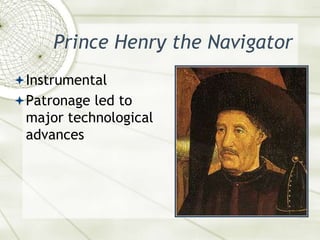
Prince Henry the NavigatorInstrumental Patronage led to major technological advances
SpainSailed westwardSeeking route --> AsiaSpainPortugal
The SpanishMotives:Settle the New World; Secure gold and valuable agricultural produce; Convert the natives (“Indians”) to CatholicismExtent: First settled in the W. Indies (Cuba, P.R., Hispaniola); Proceeded to Mexico, C. America, most of S. America, & some of U.S. (FL, NM, AZ, CA)
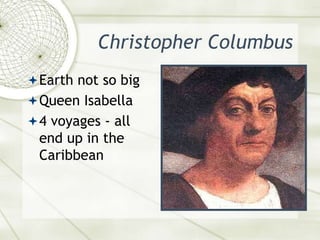
Christopher ColumbusEarth not so bigQueen Isabella 4 voyages - all end up in the Caribbean
Ferdinand Magellan1519 - 1st to circumnavigate the globe (sort of)
Spain in the AmericasConquistadors - the Spanish conquerors of the AmericasGifts from Spain
Encomienda SystemAztec & Inca civilizations destroyedSpanish controlSubjects of Queen Encomienda - the right of landowners to use Native Americans as laborersProtection - required but not followed
Columbian ExchangeThe exchange of plants and animals between Europe and the AmericasEurope --> AmericasHorses, cattle, & wheatAmericas --> EuropePotatoes, cocoa, corn, tomatoes, & tobaccoTransformed economic activity
New SpainTreaty of Tordesillas gave much of New World to SpainIntermarried with natives (mestizos)Spanish language & culture blended inSpanish encomienda systemOnly Catholics could settle in coloniesStrict control over colonies (no self-government)Colonial merchants could trade only with Spain (mercantilism)
European RivalsDutchFrenchBritish
The DutchMotives:Fur trade (Dutch West India Co.)Extent: New Netherland, Hudson R., New Amsterdam (NYC), Manhattan, Long Island, NJ, New Sweden (DE)
New HollandPatroonships (land given for transporting 50 people to colony) givenFairly open to non-Dutch immigrantsLimited population growth
The FrenchMotives:Fish in Newfoundland; Fur trade with Indians; Convert “Indians” to CatholicismExtent: Fur-trading posts and settlements (Quebec, Montreal, Detroit, St. Louis, New Orleans)
New FranceFew settlers No gold and silver Restricted immigration to CatholicsLittle interest in farming Strict rule from Old France
For Next Time…Be sure to review Chapter 3Start reading “Serving Time In Virginia”Focus: English Exploration & Protestant Reformation Review
England & Exploration
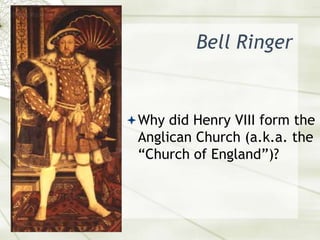
Bell RingerWhy did Henry VIII form the Anglican Church (a.k.a. the “Church of England”)?
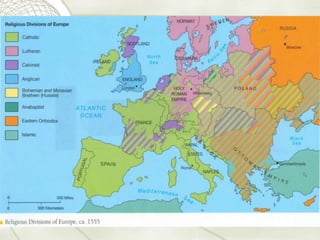
Religious Reform in EuropeBegan with…Martin Luther (Protestant/Lutherans)Wittenberg, Germany1517 – 95 ThesesJohn Calvin (Calvinists/Huguenots)Geneva, SwitzerlandThe “elect” & predestination
Henry VIII (1509-1547)Broke with Pope and Catholic churchBrought Protestant Reformation to England (Anglican Church)Added to tensions between Catholic Spain and England (Why?)Edward VI followed (1547-1553) - ProtestantMary (1553-1558) - daughter of Catherine (devout Catholic, mostly insane – nickname??)
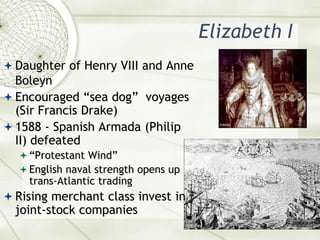
Elizabeth IDaughter of Henry VIII and Anne BoleynEncouraged “sea dog”  voyages (Sir Francis Drake)1588 - Spanish Armada (Philip II) defeated“Protestant Wind”English naval strength opens up trans-Atlantic tradingRising merchant class invest in joint-stock companies
Early English FailuresSir Walter RaleighOne time favorite of Elizabeth INamed Virginia after ElizabethThe Lost Colony (1587)Raleigh’s Virginia settlement on Roanoke IslandVanished…
The EnglishWith the support of strong monarchs, a growing merchant class, and capital from English investment companies, England began to plant settlements in North AmericaThe first successful settlement was at Jamestown, Virginia (1607)
Reasons for English SuccessStrategic/DiplomaticIsland nation with large navyAvailability of colonistsLarge standing army unnecessary“Surplus population” from enclosure movementColonies suitable place for “undesirables”RenaissanceGolden Age of English Lit.  Curiosity about unknown
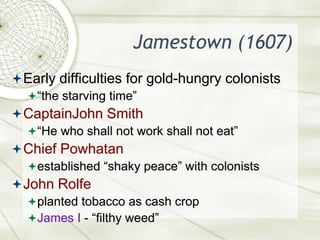
A New KingKing James I (Scottish & a Stuart)Nephew of Elizabeth I (son of Mary Queen of Scots)Chartered Virginia Companies (London & Plymouth)
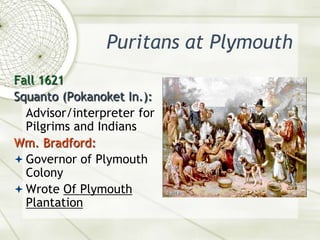
Jamestown (1607)Early difficulties for gold-hungry colonists “the starving time” CaptainJohn Smith “He who shall not work shall not eat”Chief Powhatan established “shaky peace” with colonistsJohn Rolfe planted tobacco as cash crop James I - “filthy weed”
Early Virginia Society & Gov’tTobaccoLand-intensive cropStrained relations with Natives2. Settlers60% arrived indenturedHeadrights of fifty acres to those who bought a company share and transported themselves1635: 1 Female for every 6 males in the colony
Early Virginia (cont.)3. SlaveryDeveloped later in the colony4. Government1619: First General Assembly of VA met in Jamestown1624: Became a royal colony (charter revoked)5. VA Company CharterGave settlers the same rights of Englishmen at home
More Reformation in England?PuritansAnglican church too similar to CatholicismFelt that the Anglican church needed to be “purified” of all Catholic practices SeparatistsWished to break away from Anglican church altogether
ProblemsPuritan/Separatist ideals = direct threat to James IWhy?As a result, Puritans were persecuted
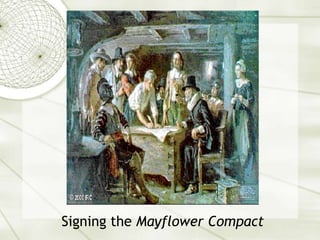
Seeking Tolerance1608: Separatists sought religious tolerance in Holland1620:Chartered by Virginia Company, Mayflower landed at Cape Codout of VA Co. limitsNo legal right to land or to establish a gov’t (squatters)Less than 1/2 were SeparatistsEstablished Mayflower CompactFirst winter - disease and death killed over 1/2 the population
Signing the Mayflower Compact
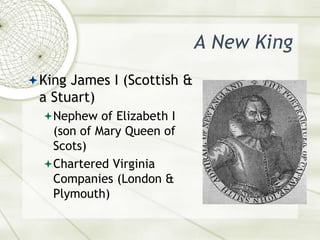
Puritans at PlymouthFall 1621Squanto (Pokanoket In.):	Advisor/interpreter for Pilgrims and IndiansWm. Bradford:Governor of Plymouth ColonyWrote Of Plymouth Plantation
Puritans at Plymouth (cont.)Political DecisionsTown meetingselected assemblies (later)1691: Merged with Mass. Bay colony
ActivityThree GroupsIt is the 17th C. You have moved with a small group of men, women, and children to a region thousands of miles from your original home. You have little with you, only rudimentary tools…
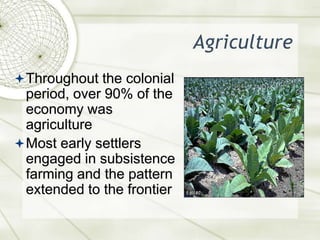
AgricultureThroughout the colonial period, over 90% of the economy was agricultureMost early settlers engaged in subsistence farming and the pattern extended to the frontier
New EnglandFarming difficultHarsh climate, rocky soil Land usually granted to a group (congregation)Towns subdivided it among families
New England (cont.)3. Profitable fishing industryWhaling (oil for lighting)4. Shipbuilding/Commerce5. Small-scale manufacturingDiscouraged by Britain
Middle Colonies1. Blended economies of the other 2 regions2. Colonial “bread basket”Climate and soil produced grain surplus3. River systems and ports (Phila./NYC)Access to back country and overseas commerce4. Merchants and artisans abound
Southern ColoniesFavorable climate and abundant landPlantation system develops2. Staple crops often grown on large estatesVA - tobaccoSC - rice
Southern (cont.)3. 50-acre “headrights” to settlers pay passage of a laborer - receive 50 acres4. Farms scattered / Less urban development
 The Frontier:   1. Opportunities for venturesome individuals2. Conditions harsh on isolated farms3. Beyond reach of govt. authorityFrontier
In Review…The survival of the Jamestown colony can be most directly attributed toReligious spirit of the settlers.Management of the Virginia Company.Development of a tobacco industry.Location of the settlement.Nobles’ diligent search for gold.
2. Unlike Separatists, PuritansAdvocated strict separation of church and state.Practiced passive resistance to oppression.Remained members of the Church of England.Held Calvinistic beliefs.Believed in the pre-destination of the “elect”.
3. A major reason for the founding of the Maryland colony was toEstablish a defensive buffer against Spanish colonies in America.Create a refuge for Catholics.Assist the Protestants in the British colonies.Allow Lord Baltimore to distribute lands to various noblemen from England.Provide a safe haven for debtors and indentured servants fleeing the Virginia colony.
4. Arrange the following events in chronological order: the founding of A) Georgia, B) The Carolinas, C) Virginia, D) MarylandA, C, B, DB, D, C, AC, D, B, AD, C, B, AC, B, D, A
5. Which of the following was NOT a factor in the formation of the New England Confederation?The problem of defending against Indian attacks.Conflicts over colonial boundaries.Concern about runaway servants.Neglect by the English government.A desire to suppress religious dissent.
For Next Time…Read “Serving Time in Virginia” and answer questions on accompanying page

APUSH: God Gold Glory

  • 1.
    God, Gold, &GloryAn Introduction to European Exploration & Expansion
  • 2.
    MotivesThe 3 G’sGodreligiousfervor convert nativesGoldexpand trade - esp. spices & precious metalsprofitGloryadventurepowernational pride
  • 3.
    MeansMid-1400sEuropean monarchs hadMORE:PowerResourcesAdvanced technologyPair/Share: Based on our last unit, why do you think the above is true?
  • 4.
  • 5.
    The PortugueseMotives:Set uptrading posts for purchase of gold and slaves along W. African coastExtent: Diaz (Cape of Good Hope - 1487), da Gama (India - 1498)Colonization: 1493-1494 Line of Demarcation (drawn by the Pope) split up the New World and Treaty of Tordesillas (with Spain) gave Portugal title to Eastern South America (Brazil)
  • 6.
    Vasco da GamaCapeof Good HopeSecured control of spice tradeTook from MuslimsHUGE $$$
  • 7.
    Prince Henry theNavigatorInstrumental Patronage led to major technological advances
  • 8.
  • 9.
    The SpanishMotives:Settle theNew World; Secure gold and valuable agricultural produce; Convert the natives (“Indians”) to CatholicismExtent: First settled in the W. Indies (Cuba, P.R., Hispaniola); Proceeded to Mexico, C. America, most of S. America, & some of U.S. (FL, NM, AZ, CA)
  • 10.
    Christopher ColumbusEarth notso bigQueen Isabella 4 voyages - all end up in the Caribbean
  • 11.
    Ferdinand Magellan1519 -1st to circumnavigate the globe (sort of)
  • 12.
    Spain in theAmericasConquistadors - the Spanish conquerors of the AmericasGifts from Spain
  • 13.
    Encomienda SystemAztec &Inca civilizations destroyedSpanish controlSubjects of Queen Encomienda - the right of landowners to use Native Americans as laborersProtection - required but not followed
  • 14.
    Columbian ExchangeThe exchangeof plants and animals between Europe and the AmericasEurope --> AmericasHorses, cattle, & wheatAmericas --> EuropePotatoes, cocoa, corn, tomatoes, & tobaccoTransformed economic activity
  • 15.
    New SpainTreaty ofTordesillas gave much of New World to SpainIntermarried with natives (mestizos)Spanish language & culture blended inSpanish encomienda systemOnly Catholics could settle in coloniesStrict control over colonies (no self-government)Colonial merchants could trade only with Spain (mercantilism)
  • 16.
  • 17.
    The DutchMotives:Fur trade(Dutch West India Co.)Extent: New Netherland, Hudson R., New Amsterdam (NYC), Manhattan, Long Island, NJ, New Sweden (DE)
  • 18.
    New HollandPatroonships (landgiven for transporting 50 people to colony) givenFairly open to non-Dutch immigrantsLimited population growth
  • 19.
    The FrenchMotives:Fish inNewfoundland; Fur trade with Indians; Convert “Indians” to CatholicismExtent: Fur-trading posts and settlements (Quebec, Montreal, Detroit, St. Louis, New Orleans)
  • 20.
    New FranceFew settlersNo gold and silver Restricted immigration to CatholicsLittle interest in farming Strict rule from Old France
  • 21.
    For Next Time…Besure to review Chapter 3Start reading “Serving Time In Virginia”Focus: English Exploration & Protestant Reformation Review
  • 22.
  • 23.
    Bell RingerWhy didHenry VIII form the Anglican Church (a.k.a. the “Church of England”)?
  • 24.
    Religious Reform inEuropeBegan with…Martin Luther (Protestant/Lutherans)Wittenberg, Germany1517 – 95 ThesesJohn Calvin (Calvinists/Huguenots)Geneva, SwitzerlandThe “elect” & predestination
  • 25.
    Henry VIII (1509-1547)Brokewith Pope and Catholic churchBrought Protestant Reformation to England (Anglican Church)Added to tensions between Catholic Spain and England (Why?)Edward VI followed (1547-1553) - ProtestantMary (1553-1558) - daughter of Catherine (devout Catholic, mostly insane – nickname??)
  • 27.
    Elizabeth IDaughter ofHenry VIII and Anne BoleynEncouraged “sea dog” voyages (Sir Francis Drake)1588 - Spanish Armada (Philip II) defeated“Protestant Wind”English naval strength opens up trans-Atlantic tradingRising merchant class invest in joint-stock companies
  • 28.
    Early English FailuresSirWalter RaleighOne time favorite of Elizabeth INamed Virginia after ElizabethThe Lost Colony (1587)Raleigh’s Virginia settlement on Roanoke IslandVanished…
  • 29.
    The EnglishWith thesupport of strong monarchs, a growing merchant class, and capital from English investment companies, England began to plant settlements in North AmericaThe first successful settlement was at Jamestown, Virginia (1607)
  • 30.
    Reasons for EnglishSuccessStrategic/DiplomaticIsland nation with large navyAvailability of colonistsLarge standing army unnecessary“Surplus population” from enclosure movementColonies suitable place for “undesirables”RenaissanceGolden Age of English Lit.  Curiosity about unknown
  • 31.
    A New KingKingJames I (Scottish & a Stuart)Nephew of Elizabeth I (son of Mary Queen of Scots)Chartered Virginia Companies (London & Plymouth)
  • 32.
    Jamestown (1607)Early difficultiesfor gold-hungry colonists “the starving time” CaptainJohn Smith “He who shall not work shall not eat”Chief Powhatan established “shaky peace” with colonistsJohn Rolfe planted tobacco as cash crop James I - “filthy weed”
  • 33.
    Early Virginia Society& Gov’tTobaccoLand-intensive cropStrained relations with Natives2. Settlers60% arrived indenturedHeadrights of fifty acres to those who bought a company share and transported themselves1635: 1 Female for every 6 males in the colony
  • 34.
    Early Virginia (cont.)3.SlaveryDeveloped later in the colony4. Government1619: First General Assembly of VA met in Jamestown1624: Became a royal colony (charter revoked)5. VA Company CharterGave settlers the same rights of Englishmen at home
  • 35.
    More Reformation inEngland?PuritansAnglican church too similar to CatholicismFelt that the Anglican church needed to be “purified” of all Catholic practices SeparatistsWished to break away from Anglican church altogether
  • 36.
    ProblemsPuritan/Separatist ideals =direct threat to James IWhy?As a result, Puritans were persecuted
  • 37.
    Seeking Tolerance1608: Separatistssought religious tolerance in Holland1620:Chartered by Virginia Company, Mayflower landed at Cape Codout of VA Co. limitsNo legal right to land or to establish a gov’t (squatters)Less than 1/2 were SeparatistsEstablished Mayflower CompactFirst winter - disease and death killed over 1/2 the population
  • 38.
  • 39.
    Puritans at PlymouthFall1621Squanto (Pokanoket In.): Advisor/interpreter for Pilgrims and IndiansWm. Bradford:Governor of Plymouth ColonyWrote Of Plymouth Plantation
  • 40.
    Puritans at Plymouth(cont.)Political DecisionsTown meetingselected assemblies (later)1691: Merged with Mass. Bay colony
  • 41.
    ActivityThree GroupsIt isthe 17th C. You have moved with a small group of men, women, and children to a region thousands of miles from your original home. You have little with you, only rudimentary tools…
  • 42.
    AgricultureThroughout the colonialperiod, over 90% of the economy was agricultureMost early settlers engaged in subsistence farming and the pattern extended to the frontier
  • 43.
    New EnglandFarming difficultHarshclimate, rocky soil Land usually granted to a group (congregation)Towns subdivided it among families
  • 44.
    New England (cont.)3.Profitable fishing industryWhaling (oil for lighting)4. Shipbuilding/Commerce5. Small-scale manufacturingDiscouraged by Britain
  • 45.
    Middle Colonies1. Blendedeconomies of the other 2 regions2. Colonial “bread basket”Climate and soil produced grain surplus3. River systems and ports (Phila./NYC)Access to back country and overseas commerce4. Merchants and artisans abound
  • 46.
    Southern ColoniesFavorable climateand abundant landPlantation system develops2. Staple crops often grown on large estatesVA - tobaccoSC - rice
  • 47.
    Southern (cont.)3. 50-acre“headrights” to settlers pay passage of a laborer - receive 50 acres4. Farms scattered / Less urban development
  • 48.
    The Frontier: 1. Opportunities for venturesome individuals2. Conditions harsh on isolated farms3. Beyond reach of govt. authorityFrontier
  • 49.
    In Review…The survivalof the Jamestown colony can be most directly attributed toReligious spirit of the settlers.Management of the Virginia Company.Development of a tobacco industry.Location of the settlement.Nobles’ diligent search for gold.
  • 50.
    2. Unlike Separatists,PuritansAdvocated strict separation of church and state.Practiced passive resistance to oppression.Remained members of the Church of England.Held Calvinistic beliefs.Believed in the pre-destination of the “elect”.
  • 51.
    3. A majorreason for the founding of the Maryland colony was toEstablish a defensive buffer against Spanish colonies in America.Create a refuge for Catholics.Assist the Protestants in the British colonies.Allow Lord Baltimore to distribute lands to various noblemen from England.Provide a safe haven for debtors and indentured servants fleeing the Virginia colony.
  • 52.
    4. Arrange thefollowing events in chronological order: the founding of A) Georgia, B) The Carolinas, C) Virginia, D) MarylandA, C, B, DB, D, C, AC, D, B, AD, C, B, AC, B, D, A
  • 53.
    5. Which ofthe following was NOT a factor in the formation of the New England Confederation?The problem of defending against Indian attacks.Conflicts over colonial boundaries.Concern about runaway servants.Neglect by the English government.A desire to suppress religious dissent.
  • 54.
    For Next Time…Read“Serving Time in Virginia” and answer questions on accompanying page
Editor's Notes

  • #28 Philip II – Bloody Mary’s husband…Elizabeth also rejected him as a suitor/husband
  • #32 Mary Queen of Scots was executed under the order of Elizabeth (for “treason”) – beheaded…interesting story if you want to know…
  • #50 c