Ureter
Dr. Mathew Joseph MBBS,MD(2nd Year),BCCPM
Junior Resident
Department of Anatomy
All India Institute of Medical Sciences - Rishikesh
Introduction
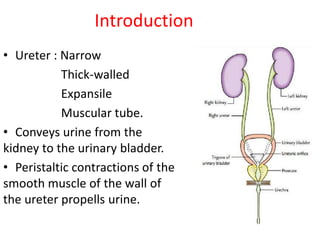
• Ureter : Narrow
Thick-walled
Expansile
Muscular tube.
• Conveys urine from the
kidney to the urinary bladder.
• Peristaltic contractions of the
smooth muscle of the wall of
the ureter propells urine.
Measurements
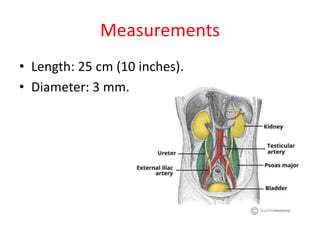
• Length: 25 cm (10 inches).
• Diameter: 3 mm.
Ureter - Histology
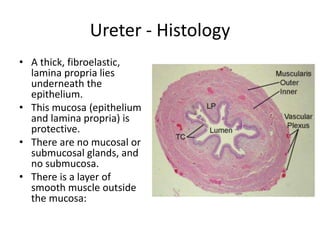
• A thick, fibroelastic,
lamina propria lies
underneath the
epithelium.
• This mucosa (epithelium
and lamina propria) is
protective.
• There are no mucosal or
submucosal glands, and
no submucosa.
• There is a layer of
smooth muscle outside
the mucosa:
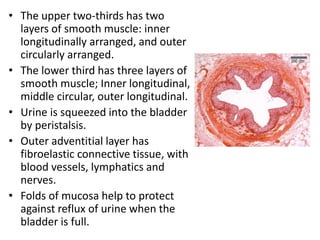
• The upper two-thirds has two
layers of smooth muscle: inner
longitudinally arranged, and outer
circularly arranged.
• The lower third has three layers of
smooth muscle; Inner longitudinal,
middle circular, outer longitudinal.
• Urine is squeezed into the bladder
by peristalsis.
• Outer adventitial layer has
fibroelastic connective tissue, with
blood vessels, lymphatics and
nerves.
• Folds of mucosa help to protect
against reflux of urine when the
bladder is full.
Course in abdominal part
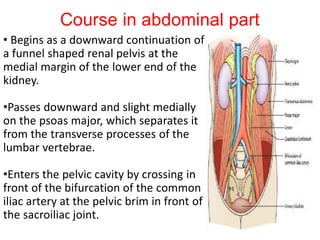
• Begins as a downward continuation of
a funnel shaped renal pelvis at the
medial margin of the lower end of the
kidney.
•Passes downward and slight medially
on the psoas major, which separates it
from the transverse processes of the
lumbar vertebrae.
•Enters the pelvic cavity by crossing in
front of the bifurcation of the common
iliac artery at the pelvic brim in front of
the sacroiliac joint.
Course in Pelvis
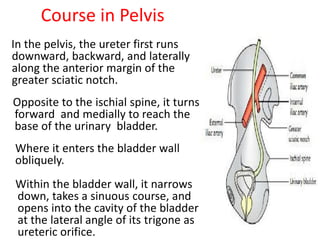
In the pelvis, the ureter first runs
downward, backward, and laterally
along the anterior margin of the
greater sciatic notch.
Opposite to the ischial spine, it turns
forward and medially to reach the
base of the urinary bladder.
Where it enters the bladder wall
obliquely.
Within the bladder wall, it narrows
down, takes a sinuous course, and
opens into the cavity of the bladder
at the lateral angle of its trigone as
ureteric orifice.
Parts and Relations
The ureter is generally divided into two parts:
Abdominal and Pelvic.
Each part is about the same length, i.e., 12.5 cm (5
inches).
The abdominal part of ureter extends from the renal
pelvis to the bifurcation of the common iliac artery.
The pelvic part of the ureter extends from the pelvic
brim (at the level of bifurcation of the common iliac
artery) to the base of the urinary bladder.
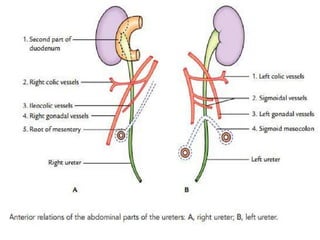
Relations of Abdominal Part
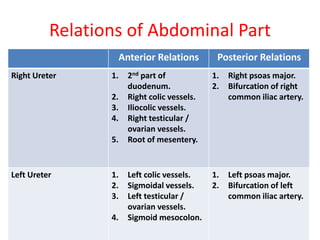
Anterior Relations Posterior Relations
Right Ureter 1. 2nd part of
duodenum.
2. Right colic vessels.
3. Iliocolic vessels.
4. Right testicular /
ovarian vessels.
5. Root of mesentery.
1. Right psoas major.
2. Bifurcation of right
common iliac artery.
Left Ureter 1. Left colic vessels.
2. Sigmoidal vessels.
3. Left testicular /
ovarian vessels.
4. Sigmoid mesocolon.
1. Left psoas major.
2. Bifurcation of left
common iliac artery.
• Medially the right ureter is related to inferior vena
cava and left ureter is related to left gonadal vein and
inferior mesenteric vein.
Relations of pelvic part
The pelvic part of the ureter crosses in front of all
the nerves and vessels on the lateral pelvic wall
except vas deferens, which crosses in front of it.
Near the uterine cervix, the uterine artery lies
above and in front of it, a highly important surgical
relationship.
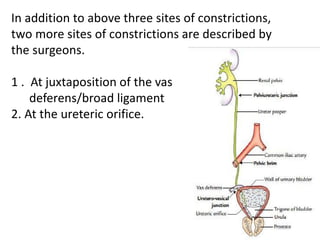
Sites of Anatomical Constrictions
The lumen of the ureter is not uniform throughout
and presents three constrictions at the following sites.
1. At the pelviureteric junction where the renal pelvis
joins the upper end of ureter. It is the upper most
constriction, found approximately 5 cm away from
the hilum of kidney.
2. At the pelvic brim where it crosses the common iliac
artery.
3.At the uretero-vesical junction (i.e., where ureter
enters into the bladder).
In addition to above three sites of constrictions,
two more sites of constrictions are described by
the surgeons.
1 . At juxtaposition of the vas
deferens/broad ligament
2. At the ureteric orifice.
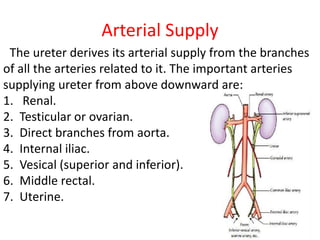
Arterial Supply
The ureter derives its arterial supply from the branches
of all the arteries related to it. The important arteries
supplying ureter from above downward are:
1. Renal.
2. Testicular or ovarian.
3. Direct branches from aorta.
4. Internal iliac.
5. Vesical (superior and inferior).
6. Middle rectal.
7. Uterine.
• Venous Drainage:
The venous blood from the ureter is drained into
the veins corresponding to the arteries.
• Lymphatic Drainage:
The lymph from the ureter is drained into lateral
aortic and iliac nodes.
•Nerve Supply:
1. The sympathetic supply of the ureter is derived
from T12–L1 spinal segments through renal, aortic,
and hypogastric plexuses.
2. The parasympathetic supply of ureter is derived
from S2–S4 spinal segments through pelvic splanchnic
nerves.
The afferent fibres travel with both sympathetic and
parasympathetic
nerves.
Clinical Correlation
Mobilization of ureter:
• Branches of the arteries supplying the ureter form
an anastomosis in the fat and fascia around the
ureter.
• Surgeons should bear in their mind that
stripping off this fascia, while mobilizing the ureter
for transplantation, will hamper the blood supply
of the ureter and may cause its necrosis.
Identification of ureter:
• Ureter is a muscular structure, and in life waves of
muscular contractions produce a worm-like rhythmic
movement (peristalsis) thus milking urine toward the
bladder.
•The ureter is readily identified in life by its thick
muscular wall which is seen to undergo worm-like
writhing movements, especially when it is gently
stroked or Squeezed.
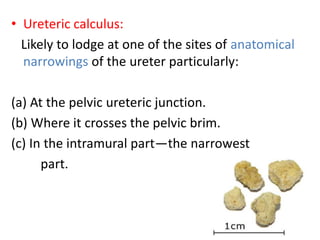
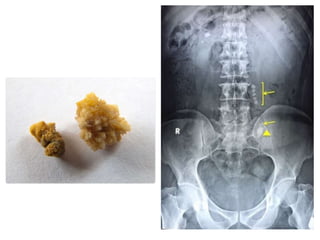
• Ureteric calculus:
Likely to lodge at one of the sites of anatomical
narrowings of the ureter particularly:
(a) At the pelvic ureteric junction.
(b) Where it crosses the pelvic brim.
(c) In the intramural part—the narrowest
part.
• Injury to ureters:
According to Kenson and Hinman, the ureter may
be
injured at one of the following four dangerous sites:
(a) Point where the ureter crosses the iliac vessels.
(b) In the ovarian fossa.
(c) Where the ureter is crossed by the uterine artery
(most dangerous site) as damage is likely at this
site during hysterectomy.
d) At the base of the bladder.
Thank You

Ureter

  • 1.
    Ureter Dr. Mathew JosephMBBS,MD(2nd Year),BCCPM Junior Resident Department of Anatomy All India Institute of Medical Sciences - Rishikesh
  • 2.
    Introduction • Ureter :Narrow Thick-walled Expansile Muscular tube. • Conveys urine from the kidney to the urinary bladder. • Peristaltic contractions of the smooth muscle of the wall of the ureter propells urine.
  • 3.
    Measurements • Length: 25cm (10 inches). • Diameter: 3 mm.
  • 4.
    Ureter - Histology •A thick, fibroelastic, lamina propria lies underneath the epithelium. • This mucosa (epithelium and lamina propria) is protective. • There are no mucosal or submucosal glands, and no submucosa. • There is a layer of smooth muscle outside the mucosa:
  • 5.
    • The uppertwo-thirds has two layers of smooth muscle: inner longitudinally arranged, and outer circularly arranged. • The lower third has three layers of smooth muscle; Inner longitudinal, middle circular, outer longitudinal. • Urine is squeezed into the bladder by peristalsis. • Outer adventitial layer has fibroelastic connective tissue, with blood vessels, lymphatics and nerves. • Folds of mucosa help to protect against reflux of urine when the bladder is full.
  • 6.
    Course in abdominalpart • Begins as a downward continuation of a funnel shaped renal pelvis at the medial margin of the lower end of the kidney. •Passes downward and slight medially on the psoas major, which separates it from the transverse processes of the lumbar vertebrae. •Enters the pelvic cavity by crossing in front of the bifurcation of the common iliac artery at the pelvic brim in front of the sacroiliac joint.
  • 7.
    Course in Pelvis Inthe pelvis, the ureter first runs downward, backward, and laterally along the anterior margin of the greater sciatic notch. Opposite to the ischial spine, it turns forward and medially to reach the base of the urinary bladder. Where it enters the bladder wall obliquely. Within the bladder wall, it narrows down, takes a sinuous course, and opens into the cavity of the bladder at the lateral angle of its trigone as ureteric orifice.
  • 8.
    Parts and Relations Theureter is generally divided into two parts: Abdominal and Pelvic. Each part is about the same length, i.e., 12.5 cm (5 inches). The abdominal part of ureter extends from the renal pelvis to the bifurcation of the common iliac artery. The pelvic part of the ureter extends from the pelvic brim (at the level of bifurcation of the common iliac artery) to the base of the urinary bladder.
  • 9.
    Relations of AbdominalPart Anterior Relations Posterior Relations Right Ureter 1. 2nd part of duodenum. 2. Right colic vessels. 3. Iliocolic vessels. 4. Right testicular / ovarian vessels. 5. Root of mesentery. 1. Right psoas major. 2. Bifurcation of right common iliac artery. Left Ureter 1. Left colic vessels. 2. Sigmoidal vessels. 3. Left testicular / ovarian vessels. 4. Sigmoid mesocolon. 1. Left psoas major. 2. Bifurcation of left common iliac artery.
  • 10.
    • Medially theright ureter is related to inferior vena cava and left ureter is related to left gonadal vein and inferior mesenteric vein.
  • 12.
    Relations of pelvicpart The pelvic part of the ureter crosses in front of all the nerves and vessels on the lateral pelvic wall except vas deferens, which crosses in front of it. Near the uterine cervix, the uterine artery lies above and in front of it, a highly important surgical relationship.
  • 13.
    Sites of AnatomicalConstrictions The lumen of the ureter is not uniform throughout and presents three constrictions at the following sites. 1. At the pelviureteric junction where the renal pelvis joins the upper end of ureter. It is the upper most constriction, found approximately 5 cm away from the hilum of kidney. 2. At the pelvic brim where it crosses the common iliac artery. 3.At the uretero-vesical junction (i.e., where ureter enters into the bladder).
  • 14.
    In addition toabove three sites of constrictions, two more sites of constrictions are described by the surgeons. 1 . At juxtaposition of the vas deferens/broad ligament 2. At the ureteric orifice.
  • 15.
    Arterial Supply The ureterderives its arterial supply from the branches of all the arteries related to it. The important arteries supplying ureter from above downward are: 1. Renal. 2. Testicular or ovarian. 3. Direct branches from aorta. 4. Internal iliac. 5. Vesical (superior and inferior). 6. Middle rectal. 7. Uterine.
  • 16.
    • Venous Drainage: Thevenous blood from the ureter is drained into the veins corresponding to the arteries. • Lymphatic Drainage: The lymph from the ureter is drained into lateral aortic and iliac nodes.
  • 17.
    •Nerve Supply: 1. Thesympathetic supply of the ureter is derived from T12–L1 spinal segments through renal, aortic, and hypogastric plexuses. 2. The parasympathetic supply of ureter is derived from S2–S4 spinal segments through pelvic splanchnic nerves. The afferent fibres travel with both sympathetic and parasympathetic nerves.
  • 18.
    Clinical Correlation Mobilization ofureter: • Branches of the arteries supplying the ureter form an anastomosis in the fat and fascia around the ureter. • Surgeons should bear in their mind that stripping off this fascia, while mobilizing the ureter for transplantation, will hamper the blood supply of the ureter and may cause its necrosis.
  • 19.
    Identification of ureter: •Ureter is a muscular structure, and in life waves of muscular contractions produce a worm-like rhythmic movement (peristalsis) thus milking urine toward the bladder. •The ureter is readily identified in life by its thick muscular wall which is seen to undergo worm-like writhing movements, especially when it is gently stroked or Squeezed.
  • 20.
    • Ureteric calculus: Likelyto lodge at one of the sites of anatomical narrowings of the ureter particularly: (a) At the pelvic ureteric junction. (b) Where it crosses the pelvic brim. (c) In the intramural part—the narrowest part.
  • 22.
    • Injury toureters: According to Kenson and Hinman, the ureter may be injured at one of the following four dangerous sites: (a) Point where the ureter crosses the iliac vessels. (b) In the ovarian fossa. (c) Where the ureter is crossed by the uterine artery (most dangerous site) as damage is likely at this site during hysterectomy. d) At the base of the bladder.
  • 23.