Male Pelvic
Viscera
Saadiya
Naeemi
Dewan Institute Of Rehabilitation Sciences,
SBB Dewan University
I- Primary Sex Organ:
Testis.
II- Reproductive Tract:
Epididymis.
Vas Deferens.
Spermatic cord.
III- Accessory Sex Glands:
Seminal vesicles.
Prostate gland.
Bulbourethral glands.
IV- External Genitalia:
Penis
Components Of Male Reproductive System
 An out pouching of loose skin
& superficial fascia.
The Left scrotum is slightly
lower than the right.
 Functions:
 Houses & Protects the
testis
 Regulates testicular
temperature (no superficial
fat )
 It has thin skin with sparse
hairs and sweat glands.
 The Dartos muscle lies
within the superficial fascia
replaces Scarpa’s fascia.
Scrotum
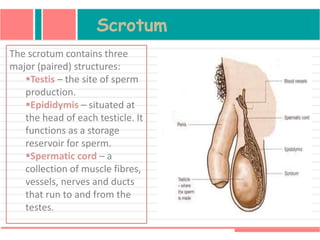
The scrotum contains three
major (paired) structures:
Testis – the site of sperm
production.
Epididymis – situated at
the head of each testicle. It
functions as a storage
reservoir for sperm.
Spermatic cord – a
collection of muscle fibres,
vessels, nerves and ducts
that run to and from the
testes.
Scrotum
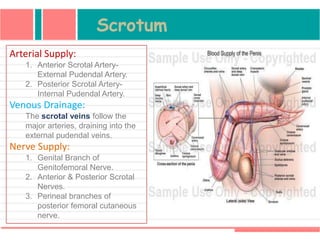
Arterial Supply:
1. Anterior Scrotal Artery-
External Pudendal Artery.
2. Posterior Scrotal Artery-
Internal Pudendal Artery.
Venous Drainage:
The scrotal veins follow the
major arteries, draining into the
external pudendal veins.
Nerve Supply:
1. Genital Branch of
Genitofemoral Nerve.
2. Anterior & Posterior Scrotal
Nerves.
3. Perineal branches of
posterior femoral cutaneous
nerve.
Scrotum
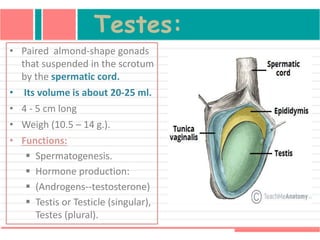
• Paired almond-shape gonads
that suspended in the scrotum
by the spermatic cord.
• Its volume is about 20-25 ml.
• 4 - 5 cm long
• Weigh (10.5 – 14 g.).
• Functions:
 Spermatogenesis.
 Hormone production:
 (Androgens--testosterone)
 Testis or Testicle (singular),
Testes (plural).
Testes:
Coverings Of The
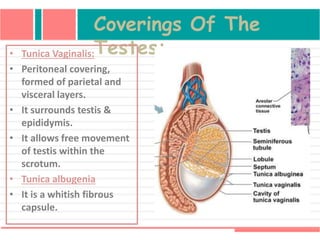
Testes:• Tunica Vaginalis:
• Peritoneal covering,
formed of parietal and
visceral layers.
• It surrounds testis &
epididymis.
• It allows free movement
of testis within the
scrotum.
• Tunica albugenia
• It is a whitish fibrous
capsule.
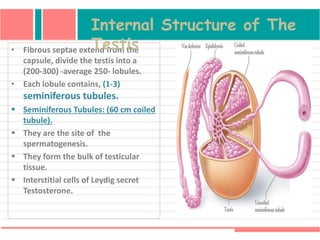
• Fibrous septae extend from the
capsule, divide the testis into a
(200-300) -average 250- lobules.
• Each lobule contains, (1-3)
seminiferous tubules.
 Seminiferous Tubules: (60 cm coiled
tubule).
 They are the site of the
spermatogenesis.
 They form the bulk of testicular
tissue.
 Interstitial cells of Leydig secret
Testosterone.
Internal Structure of The
Testis
Vascular Supply of
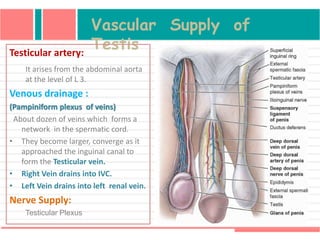
TestisTesticular artery:
It arises from the abdominal aorta
at the level of L 3.
Venous drainage :
(Pampiniform plexus of veins)
About dozen of veins which forms a
network in the spermatic cord.
• They become larger, converge as it
approached the inguinal canal to
form the Testicular vein.
• Right Vein drains into IVC.
• Left Vein drains into left renal vein.
Nerve Supply:
Testicular Plexus
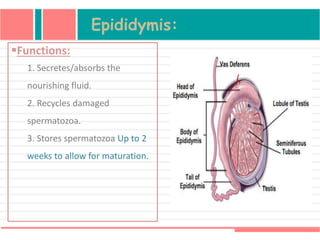
Epididymis:
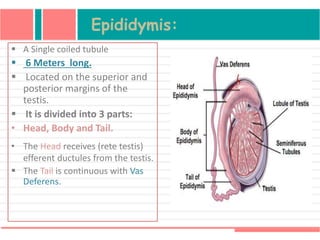
 A Single coiled tubule
 6 Meters long.
 Located on the superior and
posterior margins of the
testis.
 It is divided into 3 parts:
• Head, Body and Tail.
• The Head receives (rete testis)
efferent ductules from the testis.
 The Tail is continuous with Vas
Deferens.
Epididymis:
Functions:
1. Secretes/absorbs the
nourishing fluid.
2. Recycles damaged
spermatozoa.
3. Stores spermatozoa Up to 2
weeks to allow for maturation.
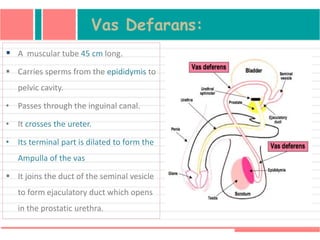
Vas Defarans:
 A muscular tube 45 cm long.
 Carries sperms from the epididymis to
pelvic cavity.
• Passes through the inguinal canal.
• It crosses the ureter.
• Its terminal part is dilated to form the
Ampulla of the vas
 It joins the duct of the seminal vesicle
to form ejaculatory duct which opens
in the prostatic urethra.
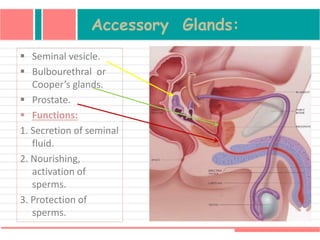
Accessory Glands:
 Seminal vesicle.
 Bulbourethral or
Cooper’s glands.
 Prostate.
 Functions:
1. Secretion of seminal
fluid.
2. Nourishing,
activation of
sperms.
3. Protection of
sperms.
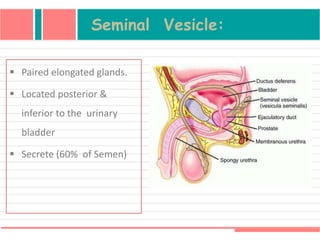
Seminal Vesicle:
 Paired elongated glands.
 Located posterior &
inferior to the urinary
bladder
 Secrete (60% of Semen)
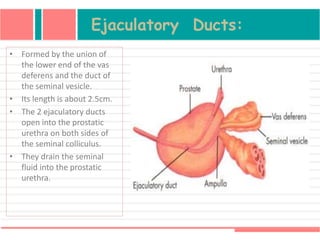
Ejaculatory Ducts:
• Formed by the union of
the lower end of the vas
deferens and the duct of
the seminal vesicle.
• Its length is about 2.5cm.
• The 2 ejaculatory ducts
open into the prostatic
urethra on both sides of
the seminal colliculus.
• They drain the seminal
fluid into the prostatic
urethra.
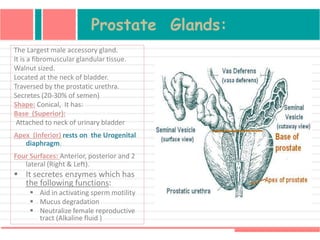
Prostate Glands:
The Largest male accessory gland.
It is a fibromuscular glandular tissue.
Walnut sized.
Located at the neck of bladder.
Traversed by the prostatic urethra.
Secretes (20-30% of semen)
Shape: Conical, It has:
Base (Superior):
Attached to neck of urinary bladder
Apex (Inferior) rests on the Urogenital
diaphragm.
Four Surfaces: Anterior, posterior and 2
lateral (Right & Left).
 It secretes enzymes which has
the following functions:
 Aid in activating sperm motility
 Mucus degradation
 Neutralize female reproductive
tract (Alkaline fluid )
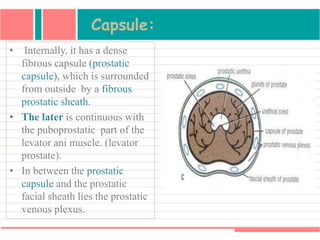
Capsule:
• Internally, it has a dense
fibrous capsule (prostatic
capsule), which is surrounded
from outside by a fibrous
prostatic sheath.
• The later is continuous with
the puboprostatic part of the
levator ani muscle. (levator
prostate).
• In between the prostatic
capsule and the prostatic
facial sheath lies the prostatic
venous plexus.
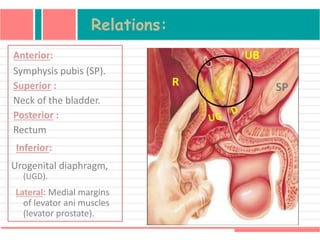
Anterior:
Symphysis pubis (SP).
Superior :
Neck of the bladder.
Posterior :
Rectum
Inferior:
Urogenital diaphragm,
(UGD).
Lateral: Medial margins
of levator ani muscles
(levator prostate).
R
UBSP
SPR
UB
Relations:
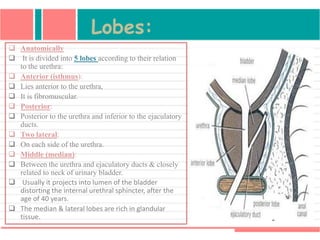
Lobes:
 Anatomically
 It is divided into 5 lobes according to their relation
to the urethra:
 Anterior (isthmus):
 Lies anterior to the urethra,
 It is fibromuscular.
 Posterior:
 Posterior to the urethra and inferior to the ejaculatory
ducts.
 Two lateral:
 On each side of the urethra.
 Middle (median):
 Between the urethra and ejaculatory ducts & closely
related to neck of urinary bladder.
 Usually it projects into lumen of the bladder
distorting the internal urethral sphincter, after the
age of 40 years.
 The median & lateral lobes are rich in glandular
tissue.
Prostatic Urethra:
Structures seen on its posterior wall:
Urethral crest:
• A longitudinal elevated ridge.
Prostatic sinus:
A groove on each side of the crest.
• The prostatic gland opens into the
sinuses.
Seminal colliculus a rounded eminence
that opens into the prostatic utricle.
Prostatic utricle
• A depression on the summit of the
urethral crest.
• The ejaculatory ducts open on the
sides of the utricle.
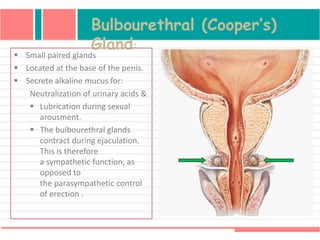
Bulbourethral (Cooper’s)
Gland:
 Small paired glands
 Located at the base of the penis.
 Secrete alkaline mucus for:
Neutralization of urinary acids &
 Lubrication during sexual
arousment.
 The bulbourethral glands
contract during ejaculation.
This is therefore
a sympathetic function, as
opposed to
the parasympathetic control
of erection .
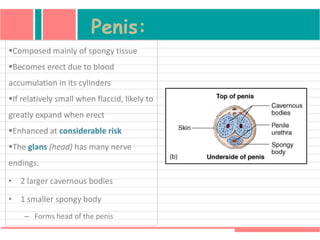
Penis:
Composed mainly of spongy tissue
Becomes erect due to blood
accumulation in its cylinders
If relatively small when flaccid, likely to
greatly expand when erect
Enhanced at considerable risk
The glans (head) has many nerve
endings.
• 2 larger cavernous bodies
• 1 smaller spongy body
– Forms head of the penis
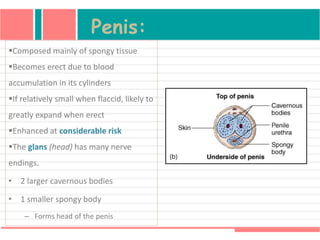
Penis:
Composed mainly of spongy tissue
Becomes erect due to blood
accumulation in its cylinders
If relatively small when flaccid, likely to
greatly expand when erect
Enhanced at considerable risk
The glans (head) has many nerve
endings.
• 2 larger cavernous bodies
• 1 smaller spongy body
– Forms head of the penis
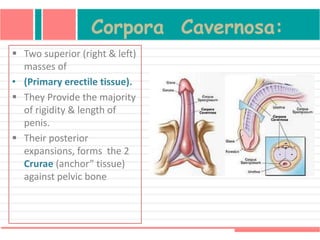
Corpora Cavernosa:
 Two superior (right & left)
masses of
• (Primary erectile tissue).
 They Provide the majority
of rigidity & length of
penis.
 Their posterior
expansions, forms the 2
Crurae (anchor” tissue)
against pelvic bone
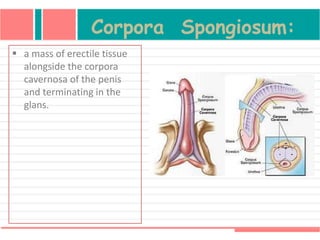
Corpora Spongiosum:
 a mass of erectile tissue
alongside the corpora
cavernosa of the penis
and terminating in the
glans.
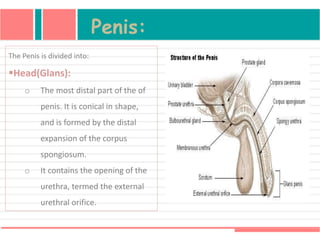
Penis:
The Penis is divided into:
Head(Glans):
o The most distal part of the of
penis. It is conical in shape,
and is formed by the distal
expansion of the corpus
spongiosum.
o It contains the opening of the
urethra, termed the external
urethral orifice.
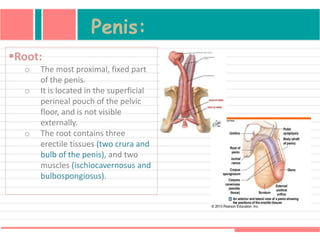
Penis:
Root:
o The most proximal, fixed part
of the penis.
o It is located in the superficial
perineal pouch of the pelvic
floor, and is not visible
externally.
o The root contains three
erectile tissues (two crura and
bulb of the penis), and two
muscles (ischiocavernosus and
bulbospongiosus).
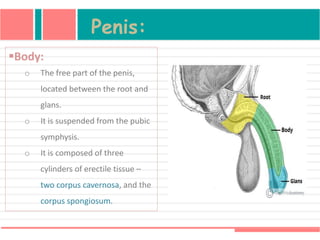
Penis:
Body:
o The free part of the penis,
located between the root and
glans.
o It is suspended from the pubic
symphysis.
o It is composed of three
cylinders of erectile tissue –
two corpus cavernosa, and the
corpus spongiosum.
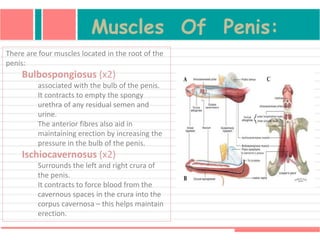
Muscles Of Penis:
There are four muscles located in the root of the
penis:
Bulbospongiosus (x2)
associated with the bulb of the penis.
It contracts to empty the spongy
urethra of any residual semen and
urine.
The anterior fibres also aid in
maintaining erection by increasing the
pressure in the bulb of the penis.
Ischiocavernosus (x2)
Surrounds the left and right crura of
the penis.
It contracts to force blood from the
cavernous spaces in the crura into the
corpus cavernosa – this helps maintain
erection.
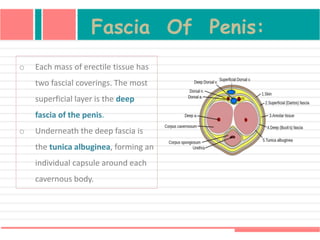
Fascia Of Penis:
o Each mass of erectile tissue has
two fascial coverings. The most
superficial layer is the deep
fascia of the penis.
o Underneath the deep fascia is
the tunica albuginea, forming an
individual capsule around each
cavernous body.
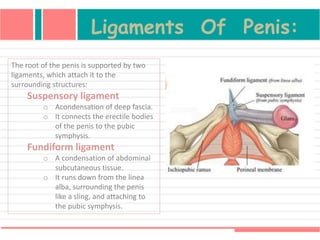
Ligaments Of Penis:
The root of the penis is supported by two
ligaments, which attach it to the
surrounding structures:
Suspensory ligament
o Acondensation of deep fascia.
o It connects the erectile bodies
of the penis to the pubic
symphysis.
Fundiform ligament
o A condensation of abdominal
subcutaneous tissue.
o It runs down from the linea
alba, surrounding the penis
like a sling, and attaching to
the pubic symphysis.
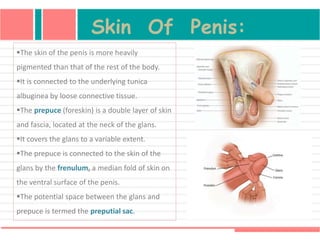
Skin Of Penis:
The skin of the penis is more heavily
pigmented than that of the rest of the body.
It is connected to the underlying tunica
albuginea by loose connective tissue.
The prepuce (foreskin) is a double layer of skin
and fascia, located at the neck of the glans.
It covers the glans to a variable extent.
The prepuce is connected to the skin of the
glans by the frenulum, a median fold of skin on
the ventral surface of the penis.
The potential space between the glans and
prepuce is termed the preputial sac.
Vascular Supply &
Innervation:
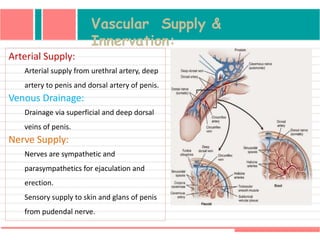
Arterial Supply:
Arterial supply from urethral artery, deep
artery to penis and dorsal artery of penis.
Venous Drainage:
Drainage via superficial and deep dorsal
veins of penis.
Nerve Supply:
Nerves are sympathetic and
parasympathetics for ejaculation and
erection.
Sensory supply to skin and glans of penis
from pudendal nerve.
Organs involved in the Production of
Semen:
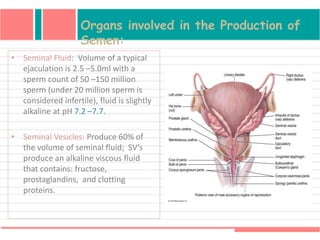
• Seminal Fluid: Volume of a typical
ejaculation is 2.5 –5.0ml with a
sperm count of 50 –150 million
sperm (under 20 million sperm is
considered infertile), fluid is slightly
alkaline at pH 7.2 –7.7.
• Seminal Vesicles: Produce 60% of
the volume of seminal fluid; SV’s
produce an alkaline viscous fluid
that contains: fructose,
prostaglandins, and clotting
proteins.
Organs involved in the Production of
Semen:
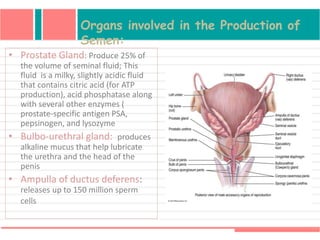
• Prostate Gland: Produce 25% of
the volume of seminal fluid; This
fluid is a milky, slightly acidic fluid
that contains citric acid (for ATP
production), acid phosphatase along
with several other enzymes (
prostate-specific antigen PSA,
pepsinogen, and lysozyme
• Bulbo-urethral gland: produces
alkaline mucus that help lubricate
the urethra and the head of the
penis
• Ampulla of ductus deferens:
releases up to 150 million sperm
cells
T
H
A
N
K
Y
O
U

Male pelvis viscera

  • 1.
    Male Pelvic Viscera Saadiya Naeemi Dewan InstituteOf Rehabilitation Sciences, SBB Dewan University
  • 2.
    I- Primary SexOrgan: Testis. II- Reproductive Tract: Epididymis. Vas Deferens. Spermatic cord. III- Accessory Sex Glands: Seminal vesicles. Prostate gland. Bulbourethral glands. IV- External Genitalia: Penis Components Of Male Reproductive System
  • 3.
     An outpouching of loose skin & superficial fascia. The Left scrotum is slightly lower than the right.  Functions:  Houses & Protects the testis  Regulates testicular temperature (no superficial fat )  It has thin skin with sparse hairs and sweat glands.  The Dartos muscle lies within the superficial fascia replaces Scarpa’s fascia. Scrotum
  • 4.
    The scrotum containsthree major (paired) structures: Testis – the site of sperm production. Epididymis – situated at the head of each testicle. It functions as a storage reservoir for sperm. Spermatic cord – a collection of muscle fibres, vessels, nerves and ducts that run to and from the testes. Scrotum
  • 5.
    Arterial Supply: 1. AnteriorScrotal Artery- External Pudendal Artery. 2. Posterior Scrotal Artery- Internal Pudendal Artery. Venous Drainage: The scrotal veins follow the major arteries, draining into the external pudendal veins. Nerve Supply: 1. Genital Branch of Genitofemoral Nerve. 2. Anterior & Posterior Scrotal Nerves. 3. Perineal branches of posterior femoral cutaneous nerve. Scrotum
  • 6.
    • Paired almond-shapegonads that suspended in the scrotum by the spermatic cord. • Its volume is about 20-25 ml. • 4 - 5 cm long • Weigh (10.5 – 14 g.). • Functions:  Spermatogenesis.  Hormone production:  (Androgens--testosterone)  Testis or Testicle (singular), Testes (plural). Testes:
  • 7.
    Coverings Of The Testes:•Tunica Vaginalis: • Peritoneal covering, formed of parietal and visceral layers. • It surrounds testis & epididymis. • It allows free movement of testis within the scrotum. • Tunica albugenia • It is a whitish fibrous capsule.
  • 8.
    • Fibrous septaeextend from the capsule, divide the testis into a (200-300) -average 250- lobules. • Each lobule contains, (1-3) seminiferous tubules.  Seminiferous Tubules: (60 cm coiled tubule).  They are the site of the spermatogenesis.  They form the bulk of testicular tissue.  Interstitial cells of Leydig secret Testosterone. Internal Structure of The Testis
  • 9.
    Vascular Supply of TestisTesticularartery: It arises from the abdominal aorta at the level of L 3. Venous drainage : (Pampiniform plexus of veins) About dozen of veins which forms a network in the spermatic cord. • They become larger, converge as it approached the inguinal canal to form the Testicular vein. • Right Vein drains into IVC. • Left Vein drains into left renal vein. Nerve Supply: Testicular Plexus
  • 10.
    Epididymis:  A Singlecoiled tubule  6 Meters long.  Located on the superior and posterior margins of the testis.  It is divided into 3 parts: • Head, Body and Tail. • The Head receives (rete testis) efferent ductules from the testis.  The Tail is continuous with Vas Deferens.
  • 11.
    Epididymis: Functions: 1. Secretes/absorbs the nourishingfluid. 2. Recycles damaged spermatozoa. 3. Stores spermatozoa Up to 2 weeks to allow for maturation.
  • 12.
    Vas Defarans:  Amuscular tube 45 cm long.  Carries sperms from the epididymis to pelvic cavity. • Passes through the inguinal canal. • It crosses the ureter. • Its terminal part is dilated to form the Ampulla of the vas  It joins the duct of the seminal vesicle to form ejaculatory duct which opens in the prostatic urethra.
  • 13.
    Accessory Glands:  Seminalvesicle.  Bulbourethral or Cooper’s glands.  Prostate.  Functions: 1. Secretion of seminal fluid. 2. Nourishing, activation of sperms. 3. Protection of sperms.
  • 14.
    Seminal Vesicle:  Pairedelongated glands.  Located posterior & inferior to the urinary bladder  Secrete (60% of Semen)
  • 15.
    Ejaculatory Ducts: • Formedby the union of the lower end of the vas deferens and the duct of the seminal vesicle. • Its length is about 2.5cm. • The 2 ejaculatory ducts open into the prostatic urethra on both sides of the seminal colliculus. • They drain the seminal fluid into the prostatic urethra.
  • 16.
    Prostate Glands: The Largestmale accessory gland. It is a fibromuscular glandular tissue. Walnut sized. Located at the neck of bladder. Traversed by the prostatic urethra. Secretes (20-30% of semen) Shape: Conical, It has: Base (Superior): Attached to neck of urinary bladder Apex (Inferior) rests on the Urogenital diaphragm. Four Surfaces: Anterior, posterior and 2 lateral (Right & Left).  It secretes enzymes which has the following functions:  Aid in activating sperm motility  Mucus degradation  Neutralize female reproductive tract (Alkaline fluid )
  • 17.
    Capsule: • Internally, ithas a dense fibrous capsule (prostatic capsule), which is surrounded from outside by a fibrous prostatic sheath. • The later is continuous with the puboprostatic part of the levator ani muscle. (levator prostate). • In between the prostatic capsule and the prostatic facial sheath lies the prostatic venous plexus.
  • 18.
    Anterior: Symphysis pubis (SP). Superior: Neck of the bladder. Posterior : Rectum Inferior: Urogenital diaphragm, (UGD). Lateral: Medial margins of levator ani muscles (levator prostate). R UBSP SPR UB Relations:
  • 19.
    Lobes:  Anatomically  Itis divided into 5 lobes according to their relation to the urethra:  Anterior (isthmus):  Lies anterior to the urethra,  It is fibromuscular.  Posterior:  Posterior to the urethra and inferior to the ejaculatory ducts.  Two lateral:  On each side of the urethra.  Middle (median):  Between the urethra and ejaculatory ducts & closely related to neck of urinary bladder.  Usually it projects into lumen of the bladder distorting the internal urethral sphincter, after the age of 40 years.  The median & lateral lobes are rich in glandular tissue.
  • 20.
    Prostatic Urethra: Structures seenon its posterior wall: Urethral crest: • A longitudinal elevated ridge. Prostatic sinus: A groove on each side of the crest. • The prostatic gland opens into the sinuses. Seminal colliculus a rounded eminence that opens into the prostatic utricle. Prostatic utricle • A depression on the summit of the urethral crest. • The ejaculatory ducts open on the sides of the utricle.
  • 21.
    Bulbourethral (Cooper’s) Gland:  Smallpaired glands  Located at the base of the penis.  Secrete alkaline mucus for: Neutralization of urinary acids &  Lubrication during sexual arousment.  The bulbourethral glands contract during ejaculation. This is therefore a sympathetic function, as opposed to the parasympathetic control of erection .
  • 22.
    Penis: Composed mainly ofspongy tissue Becomes erect due to blood accumulation in its cylinders If relatively small when flaccid, likely to greatly expand when erect Enhanced at considerable risk The glans (head) has many nerve endings. • 2 larger cavernous bodies • 1 smaller spongy body – Forms head of the penis
  • 23.
    Penis: Composed mainly ofspongy tissue Becomes erect due to blood accumulation in its cylinders If relatively small when flaccid, likely to greatly expand when erect Enhanced at considerable risk The glans (head) has many nerve endings. • 2 larger cavernous bodies • 1 smaller spongy body – Forms head of the penis
  • 24.
    Corpora Cavernosa:  Twosuperior (right & left) masses of • (Primary erectile tissue).  They Provide the majority of rigidity & length of penis.  Their posterior expansions, forms the 2 Crurae (anchor” tissue) against pelvic bone
  • 25.
    Corpora Spongiosum:  amass of erectile tissue alongside the corpora cavernosa of the penis and terminating in the glans.
  • 26.
    Penis: The Penis isdivided into: Head(Glans): o The most distal part of the of penis. It is conical in shape, and is formed by the distal expansion of the corpus spongiosum. o It contains the opening of the urethra, termed the external urethral orifice.
  • 27.
    Penis: Root: o The mostproximal, fixed part of the penis. o It is located in the superficial perineal pouch of the pelvic floor, and is not visible externally. o The root contains three erectile tissues (two crura and bulb of the penis), and two muscles (ischiocavernosus and bulbospongiosus).
  • 28.
    Penis: Body: o The freepart of the penis, located between the root and glans. o It is suspended from the pubic symphysis. o It is composed of three cylinders of erectile tissue – two corpus cavernosa, and the corpus spongiosum.
  • 29.
    Muscles Of Penis: Thereare four muscles located in the root of the penis: Bulbospongiosus (x2) associated with the bulb of the penis. It contracts to empty the spongy urethra of any residual semen and urine. The anterior fibres also aid in maintaining erection by increasing the pressure in the bulb of the penis. Ischiocavernosus (x2) Surrounds the left and right crura of the penis. It contracts to force blood from the cavernous spaces in the crura into the corpus cavernosa – this helps maintain erection.
  • 30.
    Fascia Of Penis: oEach mass of erectile tissue has two fascial coverings. The most superficial layer is the deep fascia of the penis. o Underneath the deep fascia is the tunica albuginea, forming an individual capsule around each cavernous body.
  • 31.
    Ligaments Of Penis: Theroot of the penis is supported by two ligaments, which attach it to the surrounding structures: Suspensory ligament o Acondensation of deep fascia. o It connects the erectile bodies of the penis to the pubic symphysis. Fundiform ligament o A condensation of abdominal subcutaneous tissue. o It runs down from the linea alba, surrounding the penis like a sling, and attaching to the pubic symphysis.
  • 32.
    Skin Of Penis: Theskin of the penis is more heavily pigmented than that of the rest of the body. It is connected to the underlying tunica albuginea by loose connective tissue. The prepuce (foreskin) is a double layer of skin and fascia, located at the neck of the glans. It covers the glans to a variable extent. The prepuce is connected to the skin of the glans by the frenulum, a median fold of skin on the ventral surface of the penis. The potential space between the glans and prepuce is termed the preputial sac.
  • 33.
    Vascular Supply & Innervation: ArterialSupply: Arterial supply from urethral artery, deep artery to penis and dorsal artery of penis. Venous Drainage: Drainage via superficial and deep dorsal veins of penis. Nerve Supply: Nerves are sympathetic and parasympathetics for ejaculation and erection. Sensory supply to skin and glans of penis from pudendal nerve.
  • 34.
    Organs involved inthe Production of Semen: • Seminal Fluid: Volume of a typical ejaculation is 2.5 –5.0ml with a sperm count of 50 –150 million sperm (under 20 million sperm is considered infertile), fluid is slightly alkaline at pH 7.2 –7.7. • Seminal Vesicles: Produce 60% of the volume of seminal fluid; SV’s produce an alkaline viscous fluid that contains: fructose, prostaglandins, and clotting proteins.
  • 35.
    Organs involved inthe Production of Semen: • Prostate Gland: Produce 25% of the volume of seminal fluid; This fluid is a milky, slightly acidic fluid that contains citric acid (for ATP production), acid phosphatase along with several other enzymes ( prostate-specific antigen PSA, pepsinogen, and lysozyme • Bulbo-urethral gland: produces alkaline mucus that help lubricate the urethra and the head of the penis • Ampulla of ductus deferens: releases up to 150 million sperm cells
  • 36.