MUHAMMAD UMAIR
MAJEED
ROLL NO. 25
TOPIC OF PRESENTATION :
URINARY BLADDER
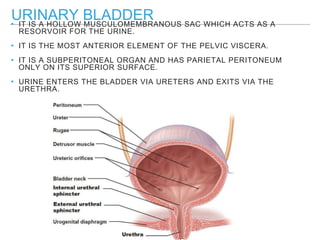
• IT IS A HOLLOW MUSCULOMEMBRANOUS SAC WHICH ACTS AS A
RESORVOIR FOR THE URINE.
• IT IS THE MOST ANTERIOR ELEMENT OF THE PELVIC VISCERA.
• IT IS A SUBPERITONEAL ORGAN AND HAS PARIETAL PERITONEUM
ONLY ON ITS SUPERIOR SURFACE.
• URINE ENTERS THE BLADDER VIA URETERS AND EXITS VIA THE
URETHRA.
URINARY BLADDER
ANATOMICAL LOCATION
▸When "Empty" , the adult urinary bladder is located in the "Lesser
pelvis" lying partially superior to and partially postetior to the pubic
Bones.
▸As the bladder fills it enters the "Greater Pelvis".
▸In some individuals, a full bladder may ascend to the level of the
"Umbilicus".
▸In infants and young children,the urinary bladder is in the abdomen
even when empty.
▸The Bladder usually enters the Greater Pelvis by 6 Years of age.
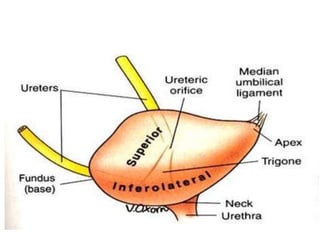
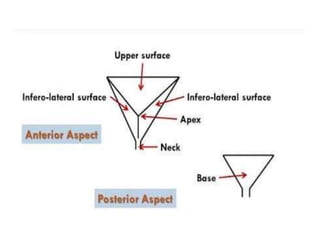
SURFACES OF THE URINARY BLADDER
▸Superior surface.
▸Right inferolateral surface.
▸Left inferateral surface
▸Posterior surface.
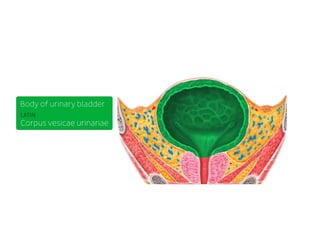
BODY OF URINARY BLADDER
▸It is lined by Transitional epithelium,
▸It holds the urine, before it is voided.
▸It can hold 400ml to 1000ml of the urine.
▸It is located between the apex and the fundus.
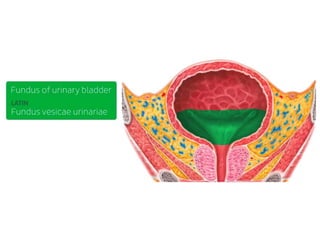
FUNDUS OF THE URINARY BLADDER
▸It is base of the bladder.
▸It has the shape of inverted triangle.
▸It faces postero-inferiorly and , is formed by the posterior
wall of bladder.
▸Trigone of the urinary bladder is found on the fundus.
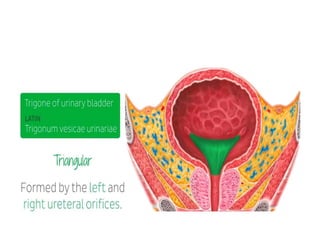
TRIGONE OF URINARY BLADDER
▸It is smooth triangular part of urinary bladder.
▸Mucosal lining of trigone is smooth and firmly attached to the
underlying wall of the bladder.
▸Formed by Right and left ureteral orifices.
▸Once the trigone of urinary bladder is stretched to a certain
degree, siganl is sent to the brain that bladder needs to be
emptied.
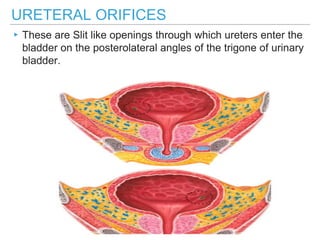
URETERAL ORIFICES
▸These are Slit like openings through which ureters enter the
bladder on the posterolateral angles of the trigone of urinary
bladder.
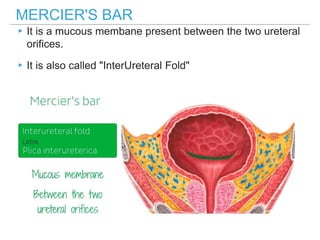
MERCIER'S BAR
▸It is a mucous membane present between the two ureteral
orifices.
▸It is also called "InterUreteral Fold"
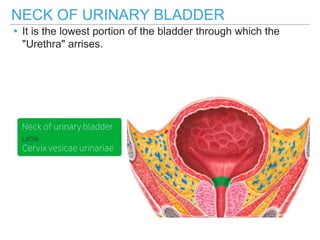
NECK OF URINARY BLADDER
▸It is the lowest portion of the bladder through which the
"Urethra" arrises.
INTERNAL URETHRAL SPHINCTER
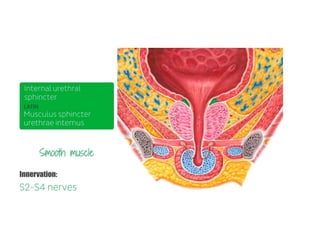
▸It is comprised of smooth muscle that is located at the
junction of urethra and the urinary bladder.
▸It is innervated by S2-S4 nerves of the pelvic plexus.
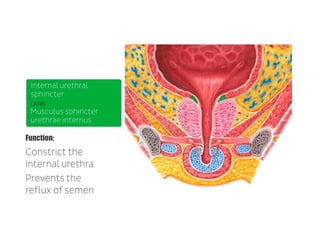
▸It's function is to constrict the internal urethra ,preventing the
urine leakage and also prevents the Retrograde ejaculation (
Ejaculatory Reflex ) of semen into the bladder.
DETRUSOR MUSCLE
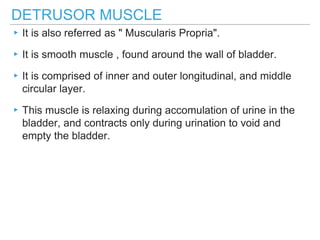
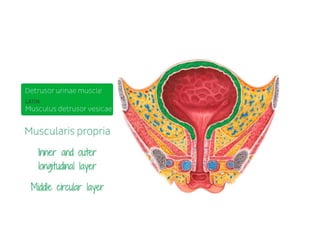
▸It is also referred as " Muscularis Propria".
▸It is smooth muscle , found around the wall of bladder.
▸It is comprised of inner and outer longitudinal, and middle
circular layer.
▸This muscle is relaxing during accomulation of urine in the
bladder, and contracts only during urination to void and
empty the bladder.
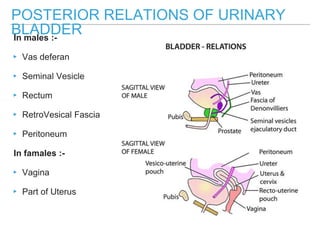
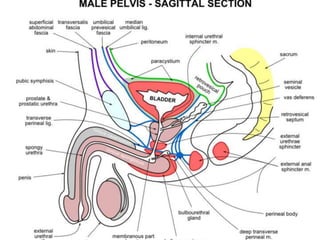
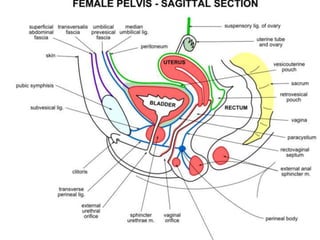
POSTERIOR RELATIONS OF URINARY
BLADDERIn males :-
▸ Vas deferan
▸ Seminal Vesicle
▸ Rectum
▸ RetroVesical Fascia
▸ Peritoneum
In famales :-
▸ Vagina
▸ Part of Uterus
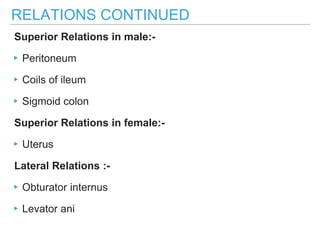
RELATIONS CONTINUED
Superior Relations in male:-
▸Peritoneum
▸Coils of ileum
▸Sigmoid colon
Superior Relations in female:-
▸Uterus
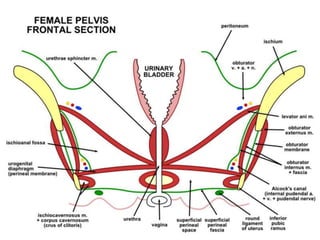
Lateral Relations :-
▸Obturator internus
▸Levator ani
ARTERIAL SUPPLY
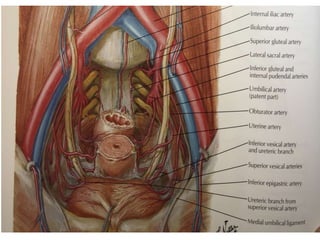
▸Branches of internal iliac arteries.
▸Superior vesical arteries supply anterosuperior parts of the bladder.
▸In males, inferior vesical arteries supply the fundus and neck of the
bladder.
▸In females, vaginal arteries replace the inferior vesical arteries and
send small branches to posteroinferior parts of the bladder.
▸Obturator and inferior gluteal arteries also supply small branches to
the bladder.
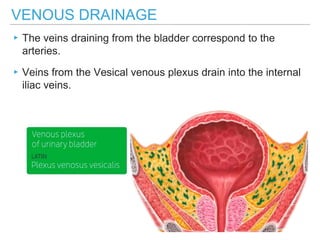
VENOUS DRAINAGE
▸The veins draining from the bladder correspond to the
arteries.
▸Veins from the Vesical venous plexus drain into the internal
iliac veins.
INNERVATION OF URINARY BLADDER
▸Pelvic Nerve (Parasympathetic nerve) comes from the sacral region of
spinal cord. It is not under our control. It causes contraction of the
Detrusor muscle.
▸Pudendal nerve (Somatic nerve) causes contraction of External
Sphincter. We are firing pudendal nerve when we are trying to hold our
urine.
▸Hypogastric nerve (Sympathetic nerve) causes relaxation of Detrusor
muscle and contraction of Internal sphincter.
▸Afferent Pelvic nerve that is sensory and comes from the detrusor
muscle. It is stimulated when the bladder is stretched.
LYMPHATIC DRAINAGE OF BLADDER
▸In both sexes, lymphatic vessels leave the superior surface
of the bladder and pass to the "External iliac lymph nodes".
▸Those from fundus pass to the "Internal iliac lymph nodes".
▸Some vessels from the neck of bladder drain into the
"Sacral" to "Common iliac lymph nodes".
Anatomy Of Urinary Bladder

Anatomy Of Urinary Bladder

  • 2.
    MUHAMMAD UMAIR MAJEED ROLL NO.25 TOPIC OF PRESENTATION : URINARY BLADDER
  • 3.
    • IT ISA HOLLOW MUSCULOMEMBRANOUS SAC WHICH ACTS AS A RESORVOIR FOR THE URINE. • IT IS THE MOST ANTERIOR ELEMENT OF THE PELVIC VISCERA. • IT IS A SUBPERITONEAL ORGAN AND HAS PARIETAL PERITONEUM ONLY ON ITS SUPERIOR SURFACE. • URINE ENTERS THE BLADDER VIA URETERS AND EXITS VIA THE URETHRA. URINARY BLADDER
  • 4.
    ANATOMICAL LOCATION ▸When "Empty", the adult urinary bladder is located in the "Lesser pelvis" lying partially superior to and partially postetior to the pubic Bones. ▸As the bladder fills it enters the "Greater Pelvis". ▸In some individuals, a full bladder may ascend to the level of the "Umbilicus". ▸In infants and young children,the urinary bladder is in the abdomen even when empty. ▸The Bladder usually enters the Greater Pelvis by 6 Years of age.
  • 5.
    SURFACES OF THEURINARY BLADDER ▸Superior surface. ▸Right inferolateral surface. ▸Left inferateral surface ▸Posterior surface.
  • 7.
    BODY OF URINARYBLADDER ▸It is lined by Transitional epithelium, ▸It holds the urine, before it is voided. ▸It can hold 400ml to 1000ml of the urine. ▸It is located between the apex and the fundus.
  • 9.
    FUNDUS OF THEURINARY BLADDER ▸It is base of the bladder. ▸It has the shape of inverted triangle. ▸It faces postero-inferiorly and , is formed by the posterior wall of bladder. ▸Trigone of the urinary bladder is found on the fundus.
  • 11.
    TRIGONE OF URINARYBLADDER ▸It is smooth triangular part of urinary bladder. ▸Mucosal lining of trigone is smooth and firmly attached to the underlying wall of the bladder. ▸Formed by Right and left ureteral orifices. ▸Once the trigone of urinary bladder is stretched to a certain degree, siganl is sent to the brain that bladder needs to be emptied.
  • 14.
    URETERAL ORIFICES ▸These areSlit like openings through which ureters enter the bladder on the posterolateral angles of the trigone of urinary bladder.
  • 15.
    MERCIER'S BAR ▸It isa mucous membane present between the two ureteral orifices. ▸It is also called "InterUreteral Fold"
  • 16.
    NECK OF URINARYBLADDER ▸It is the lowest portion of the bladder through which the "Urethra" arrises.
  • 17.
    INTERNAL URETHRAL SPHINCTER ▸Itis comprised of smooth muscle that is located at the junction of urethra and the urinary bladder. ▸It is innervated by S2-S4 nerves of the pelvic plexus. ▸It's function is to constrict the internal urethra ,preventing the urine leakage and also prevents the Retrograde ejaculation ( Ejaculatory Reflex ) of semen into the bladder.
  • 20.
    DETRUSOR MUSCLE ▸It isalso referred as " Muscularis Propria". ▸It is smooth muscle , found around the wall of bladder. ▸It is comprised of inner and outer longitudinal, and middle circular layer. ▸This muscle is relaxing during accomulation of urine in the bladder, and contracts only during urination to void and empty the bladder.
  • 22.
    POSTERIOR RELATIONS OFURINARY BLADDERIn males :- ▸ Vas deferan ▸ Seminal Vesicle ▸ Rectum ▸ RetroVesical Fascia ▸ Peritoneum In famales :- ▸ Vagina ▸ Part of Uterus
  • 23.
    RELATIONS CONTINUED Superior Relationsin male:- ▸Peritoneum ▸Coils of ileum ▸Sigmoid colon Superior Relations in female:- ▸Uterus Lateral Relations :- ▸Obturator internus ▸Levator ani
  • 27.
    ARTERIAL SUPPLY ▸Branches ofinternal iliac arteries. ▸Superior vesical arteries supply anterosuperior parts of the bladder. ▸In males, inferior vesical arteries supply the fundus and neck of the bladder. ▸In females, vaginal arteries replace the inferior vesical arteries and send small branches to posteroinferior parts of the bladder. ▸Obturator and inferior gluteal arteries also supply small branches to the bladder.
  • 29.
    VENOUS DRAINAGE ▸The veinsdraining from the bladder correspond to the arteries. ▸Veins from the Vesical venous plexus drain into the internal iliac veins.
  • 30.
    INNERVATION OF URINARYBLADDER ▸Pelvic Nerve (Parasympathetic nerve) comes from the sacral region of spinal cord. It is not under our control. It causes contraction of the Detrusor muscle. ▸Pudendal nerve (Somatic nerve) causes contraction of External Sphincter. We are firing pudendal nerve when we are trying to hold our urine. ▸Hypogastric nerve (Sympathetic nerve) causes relaxation of Detrusor muscle and contraction of Internal sphincter. ▸Afferent Pelvic nerve that is sensory and comes from the detrusor muscle. It is stimulated when the bladder is stretched.
  • 31.
    LYMPHATIC DRAINAGE OFBLADDER ▸In both sexes, lymphatic vessels leave the superior surface of the bladder and pass to the "External iliac lymph nodes". ▸Those from fundus pass to the "Internal iliac lymph nodes". ▸Some vessels from the neck of bladder drain into the "Sacral" to "Common iliac lymph nodes".