Pelvic vesseles,lymphnodes and neves
Contents
• 1 Major Arteries of the Pelvis: Internal Iliac and its
branches
• 1.1 Anterior Trunk
• 1.2 Posterior Trunk
• 2 Minor Arteries of the Pelvis
• 2.1 Gonadal Arteries
• 2.2 Median Sacral Artery
• 2.3 Superior Rectal Artery
Anterior Trunk
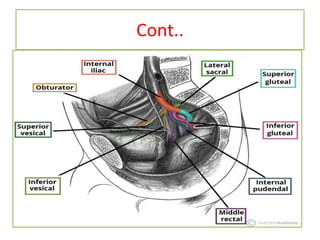
 Obturator artery – Travels through the obturator canal, accompanied by the
obturator nerve and vein. It supplies the muscles of the thigh’s adductor
region.
 Umbilical artery – Gives rise to the superior vesical artery, which supplies
the superior aspect of the urinary bladder.
 In utero, the umbilical artery transports deoxygenated blood from the fetus to
the placenta.
 Inferior vesical artery – Supplies the lower aspect of the bladder. In males, it
also supplies the prostate gland and seminal vesicles.
 Vaginal artery (female) – Descends to the vagina, supplying additional
branches to the inferior bladder and rectum.
Cont….
 Uterine artery (female) – Travels within the cardinal ligament to reach the cervix,
where it ascends along the lateral aspect of the uterus. At origin of the fallopian
tubes, it anastamoses with the ovarian artery. During its course, it crosses the
ureters superiorly.
 Middle rectal artery – Travels medially to supply the distal part of the rectum. It also
forms anastamoses with the superior rectal artery (derived from the inferior
mesenteric) and the inferior rectal artery (derived from the internal pudendal).
 Internal pudendal artery – Moves inferiorly to exit the pelvis via the greater sciatic
foramen. Accompanied by the pudendal nerve, it then enters the perineum via the
lesser sciatic foramen. It is the main artery responsible for the blood supply to the
perineum.
 Inferior gluteal artery – The terminal branch of the anterior trunk. It leaves the pelvic
cavity via the greater sciatic foramen, emerging inferiorly to the piriformis muscle in
the gluteal region. It contributes to the blood supply of the gluteal muscles and hip
joint.
Cont..
Posterior Trunk
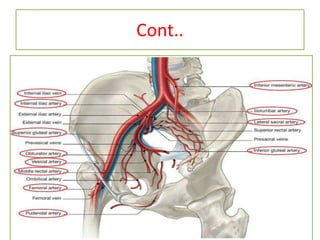
• The posterior trunk gives rise to arteries that supply the lower posterior
abdominal wall, posterior pelvic wall and the gluteal region. There are
typically three branches:
• Iliolumbar artery – Ascends to exit the lesser pelvis, dividing into a lumbar
and iliac branch. The lumbar branch supplies psoas major, quadratus
lumborum and the posterior abdominal wall.
• The iliac branch supplies the muscles and bone around the iliac fossa.
Cont…
 Lateral sacral arteries (superior and inferior) – Travel infero-medially along the
posterior pelvic wall to supply structures in the sacral canal, and the skin and
muscle posterior to the sacrum.
 Superior gluteal artery – The terminal branch of the posterior trunk. It exits the
pelvic cavity via the greater sciatic foramen, entering the gluteal region superiorly to
the piriformis muscle. It is the major blood supply to the muscles and skin of the
gluteal region.
Cont..
Minor Arteries of the Pelvis
1:Gonadal Arteries:
 The ovarian artery is the major gonadal artery in females.
 It arises from the abdominal aorta, distal to the
origin of the renal arteries.
 The artery descends towards the pelvis, crossing
the pelvic brim and the origin of the external iliac
vessels.
 It moves medially, dividing into an ovarian
branch and tubal branches, which supply their
respective structures.
2:Median Sacral Artery
The median sacral artery originates from the posterior
aspect of abdominal aorta, at its bifurcation into the
common iliac arteries. It descends anteriorly to the L4 and
L5 vertebrae, the sacrum and the coccyx, contributing to
the arterial supply of these regions.
3:Superior Rectal Artery
The superior rectal artery is the terminal continuation of the
inferior mesenteric artery. It crosses the left common iliac
artery and descends in the mesentery of the sigmoid colon.
It gives rise to branches that supply the rectum.
veins
The veins of the pelvis drain deoxygenated blood and
return it to the heart. There are three major vessels
involved in the venous drainage of the pelvis :
 the external iliac vein,
 internal iliac vein and
 common iliac vein
External Iliac Vein
The external iliac vein is a continuation of the femoral vein
(the major vessel draining the lower limb), arising when the
femoral vein crosses underneath the inguinal ligament. It
ascends along the medial aspect of the external iliac artery,
before joining with the internal iliac vein to form the
common iliac vein.
Internal Iliac Vein
 The internal iliac vein is responsible the majority of
pelvic venous drainage, and receives numerous
tributaries from veins that drain the pelvic region.
 It is formed near the greater sciatic
foramen, ascending anteriorly to the sacroiliac
joint, before combining with the external iliac vein
to form the common iliac vein.
Cont..
With the exception of the iliolumbar vein (which drains into
the common iliac), the tributaries of the internal iliac vein
correspond with the branches of the internal iliac artery. It
receives venous blood from the:
• Superior and inferior gluteal veins – drains the buttock
and upper thigh.
• Internal pudendal vein – drains the reproductive organs
and part of the rectum (via the inferior rectal vein).
Cont..
• Obturator vein.
• Lateral sacral veins – drains part of the sacrum.
• Middle rectal vein – drains the bladder, prostate (in males only), and
part of the rectum.
• Vesical veins – drains the urinary bladder via the vesical venous
plexus.
• Uterine and vaginal veins – drain the female reproductive
organs via the vaginal and uterine venous plexuses
Common Iliac Vein
• The common iliac vein is formed at the upper margin of the
pubic symphysis by the union of the external and internal
iliac veins. It receives two additional tributaries:
• Iliolumbar vein – drains the L4 and L5 vertebrae, and the
iliopsoas muscle.
• Middle sacral veins – drain part of the sacrum.
• The left and right common iliac veins combine at L5
to become the inferior vena cava, which empties into the
inferior aspect of the right atrium.
Lymph nodes of the pelvis
The lymph nodes receiving lymph drainage from pelvic organs
are dividing them into definite groups
Four primary groups of nodes are located in or adjacent to the
pelvis:
 External iliac lymph nodes: drains into the common iliac
nodes
 Internal iliac lymph nodes :drains into common iliac nodes
 Sacral lymph nodes :drain either to internal or common iliac
nodes
 Common iliac lymph nodes :They drain chiefly
the hypogastric and external iliac glands
Cont..
 Additional minor groups of nodes (e.g., the pararectal nodes)
occupy the connective tissue along the branches of the internal iliac
vessels.
 Both primary and minor groups of pelvic nodes are highly
interconnected, so that many nodes can be removed without
disturbing drainage.
 The interconnections also allow cancer to spread in virtually any
direction, to any pelvic or abdominal viscus.
NERVES OF THE PELVIC
The pelvis is innervated mainly by :
Sacral plexus
coccygeal spinal nerves and
the pelvic part of the autonomic nervous system.
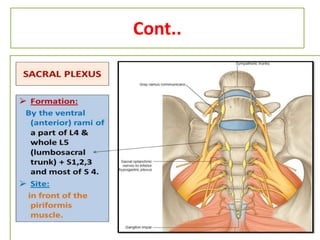
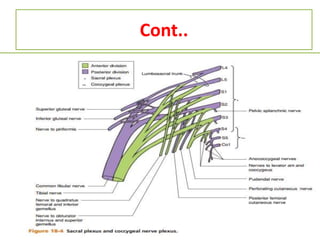
A. Sacral Plexus
 It is formed by the part of the fourth and whole fifth lumbar
ventral rami (the lumbosacral trunk) and the first four sacral
ventral rami.
 The nerves that stem from the sacral plexus include the
following:
1.Superior Gluteal Nerve (L4–S1)
 Leaves the pelvis through the greater sciatic foramen above
the piriformis.
 Innervates the gluteus medius, gluteus minimus, and tensor
fascia lata muscles.
Cont..
Cont..
Cont..
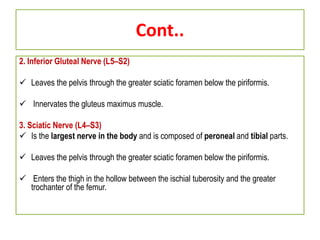
2. Inferior Gluteal Nerve (L5–S2)
 Leaves the pelvis through the greater sciatic foramen below the piriformis.
 Innervates the gluteus maximus muscle.
3. Sciatic Nerve (L4–S3)
 Is the largest nerve in the body and is composed of peroneal and tibial parts.
 Leaves the pelvis through the greater sciatic foramen below the piriformis.
 Enters the thigh in the hollow between the ischial tuberosity and the greater
trochanter of the femur.
Cont..
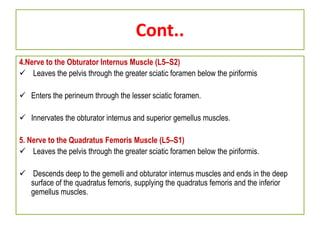
4.Nerve to the Obturator Internus Muscle (L5–S2)
 Leaves the pelvis through the greater sciatic foramen below the piriformis
 Enters the perineum through the lesser sciatic foramen.
 Innervates the obturator internus and superior gemellus muscles.
5. Nerve to the Quadratus Femoris Muscle (L5–S1)
 Leaves the pelvis through the greater sciatic foramen below the piriformis.
 Descends deep to the gemelli and obturator internus muscles and ends in the deep
surface of the quadratus femoris, supplying the quadratus femoris and the inferior
gemellus muscles.
Cont..
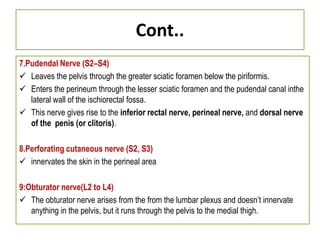
6. Posterior Femoral Cutaneous Nerve (S1–S3)
 Leaves the pelvis through the greater sciatic foramen below the
piriformis.
 Lies alongside the sciatic nerve and descends on the back of the
knee.
 Gives rise to several inferior cluneal nerves and perineal
branches.
Cont..
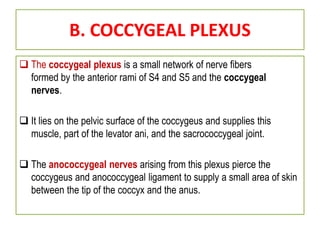
7.Pudendal Nerve (S2–S4)
 Leaves the pelvis through the greater sciatic foramen below the piriformis.
 Enters the perineum through the lesser sciatic foramen and the pudendal canal inthe
lateral wall of the ischiorectal fossa.
 This nerve gives rise to the inferior rectal nerve, perineal nerve, and dorsal nerve
of the penis (or clitoris).
8.Perforating cutaneous nerve (S2, S3)
 innervates the skin in the perineal area
9:Obturator nerve(L2 to L4)
 The obturator nerve arises from the from the lumbar plexus and doesn’t innervate
anything in the pelvis, but it runs through the pelvis to the medial thigh.
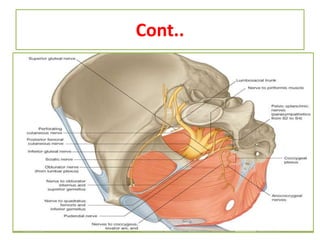
B. COCCYGEAL PLEXUS
 The coccygeal plexus is a small network of nerve fibers
formed by the anterior rami of S4 and S5 and the coccygeal
nerves.
 It lies on the pelvic surface of the coccygeus and supplies this
muscle, part of the levator ani, and the sacrococcygeal joint.
 The anococcygeal nerves arising from this plexus pierce the
coccygeus and anococcygeal ligament to supply a small area of skin
between the tip of the coccyx and the anus.
Cont..
C. Autonomic Components
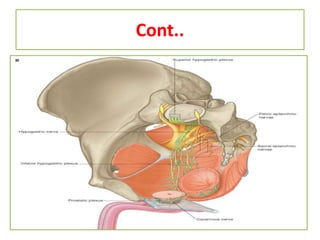
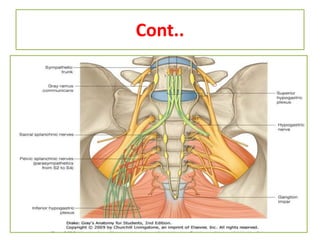
1: Superior Hypogastric Plexus is a continuation of the intermesenteric
plexus from the inferior mesenteric ganglion below the aortic bifurcation and
receives the L3 and L4 lumbar splanchnic nerves. This plexus contains
ganglionic neuronal cell bodies upon which preganglionic sympathetic
axons of the L3 and L4 lumbar splanchnic nerves synapse on.
 The superior hypogastric plexus descends anterior to the L5 vertebra and
ends by dividing into the right hypogastric nerve and left hypogastric
nerve.
Cont..
2. Right and Left Hypogastric Nerves descend on either
side lateral to the rectum and join the right or left inferior
hypogastric plexus, respectively.
3. Right and Left Inferior Hypogastric Plexuses are located
against the posterolateral pelvic wall lateral to the rectum,
vagina, and base of the bladder.
Cont..
The right and left inferior hypogastric plexuses are formed
by the union of the right or left hypogastric nerves,
sacral splanchnic nerves (L5 and S1 to S3), and pelvic
splanchnic nerves (S2 to S4).
This plexus contains ganglionic neuronal cell bodies upon
which preganglionic sympathetic axons of the sacral
splanchnic nerves (L5 and S1 to S3) synapse on.
Cont..
Cont..
4. Sacral Sympathetic Trunk is a continuation of the
paravertebral sympathetic chain ganglia in the pelvis.
The sacral trunks descend on the inner surface of the
sacrum medial to the sacral foramina and converge to form
the small median ganglion impar anterior to the coccyx.
Cont..

Pelvic vessels,nerves and lymph nodes.

  • 1.
  • 2.
    Contents • 1 MajorArteries of the Pelvis: Internal Iliac and its branches • 1.1 Anterior Trunk • 1.2 Posterior Trunk • 2 Minor Arteries of the Pelvis • 2.1 Gonadal Arteries • 2.2 Median Sacral Artery • 2.3 Superior Rectal Artery
  • 3.
    Anterior Trunk  Obturatorartery – Travels through the obturator canal, accompanied by the obturator nerve and vein. It supplies the muscles of the thigh’s adductor region.  Umbilical artery – Gives rise to the superior vesical artery, which supplies the superior aspect of the urinary bladder.  In utero, the umbilical artery transports deoxygenated blood from the fetus to the placenta.  Inferior vesical artery – Supplies the lower aspect of the bladder. In males, it also supplies the prostate gland and seminal vesicles.  Vaginal artery (female) – Descends to the vagina, supplying additional branches to the inferior bladder and rectum.
  • 4.
    Cont….  Uterine artery(female) – Travels within the cardinal ligament to reach the cervix, where it ascends along the lateral aspect of the uterus. At origin of the fallopian tubes, it anastamoses with the ovarian artery. During its course, it crosses the ureters superiorly.  Middle rectal artery – Travels medially to supply the distal part of the rectum. It also forms anastamoses with the superior rectal artery (derived from the inferior mesenteric) and the inferior rectal artery (derived from the internal pudendal).  Internal pudendal artery – Moves inferiorly to exit the pelvis via the greater sciatic foramen. Accompanied by the pudendal nerve, it then enters the perineum via the lesser sciatic foramen. It is the main artery responsible for the blood supply to the perineum.  Inferior gluteal artery – The terminal branch of the anterior trunk. It leaves the pelvic cavity via the greater sciatic foramen, emerging inferiorly to the piriformis muscle in the gluteal region. It contributes to the blood supply of the gluteal muscles and hip joint.
  • 5.
  • 6.
    Posterior Trunk • Theposterior trunk gives rise to arteries that supply the lower posterior abdominal wall, posterior pelvic wall and the gluteal region. There are typically three branches: • Iliolumbar artery – Ascends to exit the lesser pelvis, dividing into a lumbar and iliac branch. The lumbar branch supplies psoas major, quadratus lumborum and the posterior abdominal wall. • The iliac branch supplies the muscles and bone around the iliac fossa.
  • 7.
    Cont…  Lateral sacralarteries (superior and inferior) – Travel infero-medially along the posterior pelvic wall to supply structures in the sacral canal, and the skin and muscle posterior to the sacrum.  Superior gluteal artery – The terminal branch of the posterior trunk. It exits the pelvic cavity via the greater sciatic foramen, entering the gluteal region superiorly to the piriformis muscle. It is the major blood supply to the muscles and skin of the gluteal region.
  • 8.
  • 9.
    Minor Arteries ofthe Pelvis 1:Gonadal Arteries:  The ovarian artery is the major gonadal artery in females.  It arises from the abdominal aorta, distal to the origin of the renal arteries.  The artery descends towards the pelvis, crossing the pelvic brim and the origin of the external iliac vessels.  It moves medially, dividing into an ovarian branch and tubal branches, which supply their respective structures.
  • 10.
    2:Median Sacral Artery Themedian sacral artery originates from the posterior aspect of abdominal aorta, at its bifurcation into the common iliac arteries. It descends anteriorly to the L4 and L5 vertebrae, the sacrum and the coccyx, contributing to the arterial supply of these regions.
  • 11.
    3:Superior Rectal Artery Thesuperior rectal artery is the terminal continuation of the inferior mesenteric artery. It crosses the left common iliac artery and descends in the mesentery of the sigmoid colon. It gives rise to branches that supply the rectum.
  • 12.
    veins The veins ofthe pelvis drain deoxygenated blood and return it to the heart. There are three major vessels involved in the venous drainage of the pelvis :  the external iliac vein,  internal iliac vein and  common iliac vein
  • 13.
    External Iliac Vein Theexternal iliac vein is a continuation of the femoral vein (the major vessel draining the lower limb), arising when the femoral vein crosses underneath the inguinal ligament. It ascends along the medial aspect of the external iliac artery, before joining with the internal iliac vein to form the common iliac vein.
  • 14.
    Internal Iliac Vein The internal iliac vein is responsible the majority of pelvic venous drainage, and receives numerous tributaries from veins that drain the pelvic region.  It is formed near the greater sciatic foramen, ascending anteriorly to the sacroiliac joint, before combining with the external iliac vein to form the common iliac vein.
  • 15.
    Cont.. With the exceptionof the iliolumbar vein (which drains into the common iliac), the tributaries of the internal iliac vein correspond with the branches of the internal iliac artery. It receives venous blood from the: • Superior and inferior gluteal veins – drains the buttock and upper thigh. • Internal pudendal vein – drains the reproductive organs and part of the rectum (via the inferior rectal vein).
  • 16.
    Cont.. • Obturator vein. •Lateral sacral veins – drains part of the sacrum. • Middle rectal vein – drains the bladder, prostate (in males only), and part of the rectum. • Vesical veins – drains the urinary bladder via the vesical venous plexus. • Uterine and vaginal veins – drain the female reproductive organs via the vaginal and uterine venous plexuses
  • 17.
    Common Iliac Vein •The common iliac vein is formed at the upper margin of the pubic symphysis by the union of the external and internal iliac veins. It receives two additional tributaries: • Iliolumbar vein – drains the L4 and L5 vertebrae, and the iliopsoas muscle. • Middle sacral veins – drain part of the sacrum. • The left and right common iliac veins combine at L5 to become the inferior vena cava, which empties into the inferior aspect of the right atrium.
  • 18.
    Lymph nodes ofthe pelvis The lymph nodes receiving lymph drainage from pelvic organs are dividing them into definite groups Four primary groups of nodes are located in or adjacent to the pelvis:  External iliac lymph nodes: drains into the common iliac nodes  Internal iliac lymph nodes :drains into common iliac nodes  Sacral lymph nodes :drain either to internal or common iliac nodes  Common iliac lymph nodes :They drain chiefly the hypogastric and external iliac glands
  • 19.
    Cont..  Additional minorgroups of nodes (e.g., the pararectal nodes) occupy the connective tissue along the branches of the internal iliac vessels.  Both primary and minor groups of pelvic nodes are highly interconnected, so that many nodes can be removed without disturbing drainage.  The interconnections also allow cancer to spread in virtually any direction, to any pelvic or abdominal viscus.
  • 20.
    NERVES OF THEPELVIC The pelvis is innervated mainly by : Sacral plexus coccygeal spinal nerves and the pelvic part of the autonomic nervous system.
  • 21.
    A. Sacral Plexus It is formed by the part of the fourth and whole fifth lumbar ventral rami (the lumbosacral trunk) and the first four sacral ventral rami.  The nerves that stem from the sacral plexus include the following: 1.Superior Gluteal Nerve (L4–S1)  Leaves the pelvis through the greater sciatic foramen above the piriformis.  Innervates the gluteus medius, gluteus minimus, and tensor fascia lata muscles.
  • 22.
  • 23.
  • 24.
    Cont.. 2. Inferior GlutealNerve (L5–S2)  Leaves the pelvis through the greater sciatic foramen below the piriformis.  Innervates the gluteus maximus muscle. 3. Sciatic Nerve (L4–S3)  Is the largest nerve in the body and is composed of peroneal and tibial parts.  Leaves the pelvis through the greater sciatic foramen below the piriformis.  Enters the thigh in the hollow between the ischial tuberosity and the greater trochanter of the femur.
  • 25.
    Cont.. 4.Nerve to theObturator Internus Muscle (L5–S2)  Leaves the pelvis through the greater sciatic foramen below the piriformis  Enters the perineum through the lesser sciatic foramen.  Innervates the obturator internus and superior gemellus muscles. 5. Nerve to the Quadratus Femoris Muscle (L5–S1)  Leaves the pelvis through the greater sciatic foramen below the piriformis.  Descends deep to the gemelli and obturator internus muscles and ends in the deep surface of the quadratus femoris, supplying the quadratus femoris and the inferior gemellus muscles.
  • 26.
    Cont.. 6. Posterior FemoralCutaneous Nerve (S1–S3)  Leaves the pelvis through the greater sciatic foramen below the piriformis.  Lies alongside the sciatic nerve and descends on the back of the knee.  Gives rise to several inferior cluneal nerves and perineal branches.
  • 27.
    Cont.. 7.Pudendal Nerve (S2–S4) Leaves the pelvis through the greater sciatic foramen below the piriformis.  Enters the perineum through the lesser sciatic foramen and the pudendal canal inthe lateral wall of the ischiorectal fossa.  This nerve gives rise to the inferior rectal nerve, perineal nerve, and dorsal nerve of the penis (or clitoris). 8.Perforating cutaneous nerve (S2, S3)  innervates the skin in the perineal area 9:Obturator nerve(L2 to L4)  The obturator nerve arises from the from the lumbar plexus and doesn’t innervate anything in the pelvis, but it runs through the pelvis to the medial thigh.
  • 28.
    B. COCCYGEAL PLEXUS The coccygeal plexus is a small network of nerve fibers formed by the anterior rami of S4 and S5 and the coccygeal nerves.  It lies on the pelvic surface of the coccygeus and supplies this muscle, part of the levator ani, and the sacrococcygeal joint.  The anococcygeal nerves arising from this plexus pierce the coccygeus and anococcygeal ligament to supply a small area of skin between the tip of the coccyx and the anus.
  • 29.
  • 30.
    C. Autonomic Components 1:Superior Hypogastric Plexus is a continuation of the intermesenteric plexus from the inferior mesenteric ganglion below the aortic bifurcation and receives the L3 and L4 lumbar splanchnic nerves. This plexus contains ganglionic neuronal cell bodies upon which preganglionic sympathetic axons of the L3 and L4 lumbar splanchnic nerves synapse on.  The superior hypogastric plexus descends anterior to the L5 vertebra and ends by dividing into the right hypogastric nerve and left hypogastric nerve.
  • 31.
    Cont.. 2. Right andLeft Hypogastric Nerves descend on either side lateral to the rectum and join the right or left inferior hypogastric plexus, respectively. 3. Right and Left Inferior Hypogastric Plexuses are located against the posterolateral pelvic wall lateral to the rectum, vagina, and base of the bladder.
  • 32.
    Cont.. The right andleft inferior hypogastric plexuses are formed by the union of the right or left hypogastric nerves, sacral splanchnic nerves (L5 and S1 to S3), and pelvic splanchnic nerves (S2 to S4). This plexus contains ganglionic neuronal cell bodies upon which preganglionic sympathetic axons of the sacral splanchnic nerves (L5 and S1 to S3) synapse on.
  • 33.
  • 34.
    Cont.. 4. Sacral SympatheticTrunk is a continuation of the paravertebral sympathetic chain ganglia in the pelvis. The sacral trunks descend on the inner surface of the sacrum medial to the sacral foramina and converge to form the small median ganglion impar anterior to the coccyx.
  • 35.