Competency
Iceberg
Model
© ManagementStudyGuide.com. All rights reserved.
Objective
1 Explain what is a Competency
2
Describe the Components of
Competencies
3 Explain the Types of Competencies
4
Describe the Competency Iceberg
Model
5
Explain the Benefits of Iceberg
Model
© ManagementStudyGuide.com. All rights reserved.
Introduction
David Schneider is a highly qualified individual.
He has the right mix of skills and knowledge that
is required to work as a Sales Executive.
However, his actual job performance is nowhere
near what is expected from a man possessing
skills and knowledge that David has.
His actual job performance does not match the
expected job behaviour of a man of David’s
calibre.
So, what is wrong? Ideal candidate
Low job performance
What is it that makes David an ideal candidate
but stops him from actually performing on his
job?
© ManagementStudyGuide.com. All rights reserved.
Introduction
The answer to this lies in the word ‘Competency’.
Competency is a combination of skills, job
attitude, and knowledge which is reflected in job
behavior that can be observed, measured and
evaluated.
Let us learn more about ‘Competency’ and an
important model of competency, the
‘Competency Iceberg Model’.
© ManagementStudyGuide.com. All rights reserved.
Objective
© ManagementStudyGuide.com. All rights reserved.
1 Explain what is a Competency
2
Describe the Components of
Competencies
3 Explain the Types of Competencies
4
Describe the Competency Iceberg
Model
5
Explain the Benefits of Iceberg
Model
What is Competency?
© ManagementStudyGuide.com. All rights reserved.
What is Competency?
Some examples of competencies required by the employees are: -
Adaptability Motivation Commitment Creativity Independence
Analytical
Reasoning Foresight Leadership
Emotional
Stability
Communication
Skills
© ManagementStudyGuide.com. All rights reserved.
History of Competency
In the late 1960’s,
the Occupational
Competence
movement was
initiated by Dr. David
McClelland who was
a Professor of
Psychology at
Harvard Business
School
••
McClelland found
that traditional
tests such as
academic aptitude
and knowledge
tests, did not
predict success in
the job
••
Since this find and
even during the
early 70’s, leading
organizations have
been using
competencies to
help recruit, select
and manage their
outstanding
performers
••
A supporting
research conducted
by McClelland
found that students,
who did poor in
Universities, as long
as they passed, did
just as well in life as
the top students
••
Through this
McClelland proved
that superior
performance is not
always measured by
test scores but
rather related to
hidden traits and
qualitative
behaviours
© ManagementStudyGuide.com. All rights reserved.
Objective
© ManagementStudyGuide.com. All rights reserved.
1 Explain what is a Competency
2
Describe the Components of
Competencies
3 Explain the Types of Competencies
4
Describe the Competency Iceberg
Model
5
Explain the Benefits of Iceberg
Model
Components of Competency
A learned ability; how to
do the “ what you do”
(e.g. making an effective
presentation)
How you acquire
information in a
particular field;
(e.g. Using Data based
presentation)
How you see yourself
(e.g. Public Speaker-
Confidence)
What you consider as
important
(e.g. achieving
excellence/ ambition)
Relatively enduring
characteristics; why
and how do we
behave in a certain
way
(e.g. self-controlled
“big picture”
thinking)
Motives
The Psychological /
Physiological
factors that drive
your behaviour
(e.g. Maslow
Pyramid of needs)
© ManagementStudyGuide.com. All rights reserved.
Objective
© ManagementStudyGuide.com. All rights reserved.
1 Explain what is a Competency
2
Describe the Components of
Competencies
3 Explain the Types of Competencies
4
Describe the Competency Iceberg
Model
5
Explain the Benefits of Iceberg
Model
Types of Competencies
Competencies can broadly be classified into two categories:
Basic Competencies:
They are existent in all individuals
but only their degree of existence
differs. For example, problem
solving is a competency that exists
in every individual but in varying
degrees
Professional Competencies:
They are job related and are
above the basic competencies. For
example, handling a sales call
effectively is a competency that a
sales personnel would be required
to have
Competencies
Basic
Competencies
Professional
Competencies
© ManagementStudyGuide.com. All rights reserved.
Types of Basic Competencies
The basic competencies encompass the following:
Intellectual
Competencies:
Those which
determine the
intellectual
ability of a
person.
Motivational
Competencies:
Those which
determine the
level of
motivation in an
individual.
Emotional
Competencies:
Those which
determine an
individual's
emotional
quotient.
Social
Competencies:
Those that
determine the
level of social
ability in a
person.
© ManagementStudyGuide.com. All rights reserved.
Types of Professional Competencies
The professional competencies can be classified as:
Generic Competencies:
They are those which are
considered essential for all staff,
regardless of their function or
level, that is, communication,
program execution, processing
tools, linguistic, etc. These
competencies include broad
success factors not tied to a
specific work function or
industry. They usually focus on
leadership or emotional
intelligence behaviours.
Managerial Competencies:
They are those which are
considered essential for staff
with managerial or supervisory
responsibility in any service or
program. Some examples of
managerial competencies are:
customer orientation,
organizing skills, cross
functional perspective, planning
skills, execution skills, analytical
skills, decision making,
delegation, leadership
Functional/Technical
Competencies:
These are specific competencies
which are considered essential
to perform any job in the
organization within a defined
technical or functional area of
work. Some examples of
functional/technical
competencies are: business
awareness, business skills,
technical skills.
© ManagementStudyGuide.com. All rights reserved.
Categories of Competencies
Competencies can be divided into two categories, they are:
• These are the
essential
characteristics that
everyone in the job
needs to be minimally
effective.
• However, this does
not distinguish
superior from average
performers.
• These factors
distinguish superior
from average
performers.
© ManagementStudyGuide.com. All rights reserved.
What is a Threshold Competency?
6
5
4
3
2
1
© ManagementStudyGuide.com. All rights reserved.
What is a Threshold Competency?
6
5
4
3
2
1
It is important to understand whether competencies are unique to a
particular job or whether they are generic in nature.
© ManagementStudyGuide.com. All rights reserved.
What is a Threshold Competency?
6
5
4
3
2
1
It is important to understand whether competencies are unique to a
particular job or whether they are generic in nature.
According to the MCBer research, twelve characteristics were
identified related to managerial effectiveness, whereas seven were
found to be threshold competencies.
© ManagementStudyGuide.com. All rights reserved.
What is a Threshold Competency?
6
5
4
3
2
It is important to understand whether competencies are unique to a
particular job or whether they are generic in nature.
According to the MCBer research, twelve characteristics were
identified related to managerial effectiveness, whereas seven were
found to be threshold competencies.
Every job at any level in the organization would have a threshold
competency.
© ManagementStudyGuide.com. All rights reserved.
What is a Threshold Competency?
6
5
4
3
It is important to understand whether competencies are unique to a
particular job or whether they are generic in nature.
According to the MCBer research, twelve characteristics were
identified related to managerial effectiveness, whereas seven were
found to be threshold competencies.
Every job at any level in the organization would have a threshold
competency.
Threshold competency is the bare minimum required to perform the
job.
© ManagementStudyGuide.com. All rights reserved.
What is a Threshold Competency?
6
5
4
It is important to understand whether competencies are unique to a
particular job or whether they are generic in nature.
According to the MCBer research, twelve characteristics were
identified related to managerial effectiveness, whereas seven were
found to be threshold competencies.
Every job at any level in the organization would have a threshold
competency.
Threshold competency is the bare minimum required to perform the
job.
It is summarized as a quality that a person needs in order to do a job.
© ManagementStudyGuide.com. All rights reserved.
What is a Threshold Competency?
6
5
It is important to understand whether competencies are unique to a
particular job or whether they are generic in nature.
According to the MCBer research, twelve characteristics were
identified related to managerial effectiveness, whereas seven were
found to be threshold competencies.
Every job at any level in the organization would have a threshold
competency.
Threshold competency is the bare minimum required to perform the
job.
It is summarized as a quality that a person needs in order to do a job.
It differs from competency, such that it does not offer any aid in
distinguishing superior performance from average and poor
performance.
© ManagementStudyGuide.com. All rights reserved.
What are Core Competencies?
• ‘Core Competencies’ are the
competencies that help transcend
any single business event within the
organization.
• It is important for organizations to
identify, develop and manage
organizational core competencies
that drive large enterprise critical
projects.
• This is so because some projects are
so complex and massive that it is
impossible for a single individual to
possess the competencies required
to successfully complete a project.
© ManagementStudyGuide.com. All rights reserved.
What are Workplace Competencies?
• ‘Workplace Competencies’
focus on individuals instead of
the organization.
• Therefore, workplace
competencies may vary by job
positions.
• The unit of measure is people
rather than the business.
© ManagementStudyGuide.com. All rights reserved.
Core vs. Workplace Competencies
Core Workplace
Scope Organization Individual
Purpose Strategic Tactical
Participant(s) Business Unit Worker
Tasks Processes Activities
Competencies Global Position
© ManagementStudyGuide.com. All rights reserved.
Who Identifies Competencies?
Competencies can be identified by one of
more of the following category of people:
• Experts
• HR Specialists
• Job analysts
• Psychologists
• Industrial Engineers etc.
• In consultation with: Line Managers,
Current & Past Role holders,
Supervising Seniors, Reporting and
Reviewing Officers, Internal Customers,
Subordinates of the role holders
© ManagementStudyGuide.com. All rights reserved.
• ••
Myths about Competency
Competence is a state of
being that provides a
qualification to perform.
It is in relation to
performance, a necessary
but not sufficient condition.
Competencies cannot
guarantee that workers will
perform adequately.
© ManagementStudyGuide.com. All rights reserved.
• ••
Myths about Competency
However, workers cannot
perform to standards
without competencies.
Extremely competent
workers may fail on the job
due to a variety of personal
or environmental factors.
Whereas, some others that
lack competencies can make
up for a lot of shortcomings
with exceptionally hard work.
© ManagementStudyGuide.com. All rights reserved.
• ••
Myths about Competency
Competence is necessary
but it cannot guarantee
results.
Hence, it is important that
organizations’ should not
confuse competency
measurement with
performance measurement.
Competencies are about
being qualified to do the
work whereas performance is
the result of the actual work.
© ManagementStudyGuide.com. All rights reserved.
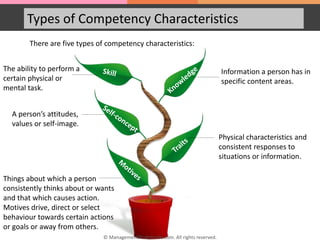
Things about which a person
consistently thinks about or wants
and that which causes action.
Motives drive, direct or select
behaviour towards certain actions
or goals or away from others.
Types of Competency Characteristics
There are five types of competency characteristics:
Physical characteristics and
consistent responses to
situations or information.
A person’s attitudes,
values or self-image.
Information a person has in
specific content areas.
The ability to perform a
certain physical or
mental task.
© ManagementStudyGuide.com. All rights reserved.
Objective
© ManagementStudyGuide.com. All rights reserved.
1 Explain what is a Competency
2
Describe the Components of
Competencies
3 Explain the Types of Competencies
4
Describe the Competency Iceberg
Model
5
Explain the Benefits of Iceberg
Model
Iceberg Model
The Iceberg Model for
competencies takes the help of
an iceberg to explain the
concept of competency.
An iceberg has just one-ninth of
its volume above water and the
rest remains beneath the
surface in the sea.
Similarly, a competency also
has some components which
are visible like knowledge and
skills but other behavioural
components like attitude, traits,
thinking styles, self-image,
organizational fit etc. are
hidden or beneath the surface.
Knowledge &
Skills
Attitude, Traits,
Thinking styles,
Self-image,
Organizational
fit
© ManagementStudyGuide.com. All rights reserved.
Competency Studies of L.M. Spencer and S.M. Spencer
L.M Spencer and S.M. Spencer gave the
definition and structure of the
competence as five types of
competence characteristics in the
Iceberg Model.
© ManagementStudyGuide.com. All rights reserved.
Competency Studies of L.M. Spencer and S.M. Spencer
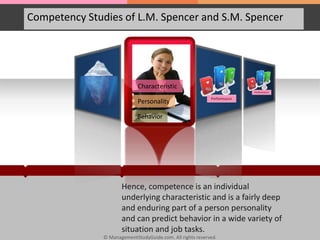
Hence, competence is an individual
underlying characteristic and is a fairly deep
and enduring part of a person personality
and can predict behavior in a wide variety of
situation and job tasks.
Characteristic
Personality
Behavior
© ManagementStudyGuide.com. All rights reserved.
Competency Studies of L.M. Spencer and S.M. Spencer
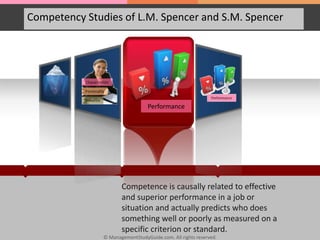
Competence is causally related to effective
and superior performance in a job or
situation and actually predicts who does
something well or poorly as measured on a
specific criterion or standard.
Characteristic
Personality
Behavior
Performance
© ManagementStudyGuide.com. All rights reserved.
Components of the Iceberg Model
Traits
Self Image
Skill
Knowledge
Content knowledge / information in
field of work, - from education to
experience
Ability to do something well; most
easily trained on - e.g. technical skills
to use knowledge
How people see/view themselves;
identity; worth - e.g. an expert, a
learner, leader, manager, agent,
innovator
Habitual / enduring characteristics
- e.g. flexibility, self - control, good
listener, builds trust, engages &
inspires, mindset
© ManagementStudyGuide.com. All rights reserved.
Importance of Iceberg Model
It is important to understand that
there is a relation between the
competencies which are above the
surface and those which lie beneath
in an iceberg.
The aspects of competencies which
lie below the surface like attitude,
traits, thinking styles etc. directly
influence the usage of knowledge
and skills to complete a job
effectively.
© ManagementStudyGuide.com. All rights reserved.
Importance of Iceberg Model
However, if the person is not
happy to work with his new team
members, he may not be able to
perform to the best of his
abilities.
Consider that a highly qualified
person with the perfect
combination of skills and
knowledge is chosen for an
esteemed project.
Let us try to understand this
through an example.
© ManagementStudyGuide.com. All rights reserved.
Importance of Iceberg Model
• •
Developing the two
levels of
competencies also
takes different
routes.
The visible competencies like
knowledge and skills can be
easily developed through
training and skill building
exercises however the
behavioural competencies are
rather difficult to assess and
develop.
It takes more time and
effort intensive exercises,
like psychotherapy,
counselling, coaching and
mentoring, developmental
experiences etc.
•
© ManagementStudyGuide.com. All rights reserved.
Objective
© ManagementStudyGuide.com. All rights reserved.
1 Explain what is a Competency
2
Describe the Components of
Competencies
3 Explain the Types of Competencies
4
Describe the Competency Iceberg
Model
5
Explain the Benefits of Iceberg
Model
Benefits of Iceberg Model
• Identify and prioritize skills,
knowledge and personal
attributes required for the
job
• Use past and current
behavior to predict future
behavior
• Ensure consistency and
fairness of selection process
• Minimize Hiring Risks
• Communicate clear expected
behaviors to job holders for
becoming superior
performers
• Set core organizational
capabilities
• Align aggregate behaviors to
vision, strategies, priorities &
goals
• Promote positive behavioral
change
• Introduce high performance
qualities (Job, Family &
Organization Specific)
© ManagementStudyGuide.com. All rights reserved.
What is Competency Mapping?
Competency mapping is the process of
identification of the competencies
required to perform successfully in a
given job or role or a set of tasks at a
given point of time. It generally examines
two areas: emotional intelligence or
emotional quotient (EQ), and strengths
of the individual in areas like team
structure, leadership, and decision-
making.
The process of competency mapping consists of breaking
a given role or job into its constituent tasks or activities
and identifying the competencies (technical, managerial,
behavioural, conceptual knowledge, attitudes, skills, etc.)
needed to perform the same successfully.
© ManagementStudyGuide.com. All rights reserved.
Steps to Develop Competency Model
Step 1:
Data Gathering & Preparation
Step 2:
Data Analysis
Step 3:
Validation
© ManagementStudyGuide.com. All rights reserved.
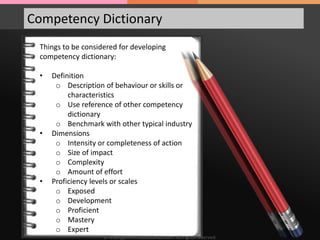
Competency Dictionary
Things to be considered for developing
competency dictionary:
• Definition
o Description of behaviour or skills or
characteristics
o Use reference of other competency
dictionary
o Benchmark with other typical industry
• Dimensions
o Intensity or completeness of action
o Size of impact
o Complexity
o Amount of effort
• Proficiency levels or scales
o Exposed
o Development
o Proficient
o Mastery
o Expert
© ManagementStudyGuide.com. All rights reserved.
Competency Based-Behavioral Interviewing (CBBI)
© ManagementStudyGuide.com. All rights reserved.
However, the hiring process has also
undergone a change therefore a lot of
emphasis is being put on the hidden
behavioral aspects as well to make a
sound decision.
They believe that the behavioral aspects
can be developed through proper
guidance and good management.
Most of the organizations look at just the
visible components of competencies: the
knowledge and skills in the traditional
method of hiring.
Hence, a complete picture regarding the
competence of a person consists of both
visible and hidden aspects and it becomes
necessary to understand both to arrive at
identifying the best man for a job.
Competency Based-Behavioral Interviewing (CBBI)
This is where Competency Based-
Behavioral Interviewing (CBBI) comes
into picture.
The questions in a CBBI are so
structured so as to gather maximum
information about the competency
of the candidate and to make a right
decision.
© ManagementStudyGuide.com. All rights reserved.
CBBI Structuring (Questions/ Probing)
• • •
The lead question
for the first
Competency is
asked and then
proceed to obtain
an overview of the
event.
The event’s
overview is the
road map to
structure how the
candidate will
provide the
information.
The event’s
overview provides
high-level overview
of:
1. Situation/Tasks,
2. Actions and
3. Results of the
Candidate’s
involvement.
A few Standard/ Generic
questions are designed
to obtain the overview
in the most effective
manner.
•
© ManagementStudyGuide.com. All rights reserved.
Generic CBBI Questions
These Questions are applicable for all of the competencies:
• State a caption or heading that describes the
candidate’s role in the event.
• Describe in two sentences, what is the event about?
• Who else was involved, what was his/her/their
role?
• What was your function at the time with
respect to position or title?
• What were the major milestones?
• Why is this event a good example of a time
when you (rephrase the questions that was
asked)?
• What was the outcome?
© ManagementStudyGuide.com. All rights reserved.
Benefits of CBBI
Key Benefits
It is a systematic, non-discriminatory
technique that helps interviewers get
the right information from applicants
and make right hiring decisions.
It takes into consideration past
behaviours of relevant role to best
predict future behaviour on similar or
higher role.
It prevents biased and subjective
hiring decisions.
It limits the possibility of candidates
“faking it” with vague generalization.
The following are the key benefits of Competency Based-Behavioural Interview (CBBI):
© ManagementStudyGuide.com. All rights reserved.
Case Study
Richard Hadley has just joined
as the HR Head in an MNC. He
finds that despite his new
company having a talented and
qualified workforce, the
organization is not completing
its projects efficiently and
successfully.
1. What do you think could
be the reasons for this?
2. What should Richard do
to change the
competency levels of
the existing workforce?
3. What should Richard do
to make sure that the
new hires are
competent enough to
do their jobs?
© ManagementStudyGuide.com. All rights reserved.
Summary
In this module you learnt that:
Competencies refer to skills or knowledge that leads to superior performance.
Competencies are individual abilities or characteristics that are key to effectiveness
in work.
Competency mapping is the process of identification of the competencies required to
perform successfully in a given job or role or a set of tasks at a given point of time.
The Iceberg Model for competencies takes the help of an iceberg to explain the
concept of competency. A competency also has some components which are visible
like knowledge and skills but other behavioural components like attitude, traits,
thinking styles, self-image, organizational fit etc. are hidden or beneath the surface.
© ManagementStudyGuide.com. All rights reserved.

Competency iceberg-model

  • 1.
  • 2.
    Objective 1 Explain whatis a Competency 2 Describe the Components of Competencies 3 Explain the Types of Competencies 4 Describe the Competency Iceberg Model 5 Explain the Benefits of Iceberg Model © ManagementStudyGuide.com. All rights reserved.
  • 3.
    Introduction David Schneider isa highly qualified individual. He has the right mix of skills and knowledge that is required to work as a Sales Executive. However, his actual job performance is nowhere near what is expected from a man possessing skills and knowledge that David has. His actual job performance does not match the expected job behaviour of a man of David’s calibre. So, what is wrong? Ideal candidate Low job performance What is it that makes David an ideal candidate but stops him from actually performing on his job? © ManagementStudyGuide.com. All rights reserved.
  • 4.
    Introduction The answer tothis lies in the word ‘Competency’. Competency is a combination of skills, job attitude, and knowledge which is reflected in job behavior that can be observed, measured and evaluated. Let us learn more about ‘Competency’ and an important model of competency, the ‘Competency Iceberg Model’. © ManagementStudyGuide.com. All rights reserved.
  • 5.
    Objective © ManagementStudyGuide.com. Allrights reserved. 1 Explain what is a Competency 2 Describe the Components of Competencies 3 Explain the Types of Competencies 4 Describe the Competency Iceberg Model 5 Explain the Benefits of Iceberg Model
  • 6.
    What is Competency? ©ManagementStudyGuide.com. All rights reserved.
  • 7.
    What is Competency? Someexamples of competencies required by the employees are: - Adaptability Motivation Commitment Creativity Independence Analytical Reasoning Foresight Leadership Emotional Stability Communication Skills © ManagementStudyGuide.com. All rights reserved.
  • 8.
    History of Competency Inthe late 1960’s, the Occupational Competence movement was initiated by Dr. David McClelland who was a Professor of Psychology at Harvard Business School •• McClelland found that traditional tests such as academic aptitude and knowledge tests, did not predict success in the job •• Since this find and even during the early 70’s, leading organizations have been using competencies to help recruit, select and manage their outstanding performers •• A supporting research conducted by McClelland found that students, who did poor in Universities, as long as they passed, did just as well in life as the top students •• Through this McClelland proved that superior performance is not always measured by test scores but rather related to hidden traits and qualitative behaviours © ManagementStudyGuide.com. All rights reserved.
  • 9.
    Objective © ManagementStudyGuide.com. Allrights reserved. 1 Explain what is a Competency 2 Describe the Components of Competencies 3 Explain the Types of Competencies 4 Describe the Competency Iceberg Model 5 Explain the Benefits of Iceberg Model
  • 10.
    Components of Competency Alearned ability; how to do the “ what you do” (e.g. making an effective presentation) How you acquire information in a particular field; (e.g. Using Data based presentation) How you see yourself (e.g. Public Speaker- Confidence) What you consider as important (e.g. achieving excellence/ ambition) Relatively enduring characteristics; why and how do we behave in a certain way (e.g. self-controlled “big picture” thinking) Motives The Psychological / Physiological factors that drive your behaviour (e.g. Maslow Pyramid of needs) © ManagementStudyGuide.com. All rights reserved.
  • 11.
    Objective © ManagementStudyGuide.com. Allrights reserved. 1 Explain what is a Competency 2 Describe the Components of Competencies 3 Explain the Types of Competencies 4 Describe the Competency Iceberg Model 5 Explain the Benefits of Iceberg Model
  • 12.
    Types of Competencies Competenciescan broadly be classified into two categories: Basic Competencies: They are existent in all individuals but only their degree of existence differs. For example, problem solving is a competency that exists in every individual but in varying degrees Professional Competencies: They are job related and are above the basic competencies. For example, handling a sales call effectively is a competency that a sales personnel would be required to have Competencies Basic Competencies Professional Competencies © ManagementStudyGuide.com. All rights reserved.
  • 13.
    Types of BasicCompetencies The basic competencies encompass the following: Intellectual Competencies: Those which determine the intellectual ability of a person. Motivational Competencies: Those which determine the level of motivation in an individual. Emotional Competencies: Those which determine an individual's emotional quotient. Social Competencies: Those that determine the level of social ability in a person. © ManagementStudyGuide.com. All rights reserved.
  • 14.
    Types of ProfessionalCompetencies The professional competencies can be classified as: Generic Competencies: They are those which are considered essential for all staff, regardless of their function or level, that is, communication, program execution, processing tools, linguistic, etc. These competencies include broad success factors not tied to a specific work function or industry. They usually focus on leadership or emotional intelligence behaviours. Managerial Competencies: They are those which are considered essential for staff with managerial or supervisory responsibility in any service or program. Some examples of managerial competencies are: customer orientation, organizing skills, cross functional perspective, planning skills, execution skills, analytical skills, decision making, delegation, leadership Functional/Technical Competencies: These are specific competencies which are considered essential to perform any job in the organization within a defined technical or functional area of work. Some examples of functional/technical competencies are: business awareness, business skills, technical skills. © ManagementStudyGuide.com. All rights reserved.
  • 15.
    Categories of Competencies Competenciescan be divided into two categories, they are: • These are the essential characteristics that everyone in the job needs to be minimally effective. • However, this does not distinguish superior from average performers. • These factors distinguish superior from average performers. © ManagementStudyGuide.com. All rights reserved.
  • 16.
    What is aThreshold Competency? 6 5 4 3 2 1 © ManagementStudyGuide.com. All rights reserved.
  • 17.
    What is aThreshold Competency? 6 5 4 3 2 1 It is important to understand whether competencies are unique to a particular job or whether they are generic in nature. © ManagementStudyGuide.com. All rights reserved.
  • 18.
    What is aThreshold Competency? 6 5 4 3 2 1 It is important to understand whether competencies are unique to a particular job or whether they are generic in nature. According to the MCBer research, twelve characteristics were identified related to managerial effectiveness, whereas seven were found to be threshold competencies. © ManagementStudyGuide.com. All rights reserved.
  • 19.
    What is aThreshold Competency? 6 5 4 3 2 It is important to understand whether competencies are unique to a particular job or whether they are generic in nature. According to the MCBer research, twelve characteristics were identified related to managerial effectiveness, whereas seven were found to be threshold competencies. Every job at any level in the organization would have a threshold competency. © ManagementStudyGuide.com. All rights reserved.
  • 20.
    What is aThreshold Competency? 6 5 4 3 It is important to understand whether competencies are unique to a particular job or whether they are generic in nature. According to the MCBer research, twelve characteristics were identified related to managerial effectiveness, whereas seven were found to be threshold competencies. Every job at any level in the organization would have a threshold competency. Threshold competency is the bare minimum required to perform the job. © ManagementStudyGuide.com. All rights reserved.
  • 21.
    What is aThreshold Competency? 6 5 4 It is important to understand whether competencies are unique to a particular job or whether they are generic in nature. According to the MCBer research, twelve characteristics were identified related to managerial effectiveness, whereas seven were found to be threshold competencies. Every job at any level in the organization would have a threshold competency. Threshold competency is the bare minimum required to perform the job. It is summarized as a quality that a person needs in order to do a job. © ManagementStudyGuide.com. All rights reserved.
  • 22.
    What is aThreshold Competency? 6 5 It is important to understand whether competencies are unique to a particular job or whether they are generic in nature. According to the MCBer research, twelve characteristics were identified related to managerial effectiveness, whereas seven were found to be threshold competencies. Every job at any level in the organization would have a threshold competency. Threshold competency is the bare minimum required to perform the job. It is summarized as a quality that a person needs in order to do a job. It differs from competency, such that it does not offer any aid in distinguishing superior performance from average and poor performance. © ManagementStudyGuide.com. All rights reserved.
  • 23.
    What are CoreCompetencies? • ‘Core Competencies’ are the competencies that help transcend any single business event within the organization. • It is important for organizations to identify, develop and manage organizational core competencies that drive large enterprise critical projects. • This is so because some projects are so complex and massive that it is impossible for a single individual to possess the competencies required to successfully complete a project. © ManagementStudyGuide.com. All rights reserved.
  • 24.
    What are WorkplaceCompetencies? • ‘Workplace Competencies’ focus on individuals instead of the organization. • Therefore, workplace competencies may vary by job positions. • The unit of measure is people rather than the business. © ManagementStudyGuide.com. All rights reserved.
  • 25.
    Core vs. WorkplaceCompetencies Core Workplace Scope Organization Individual Purpose Strategic Tactical Participant(s) Business Unit Worker Tasks Processes Activities Competencies Global Position © ManagementStudyGuide.com. All rights reserved.
  • 26.
    Who Identifies Competencies? Competenciescan be identified by one of more of the following category of people: • Experts • HR Specialists • Job analysts • Psychologists • Industrial Engineers etc. • In consultation with: Line Managers, Current & Past Role holders, Supervising Seniors, Reporting and Reviewing Officers, Internal Customers, Subordinates of the role holders © ManagementStudyGuide.com. All rights reserved.
  • 27.
    • •• Myths aboutCompetency Competence is a state of being that provides a qualification to perform. It is in relation to performance, a necessary but not sufficient condition. Competencies cannot guarantee that workers will perform adequately. © ManagementStudyGuide.com. All rights reserved.
  • 28.
    • •• Myths aboutCompetency However, workers cannot perform to standards without competencies. Extremely competent workers may fail on the job due to a variety of personal or environmental factors. Whereas, some others that lack competencies can make up for a lot of shortcomings with exceptionally hard work. © ManagementStudyGuide.com. All rights reserved.
  • 29.
    • •• Myths aboutCompetency Competence is necessary but it cannot guarantee results. Hence, it is important that organizations’ should not confuse competency measurement with performance measurement. Competencies are about being qualified to do the work whereas performance is the result of the actual work. © ManagementStudyGuide.com. All rights reserved.
  • 30.
    Things about whicha person consistently thinks about or wants and that which causes action. Motives drive, direct or select behaviour towards certain actions or goals or away from others. Types of Competency Characteristics There are five types of competency characteristics: Physical characteristics and consistent responses to situations or information. A person’s attitudes, values or self-image. Information a person has in specific content areas. The ability to perform a certain physical or mental task. © ManagementStudyGuide.com. All rights reserved.
  • 31.
    Objective © ManagementStudyGuide.com. Allrights reserved. 1 Explain what is a Competency 2 Describe the Components of Competencies 3 Explain the Types of Competencies 4 Describe the Competency Iceberg Model 5 Explain the Benefits of Iceberg Model
  • 32.
    Iceberg Model The IcebergModel for competencies takes the help of an iceberg to explain the concept of competency. An iceberg has just one-ninth of its volume above water and the rest remains beneath the surface in the sea. Similarly, a competency also has some components which are visible like knowledge and skills but other behavioural components like attitude, traits, thinking styles, self-image, organizational fit etc. are hidden or beneath the surface. Knowledge & Skills Attitude, Traits, Thinking styles, Self-image, Organizational fit © ManagementStudyGuide.com. All rights reserved.
  • 33.
    Competency Studies ofL.M. Spencer and S.M. Spencer L.M Spencer and S.M. Spencer gave the definition and structure of the competence as five types of competence characteristics in the Iceberg Model. © ManagementStudyGuide.com. All rights reserved.
  • 34.
    Competency Studies ofL.M. Spencer and S.M. Spencer Hence, competence is an individual underlying characteristic and is a fairly deep and enduring part of a person personality and can predict behavior in a wide variety of situation and job tasks. Characteristic Personality Behavior © ManagementStudyGuide.com. All rights reserved.
  • 35.
    Competency Studies ofL.M. Spencer and S.M. Spencer Competence is causally related to effective and superior performance in a job or situation and actually predicts who does something well or poorly as measured on a specific criterion or standard. Characteristic Personality Behavior Performance © ManagementStudyGuide.com. All rights reserved.
  • 36.
    Components of theIceberg Model Traits Self Image Skill Knowledge Content knowledge / information in field of work, - from education to experience Ability to do something well; most easily trained on - e.g. technical skills to use knowledge How people see/view themselves; identity; worth - e.g. an expert, a learner, leader, manager, agent, innovator Habitual / enduring characteristics - e.g. flexibility, self - control, good listener, builds trust, engages & inspires, mindset © ManagementStudyGuide.com. All rights reserved.
  • 37.
    Importance of IcebergModel It is important to understand that there is a relation between the competencies which are above the surface and those which lie beneath in an iceberg. The aspects of competencies which lie below the surface like attitude, traits, thinking styles etc. directly influence the usage of knowledge and skills to complete a job effectively. © ManagementStudyGuide.com. All rights reserved.
  • 38.
    Importance of IcebergModel However, if the person is not happy to work with his new team members, he may not be able to perform to the best of his abilities. Consider that a highly qualified person with the perfect combination of skills and knowledge is chosen for an esteemed project. Let us try to understand this through an example. © ManagementStudyGuide.com. All rights reserved.
  • 39.
    Importance of IcebergModel • • Developing the two levels of competencies also takes different routes. The visible competencies like knowledge and skills can be easily developed through training and skill building exercises however the behavioural competencies are rather difficult to assess and develop. It takes more time and effort intensive exercises, like psychotherapy, counselling, coaching and mentoring, developmental experiences etc. • © ManagementStudyGuide.com. All rights reserved.
  • 40.
    Objective © ManagementStudyGuide.com. Allrights reserved. 1 Explain what is a Competency 2 Describe the Components of Competencies 3 Explain the Types of Competencies 4 Describe the Competency Iceberg Model 5 Explain the Benefits of Iceberg Model
  • 41.
    Benefits of IcebergModel • Identify and prioritize skills, knowledge and personal attributes required for the job • Use past and current behavior to predict future behavior • Ensure consistency and fairness of selection process • Minimize Hiring Risks • Communicate clear expected behaviors to job holders for becoming superior performers • Set core organizational capabilities • Align aggregate behaviors to vision, strategies, priorities & goals • Promote positive behavioral change • Introduce high performance qualities (Job, Family & Organization Specific) © ManagementStudyGuide.com. All rights reserved.
  • 42.
    What is CompetencyMapping? Competency mapping is the process of identification of the competencies required to perform successfully in a given job or role or a set of tasks at a given point of time. It generally examines two areas: emotional intelligence or emotional quotient (EQ), and strengths of the individual in areas like team structure, leadership, and decision- making. The process of competency mapping consists of breaking a given role or job into its constituent tasks or activities and identifying the competencies (technical, managerial, behavioural, conceptual knowledge, attitudes, skills, etc.) needed to perform the same successfully. © ManagementStudyGuide.com. All rights reserved.
  • 43.
    Steps to DevelopCompetency Model Step 1: Data Gathering & Preparation Step 2: Data Analysis Step 3: Validation © ManagementStudyGuide.com. All rights reserved.
  • 44.
    Competency Dictionary Things tobe considered for developing competency dictionary: • Definition o Description of behaviour or skills or characteristics o Use reference of other competency dictionary o Benchmark with other typical industry • Dimensions o Intensity or completeness of action o Size of impact o Complexity o Amount of effort • Proficiency levels or scales o Exposed o Development o Proficient o Mastery o Expert © ManagementStudyGuide.com. All rights reserved.
  • 45.
    Competency Based-Behavioral Interviewing(CBBI) © ManagementStudyGuide.com. All rights reserved. However, the hiring process has also undergone a change therefore a lot of emphasis is being put on the hidden behavioral aspects as well to make a sound decision. They believe that the behavioral aspects can be developed through proper guidance and good management. Most of the organizations look at just the visible components of competencies: the knowledge and skills in the traditional method of hiring. Hence, a complete picture regarding the competence of a person consists of both visible and hidden aspects and it becomes necessary to understand both to arrive at identifying the best man for a job.
  • 46.
    Competency Based-Behavioral Interviewing(CBBI) This is where Competency Based- Behavioral Interviewing (CBBI) comes into picture. The questions in a CBBI are so structured so as to gather maximum information about the competency of the candidate and to make a right decision. © ManagementStudyGuide.com. All rights reserved.
  • 47.
    CBBI Structuring (Questions/Probing) • • • The lead question for the first Competency is asked and then proceed to obtain an overview of the event. The event’s overview is the road map to structure how the candidate will provide the information. The event’s overview provides high-level overview of: 1. Situation/Tasks, 2. Actions and 3. Results of the Candidate’s involvement. A few Standard/ Generic questions are designed to obtain the overview in the most effective manner. • © ManagementStudyGuide.com. All rights reserved.
  • 48.
    Generic CBBI Questions TheseQuestions are applicable for all of the competencies: • State a caption or heading that describes the candidate’s role in the event. • Describe in two sentences, what is the event about? • Who else was involved, what was his/her/their role? • What was your function at the time with respect to position or title? • What were the major milestones? • Why is this event a good example of a time when you (rephrase the questions that was asked)? • What was the outcome? © ManagementStudyGuide.com. All rights reserved.
  • 49.
    Benefits of CBBI KeyBenefits It is a systematic, non-discriminatory technique that helps interviewers get the right information from applicants and make right hiring decisions. It takes into consideration past behaviours of relevant role to best predict future behaviour on similar or higher role. It prevents biased and subjective hiring decisions. It limits the possibility of candidates “faking it” with vague generalization. The following are the key benefits of Competency Based-Behavioural Interview (CBBI): © ManagementStudyGuide.com. All rights reserved.
  • 50.
    Case Study Richard Hadleyhas just joined as the HR Head in an MNC. He finds that despite his new company having a talented and qualified workforce, the organization is not completing its projects efficiently and successfully. 1. What do you think could be the reasons for this? 2. What should Richard do to change the competency levels of the existing workforce? 3. What should Richard do to make sure that the new hires are competent enough to do their jobs? © ManagementStudyGuide.com. All rights reserved.
  • 51.
    Summary In this moduleyou learnt that: Competencies refer to skills or knowledge that leads to superior performance. Competencies are individual abilities or characteristics that are key to effectiveness in work. Competency mapping is the process of identification of the competencies required to perform successfully in a given job or role or a set of tasks at a given point of time. The Iceberg Model for competencies takes the help of an iceberg to explain the concept of competency. A competency also has some components which are visible like knowledge and skills but other behavioural components like attitude, traits, thinking styles, self-image, organizational fit etc. are hidden or beneath the surface. © ManagementStudyGuide.com. All rights reserved.