
Team Building
What is Teamwork & Team Building
Teamwork
 Concept of people working together as a team
Team player
 A team player is someone who is able to get along with their
colleagues and work together in a cohesive group
Team Building
 Process of establishing and developing a greater sense of
collaboration and trust between members
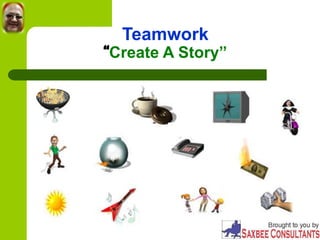
Teamwork
“Create A Story”
Why Should We Be a Team?
 When staff use their skills and knowledge together,
the result is a stronger agency that can fulfill its
mission
“To provide accurate information that would assist
individuals in achieving a better quality of life.”
 People working together can sustain the enthusiasm
and lend support needed to complete the work of
each program.
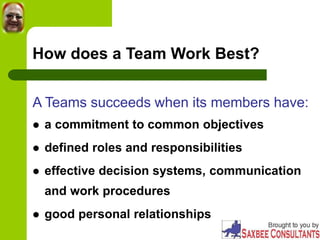
How does a Team Work Best?
A Teams succeeds when its members have:
 a commitment to common objectives
 defined roles and responsibilities
 effective decision systems, communication
and work procedures
 good personal relationships
Team Morale Depends On
Support
Resources
Communication
Personalities
Teamwork Skills
 Listen
 Question
 Persuade
 Respect
 Help
 Share
 Participate
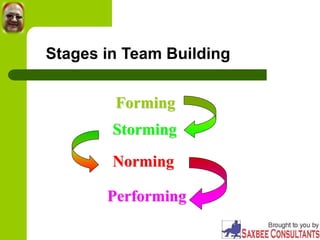
Stages in Team Building
Forming
Storming
Norming
Performing
Stage 1: FORMING
The Team
 defines the problem
 agrees on goals and formulates strategies for
tackling the tasks
 determines the challenges and identifies
information needed
 Individuals take on certain roles
 develops trust and communication
Team Roles - Leader
Encourages and maintains open communication
Leads by setting a good example
Motivates and inspires team members
Helps the team focus on the task
Facilitates problem solving and collaboration
Maintains healthy group dynamics
Encourages creativity and risk-taking
Recognizes and celebrates team member
contributions
Other Team Roles – Members Can Formally
or Informally Take on These Roles
Initiator - Someone who suggests new ideas. One or more people can have this role at
a time.
Recorder - This person records whatever ideas a team member may have. It is
important that this person quote a team member accurately and not "edit" or
evaluate them.
Devil's Advocate/Skeptic - This is someone whose responsibility is to look for
potential flaws in an idea.
Optimist - This is someone who tries to maintain a positive frame of mind and
facilitates the search for solutions.
Timekeeper - Someone who tracks time spent on each portion of the meeting.
Gate Keeper - This person works to ensure that each member gives input on an issue.
One strategy to do this is to ask everyone to voice their opinion one at a time.
Another is to cast votes.
Summarizer - Someone who summarizes a list of options.
From Individuals A Group Forms
Help members understand each other
Myers-Briggs Type Indicator (MBTI)
Extraverts ------------------ Introverts
Sensors --------------------- iNtuitive
Thinker ---------------------- Feelers
Judger ----------------------- Perceiver
By selecting one from each category, we define our
personality type, ESTJ, ENTJ…INFP
Relevance to Teams (E/I)
 Extraverts
– Need to think
aloud
– Great explainers
– May overwhelm
others
 Introverts
– Need time to
process
– Great
concentration
– May not be heard
Relevance to Teams (N/S)
 iNtuitive
– Great at big
picture
– See connections
– May make
mistakes in
carrying out
plans
 Sensor
– Great executors
– May miss big
picture, relative
importance
Relevance to Teams (T/F)
 Thinker
– Skillful at
understanding
how anything
works
 Feeler
– Knows why
something
matters
Relevance to Teams (J/P)
 Judger
– Good at
schedules, plans,
completion
– Makes decisions
easily (quickly)
– May overlook
vital issues
 Perceiver
– Always curious,
wants more
knowledge
– May not get
around to acting
Stage 2: STORMING
During the Storming stage team members:
 realize that the task is more difficult than
they imagined
 have fluctuations in attitude about
chances of success
 may be resistant to the task
 have poor collaboration
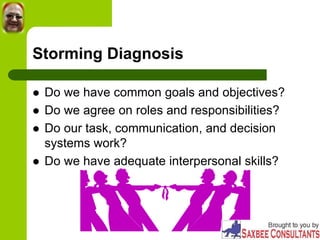
Storming Diagnosis
 Do we have common goals and objectives?
 Do we agree on roles and responsibilities?
 Do our task, communication, and decision
systems work?
 Do we have adequate interpersonal skills?
Negotiating Conflict
 Separate problem issues from people issues.
 Be soft on people, hard on problem.
 Look for underlying needs, goals of each
party rather than specific solutions.
Addressing the Problem
 State your views in clear non-judgmental
language.
 Clarify the core issues.
 Listen carefully to each person’s point of
view.
 Check understanding by restating the core
issues.
Stage 3: NORMING
 During this stage members accept:
– their team
– team rules and procedures
– their roles in the team
– the individuality of fellow members
 Team members realize that they are not
going to crash-and-burn and start helping
each other.
Behaviors
 Competitive relationships become more
cooperative.
 There is a willingness to confront issues
and solve problems.
 Teams develop the ability to express criticism
constructively.
 There is a sense of team spirit.
Giving Constructive Feedback
 Be descriptive
 Don't use labels
 Don’t exaggerate
 Don’t be judgmental
 Speak for yourself
Giving Constructive Feedback
 Use “I” messages.
 Restrict your feedback to things you know for
certain.
 Help people hear and accept your
compliments when giving positive feedback.
Receiving Feedback
 Listen carefully.
 Ask questions for clarity.
 Acknowledge the feedback.
 Acknowledge the valid points.
 Take time to sort out what you heard.
Stage 4: PERFORMING
Team members have:
 gained insight into personal and team
processes
 a better understanding of each other’s
strengths and weaknesses
 gained the ability to prevent or work
through group conflict and resolve
differences
 developed a close attachment to the team
Recipe for Successful Team
 Commitment to shared goals and
objectives
 Clearly define roles and responsibilities
 Use best skills of each
 Allows each to develop in all areas
Recipe for Successful Team
 Effective systems and processes
– Clear communication
– Beneficial team behaviors; well-defined
decision procedures and ground rules
– Balanced participation
– Awareness of the group process
– Good personal relationships
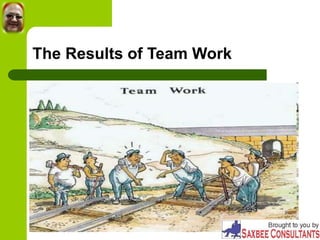
The Results of Team Work
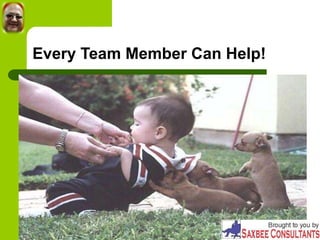
Every Team Member Can Help!
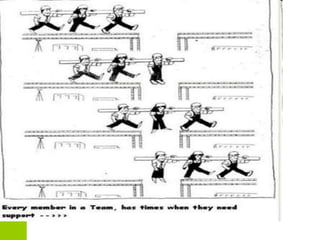
Everyone Has to Hang in There!
Enjoy your Success!
For details and bookings contact:-
Parveen Kumar Chadha… THINK TANK
(Founder and C.E.O of Saxbee Consultants & Other-Mother
marketingandcommunicationconsultants.com)
Email :-saxbeeconsultants@gmail.com
Mobile No. +91-9818308353
Address:-First Floor G-20(A), Kirti Nagar, New Delhi India Postal
Code-110015

Team building

  • 1.
  • 2.
    What is Teamwork& Team Building Teamwork  Concept of people working together as a team Team player  A team player is someone who is able to get along with their colleagues and work together in a cohesive group Team Building  Process of establishing and developing a greater sense of collaboration and trust between members
  • 3.
  • 4.
    Why Should WeBe a Team?  When staff use their skills and knowledge together, the result is a stronger agency that can fulfill its mission “To provide accurate information that would assist individuals in achieving a better quality of life.”  People working together can sustain the enthusiasm and lend support needed to complete the work of each program.
  • 5.
    How does aTeam Work Best? A Teams succeeds when its members have:  a commitment to common objectives  defined roles and responsibilities  effective decision systems, communication and work procedures  good personal relationships
  • 6.
    Team Morale DependsOn Support Resources Communication Personalities
  • 7.
    Teamwork Skills  Listen Question  Persuade  Respect  Help  Share  Participate
  • 8.
    Stages in TeamBuilding Forming Storming Norming Performing
  • 9.
    Stage 1: FORMING TheTeam  defines the problem  agrees on goals and formulates strategies for tackling the tasks  determines the challenges and identifies information needed  Individuals take on certain roles  develops trust and communication
  • 10.
    Team Roles -Leader Encourages and maintains open communication Leads by setting a good example Motivates and inspires team members Helps the team focus on the task Facilitates problem solving and collaboration Maintains healthy group dynamics Encourages creativity and risk-taking Recognizes and celebrates team member contributions
  • 11.
    Other Team Roles– Members Can Formally or Informally Take on These Roles Initiator - Someone who suggests new ideas. One or more people can have this role at a time. Recorder - This person records whatever ideas a team member may have. It is important that this person quote a team member accurately and not "edit" or evaluate them. Devil's Advocate/Skeptic - This is someone whose responsibility is to look for potential flaws in an idea. Optimist - This is someone who tries to maintain a positive frame of mind and facilitates the search for solutions. Timekeeper - Someone who tracks time spent on each portion of the meeting. Gate Keeper - This person works to ensure that each member gives input on an issue. One strategy to do this is to ask everyone to voice their opinion one at a time. Another is to cast votes. Summarizer - Someone who summarizes a list of options.
  • 12.
    From Individuals AGroup Forms Help members understand each other Myers-Briggs Type Indicator (MBTI) Extraverts ------------------ Introverts Sensors --------------------- iNtuitive Thinker ---------------------- Feelers Judger ----------------------- Perceiver By selecting one from each category, we define our personality type, ESTJ, ENTJ…INFP
  • 13.
    Relevance to Teams(E/I)  Extraverts – Need to think aloud – Great explainers – May overwhelm others  Introverts – Need time to process – Great concentration – May not be heard
  • 14.
    Relevance to Teams(N/S)  iNtuitive – Great at big picture – See connections – May make mistakes in carrying out plans  Sensor – Great executors – May miss big picture, relative importance
  • 15.
    Relevance to Teams(T/F)  Thinker – Skillful at understanding how anything works  Feeler – Knows why something matters
  • 16.
    Relevance to Teams(J/P)  Judger – Good at schedules, plans, completion – Makes decisions easily (quickly) – May overlook vital issues  Perceiver – Always curious, wants more knowledge – May not get around to acting
  • 17.
    Stage 2: STORMING Duringthe Storming stage team members:  realize that the task is more difficult than they imagined  have fluctuations in attitude about chances of success  may be resistant to the task  have poor collaboration
  • 18.
    Storming Diagnosis  Dowe have common goals and objectives?  Do we agree on roles and responsibilities?  Do our task, communication, and decision systems work?  Do we have adequate interpersonal skills?
  • 19.
    Negotiating Conflict  Separateproblem issues from people issues.  Be soft on people, hard on problem.  Look for underlying needs, goals of each party rather than specific solutions.
  • 20.
    Addressing the Problem State your views in clear non-judgmental language.  Clarify the core issues.  Listen carefully to each person’s point of view.  Check understanding by restating the core issues.
  • 21.
    Stage 3: NORMING During this stage members accept: – their team – team rules and procedures – their roles in the team – the individuality of fellow members  Team members realize that they are not going to crash-and-burn and start helping each other.
  • 22.
    Behaviors  Competitive relationshipsbecome more cooperative.  There is a willingness to confront issues and solve problems.  Teams develop the ability to express criticism constructively.  There is a sense of team spirit.
  • 23.
    Giving Constructive Feedback Be descriptive  Don't use labels  Don’t exaggerate  Don’t be judgmental  Speak for yourself
  • 24.
    Giving Constructive Feedback Use “I” messages.  Restrict your feedback to things you know for certain.  Help people hear and accept your compliments when giving positive feedback.
  • 25.
    Receiving Feedback  Listencarefully.  Ask questions for clarity.  Acknowledge the feedback.  Acknowledge the valid points.  Take time to sort out what you heard.
  • 26.
    Stage 4: PERFORMING Teammembers have:  gained insight into personal and team processes  a better understanding of each other’s strengths and weaknesses  gained the ability to prevent or work through group conflict and resolve differences  developed a close attachment to the team
  • 27.
    Recipe for SuccessfulTeam  Commitment to shared goals and objectives  Clearly define roles and responsibilities  Use best skills of each  Allows each to develop in all areas
  • 28.
    Recipe for SuccessfulTeam  Effective systems and processes – Clear communication – Beneficial team behaviors; well-defined decision procedures and ground rules – Balanced participation – Awareness of the group process – Good personal relationships
  • 29.
    The Results ofTeam Work
  • 30.
  • 32.
    Everyone Has toHang in There!
  • 33.
  • 34.
    For details andbookings contact:- Parveen Kumar Chadha… THINK TANK (Founder and C.E.O of Saxbee Consultants & Other-Mother marketingandcommunicationconsultants.com) Email :-saxbeeconsultants@gmail.com Mobile No. +91-9818308353 Address:-First Floor G-20(A), Kirti Nagar, New Delhi India Postal Code-110015