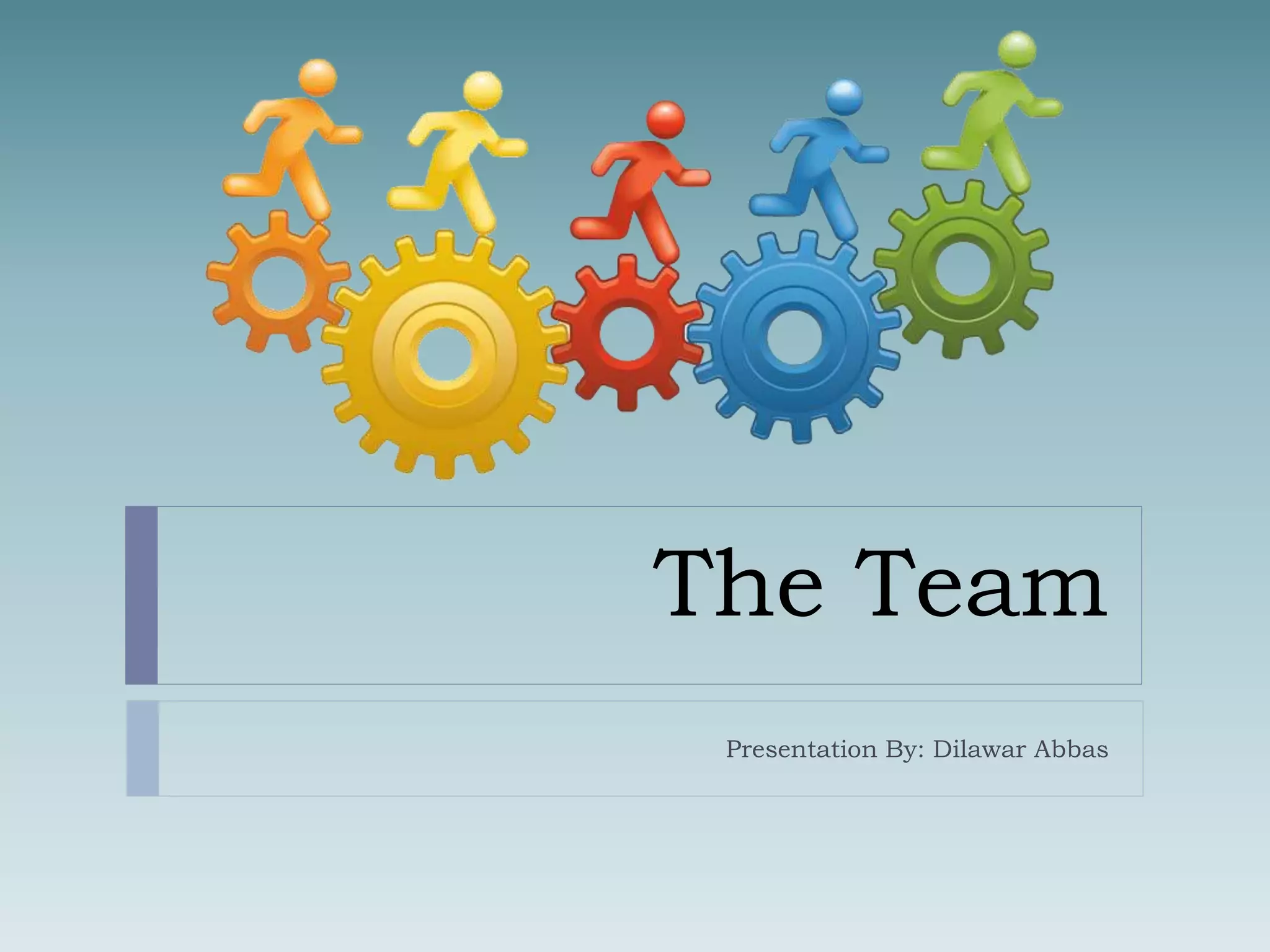
The Team 
Presentation By: Dilawar Abbas
Introduction to Team
What is a Team 
A group of people with a full set of complementary skills 
required to complete a task, job, or project. 
Team members 
(1) operate with a high degree of interdependence, 
(2) share authority and responsibility for self-management, 
(3) are accountable for the collective performance, and 
(4) work toward a common goal and shared rewards(s). 
A team becomes more than just a collection of people 
when a strong sense of mutual commitment creates 
synergy, thus generating performance greater than the sum 
of the performance of its individual members.
“Talent wins games, 
but teamwork and intelligence 
wins championships.” 
Michael Jordan
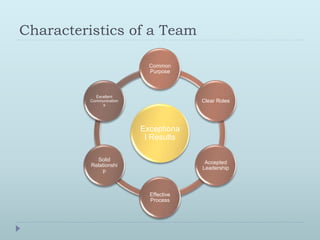
Characteristics of a Team 
Common 
Purpose 
Exceptiona 
l Results 
Clear Roles 
Accepted 
Leadership 
Effective 
Process 
Excellent 
Communication 
s 
Solid 
Relationshi 
p
Successful Team Dynamics 
 The team member: Successful teams are made up of a collection of effective 
individuals. These are people who are experienced, have problem solving ability, are 
open to addressing the problem, and are action oriented. 
 Team relationships: For a team to be successful the members of the team must be 
able to give and receive feedback. 
 Team problem solving: An effective team depends on how focused and clear the 
goal of the team is. A relaxed, comfortable and accepting environment and finally, 
open and honest communication are required. 
 Team leadership: Effective team leadership depends on leadership competencies. A 
competent leader is: focused on the goal, ensures a collaborative climate, builds 
confidence of team members, sets priorities, demonstrates sufficient “know-how” and 
manages performance through feedback. 
 Organizational environment: The climate and culture of the organization must be 
conductive to team behavior. Competitiveness should be discouraged and uniformity 
should be encouraged - this will eliminate conflict and discord among team members.
“The strength of the team is each 
individual member. 
The strength of each member is 
the team.” 
Phil Jackson
Team Roles & Responsibilities
Team Roles & Responsibilities 
Imagine a cricket team that assigned players to a different 
position everyday. 
Consider working in a company where one day you're an 
accountant, the next day a security guard, another day, 
you're assigned as a salesperson. 
Chances are, with both the cricket team and company, 
success would not come easy, if at all!
Team Leader 
Team Leaders may or may not be supervisory/managerial personnel. Most 
importantly, team leaders should never "pull rank," or apply undue influence on 
the team. 
Good team leaders know the lessons learned from experience are stronger and 
longer lasting than those learned simply by having a supervisor telling someone 
what to do. Being a team leader is a good deal of work. A balance must be 
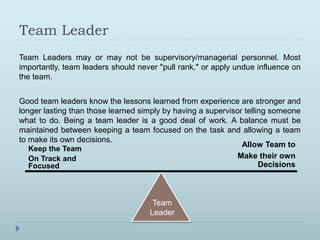
maintained between keeping a team focused on the task and allowing a team 
to make its own decisions. 
Team 
Leader 
Keep the Team 
On Track and 
Focused 
Allow Team to 
Make their own 
Decisions
Team Leader 
Makes things happen with ease... 
Team Lead develop and manage the process for the team, helping them to stay on 
track and proceed through ground rules 
Helps the team with the process... 
Have you ever been a member of a team where only two or three people made all 
the decisions? That's not a good process. A good Team Lead help the team through 
situations similar to that by neutralizing potentially dominating people. The result is 
a process reflecting the group's collective brain power, not simply the ideas of two 
or three people! 
Helps the Team with the "how" decisions... 
Elsewhere in this program are descriptions of several tools and techniques teams 
can use to help make decisions. Some of these tools are brainstorming, prioritizing, 
and parking lots. Team Leads are skilled at using these tools and helping teams 
realize their potential.
Team Members – Everyone Else 
Team members don't have specific responsibilities, but their participation is critical to the team's 
success. 
Team members must agree to: 
1. Be enthusiastic and committed to the team's purpose. 
2. Be honest and keep any confidential information behind closed doors. 
3. Share responsibility and help other team members to complete their task. 
4. Share knowledge and expertise and not withhold information. 
5. Ask questions, even seemingly "dumb" ones. Often the new perspective of "inexperienced" 
team members can provide insight. 
6. Fulfill duties in between meetings. 
7. Respect the opinions and positions of others on the team, even if the person has an 
opposing view or different opinion.
Team Members – Informal Roles 
Teams can have unofficial, informal roles too. Some are helpful and some are 
not so helpful. The list below summarizes some common, informal roles in 
teams. 
Helpful Roles: 
The Expert 
A knowledgeable subject matter expert who can clarify technical issues. 
The Summarizer 
Often, a "big picture" person who helps to sum up items. 
The Bridge Builder 
Experienced negotiators who can help bring opposing views together.
Team Members – Informal Roles 
Not Always Helpful Roles 
The Joker 
Always telling jokes to the extent that others can't accomplish their goals. 
The Blocker 
Hates to make decisions, or reach closure; always looking for more information or 
wants to "think things over a little bit." 
The Busier Than Thou 
Always busier, harder working and has more responsibilities than others. 
The Disrupter 
If they aren't interrupting for some reason, Disrupters like to hold side conversations 
or generally disturb the group. 
The Loner 
Doesn't like to participate, rarely contributes.
“Never give up on someone with a 
mental illness. 
When "I" is replaced by "We", 
illness becomes wellness.” 
Shannon L. Alder
Stages of Team Building
Stages of Team Building 
Working Together 
Whether it's on the playing field or in the workplace, teams take time to come 
together. There is a natural development process every team progresses 
through. It is useful to examine this maturation so that as a team member or 
team leader you can be prepared to work effectively with the team. 
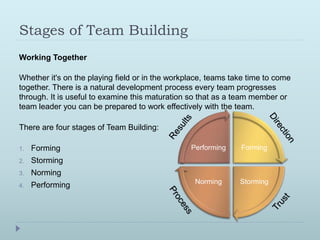
There are four stages of Team Building: 
1. Forming 
2. Storming 
3. Norming 
4. Performing 
Forming 
Performing 
Norming Storming
Forming – Getting to Know You… 
In the Forming stage, team members are getting to know one another and getting 
comfortable with one another. Members will naturally try to understand their own 
roles, the roles of the other team members and their purpose in the group. This is 
entirely natural and to be expected. People are unsure, suspicious and nervous. 
Characteristics of Forming 
Look for the following behaviors in the Forming stage: 
1. Members trying to define the task. 
2. Lofty, conceptual discussions as people try to express who they are. 
3. Discussions about what information needs to be gathered. 
How to Address the Forming Stage 
Help team members get to know one another. Make sure the purpose and task are 
clearly defined and share management expectations of the group. Give the team 
time to get comfortable with one another, but move the team along as well.
Storming – High Winds Predicted… 
Once the team works together for a while, they will leave the Forming stage and enter Storming. Politeness 
begins to wear off and dissension occurs over basic mission and operating procedures. Control often 
becomes the primary issue. Who is going to decide what? Disagreements can be either very obvious or 
subtle. 
Storming is the most difficult stage for a team to weather, but it is necessary for healthy team 
development. When team members begin to trust one another enough to air differences, this 
signals readiness to work things out. 
Characteristics of Storming 
Look for the following behaviors in the storming stage: 
1. Members begin to show their true styles. 
2. A growing impatience will surface over lack of progress. 
3. Members will get into one another's territory, causing irritation. 
4. General disagreement over process, task and overall purpose of the team. 
How to Address the Storming Stage 
Don't ignore the Storming stage. Acknowledge it with the team as a natural developmental 
step. Facilitators should surface the conflicts and address them. This is a good time to review 
ground rules, revisit the purpose and related administrative matters of the team.
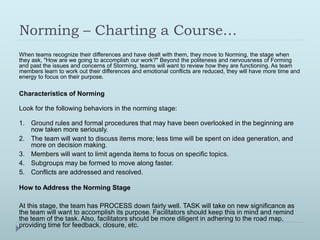
Norming – Charting a Course… 
When teams recognize their differences and have dealt with them, they move to Norming, the stage when 
they ask, "How are we going to accomplish our work?" Beyond the politeness and nervousness of Forming 
and past the issues and concerns of Storming, teams will want to review how they are functioning. As team 
members learn to work out their differences and emotional conflicts are reduced, they will have more time and 
energy to focus on their purpose. 
Characteristics of Norming 
Look for the following behaviors in the norming stage: 
1. Ground rules and formal procedures that may have been overlooked in the beginning are 
now taken more seriously. 
2. The team will want to discuss items more; less time will be spent on idea generation, and 
more on decision making. 
3. Members will want to limit agenda items to focus on specific topics. 
4. Subgroups may be formed to move along faster. 
5. Conflicts are addressed and resolved. 
How to Address the Norming Stage 
At this stage, the team has PROCESS down fairly well. TASK will take on new significance as 
the team will want to accomplish its purpose. Facilitators should keep this in mind and remind 
the team of the task. Also, facilitators should be more diligent in adhering to the road map, 
providing time for feedback, closure, etc.
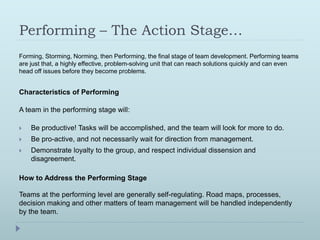
Performing – The Action Stage… 
Forming, Storming, Norming, then Performing, the final stage of team development. Performing teams 
are just that, a highly effective, problem-solving unit that can reach solutions quickly and can even 
head off issues before they become problems. 
Characteristics of Performing 
A team in the performing stage will: 
 Be productive! Tasks will be accomplished, and the team will look for more to do. 
 Be pro-active, and not necessarily wait for direction from management. 
 Demonstrate loyalty to the group, and respect individual dissension and 
disagreement. 
How to Address the Performing Stage 
Teams at the performing level are generally self-regulating. Road maps, processes, 
decision making and other matters of team management will be handled independently 
by the team.
“If two men on the same job agree 
all the time, then one is useless. 
If they disagree all the time, both 
are useless.” 
Darryl F. Zanuck
Qualities of an Effective Team Player
Demonstrate Reliability 
You can count on a reliable team member who 
gets work done and does his fair share to work 
hard and meet commitments. 
He or she follows through on assignments. 
Consistency is key. You can count on him or her to 
deliver good performance all the time, not just 
some of the time.
Communicate Constructively 
Teams need people who speak up and express 
their thoughts and ideas clearly, directly, honestly, 
and with respect for others and for the work of the 
team. 
That's what it means to communicate 
constructively. 
Such a team member does not shy away from 
making a point but makes it in the best way 
possible — in a positive, confident, and respectful 
manner.
Listens Actively 
Good listeners are essential for teams to function 
effectively. Teams need team players who can 
absorb, understand, and consider ideas and points 
of view from other people without debating and 
arguing every point. Such a team member also 
can receive criticism without reacting defensively. . 
Most important, for effective communication and 
problem solving, team members need the 
discipline to listen first and speak second so that 
meaningful dialogue results.
Functions as an Active Participant 
Good team players are active participants. They 
come prepared for team meetings and listen and 
speak up in discussions. They're fully engaged in 
the work of the team and do not sit passively on 
the sidelines. 
Team members who function as active participants 
take the initiative to help make things happen, and 
they volunteer for assignments. Their whole 
approach is can-do: "What contribution can I make 
to help the team achieve success?"
Shares openly and willingly 
Good team players share. They're willing to share 
information, knowledge, and experience. They take the 
initiative to keep other team members informed. 
Much of the communication within teams takes place 
informally. Beyond discussion at organized meetings, 
team members need to feel comfortable talking with 
one another and passing along important news and 
information day-to-day. Good team players are active 
in this informal sharing. 
They keep other team members in the loop with 
information and expertise that helps get the job done 
and prevents surprises.
Cooperates and pitching in to help 
Cooperation is the act of working with others and 
acting together to accomplish a job. Effective team 
players work this way by second nature. 
Good team players, despite differences they may 
have with other team members concerning style 
and perspective, figure out ways to work together 
to solve problems and get work done. They 
respond to requests for assistance and take the 
initiative to offer help.
Exhibits flexibility 
Teams often deal with changing conditions — and 
often create changes themselves. Good team players 
roll with the punches; they adapt to ever-changing 
situations. They don't complain or get stressed out 
because something new is being tried or some new 
direction is being set. 
In addition, a flexible team member can consider 
different points of views and compromise when 
needed. He or she doesn't hold rigidly to a point of 
view and argue it to death, especially when the team 
needs to move forward to make a decision or get 
something done. Strong team players are firm in their 
thoughts yet open to what others have to offer — 
flexibility at its best.
Show Commitment to the Team 
Strong team players care about their work, the 
team, and the team's work. They show up every 
day with this care and commitment up front. They 
want to give a good effort, and they want other 
team members to do the same.
Work as a Problem Solver 
Teams, of course, deal with problems. Sometimes, it 
appears, that's the whole reason why a team is created — 
to address problems. Good team players are willing to deal 
with all kinds of problems in a solutions-oriented manner. 
They're problem-solvers, not problem-dwellers, problem-blamers, 
or problem-avoiders. 
They don't simply rehash a problem the way problem-dwellers 
do. They don't look for others to fault, as the 
blamers do. And they don't put off dealing with issues, the 
way avoiders do. 
Team players get problems out in the open for discussion 
and then collaborate with others to find solutions and form 
action plans.
Treats others in a respectful and 
supportive manner 
Team players treat fellow team members with courtesy and 
consideration — not just some of the time but consistently. In 
addition, they show understanding and the appropriate support 
of other team members to help get the job done. They don't 
place conditions on when they'll provide assistance, when they'll 
choose to listen, and when they'll share information. Good team 
players also have a sense of humor and know how to have fun 
(and all teams can use a bit of both), but they don't have fun at 
someone else's expense. Quite simply, effective team players 
deal with other people in a professional manner. 
Team players who show commitment don't come in any 
particular style or personality. They don't need to be rah-rah, 
cheerleader types. 
In fact, they may even be soft-spoken, but they aren't passive. 
They care about what the team is doing and they contribute to its 
success — without needing a push.

The Team

  • 1.
    The Team PresentationBy: Dilawar Abbas
  • 2.
  • 3.
    What is aTeam A group of people with a full set of complementary skills required to complete a task, job, or project. Team members (1) operate with a high degree of interdependence, (2) share authority and responsibility for self-management, (3) are accountable for the collective performance, and (4) work toward a common goal and shared rewards(s). A team becomes more than just a collection of people when a strong sense of mutual commitment creates synergy, thus generating performance greater than the sum of the performance of its individual members.
  • 4.
    “Talent wins games, but teamwork and intelligence wins championships.” Michael Jordan
  • 5.
    Characteristics of aTeam Common Purpose Exceptiona l Results Clear Roles Accepted Leadership Effective Process Excellent Communication s Solid Relationshi p
  • 6.
    Successful Team Dynamics  The team member: Successful teams are made up of a collection of effective individuals. These are people who are experienced, have problem solving ability, are open to addressing the problem, and are action oriented.  Team relationships: For a team to be successful the members of the team must be able to give and receive feedback.  Team problem solving: An effective team depends on how focused and clear the goal of the team is. A relaxed, comfortable and accepting environment and finally, open and honest communication are required.  Team leadership: Effective team leadership depends on leadership competencies. A competent leader is: focused on the goal, ensures a collaborative climate, builds confidence of team members, sets priorities, demonstrates sufficient “know-how” and manages performance through feedback.  Organizational environment: The climate and culture of the organization must be conductive to team behavior. Competitiveness should be discouraged and uniformity should be encouraged - this will eliminate conflict and discord among team members.
  • 7.
    “The strength ofthe team is each individual member. The strength of each member is the team.” Phil Jackson
  • 8.
    Team Roles &Responsibilities
  • 9.
    Team Roles &Responsibilities Imagine a cricket team that assigned players to a different position everyday. Consider working in a company where one day you're an accountant, the next day a security guard, another day, you're assigned as a salesperson. Chances are, with both the cricket team and company, success would not come easy, if at all!
  • 10.
    Team Leader TeamLeaders may or may not be supervisory/managerial personnel. Most importantly, team leaders should never "pull rank," or apply undue influence on the team. Good team leaders know the lessons learned from experience are stronger and longer lasting than those learned simply by having a supervisor telling someone what to do. Being a team leader is a good deal of work. A balance must be maintained between keeping a team focused on the task and allowing a team to make its own decisions. Team Leader Keep the Team On Track and Focused Allow Team to Make their own Decisions
  • 11.
    Team Leader Makesthings happen with ease... Team Lead develop and manage the process for the team, helping them to stay on track and proceed through ground rules Helps the team with the process... Have you ever been a member of a team where only two or three people made all the decisions? That's not a good process. A good Team Lead help the team through situations similar to that by neutralizing potentially dominating people. The result is a process reflecting the group's collective brain power, not simply the ideas of two or three people! Helps the Team with the "how" decisions... Elsewhere in this program are descriptions of several tools and techniques teams can use to help make decisions. Some of these tools are brainstorming, prioritizing, and parking lots. Team Leads are skilled at using these tools and helping teams realize their potential.
  • 12.
    Team Members –Everyone Else Team members don't have specific responsibilities, but their participation is critical to the team's success. Team members must agree to: 1. Be enthusiastic and committed to the team's purpose. 2. Be honest and keep any confidential information behind closed doors. 3. Share responsibility and help other team members to complete their task. 4. Share knowledge and expertise and not withhold information. 5. Ask questions, even seemingly "dumb" ones. Often the new perspective of "inexperienced" team members can provide insight. 6. Fulfill duties in between meetings. 7. Respect the opinions and positions of others on the team, even if the person has an opposing view or different opinion.
  • 13.
    Team Members –Informal Roles Teams can have unofficial, informal roles too. Some are helpful and some are not so helpful. The list below summarizes some common, informal roles in teams. Helpful Roles: The Expert A knowledgeable subject matter expert who can clarify technical issues. The Summarizer Often, a "big picture" person who helps to sum up items. The Bridge Builder Experienced negotiators who can help bring opposing views together.
  • 14.
    Team Members –Informal Roles Not Always Helpful Roles The Joker Always telling jokes to the extent that others can't accomplish their goals. The Blocker Hates to make decisions, or reach closure; always looking for more information or wants to "think things over a little bit." The Busier Than Thou Always busier, harder working and has more responsibilities than others. The Disrupter If they aren't interrupting for some reason, Disrupters like to hold side conversations or generally disturb the group. The Loner Doesn't like to participate, rarely contributes.
  • 15.
    “Never give upon someone with a mental illness. When "I" is replaced by "We", illness becomes wellness.” Shannon L. Alder
  • 16.
  • 17.
    Stages of TeamBuilding Working Together Whether it's on the playing field or in the workplace, teams take time to come together. There is a natural development process every team progresses through. It is useful to examine this maturation so that as a team member or team leader you can be prepared to work effectively with the team. There are four stages of Team Building: 1. Forming 2. Storming 3. Norming 4. Performing Forming Performing Norming Storming
  • 18.
    Forming – Gettingto Know You… In the Forming stage, team members are getting to know one another and getting comfortable with one another. Members will naturally try to understand their own roles, the roles of the other team members and their purpose in the group. This is entirely natural and to be expected. People are unsure, suspicious and nervous. Characteristics of Forming Look for the following behaviors in the Forming stage: 1. Members trying to define the task. 2. Lofty, conceptual discussions as people try to express who they are. 3. Discussions about what information needs to be gathered. How to Address the Forming Stage Help team members get to know one another. Make sure the purpose and task are clearly defined and share management expectations of the group. Give the team time to get comfortable with one another, but move the team along as well.
  • 19.
    Storming – HighWinds Predicted… Once the team works together for a while, they will leave the Forming stage and enter Storming. Politeness begins to wear off and dissension occurs over basic mission and operating procedures. Control often becomes the primary issue. Who is going to decide what? Disagreements can be either very obvious or subtle. Storming is the most difficult stage for a team to weather, but it is necessary for healthy team development. When team members begin to trust one another enough to air differences, this signals readiness to work things out. Characteristics of Storming Look for the following behaviors in the storming stage: 1. Members begin to show their true styles. 2. A growing impatience will surface over lack of progress. 3. Members will get into one another's territory, causing irritation. 4. General disagreement over process, task and overall purpose of the team. How to Address the Storming Stage Don't ignore the Storming stage. Acknowledge it with the team as a natural developmental step. Facilitators should surface the conflicts and address them. This is a good time to review ground rules, revisit the purpose and related administrative matters of the team.
  • 20.
    Norming – Chartinga Course… When teams recognize their differences and have dealt with them, they move to Norming, the stage when they ask, "How are we going to accomplish our work?" Beyond the politeness and nervousness of Forming and past the issues and concerns of Storming, teams will want to review how they are functioning. As team members learn to work out their differences and emotional conflicts are reduced, they will have more time and energy to focus on their purpose. Characteristics of Norming Look for the following behaviors in the norming stage: 1. Ground rules and formal procedures that may have been overlooked in the beginning are now taken more seriously. 2. The team will want to discuss items more; less time will be spent on idea generation, and more on decision making. 3. Members will want to limit agenda items to focus on specific topics. 4. Subgroups may be formed to move along faster. 5. Conflicts are addressed and resolved. How to Address the Norming Stage At this stage, the team has PROCESS down fairly well. TASK will take on new significance as the team will want to accomplish its purpose. Facilitators should keep this in mind and remind the team of the task. Also, facilitators should be more diligent in adhering to the road map, providing time for feedback, closure, etc.
  • 21.
    Performing – TheAction Stage… Forming, Storming, Norming, then Performing, the final stage of team development. Performing teams are just that, a highly effective, problem-solving unit that can reach solutions quickly and can even head off issues before they become problems. Characteristics of Performing A team in the performing stage will:  Be productive! Tasks will be accomplished, and the team will look for more to do.  Be pro-active, and not necessarily wait for direction from management.  Demonstrate loyalty to the group, and respect individual dissension and disagreement. How to Address the Performing Stage Teams at the performing level are generally self-regulating. Road maps, processes, decision making and other matters of team management will be handled independently by the team.
  • 22.
    “If two menon the same job agree all the time, then one is useless. If they disagree all the time, both are useless.” Darryl F. Zanuck
  • 23.
    Qualities of anEffective Team Player
  • 24.
    Demonstrate Reliability Youcan count on a reliable team member who gets work done and does his fair share to work hard and meet commitments. He or she follows through on assignments. Consistency is key. You can count on him or her to deliver good performance all the time, not just some of the time.
  • 25.
    Communicate Constructively Teamsneed people who speak up and express their thoughts and ideas clearly, directly, honestly, and with respect for others and for the work of the team. That's what it means to communicate constructively. Such a team member does not shy away from making a point but makes it in the best way possible — in a positive, confident, and respectful manner.
  • 26.
    Listens Actively Goodlisteners are essential for teams to function effectively. Teams need team players who can absorb, understand, and consider ideas and points of view from other people without debating and arguing every point. Such a team member also can receive criticism without reacting defensively. . Most important, for effective communication and problem solving, team members need the discipline to listen first and speak second so that meaningful dialogue results.
  • 27.
    Functions as anActive Participant Good team players are active participants. They come prepared for team meetings and listen and speak up in discussions. They're fully engaged in the work of the team and do not sit passively on the sidelines. Team members who function as active participants take the initiative to help make things happen, and they volunteer for assignments. Their whole approach is can-do: "What contribution can I make to help the team achieve success?"
  • 28.
    Shares openly andwillingly Good team players share. They're willing to share information, knowledge, and experience. They take the initiative to keep other team members informed. Much of the communication within teams takes place informally. Beyond discussion at organized meetings, team members need to feel comfortable talking with one another and passing along important news and information day-to-day. Good team players are active in this informal sharing. They keep other team members in the loop with information and expertise that helps get the job done and prevents surprises.
  • 29.
    Cooperates and pitchingin to help Cooperation is the act of working with others and acting together to accomplish a job. Effective team players work this way by second nature. Good team players, despite differences they may have with other team members concerning style and perspective, figure out ways to work together to solve problems and get work done. They respond to requests for assistance and take the initiative to offer help.
  • 30.
    Exhibits flexibility Teamsoften deal with changing conditions — and often create changes themselves. Good team players roll with the punches; they adapt to ever-changing situations. They don't complain or get stressed out because something new is being tried or some new direction is being set. In addition, a flexible team member can consider different points of views and compromise when needed. He or she doesn't hold rigidly to a point of view and argue it to death, especially when the team needs to move forward to make a decision or get something done. Strong team players are firm in their thoughts yet open to what others have to offer — flexibility at its best.
  • 31.
    Show Commitment tothe Team Strong team players care about their work, the team, and the team's work. They show up every day with this care and commitment up front. They want to give a good effort, and they want other team members to do the same.
  • 32.
    Work as aProblem Solver Teams, of course, deal with problems. Sometimes, it appears, that's the whole reason why a team is created — to address problems. Good team players are willing to deal with all kinds of problems in a solutions-oriented manner. They're problem-solvers, not problem-dwellers, problem-blamers, or problem-avoiders. They don't simply rehash a problem the way problem-dwellers do. They don't look for others to fault, as the blamers do. And they don't put off dealing with issues, the way avoiders do. Team players get problems out in the open for discussion and then collaborate with others to find solutions and form action plans.
  • 33.
    Treats others ina respectful and supportive manner Team players treat fellow team members with courtesy and consideration — not just some of the time but consistently. In addition, they show understanding and the appropriate support of other team members to help get the job done. They don't place conditions on when they'll provide assistance, when they'll choose to listen, and when they'll share information. Good team players also have a sense of humor and know how to have fun (and all teams can use a bit of both), but they don't have fun at someone else's expense. Quite simply, effective team players deal with other people in a professional manner. Team players who show commitment don't come in any particular style or personality. They don't need to be rah-rah, cheerleader types. In fact, they may even be soft-spoken, but they aren't passive. They care about what the team is doing and they contribute to its success — without needing a push.