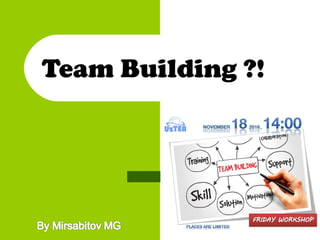
Team Building ?!
What is a team?
What is Building?
What is Team Building?
Let’s Create A Story”
What is Teamwork & Team Building
Teamwork
 Concept of people working together as a team
Team player
 A team player is someone who is able to get along with their
colleagues and work together in a cohesive group
Team Building
 Process of establishing and developing a greater sense of
collaboration and trust between members
Why Should We Be a Team?
 When staff use their skills and knowledge
together, the result is a stronger agency that
can fulfill its mission
 People working together can sustain the
enthusiasm and lend support needed to
complete the work of each program.
How does a Team Work Best?
A Teams succeeds when its members
have:
 a commitment to common objectives
 defined roles and responsibilities
 effective decision systems, communication
and work procedures
 good personal relationships
Team Morale Depends On
Support
Resources
Communication
Personalities
Teamwork Skills
 Listen
 Question
 Persuade
 Respect
 Help
 Share
 Participate
Stages in Team Building
FormingForming
StormingStorming
NormingNorming
PerformingPerforming
Four steps
Team members Performance goals
Step 1
Formation
Step 2
Storm
Step 3
Acceptation
Step 4
Performance
Team Roles - Leader
Encourages and maintains open communication
Leads by setting a good example
Motivates and inspires team members
Helps the team focus on the task
Facilitates problem solving and collaboration
Maintains healthy group dynamics
Encourages creativity and risk-taking
Recognizes and celebrates team member
contributions
Other Team Roles – Members Can Formally
or Informally Take on These Roles
Initiator - Someone who suggests new ideas. One or more people can have this role at a
time.
Recorder - This person records whatever ideas a team member may have. It is important
that this person quote a team member accurately and not "edit" or evaluate them.
Devil's Advocate/Skeptic - This is someone whose responsibility is to look for potential
flaws in an idea.
Optimist - This is someone who tries to maintain a positive frame of mind and facilitates
the search for solutions.
Timekeeper - Someone who tracks time spent on each portion of the meeting.
Gate Keeper - This person works to ensure that each member gives input on an issue. One
strategy to do this is to ask everyone to voice their opinion one at a time. Another is
to cast votes.
Summarizer - Someone who summarizes a list of options.
Giving Constructive Feedback
 Be descriptive
 Don't use labels
 Don’t exaggerate
 Don’t be judgmental
 Speak for yourself
Giving Constructive Feedback
 Use “I” messages.
 Restrict your feedback to things you know for
certain.
 Help people hear and accept your
compliments when giving positive feedback.
Receiving Feedback
 Listen carefully.
 Ask questions for clarity.
 Acknowledge the feedback.
 Acknowledge the valid points.
 Take time to sort out what you heard.
The Results of Team Work
Every Team Member Can Help!
Everyone Has to Hang in There!
Enjoy your Game!

Teambuilding

  • 1.
  • 2.
    What is ateam?
  • 3.
  • 4.
    What is TeamBuilding?
  • 5.
  • 6.
    What is Teamwork& Team Building Teamwork  Concept of people working together as a team Team player  A team player is someone who is able to get along with their colleagues and work together in a cohesive group Team Building  Process of establishing and developing a greater sense of collaboration and trust between members
  • 7.
    Why Should WeBe a Team?  When staff use their skills and knowledge together, the result is a stronger agency that can fulfill its mission  People working together can sustain the enthusiasm and lend support needed to complete the work of each program.
  • 8.
    How does aTeam Work Best? A Teams succeeds when its members have:  a commitment to common objectives  defined roles and responsibilities  effective decision systems, communication and work procedures  good personal relationships
  • 9.
    Team Morale DependsOn Support Resources Communication Personalities
  • 10.
    Teamwork Skills  Listen Question  Persuade  Respect  Help  Share  Participate
  • 11.
    Stages in TeamBuilding FormingForming StormingStorming NormingNorming PerformingPerforming
  • 12.
    Four steps Team membersPerformance goals Step 1 Formation Step 2 Storm Step 3 Acceptation Step 4 Performance
  • 13.
    Team Roles -Leader Encourages and maintains open communication Leads by setting a good example Motivates and inspires team members Helps the team focus on the task Facilitates problem solving and collaboration Maintains healthy group dynamics Encourages creativity and risk-taking Recognizes and celebrates team member contributions
  • 14.
    Other Team Roles– Members Can Formally or Informally Take on These Roles Initiator - Someone who suggests new ideas. One or more people can have this role at a time. Recorder - This person records whatever ideas a team member may have. It is important that this person quote a team member accurately and not "edit" or evaluate them. Devil's Advocate/Skeptic - This is someone whose responsibility is to look for potential flaws in an idea. Optimist - This is someone who tries to maintain a positive frame of mind and facilitates the search for solutions. Timekeeper - Someone who tracks time spent on each portion of the meeting. Gate Keeper - This person works to ensure that each member gives input on an issue. One strategy to do this is to ask everyone to voice their opinion one at a time. Another is to cast votes. Summarizer - Someone who summarizes a list of options.
  • 15.
    Giving Constructive Feedback Be descriptive  Don't use labels  Don’t exaggerate  Don’t be judgmental  Speak for yourself
  • 16.
    Giving Constructive Feedback Use “I” messages.  Restrict your feedback to things you know for certain.  Help people hear and accept your compliments when giving positive feedback.
  • 17.
    Receiving Feedback  Listencarefully.  Ask questions for clarity.  Acknowledge the feedback.  Acknowledge the valid points.  Take time to sort out what you heard.
  • 18.
    The Results ofTeam Work
  • 19.
  • 21.
    Everyone Has toHang in There!
  • 22.

Editor's Notes

  • #9 According to Bob Mendonsa and Associates’ web page http://www. trainingplus.com on Team building : Team Building is a process and not an event. Team Building is about both willingness and ability. Sometimes teams problems occur because team members lack important skills. Sometimes there are trust issues. Team Building must address individual and group issues. People do not “disappear” when they choose to belong to a group. Any team building effort must address the strengths and development needs of individual team members that impact the group as a whole. Of course the corollary is true and groups or teams fail when they: Think differently Have poor leadership Have communications difficulties Have competition between members
  • #12 As the team matures, members gradually learn to cope with each other and the pressures that they face. As a result, the team goes through the fairly predictable stages noted on the slide.
  • #16 Be descriptive -- relate what you saw or heard the other person do. Give specific recent examples Don’t use labels -- Be specific and unambiguous. Don’t use words like immature, unprofessional, irresponsible which are labels attached to behavior. For example, say “ You missed the deadline we had agreed to meet rather than, “You’re being irresponsible and I want to know what you are going to do about it. Don’t exaggerate. Be exact. To say, “You’re always late for deadlines” is probably untrue and unfair. It invites the receiver to argue with exaggeration rather than respond to real issue Don’t be judgmental. Don’t use words like good, better, bad, worst or should which place you in the role of controlling parent. This invites the receiver to respond as a child. Speak for yourself. Don’t refer to absent, anonymous people. Avoid references like “A lot of people here don’t like it when you…” Encourage others to speak for themselves
  • #17 Talk first about yourself, not about the other person. Use a statement with with “I” as the subject not “you”. People are more likely to remain open to your message when an “I” statement is used. Phrase the issue as a statement, not a question. “I” statements allows the receiver to see what effect the behavior had on you. Restrict your feedback. Don’t present your opinions as facts. Help people hear and receive positive feedback. Many people fell awkward when told good things about themselves. It may be important to reinforce the positive feedback and help the person hear it, acknowledge it and accept it.
  • #18 Listen carefully. Don’t interrupt. Don’t discourage the feedback-giver. Ask questions for clarity. You have the right to receive clear feedback. Ask for specific examples. Acknowledge the feedback. Paraphrase the message in your own words to let the person know what you have heard and understood what was said. Acknowledge the valid points. Agree with what is true. Agree with what is possible. Acknowledge the other person’s point of view and try to understand their reaction. Agreeing with what’s true or possible doesn’t mean you agree to change your behavior or mean agreeing with any value judgment about you. You can agree that your reports are late with out thereby agreeing that your are irresponsible Take time to sort out what you heard. You may need time for sorting out or checking with others before responding to feedback. It is reasonable to ask the feedback-giver for time to think about what was said and how you feel about it. Don’t use this time as an excuse to avoid the issue.