Cueto, Leoneil M.
BSIT 3- 1N
Customer Satisfaction
 Price
Customers are constantly evaluating one business
organization’s products and/or services against those
of its competitors to determine who provides the
greater value.
 Reputation
Total customer satisfaction is based on the entire
experience with the business organization, not just the
product. Good experiences are repeated to six people
and bad experiences are repeated to fifteen people:
therefore, it is more difficult to create a favorable
reputation.
 Toll – free Telephone Numbers
Toll – free service phone numbers are good
technique for receiving complaint feedback.
Business organizations can respond faster and
cheaper to the complaint.
 Customer Visits
Visit to a customer’s place is another strategy
to gather information about the products and
services of a business organization. Managers
should be evolved in these visits and should not be
delegated to just anybody.
 Report Card
Report card is another way of gathering information about
a given product or service. Normally it is sent to every customer
on a quarterly basis. The data shall be analyzed to determine
areas of improvement.
Focusing on Customers
UNDERSTANDING CUSTOMER NEEDS
 David A. Garvin suggests that products and services have many
dimensions of quality.
1. Performance: A product’s primary operating characteristics.
2. Features: The “bell and whistles” of a product.
3. Conformance: The degree to which physical and performance
characteristics of a product match pre-established standards.
3. Reliability: The probability of a product’s surviving over specified
period under stated conditions of use.
5. Durability: The amount of use one gets from a product before it
physically deteriorates or until replacement is preferable.
6. Serviceability: The speed, courtesy, and competence of repair
work.
7. Aesthetics: How a product looks, feels, sounds, tastes, or smells.
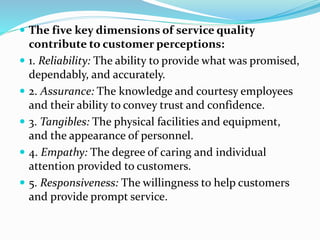
 The five key dimensions of service quality
contribute to customer perceptions:
 1. Reliability: The ability to provide what was promised,
dependably, and accurately.
 2. Assurance: The knowledge and courtesy employees
and their ability to convey trust and confidence.
 3. Tangibles: The physical facilities and equipment,
and the appearance of personnel.
 4. Empathy: The degree of caring and individual
attention provided to customers.
 5. Responsiveness: The willingness to help customers
and provide prompt service.
Noriaki Kano, a Japanese professor whom suggested
three classes of customer requirements:
1. Dissatisfiers: Requirements that are expected in a
product or service.
2. Satisfiers: Requirements that customer say they want.
3. Exciters/delighters: New or innovative features that
customers do not expect.
GATHERING AND ANALYZING CUSTOMER
INFORMATION
 Customer requirements , as expected in the customer’s
own terms, are called the voice of the customer
Some of the key approaches of gathering customer
information include the following:
 Comment cards ad formal surveys
 Focus groups
 Direct Customer Contact
 Field Intelligence
 Complaint Analysis
 Internet Monitoring
The list of key elements of timely closings from focus groups
and other customer interviews
1. Expeditious processes
2. Reliability
3. Consistent and accurate information
4. Competitive rates
5. Notification of industry changes
6. Prior approvals
7. Innovation
8. Modem link between computers
9. Buyer orientation
10. Diversity of programs
11. Mutual job understanding
12. Flexibility
13. Professionalism
14. Timely and accurate status reports
LINKING CUSTOMER INFORMATION TO DESIGN,
PRODUCTION, AND SERVICE DELIVERY

Customer satisfaction presentation

  • 1.
  • 2.
  • 3.
     Price Customers areconstantly evaluating one business organization’s products and/or services against those of its competitors to determine who provides the greater value.  Reputation Total customer satisfaction is based on the entire experience with the business organization, not just the product. Good experiences are repeated to six people and bad experiences are repeated to fifteen people: therefore, it is more difficult to create a favorable reputation.
  • 4.
     Toll –free Telephone Numbers Toll – free service phone numbers are good technique for receiving complaint feedback. Business organizations can respond faster and cheaper to the complaint.  Customer Visits Visit to a customer’s place is another strategy to gather information about the products and services of a business organization. Managers should be evolved in these visits and should not be delegated to just anybody.
  • 5.
     Report Card Reportcard is another way of gathering information about a given product or service. Normally it is sent to every customer on a quarterly basis. The data shall be analyzed to determine areas of improvement.
  • 6.
  • 7.
    UNDERSTANDING CUSTOMER NEEDS David A. Garvin suggests that products and services have many dimensions of quality. 1. Performance: A product’s primary operating characteristics. 2. Features: The “bell and whistles” of a product. 3. Conformance: The degree to which physical and performance characteristics of a product match pre-established standards. 3. Reliability: The probability of a product’s surviving over specified period under stated conditions of use. 5. Durability: The amount of use one gets from a product before it physically deteriorates or until replacement is preferable. 6. Serviceability: The speed, courtesy, and competence of repair work. 7. Aesthetics: How a product looks, feels, sounds, tastes, or smells.
  • 8.
     The fivekey dimensions of service quality contribute to customer perceptions:  1. Reliability: The ability to provide what was promised, dependably, and accurately.  2. Assurance: The knowledge and courtesy employees and their ability to convey trust and confidence.  3. Tangibles: The physical facilities and equipment, and the appearance of personnel.  4. Empathy: The degree of caring and individual attention provided to customers.  5. Responsiveness: The willingness to help customers and provide prompt service.
  • 10.
    Noriaki Kano, aJapanese professor whom suggested three classes of customer requirements: 1. Dissatisfiers: Requirements that are expected in a product or service. 2. Satisfiers: Requirements that customer say they want. 3. Exciters/delighters: New or innovative features that customers do not expect.
  • 11.
    GATHERING AND ANALYZINGCUSTOMER INFORMATION  Customer requirements , as expected in the customer’s own terms, are called the voice of the customer
  • 12.
    Some of thekey approaches of gathering customer information include the following:  Comment cards ad formal surveys  Focus groups  Direct Customer Contact  Field Intelligence  Complaint Analysis  Internet Monitoring
  • 13.
    The list ofkey elements of timely closings from focus groups and other customer interviews 1. Expeditious processes 2. Reliability 3. Consistent and accurate information 4. Competitive rates 5. Notification of industry changes 6. Prior approvals 7. Innovation 8. Modem link between computers 9. Buyer orientation 10. Diversity of programs 11. Mutual job understanding 12. Flexibility 13. Professionalism 14. Timely and accurate status reports
  • 14.
    LINKING CUSTOMER INFORMATIONTO DESIGN, PRODUCTION, AND SERVICE DELIVERY