10. ROBOTIC
MANUFACTURING
SYSTEMS
D E S I G N A N D A P P L I C AT I O N S O F I N D U S T R I A L R O B OT S
S A B A R I G I R I VA S A N . R
I S B N 978-81-908268-0-8
10. ROBOTIC
MANUFACTURING
SYSTEMS
D E S I G N A N D A P P L I C AT I O N S O F I N D U S T R I A L R O B OT S
S A B A R I G I R I VA S A N . R
I S B N 978-81-908268-0-8
Robotic Manufacturing Systems
1. Robots are designed to automate
manufacturing operations that are
monotonous and dangerous in nature.
2. The manufacturing cell that is serviced by
one or more robots is known as robot
work cell.
3. The robot work cell should have complete
set of hardware, software and cell control
system.
2
Structure of a Robot Work cell
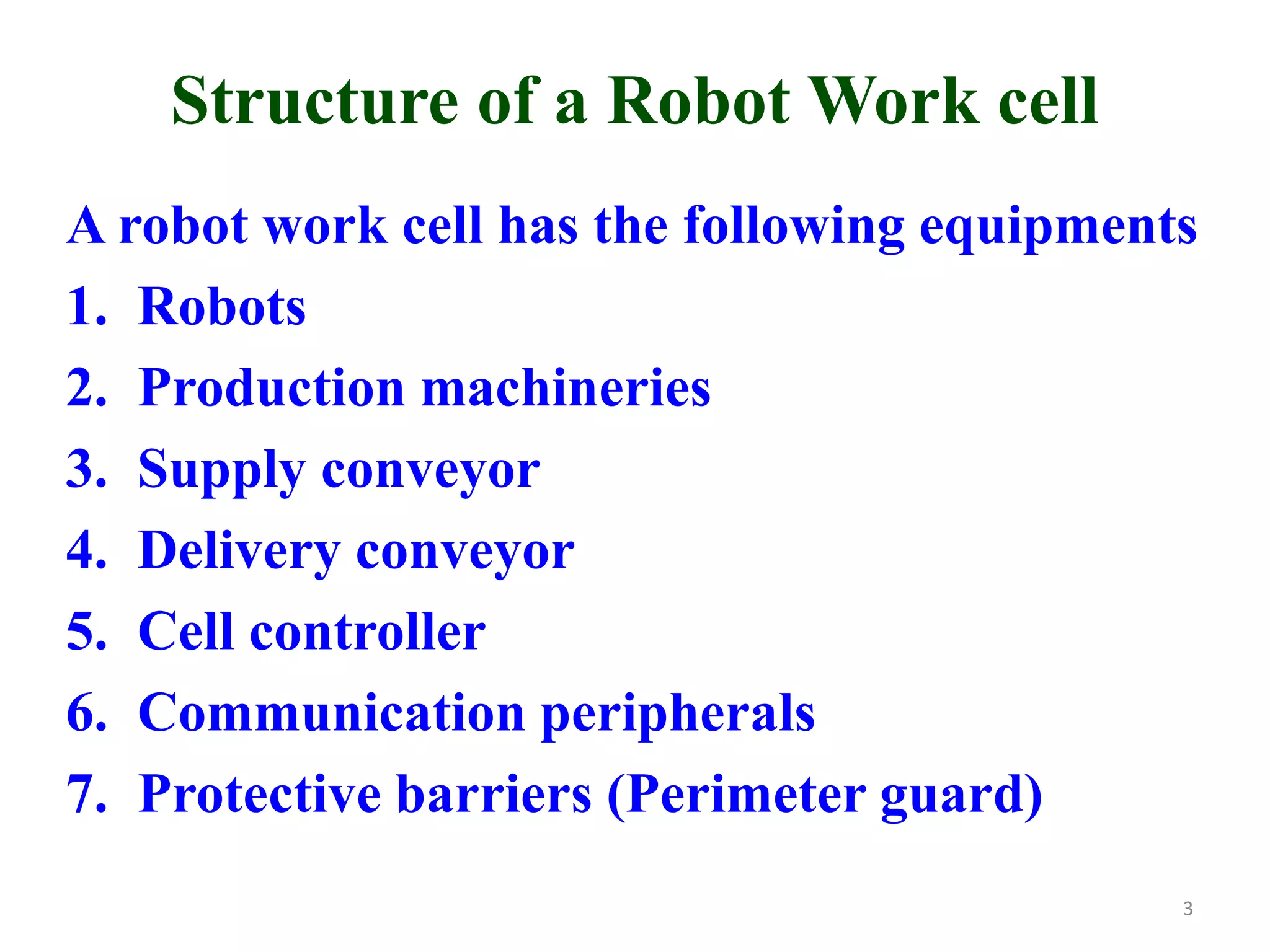
A robot work cell has the following equipments
1. Robots
2. Production machineries
3. Supply conveyor
4. Delivery conveyor
5. Cell controller
6. Communication peripherals
7. Protective barriers (Perimeter guard)
3
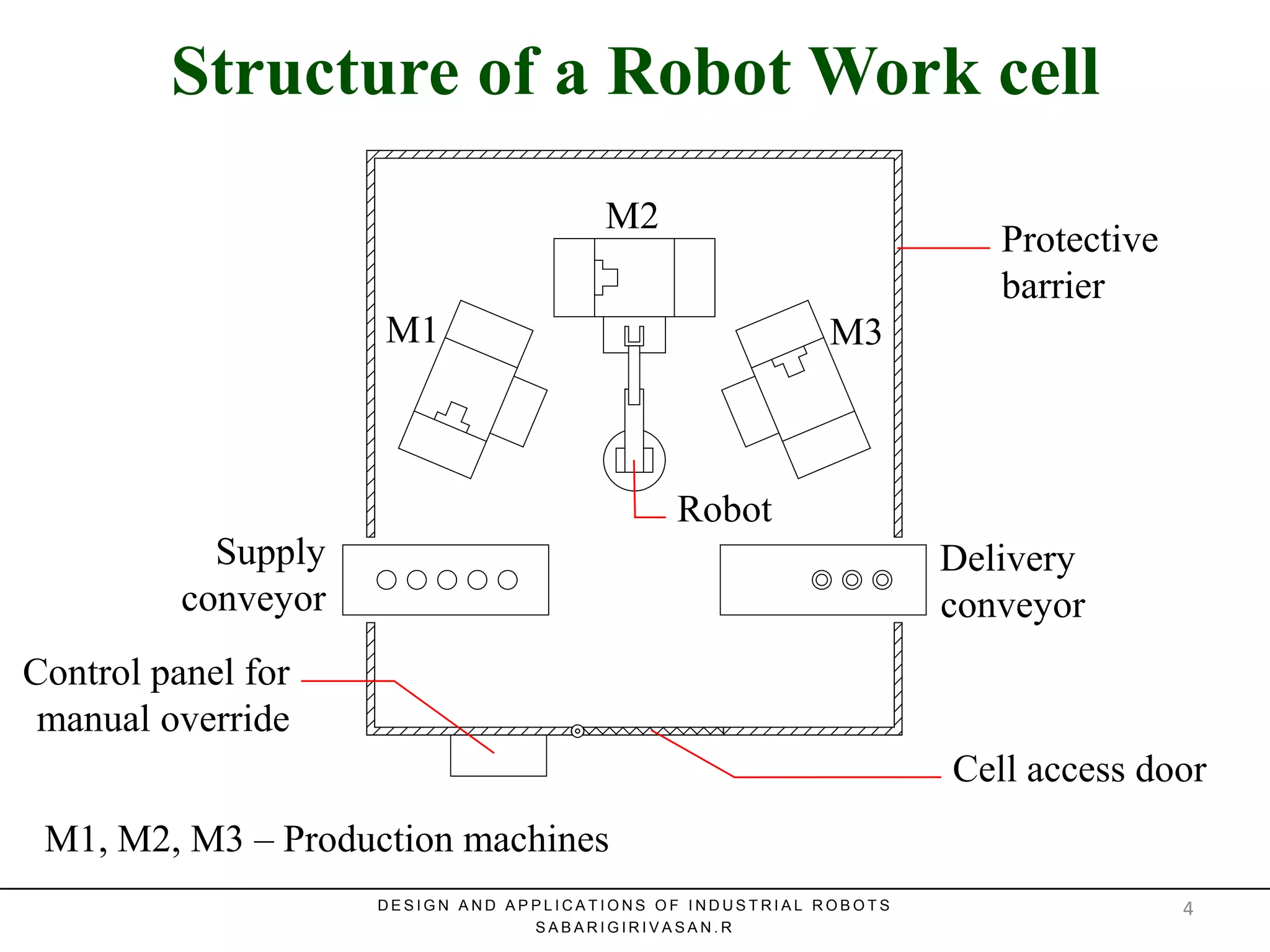
Structure of a Robot Work cell
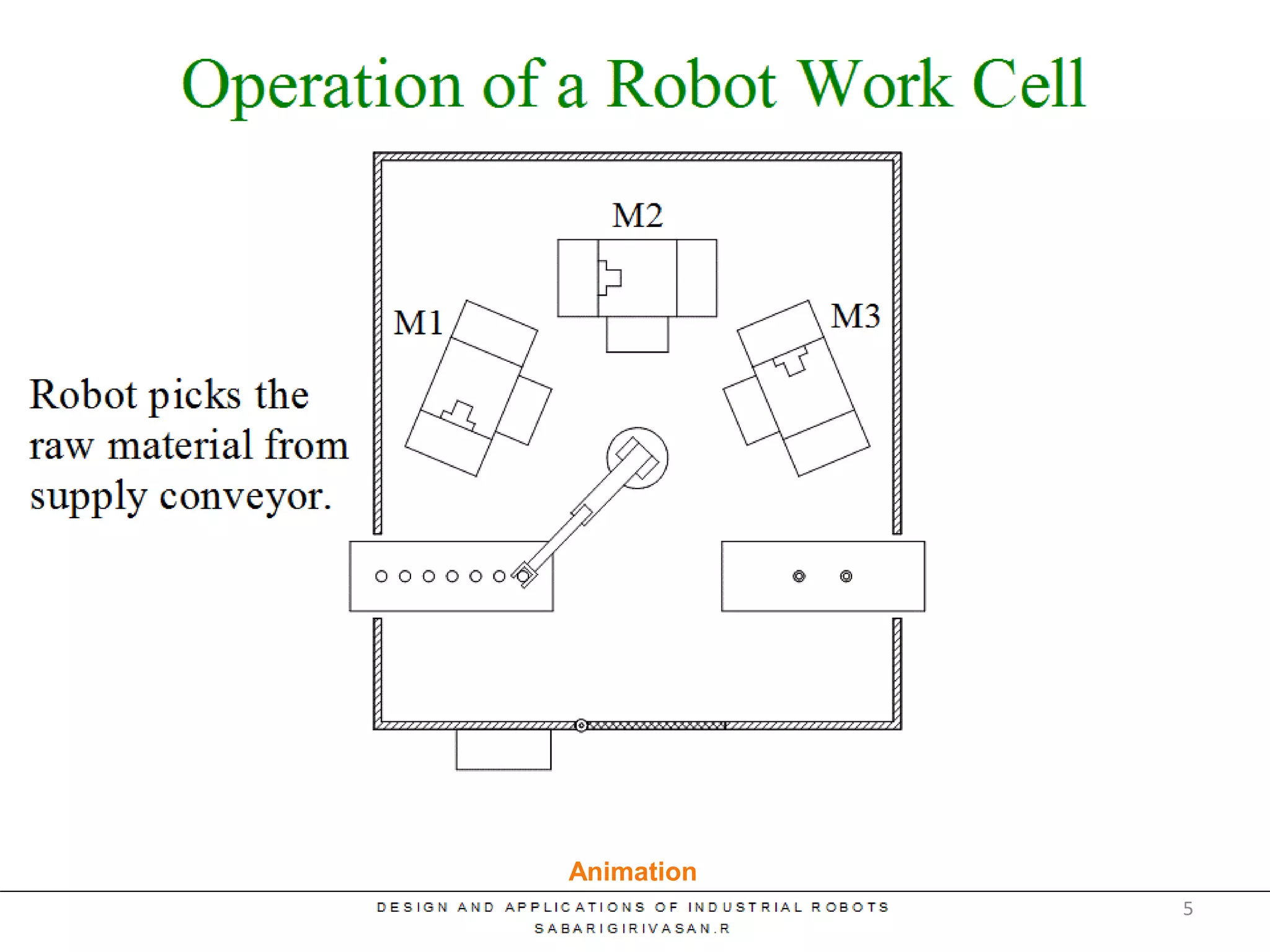
M1
M2
M3
M1, M2, M3 – Production machines
Protective
barrier
Robot
Control panel for
manual override
Cell access door
Supply
conveyor
Delivery
conveyor
D E S I G N A N D A P P L I C A T I O N S O F I N D U S T R I A L R O B O T S
S A B A R I G I R I V A S A N . R
4
Structure of a Robot Work cell
Animation
5
Classification of Robot Work cell
Based on Number of Robots
1. Single robot work cell
a) Only one robot is employed to perform all
operations.
b) Machine interference can occur.
c) Interference is caused due to imbalance in
machine cycle and robot service times.
2. Multiple robot work cell
a) More than one robot will be employed to perform
all the required operation.
b) Cell control system is employed to avoid collision.
6
Classification of Robot Work cell
Based on the Position of Robots
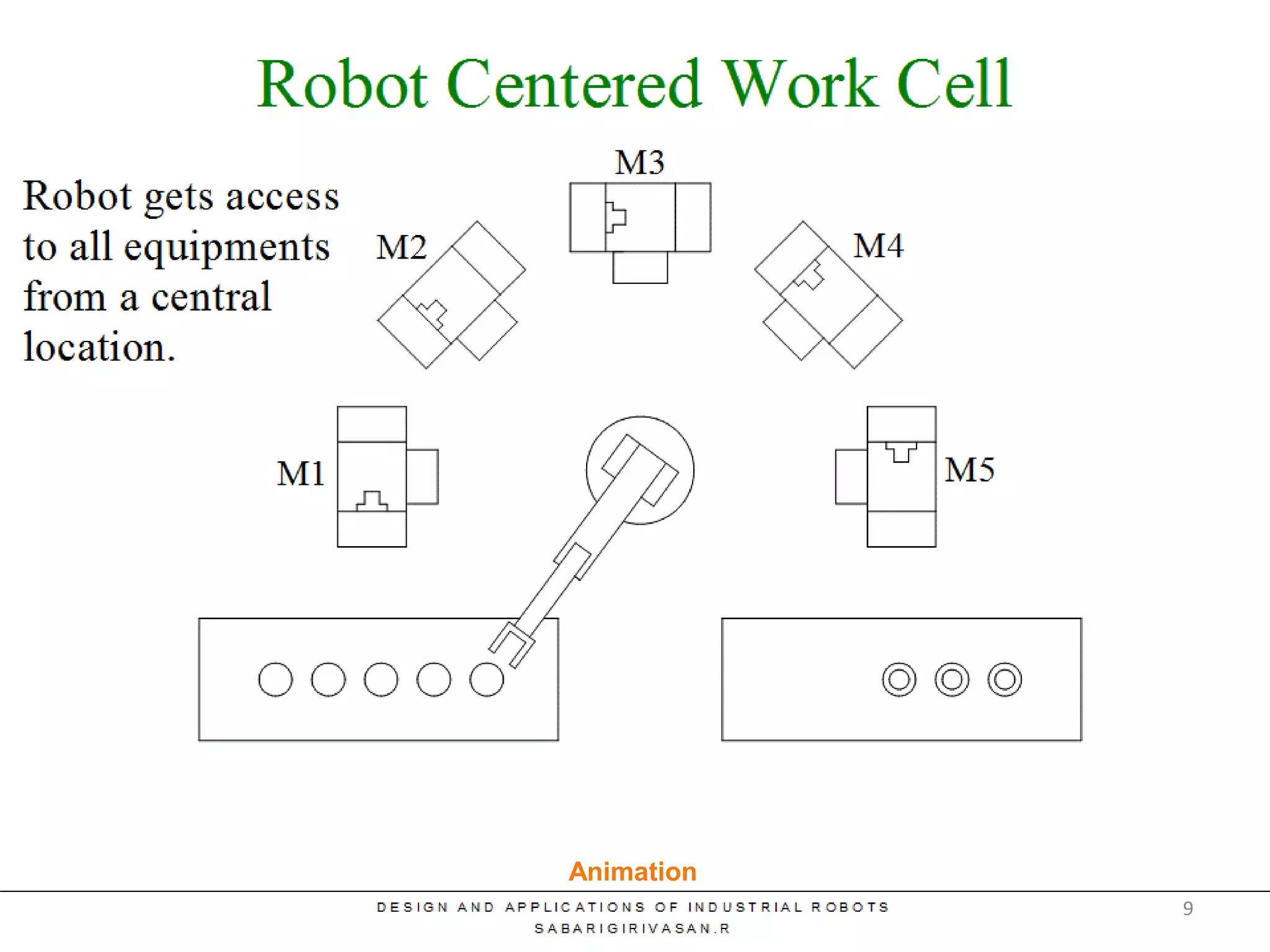
1. Robot centered work cell.
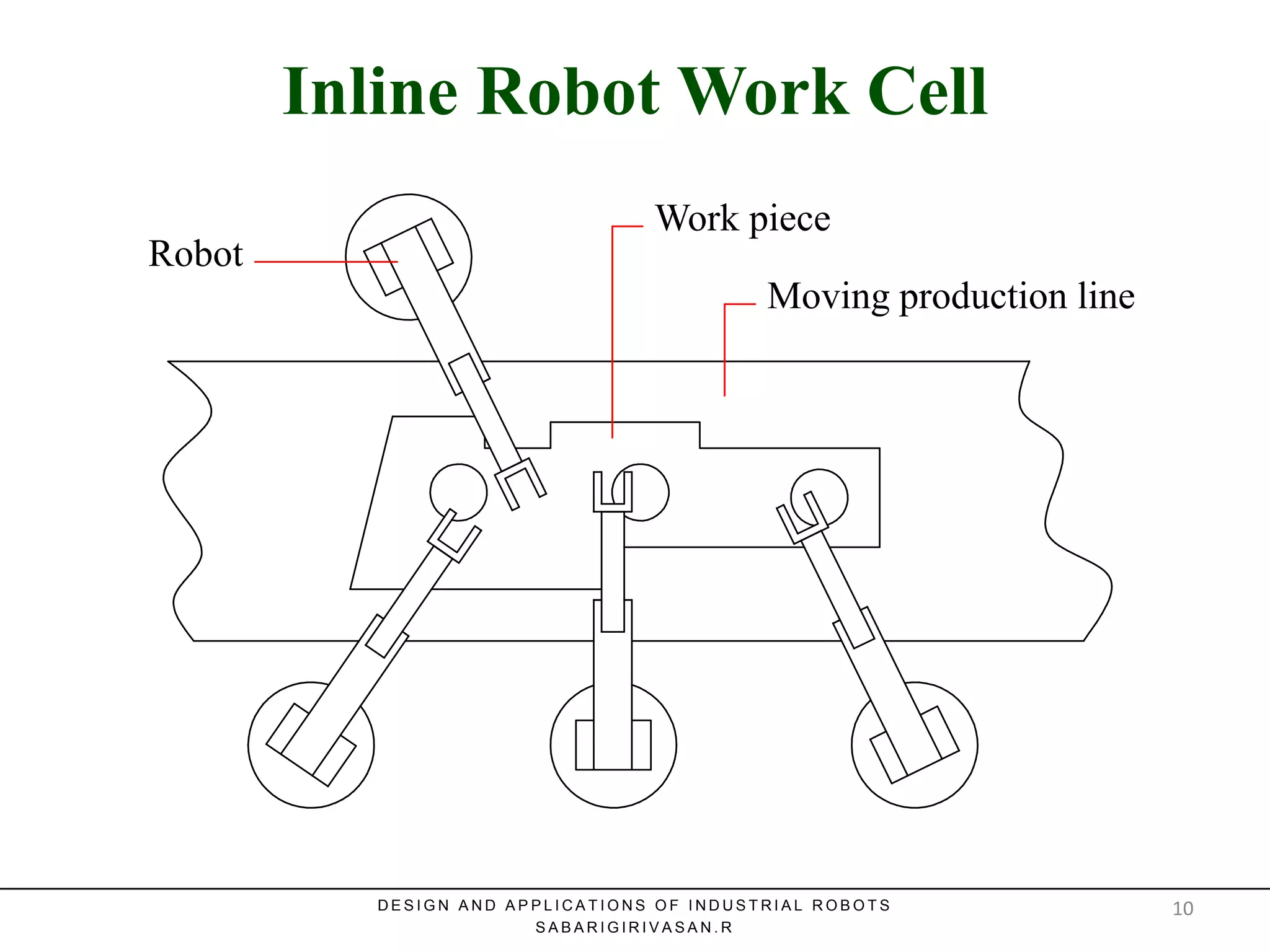
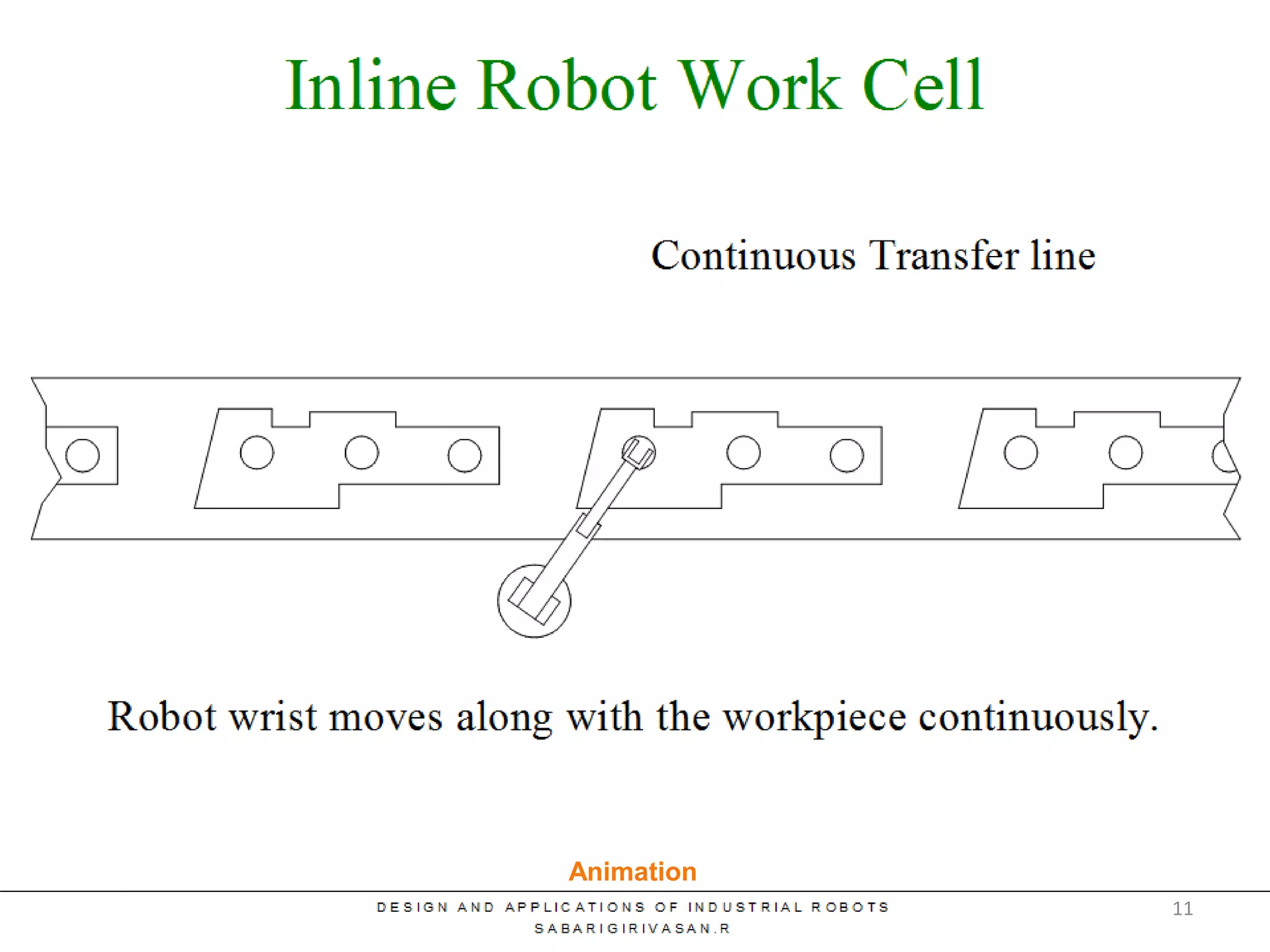
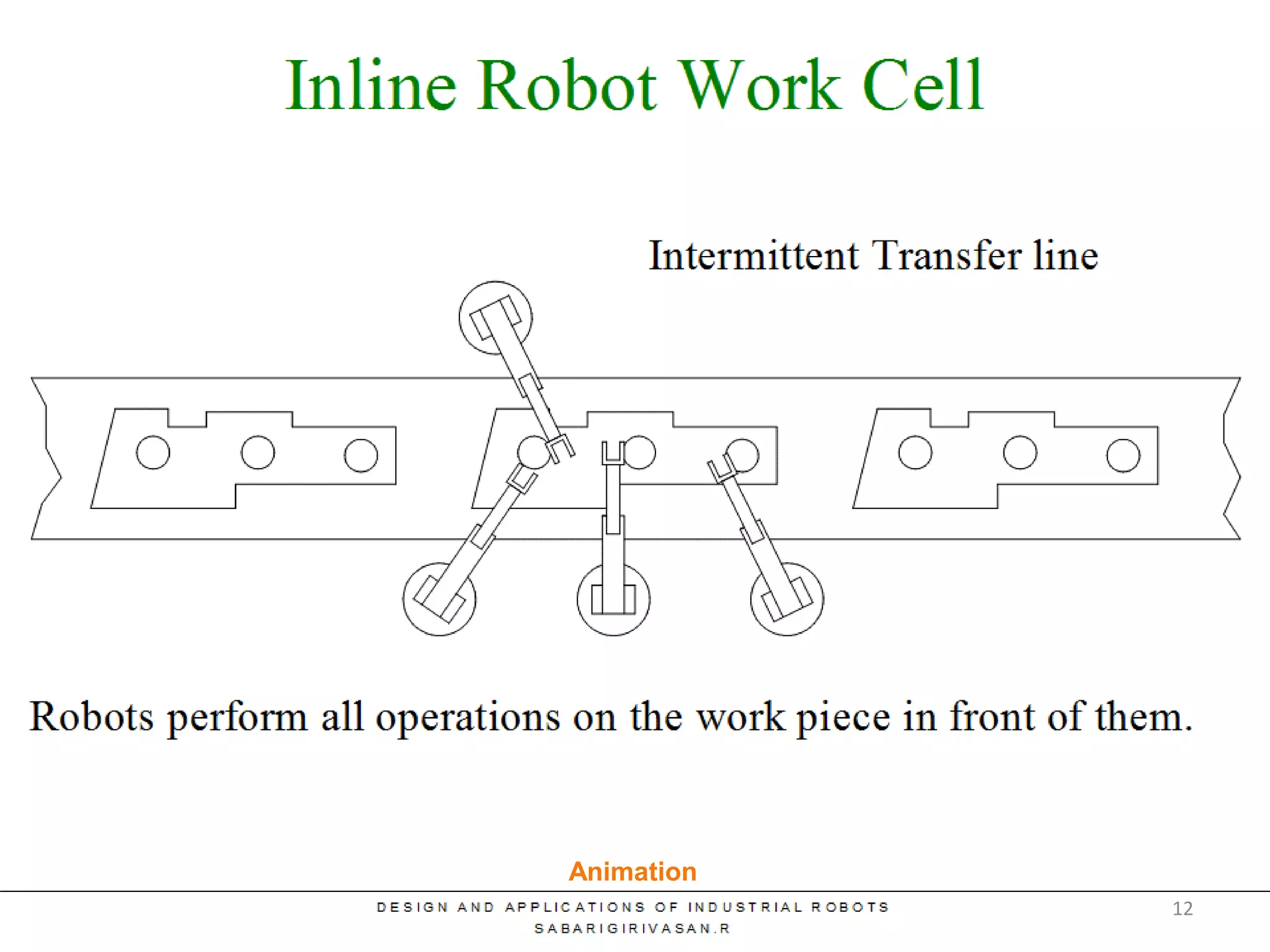
2. Inline robot work cell.
a) Intermittent part transfer
b) Continuous part transfer
3. Mobile robot work cell
a) Floor mounted rail system
b) Overhead rail system
7
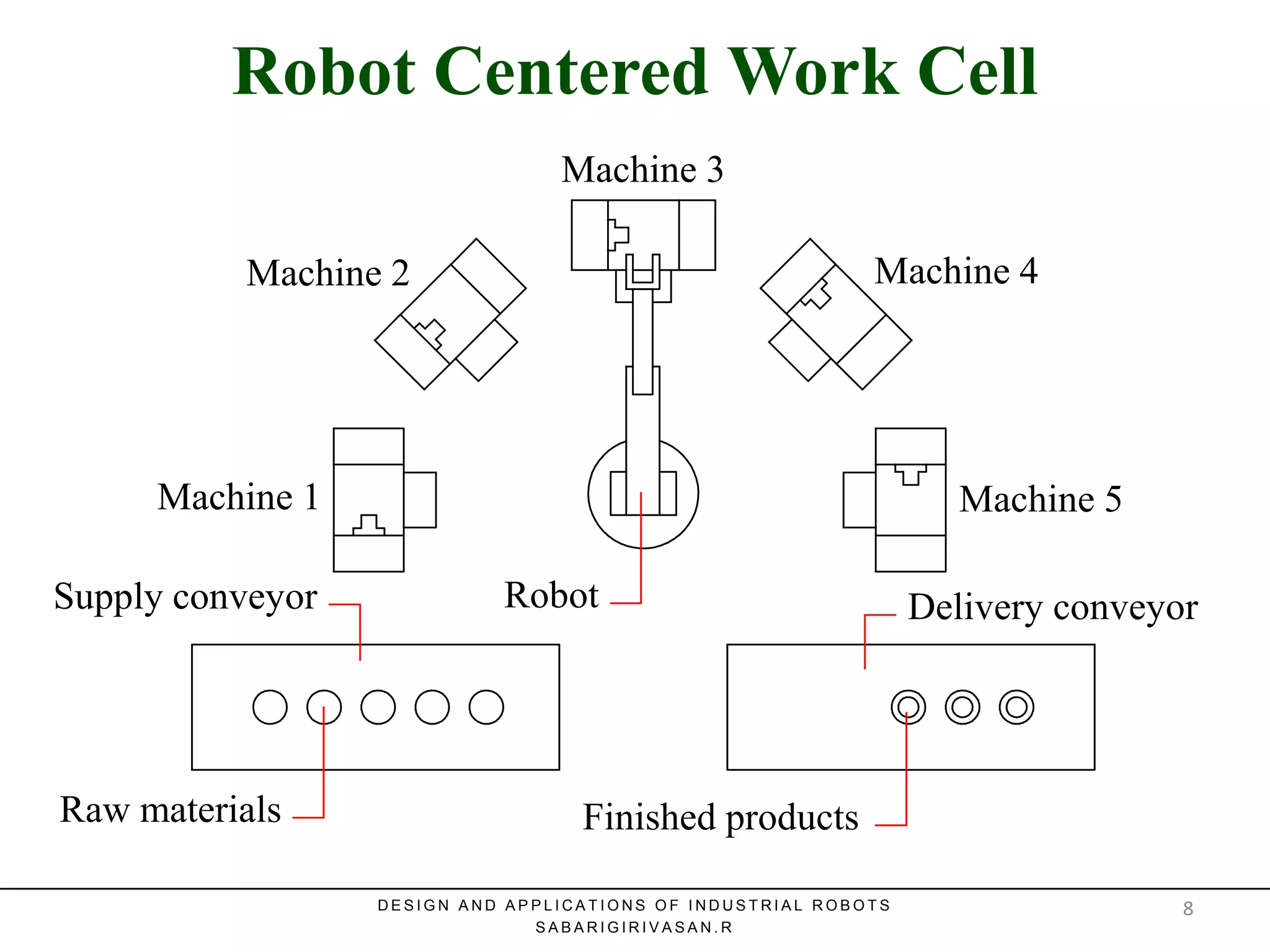
Robot Centered Work Cell
Machine 1
Machine 3
Machine 5
Machine 2 Machine 4
RobotSupply conveyor
Raw materials
Delivery conveyor
Finished products
D E S I G N A N D A P P L I C A T I O N S O F I N D U S T R I A L R O B O T S
S A B A R I G I R I V A S A N . R
8
Robot Centered Work Cell
Animation
9
Inline Robot Work CellInline Robot Work Cell
Robot
Work piece
Moving production line
D E S I G N A N D A P P L I C A T I O N S O F I N D U S T R I A L R O B O T S
S A B A R I G I R I V A S A N . R
10
Inline Robot Work Cell
Animation
11
Inline Robot Work Cell
Animation
12
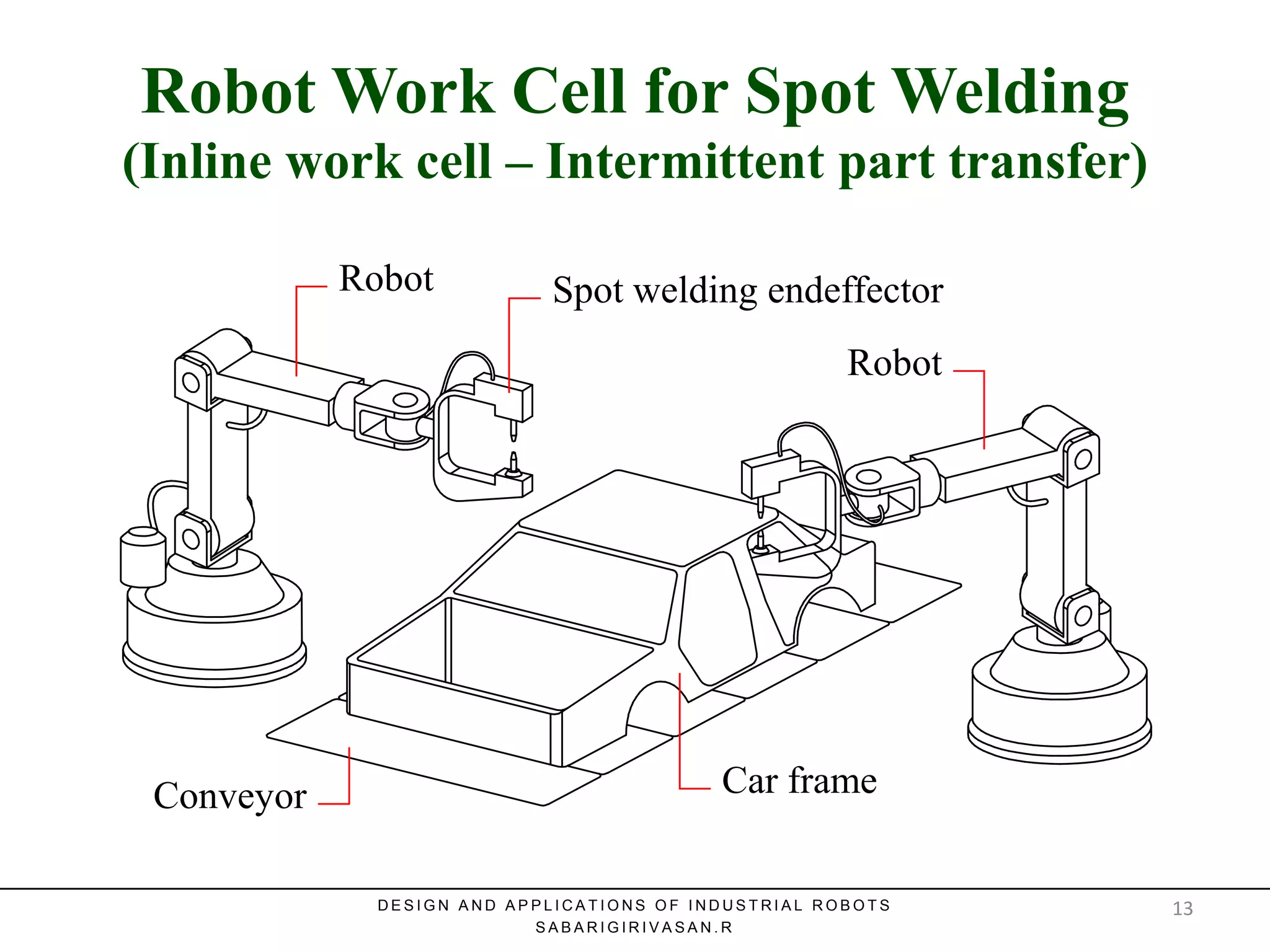
Robot Work Cell for Spot Welding
(Inline work cell – Intermittent part transfer)
Robot Work Cell for Spot Welding
(Inline work cell – Intermittent part transfer)
Robot Spot welding endeffector
Car frameConveyor
Robot
D E S I G N A N D A P P L I C A T I O N S O F I N D U S T R I A L R O B O T S
S A B A R I G I R I V A S A N . R
13
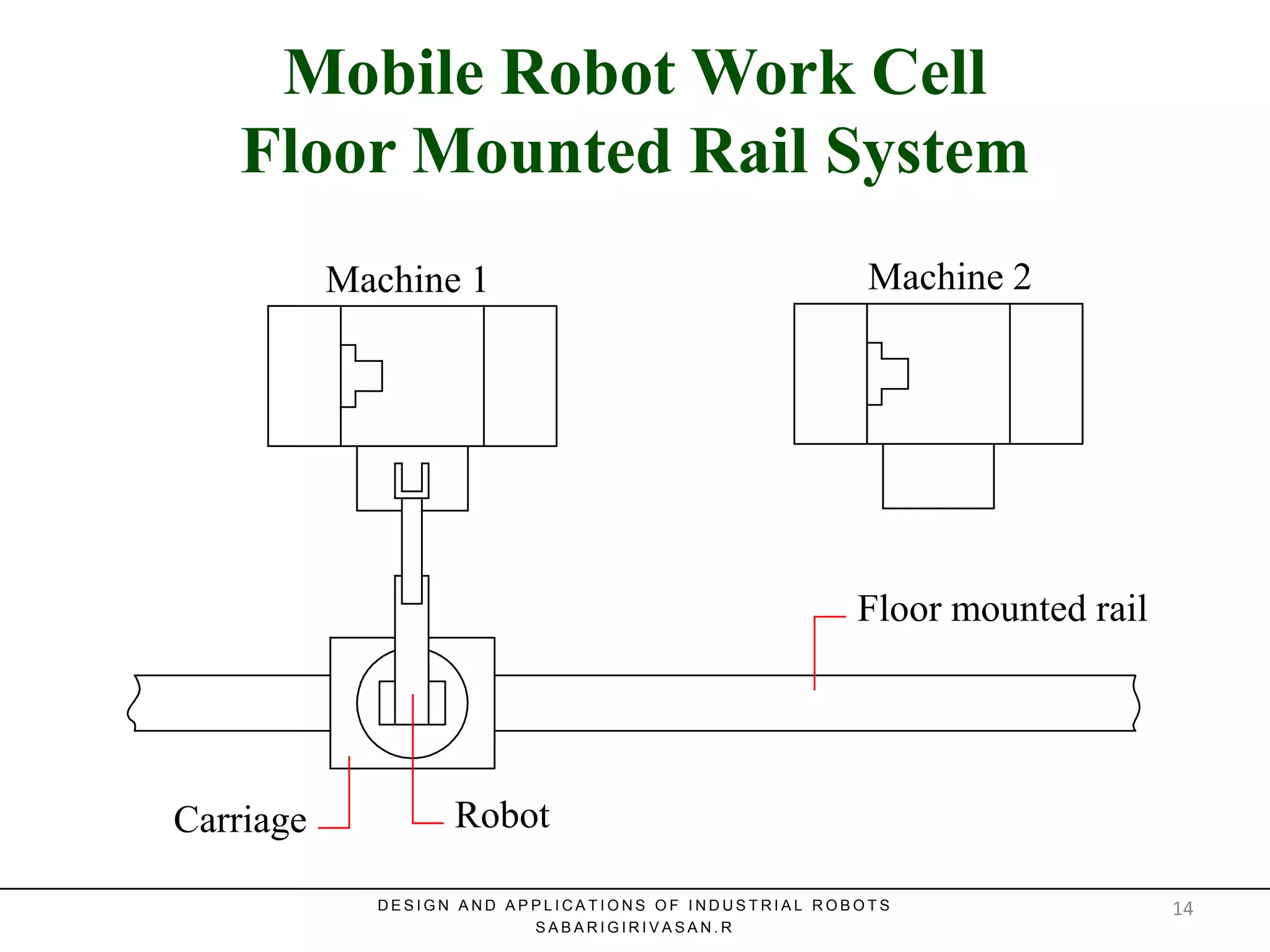
Mobile Robot Work Cell – Floor
Mounted Rail System
Mobile Robot Work Cell
Floor Mounted Rail System
Machine 1 Machine 2
Carriage Robot
Floor mounted rail
D E S I G N A N D A P P L I C A T I O N S O F I N D U S T R I A L R O B O T S
S A B A R I G I R I V A S A N . R
14
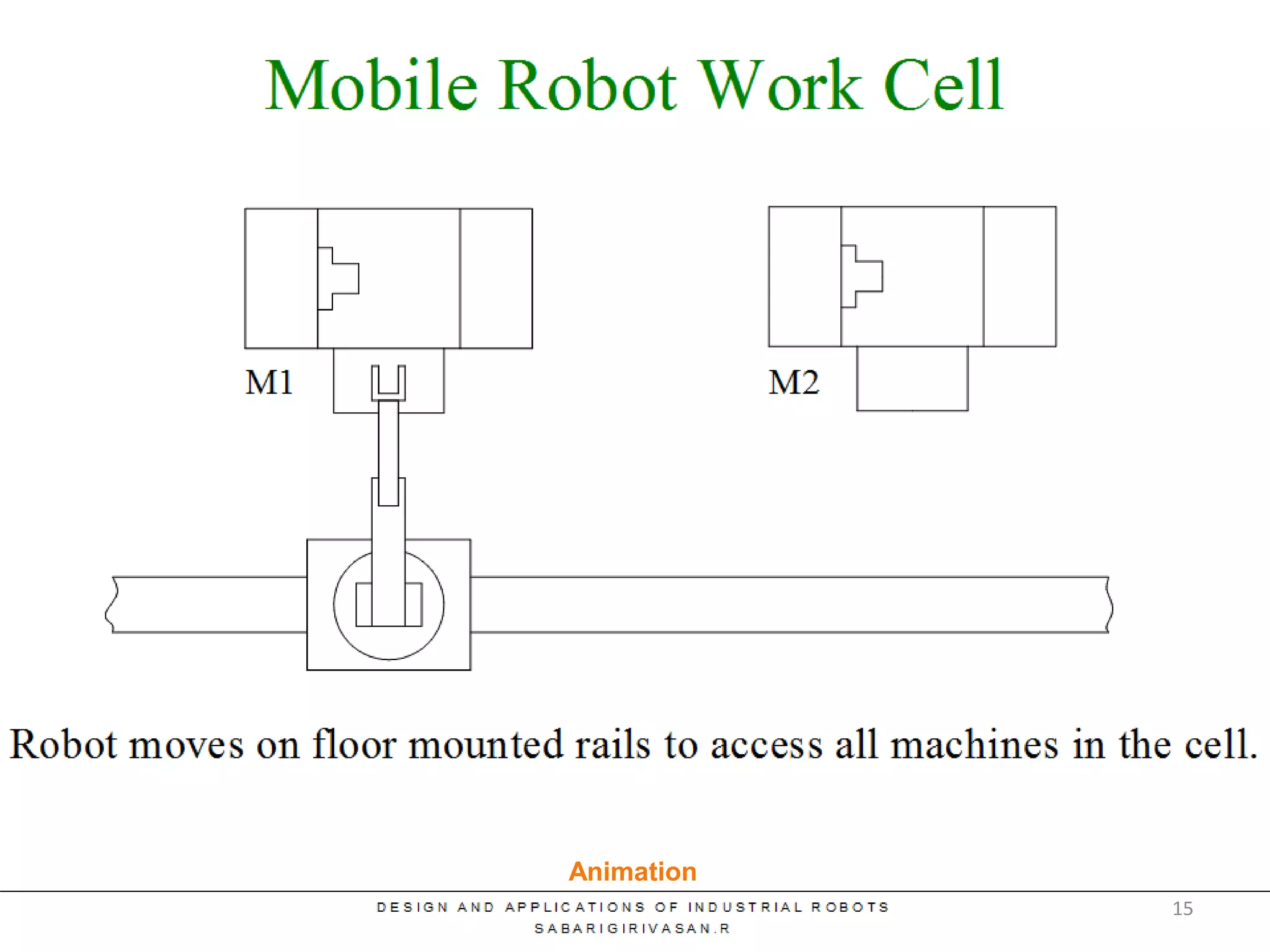
Mobile Robot Work Cell – Floor
Mounted Rail System
Animation
15
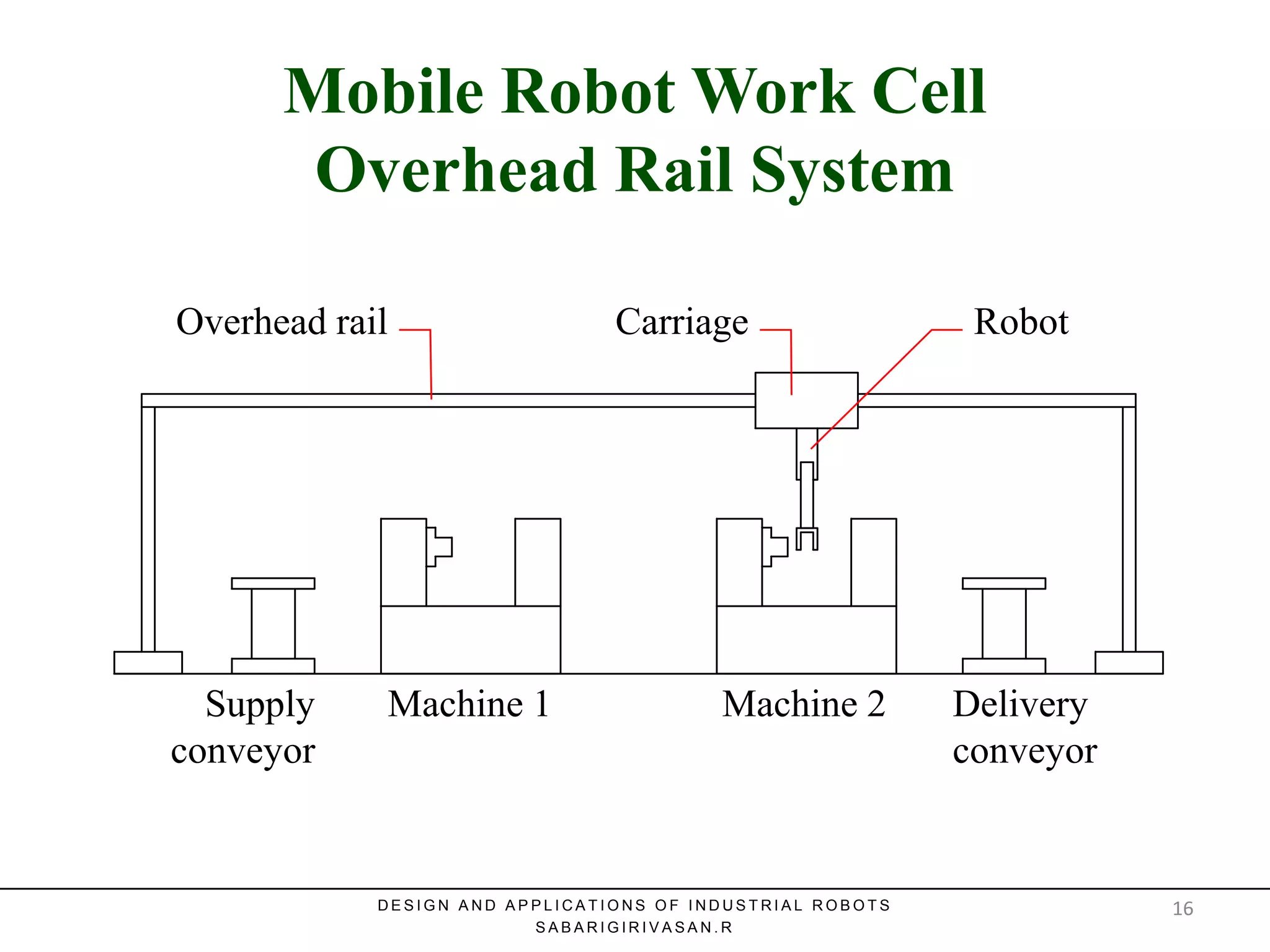
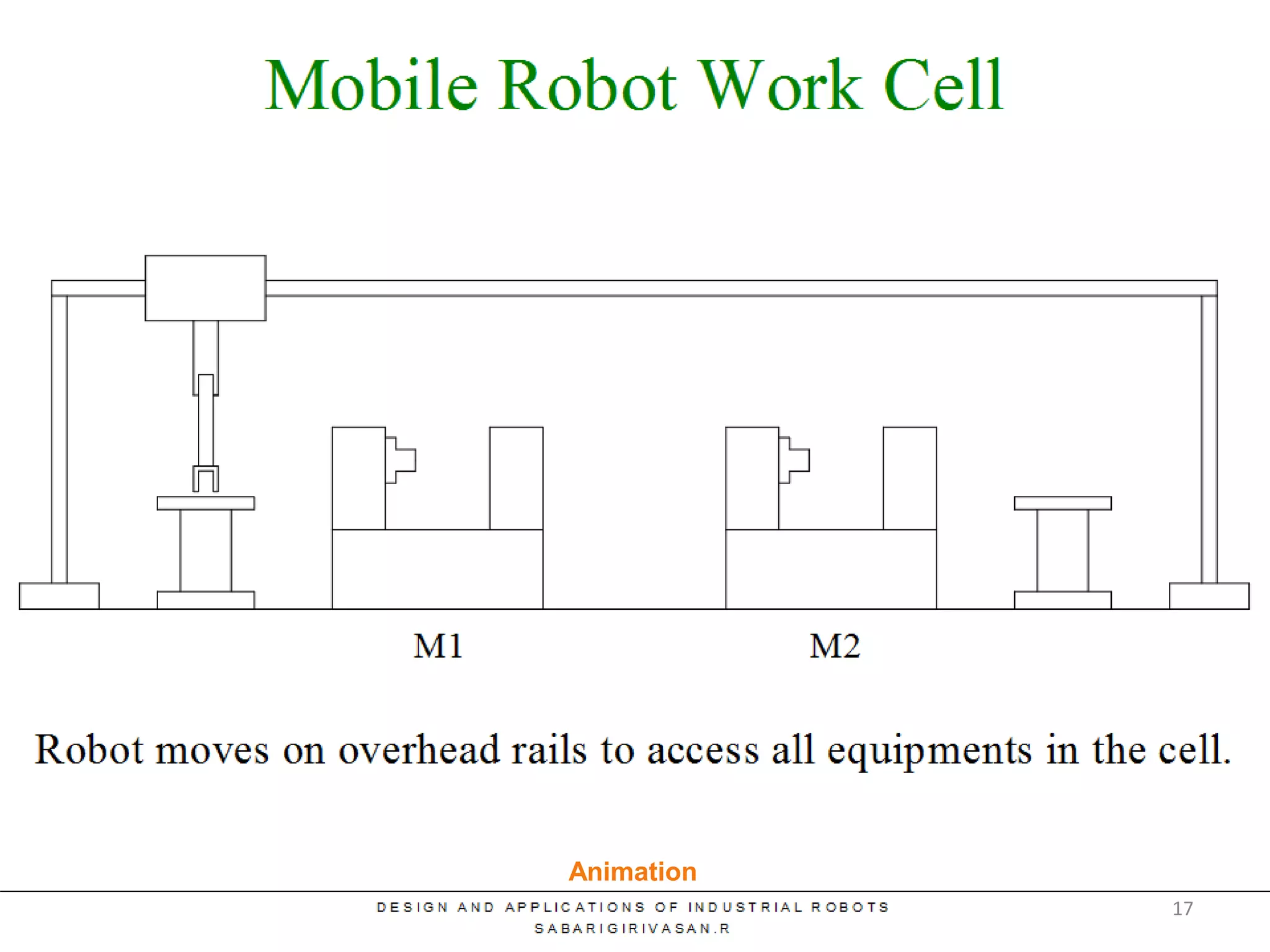
Mobile Robot Work Cell – Overhead
Rail System
Mobile Robot Work Cell
Overhead Rail System
D E S I G N A N D A P P L I C A T I O N S O F I N D U S T R I A L R O B O T S
S A B A R I G I R I V A S A N . R
Machine 1 Machine 2Supply
conveyor
Delivery
conveyor
Overhead rail RobotCarriage
16
Mobile Robot Work Cell – Overhead
Rail System
Animation
17
Safety Considerations
1. Safety is of paramount importance in any
industrial operation.
2. The robot should be protected from
damaging itself and injuring humans while
in action.
3. Everything in the cell should be
maintained well and checked for safe
operation so that no mishap occurs.
18
Potential Hazards for Safety
1. Oil leaks in hydraulic robots and pressure
loss in pneumatic robots.
2. Broken power cables.
3. Poor maintenance.
4. Poor quality of components.
5. Software errors.
6. Uncoordinated robot motion with the
production machine.
19
Potential Hazards for Safety
7. Careless attitude of workers.
8. Unauthorized entry of workers into the
cell.
9. Careless attitude of management.
20
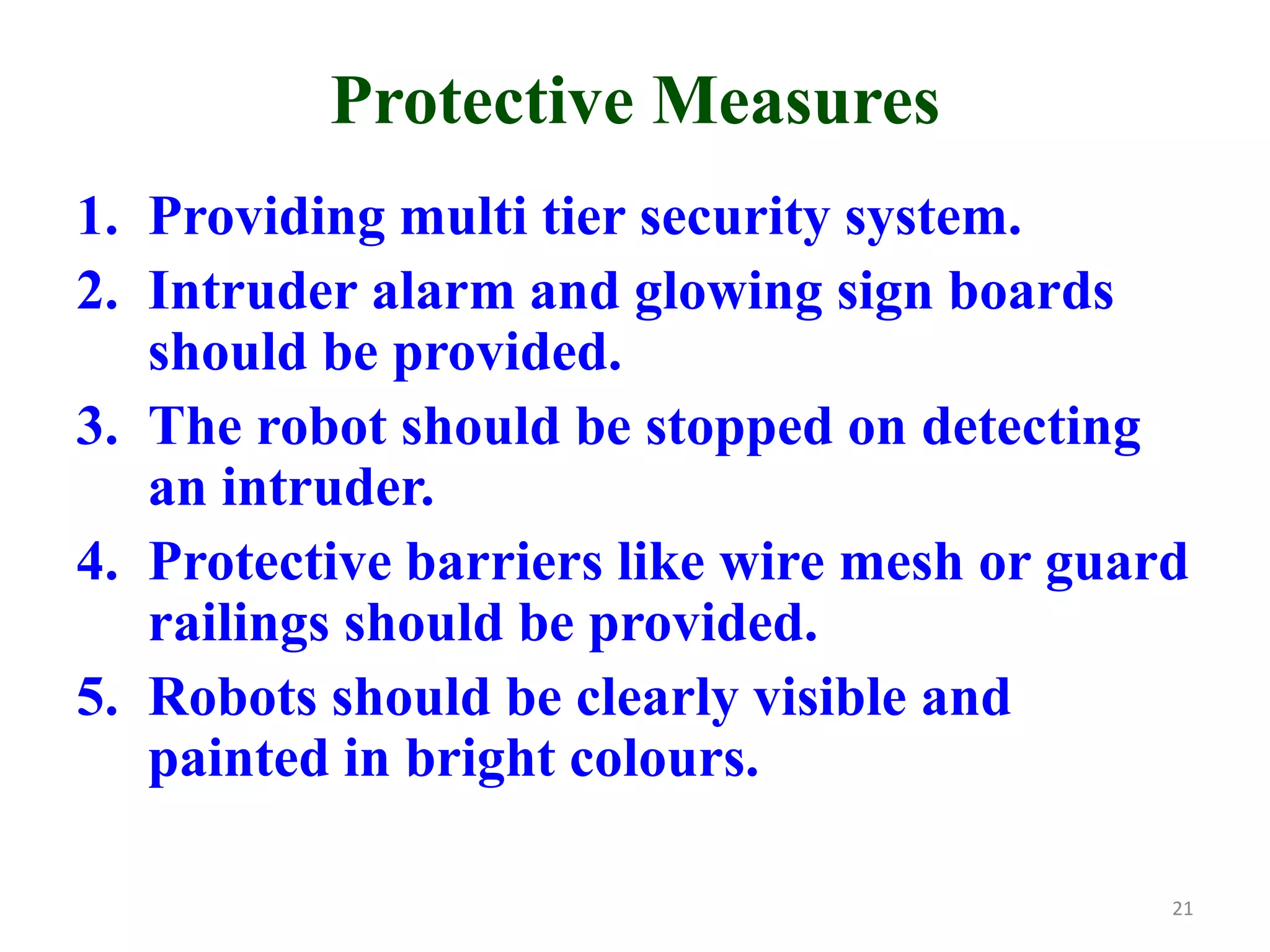
Protective Measures
1. Providing multi tier security system.
2. Intruder alarm and glowing sign boards
should be provided.
3. The robot should be stopped on detecting
an intruder.
4. Protective barriers like wire mesh or guard
railings should be provided.
5. Robots should be clearly visible and
painted in bright colours.
21
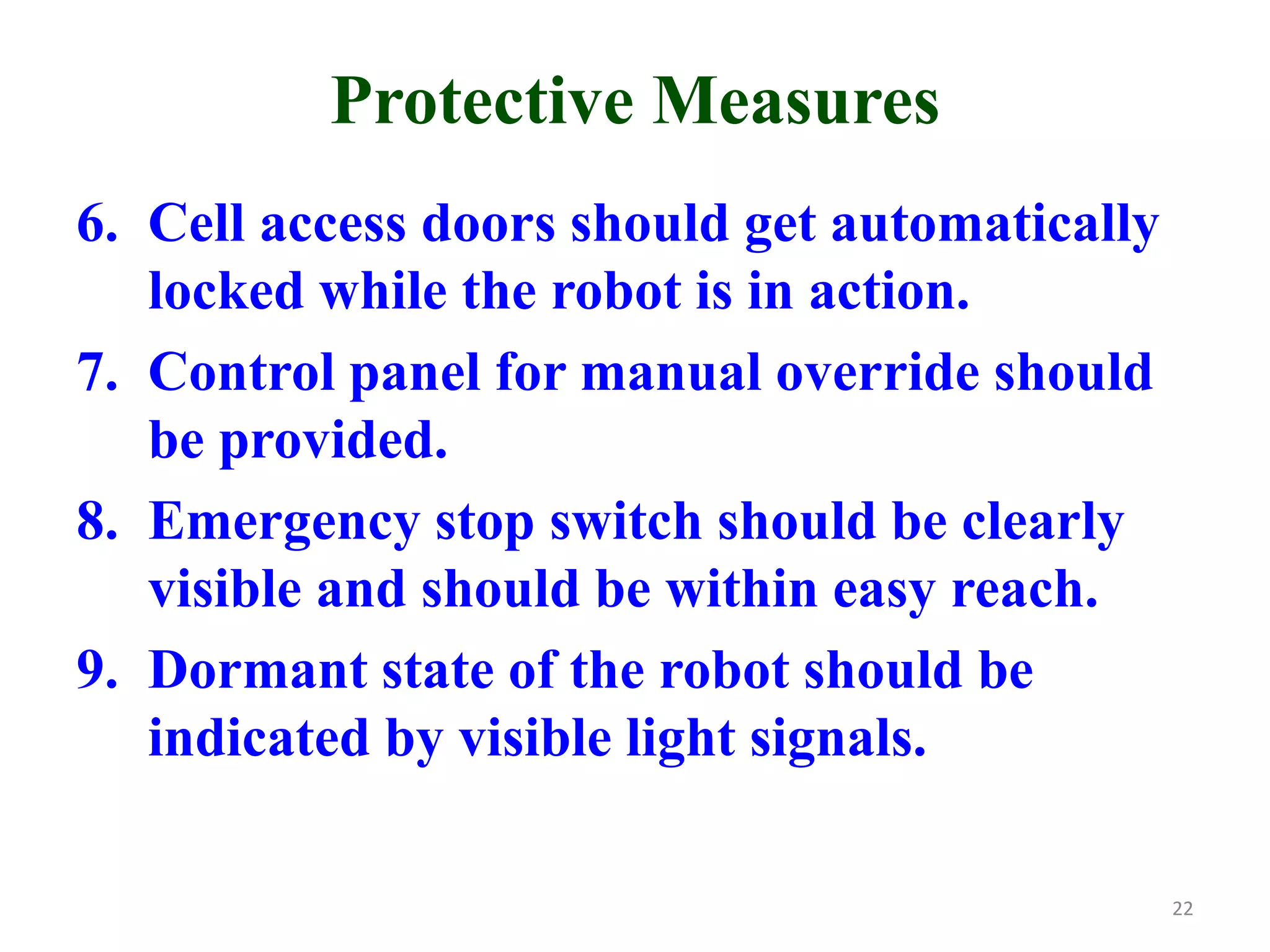
Protective Measures
6. Cell access doors should get automatically
locked while the robot is in action.
7. Control panel for manual override should
be provided.
8. Emergency stop switch should be clearly
visible and should be within easy reach.
9. Dormant state of the robot should be
indicated by visible light signals.
22
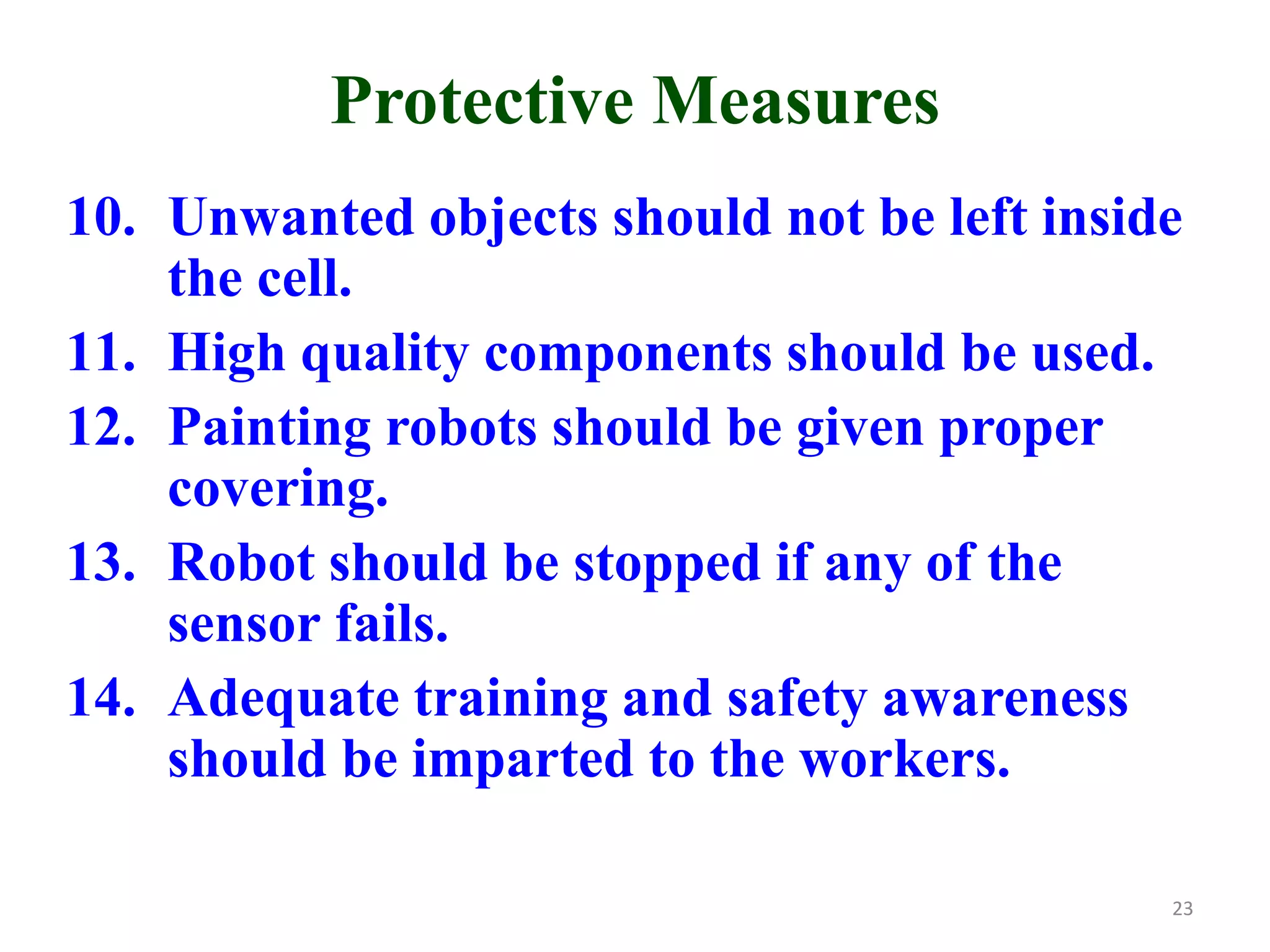
Protective Measures
10. Unwanted objects should not be left inside
the cell.
11. High quality components should be used.
12. Painting robots should be given proper
covering.
13. Robot should be stopped if any of the
sensor fails.
14. Adequate training and safety awareness
should be imparted to the workers.
23
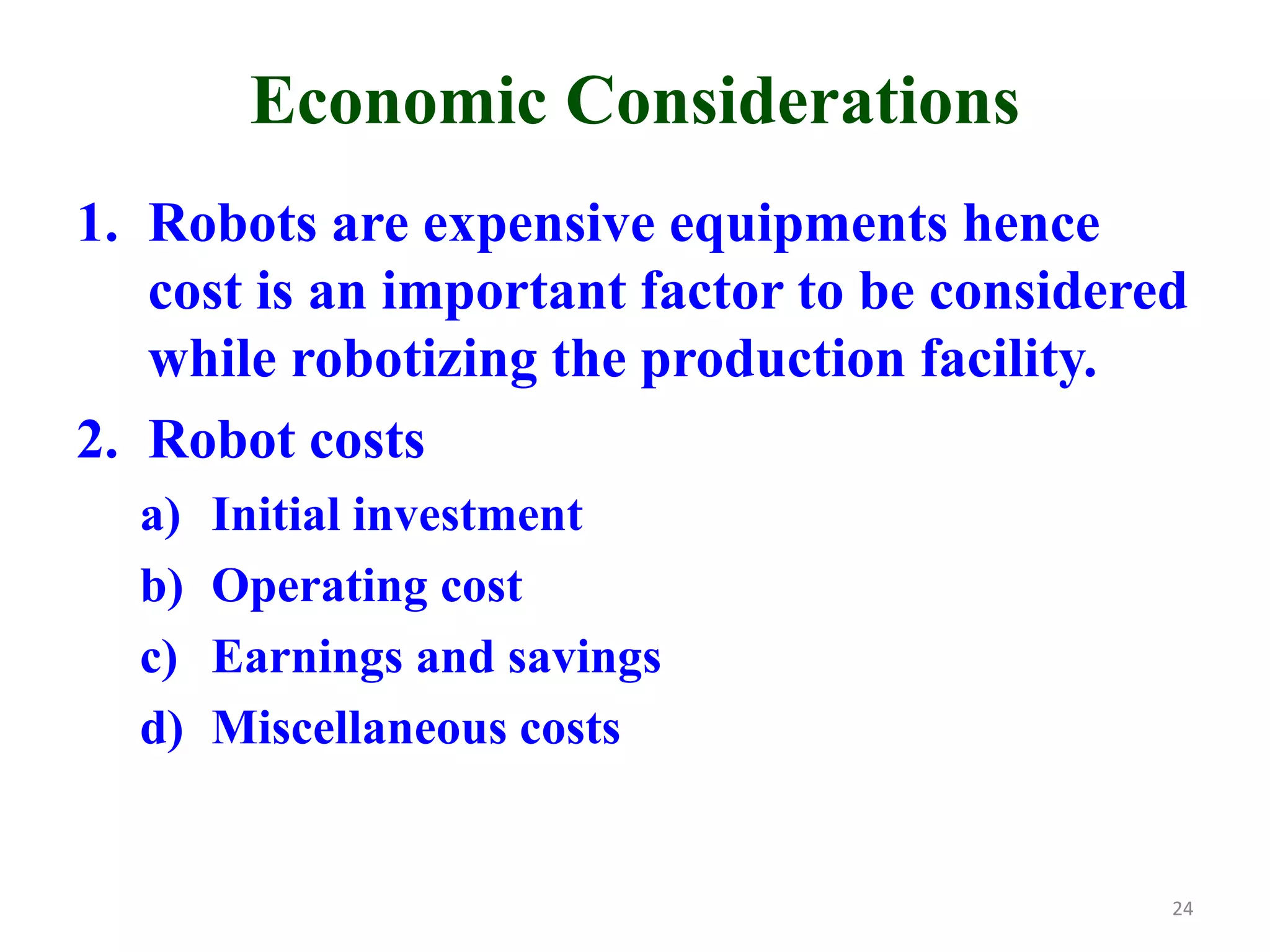
Economic Considerations
1. Robots are expensive equipments hence
cost is an important factor to be considered
while robotizing the production facility.
2. Robot costs
a) Initial investment
b) Operating cost
c) Earnings and savings
d) Miscellaneous costs
24
Cost Comparison
1. Before robotizing, other production process
should be considered to arrive an optimal
conclusion.
2. Earnings made for certain production
volume should be compared with manual
production and fixed automation.
3. Only when substantial cost benefits are
realized it will be a profitable business.
25
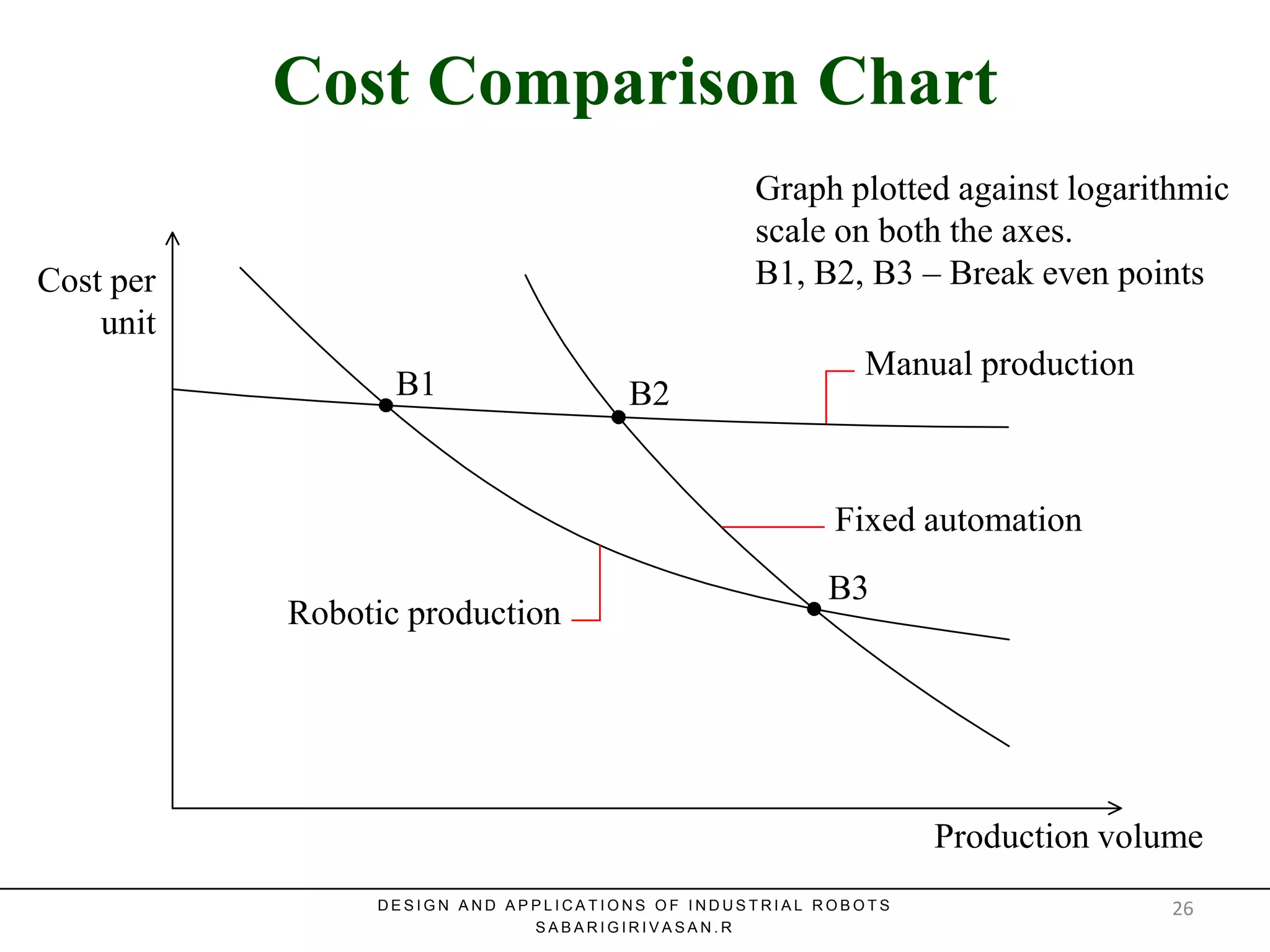
Cost Comparison ChartCost Comparison Chart
Cost per
unit
Production volume
Graph plotted against logarithmic
scale on both the axes.
B1, B2, B3 – Break even points
B1 B2
B3
Robotic production
Manual production
Fixed automation
D E S I G N A N D A P P L I C A T I O N S O F I N D U S T R I A L R O B O T S
S A B A R I G I R I V A S A N . R
26
Cost Estimation
Two simple techniques for making estimates
of earnings to justify robotization are
1. Payback period method
2. Return on Investment method
27
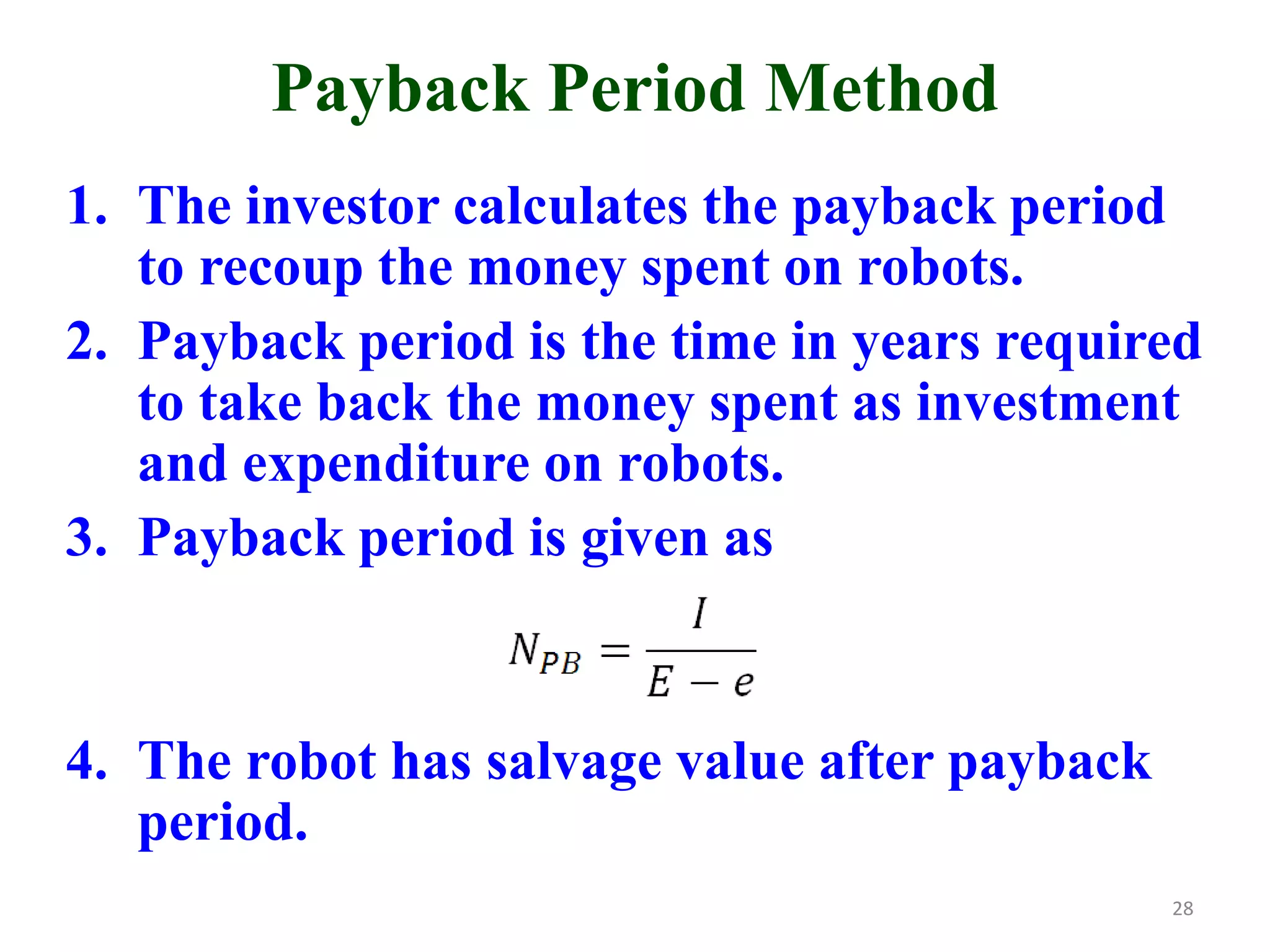
Payback Period Method
1. The investor calculates the payback period
to recoup the money spent on robots.
2. Payback period is the time in years required
to take back the money spent as investment
and expenditure on robots.
3. Payback period is given as
4. The robot has salvage value after payback
period.
28
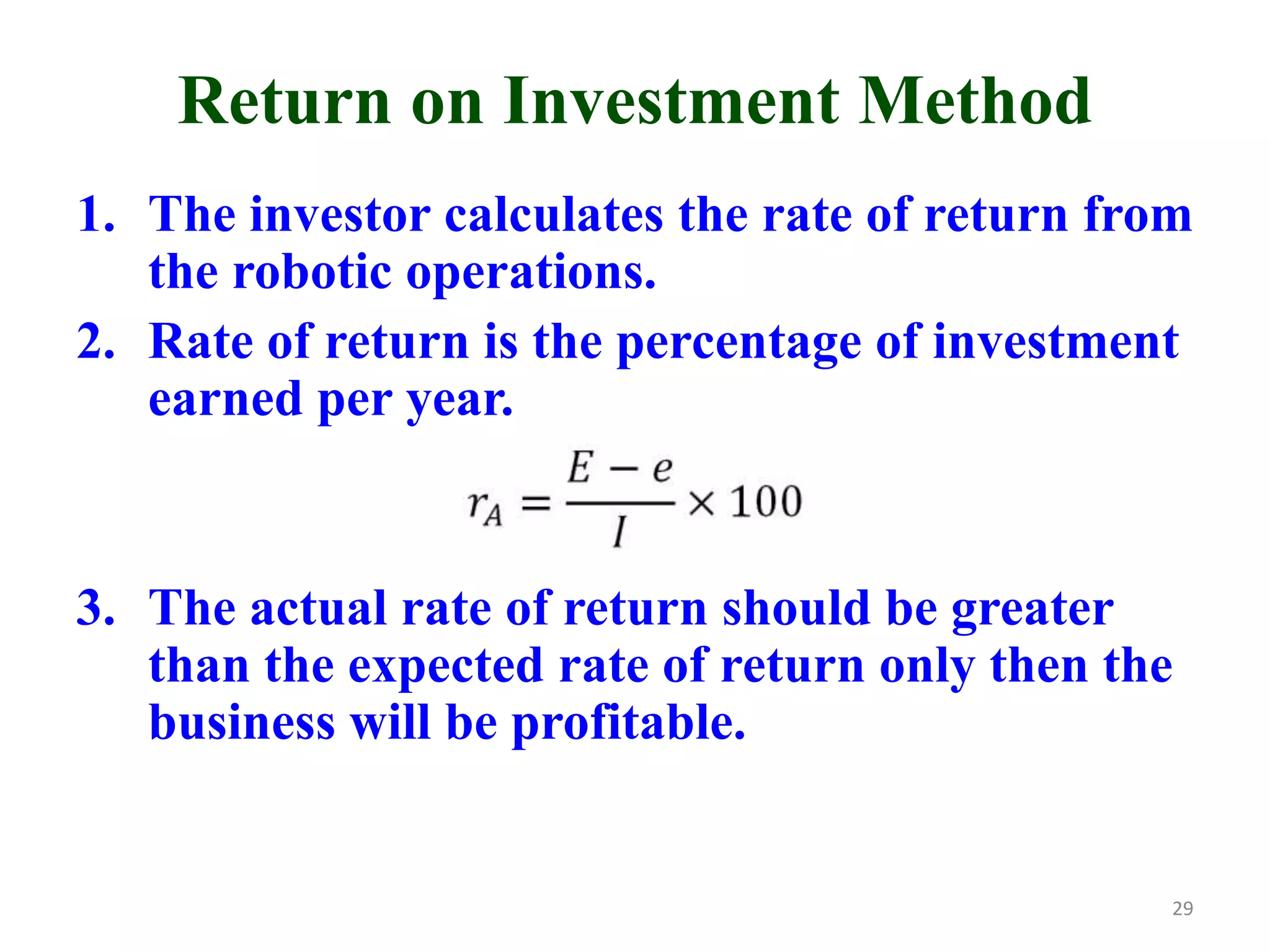
Return on Investment Method
1. The investor calculates the rate of return from
the robotic operations.
2. Rate of return is the percentage of investment
earned per year.
3. The actual rate of return should be greater
than the expected rate of return only then the
business will be profitable.
29
Robot Selection
1. A robot is selected by considering its
various operational parameters.
2. The features of a robot required to do the
required operations are determined in
advance using results of the study made by
the Industrial Engineering department.
3. The robot should meet the required
criteria so that it can perform all the
operations effectively to which it is
intended for.
30
Robot Selection Criteria
1. Precession – Accuracy, resolution and
repeatability.
2. Speed.
3. Payload.
4. Type of drive system.
5. Programming methods.
6. Memory capacity.
7. Number of Degrees of Freedom.
31
Robot Selection Criteria
8. Power interface.
9. Communication interface.
10. Availability of standard endeffectors.
11. Cost, the most important deciding factor.
32
End of the Presentation
Press Esc to Exit

10 robotic manufacturing systems

  • 1.
    10. ROBOTIC MANUFACTURING SYSTEMS D ES I G N A N D A P P L I C AT I O N S O F I N D U S T R I A L R O B OT S S A B A R I G I R I VA S A N . R I S B N 978-81-908268-0-8 10. ROBOTIC MANUFACTURING SYSTEMS D E S I G N A N D A P P L I C AT I O N S O F I N D U S T R I A L R O B OT S S A B A R I G I R I VA S A N . R I S B N 978-81-908268-0-8
  • 2.
    Robotic Manufacturing Systems 1.Robots are designed to automate manufacturing operations that are monotonous and dangerous in nature. 2. The manufacturing cell that is serviced by one or more robots is known as robot work cell. 3. The robot work cell should have complete set of hardware, software and cell control system. 2
  • 3.
    Structure of aRobot Work cell A robot work cell has the following equipments 1. Robots 2. Production machineries 3. Supply conveyor 4. Delivery conveyor 5. Cell controller 6. Communication peripherals 7. Protective barriers (Perimeter guard) 3
  • 4.
    Structure of aRobot Work cell Structure of a Robot Work cell M1 M2 M3 M1, M2, M3 – Production machines Protective barrier Robot Control panel for manual override Cell access door Supply conveyor Delivery conveyor D E S I G N A N D A P P L I C A T I O N S O F I N D U S T R I A L R O B O T S S A B A R I G I R I V A S A N . R 4
  • 5.
    Structure of aRobot Work cell Animation 5
  • 6.
    Classification of RobotWork cell Based on Number of Robots 1. Single robot work cell a) Only one robot is employed to perform all operations. b) Machine interference can occur. c) Interference is caused due to imbalance in machine cycle and robot service times. 2. Multiple robot work cell a) More than one robot will be employed to perform all the required operation. b) Cell control system is employed to avoid collision. 6
  • 7.
    Classification of RobotWork cell Based on the Position of Robots 1. Robot centered work cell. 2. Inline robot work cell. a) Intermittent part transfer b) Continuous part transfer 3. Mobile robot work cell a) Floor mounted rail system b) Overhead rail system 7
  • 8.
    Robot Centered WorkCell Robot Centered Work Cell Machine 1 Machine 3 Machine 5 Machine 2 Machine 4 RobotSupply conveyor Raw materials Delivery conveyor Finished products D E S I G N A N D A P P L I C A T I O N S O F I N D U S T R I A L R O B O T S S A B A R I G I R I V A S A N . R 8
  • 9.
    Robot Centered WorkCell Animation 9
  • 10.
    Inline Robot WorkCellInline Robot Work Cell Robot Work piece Moving production line D E S I G N A N D A P P L I C A T I O N S O F I N D U S T R I A L R O B O T S S A B A R I G I R I V A S A N . R 10
  • 11.
    Inline Robot WorkCell Animation 11
  • 12.
    Inline Robot WorkCell Animation 12
  • 13.
    Robot Work Cellfor Spot Welding (Inline work cell – Intermittent part transfer) Robot Work Cell for Spot Welding (Inline work cell – Intermittent part transfer) Robot Spot welding endeffector Car frameConveyor Robot D E S I G N A N D A P P L I C A T I O N S O F I N D U S T R I A L R O B O T S S A B A R I G I R I V A S A N . R 13
  • 14.
    Mobile Robot WorkCell – Floor Mounted Rail System Mobile Robot Work Cell Floor Mounted Rail System Machine 1 Machine 2 Carriage Robot Floor mounted rail D E S I G N A N D A P P L I C A T I O N S O F I N D U S T R I A L R O B O T S S A B A R I G I R I V A S A N . R 14
  • 15.
    Mobile Robot WorkCell – Floor Mounted Rail System Animation 15
  • 16.
    Mobile Robot WorkCell – Overhead Rail System Mobile Robot Work Cell Overhead Rail System D E S I G N A N D A P P L I C A T I O N S O F I N D U S T R I A L R O B O T S S A B A R I G I R I V A S A N . R Machine 1 Machine 2Supply conveyor Delivery conveyor Overhead rail RobotCarriage 16
  • 17.
    Mobile Robot WorkCell – Overhead Rail System Animation 17
  • 18.
    Safety Considerations 1. Safetyis of paramount importance in any industrial operation. 2. The robot should be protected from damaging itself and injuring humans while in action. 3. Everything in the cell should be maintained well and checked for safe operation so that no mishap occurs. 18
  • 19.
    Potential Hazards forSafety 1. Oil leaks in hydraulic robots and pressure loss in pneumatic robots. 2. Broken power cables. 3. Poor maintenance. 4. Poor quality of components. 5. Software errors. 6. Uncoordinated robot motion with the production machine. 19
  • 20.
    Potential Hazards forSafety 7. Careless attitude of workers. 8. Unauthorized entry of workers into the cell. 9. Careless attitude of management. 20
  • 21.
    Protective Measures 1. Providingmulti tier security system. 2. Intruder alarm and glowing sign boards should be provided. 3. The robot should be stopped on detecting an intruder. 4. Protective barriers like wire mesh or guard railings should be provided. 5. Robots should be clearly visible and painted in bright colours. 21
  • 22.
    Protective Measures 6. Cellaccess doors should get automatically locked while the robot is in action. 7. Control panel for manual override should be provided. 8. Emergency stop switch should be clearly visible and should be within easy reach. 9. Dormant state of the robot should be indicated by visible light signals. 22
  • 23.
    Protective Measures 10. Unwantedobjects should not be left inside the cell. 11. High quality components should be used. 12. Painting robots should be given proper covering. 13. Robot should be stopped if any of the sensor fails. 14. Adequate training and safety awareness should be imparted to the workers. 23
  • 24.
    Economic Considerations 1. Robotsare expensive equipments hence cost is an important factor to be considered while robotizing the production facility. 2. Robot costs a) Initial investment b) Operating cost c) Earnings and savings d) Miscellaneous costs 24
  • 25.
    Cost Comparison 1. Beforerobotizing, other production process should be considered to arrive an optimal conclusion. 2. Earnings made for certain production volume should be compared with manual production and fixed automation. 3. Only when substantial cost benefits are realized it will be a profitable business. 25
  • 26.
    Cost Comparison ChartCostComparison Chart Cost per unit Production volume Graph plotted against logarithmic scale on both the axes. B1, B2, B3 – Break even points B1 B2 B3 Robotic production Manual production Fixed automation D E S I G N A N D A P P L I C A T I O N S O F I N D U S T R I A L R O B O T S S A B A R I G I R I V A S A N . R 26
  • 27.
    Cost Estimation Two simpletechniques for making estimates of earnings to justify robotization are 1. Payback period method 2. Return on Investment method 27
  • 28.
    Payback Period Method 1.The investor calculates the payback period to recoup the money spent on robots. 2. Payback period is the time in years required to take back the money spent as investment and expenditure on robots. 3. Payback period is given as 4. The robot has salvage value after payback period. 28
  • 29.
    Return on InvestmentMethod 1. The investor calculates the rate of return from the robotic operations. 2. Rate of return is the percentage of investment earned per year. 3. The actual rate of return should be greater than the expected rate of return only then the business will be profitable. 29
  • 30.
    Robot Selection 1. Arobot is selected by considering its various operational parameters. 2. The features of a robot required to do the required operations are determined in advance using results of the study made by the Industrial Engineering department. 3. The robot should meet the required criteria so that it can perform all the operations effectively to which it is intended for. 30
  • 31.
    Robot Selection Criteria 1.Precession – Accuracy, resolution and repeatability. 2. Speed. 3. Payload. 4. Type of drive system. 5. Programming methods. 6. Memory capacity. 7. Number of Degrees of Freedom. 31
  • 32.
    Robot Selection Criteria 8.Power interface. 9. Communication interface. 10. Availability of standard endeffectors. 11. Cost, the most important deciding factor. 32
  • 33.
    End of thePresentation Press Esc to Exit