AX4092 - DISASTER MANAGEMENT
Mr. R. SHANMUGASUNDARAM
Assistant Professor
Dept. of Civil Engineering,
PSNACET
SYLLABUS
UNIT I - INTRODUCTION
Disaster: Definition, Factors and Significance; Difference between
Hazard And Disaster; Natural and Manmade Disasters: Difference,
Nature, Types and Magnitude.
UNIT II - REPERCUSSIONS OF DISASTERS AND HAZARDS
Economic Damage, Loss of Human and Animal Life, Destruction Of
Ecosystem. Natural Disasters: Earthquakes, Volcanisms, Cyclones,
Tsunamis, Floods, Droughts And Famines, Landslides And Avalanches,
Man-made disaster: Nuclear Reactor Meltdown, Industrial Accidents,
Oil Slicks And Spills, Outbreaks Of Disease And Epidemics, War And
Conflicts
UNIT III - DISASTER PRONE AREAS IN INDIA
Study of Seismic Zones; Areas Prone To Floods and Droughts,
Landslides And Avalanches; Areas Prone To Cyclonic and Coastal
Hazards with Special Reference To Tsunami; Post-Disaster Diseases
and Epidemics
UNIT IV - DISASTER PREPAREDNESS AND MANAGEMENT
Preparedness: Monitoring Of Phenomena Triggering a Disaster or
Hazard; Evaluation of Risk: Application of Remote Sensing, Data from
Meteorological And Other Agencies, Media Reports: Governmental and
Community Preparedness.
UNIT V - RISK ASSESSMENT
Disaster Risk: Concept and Elements, Disaster Risk Reduction, Global
and National Disaster Risk Situation. Techniques of Risk Assessment,
Global Co-Operation in Risk Assessment and Warning, People’s
Participation in Risk Assessment. Strategies for Survival
UNIT I - INTRODUCTION
• Disasters are serious disruptions to the functioning of
a community that exceed its capacity to cope using its
own resources
• A disaster is a sudden, calamitous event bringing
great damage, loss, destruction and devastation to life
and property.
• The damage caused by disasters is immeasurable and
varies with the geographical location, climate and
type of the earth surface/degree of vulnerability.
HAZARD:
• Phenomena that pose a threat to people, structures or
economic assets and which may cause a disaster.
• They could be either naturally occurring or manmade.
• Extent of damage in a disaster depends on
– Impact, intensity and characteristics of the
phenomenon.
– How people, environment and infrastructures are
affected by the phenomenon.
VULNERABILITY:
The extent to which a community, structure,
service and / or geographic area is likely to be damaged
or disrupted by the impact of particular hazard on
account of their nature, construction and proximity to
hazardous terrain or a disaster prone area.
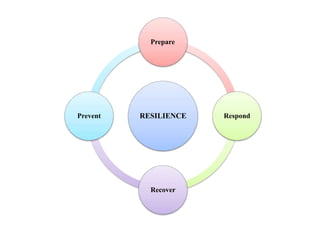
RESILIENCE:
The capacity to prevent, mitigate, prepare for, respond to
and recover from the impacts of disasters.
RESILIENCE
Prepare
Respond
Recover
Prevent
RISKS:
• It is a measure of the expected losses due to a
hazardous event of a particular event of a particular
magnitude occurring in a given area over a specific
time period.
• It is a function of probability of particular
occurrences and losses each would cause.
• The level of risks depends on
 Nature of Hazard
 Vulnerability of elements which are affected.
 Economic value of those elements.
Types of Disaster
Based on Nature of Hazardous Event:
1. Natural Disaster: A disaster caused by natural factors
called as a natural disaster e.g., earthquake, flood, ,
cyclone etc.
2. Man-made disaster: A disaster caused due to the
human activities e.g., epidemics, fire accidents,
industrial accidents etc.
3. Armed Conflict Related disaster: Eg. War, Genocide,
social violence
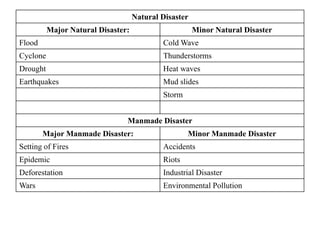
Natural Disaster
Major Natural Disaster: Minor Natural Disaster
Flood Cold Wave
Cyclone Thunderstorms
Drought Heat waves
Earthquakes Mud slides
Storm
Manmade Disaster
Major Manmade Disaster: Minor Manmade Disaster
Setting of Fires Accidents
Epidemic Riots
Deforestation Industrial Disaster
Wars Environmental Pollution
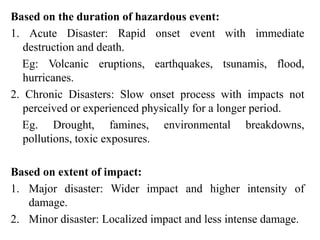
Based on the duration of hazardous event:
1. Acute Disaster: Rapid onset event with immediate
destruction and death.
Eg: Volcanic eruptions, earthquakes, tsunamis, flood,
hurricanes.
2. Chronic Disasters: Slow onset process with impacts not
perceived or experienced physically for a longer period.
Eg. Drought, famines, environmental breakdowns,
pollutions, toxic exposures.
Based on extent of impact:
1. Major disaster: Wider impact and higher intensity of
damage.
2. Minor disaster: Localized impact and less intense damage.
NATURAL DISASTER
• A natural disaster is "the negative impact following an
actual occurrence of natural hazard in the event that it
significantly harms a community".
• A natural disaster can cause loss of life or damage
property, and typically leaves some economic damage in
its wake.
• The severity of the damage depends on the affected
population's resilience and on the infrastructure
available.
There are 5 major types of natural disasters.
Geological disaster
• Changes in the above or underneath the earth's surface
cause geological disasters.
• Earthquakes, volcanic eruptions, landslides,
avalanches, etc., are examples of geological disasters.
Hydrological disaster
• Hydrological disasters are caused due to sudden
changes in the quality or distribution of water below
the earth’s surface or atmospheric conditions.
• Limnic eruption, Tsunami, Volcano, etc., are examples
of Hydrological disasters.
Meteorological disaster
• Meteorological disasters are mainly caused by extreme
weather conditions such as drought, snow, and rain.
• Examples of meteorological disasters include blizzards,
drought, cold waves, tornadoes, cyclonic storms, etc.
Space disaster
• This includes disasters caused due to asteroids,
meteors, and solar flares.
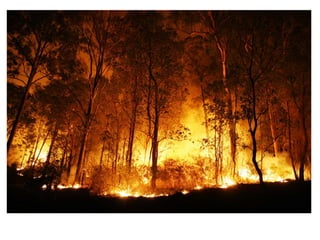
Wildfires
• Natural disasters like drought and lightning can lead to
wildfires.
Major Causes of Natural Disaster
• Natural phenomenon
• Moon activities
• Tectonic movement
• Soil erosion
• Deforestation
• Ocean currents
• Air pressure
• Seismic waves
• Pollution
• Global warming
• Mining
The common effects of natural disasters include
• Damages to infrastructure
• Food and water scarcity
• Public health issues and diseases
• Environmental issues
• Economic impact
• Fatalities
• Injuries and emotional impact
Preventive Measures:
• Preparing emergency measures- medical kits, keeping
a tab over weather updates
• Reforestation
• Risk reduction methods- building shelters and
stocking food supplies
• Information sharing
• Investing in technology for accurate weather
predictions
• Economic support
• Evacuating areas closer to disaster
• Don’t Move around or outruns a disaster
• Don’t Go near-live wire or debris
• Don’t take shelter under a flimsy structure
• Avoid standing under the trees
• Stay away from river or sea areas during cyclones
and floods
• Avoid using gas stoves or electronic gadgets during a
disaster.
These are some insurance policies individuals residing
in natural disaster-prone areas should check.
• Home Insurance: Insuring a house can be helpful
during disasters. The policy covers the damage caused
by natural events like floods, cyclones and storms.
Additionally, it also gives coverage against theft and
burglary.
• Life Insurance: A life insurance policy is a contract
between a policyholder and insurance company that
promises to pay a sum after the death of an insured
person. It offers an insured and his/her family financial
protection during unforeseen events. You can also find
some policies that offer additional add on options like
accidental death benefit, critical ill benefit, etc.
• Vehicle Insurance: Vehicle insurance gives
protection against natural calamities and disasters.
It also covers accidents and theft. Individuals can
avail the policy against their vehicle and get
compensation for damages caused by natural
disasters.
Man Made Disaster
• Man-made disasters have an element of human intent,
negligence, or error involving a failure of a man-made
system, as opposed to natural disasters resulting from
natural hazards.
• Such man-made disasters are crime, arson, civil disorder,
terrorism, war, biological/chemical threat, cyber-attacks,
etc.
• Anthropogenic hazards can be grouped into
 Societal hazards (criminality, civil
disorder, terrorism, war, industrial hazards,
engineering hazards, power outage, fire;
 Hazards caused by transportation and environmental
hazards.
• Man-made disasters can be divided into 3 categories:
• Technological Disasters: Examples include industrial
accidents like chemical spills, transportation accidents,
and mining accidents.
• Social Disasters: Examples include warfare, genocide,
civil unrest, hyperinflation, and terrorism.
• Environmental Disasters: Examples include
deforestation and climate change.
List of Man-Made Disasters by Type
• Chemical & Oil Spills
• Structural Collapse
• Drinking Water Contamination
• Transport Disasters / Accidents
• Mining Accidents
• Explosions and Fires
• Nuclear and Radiation Accidents
• Electric Failures
• War, Riots, Strikes
• Genocide
Terrorism
• Terrorism is the use of force or violence against persons
or property in violation of the criminal laws of the
United States for purposes of intimidation, coercion, or
ransom.
• Terrorists often use threats to create fear among the
public to try to convince citizens that their government
is powerless to prevent terrorism and to get immediate
publicity for their causes.
• Acts of terrorism range from threats of terrorism,
assassinations, kidnappings, hijackings, bomb scares
and bombings, and cyber attacks (computer-based), to
the use of chemical, biological, and nuclear weapons.
KEY TERMS
• Hazard: a threat (natural or human) that has the potential to
cause loss of life, injury, property damage, socio-economic
disruption or environmental degradation.
• Hazard event: the occurrence of a hazard eg. an earthquake
• Disaster: a major hazard event that causes widespread
disruption to a community or region, with significant
demographic, economic and/or environmental losses, and
which the affected community is unable to deal with
adequately without outside help.
• Vulnerability: the geographical conditions that increases the
susceptibility of a community to a hazard or to the impact of a
hazard event.
• Risk: the probability of a hazard event causing harmful
consequences (loss of life, injuries damage)
WHAT DETERMINES THE
SEVERITY OF A HAZARD?
• Duration: The length of time that a hazard lasts for. As a
general rule the longer the hazard the more severe it is likely to
be.
• For example and earthquake that lasts 1 minute is likely to be
more severe than one that last two seconds and a drought that
lasts ten years is likely to be more severe than one that last
three months.
• Magnitude: This is the strength of a hazard. Most hazards are
measured on a scale e.g. the Richter scale or the volcanic
explosivity index (VEI).
• Generally speaking, the stronger the hazard the more severe
the hazard is.
• Predictability: Some hazards are easier to predict than
others.
• For example, volcanoes normally give warning signs before
they erupt and tropical storms can be tracked from
development to landfall. However, others like earthquakes
are much harder to predict.
• Generally speaking hazards that hit with no warning are
going to be more serious.
• Regularity: If hazards happen often and in quick
succession e.g. a earthquake followed by multiple
aftershocks then then the severity is likely to be greater.
• During hurricane seasons, countries can be hit by repeated
storms each causing greater damage because it has not been
possible to recover from previous damage.
• Frequency: The return interval of hazards of certain sizes. If
the hazard is a less frequent strong event, then it is going to
have a bigger impact.
• Speed of onset: If the peak of the hazard arrives first or
arrives quickly e.g. an earthquake, then the affects are likely
to be worse than one that arrives slowly e.g. a drought.
• Spatial concentration: Where hazards are located or centred.
• For example earthquakes tended to be focused along plate
boundaries, whereas tropical storms tend to be located in
coastal areas in the tropics.
• Hazards that are located in known areas can be better
prepared for and managed better.
• Areal extent: If a hazard covers a large area e.g. a
drought covering the whole of East Africa, then the
severity of the hazard is likely to be more severe, than
a flood hitting just one village.
• Number of hazards: If a location is hit by multiple
hazards that the affects can be more severe.
• For example hazard hotspots like Indonesia can be hit
by earthquakes, volcanoes, landslides and flooding all
simultaneously.
• As a general rule as the magnitude of a hazard
increases, the frequency of the hazard happening
actually decreases.

UNIT 1 - INTRODUCTION ON DISASTER MANAGEMENT.ppt

  • 1.
    AX4092 - DISASTERMANAGEMENT Mr. R. SHANMUGASUNDARAM Assistant Professor Dept. of Civil Engineering, PSNACET
  • 2.
    SYLLABUS UNIT I -INTRODUCTION Disaster: Definition, Factors and Significance; Difference between Hazard And Disaster; Natural and Manmade Disasters: Difference, Nature, Types and Magnitude. UNIT II - REPERCUSSIONS OF DISASTERS AND HAZARDS Economic Damage, Loss of Human and Animal Life, Destruction Of Ecosystem. Natural Disasters: Earthquakes, Volcanisms, Cyclones, Tsunamis, Floods, Droughts And Famines, Landslides And Avalanches, Man-made disaster: Nuclear Reactor Meltdown, Industrial Accidents, Oil Slicks And Spills, Outbreaks Of Disease And Epidemics, War And Conflicts
  • 3.
    UNIT III -DISASTER PRONE AREAS IN INDIA Study of Seismic Zones; Areas Prone To Floods and Droughts, Landslides And Avalanches; Areas Prone To Cyclonic and Coastal Hazards with Special Reference To Tsunami; Post-Disaster Diseases and Epidemics UNIT IV - DISASTER PREPAREDNESS AND MANAGEMENT Preparedness: Monitoring Of Phenomena Triggering a Disaster or Hazard; Evaluation of Risk: Application of Remote Sensing, Data from Meteorological And Other Agencies, Media Reports: Governmental and Community Preparedness. UNIT V - RISK ASSESSMENT Disaster Risk: Concept and Elements, Disaster Risk Reduction, Global and National Disaster Risk Situation. Techniques of Risk Assessment, Global Co-Operation in Risk Assessment and Warning, People’s Participation in Risk Assessment. Strategies for Survival
  • 4.
    UNIT I -INTRODUCTION • Disasters are serious disruptions to the functioning of a community that exceed its capacity to cope using its own resources • A disaster is a sudden, calamitous event bringing great damage, loss, destruction and devastation to life and property. • The damage caused by disasters is immeasurable and varies with the geographical location, climate and type of the earth surface/degree of vulnerability.
  • 8.
    HAZARD: • Phenomena thatpose a threat to people, structures or economic assets and which may cause a disaster. • They could be either naturally occurring or manmade. • Extent of damage in a disaster depends on – Impact, intensity and characteristics of the phenomenon. – How people, environment and infrastructures are affected by the phenomenon.
  • 9.
    VULNERABILITY: The extent towhich a community, structure, service and / or geographic area is likely to be damaged or disrupted by the impact of particular hazard on account of their nature, construction and proximity to hazardous terrain or a disaster prone area. RESILIENCE: The capacity to prevent, mitigate, prepare for, respond to and recover from the impacts of disasters.
  • 10.
  • 11.
    RISKS: • It isa measure of the expected losses due to a hazardous event of a particular event of a particular magnitude occurring in a given area over a specific time period. • It is a function of probability of particular occurrences and losses each would cause. • The level of risks depends on  Nature of Hazard  Vulnerability of elements which are affected.  Economic value of those elements.
  • 12.
    Types of Disaster Basedon Nature of Hazardous Event: 1. Natural Disaster: A disaster caused by natural factors called as a natural disaster e.g., earthquake, flood, , cyclone etc. 2. Man-made disaster: A disaster caused due to the human activities e.g., epidemics, fire accidents, industrial accidents etc. 3. Armed Conflict Related disaster: Eg. War, Genocide, social violence
  • 13.
    Natural Disaster Major NaturalDisaster: Minor Natural Disaster Flood Cold Wave Cyclone Thunderstorms Drought Heat waves Earthquakes Mud slides Storm Manmade Disaster Major Manmade Disaster: Minor Manmade Disaster Setting of Fires Accidents Epidemic Riots Deforestation Industrial Disaster Wars Environmental Pollution
  • 14.
    Based on theduration of hazardous event: 1. Acute Disaster: Rapid onset event with immediate destruction and death. Eg: Volcanic eruptions, earthquakes, tsunamis, flood, hurricanes. 2. Chronic Disasters: Slow onset process with impacts not perceived or experienced physically for a longer period. Eg. Drought, famines, environmental breakdowns, pollutions, toxic exposures. Based on extent of impact: 1. Major disaster: Wider impact and higher intensity of damage. 2. Minor disaster: Localized impact and less intense damage.
  • 15.
    NATURAL DISASTER • Anatural disaster is "the negative impact following an actual occurrence of natural hazard in the event that it significantly harms a community". • A natural disaster can cause loss of life or damage property, and typically leaves some economic damage in its wake. • The severity of the damage depends on the affected population's resilience and on the infrastructure available.
  • 16.
    There are 5major types of natural disasters. Geological disaster • Changes in the above or underneath the earth's surface cause geological disasters. • Earthquakes, volcanic eruptions, landslides, avalanches, etc., are examples of geological disasters. Hydrological disaster • Hydrological disasters are caused due to sudden changes in the quality or distribution of water below the earth’s surface or atmospheric conditions. • Limnic eruption, Tsunami, Volcano, etc., are examples of Hydrological disasters.
  • 17.
    Meteorological disaster • Meteorologicaldisasters are mainly caused by extreme weather conditions such as drought, snow, and rain. • Examples of meteorological disasters include blizzards, drought, cold waves, tornadoes, cyclonic storms, etc. Space disaster • This includes disasters caused due to asteroids, meteors, and solar flares. Wildfires • Natural disasters like drought and lightning can lead to wildfires.
  • 18.
    Major Causes ofNatural Disaster • Natural phenomenon • Moon activities • Tectonic movement • Soil erosion • Deforestation • Ocean currents • Air pressure • Seismic waves • Pollution • Global warming • Mining
  • 19.
    The common effectsof natural disasters include • Damages to infrastructure • Food and water scarcity • Public health issues and diseases • Environmental issues • Economic impact • Fatalities • Injuries and emotional impact
  • 20.
    Preventive Measures: • Preparingemergency measures- medical kits, keeping a tab over weather updates • Reforestation • Risk reduction methods- building shelters and stocking food supplies • Information sharing • Investing in technology for accurate weather predictions • Economic support • Evacuating areas closer to disaster
  • 21.
    • Don’t Movearound or outruns a disaster • Don’t Go near-live wire or debris • Don’t take shelter under a flimsy structure • Avoid standing under the trees • Stay away from river or sea areas during cyclones and floods • Avoid using gas stoves or electronic gadgets during a disaster.
  • 22.
    These are someinsurance policies individuals residing in natural disaster-prone areas should check. • Home Insurance: Insuring a house can be helpful during disasters. The policy covers the damage caused by natural events like floods, cyclones and storms. Additionally, it also gives coverage against theft and burglary. • Life Insurance: A life insurance policy is a contract between a policyholder and insurance company that promises to pay a sum after the death of an insured person. It offers an insured and his/her family financial protection during unforeseen events. You can also find some policies that offer additional add on options like accidental death benefit, critical ill benefit, etc.
  • 23.
    • Vehicle Insurance:Vehicle insurance gives protection against natural calamities and disasters. It also covers accidents and theft. Individuals can avail the policy against their vehicle and get compensation for damages caused by natural disasters.
  • 24.
    Man Made Disaster •Man-made disasters have an element of human intent, negligence, or error involving a failure of a man-made system, as opposed to natural disasters resulting from natural hazards. • Such man-made disasters are crime, arson, civil disorder, terrorism, war, biological/chemical threat, cyber-attacks, etc. • Anthropogenic hazards can be grouped into  Societal hazards (criminality, civil disorder, terrorism, war, industrial hazards, engineering hazards, power outage, fire;  Hazards caused by transportation and environmental hazards.
  • 25.
    • Man-made disasterscan be divided into 3 categories: • Technological Disasters: Examples include industrial accidents like chemical spills, transportation accidents, and mining accidents. • Social Disasters: Examples include warfare, genocide, civil unrest, hyperinflation, and terrorism. • Environmental Disasters: Examples include deforestation and climate change.
  • 26.
    List of Man-MadeDisasters by Type • Chemical & Oil Spills • Structural Collapse • Drinking Water Contamination • Transport Disasters / Accidents • Mining Accidents • Explosions and Fires • Nuclear and Radiation Accidents • Electric Failures • War, Riots, Strikes • Genocide
  • 27.
    Terrorism • Terrorism isthe use of force or violence against persons or property in violation of the criminal laws of the United States for purposes of intimidation, coercion, or ransom. • Terrorists often use threats to create fear among the public to try to convince citizens that their government is powerless to prevent terrorism and to get immediate publicity for their causes. • Acts of terrorism range from threats of terrorism, assassinations, kidnappings, hijackings, bomb scares and bombings, and cyber attacks (computer-based), to the use of chemical, biological, and nuclear weapons.
  • 28.
    KEY TERMS • Hazard:a threat (natural or human) that has the potential to cause loss of life, injury, property damage, socio-economic disruption or environmental degradation. • Hazard event: the occurrence of a hazard eg. an earthquake • Disaster: a major hazard event that causes widespread disruption to a community or region, with significant demographic, economic and/or environmental losses, and which the affected community is unable to deal with adequately without outside help. • Vulnerability: the geographical conditions that increases the susceptibility of a community to a hazard or to the impact of a hazard event. • Risk: the probability of a hazard event causing harmful consequences (loss of life, injuries damage)
  • 29.
    WHAT DETERMINES THE SEVERITYOF A HAZARD? • Duration: The length of time that a hazard lasts for. As a general rule the longer the hazard the more severe it is likely to be. • For example and earthquake that lasts 1 minute is likely to be more severe than one that last two seconds and a drought that lasts ten years is likely to be more severe than one that last three months. • Magnitude: This is the strength of a hazard. Most hazards are measured on a scale e.g. the Richter scale or the volcanic explosivity index (VEI). • Generally speaking, the stronger the hazard the more severe the hazard is.
  • 30.
    • Predictability: Somehazards are easier to predict than others. • For example, volcanoes normally give warning signs before they erupt and tropical storms can be tracked from development to landfall. However, others like earthquakes are much harder to predict. • Generally speaking hazards that hit with no warning are going to be more serious. • Regularity: If hazards happen often and in quick succession e.g. a earthquake followed by multiple aftershocks then then the severity is likely to be greater. • During hurricane seasons, countries can be hit by repeated storms each causing greater damage because it has not been possible to recover from previous damage.
  • 31.
    • Frequency: Thereturn interval of hazards of certain sizes. If the hazard is a less frequent strong event, then it is going to have a bigger impact. • Speed of onset: If the peak of the hazard arrives first or arrives quickly e.g. an earthquake, then the affects are likely to be worse than one that arrives slowly e.g. a drought. • Spatial concentration: Where hazards are located or centred. • For example earthquakes tended to be focused along plate boundaries, whereas tropical storms tend to be located in coastal areas in the tropics. • Hazards that are located in known areas can be better prepared for and managed better.
  • 32.
    • Areal extent:If a hazard covers a large area e.g. a drought covering the whole of East Africa, then the severity of the hazard is likely to be more severe, than a flood hitting just one village. • Number of hazards: If a location is hit by multiple hazards that the affects can be more severe. • For example hazard hotspots like Indonesia can be hit by earthquakes, volcanoes, landslides and flooding all simultaneously. • As a general rule as the magnitude of a hazard increases, the frequency of the hazard happening actually decreases.