1
DISASTER RISK REDUCTION AND
CLIMATE CHANGE (ADAPTATION) –
THE NEEDS FOR HARMONIZATION
www.grforum.org
CONTACT INFORMATION
Global Risk Forum GRF Davos
Promenade 35
CH-7270 Davos
Phone: +41 (0) 81 414 1600
Fax: +41 (0) 81 414 1610
info@grforum.org
www.grforum.org
Walter J. Ammann
President and CEO Global Risk Forum GRF Davos
walter.ammann@grforum.org
2
• The link between natural disasters and climate
change
• Disaster risk reduction and the need to
harmonize with climate change adaptation
• .....and how to combine disaster risk reduction
not only with climate change adaptation but also
with climate change mitigation (example
combatting land degradation).
INTRODUCTION
3
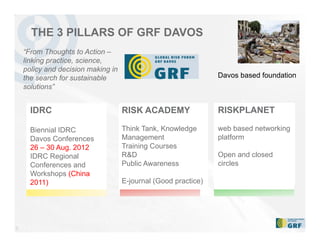
THE 3 PILLARS OF GRF DAVOS
RISKPLANET
web based networking
platform
Open and closed
circles
RISK ACADEMY
Think Tank, Knowledge
Management
Training Courses
R&D
Public Awareness
E-journal (Good practice)
IDRC
Biennial IDRC
Davos Conferences
26 – 30 Aug. 2012
IDRC Regional
Conferences and
Workshops (China
2011)
“From Thoughts to Action –
linking practice, science,
policy and decision making in
the search for sustainable
solutions”
Davos based foundation
4
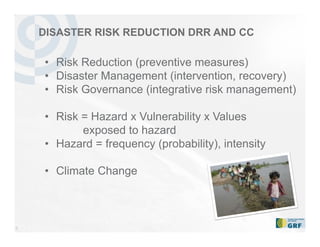
• Risk Reduction (preventive measures)
• Disaster Management (intervention, recovery)
• Risk Governance (integrative risk management)
• Risk = Hazard x Vulnerability x Values
exposed to hazard
• Hazard = frequency (probability), intensity
• Climate Change
DISASTER RISK REDUCTION DRR AND CC
5
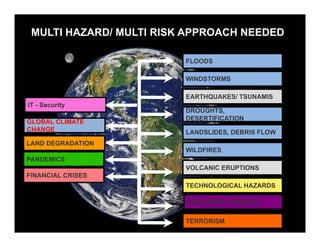
FLOODS
WINDSTORMS
EARTHQUAKES/ TSUNAMIS
DROUGHTS,
DESERTIFICATION
LANDSLIDES, DEBRIS FLOW
WILDFIRES
VOLCANIC ERUPTIONS
TECHNOLOGICAL HAZARDS
GLOBAL CLIMATE
CHANGE
TERRORISM
LAND DEGRADATION
PANDEMICS
FINANCIAL CRISES
BIOLOGICAL THREATS
MULTI HAZARD/ MULTI RISK APPROACH NEEDED
IT - Security
6
7
8
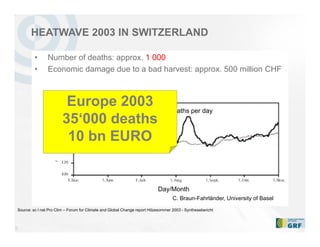
HEATWAVE 2003 IN SWITZERLAND
• Number of deaths: approx. 1 000
• Economic damage due to a bad harvest: approx. 500 million CHF
Source: sc l nat Pro Clim – Forum for Climate and Global Change report Hitzesommer 2003 - Synthesebericht
C. Braun-Fahrländer, University of Basel
Day/Month
Number of deaths per day
Europe 2003
35‘000 deaths
10 bn EURO
9
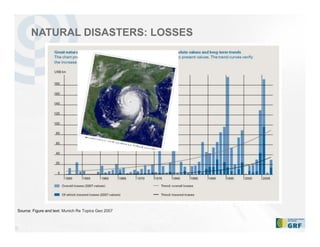
NATURAL DISASTERS: LOSSES
Source: Figure and text: Munich Re Topics Geo 2007
10
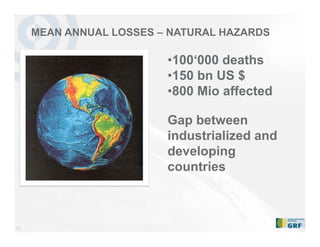
MEAN ANNUAL LOSSES – NATURAL HAZARDS
•100‘000 deaths
•150 bn US $
•800 Mio affected
Gap between
industrialized and
developing
countries
11
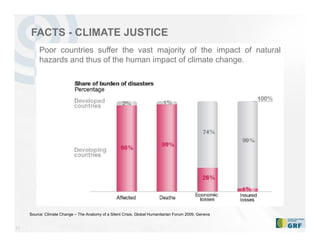
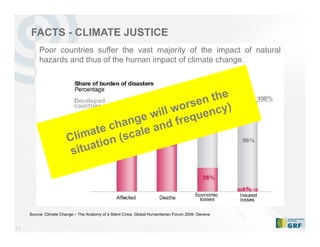
FACTS - CLIMATE JUSTICE
Poor countries suffer the vast majority of the impact of natural
hazards and thus of the human impact of climate change.
Source: Climate Change – The Anatomy of a Silent Crisis, Global Humanitarian Forum 2009, Geneva
12
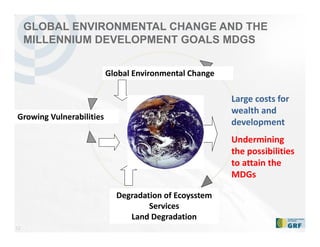
GLOBAL ENVIRONMENTAL CHANGE AND THE
MILLENNIUM DEVELOPMENT GOALS MDGS
Global Environmental Change
Degradation of Ecoysstem 
Services
Land Degradation
Growing Vulnerabilities
Large costs for 
wealth and 
development
Undermining 
the possibilities 
to attain the 
MDGs
13
FACTS - CLIMATE JUSTICE
Poor countries suffer the vast majority of the impact of natural
hazards and thus of the human impact of climate change.
Source: Climate Change – The Anatomy of a Silent Crisis, Global Humanitarian Forum 2009, Geneva
14
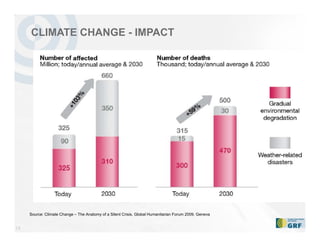
CLIMATE CHANGE - IMPACT
Source: Climate Change – The Anatomy of a Silent Crisis, Global Humanitarian Forum 2009, Geneva
15
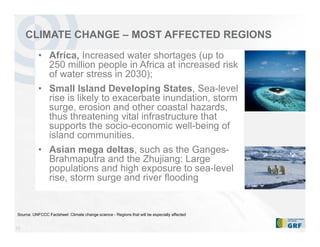
CLIMATE CHANGE – MOST AFFECTED REGIONS
• Africa, Increased water shortages (up to
250 million people in Africa at increased risk
of water stress in 2030);
• Small Island Developing States, Sea-level
rise is likely to exacerbate inundation, storm
surge, erosion and other coastal hazards,
thus threatening vital infrastructure that
supports the socio-economic well-being of
island communities.
• Asian mega deltas, such as the Ganges-
Brahmaputra and the Zhujiang: Large
populations and high exposure to sea-level
rise, storm surge and river flooding
Source: UNFCCC Factsheet: Climate change science - Regions that will be especially affected
16
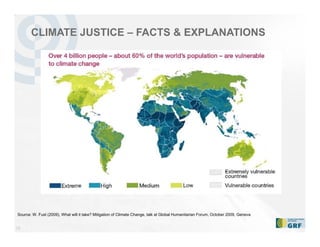
CLIMATE JUSTICE – FACTS & EXPLANATIONS
Source: W. Fust (2009), What will it take? Mitigation of Climate Change, talk at Global Humanitarian Forum, October 2009, Geneva
17
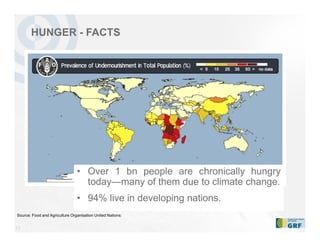
HUNGER - FACTS
Source: Food and Agriculture Organisation United Nations:
• Over 1 bn people are chronically hungry
today—many of them due to climate change.
• 94% live in developing nations.
18
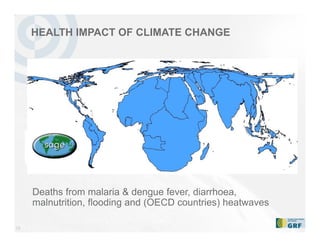
Deaths from malaria & dengue fever, diarrhoea,
malnutrition, flooding and (OECD countries) heatwaves
HEALTH IMPACT OF CLIMATE CHANGE
19
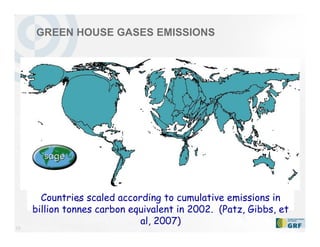
Countries scaled according to cumulative emissions in
billion tonnes carbon equivalent in 2002. (Patz, Gibbs, et
al, 2007)
GREEN HOUSE GASES EMISSIONS
20
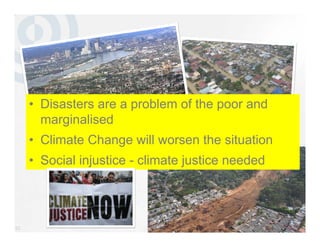
• Disasters are a problem of the poor and
marginalised
• Climate Change will worsen the situation
• Social injustice - climate justice needed
• Disasters are a problem of the poor and
marginalised
• Climate Change will worsen the situation
• Social injustice - climate justice needed
21
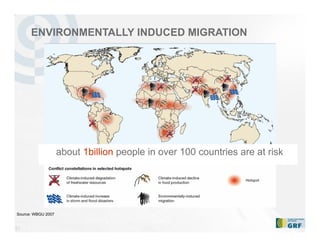
ENVIRONMENTALLY INDUCED MIGRATION
Source: WBGU 2007
about 1billion people in over 100 countries are at risk
22
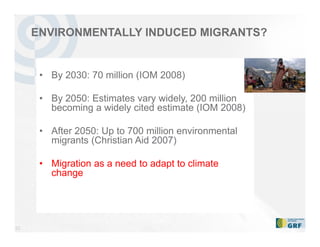
ENVIRONMENTALLY INDUCED MIGRANTS?
• By 2030: 70 million (IOM 2008)
• By 2050: Estimates vary widely, 200 million
becoming a widely cited estimate (IOM 2008)
• After 2050: Up to 700 million environmental
migrants (Christian Aid 2007)
• Migration as a need to adapt to climate
change
23
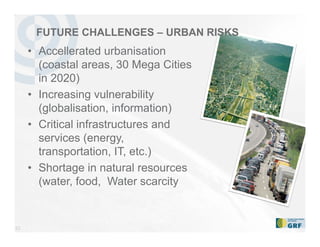
• Accellerated urbanisation
(coastal areas, 30 Mega Cities
in 2020)
• Increasing vulnerability
(globalisation, information)
• Critical infrastructures and
services (energy,
transportation, IT, etc.)
• Shortage in natural resources
(water, food, Water scarcity
FUTURE CHALLENGES – URBAN RISKS
24
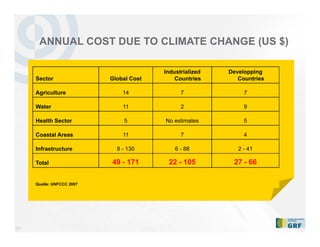
ANNUAL COST DUE TO CLIMATE CHANGE (US $)
Sector Global Cost
Industrialized
Countries
Developping
Countries
Agriculture 14 7 7
Water 11 2 9
Health Sector 5 No estimates 5
Coastal Areas 11 7 4
Infrastructure 8 - 130 6 - 88 2 - 41
Total 49 - 171 22 - 105 27 - 66
Quelle: UNFCCC 2007
25
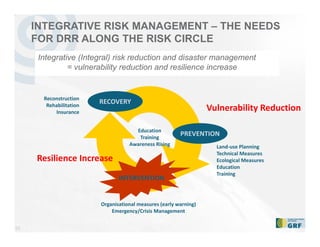
INTEGRATIVE RISK MANAGEMENT – THE NEEDS
FOR DRR ALONG THE RISK CIRCLE
Integrative (Integral) risk reduction and disaster management
= vulnerability reduction and resilience increase
RECOVERY
INTERVENTION
PREVENTION
Reconstruction
Rehabilitation
Insurance
Land‐use Planning
Technical Measures
Ecological Measures
Education
Training
Organisational measures (early warning)
Emergency/Crisis Management
Education
Training
Awareness Rising
Vulnerability Reduction
Resilience Increase
26
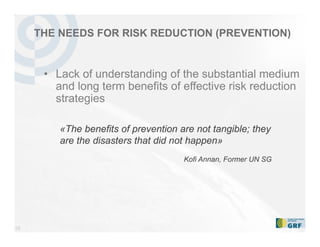
• Lack of understanding of the substantial medium
and long term benefits of effective risk reduction
strategies
THE NEEDS FOR RISK REDUCTION (PREVENTION)
«The benefits of prevention are not tangible; they
are the disasters that did not happen»
Kofi Annan, Former UN SG
27
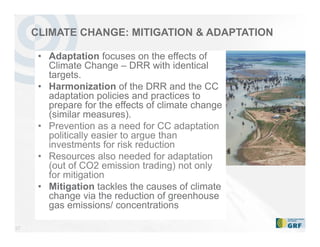
CLIMATE CHANGE: MITIGATION & ADAPTATION
• Adaptation focuses on the effects of
Climate Change – DRR with identical
targets.
• Harmonization of the DRR and the CC
adaptation policies and practices to
prepare for the effects of climate change
(similar measures).
• Prevention as a need for CC adaptation
politically easier to argue than
investments for risk reduction
• Resources also needed for adaptation
(out of CO2 emission trading) not only
for mitigation
• Mitigation tackles the causes of climate
change via the reduction of greenhouse
gas emissions/ concentrations
28
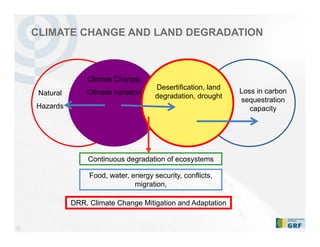
Climate Change,
Climate variation
Desertification, land
degradation, drought
Continuous degradation of ecosystems
Food, water, energy security, conflicts,
migration,
Natural
Hazards
DRR, Climate Change Mitigation and Adaptation
Loss in carbon
sequestration
capacity
CLIMATE CHANGE AND LAND DEGRADATION
29
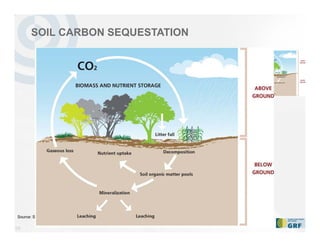
SOIL CARBON SEQUESTATION
• Soil carbon sequestration is the process of
transferring carbon dioxide from the atmosphere into
the soil through crop residues and other organic
solids, and in a form that is not immediately reemitted.
• Soil carbon sequestration can be accomplished by
management systems that add high amounts of
biomass to the soil, cause minimal soil disturbance,
etc.
• This transfer of carbon helps off-set emissions
from fossil fuel combustion and other carbon-emitting
activities.
Source: Soil Carbon Sequestration— Fundamentals online at: http://ohioline.osu.edu/aex-fact/pdf/0510.pdf
30
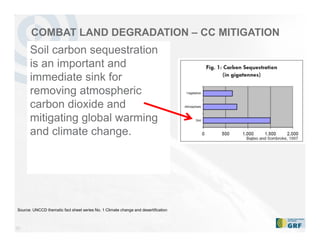
COMBAT LAND DEGRADATION – CC MITIGATION
Soil carbon sequestration
is an important and
immediate sink for
removing atmospheric
carbon dioxide and
mitigating global warming
and climate change.
Source: UNCCD thematic fact sheet series No. 1 Climate change and desertification
31
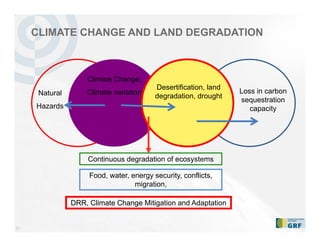
Climate Change,
Climate variation
Desertification, land
degradation, drought
Continuous degradation of ecosystems
Food, water, energy security, conflicts,
migration,
Natural
Hazards
DRR, Climate Change Mitigation and Adaptation
Loss in carbon
sequestration
capacity
CLIMATE CHANGE AND LAND DEGRADATION
32
WILD World Initiative to combat Land
Degradation
DLDD, Climate Change, Risk and Security - An
Integrative Approach. A joint campaign and work
programme fostering sustainable investments for
integrated risk reduction and disaster management in
the drylands
30 September 2010 Walter AmmannAVINA‐Stiftung
33
WILD and its context to climate change
• The top-soils are among the most efficient carbon
sequestration media
• Combating land degradation, in particular prevention
in eroding top-soils due to meteorological events
supports carbon sequestration
• WILD therefore – as a combined effort - reduces the
vulnerability of ecological systems due to natural
hazards (Climate change adaptation) and supports
sequestration of CO2 (climate change mitigation).
• Resources for mitigation easier available than for
adaptation
30 September 2010 Walter AmmannAVINA‐Stiftung
34
• The link between natural disasters and climate
change
• Disaster risk reduction and the need to
harmonize with climate change adaptation
• .....and how to combine disaster risk reduction
not only with climate change adaptation but also
with climate change mitigation (example
combatting land degradation).
SUMMARY
35
FROM THOUGHTS TO ACTION!
THANK YOU FOR YOUR
ATTENTION!
CONTACT INFORMATION
Global Risk Forum GRF Davos
Promenade 35
CH-7270 Davos
Phone: +41 (0) 81 414 1600
Fax: +41 (0) 81 414 1610
info@grforum.org
www.grforum.org
walter.amman@grforum.org

DISASTER RISK REDUCTION AND CLIMATE CHANGE (ADAPTATION) – THE NEEDS FOR HARMONIZATION

  • 1.
    1 DISASTER RISK REDUCTIONAND CLIMATE CHANGE (ADAPTATION) – THE NEEDS FOR HARMONIZATION www.grforum.org CONTACT INFORMATION Global Risk Forum GRF Davos Promenade 35 CH-7270 Davos Phone: +41 (0) 81 414 1600 Fax: +41 (0) 81 414 1610 info@grforum.org www.grforum.org Walter J. Ammann President and CEO Global Risk Forum GRF Davos walter.ammann@grforum.org
  • 2.
    2 • The linkbetween natural disasters and climate change • Disaster risk reduction and the need to harmonize with climate change adaptation • .....and how to combine disaster risk reduction not only with climate change adaptation but also with climate change mitigation (example combatting land degradation). INTRODUCTION
  • 3.
    3 THE 3 PILLARSOF GRF DAVOS RISKPLANET web based networking platform Open and closed circles RISK ACADEMY Think Tank, Knowledge Management Training Courses R&D Public Awareness E-journal (Good practice) IDRC Biennial IDRC Davos Conferences 26 – 30 Aug. 2012 IDRC Regional Conferences and Workshops (China 2011) “From Thoughts to Action – linking practice, science, policy and decision making in the search for sustainable solutions” Davos based foundation
  • 4.
    4 • Risk Reduction(preventive measures) • Disaster Management (intervention, recovery) • Risk Governance (integrative risk management) • Risk = Hazard x Vulnerability x Values exposed to hazard • Hazard = frequency (probability), intensity • Climate Change DISASTER RISK REDUCTION DRR AND CC
  • 5.
    5 FLOODS WINDSTORMS EARTHQUAKES/ TSUNAMIS DROUGHTS, DESERTIFICATION LANDSLIDES, DEBRISFLOW WILDFIRES VOLCANIC ERUPTIONS TECHNOLOGICAL HAZARDS GLOBAL CLIMATE CHANGE TERRORISM LAND DEGRADATION PANDEMICS FINANCIAL CRISES BIOLOGICAL THREATS MULTI HAZARD/ MULTI RISK APPROACH NEEDED IT - Security
  • 6.
  • 7.
  • 8.
    8 HEATWAVE 2003 INSWITZERLAND • Number of deaths: approx. 1 000 • Economic damage due to a bad harvest: approx. 500 million CHF Source: sc l nat Pro Clim – Forum for Climate and Global Change report Hitzesommer 2003 - Synthesebericht C. Braun-Fahrländer, University of Basel Day/Month Number of deaths per day Europe 2003 35‘000 deaths 10 bn EURO
  • 9.
    9 NATURAL DISASTERS: LOSSES Source:Figure and text: Munich Re Topics Geo 2007
  • 10.
    10 MEAN ANNUAL LOSSES– NATURAL HAZARDS •100‘000 deaths •150 bn US $ •800 Mio affected Gap between industrialized and developing countries
  • 11.
    11 FACTS - CLIMATEJUSTICE Poor countries suffer the vast majority of the impact of natural hazards and thus of the human impact of climate change. Source: Climate Change – The Anatomy of a Silent Crisis, Global Humanitarian Forum 2009, Geneva
  • 12.
    12 GLOBAL ENVIRONMENTAL CHANGEAND THE MILLENNIUM DEVELOPMENT GOALS MDGS Global Environmental Change Degradation of Ecoysstem  Services Land Degradation Growing Vulnerabilities Large costs for  wealth and  development Undermining  the possibilities  to attain the  MDGs
  • 13.
    13 FACTS - CLIMATEJUSTICE Poor countries suffer the vast majority of the impact of natural hazards and thus of the human impact of climate change. Source: Climate Change – The Anatomy of a Silent Crisis, Global Humanitarian Forum 2009, Geneva
  • 14.
    14 CLIMATE CHANGE -IMPACT Source: Climate Change – The Anatomy of a Silent Crisis, Global Humanitarian Forum 2009, Geneva
  • 15.
    15 CLIMATE CHANGE –MOST AFFECTED REGIONS • Africa, Increased water shortages (up to 250 million people in Africa at increased risk of water stress in 2030); • Small Island Developing States, Sea-level rise is likely to exacerbate inundation, storm surge, erosion and other coastal hazards, thus threatening vital infrastructure that supports the socio-economic well-being of island communities. • Asian mega deltas, such as the Ganges- Brahmaputra and the Zhujiang: Large populations and high exposure to sea-level rise, storm surge and river flooding Source: UNFCCC Factsheet: Climate change science - Regions that will be especially affected
  • 16.
    16 CLIMATE JUSTICE –FACTS & EXPLANATIONS Source: W. Fust (2009), What will it take? Mitigation of Climate Change, talk at Global Humanitarian Forum, October 2009, Geneva
  • 17.
    17 HUNGER - FACTS Source:Food and Agriculture Organisation United Nations: • Over 1 bn people are chronically hungry today—many of them due to climate change. • 94% live in developing nations.
  • 18.
    18 Deaths from malaria& dengue fever, diarrhoea, malnutrition, flooding and (OECD countries) heatwaves HEALTH IMPACT OF CLIMATE CHANGE
  • 19.
    19 Countries scaled accordingto cumulative emissions in billion tonnes carbon equivalent in 2002. (Patz, Gibbs, et al, 2007) GREEN HOUSE GASES EMISSIONS
  • 20.
    20 • Disasters area problem of the poor and marginalised • Climate Change will worsen the situation • Social injustice - climate justice needed • Disasters are a problem of the poor and marginalised • Climate Change will worsen the situation • Social injustice - climate justice needed
  • 21.
    21 ENVIRONMENTALLY INDUCED MIGRATION Source:WBGU 2007 about 1billion people in over 100 countries are at risk
  • 22.
    22 ENVIRONMENTALLY INDUCED MIGRANTS? •By 2030: 70 million (IOM 2008) • By 2050: Estimates vary widely, 200 million becoming a widely cited estimate (IOM 2008) • After 2050: Up to 700 million environmental migrants (Christian Aid 2007) • Migration as a need to adapt to climate change
  • 23.
    23 • Accellerated urbanisation (coastalareas, 30 Mega Cities in 2020) • Increasing vulnerability (globalisation, information) • Critical infrastructures and services (energy, transportation, IT, etc.) • Shortage in natural resources (water, food, Water scarcity FUTURE CHALLENGES – URBAN RISKS
  • 24.
    24 ANNUAL COST DUETO CLIMATE CHANGE (US $) Sector Global Cost Industrialized Countries Developping Countries Agriculture 14 7 7 Water 11 2 9 Health Sector 5 No estimates 5 Coastal Areas 11 7 4 Infrastructure 8 - 130 6 - 88 2 - 41 Total 49 - 171 22 - 105 27 - 66 Quelle: UNFCCC 2007
  • 25.
    25 INTEGRATIVE RISK MANAGEMENT– THE NEEDS FOR DRR ALONG THE RISK CIRCLE Integrative (Integral) risk reduction and disaster management = vulnerability reduction and resilience increase RECOVERY INTERVENTION PREVENTION Reconstruction Rehabilitation Insurance Land‐use Planning Technical Measures Ecological Measures Education Training Organisational measures (early warning) Emergency/Crisis Management Education Training Awareness Rising Vulnerability Reduction Resilience Increase
  • 26.
    26 • Lack ofunderstanding of the substantial medium and long term benefits of effective risk reduction strategies THE NEEDS FOR RISK REDUCTION (PREVENTION) «The benefits of prevention are not tangible; they are the disasters that did not happen» Kofi Annan, Former UN SG
  • 27.
    27 CLIMATE CHANGE: MITIGATION& ADAPTATION • Adaptation focuses on the effects of Climate Change – DRR with identical targets. • Harmonization of the DRR and the CC adaptation policies and practices to prepare for the effects of climate change (similar measures). • Prevention as a need for CC adaptation politically easier to argue than investments for risk reduction • Resources also needed for adaptation (out of CO2 emission trading) not only for mitigation • Mitigation tackles the causes of climate change via the reduction of greenhouse gas emissions/ concentrations
  • 28.
    28 Climate Change, Climate variation Desertification,land degradation, drought Continuous degradation of ecosystems Food, water, energy security, conflicts, migration, Natural Hazards DRR, Climate Change Mitigation and Adaptation Loss in carbon sequestration capacity CLIMATE CHANGE AND LAND DEGRADATION
  • 29.
    29 SOIL CARBON SEQUESTATION •Soil carbon sequestration is the process of transferring carbon dioxide from the atmosphere into the soil through crop residues and other organic solids, and in a form that is not immediately reemitted. • Soil carbon sequestration can be accomplished by management systems that add high amounts of biomass to the soil, cause minimal soil disturbance, etc. • This transfer of carbon helps off-set emissions from fossil fuel combustion and other carbon-emitting activities. Source: Soil Carbon Sequestration— Fundamentals online at: http://ohioline.osu.edu/aex-fact/pdf/0510.pdf
  • 30.
    30 COMBAT LAND DEGRADATION– CC MITIGATION Soil carbon sequestration is an important and immediate sink for removing atmospheric carbon dioxide and mitigating global warming and climate change. Source: UNCCD thematic fact sheet series No. 1 Climate change and desertification
  • 31.
    31 Climate Change, Climate variation Desertification,land degradation, drought Continuous degradation of ecosystems Food, water, energy security, conflicts, migration, Natural Hazards DRR, Climate Change Mitigation and Adaptation Loss in carbon sequestration capacity CLIMATE CHANGE AND LAND DEGRADATION
  • 32.
    32 WILD World Initiativeto combat Land Degradation DLDD, Climate Change, Risk and Security - An Integrative Approach. A joint campaign and work programme fostering sustainable investments for integrated risk reduction and disaster management in the drylands 30 September 2010 Walter AmmannAVINA‐Stiftung
  • 33.
    33 WILD and itscontext to climate change • The top-soils are among the most efficient carbon sequestration media • Combating land degradation, in particular prevention in eroding top-soils due to meteorological events supports carbon sequestration • WILD therefore – as a combined effort - reduces the vulnerability of ecological systems due to natural hazards (Climate change adaptation) and supports sequestration of CO2 (climate change mitigation). • Resources for mitigation easier available than for adaptation 30 September 2010 Walter AmmannAVINA‐Stiftung
  • 34.
    34 • The linkbetween natural disasters and climate change • Disaster risk reduction and the need to harmonize with climate change adaptation • .....and how to combine disaster risk reduction not only with climate change adaptation but also with climate change mitigation (example combatting land degradation). SUMMARY
  • 35.
    35 FROM THOUGHTS TOACTION! THANK YOU FOR YOUR ATTENTION! CONTACT INFORMATION Global Risk Forum GRF Davos Promenade 35 CH-7270 Davos Phone: +41 (0) 81 414 1600 Fax: +41 (0) 81 414 1610 info@grforum.org www.grforum.org walter.amman@grforum.org