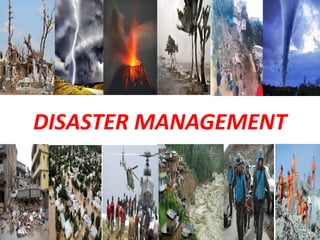
DISASTER MANAGEMENT
• “A disaster can be defined as any occurrence that cause damage,
ecological disruption, loss of human life, deterioration of health and
health services on a scale, sufficient to warrant an extraordinary
response from outside the affected community or area”.
(W.H.O.)
• “A disaster can be defined as an occurrence either nature or
manmade that causes human suffering and creates human needs that
victims cannot alleviate without assistance”.
American Red Cross (ARC) ’
What is Disaster
Natural
Disasters
Meteorological
Topographical
Environmental
Man-made
Disasters
Technological
Industrial
accidents
Security
related
TYPES OF DISASTER
A continuous and integrated process of planning, organizing, coordinating and
implementing measures which are necessary or expedient for-
● Prevention of danger or threat of any disaster.
● Reduction of risk of any disaster or its severity or consequences.
● Capacity-building.
● Preparedness to deal with any disaster.
● Prompt response to any threatening disaster situation or disaster.
● Assessing the severity or magnitude of effects of any disaster.
● Evacuation, rescue and relief.
● Rehabilitation and reconstruction.
Disaster Management
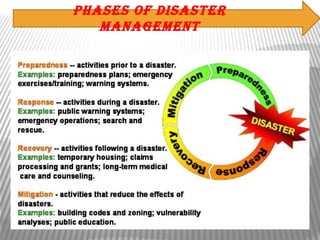
PHASES OF DISASTER
MANAGEMENT
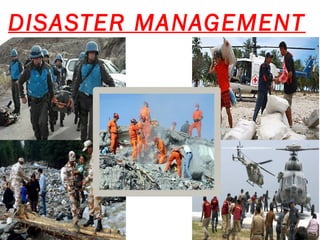
DISASTER MANAGEMENT
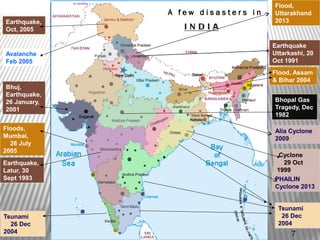
Floods,
Mumbai,
26 July
2005
Tsunami
26 Dec
2004
Cyclone
29 Oct
1999
Flood, Assam
& Bihar 2004
MAJOR DISASTERS
(1980-2005)
Earthquake
Uttarkashi, 20
Oct 1991
Bhuj,
Earthquake,
26 January,
2001
Avalanche
Feb 2005
Earthquake,
Latur, 30
Sept 1993
Tsunami
26 Dec
2004
Alia Cyclone
2009
Bhopal Gas
Tragedy, Dec
1982
Earthquake,
Oct, 2005
PHAILIN
Cyclone 2013
Flood,
Uttarakhand
2013
A f e w d i s a s t e r s i n
7
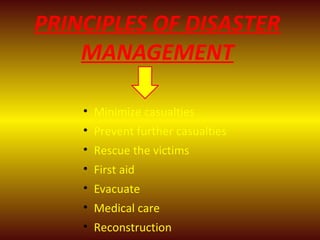
• Minimize casualties
• Prevent further casualties
• Rescue the victims
• First aid
• Evacuate
• Medical care
• Reconstruction
PRINCIPLES OF DISASTER
MANAGEMENT
THANK YOU
MADE BY:PIYUSH KANDARI
THANK YOU
MADE BY:PIYUSH KANDARI

DISASTER MANAGEMENT

  • 1.
  • 2.
    • “A disastercan be defined as any occurrence that cause damage, ecological disruption, loss of human life, deterioration of health and health services on a scale, sufficient to warrant an extraordinary response from outside the affected community or area”. (W.H.O.) • “A disaster can be defined as an occurrence either nature or manmade that causes human suffering and creates human needs that victims cannot alleviate without assistance”. American Red Cross (ARC) ’ What is Disaster
  • 3.
  • 4.
    A continuous andintegrated process of planning, organizing, coordinating and implementing measures which are necessary or expedient for- ● Prevention of danger or threat of any disaster. ● Reduction of risk of any disaster or its severity or consequences. ● Capacity-building. ● Preparedness to deal with any disaster. ● Prompt response to any threatening disaster situation or disaster. ● Assessing the severity or magnitude of effects of any disaster. ● Evacuation, rescue and relief. ● Rehabilitation and reconstruction. Disaster Management
  • 5.
  • 6.
  • 7.
    Floods, Mumbai, 26 July 2005 Tsunami 26 Dec 2004 Cyclone 29Oct 1999 Flood, Assam & Bihar 2004 MAJOR DISASTERS (1980-2005) Earthquake Uttarkashi, 20 Oct 1991 Bhuj, Earthquake, 26 January, 2001 Avalanche Feb 2005 Earthquake, Latur, 30 Sept 1993 Tsunami 26 Dec 2004 Alia Cyclone 2009 Bhopal Gas Tragedy, Dec 1982 Earthquake, Oct, 2005 PHAILIN Cyclone 2013 Flood, Uttarakhand 2013 A f e w d i s a s t e r s i n 7
  • 8.
    • Minimize casualties •Prevent further casualties • Rescue the victims • First aid • Evacuate • Medical care • Reconstruction PRINCIPLES OF DISASTER MANAGEMENT
  • 9.
  • 10.