Hazards
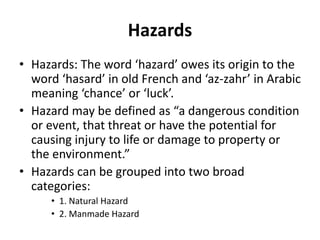
• Hazards: The word ‘hazard’ owes its origin to the
word ‘hasard’ in old French and ‘az-zahr’ in Arabic
meaning ‘chance’ or ‘luck’.
• Hazard may be defined as “a dangerous condition
or event, that threat or have the potential for
causing injury to life or damage to property or
the environment.”
• Hazards can be grouped into two broad
categories:
• 1. Natural Hazard
• 2. Manmade Hazard
Quasi-Natural Hazards
Manmade Hazards
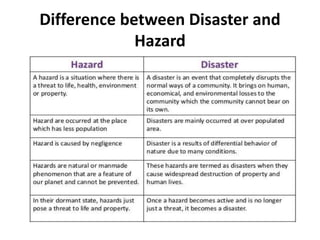
Difference between Disaster and
Hazard
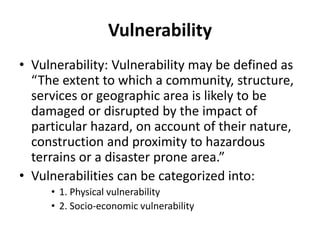
Vulnerability
• Vulnerability: Vulnerability may be defined as
“The extent to which a community, structure,
services or geographic area is likely to be
damaged or disrupted by the impact of
particular hazard, on account of their nature,
construction and proximity to hazardous
terrains or a disaster prone area.”
• Vulnerabilities can be categorized into:
• 1. Physical vulnerability
• 2. Socio-economic vulnerability
Physical Vulnerability
• Physical Vulnerability: It includes notions of who
and what may be damaged or destroyed by
natural hazard such as earthquakes or floods.
• It is based on the physical condition of people
and elements at risk, such as buildings,
infrastructure etc; and their proximity, location
and nature of the hazard.
• It also relates to the technical capability of
building and structures to resist the forces acting
upon them during a hazard event.
Socio-economic vulnerability
• Socio-economic Vulnerability: The degree to which a
population is affected by a hazard will not merely lie in
the physical components of vulnerability but also on
the socioeconomic conditions.
• The socio-economic condition of the people also
determines the intensity of the impact. For example,
people who are poor and living in the sea coast don’t
have the money to construct strong concrete houses.
They are generally at risk and lose their shelters
whenever there is strong wind or cyclone. Because of
their poverty they too are not able to rebuild their
houses.
Risk
• Risk is a “measure of the expected losses due to a
hazard event occurring in a given area over a
specific time period. Risk is a function of the
probability of particular hazardous event and the
losses each would cause.”
• The level of risk depends upon:
– Nature of the hazard
– Vulnerability of the elements which are affected
Economic value of those elements
– A community/locality is said to be at ‘risk’ when it is
exposed to hazards and is likely to be adversely
affected by its impact.

Disaster management lecture notes presentation

  • 2.
    Hazards • Hazards: Theword ‘hazard’ owes its origin to the word ‘hasard’ in old French and ‘az-zahr’ in Arabic meaning ‘chance’ or ‘luck’. • Hazard may be defined as “a dangerous condition or event, that threat or have the potential for causing injury to life or damage to property or the environment.” • Hazards can be grouped into two broad categories: • 1. Natural Hazard • 2. Manmade Hazard
  • 3.
  • 4.
  • 6.
  • 7.
    Vulnerability • Vulnerability: Vulnerabilitymay be defined as “The extent to which a community, structure, services or geographic area is likely to be damaged or disrupted by the impact of particular hazard, on account of their nature, construction and proximity to hazardous terrains or a disaster prone area.” • Vulnerabilities can be categorized into: • 1. Physical vulnerability • 2. Socio-economic vulnerability
  • 8.
    Physical Vulnerability • PhysicalVulnerability: It includes notions of who and what may be damaged or destroyed by natural hazard such as earthquakes or floods. • It is based on the physical condition of people and elements at risk, such as buildings, infrastructure etc; and their proximity, location and nature of the hazard. • It also relates to the technical capability of building and structures to resist the forces acting upon them during a hazard event.
  • 9.
    Socio-economic vulnerability • Socio-economicVulnerability: The degree to which a population is affected by a hazard will not merely lie in the physical components of vulnerability but also on the socioeconomic conditions. • The socio-economic condition of the people also determines the intensity of the impact. For example, people who are poor and living in the sea coast don’t have the money to construct strong concrete houses. They are generally at risk and lose their shelters whenever there is strong wind or cyclone. Because of their poverty they too are not able to rebuild their houses.
  • 10.
    Risk • Risk isa “measure of the expected losses due to a hazard event occurring in a given area over a specific time period. Risk is a function of the probability of particular hazardous event and the losses each would cause.” • The level of risk depends upon: – Nature of the hazard – Vulnerability of the elements which are affected Economic value of those elements – A community/locality is said to be at ‘risk’ when it is exposed to hazards and is likely to be adversely affected by its impact.