GLOBAL WARMING,
DISASTER RISK
REDUCTION AND
MANAGEMENT AWARENESS
tanong mo saken
WHAT IS GLOBAL WARMING?
GLOBAL WARMING
-IS A LONG-TERM RISE IN THE AVERAGE
TEMPERATURE OF THE EARTH’S CLIMATE
SYSTEM, AN ASPECT OF CLIMATE CHANGE
SHOWN BY TEMPERATURE MEASUREMENTS AND
BY MULTIPLE EFFECTS OF THE WARMING. THE
TERM COMMONLY REFERS TO THE MAINLY
HUMAN-CAUSED OBSERVED WARMING SINCE
PRE-INDUSTRIAL TIMES AND ITS PROJECTED
CONTINUATION THOUGH THERE WERE ALSO
MUCH EARLIER PERIODS OF GLOBAL WARMING
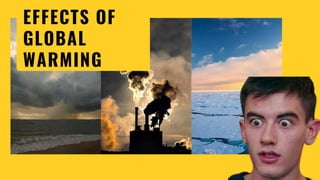
EFFECTS OF
GLOBAL
WARMING
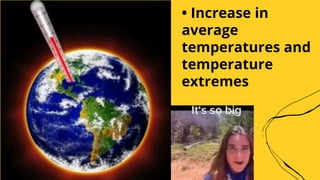
• Increase in
average
temperatures and
temperature
extremes
- One of the most immediate and obvious effects of
global warming is the increase in temperatures around
the world. The average global temperature has increased
by about 1.4 degrees Fahrenheit (0.8 degrees Celsius)
over the past 100 years, according to the National
Oceanic and Atmospheric Administration (NOAA).
• Increase in average temperatures and
temperature extremes
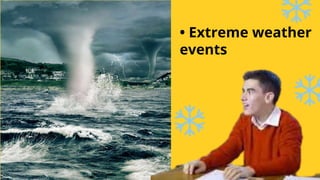
• Extreme weather
events
• Extreme weather events
- Changes in climate can cause the polar jet stream — the
boundary between the cold North Pole air and the warm
equatorial air — to migrate south, bringing with it cold,
Arctic air. This is why some states can have a sudden cold
snap or colder-than-normal winter, even during the long-
term trend of global warming. Global warming may also
lead to extreme weather other than cold or heat extremes.
• Iceberg melting
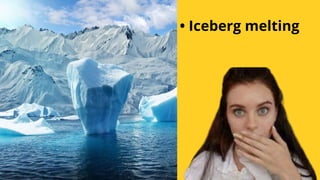
• Iceberg melting
- One of the most dramatic effects of global warming is the
reduction in Arctic sea ice. Sea ice hit record-low extents in both
the fall and winter of 2015 and 2016, meaning that at the time
when the ice is supposed to be at its peak, it was lagging. The
melt means there is less thick sea ice that persists for multiple
years. That means less heat is reflected back into the
atmosphere by the shiny surface of the ice and more is absorbed
by the comparatively darker ocean, creating a feedback loop
that causes even more melt, according to NASA's Operation
IceBridge.
• Sea level and
ocean
acidification
- Melting polar ice in the Arctic and Antarctic regions, coupled
with melting ice sheets and glaciers across Greenland, North
America, South America, Europe and Asia, are expected to
raise sea levels significantly. And humans are mostly to
blame: In the IPCC report released on Sept. 27, 2013, climate
scientists said they are at least 95 percent certain that
humans are to blame for warming oceans, rapidly melting ice
and rising sea levels, changes that have been observed
• Sea level and ocean acidification
tanong mo si kiel
HOW DO WE PREVENT IT?
- As individuals, we can help by taking action to reduce our
personal carbon emissions. But to fully address the threat of
global warming, we must demand action from our elected
leaders to support and implement a comprehensive set of
climate solutions:
- Expand the use of renewable energy and transform our energy
system to one that is cleaner and less dependent on coal and
other fossil fuels.
• § Solar
• § Wind Power
• § Geothermal
• § Hydropower
- Place limits on the amount of carbon that
polluters are allowed to emit.
- Reduce tropical deforestation and its
associated global warming emissions.
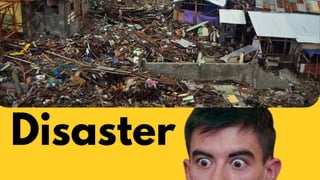
Disaster
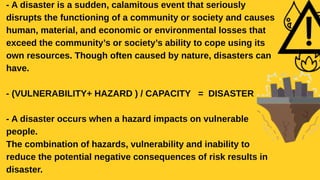
- A disaster is a sudden, calamitous event that seriously
disrupts the functioning of a community or society and causes
human, material, and economic or environmental losses that
exceed the community’s or society’s ability to cope using its
own resources. Though often caused by nature, disasters can
have.
- (VULNERABILITY+ HAZARD ) / CAPACITY = DISASTER
- A disaster occurs when a hazard impacts on vulnerable
people.
The combination of hazards, vulnerability and inability to
reduce the potential negative consequences of risk results in
disaster.
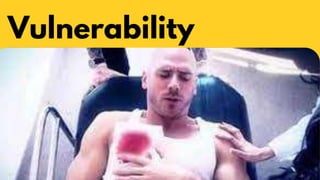
Vulnerability
- Vulnerability in this context can be defined as the
diminished capacity of an individual or group to anticipate,
cope with, resist and recover from the impact of a natural or
man-made hazard. The concept is relative and dynamic.
Vulnerability is most often associated with poverty, but it can
also arise when people are isolated, insecure and
defenseless in the face of risk, shock or stress.
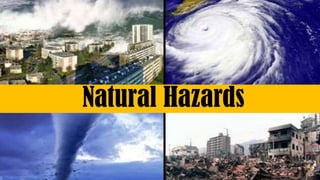
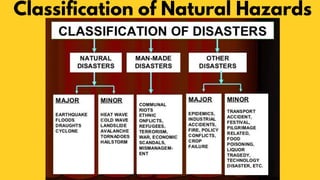
Natural Hazards
- This are naturally occurring physical phenomena caused
either by rapid or slow onset events which can be geophysical
(earthquake, landslides, tsunamis and volcanic activity),
hydrological (avalanches and floods), climatological (extreme
temperatures, drought and wildfires), meteorological (cyclones
and storms/wave surges) or biological (disease epidemics and
insect/animal plagues).
Natural Hazards
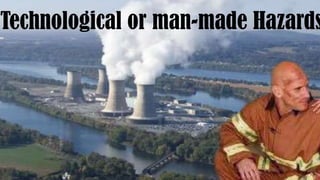
Technological or man-made Hazards
- This are events that are caused by humans and occur in or
close to human settlements. This can include environmental
degradation, pollution and accidents. Technological or man-
made hazards (complex emergencies/conflicts, famine,
displaced populations, industrial accidents and transport
accidents)
Technological or man-made Hazards
Disaster Management
- It can be defined as the organization and management of
resources and responsibilities for dealing with all humanitarian
aspects of emergencies, in particular preparedness, response and
recovery in order to lessen the impact of disasters. The first
people to respond to a disaster are those living in the local
community. They are the first to start rescue and relief
operations. The Red Cross and Red Crescent National Societies
therefore focus on community-based disaster preparedness,
which assists communities to reduce their vulnerability to
disasters and strengthen their capacities to resist them.
- Disaster preparedness refers to
measures taken to prepare for and reduce
the effects of disasters. That is, to predict
and, where possible, prevent disasters,
mitigate their impact on vulnerable
populations, and respond to and
effectively cope with their consequences.
Preparing
- The primary aims of disaster response are rescue from
immediate danger and stabilization of the physical and emotional
condition of survivors. These go hand in hand with the recovery of
the dead and the restoration of essential services such as water
and power. How long this takes varies according to the scale, type
and context of the disaster but typically takes between one and six
months and is composed of a search and rescue phase in the
immediate aftermath of a disaster followed by a medium-term
phase devoted to stabilizing the survivors’ physical and emotional
condition.
Respondin
g
- The social, economic and political consequences of disasters are
frequently complex. For instance, the disaster may:
• Disrupt vital community self-help networks, further increasing
vulnerability.
• Disrupt markets over a wide area, reducing the availability of food
and opportunities for income generation.
• Destroy essential health infrastructure such as hospitals, resulting in
a lack of emergency and longer-term medical care for the affected
population.
Respondin
g
Recovery
- Recovery refers to those programs which go beyond the
provision of immediate relief to assist those who have
suffered the full impact of a disaster to rebuild their
homes, lives and services and to strengthen their
capacity to cope with future disasters.
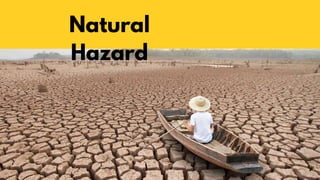
Natural
Hazard
Natural
Hazard
- A hazard is distinguished from an extreme event and a
disaster. A natural hazard is an extreme event that occurs
naturally and causes harm to humans – or to other things that
we care about, though usually the focus is on humans (which,
we might note, is anthropocentric). A natural hazard escalates
into a natural disaster when an extreme event caused harm in
significant amounts and overwhelms the capability of people
to cope and respond.
Classification of Natural Hazards
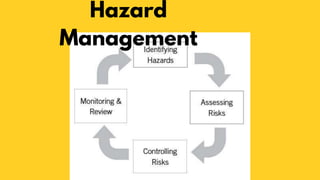
Hazard
Management
Emergency
Preparedness
Step 1: Know the risk
- Every member of
family or a group of
people should be
aware if there’s a
incoming risk of
calamity.
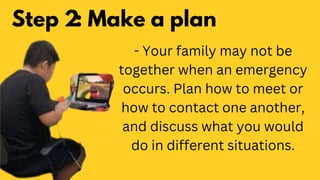
Step 2: Make a plan
- Your family may not be
together when an emergency
occurs. Plan how to meet or
how to contact one another,
and discuss what you would
do in different situations.
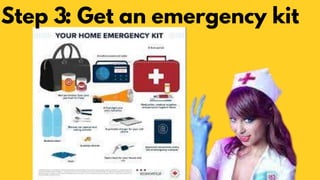
Step 3: Get an emergency kit
Disaster Prevention and
Mitigation
Emergency
Preparedness
- The ultimate purpose of emergency management is to
save lives, preserve the environment and protect property
and the economy. Emergency management is comprised of
four interdependent risk-based functions: prevention/
mitigation, preparedness, response and recovery.
Mitigation provides a critical foundation for emergency
management. Disaster mitigation measures are those that
eliminate or reduce the impacts and risk of hazards
through proactive measures taken before an emergency or
disaster occurs.
Mitigation
• means to reduce the severity of the human and
material damage caused by disaster.
Prevention
• is to ensure that the human action or natural
phenomena do not result in disaster or emergency.
Difference of Mitigation and Prevention
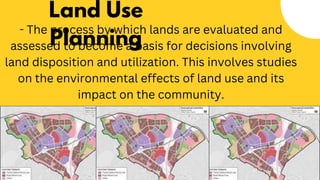
Land Use
Planning
- The process by which lands are evaluated and
assessed to become a basis for decisions involving
land disposition and utilization. This involves studies
on the environmental effects of land use and its
impact on the community.
• formerly known as the National Disaster Coordinating
Council (NDCC), is working group of various government,
non-government, civil sector and private sector
organizations of the Government of the Republic Act 10121
of 2009.
• The council is responsible for ensuring the protection and
welfare of the people during disasters or emergencies.
National Disaster Risk Reduction
Management Council (NDRRMC)
National Disaster Risk Reduction
Management Council (NDRRMC)
• Serve as the President’s adviser on disaster preparedness
programs, disaster operations and rehabilitation efforts
undertaken by the government and the private sector.
• Plans and leads the guiding activities when there is a disaster.
• It is administered by the Office of the Civil Defense (OCD) under
the Department of National Defense (DND).
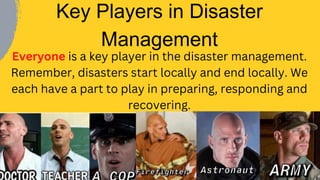
Everyone is a key player in the disaster management.
Remember, disasters start locally and end locally. We
each have a part to play in preparing, responding and
recovering.
Key Players in Disaster
Management
- Your local government has first-hand knowledge of
your community’s social, economic, infrastructure, and
environmental needs, helping them to provide support
in a disaster.
Role of Local Government in a
Disaster (NDRRMC)
- The role of local government under the Disaster
Management Act 2003 is to:
• Have a disaster response capability
• Approved a local disaster management plan
• Ensure local disaster information is promptly
given to the District Disaster Coordinator.
Local Management
Groups
Their role is to:
• Develop, review and asses effective disaster management
practices
• Help local government to prepare a local disaster
management plan.
• Ensure the community knows how to respond in a disaster.
• Identify and coordinate disaster resources .
• Manage local disaster operations
Ensure local disaster management and disaster operations
DIWAO!!

NSTP.GLOBALWARMING.pptx

  • 1.
  • 2.
    tanong mo saken WHATIS GLOBAL WARMING?
  • 3.
    GLOBAL WARMING -IS ALONG-TERM RISE IN THE AVERAGE TEMPERATURE OF THE EARTH’S CLIMATE SYSTEM, AN ASPECT OF CLIMATE CHANGE SHOWN BY TEMPERATURE MEASUREMENTS AND BY MULTIPLE EFFECTS OF THE WARMING. THE TERM COMMONLY REFERS TO THE MAINLY HUMAN-CAUSED OBSERVED WARMING SINCE PRE-INDUSTRIAL TIMES AND ITS PROJECTED CONTINUATION THOUGH THERE WERE ALSO MUCH EARLIER PERIODS OF GLOBAL WARMING
  • 5.
  • 6.
    • Increase in average temperaturesand temperature extremes
  • 7.
    - One ofthe most immediate and obvious effects of global warming is the increase in temperatures around the world. The average global temperature has increased by about 1.4 degrees Fahrenheit (0.8 degrees Celsius) over the past 100 years, according to the National Oceanic and Atmospheric Administration (NOAA). • Increase in average temperatures and temperature extremes
  • 8.
  • 9.
    • Extreme weatherevents - Changes in climate can cause the polar jet stream — the boundary between the cold North Pole air and the warm equatorial air — to migrate south, bringing with it cold, Arctic air. This is why some states can have a sudden cold snap or colder-than-normal winter, even during the long- term trend of global warming. Global warming may also lead to extreme weather other than cold or heat extremes.
  • 10.
  • 11.
    • Iceberg melting -One of the most dramatic effects of global warming is the reduction in Arctic sea ice. Sea ice hit record-low extents in both the fall and winter of 2015 and 2016, meaning that at the time when the ice is supposed to be at its peak, it was lagging. The melt means there is less thick sea ice that persists for multiple years. That means less heat is reflected back into the atmosphere by the shiny surface of the ice and more is absorbed by the comparatively darker ocean, creating a feedback loop that causes even more melt, according to NASA's Operation IceBridge.
  • 12.
    • Sea leveland ocean acidification
  • 13.
    - Melting polarice in the Arctic and Antarctic regions, coupled with melting ice sheets and glaciers across Greenland, North America, South America, Europe and Asia, are expected to raise sea levels significantly. And humans are mostly to blame: In the IPCC report released on Sept. 27, 2013, climate scientists said they are at least 95 percent certain that humans are to blame for warming oceans, rapidly melting ice and rising sea levels, changes that have been observed • Sea level and ocean acidification
  • 14.
    tanong mo sikiel HOW DO WE PREVENT IT?
  • 15.
    - As individuals,we can help by taking action to reduce our personal carbon emissions. But to fully address the threat of global warming, we must demand action from our elected leaders to support and implement a comprehensive set of climate solutions: - Expand the use of renewable energy and transform our energy system to one that is cleaner and less dependent on coal and other fossil fuels. • § Solar • § Wind Power • § Geothermal • § Hydropower
  • 16.
    - Place limitson the amount of carbon that polluters are allowed to emit. - Reduce tropical deforestation and its associated global warming emissions.
  • 17.
  • 18.
    - A disasteris a sudden, calamitous event that seriously disrupts the functioning of a community or society and causes human, material, and economic or environmental losses that exceed the community’s or society’s ability to cope using its own resources. Though often caused by nature, disasters can have. - (VULNERABILITY+ HAZARD ) / CAPACITY = DISASTER - A disaster occurs when a hazard impacts on vulnerable people. The combination of hazards, vulnerability and inability to reduce the potential negative consequences of risk results in disaster.
  • 19.
  • 20.
    - Vulnerability inthis context can be defined as the diminished capacity of an individual or group to anticipate, cope with, resist and recover from the impact of a natural or man-made hazard. The concept is relative and dynamic. Vulnerability is most often associated with poverty, but it can also arise when people are isolated, insecure and defenseless in the face of risk, shock or stress.
  • 22.
  • 23.
    - This arenaturally occurring physical phenomena caused either by rapid or slow onset events which can be geophysical (earthquake, landslides, tsunamis and volcanic activity), hydrological (avalanches and floods), climatological (extreme temperatures, drought and wildfires), meteorological (cyclones and storms/wave surges) or biological (disease epidemics and insect/animal plagues). Natural Hazards
  • 24.
  • 25.
    - This areevents that are caused by humans and occur in or close to human settlements. This can include environmental degradation, pollution and accidents. Technological or man- made hazards (complex emergencies/conflicts, famine, displaced populations, industrial accidents and transport accidents) Technological or man-made Hazards
  • 26.
    Disaster Management - Itcan be defined as the organization and management of resources and responsibilities for dealing with all humanitarian aspects of emergencies, in particular preparedness, response and recovery in order to lessen the impact of disasters. The first people to respond to a disaster are those living in the local community. They are the first to start rescue and relief operations. The Red Cross and Red Crescent National Societies therefore focus on community-based disaster preparedness, which assists communities to reduce their vulnerability to disasters and strengthen their capacities to resist them.
  • 27.
    - Disaster preparednessrefers to measures taken to prepare for and reduce the effects of disasters. That is, to predict and, where possible, prevent disasters, mitigate their impact on vulnerable populations, and respond to and effectively cope with their consequences. Preparing
  • 28.
    - The primaryaims of disaster response are rescue from immediate danger and stabilization of the physical and emotional condition of survivors. These go hand in hand with the recovery of the dead and the restoration of essential services such as water and power. How long this takes varies according to the scale, type and context of the disaster but typically takes between one and six months and is composed of a search and rescue phase in the immediate aftermath of a disaster followed by a medium-term phase devoted to stabilizing the survivors’ physical and emotional condition. Respondin g
  • 29.
    - The social,economic and political consequences of disasters are frequently complex. For instance, the disaster may: • Disrupt vital community self-help networks, further increasing vulnerability. • Disrupt markets over a wide area, reducing the availability of food and opportunities for income generation. • Destroy essential health infrastructure such as hospitals, resulting in a lack of emergency and longer-term medical care for the affected population. Respondin g
  • 30.
    Recovery - Recovery refersto those programs which go beyond the provision of immediate relief to assist those who have suffered the full impact of a disaster to rebuild their homes, lives and services and to strengthen their capacity to cope with future disasters.
  • 31.
  • 32.
    Natural Hazard - A hazardis distinguished from an extreme event and a disaster. A natural hazard is an extreme event that occurs naturally and causes harm to humans – or to other things that we care about, though usually the focus is on humans (which, we might note, is anthropocentric). A natural hazard escalates into a natural disaster when an extreme event caused harm in significant amounts and overwhelms the capability of people to cope and respond.
  • 33.
  • 34.
  • 35.
    Emergency Preparedness Step 1: Knowthe risk - Every member of family or a group of people should be aware if there’s a incoming risk of calamity.
  • 36.
    Step 2: Makea plan - Your family may not be together when an emergency occurs. Plan how to meet or how to contact one another, and discuss what you would do in different situations.
  • 37.
    Step 3: Getan emergency kit
  • 38.
  • 39.
    Emergency Preparedness - The ultimatepurpose of emergency management is to save lives, preserve the environment and protect property and the economy. Emergency management is comprised of four interdependent risk-based functions: prevention/ mitigation, preparedness, response and recovery. Mitigation provides a critical foundation for emergency management. Disaster mitigation measures are those that eliminate or reduce the impacts and risk of hazards through proactive measures taken before an emergency or disaster occurs.
  • 40.
    Mitigation • means toreduce the severity of the human and material damage caused by disaster. Prevention • is to ensure that the human action or natural phenomena do not result in disaster or emergency. Difference of Mitigation and Prevention
  • 41.
    Land Use Planning - Theprocess by which lands are evaluated and assessed to become a basis for decisions involving land disposition and utilization. This involves studies on the environmental effects of land use and its impact on the community.
  • 42.
    • formerly knownas the National Disaster Coordinating Council (NDCC), is working group of various government, non-government, civil sector and private sector organizations of the Government of the Republic Act 10121 of 2009. • The council is responsible for ensuring the protection and welfare of the people during disasters or emergencies. National Disaster Risk Reduction Management Council (NDRRMC)
  • 43.
    National Disaster RiskReduction Management Council (NDRRMC) • Serve as the President’s adviser on disaster preparedness programs, disaster operations and rehabilitation efforts undertaken by the government and the private sector. • Plans and leads the guiding activities when there is a disaster. • It is administered by the Office of the Civil Defense (OCD) under the Department of National Defense (DND).
  • 44.
    Everyone is akey player in the disaster management. Remember, disasters start locally and end locally. We each have a part to play in preparing, responding and recovering. Key Players in Disaster Management
  • 45.
    - Your localgovernment has first-hand knowledge of your community’s social, economic, infrastructure, and environmental needs, helping them to provide support in a disaster. Role of Local Government in a Disaster (NDRRMC)
  • 46.
    - The roleof local government under the Disaster Management Act 2003 is to: • Have a disaster response capability • Approved a local disaster management plan • Ensure local disaster information is promptly given to the District Disaster Coordinator.
  • 47.
    Local Management Groups Their roleis to: • Develop, review and asses effective disaster management practices • Help local government to prepare a local disaster management plan. • Ensure the community knows how to respond in a disaster. • Identify and coordinate disaster resources . • Manage local disaster operations Ensure local disaster management and disaster operations
  • 48.