DISASTER MANAGEMENT
CYCLONE IN TAMILNADU
EARTHQUAKE IN HIMALAYAN REGION
FLOODS IN UTTARKAND
• Hazards: famine drought floods etc are
called hazards
• Multi hazard zone : a place which is
prone to more than one hazard
• Disaster management : preparing
ourselves to face these hazards is
called disaster management
TYPES OF DISASTERS
• Slow onset disaster
• Rapid onset disaster
• Natural disasters
• Human induced disaster
SLOW INDUCED DISASTERS
• The disasters which happen slowly
FAMINE DROUGHT
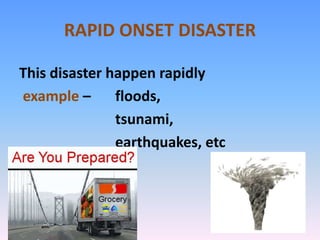
RAPID ONSET DISASTER
This disaster happen rapidly
example – floods,
tsunami,
earthquakes, etc
FLOODS
NATURAL DISASTER
• Caused naturally cannot be controlled by
man
HUMAN INDUCED DISASTER
• Caused by man and can be controlled by
man
• Examples bomblast, Terrorists attacks
BHOPAL GAS TRAGEDY
BOMB BLASTS
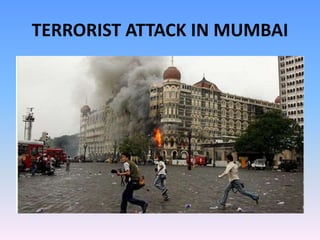
TERRORIST ATTACK IN MUMBAI
TERRORIST ATTACK ON TWIN TOWERS
FLYOVER THAT COLLAPSED IN
KOLKATA
• We nedd to prepare ourselves
to face these disasters because
we have very little contol on
natural disasters which occur
frequently .
RESPONSE
Response measures are usually those which are taken
immediately prior to and following disaster impact.
Typical measures include
• Implementation of plan
• Activation of the counter disaster system.
• Search and rescue
• Provision of emergency food, shelter and medical
assistance etc
• Survey and assessment
• Evacuation measures
RECOVERY
Recovery is the process by which communities and
the nation are assisted in returning to their
proper level of functioning following a disaster
Three main categories of activity are normally
regarded as coming within the recovery segment
Restoration
Reconstruction
Rehabilitation
PREVENTION AND MITIGATION
• Prevention: Action within this segment is
designed to impede the occurrence of a
disaster and prevent such occurrence from
having harmful effects on communities
• Mitigation: Action within this segment takes
the form of specific programs intended to
reduce the effects of disaster on a nation or
community
DISASTER PREPAREDNESS
Preparedness should be in the form of money ,
manpower and material
Evaluation from past experiences.
Location of disaster prone areas.
Organization of communication, information and warning
systems.
Development of public education programmes
Ensuring co-ordination and response mechanisms,
National and international relations.
Keeping stock of food, drugs and other essential
commodities.
DISASTER EFFECTS
• Deaths
• Disability
• Increase in communicable disease
• Psychological problems
• Food shortage
• Socioeconomic losses
• Shortage of drugs and medical supplies
• Environmental disruption.
GOI-NGP DISASTER PREPARATION
AND RESPONSE COMMITTEE
• World vision of India
• SOS Children’s village India
• Ramakrishna Mission
• Plan international
• OXFAM India trust
• Lutheran World Services India
• Red cross
• Catholic Relief Services
• CASA
• Voluntary Health association of India
• Action for Food Production – AFPRO
• Indo German Social Services Society
NODAL AGENCIES FOR DISASTER
MANAGEMENT
• Floods: Ministry of water resources
• Cyclones: Indian Meteorological Department
• Earthquakes: Indian Meteorological Department
• Epidemics: Ministry of Health and environment
• Chemical Disasters: Ministry of Environment and
Forests
• Industrial Disasters: Ministry of labour
• Rail Accidents: Ministy of Railways
• Air Accidents: Ministry of Civil Aviation
• Fire Accidents: Ministry of Home affairs
• Nuclear incidents: Department of Atomic
Energy
• Mine Disasters: Department of mines
Disaster management

Disaster management

  • 2.
  • 3.
  • 4.
  • 5.
  • 6.
    • Hazards: faminedrought floods etc are called hazards • Multi hazard zone : a place which is prone to more than one hazard • Disaster management : preparing ourselves to face these hazards is called disaster management
  • 7.
    TYPES OF DISASTERS •Slow onset disaster • Rapid onset disaster • Natural disasters • Human induced disaster
  • 8.
    SLOW INDUCED DISASTERS •The disasters which happen slowly FAMINE DROUGHT
  • 9.
    RAPID ONSET DISASTER Thisdisaster happen rapidly example – floods, tsunami, earthquakes, etc
  • 10.
  • 11.
    NATURAL DISASTER • Causednaturally cannot be controlled by man
  • 12.
    HUMAN INDUCED DISASTER •Caused by man and can be controlled by man • Examples bomblast, Terrorists attacks
  • 13.
  • 14.
  • 15.
  • 16.
  • 17.
  • 18.
    • We neddto prepare ourselves to face these disasters because we have very little contol on natural disasters which occur frequently .
  • 20.
    RESPONSE Response measures areusually those which are taken immediately prior to and following disaster impact. Typical measures include • Implementation of plan • Activation of the counter disaster system. • Search and rescue • Provision of emergency food, shelter and medical assistance etc • Survey and assessment • Evacuation measures
  • 21.
    RECOVERY Recovery is theprocess by which communities and the nation are assisted in returning to their proper level of functioning following a disaster Three main categories of activity are normally regarded as coming within the recovery segment Restoration Reconstruction Rehabilitation
  • 22.
    PREVENTION AND MITIGATION •Prevention: Action within this segment is designed to impede the occurrence of a disaster and prevent such occurrence from having harmful effects on communities • Mitigation: Action within this segment takes the form of specific programs intended to reduce the effects of disaster on a nation or community
  • 23.
    DISASTER PREPAREDNESS Preparedness shouldbe in the form of money , manpower and material Evaluation from past experiences. Location of disaster prone areas. Organization of communication, information and warning systems. Development of public education programmes Ensuring co-ordination and response mechanisms, National and international relations. Keeping stock of food, drugs and other essential commodities.
  • 24.
    DISASTER EFFECTS • Deaths •Disability • Increase in communicable disease • Psychological problems • Food shortage • Socioeconomic losses • Shortage of drugs and medical supplies • Environmental disruption.
  • 25.
    GOI-NGP DISASTER PREPARATION ANDRESPONSE COMMITTEE • World vision of India • SOS Children’s village India • Ramakrishna Mission • Plan international • OXFAM India trust • Lutheran World Services India • Red cross • Catholic Relief Services • CASA • Voluntary Health association of India • Action for Food Production – AFPRO • Indo German Social Services Society
  • 26.
    NODAL AGENCIES FORDISASTER MANAGEMENT • Floods: Ministry of water resources • Cyclones: Indian Meteorological Department • Earthquakes: Indian Meteorological Department • Epidemics: Ministry of Health and environment • Chemical Disasters: Ministry of Environment and Forests • Industrial Disasters: Ministry of labour • Rail Accidents: Ministy of Railways
  • 27.
    • Air Accidents:Ministry of Civil Aviation • Fire Accidents: Ministry of Home affairs • Nuclear incidents: Department of Atomic Energy • Mine Disasters: Department of mines