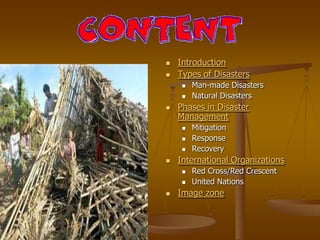
   Introduction
   Types of Disasters
        Man-made Disasters
        Natural Disasters
   Phases in Disaster
    Management
        Mitigation
        Response
        Recovery
   International Organizations
        Red Cross/Red Crescent
        United Nations
   Image zone
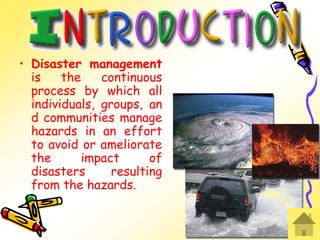
• Disaster management
  is    the    continuous
  process by which all
  individuals, groups, an
  d communities manage
  hazards in an effort
  to avoid or ameliorate
  the       impact      of
  disasters      resulting
  from the hazards.
• Man Made
  Disasters
  – Some types of Man-
    Made disasters
• Natural Disasters
  – Disaster prone
    areas in India
  – Some Natural
    Disasters and how
    to reduce their
    intensity
• Man-made hazards
  are threats having an
  element of human
  intent, negligence, er
  ror or involving a
  failure of a system.
  Man-made disasters
  are a result of
  inadequately managed
  resource.
• Nuclear Disaster
• Chemical Disasters
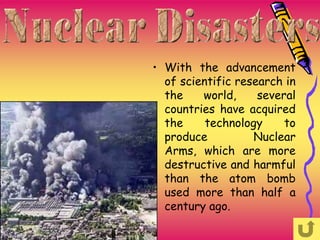
• With the advancement
  of scientific research in
  the    world,     several
  countries have acquired
  the     technology     to
  produce          Nuclear
  Arms, which are more
  destructive and harmful
  than the atom bomb
  used more than half a
  century ago.
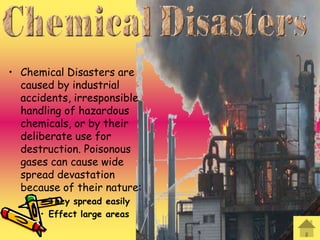
• Chemical Disasters are
  caused by industrial
  accidents, irresponsible
  handling of hazardous
  chemicals, or by their
  deliberate use for
  destruction. Poisonous
  gases can cause wide
  spread devastation
  because of their nature:
      • They spread easily
      • Effect large areas
• A natural disaster is the
  consequence of a natural
  hazard               (e.g.
  tsunami,      earthquake)
  which     moves      from
  potential into an active
  phase, and as a result
  affects human activities.
Disaster prone areas in India
• Earthquake
     – Earthquakes
– How to reduce its Effect
     • Tsunami
       – Tsunami
– How to reduce its Effect
      • Floods
        – Floods
– How to reduce its Effect
     • Drought
       – Drought
– How to reduce its Effect
    • Cyclones
       – Cyclones
– How to reduce its effect
–   An earthquake is a
    phenomenon that results
    from and is powered by
    the sudden release of
    stored energy that
    radiates seismic waves.
    At the Earth's
    surface, earthquakes may
    manifest themselves by a
    shaking or displacement
    of the ground and
    sometimes tsunamis.
• Do not Panic any-time
• Help Survivors quickly
• Retrofitting of Buildings should be
  done regularly
• If in school, hide under desk’s.
• Avoid using lift & staircase
• Move away from Window
• If Outdoor or Driving, move to an open
  area with no trees, building, electric
  wires etc.
• If in Stadium, Theatre or Auditorium
  stay inside.
• Cover your head with your arms.
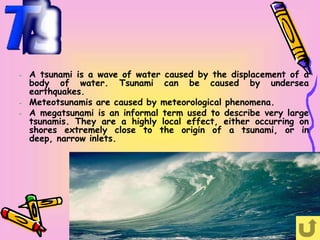
–   A tsunami is a wave of water caused by the displacement of a
    body of water. Tsunami can be caused by undersea
    earthquakes.
–   Meteotsunamis are caused by meteorological phenomena.
–   A megatsunami is an informal term used to describe very large
    tsunamis. They are a highly local effect, either occurring on
    shores extremely close to the origin of a tsunami, or in
    deep, narrow inlets.
• Provide for Emergency
  Housing.
• Emergency repairs to
  homes, drains and water
  supply and sanitation
  infrastructure.
• Early warning systems
  to    identify   health
  effects.
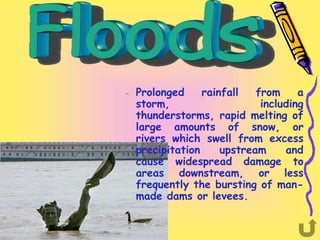
–   Prolonged     rainfall   from     a
    storm,                    including
    thunderstorms, rapid melting of
    large amounts of snow, or
    rivers which swell from excess
    precipitation     upstream     and
    cause widespread damage to
    areas downstream, or less
    frequently the bursting of man-
    made dams or levees.
• Provide for Emergency
  Housing
• Emergency repairs to
  homes, drains and water
  supply and sanitation
  infrastructure
• Early warning systems to
  identify health effects
–   An     abnormally   dry
    period when there is
    not enough water to
    support
    agricultural, urban or
    environmental     water
    needs.
–   Extended droughts can
    result in deaths by
    starvation           or
    disease, and can result
• Create Rain Water
  Harvesting System
• Promote Watershed
  Programmes
• Increasing Forest
  cover
• Using Alternative crops
  in drought
–   Hurricane,        tropical
    cyclone, and typhoon are
    different names for the
    same      phenomenon:     a
    cyclonic storm system that
    forms over the oceans.
–   It is caused by evaporated
    water that comes off of
    the ocean and becomes a
    storm. The Coriolis Effect
    causes the storms to
    spin, and a hurricane is
    declared when this spinning
    mass of storms attains a
    wind speed greater than 74
    mph.
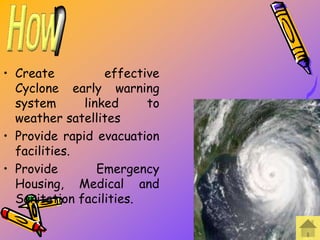
• Create          effective
  Cyclone early warning
  system      linked     to
  weather satellites
• Provide rapid evacuation
  facilities.
• Provide        Emergency
  Housing, Medical and
  Sanitation facilities.
• The nature of Disaster
  management      is   highly
  dependent on economic
  and social conditions local
  to the emergency, or
  disaster.      This      is
  particularly important in
  developing nations
• The process of emergency
  management         involves
  three               phases:
  mitigation, response, and
  recovery.
• Mitigation is to reduce the effects of disasters when
  they occur.
• The mitigation phase differs from the other phases
  because it focuses on long-term measures for reducing
  or eliminating risk.
• The implementation of mitigation strategies can be
  considered a part of the recovery process if applied
  after a disaster occurs.
• The response phase includes the mobilization of the
  necessary emergency services and first responders in
  the disaster area.
• This is likely to include a first wave of core
  emergency services, such as firefighters, police and
  ambulance crews.
• They may be supported by a number of secondary
  emergency services, such as specialist rescue teams.
• The aim of the recovery phase is to restore the
  affected area to its previous state. It differs from the
  response phase in its focus; recovery efforts are
  concerned with issues and decisions that must be made
  after immediate needs are addressed.
• Recovery efforts are primarily concerned with actions
  that involve rebuilding destroyed property, re-
  employment, and the repair of other essential
  infrastructure.
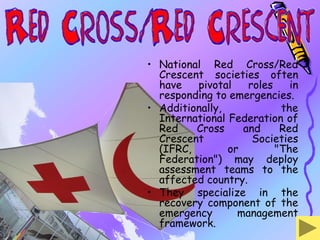
• National Red Cross/Red
  Crescent societies often
  have   pivotal    roles    in
  responding to emergencies.
• Additionally,            the
  International Federation of
  Red    Cross     and     Red
  Crescent           Societies
  (IFRC,        or        "The
  Federation") may deploy
  assessment teams to the
  affected country.
• They specialize in the
  recovery component of the
  emergency       management
  framework.
United Nations
• Within the United Nations system responsibility
  for emergency response rests with the Resident
  Coordinator within the affected country.
  However, in practice international response will
  be coordinated, if requested by the affected
  country’s government, by the UN Office for the
  Coordination of Humanitarian Affairs (UN-
  OCHA), by deploying a UN Disaster Assessment
  and Coordination (UNDAC) team.
Image Zone
Shubham Jain
     Udayan Tandon
            Of
Bal Bharati Public School,
        Pitampura

Disaster management

  • 2.
    Introduction  Types of Disasters  Man-made Disasters  Natural Disasters  Phases in Disaster Management  Mitigation  Response  Recovery  International Organizations  Red Cross/Red Crescent  United Nations  Image zone
  • 3.
    • Disaster management is the continuous process by which all individuals, groups, an d communities manage hazards in an effort to avoid or ameliorate the impact of disasters resulting from the hazards.
  • 4.
    • Man Made Disasters – Some types of Man- Made disasters • Natural Disasters – Disaster prone areas in India – Some Natural Disasters and how to reduce their intensity
  • 5.
    • Man-made hazards are threats having an element of human intent, negligence, er ror or involving a failure of a system. Man-made disasters are a result of inadequately managed resource.
  • 6.
    • Nuclear Disaster •Chemical Disasters
  • 7.
    • With theadvancement of scientific research in the world, several countries have acquired the technology to produce Nuclear Arms, which are more destructive and harmful than the atom bomb used more than half a century ago.
  • 8.
    • Chemical Disastersare caused by industrial accidents, irresponsible handling of hazardous chemicals, or by their deliberate use for destruction. Poisonous gases can cause wide spread devastation because of their nature: • They spread easily • Effect large areas
  • 9.
    • A naturaldisaster is the consequence of a natural hazard (e.g. tsunami, earthquake) which moves from potential into an active phase, and as a result affects human activities.
  • 10.
  • 11.
    • Earthquake – Earthquakes – How to reduce its Effect • Tsunami – Tsunami – How to reduce its Effect • Floods – Floods – How to reduce its Effect • Drought – Drought – How to reduce its Effect • Cyclones – Cyclones – How to reduce its effect
  • 12.
    An earthquake is a phenomenon that results from and is powered by the sudden release of stored energy that radiates seismic waves. At the Earth's surface, earthquakes may manifest themselves by a shaking or displacement of the ground and sometimes tsunamis.
  • 13.
    • Do notPanic any-time • Help Survivors quickly • Retrofitting of Buildings should be done regularly • If in school, hide under desk’s. • Avoid using lift & staircase • Move away from Window • If Outdoor or Driving, move to an open area with no trees, building, electric wires etc. • If in Stadium, Theatre or Auditorium stay inside. • Cover your head with your arms.
  • 14.
    A tsunami is a wave of water caused by the displacement of a body of water. Tsunami can be caused by undersea earthquakes. – Meteotsunamis are caused by meteorological phenomena. – A megatsunami is an informal term used to describe very large tsunamis. They are a highly local effect, either occurring on shores extremely close to the origin of a tsunami, or in deep, narrow inlets.
  • 15.
    • Provide forEmergency Housing. • Emergency repairs to homes, drains and water supply and sanitation infrastructure. • Early warning systems to identify health effects.
  • 16.
    Prolonged rainfall from a storm, including thunderstorms, rapid melting of large amounts of snow, or rivers which swell from excess precipitation upstream and cause widespread damage to areas downstream, or less frequently the bursting of man- made dams or levees.
  • 17.
    • Provide forEmergency Housing • Emergency repairs to homes, drains and water supply and sanitation infrastructure • Early warning systems to identify health effects
  • 18.
    An abnormally dry period when there is not enough water to support agricultural, urban or environmental water needs. – Extended droughts can result in deaths by starvation or disease, and can result
  • 19.
    • Create RainWater Harvesting System • Promote Watershed Programmes • Increasing Forest cover • Using Alternative crops in drought
  • 20.
    Hurricane, tropical cyclone, and typhoon are different names for the same phenomenon: a cyclonic storm system that forms over the oceans. – It is caused by evaporated water that comes off of the ocean and becomes a storm. The Coriolis Effect causes the storms to spin, and a hurricane is declared when this spinning mass of storms attains a wind speed greater than 74 mph.
  • 21.
    • Create effective Cyclone early warning system linked to weather satellites • Provide rapid evacuation facilities. • Provide Emergency Housing, Medical and Sanitation facilities.
  • 23.
    • The natureof Disaster management is highly dependent on economic and social conditions local to the emergency, or disaster. This is particularly important in developing nations • The process of emergency management involves three phases: mitigation, response, and recovery.
  • 24.
    • Mitigation isto reduce the effects of disasters when they occur. • The mitigation phase differs from the other phases because it focuses on long-term measures for reducing or eliminating risk. • The implementation of mitigation strategies can be considered a part of the recovery process if applied after a disaster occurs.
  • 25.
    • The responsephase includes the mobilization of the necessary emergency services and first responders in the disaster area. • This is likely to include a first wave of core emergency services, such as firefighters, police and ambulance crews. • They may be supported by a number of secondary emergency services, such as specialist rescue teams.
  • 26.
    • The aimof the recovery phase is to restore the affected area to its previous state. It differs from the response phase in its focus; recovery efforts are concerned with issues and decisions that must be made after immediate needs are addressed. • Recovery efforts are primarily concerned with actions that involve rebuilding destroyed property, re- employment, and the repair of other essential infrastructure.
  • 28.
    • National RedCross/Red Crescent societies often have pivotal roles in responding to emergencies. • Additionally, the International Federation of Red Cross and Red Crescent Societies (IFRC, or "The Federation") may deploy assessment teams to the affected country. • They specialize in the recovery component of the emergency management framework.
  • 29.
    United Nations • Withinthe United Nations system responsibility for emergency response rests with the Resident Coordinator within the affected country. However, in practice international response will be coordinated, if requested by the affected country’s government, by the UN Office for the Coordination of Humanitarian Affairs (UN- OCHA), by deploying a UN Disaster Assessment and Coordination (UNDAC) team.
  • 30.
  • 31.
    Shubham Jain Udayan Tandon Of Bal Bharati Public School, Pitampura