
Disaster
Management
Presented By:
Mr. Abhay Rajpoot
What is disaster management ?
 “A disaster can be defined as any occurrence
that cause damage, ecological disruption, loss of
human life, deterioration of health and health
services on a scale, sufficient to warrant an
extraordinary response from outside the affected
community or area”.
(W.H.O.)
 “A disaster can be defined as an occurrence
either nature or manmade that causes human
suffering and creates human needs that victims
cannot alleviate without assistance”.
American Red Cross (ARC) ’
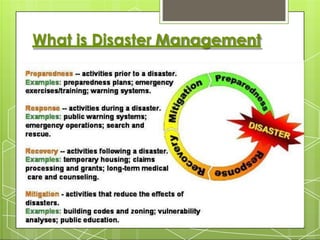
What is Disaster Management
What it involves ??
 Dealing with and avoiding both natural and
man made disasters.
 Preparedness before disaster.
 Rebuilding and supporting society after
natural disasters.
BACKGROUND
population pressures and Enormous
urbanization
 A flood, a drought or an earthquake millions
of peoples are affected each time a disaster
occurs
 Large-scale displacement and the loss of
life, loss of property and agricultural crops
 The reasons for this are varied including:
 an increasing population pressures in urban
areas
 an increase in the extent of encroachment
into lands, e.g., river beds or drainage
courses, low lying areas etc.
 poor or ignored zoning laws and policies
 lack of proper risk management (insurance)
BACKGROUND
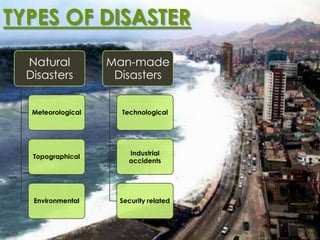
TYPES OF DISASTER
Natural
Disasters
Meteorological
Topographical
Environmental
Man-made
Disasters
Technological
Industrial
accidents
Security related
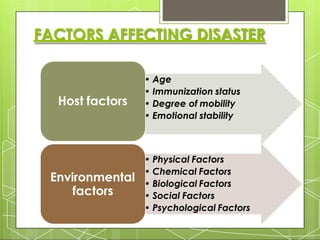
FACTORS AFFECTING DISASTER
• Age
• Immunization status
• Degree of mobility
• Emotional stability
Host factors
• Physical Factors
• Chemical Factors
• Biological Factors
• Social Factors
• Psychological Factors
Environmental
factors
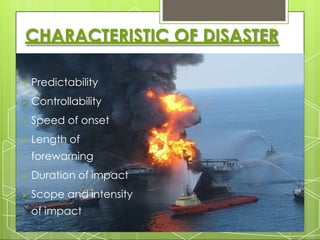
CHARACTERISTIC OF DISASTER
 Predictability
 Controllability
 Speed of onset
 Length of
forewarning
 Duration of impact
 Scope and intensity
of impact
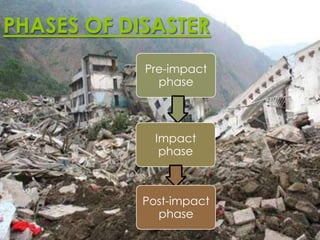
PHASES OF DISASTER
Pre-impact
phase
Impact
phase
Post-impact
phase
PRINCIPLES OF DISASTER MANAGEMENT
 Disaster management is the responsibility of all
spheres of government
 Disaster management should use resources that
exist for a day-to-day purpose.
 Organizations should function as an extensionof
their core business
 Individuals are responsible for their own safety.
 Disaster management planning should focus on
large-scale events.
Contd….
 DM planning should recognize thedifference
between incidents and disasters.
 DM planning must take account of the type of
physical environment and the structure of the
population.
 DM arrangements must recognise the involvement
and potential role of non- government agencies.
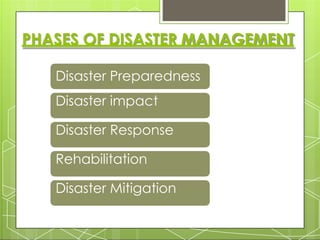
PHASES OF DISASTER MANAGEMENT
Disaster Preparedness
Disaster impact
Disaster Response
Rehabilitation
Disaster Mitigation
Disaster preparedness
Preparedness should be in the form of
money, manpower and materials
 Evaluation from past experiences about risk
 Location of disaster prone areas
 Organization of communication, information
and warning system
 Ensuring co-ordination and response
mechanisms
 Development of public education
programme
 Co-ordination with media
 National & international relations
 Keeping stock of foods, drug and other
essential commodities.
Contd….
E.g.: Indian Meteorological department (IMD) plays a key role
in forewarning the disaster of cyclone-storms by detection tracing. It has
5 centres in Kolkata, Bhubaneswar, Vishakapatanam, Chennai &
Mumbai. In addition there are 31 special observation posts setup a long
the east coast of India.
The International Agencies which provides humanitarian assistance to the
disaster strike areas are United Nation agencies.
 Office for the co-ordination of Humanitarian Affair (OCHA)
 World Health Organization (WHO)
 UNICEF
 World Food Programme (WFP)
 Food & Agricultural Organisation (FAD)
E.g.: Non Governmental Organizations
 Co-Operative American Relief Every where (CARE)
 International committee of Red cross
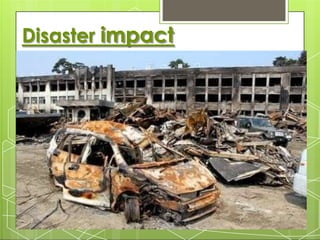
Disaster impact
Disaster response
 Epidemiologic surveillance and disease
control
 Vaccination
 Nutrition
Rehabilitation phase
 Water supply
 Food safety
 Basic sanitation and personal hygiene
 Vector control
Disaster mitigation
 This involves lessening the likely effects of emergencies.
 These include depending upon the disaster, protection of
vulnerable population and structure.
Eg. improving structural qualities of schools, houses and such other
buildings so that medical causalities can be minimized.
 Similarly ensuring the safety of health facilities and public health
services including water supply and sewerage system to reduce the
cost of rehabilitation and reconstruction.
This mitigation compliments the disaster preparedness and disaster
response activities.
DISASTER-EFFECTS
 Deaths
 Disability
 Increase in communicable disease
 Psychological problems
 Food shortage
 Socioeconomic losses
 Shortage of drugs and medical supplies.
 Environmental disruption
DISASTER RECOVERY
 Successful Recovery Preparation
 Be vigilant in Health teaching
 Psychological support
 Referrals to hospital as needed
 Remain alert for environmental health
 Nurse must be attentive to the danger
Major Disasters in India
 1984 Bhopal Gas Tragedy
 2001 Gujarat earthquake
 2004 Indian Ocean tsunami
 2008 Mumbai attacks
India’s Vulnerability to Disasters
 57% land is vulnerable to earthquakes. Of
these, 12% is vulnerable to severe earthquakes.
 68% land is vulnerable to drought.
 12% land is vulnerable to floods.
 8% land is vulnerable to cyclones.
 Apart from natural disasters, some cities in India
are also vulnerable to chemical and industrial
disasters and man-made disasters.
Nodal Agencies for Disaster Management
 Floods : Ministry of Water Resources, CWC
 Cyclones : Indian Meteorological Department
 Earthquakes : Indian Meteorological Department
 Epidemics : Ministry of Health and Family Welfare
 Avian Flu: Ministry of Health, Ministry of Environment,
 Ministry of Agriculture and Animal Husbandry
 Chemical Disasters : Ministry of Environment and
Forests
 Industrial Disasters : Ministry of Labour
 Rail Accidents : Ministry of Railways
 Air Accidents : Ministry of Civil Aviation
 Fire : Ministry of Home Affairs
 Nuclear Incidents : Department of Atomic Energy
 Mine Disasters : Department of Mines
Nodal Agencies for Disaster Management
Dynamics of Disasters
 There is a high probability or a low probability for an
event happening somewhere sometime soon…
 The unpredictability of disaster events and the high
risk and vulnerability profiles make it imperative to
strengthen disaster preparedness, mitigation and
enforcement of guidelines, building codes and
restrictions on construction of buildings in flood-prone
areas and storm surge prone coastal areas.
New Directions for Disaster Management in
India
 The National Disaster Management Authority (NDMA) has
been set up as the apex body for Disaster Management in
India, with the Prime Minister as its Chairman.
 Disaster Management Authorities will be set up at the State
and District Levels to be headed by the Chief Ministers and
Collectors/Zilla Parishad Chairmen respectively.
New Directions for Disaster Management in
India
 A National Disaster Mitigation Fund will be administerd by NDMA.
States and districts will administer mitigation funds.
 A National Disaster Response Fund will be administerd by NDMA
through the National Executive Committee. States and Districts will
administer state Disaster Response Fund and Disaster Response Fund
respectively.
 8 Battalions of National Disaster Response Force (NDRF) are being
trained and deployed with CSSR and MFR equipments and tools in
eight strategic locations.
 A National Disaster Management Policy and National Disaster
Response Plan will also be drawn up.
Invest in Preparedness
 Investments in Preparedness and Prevention
(Mitigation) will yield sustainable results, rather than
spending money on relief after a disaster.
 Most disasters are predictable, especially in their
seasonality and the disaster-prone areas which are
vulnerable.
 Communities must be involved in disaster
preparedness.
 Inclusive, participatory, gender sensitive, child
friendly, eco-friendly and disabled friendly
disaster management
 Technology driven but people owned
 Knowledge Management: Documentation and
dissemination of good practices
 Public Private Partnership
Future Directions
Best Practices
 On 12 November, 1970 a major cyclone hit the coastal belt of
Bangladesh at 223 km/hr. with a storm surge of six to nine
meters height, killing an estimated 500,000 people.
 Due to the Cyclone Preparedness Program, the April 1991
cyclone with wind speed of 225 km/hr. killed only 138,000
people even though the coastal population had doubledby
that time.
 In May 1994, in a similar cyclone with a wind speed of 250
km/hr. only 127 people lost their lives.
 In May 1997, in a cyclone with wind speed of 200 km/hr. only
111 people lost their lives.
New possibilities
 National Urban Renewal Mission for 70 cities:
recent experience of “unprecedented”
extreme weather conditions in a few major
metros and megacities
 100,000 Rural Knowledge Centres
( IT Kiosks): Need for Spatial e-Governance for
informed decision making in disaster-prone
areas: before, during and after disasters
Disaster Reduction Day
 NIDM observed "Disaster Reduction Day" on the
12th October
 Rallies and special lectures were organized in the
universities and colleges to mark the initiatives of
awareness for disaster reduction amongst youth &
children
 Children's Colour Activity Book for Disaster
Preparedness
 FOR INFORMATION ON DISASTERS DIAL
TOLL FREE No. 1070
 Log on to http://www.ndmindia.nic.in
DISASTER NURSING
 It can be defined as the adaptation of
professional nursing skills in recognizing
and meeting the nursing, physical and
emotional needs resulting from a
disaster.
Disaster management

Disaster management

  • 1.
  • 2.
    What is disastermanagement ?  “A disaster can be defined as any occurrence that cause damage, ecological disruption, loss of human life, deterioration of health and health services on a scale, sufficient to warrant an extraordinary response from outside the affected community or area”. (W.H.O.)  “A disaster can be defined as an occurrence either nature or manmade that causes human suffering and creates human needs that victims cannot alleviate without assistance”. American Red Cross (ARC) ’
  • 3.
    What is DisasterManagement
  • 4.
    What it involves??  Dealing with and avoiding both natural and man made disasters.  Preparedness before disaster.  Rebuilding and supporting society after natural disasters.
  • 5.
    BACKGROUND population pressures andEnormous urbanization  A flood, a drought or an earthquake millions of peoples are affected each time a disaster occurs  Large-scale displacement and the loss of life, loss of property and agricultural crops
  • 6.
     The reasonsfor this are varied including:  an increasing population pressures in urban areas  an increase in the extent of encroachment into lands, e.g., river beds or drainage courses, low lying areas etc.  poor or ignored zoning laws and policies  lack of proper risk management (insurance) BACKGROUND
  • 7.
  • 8.
    FACTORS AFFECTING DISASTER •Age • Immunization status • Degree of mobility • Emotional stability Host factors • Physical Factors • Chemical Factors • Biological Factors • Social Factors • Psychological Factors Environmental factors
  • 9.
    CHARACTERISTIC OF DISASTER Predictability  Controllability  Speed of onset  Length of forewarning  Duration of impact  Scope and intensity of impact
  • 10.
  • 11.
    PRINCIPLES OF DISASTERMANAGEMENT  Disaster management is the responsibility of all spheres of government  Disaster management should use resources that exist for a day-to-day purpose.  Organizations should function as an extensionof their core business  Individuals are responsible for their own safety.  Disaster management planning should focus on large-scale events.
  • 12.
    Contd….  DM planningshould recognize thedifference between incidents and disasters.  DM planning must take account of the type of physical environment and the structure of the population.  DM arrangements must recognise the involvement and potential role of non- government agencies.
  • 13.
    PHASES OF DISASTERMANAGEMENT Disaster Preparedness Disaster impact Disaster Response Rehabilitation Disaster Mitigation
  • 14.
    Disaster preparedness Preparedness shouldbe in the form of money, manpower and materials  Evaluation from past experiences about risk  Location of disaster prone areas  Organization of communication, information and warning system  Ensuring co-ordination and response mechanisms
  • 15.
     Development ofpublic education programme  Co-ordination with media  National & international relations  Keeping stock of foods, drug and other essential commodities. Contd….
  • 16.
    E.g.: Indian Meteorologicaldepartment (IMD) plays a key role in forewarning the disaster of cyclone-storms by detection tracing. It has 5 centres in Kolkata, Bhubaneswar, Vishakapatanam, Chennai & Mumbai. In addition there are 31 special observation posts setup a long the east coast of India. The International Agencies which provides humanitarian assistance to the disaster strike areas are United Nation agencies.  Office for the co-ordination of Humanitarian Affair (OCHA)  World Health Organization (WHO)  UNICEF  World Food Programme (WFP)  Food & Agricultural Organisation (FAD) E.g.: Non Governmental Organizations  Co-Operative American Relief Every where (CARE)  International committee of Red cross  International committee of Red cross
  • 17.
  • 18.
    Disaster response  Epidemiologicsurveillance and disease control  Vaccination  Nutrition
  • 19.
    Rehabilitation phase  Watersupply  Food safety  Basic sanitation and personal hygiene  Vector control
  • 20.
    Disaster mitigation  Thisinvolves lessening the likely effects of emergencies.  These include depending upon the disaster, protection of vulnerable population and structure. Eg. improving structural qualities of schools, houses and such other buildings so that medical causalities can be minimized.  Similarly ensuring the safety of health facilities and public health services including water supply and sewerage system to reduce the cost of rehabilitation and reconstruction. This mitigation compliments the disaster preparedness and disaster response activities.
  • 21.
    DISASTER-EFFECTS  Deaths  Disability Increase in communicable disease  Psychological problems  Food shortage  Socioeconomic losses  Shortage of drugs and medical supplies.  Environmental disruption
  • 22.
    DISASTER RECOVERY  SuccessfulRecovery Preparation  Be vigilant in Health teaching  Psychological support  Referrals to hospital as needed  Remain alert for environmental health  Nurse must be attentive to the danger
  • 23.
    Major Disasters inIndia  1984 Bhopal Gas Tragedy  2001 Gujarat earthquake  2004 Indian Ocean tsunami  2008 Mumbai attacks
  • 24.
    India’s Vulnerability toDisasters  57% land is vulnerable to earthquakes. Of these, 12% is vulnerable to severe earthquakes.  68% land is vulnerable to drought.  12% land is vulnerable to floods.  8% land is vulnerable to cyclones.  Apart from natural disasters, some cities in India are also vulnerable to chemical and industrial disasters and man-made disasters.
  • 25.
    Nodal Agencies forDisaster Management  Floods : Ministry of Water Resources, CWC  Cyclones : Indian Meteorological Department  Earthquakes : Indian Meteorological Department  Epidemics : Ministry of Health and Family Welfare  Avian Flu: Ministry of Health, Ministry of Environment,  Ministry of Agriculture and Animal Husbandry
  • 26.
     Chemical Disasters: Ministry of Environment and Forests  Industrial Disasters : Ministry of Labour  Rail Accidents : Ministry of Railways  Air Accidents : Ministry of Civil Aviation  Fire : Ministry of Home Affairs  Nuclear Incidents : Department of Atomic Energy  Mine Disasters : Department of Mines Nodal Agencies for Disaster Management
  • 27.
    Dynamics of Disasters There is a high probability or a low probability for an event happening somewhere sometime soon…  The unpredictability of disaster events and the high risk and vulnerability profiles make it imperative to strengthen disaster preparedness, mitigation and enforcement of guidelines, building codes and restrictions on construction of buildings in flood-prone areas and storm surge prone coastal areas.
  • 28.
    New Directions forDisaster Management in India  The National Disaster Management Authority (NDMA) has been set up as the apex body for Disaster Management in India, with the Prime Minister as its Chairman.  Disaster Management Authorities will be set up at the State and District Levels to be headed by the Chief Ministers and Collectors/Zilla Parishad Chairmen respectively.
  • 29.
    New Directions forDisaster Management in India  A National Disaster Mitigation Fund will be administerd by NDMA. States and districts will administer mitigation funds.  A National Disaster Response Fund will be administerd by NDMA through the National Executive Committee. States and Districts will administer state Disaster Response Fund and Disaster Response Fund respectively.  8 Battalions of National Disaster Response Force (NDRF) are being trained and deployed with CSSR and MFR equipments and tools in eight strategic locations.  A National Disaster Management Policy and National Disaster Response Plan will also be drawn up.
  • 30.
    Invest in Preparedness Investments in Preparedness and Prevention (Mitigation) will yield sustainable results, rather than spending money on relief after a disaster.  Most disasters are predictable, especially in their seasonality and the disaster-prone areas which are vulnerable.  Communities must be involved in disaster preparedness.
  • 31.
     Inclusive, participatory,gender sensitive, child friendly, eco-friendly and disabled friendly disaster management  Technology driven but people owned  Knowledge Management: Documentation and dissemination of good practices  Public Private Partnership Future Directions
  • 32.
    Best Practices  On12 November, 1970 a major cyclone hit the coastal belt of Bangladesh at 223 km/hr. with a storm surge of six to nine meters height, killing an estimated 500,000 people.  Due to the Cyclone Preparedness Program, the April 1991 cyclone with wind speed of 225 km/hr. killed only 138,000 people even though the coastal population had doubledby that time.  In May 1994, in a similar cyclone with a wind speed of 250 km/hr. only 127 people lost their lives.  In May 1997, in a cyclone with wind speed of 200 km/hr. only 111 people lost their lives.
  • 33.
    New possibilities  NationalUrban Renewal Mission for 70 cities: recent experience of “unprecedented” extreme weather conditions in a few major metros and megacities  100,000 Rural Knowledge Centres ( IT Kiosks): Need for Spatial e-Governance for informed decision making in disaster-prone areas: before, during and after disasters
  • 34.
    Disaster Reduction Day NIDM observed "Disaster Reduction Day" on the 12th October  Rallies and special lectures were organized in the universities and colleges to mark the initiatives of awareness for disaster reduction amongst youth & children  Children's Colour Activity Book for Disaster Preparedness
  • 35.
     FOR INFORMATIONON DISASTERS DIAL TOLL FREE No. 1070  Log on to http://www.ndmindia.nic.in
  • 36.
    DISASTER NURSING  Itcan be defined as the adaptation of professional nursing skills in recognizing and meeting the nursing, physical and emotional needs resulting from a disaster.