UGC-Academic Staff College 
7th 4-week Orientation Programme 
For Academic Administrators 
from 06 August to 04 September 2014 
Prof (Col) Rajive Kohli, Ph.D. 
21 August 2014 from 12.45 to 2.15 p.m. 
9910744340 kohli9r@gmail.com
DEFINATION 
“a sudden accident or a natural catastrophe that causes great 
damage or loss of life” (Oxford dictionary) 
“a catastrophic, mishap, calamity or grave occurrence in any 
area, arising from natural or man-made cause, or by accident or 
negligence which results in substantial loss of life or human 
suffering or damage to, and destruction of property, or damage 
to, or degradation of, environment, and is of such a nature or 
magnitude as to be beyond the coping capacity of the 
community of the affected area” (Disaster Management Act 
2005)
A Disaster is an event or series of events, 
which gives rise to casualties and damage or 
loss of properties, infrastructure, 
environment, essential services or means of 
livelihood on such a scale which is beyond 
the normal capacity of the affected 
community to cope with.
DISASTER dimensions 
– Disruption to normal pattern of life, usually 
severe and may also be sudden, unexpected 
and widespread 
– Human effects like loss of life, injury, hardship 
and adverse effect on health 
– Effect on social infrastructure such as 
destruction of or damage to government 
systems, buildings, communications and 
essential services 
– Community needs such shelter, food, 
clothing, medical assistance and social care.
Impact of Disasters 
• Direct effects include deaths, injuries and 
physical damage. 
• Secondary disaster impacts such as releasing 
fire or hazardous material that is triggered by 
disasters. 
• Indirect impacts include the ripple effect 
resulting from the flow of goods, services, 
unemployment etc.
GENERAL EFFECTS OF DISASTER 
 LOSS OF LIFE. 
 INJURY. 
 DAMAGE TO AND DESTRUCTION OF PROPERTY. 
 DAMAGE TO AND DESTRUCTION OF PRODUCTION. 
 DISRUPTION OF LIFESTYLE. 
 LOSS OF LIVELIHOOD. 
 DISRUPTION TO ESSENTIAL SERVICES. 
 DAMAGE TO NATIONAL INFRASTRUCTURE. 
 DISRUPTION TO GOVERNMENTAL SYSTEMS. 
 NATIONAL ECONOMIC LOSS. 
 SOCIOLOGICAL AND PSYCHOLOGICAL AFTER 
EFFECT. 
 ENVIRONMENTAL DISRUPTION
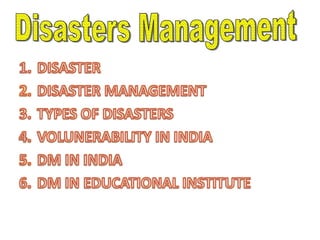
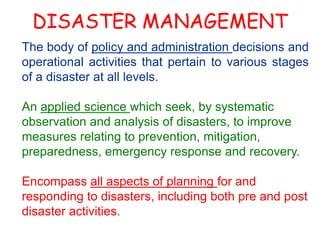
DISASTER MANAGEMENT 
The body of policy and administration decisions and 
operational activities that pertain to various stages 
of a disaster at all levels. 
An applied science which seek, by systematic 
observation and analysis of disasters, to improve 
measures relating to prevention, mitigation, 
preparedness, emergency response and recovery. 
Encompass all aspects of planning for and 
responding to disasters, including both pre and post 
disaster activities.
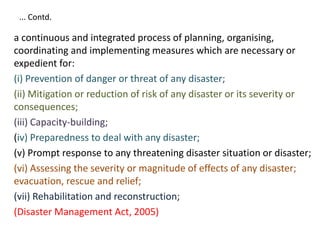
... Contd. 
a continuous and integrated process of planning, organising, 
coordinating and implementing measures which are necessary or 
expedient for: 
(i) Prevention of danger or threat of any disaster; 
(ii) Mitigation or reduction of risk of any disaster or its severity or 
consequences; 
(iii) Capacity-building; 
(iv) Preparedness to deal with any disaster; 
(v) Prompt response to any threatening disaster situation or disaster; 
(vi) Assessing the severity or magnitude of effects of any disaster; 
evacuation, rescue and relief; 
(vii) Rehabilitation and reconstruction; 
(Disaster Management Act, 2005)
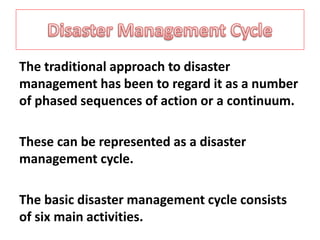
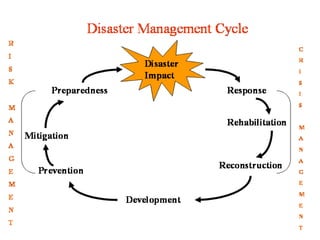
The traditional approach to disaster 
management has been to regard it as a number 
of phased sequences of action or a continuum. 
These can be represented as a disaster 
management cycle. 
The basic disaster management cycle consists 
of six main activities.
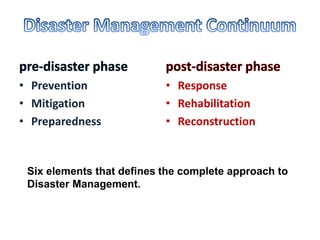
• Prevention 
• Mitigation 
• Preparedness 
• Response 
• Rehabilitation 
• Reconstruction 
Six elements that defines the complete approach to 
Disaster Management.
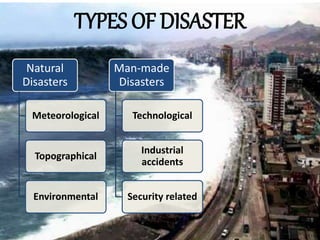
TYPES OF DISASTER 
Natural 
Disasters 
Meteorological 
Topographical 
Environmental 
Man-made 
Disasters 
Technological 
Industrial 
accidents 
Security related
Disasters occur in varied forms 
•Some are predictable in advance 
•Some are annual or seasonal 
•Some are sudden and unpredictable 
Floods Days and weeks 
Earthquakes Seconds/minutes 
Cyclones Days 
Droughts Months
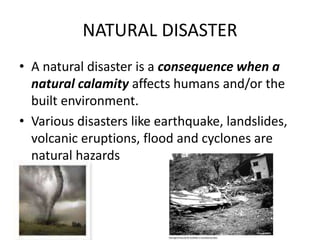
NATURAL DISASTER 
• A natural disaster is a consequence when a 
natural calamity affects humans and/or the 
built environment. 
• Various disasters like earthquake, landslides, 
volcanic eruptions, flood and cyclones are 
natural hazards
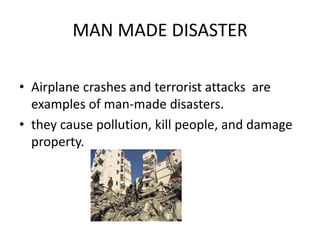
MAN MADE DISASTER 
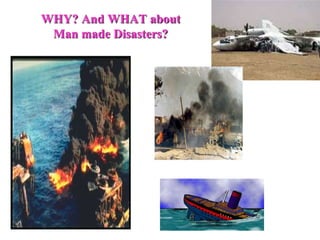
• Airplane crashes and terrorist attacks are 
examples of man-made disasters. 
• they cause pollution, kill people, and damage 
property.
Distinction between 
Hazard and Disaster : 
“A hazard is a natural event while the disaster 
is its consequence. A hazard is a perceived 
natural event which threatens both life and 
property….a disaster is a realization of this 
hazard…” 
– John Whittow, Disaster. 1980
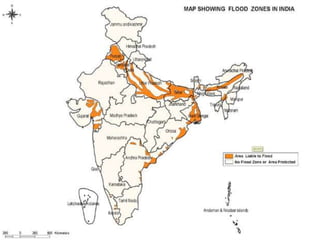
Water and Climate related disasters 
• Floods and Drainage Management 
• Cyclones 
• Tornadoes and Hurricanes 
• Hailstorm 
• Cloud Burst 
• Heat Wave and Cold Wave 
• Snow Avalanches 
• Droughts 
• Sea Erosion 
• Thunder & Lightning
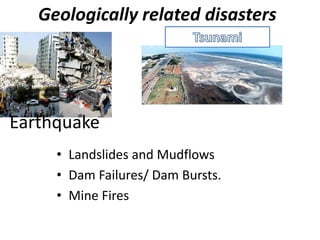
Geologically related disasters 
Earthquake 
• Landslides and Mudflows 
• Dam Failures/ Dam Bursts. 
• Mine Fires
Biologically related disasters 
• Biological Disasters and Epidemics 
• Pest Attacks 
• Cattle Epidemics 
• Food Poisoning
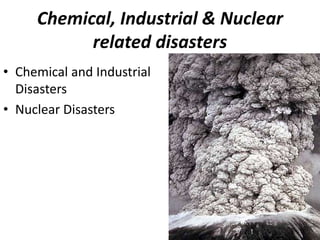
Chemical, Industrial & Nuclear 
related disasters 
• Chemical and Industrial 
Disasters 
• Nuclear Disasters
Accident related disasters 
• Forest Fires 
• Urban Fires 
• Mine Flooding 
• Oil Spill 
• Major Building Collapse 
• Serial Bomb Blasts 
• Festival related disasters 
• Electrical Disasters & Fires 
• Air, Road and Rail Accidents. 
• Boat Capsizing. 
• Village Fire
WHY? And WHAT about 
Man made Disasters?
Manmade Disasters 
• Urban fires 
• Village fire 
• Mine fires 
• Air, road and rail accidents 
• Boat capsizing 
• Electrical disasters 
• Chemical and industrial 
disasters 
• Nuclear disasters 
• Mine flooding 
• Oil spill 
• Major building collapse 
• Serial bomb blasts 
• Festival related disasters 
 civil strife 
 communal violence 
 internal conflict, 
 “complex emergencies” 
 rapid or slow onset types 
COMPLEX DISASTERS 
urbanisation chaotic growth 
policy disasters 
war and civil strife 
Social violence
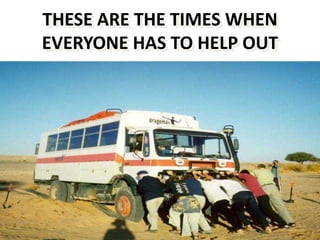
THESE ARE THE TIMES WHEN 
EVERYONE HAS TO HELP OUT
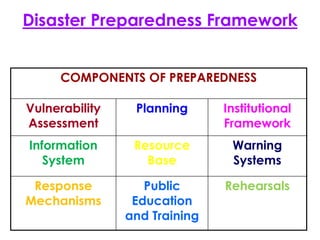
Disaster Preparedness Framework 
COMPONENTS OF PREPAREDNESS 
Public Rehearsals 
Education 
and Training 
Response 
Mechanisms 
Warning 
Systems 
Resource 
Base 
Information 
System 
Institutional 
Framework 
Vulnerability Planning 
Assessment
Role Players in Disasters 
• People : Individuals, House -Holds, 
Volunteers 
• Gram Panchayat : Sarpanch, Panchayati 
Secretary, Panchayat Members 
• Village Elders : Caste/Community/Religious 
Leaders, Teachers, Doctors, Engineers, 
Retired Army & Police Personnel 
• Govt. Deptl. Officers : Agriculture, Medical, 
Engineers (Housing, Roads & Buildings, 
Irrigation) Revenue Department, Public 
Health, Police, Defence, NGOs
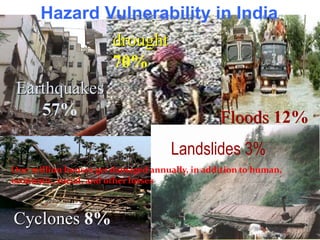
Hazard Vulnerability in India 
Earthquakes 
57% 
Cyclones 8% 
Floods 12% 
drought 
70% 
Landslides 3% 
One million houses get damaged annually, in addition to human, 
economic, social, and other losses
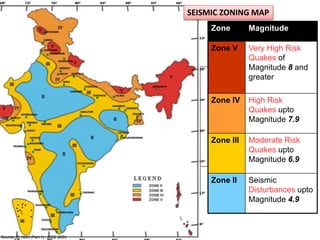
Zone Magnitude 
Zone V Very High Risk 
Quakes of 
Magnitude 8 and 
greater 
Zone IV High Risk 
Quakes upto 
Magnitude 7.9 
Zone III Moderate Risk 
Quakes upto 
Magnitude 6.9 
Zone II Seismic 
Disturbances upto 
Magnitude 4.9 
Source: IS 1893 (Part 1) : 2002 (BIS) 
SEISMIC ZONING MAP
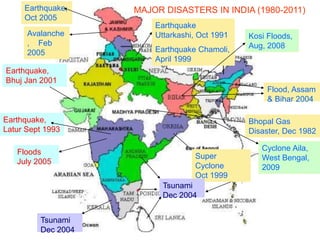
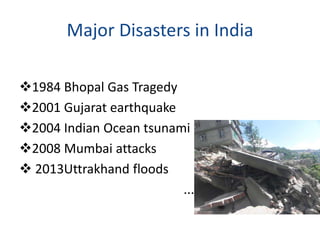
Major Disasters in India 
1984 Bhopal Gas Tragedy 
2001 Gujarat earthquake 
2004 Indian Ocean tsunami 
2008 Mumbai attacks 
 2013Uttrakhand floods 
..........
Avalanche 
, Feb 
2005 
Floods 
July 2005 
Tsunami 
Dec 2004 
MAJOR DISASTERS IN INDIA (1980-2011) 
Super 
Cyclone 
Oct 1999 
Flood, Assam 
& Bihar 2004 
Earthquake 
Uttarkashi, Oct 1991 
Earthquake Chamoli, 
April 1999 
Earthquake, 
Bhuj Jan 2001 
Earthquake, 
Latur Sept 1993 
Tsunami 
Dec 2004 
Bhopal Gas 
Disaster, Dec 1982 
Earthquake, 
Oct 2005 
Kosi Floods, 
Aug, 2008 
Cyclone Aila, 
West Bengal, 
2009
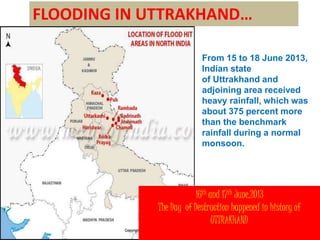
FLOODING IN UTTRAKHAND… 
From 15 to 18 June 2013, 
Indian state 
of Uttrakhand and 
adjoining area received 
heavy rainfall, which was 
about 375 percent more 
than the benchmark 
rainfall during a normal 
monsoon. 
16th and 17th June,2013 
The Day of Destruction happened in history of 
UTTRAKHAND
HUMAN LOSS 
 According to the official records 400 houses were destroyed and 265 
were damaged 
 4,200 villages effected 
 6,000 people were dead,10,000 injured and 1,00,000 stranded 
ECONOMIC LOSS 
 20,000 crores loss 
 Major roads, telephone towers 
destroyed due, communication lost 
 Tourism loss
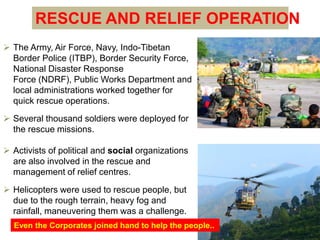
RESCUE AND RELIEF OPERATION 
 The Army, Air Force, Navy, Indo-Tibetan 
Border Police (ITBP), Border Security Force, 
National Disaster Response 
Force (NDRF), Public Works Department and 
local administrations worked together for 
quick rescue operations. 
 Several thousand soldiers were deployed for 
the rescue missions. 
 Activists of political and social organizations 
are also involved in the rescue and 
management of relief centres. 
 Helicopters were used to rescue people, but 
due to the rough terrain, heavy fog and 
rainfall, maneuvering them was a challenge. 
Even the Corporates joined hand to help the people..
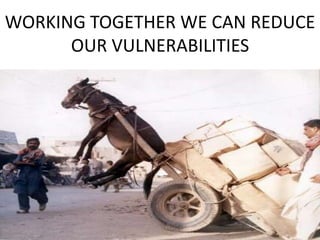
WORKING TOGETHER WE CAN REDUCE 
OUR VULNERABILITIES
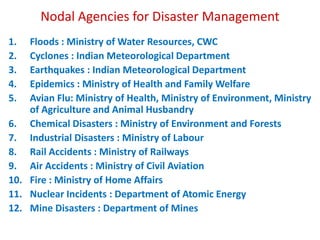
Nodal Agencies for Disaster Management 
1. Floods : Ministry of Water Resources, CWC 
2. Cyclones : Indian Meteorological Department 
3. Earthquakes : Indian Meteorological Department 
4. Epidemics : Ministry of Health and Family Welfare 
5. Avian Flu: Ministry of Health, Ministry of Environment, Ministry 
of Agriculture and Animal Husbandry 
6. Chemical Disasters : Ministry of Environment and Forests 
7. Industrial Disasters : Ministry of Labour 
8. Rail Accidents : Ministry of Railways 
9. Air Accidents : Ministry of Civil Aviation 
10. Fire : Ministry of Home Affairs 
11. Nuclear Incidents : Department of Atomic Energy 
12. Mine Disasters : Department of Mines
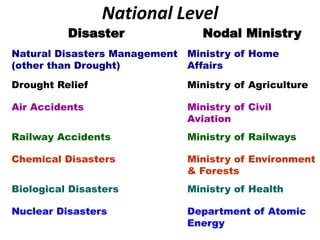
National Level 
Disaster Nodal Ministry 
Natural Disasters Management 
(other than Drought) 
Ministry of Home 
Affairs 
Drought Relief Ministry of Agriculture 
Air Accidents Ministry of Civil 
Aviation 
Railway Accidents Ministry of Railways 
Chemical Disasters Ministry of Environment 
& Forests 
Biological Disasters Ministry of Health 
Nuclear Disasters Department of Atomic 
Energy
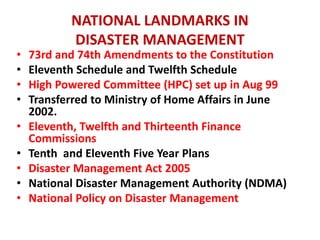
NATIONAL LANDMARKS IN 
DISASTER MANAGEMENT 
• 73rd and 74th Amendments to the Constitution 
• Eleventh Schedule and Twelfth Schedule 
• High Powered Committee (HPC) set up in Aug 99 
• Transferred to Ministry of Home Affairs in June 
2002. 
• Eleventh, Twelfth and Thirteenth Finance 
Commissions 
• Tenth and Eleventh Five Year Plans 
• Disaster Management Act 2005 
• National Disaster Management Authority (NDMA) 
• National Policy on Disaster Management
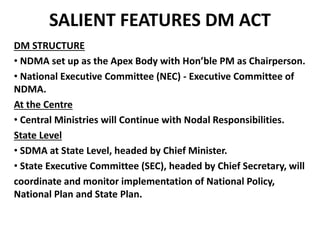
SALIENT FEATURES DM ACT 
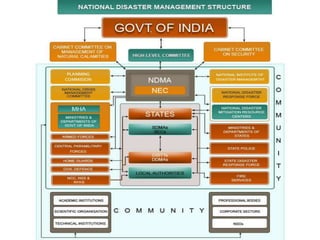
DM STRUCTURE 
• NDMA set up as the Apex Body with Hon’ble PM as Chairperson. 
• National Executive Committee (NEC) - Executive Committee of 
NDMA. 
At the Centre 
• Central Ministries will Continue with Nodal Responsibilities. 
State Level 
• SDMA at State Level, headed by Chief Minister. 
• State Executive Committee (SEC), headed by Chief Secretary, will 
coordinate and monitor implementation of National Policy, 
National Plan and State Plan.
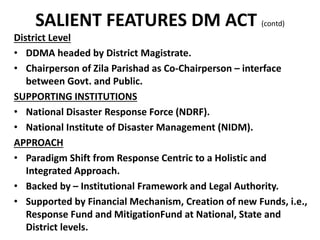
SALIENT FEATURES DM ACT (contd) 
District Level 
• DDMA headed by District Magistrate. 
• Chairperson of Zila Parishad as Co-Chairperson – interface 
between Govt. and Public. 
SUPPORTING INSTITUTIONS 
• National Disaster Response Force (NDRF). 
• National Institute of Disaster Management (NIDM). 
APPROACH 
• Paradigm Shift from Response Centric to a Holistic and 
Integrated Approach. 
• Backed by – Institutional Framework and Legal Authority. 
• Supported by Financial Mechanism, Creation of new Funds, i.e., 
Response Fund and MitigationFund at National, State and 
District levels.
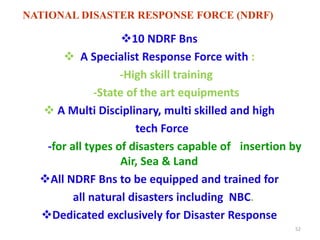
10 NDRF Bns 
 A Specialist Response Force with : 
-High skill training 
-State of the art equipments 
 A Multi Disciplinary, multi skilled and high 
tech Force 
-for all types of disasters capable of insertion by 
Air, Sea & Land 
All NDRF Bns to be equipped and trained for 
all natural disasters including NBC. 
Dedicated exclusively for Disaster Response 
52 
NATIONAL DISASTER RESPONSE FORCE (NDRF)
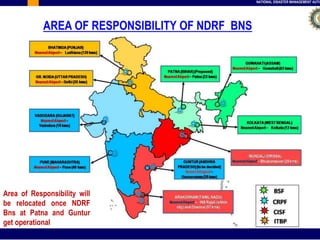
NATIONAL DISASTER MANAGEMENT AUTHORITY 
AREA OF RESPONSIBILITY OF NDRF BNS 
Area of Responsibility will 
be relocated once NDRF 
Bns at Patna and Guntur 
get operational
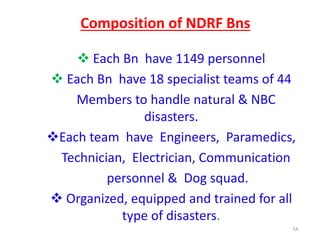
Composition of NDRF Bns 
 Each Bn have 1149 personnel 
 Each Bn have 18 specialist teams of 44 
Members to handle natural & NBC 
disasters. 
Each team have Engineers, Paramedics, 
Technician, Electrician, Communication 
personnel & Dog squad. 
 Organized, equipped and trained for all 
type of disasters. 
54
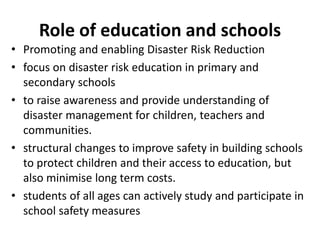
Role of education and schools 
• Promoting and enabling Disaster Risk Reduction 
• focus on disaster risk education in primary and 
secondary schools 
• to raise awareness and provide understanding of 
disaster management for children, teachers and 
communities. 
• structural changes to improve safety in building schools 
to protect children and their access to education, but 
also minimise long term costs. 
• students of all ages can actively study and participate in 
school safety measures
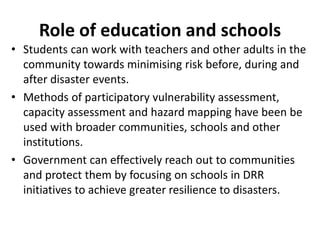
Role of education and schools 
• Students can work with teachers and other adults in the 
community towards minimising risk before, during and 
after disaster events. 
• Methods of participatory vulnerability assessment, 
capacity assessment and hazard mapping have been be 
used with broader communities, schools and other 
institutions. 
• Government can effectively reach out to communities 
and protect them by focusing on schools in DRR 
initiatives to achieve greater resilience to disasters.
Relevance of 
Community Based Disaster Management 
• If readiness (and capacity) is insufficient 
• If vulnerabilities are too great 
• If the scale of hazard is too big 
• Then, the risk is too high, emergencies 
may not be managed locally, the communities 
may not cope, 
DISASTER WILL OCCUR
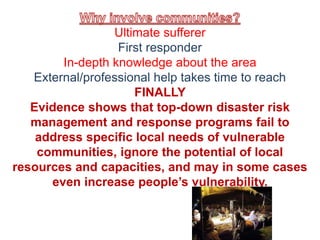
Ultimate sufferer 
First responder 
In-depth knowledge about the area 
External/professional help takes time to reach 
FINALLY 
Evidence shows that top-down disaster risk 
management and response programs fail to 
address specific local needs of vulnerable 
communities, ignore the potential of local 
resources and capacities, and may in some cases 
even increase people’s vulnerability.
The Myths about Disasters 
• It Can’t Happen to Us. 
• The Nature’s forces are so Deadly the 
Victims will Die anyway. 
• There is Nothing We Can Do.
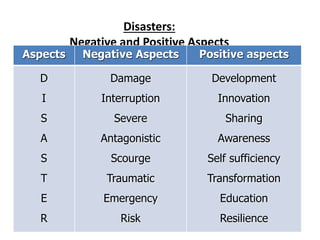
Disasters: 
Negative and Positive Aspects 
Aspects Negative Aspects Positive aspects 
D 
I 
S 
A 
S 
T 
E 
R 
Damage 
Interruption 
Severe 
Antagonistic 
Scourge 
Traumatic 
Emergency 
Risk 
Development 
Innovation 
Sharing 
Awareness 
Self sufficiency 
Transformation 
Education 
Resilience
Dm jamia asc 21 aug14

Dm jamia asc 21 aug14

  • 1.
    UGC-Academic Staff College 7th 4-week Orientation Programme For Academic Administrators from 06 August to 04 September 2014 Prof (Col) Rajive Kohli, Ph.D. 21 August 2014 from 12.45 to 2.15 p.m. 9910744340 kohli9r@gmail.com
  • 4.
    DEFINATION “a suddenaccident or a natural catastrophe that causes great damage or loss of life” (Oxford dictionary) “a catastrophic, mishap, calamity or grave occurrence in any area, arising from natural or man-made cause, or by accident or negligence which results in substantial loss of life or human suffering or damage to, and destruction of property, or damage to, or degradation of, environment, and is of such a nature or magnitude as to be beyond the coping capacity of the community of the affected area” (Disaster Management Act 2005)
  • 5.
    A Disaster isan event or series of events, which gives rise to casualties and damage or loss of properties, infrastructure, environment, essential services or means of livelihood on such a scale which is beyond the normal capacity of the affected community to cope with.
  • 6.
    DISASTER dimensions –Disruption to normal pattern of life, usually severe and may also be sudden, unexpected and widespread – Human effects like loss of life, injury, hardship and adverse effect on health – Effect on social infrastructure such as destruction of or damage to government systems, buildings, communications and essential services – Community needs such shelter, food, clothing, medical assistance and social care.
  • 7.
    Impact of Disasters • Direct effects include deaths, injuries and physical damage. • Secondary disaster impacts such as releasing fire or hazardous material that is triggered by disasters. • Indirect impacts include the ripple effect resulting from the flow of goods, services, unemployment etc.
  • 8.
    GENERAL EFFECTS OFDISASTER  LOSS OF LIFE.  INJURY.  DAMAGE TO AND DESTRUCTION OF PROPERTY.  DAMAGE TO AND DESTRUCTION OF PRODUCTION.  DISRUPTION OF LIFESTYLE.  LOSS OF LIVELIHOOD.  DISRUPTION TO ESSENTIAL SERVICES.  DAMAGE TO NATIONAL INFRASTRUCTURE.  DISRUPTION TO GOVERNMENTAL SYSTEMS.  NATIONAL ECONOMIC LOSS.  SOCIOLOGICAL AND PSYCHOLOGICAL AFTER EFFECT.  ENVIRONMENTAL DISRUPTION
  • 10.
    DISASTER MANAGEMENT Thebody of policy and administration decisions and operational activities that pertain to various stages of a disaster at all levels. An applied science which seek, by systematic observation and analysis of disasters, to improve measures relating to prevention, mitigation, preparedness, emergency response and recovery. Encompass all aspects of planning for and responding to disasters, including both pre and post disaster activities.
  • 12.
    ... Contd. acontinuous and integrated process of planning, organising, coordinating and implementing measures which are necessary or expedient for: (i) Prevention of danger or threat of any disaster; (ii) Mitigation or reduction of risk of any disaster or its severity or consequences; (iii) Capacity-building; (iv) Preparedness to deal with any disaster; (v) Prompt response to any threatening disaster situation or disaster; (vi) Assessing the severity or magnitude of effects of any disaster; evacuation, rescue and relief; (vii) Rehabilitation and reconstruction; (Disaster Management Act, 2005)
  • 13.
    The traditional approachto disaster management has been to regard it as a number of phased sequences of action or a continuum. These can be represented as a disaster management cycle. The basic disaster management cycle consists of six main activities.
  • 15.
    • Prevention •Mitigation • Preparedness • Response • Rehabilitation • Reconstruction Six elements that defines the complete approach to Disaster Management.
  • 17.
    TYPES OF DISASTER Natural Disasters Meteorological Topographical Environmental Man-made Disasters Technological Industrial accidents Security related
  • 18.
    Disasters occur invaried forms •Some are predictable in advance •Some are annual or seasonal •Some are sudden and unpredictable Floods Days and weeks Earthquakes Seconds/minutes Cyclones Days Droughts Months
  • 19.
    NATURAL DISASTER •A natural disaster is a consequence when a natural calamity affects humans and/or the built environment. • Various disasters like earthquake, landslides, volcanic eruptions, flood and cyclones are natural hazards
  • 20.
    MAN MADE DISASTER • Airplane crashes and terrorist attacks are examples of man-made disasters. • they cause pollution, kill people, and damage property.
  • 21.
    Distinction between Hazardand Disaster : “A hazard is a natural event while the disaster is its consequence. A hazard is a perceived natural event which threatens both life and property….a disaster is a realization of this hazard…” – John Whittow, Disaster. 1980
  • 24.
    Water and Climaterelated disasters • Floods and Drainage Management • Cyclones • Tornadoes and Hurricanes • Hailstorm • Cloud Burst • Heat Wave and Cold Wave • Snow Avalanches • Droughts • Sea Erosion • Thunder & Lightning
  • 25.
    Geologically related disasters Earthquake • Landslides and Mudflows • Dam Failures/ Dam Bursts. • Mine Fires
  • 26.
    Biologically related disasters • Biological Disasters and Epidemics • Pest Attacks • Cattle Epidemics • Food Poisoning
  • 27.
    Chemical, Industrial &Nuclear related disasters • Chemical and Industrial Disasters • Nuclear Disasters
  • 28.
    Accident related disasters • Forest Fires • Urban Fires • Mine Flooding • Oil Spill • Major Building Collapse • Serial Bomb Blasts • Festival related disasters • Electrical Disasters & Fires • Air, Road and Rail Accidents. • Boat Capsizing. • Village Fire
  • 29.
    WHY? And WHATabout Man made Disasters?
  • 30.
    Manmade Disasters •Urban fires • Village fire • Mine fires • Air, road and rail accidents • Boat capsizing • Electrical disasters • Chemical and industrial disasters • Nuclear disasters • Mine flooding • Oil spill • Major building collapse • Serial bomb blasts • Festival related disasters  civil strife  communal violence  internal conflict,  “complex emergencies”  rapid or slow onset types COMPLEX DISASTERS urbanisation chaotic growth policy disasters war and civil strife Social violence
  • 31.
    THESE ARE THETIMES WHEN EVERYONE HAS TO HELP OUT
  • 32.
    Disaster Preparedness Framework COMPONENTS OF PREPAREDNESS Public Rehearsals Education and Training Response Mechanisms Warning Systems Resource Base Information System Institutional Framework Vulnerability Planning Assessment
  • 33.
    Role Players inDisasters • People : Individuals, House -Holds, Volunteers • Gram Panchayat : Sarpanch, Panchayati Secretary, Panchayat Members • Village Elders : Caste/Community/Religious Leaders, Teachers, Doctors, Engineers, Retired Army & Police Personnel • Govt. Deptl. Officers : Agriculture, Medical, Engineers (Housing, Roads & Buildings, Irrigation) Revenue Department, Public Health, Police, Defence, NGOs
  • 35.
    Hazard Vulnerability inIndia Earthquakes 57% Cyclones 8% Floods 12% drought 70% Landslides 3% One million houses get damaged annually, in addition to human, economic, social, and other losses
  • 36.
    Zone Magnitude ZoneV Very High Risk Quakes of Magnitude 8 and greater Zone IV High Risk Quakes upto Magnitude 7.9 Zone III Moderate Risk Quakes upto Magnitude 6.9 Zone II Seismic Disturbances upto Magnitude 4.9 Source: IS 1893 (Part 1) : 2002 (BIS) SEISMIC ZONING MAP
  • 39.
    Major Disasters inIndia 1984 Bhopal Gas Tragedy 2001 Gujarat earthquake 2004 Indian Ocean tsunami 2008 Mumbai attacks  2013Uttrakhand floods ..........
  • 40.
    Avalanche , Feb 2005 Floods July 2005 Tsunami Dec 2004 MAJOR DISASTERS IN INDIA (1980-2011) Super Cyclone Oct 1999 Flood, Assam & Bihar 2004 Earthquake Uttarkashi, Oct 1991 Earthquake Chamoli, April 1999 Earthquake, Bhuj Jan 2001 Earthquake, Latur Sept 1993 Tsunami Dec 2004 Bhopal Gas Disaster, Dec 1982 Earthquake, Oct 2005 Kosi Floods, Aug, 2008 Cyclone Aila, West Bengal, 2009
  • 41.
    FLOODING IN UTTRAKHAND… From 15 to 18 June 2013, Indian state of Uttrakhand and adjoining area received heavy rainfall, which was about 375 percent more than the benchmark rainfall during a normal monsoon. 16th and 17th June,2013 The Day of Destruction happened in history of UTTRAKHAND
  • 42.
    HUMAN LOSS According to the official records 400 houses were destroyed and 265 were damaged  4,200 villages effected  6,000 people were dead,10,000 injured and 1,00,000 stranded ECONOMIC LOSS  20,000 crores loss  Major roads, telephone towers destroyed due, communication lost  Tourism loss
  • 43.
    RESCUE AND RELIEFOPERATION  The Army, Air Force, Navy, Indo-Tibetan Border Police (ITBP), Border Security Force, National Disaster Response Force (NDRF), Public Works Department and local administrations worked together for quick rescue operations.  Several thousand soldiers were deployed for the rescue missions.  Activists of political and social organizations are also involved in the rescue and management of relief centres.  Helicopters were used to rescue people, but due to the rough terrain, heavy fog and rainfall, maneuvering them was a challenge. Even the Corporates joined hand to help the people..
  • 44.
    WORKING TOGETHER WECAN REDUCE OUR VULNERABILITIES
  • 46.
    Nodal Agencies forDisaster Management 1. Floods : Ministry of Water Resources, CWC 2. Cyclones : Indian Meteorological Department 3. Earthquakes : Indian Meteorological Department 4. Epidemics : Ministry of Health and Family Welfare 5. Avian Flu: Ministry of Health, Ministry of Environment, Ministry of Agriculture and Animal Husbandry 6. Chemical Disasters : Ministry of Environment and Forests 7. Industrial Disasters : Ministry of Labour 8. Rail Accidents : Ministry of Railways 9. Air Accidents : Ministry of Civil Aviation 10. Fire : Ministry of Home Affairs 11. Nuclear Incidents : Department of Atomic Energy 12. Mine Disasters : Department of Mines
  • 47.
    National Level DisasterNodal Ministry Natural Disasters Management (other than Drought) Ministry of Home Affairs Drought Relief Ministry of Agriculture Air Accidents Ministry of Civil Aviation Railway Accidents Ministry of Railways Chemical Disasters Ministry of Environment & Forests Biological Disasters Ministry of Health Nuclear Disasters Department of Atomic Energy
  • 48.
    NATIONAL LANDMARKS IN DISASTER MANAGEMENT • 73rd and 74th Amendments to the Constitution • Eleventh Schedule and Twelfth Schedule • High Powered Committee (HPC) set up in Aug 99 • Transferred to Ministry of Home Affairs in June 2002. • Eleventh, Twelfth and Thirteenth Finance Commissions • Tenth and Eleventh Five Year Plans • Disaster Management Act 2005 • National Disaster Management Authority (NDMA) • National Policy on Disaster Management
  • 49.
    SALIENT FEATURES DMACT DM STRUCTURE • NDMA set up as the Apex Body with Hon’ble PM as Chairperson. • National Executive Committee (NEC) - Executive Committee of NDMA. At the Centre • Central Ministries will Continue with Nodal Responsibilities. State Level • SDMA at State Level, headed by Chief Minister. • State Executive Committee (SEC), headed by Chief Secretary, will coordinate and monitor implementation of National Policy, National Plan and State Plan.
  • 50.
    SALIENT FEATURES DMACT (contd) District Level • DDMA headed by District Magistrate. • Chairperson of Zila Parishad as Co-Chairperson – interface between Govt. and Public. SUPPORTING INSTITUTIONS • National Disaster Response Force (NDRF). • National Institute of Disaster Management (NIDM). APPROACH • Paradigm Shift from Response Centric to a Holistic and Integrated Approach. • Backed by – Institutional Framework and Legal Authority. • Supported by Financial Mechanism, Creation of new Funds, i.e., Response Fund and MitigationFund at National, State and District levels.
  • 52.
    10 NDRF Bns  A Specialist Response Force with : -High skill training -State of the art equipments  A Multi Disciplinary, multi skilled and high tech Force -for all types of disasters capable of insertion by Air, Sea & Land All NDRF Bns to be equipped and trained for all natural disasters including NBC. Dedicated exclusively for Disaster Response 52 NATIONAL DISASTER RESPONSE FORCE (NDRF)
  • 53.
    NATIONAL DISASTER MANAGEMENTAUTHORITY AREA OF RESPONSIBILITY OF NDRF BNS Area of Responsibility will be relocated once NDRF Bns at Patna and Guntur get operational
  • 54.
    Composition of NDRFBns  Each Bn have 1149 personnel  Each Bn have 18 specialist teams of 44 Members to handle natural & NBC disasters. Each team have Engineers, Paramedics, Technician, Electrician, Communication personnel & Dog squad.  Organized, equipped and trained for all type of disasters. 54
  • 56.
    Role of educationand schools • Promoting and enabling Disaster Risk Reduction • focus on disaster risk education in primary and secondary schools • to raise awareness and provide understanding of disaster management for children, teachers and communities. • structural changes to improve safety in building schools to protect children and their access to education, but also minimise long term costs. • students of all ages can actively study and participate in school safety measures
  • 57.
    Role of educationand schools • Students can work with teachers and other adults in the community towards minimising risk before, during and after disaster events. • Methods of participatory vulnerability assessment, capacity assessment and hazard mapping have been be used with broader communities, schools and other institutions. • Government can effectively reach out to communities and protect them by focusing on schools in DRR initiatives to achieve greater resilience to disasters.
  • 59.
    Relevance of CommunityBased Disaster Management • If readiness (and capacity) is insufficient • If vulnerabilities are too great • If the scale of hazard is too big • Then, the risk is too high, emergencies may not be managed locally, the communities may not cope, DISASTER WILL OCCUR
  • 60.
    Ultimate sufferer Firstresponder In-depth knowledge about the area External/professional help takes time to reach FINALLY Evidence shows that top-down disaster risk management and response programs fail to address specific local needs of vulnerable communities, ignore the potential of local resources and capacities, and may in some cases even increase people’s vulnerability.
  • 61.
    The Myths aboutDisasters • It Can’t Happen to Us. • The Nature’s forces are so Deadly the Victims will Die anyway. • There is Nothing We Can Do.
  • 62.
    Disasters: Negative andPositive Aspects Aspects Negative Aspects Positive aspects D I S A S T E R Damage Interruption Severe Antagonistic Scourge Traumatic Emergency Risk Development Innovation Sharing Awareness Self sufficiency Transformation Education Resilience