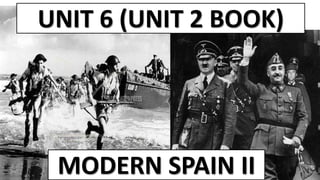
UNIT 6 (UNIT 2 BOOK)
MODERN SPAIN II
MIDDLE AGES
PREHISTORY
HISTORY
PALEOLITIC NEOLITHIC EGYPT GREECE
ANCIENT HISTORY
HUNTERS
WHO LIVED IN
CAVES
FIRST
SETTLEMENTS
(VILLAGES).
AGRICULTURE
BEGINS
WRITING INVENTION
(3500 BC)
JESUS CHRIST IS
BORN (YEAR 0 A.D.)
THEFALLOFTHEROMANEMPIRE
VISIGOTHS
MUSLIMS
(711.A.D)
CHRISTIANS
(722A.D.)
DISCOVERYOFAMERIA
Catholic
Monarchs
MODERN
AGE
16THcentury:
CarlosIandFelipeII
1492 A.D.
ROME
17thcentury
18thcentury
Baroque:
GOLDEN
AGE
Renaissance
FRENCHREVOLUTION(1789A.D.)
BIG
BANG
2-3 million years B.C.
(humans appeared)
1789 A.D.
5TH century A.D.
CONTEMPORARYAGE
CONTEMPORARY AGE:19TH CENTURY
FRENCH
REVOLUTION
(1789 A.D.)
FERNANDO
VII’s reign
ISABEL II
19TH CENTURY
WAR OF
INDEPENDENCE
KING
AMADEO I
de SABOYA
FIRST
REPUBLIC
(democracy
but without
monarchy)
KING
ALFONSO
XII
1875-1885
1808 1814
ABSOLUTISM
(1814-1820)
LIBERAL
TRIENNIUM
(1820-1823)
OMINOUS
DECADE
(1823-1833)
LIBERAL
IDEAS
(1833-1868)
REGENTS: GENERAL ESPARTERO &
MARIA CRISTINA
It began in 1789 and continues up to the present day
IN SPAIN, 19TH CENTURY...
(1870-1873)
1873-1874
RESTORATION
(1875-1923)
KING
ALFONSO
XIII
1902-1923
CONTEMPORARY AGE:
20TH CENTURY
THE END OF
19TH
CENTURY
20TH CENTURY
KING
ALFONSO
XIII
PRIMO DE
RIVERA
DICTATORSHIP
SECOND
REPUBLIC
CIVIL WAR
FRANCO’S
DICTATORSHIP
TRANSITION TO
DEMOCRACY
YEARS OF POLITICAL INSTABILITY
ISABEL II (1833 –
1868)
Isabel II’s wasn`t popular among the different political parties at
that time because of her liberal ideas.
When he died, the government
became too weak to continue
She was helped closely by one
military politician called Leopoldo
O’Donnell
General Juan Prim sent the Queen into exile
and he started looking for a new monarch to take
over
King AMADEO I de SABOYA
(1870-1873)
The General JUAN PRIM took the control of
the government and spent 2 years looking
for a new monarch…
Eventually he found him in SAVOY (Italy)
AMADEO I DE SABOYA His reing started badly when his main
supporter, GENERAL PRIM, was assasinated
It was an extremely unstable period: He had to deal with
violent conflicts between different political parties, the Cuba
revolution, rebellions by Carlists…
Unable to cope, he returned to Italy…
1868-1870
1870-1873
1873
FIRST REPUBLIC (1873-1874)
After Amadeo left Spain and came back to Italy
Spain became a REPUBLIC (democratic form
of government in which there wasn’t a monarch)
But the period of political and social instability continued.
THERE WERE 4 PRESIDENTS DURING THIS PERIOD (1 YEAR)
General Manuel Pavia tired of this situation initiated a
successful military coup which led to the end of the Republic
The Monarchy was restored and Alfonso XII, Isabel
II’s son, became the new king of Spain
SO…
1873
1873-1874
1874
SPANISH RESTORATION (1875-1923).
Alfonso XII’S reign
The Spanish Restoration or Bourbon Restoration is the name given to the period that...
Began when the First Spanish Republic ended and
the monarchy was restored again under Alfonso XII
Finished with the
II REPUBLIC
King Alfonso XII (1875-
1885)
Although he was young, he was popular.
He ruled a Constitutional monarchy (not an absolute one)
under the Constitution of 1876
Under his reign only two political parties were
permitted.
LIBERALS
(left wing)
CONSERVATIVES
(right wing)
These parties took turns
to hold the power
(Peaceful turn)
1875 1931The Spanish Restoration or Bourbon Restoration
King Alfonso XII (1875-
1885)
Alfonso XII’S reign (1875-1885)
Despite his popularity there were two attempts to assassinate him
LIBERALS
(left wing)
CONSERVATIVES
(right wing)
In this new system of alternating power, there were
two key political figures:
Mateo Sagasta
(Prime Minister 8
times)
Antonio Cánovas del
Castillo
(Prime Minister 6 times)
Characteristics
of this period
Cons
Pros
Spain was stable again. Economic prosperity and
modernisation. Cuba and Puerto Rico (peace)
Electoral fraud (FAKE ELECTIONS!!): the king chose the
government and the result of the election was decided in advance.
Alfonso XIII’s reign (1885-1923) and Primo de
Rivera’s dictatorship (1923-1930)
1885 After Alfonso XII’s death, his son Alfonso XIII became
the heir of the throne…
1885
-1902
His mother Maria Cristina ruled as a regent until the young Alfonso turned
sixteen in 1902 and became King Alfonso XIII
He was a baby
SO…
During the regency period, Spain lost its colonies in Cuba, Puerto Rico and
Philippines and suffered violents rioting in Barcelona
1902-1923
Primo de Rivera lost all confidence in the Spanish government and
organised a coup. Alfonso XIII supported him and Rivera became a
dictator
Alfonso XIII’S reign
1923
1923-1930 Primo de Rivera’s dictatorship
Primo de Rivera’s dictatorship and II
Republic
1923-
1930
Primo de Rivera wasn’t a good leader and Spain went bankrupt
under his rule and, eventually, the army stopped supporting him
and Alfonso XIII forced him to resign
1931 People no longer trusted Alfonso XIII and the Republicans won the elections.
THE MONARCHY WAS ABOLISHED AND THE II REPUBLIC WAS ESTABLISHED
1931-1936
(1939)
1931
Second Republic lasted until the end of the Civil war (1939)
A new Constitution was established (rights improvement): freedom of
speech, vote to women, took away some privileges from nobility, limited
the power of the church
Opposition Monarchists, the church,
the military
Primo de Rivera’s
dictatorship
II Republic
THE SPANISH CIVIL WAR (1936-1939)
In July 1936, General FRANCISCO
FRANCO led a military coup and
the CIVIL WAR STARTED…
SPAIN was divided into two sides:
The NATIONALISTS
(supporters of
Franco)
The REPUBLICANS
(supporters of the
Republic)
The war officially ended in April
1939 with a Nationalist victory
FROM DICTATORSHIP (1939-1975)
TO DEMOCRACY (1975-…)
General Franco established a dictatorship which lasted until his death in 1975
REPRESSION
CULTURAL RESTRICTIONS
CONSEQUENCES
LACK OF FREEDOM
STARVATION
Because of the shortage/lack of food and
other basic products, people had ration
books which specified the quantity of
necessity goods they could buy
Around 26,000 people were sent to prison
for their political beliefs
The press was restricted, trade unions were
banned and protests were repressed
Many artists were forced to leave Spain
(Pablo Picasso) other were even killed
(Federico García Lorca). Other cultural
tradition were repressed.
THE TRANSITION TO DEMOCRACY
In 1969, Franco chose Prince Juan Carlos as his
successor (Alfonso XIII’s grandson)
Franco thought that the regime (dictatorship) would continue under
Juan Carlos (absolute monarchy), however, as soon as he became king,
Juan Carlos tooks the steps to make Spain a constitutional monarchy.
In 1975, General Franco died and the TRANSITION
from a dictatorship to a democracy began
In 1976, King Juan Carlos I appointed/designated Adolfo
Suárez as Prime Minister. He was in charge of organising the
first free elections (1977) and become a democratic state.
In 1978, The Spanish Constitution
was approved by Parliament and
the Spanish citizens
Right to strike and form trade unions
Legalisation of all political parties
Release political prisioners
IMPORTANT EVENTS IN EUROPE (20TH CENTURY)
5. Leading the United Kingdom
to declare war on Germany.
1. The trigger for the war was the assassination of the heir
to the throne of Austria-Hungary in Serbia.
2. The Austro-Hungarians declared war on Serbia
3. Russia supported Serbia
4. Germany invaded neutral Belgium and
Luxembourg before moving towards France
FIRST
WORLD
WAR
(WWI)
1914
FIRST WORLD WAR (WWI)
THE GREAT WAR
1914-1918
Central
Powers
Allied Powers
(Allies)
Triple Entente
Germany
Austro-Hungarian
Empire
France
United Kingdom
Russia
IMPORTANT EVENTS IN EUROPE (20TH CENTURY)
WORLD WAR I
IMPORTANT EVENTS IN EUROPE (20TH CENTURY)
WORLD WAR II
BEFORE WWI
AFTER WWI
AFTER THE WORLD WAR I, MOST OF THE COUNTRIES ESTABLISHED
A DEMOCRACY, BUT THEY WERE THREATENED BY TWO
IDEOLOGIES: COMMUNISM AND FASCISM
IMPORTANT EVENTS IN EUROPE (20TH CENTURY)
WORLD WAR II
FIRST WORLD WAR (WWII)
1939-1945
AXIS Powers (Allies)
Germany
Italy
Japan
France
United Kingdom
Russia
USA (1944)
1941
Desembarco de Normandía: The USA Army arrived Europe (North France)
BERLIN
WALL
COLD WAR (1947-1991): PEACEFUL PERIOD?
WESTERN
BLOC
(capitalist)
COMMUNIST BLOC
IRON CURTAIN
After the WWII tensions between the two nations grew out, the Cold War rivalry/competition between the United
States and the Soviet Union lasted for much of the second half of the 20th century resulted in mutual suspicions,
tensions and a series of international incidents that brought the world’s superpowers to the brink of disaster.

Unit 6 final

  • 1.
    UNIT 6 (UNIT2 BOOK) MODERN SPAIN II
  • 2.
    MIDDLE AGES PREHISTORY HISTORY PALEOLITIC NEOLITHICEGYPT GREECE ANCIENT HISTORY HUNTERS WHO LIVED IN CAVES FIRST SETTLEMENTS (VILLAGES). AGRICULTURE BEGINS WRITING INVENTION (3500 BC) JESUS CHRIST IS BORN (YEAR 0 A.D.) THEFALLOFTHEROMANEMPIRE VISIGOTHS MUSLIMS (711.A.D) CHRISTIANS (722A.D.) DISCOVERYOFAMERIA Catholic Monarchs MODERN AGE 16THcentury: CarlosIandFelipeII 1492 A.D. ROME 17thcentury 18thcentury Baroque: GOLDEN AGE Renaissance FRENCHREVOLUTION(1789A.D.) BIG BANG 2-3 million years B.C. (humans appeared) 1789 A.D. 5TH century A.D. CONTEMPORARYAGE
  • 3.
    CONTEMPORARY AGE:19TH CENTURY FRENCH REVOLUTION (1789A.D.) FERNANDO VII’s reign ISABEL II 19TH CENTURY WAR OF INDEPENDENCE KING AMADEO I de SABOYA FIRST REPUBLIC (democracy but without monarchy) KING ALFONSO XII 1875-1885 1808 1814 ABSOLUTISM (1814-1820) LIBERAL TRIENNIUM (1820-1823) OMINOUS DECADE (1823-1833) LIBERAL IDEAS (1833-1868) REGENTS: GENERAL ESPARTERO & MARIA CRISTINA It began in 1789 and continues up to the present day IN SPAIN, 19TH CENTURY... (1870-1873) 1873-1874 RESTORATION (1875-1923) KING ALFONSO XIII 1902-1923
  • 4.
    CONTEMPORARY AGE: 20TH CENTURY THEEND OF 19TH CENTURY 20TH CENTURY KING ALFONSO XIII PRIMO DE RIVERA DICTATORSHIP SECOND REPUBLIC CIVIL WAR FRANCO’S DICTATORSHIP TRANSITION TO DEMOCRACY
  • 5.
    YEARS OF POLITICALINSTABILITY ISABEL II (1833 – 1868) Isabel II’s wasn`t popular among the different political parties at that time because of her liberal ideas. When he died, the government became too weak to continue She was helped closely by one military politician called Leopoldo O’Donnell General Juan Prim sent the Queen into exile and he started looking for a new monarch to take over
  • 6.
    King AMADEO Ide SABOYA (1870-1873) The General JUAN PRIM took the control of the government and spent 2 years looking for a new monarch… Eventually he found him in SAVOY (Italy) AMADEO I DE SABOYA His reing started badly when his main supporter, GENERAL PRIM, was assasinated It was an extremely unstable period: He had to deal with violent conflicts between different political parties, the Cuba revolution, rebellions by Carlists… Unable to cope, he returned to Italy… 1868-1870 1870-1873 1873
  • 7.
    FIRST REPUBLIC (1873-1874) AfterAmadeo left Spain and came back to Italy Spain became a REPUBLIC (democratic form of government in which there wasn’t a monarch) But the period of political and social instability continued. THERE WERE 4 PRESIDENTS DURING THIS PERIOD (1 YEAR) General Manuel Pavia tired of this situation initiated a successful military coup which led to the end of the Republic The Monarchy was restored and Alfonso XII, Isabel II’s son, became the new king of Spain SO… 1873 1873-1874 1874
  • 8.
    SPANISH RESTORATION (1875-1923). AlfonsoXII’S reign The Spanish Restoration or Bourbon Restoration is the name given to the period that... Began when the First Spanish Republic ended and the monarchy was restored again under Alfonso XII Finished with the II REPUBLIC King Alfonso XII (1875- 1885) Although he was young, he was popular. He ruled a Constitutional monarchy (not an absolute one) under the Constitution of 1876 Under his reign only two political parties were permitted. LIBERALS (left wing) CONSERVATIVES (right wing) These parties took turns to hold the power (Peaceful turn) 1875 1931The Spanish Restoration or Bourbon Restoration
  • 9.
    King Alfonso XII(1875- 1885) Alfonso XII’S reign (1875-1885) Despite his popularity there were two attempts to assassinate him LIBERALS (left wing) CONSERVATIVES (right wing) In this new system of alternating power, there were two key political figures: Mateo Sagasta (Prime Minister 8 times) Antonio Cánovas del Castillo (Prime Minister 6 times) Characteristics of this period Cons Pros Spain was stable again. Economic prosperity and modernisation. Cuba and Puerto Rico (peace) Electoral fraud (FAKE ELECTIONS!!): the king chose the government and the result of the election was decided in advance.
  • 14.
    Alfonso XIII’s reign(1885-1923) and Primo de Rivera’s dictatorship (1923-1930) 1885 After Alfonso XII’s death, his son Alfonso XIII became the heir of the throne… 1885 -1902 His mother Maria Cristina ruled as a regent until the young Alfonso turned sixteen in 1902 and became King Alfonso XIII He was a baby SO… During the regency period, Spain lost its colonies in Cuba, Puerto Rico and Philippines and suffered violents rioting in Barcelona 1902-1923 Primo de Rivera lost all confidence in the Spanish government and organised a coup. Alfonso XIII supported him and Rivera became a dictator Alfonso XIII’S reign 1923 1923-1930 Primo de Rivera’s dictatorship
  • 15.
    Primo de Rivera’sdictatorship and II Republic 1923- 1930 Primo de Rivera wasn’t a good leader and Spain went bankrupt under his rule and, eventually, the army stopped supporting him and Alfonso XIII forced him to resign 1931 People no longer trusted Alfonso XIII and the Republicans won the elections. THE MONARCHY WAS ABOLISHED AND THE II REPUBLIC WAS ESTABLISHED 1931-1936 (1939) 1931 Second Republic lasted until the end of the Civil war (1939) A new Constitution was established (rights improvement): freedom of speech, vote to women, took away some privileges from nobility, limited the power of the church Opposition Monarchists, the church, the military Primo de Rivera’s dictatorship II Republic
  • 16.
    THE SPANISH CIVILWAR (1936-1939) In July 1936, General FRANCISCO FRANCO led a military coup and the CIVIL WAR STARTED… SPAIN was divided into two sides: The NATIONALISTS (supporters of Franco) The REPUBLICANS (supporters of the Republic) The war officially ended in April 1939 with a Nationalist victory
  • 17.
    FROM DICTATORSHIP (1939-1975) TODEMOCRACY (1975-…) General Franco established a dictatorship which lasted until his death in 1975 REPRESSION CULTURAL RESTRICTIONS CONSEQUENCES LACK OF FREEDOM STARVATION Because of the shortage/lack of food and other basic products, people had ration books which specified the quantity of necessity goods they could buy Around 26,000 people were sent to prison for their political beliefs The press was restricted, trade unions were banned and protests were repressed Many artists were forced to leave Spain (Pablo Picasso) other were even killed (Federico García Lorca). Other cultural tradition were repressed.
  • 18.
    THE TRANSITION TODEMOCRACY In 1969, Franco chose Prince Juan Carlos as his successor (Alfonso XIII’s grandson) Franco thought that the regime (dictatorship) would continue under Juan Carlos (absolute monarchy), however, as soon as he became king, Juan Carlos tooks the steps to make Spain a constitutional monarchy. In 1975, General Franco died and the TRANSITION from a dictatorship to a democracy began In 1976, King Juan Carlos I appointed/designated Adolfo Suárez as Prime Minister. He was in charge of organising the first free elections (1977) and become a democratic state. In 1978, The Spanish Constitution was approved by Parliament and the Spanish citizens Right to strike and form trade unions Legalisation of all political parties Release political prisioners
  • 19.
    IMPORTANT EVENTS INEUROPE (20TH CENTURY) 5. Leading the United Kingdom to declare war on Germany. 1. The trigger for the war was the assassination of the heir to the throne of Austria-Hungary in Serbia. 2. The Austro-Hungarians declared war on Serbia 3. Russia supported Serbia 4. Germany invaded neutral Belgium and Luxembourg before moving towards France FIRST WORLD WAR (WWI) 1914
  • 20.
    FIRST WORLD WAR(WWI) THE GREAT WAR 1914-1918 Central Powers Allied Powers (Allies) Triple Entente Germany Austro-Hungarian Empire France United Kingdom Russia IMPORTANT EVENTS IN EUROPE (20TH CENTURY) WORLD WAR I
  • 21.
    IMPORTANT EVENTS INEUROPE (20TH CENTURY) WORLD WAR II BEFORE WWI AFTER WWI AFTER THE WORLD WAR I, MOST OF THE COUNTRIES ESTABLISHED A DEMOCRACY, BUT THEY WERE THREATENED BY TWO IDEOLOGIES: COMMUNISM AND FASCISM
  • 22.
    IMPORTANT EVENTS INEUROPE (20TH CENTURY) WORLD WAR II FIRST WORLD WAR (WWII) 1939-1945 AXIS Powers (Allies) Germany Italy Japan France United Kingdom Russia USA (1944) 1941
  • 23.
    Desembarco de Normandía:The USA Army arrived Europe (North France)
  • 24.
  • 25.
    COLD WAR (1947-1991):PEACEFUL PERIOD? WESTERN BLOC (capitalist) COMMUNIST BLOC IRON CURTAIN
  • 26.
    After the WWIItensions between the two nations grew out, the Cold War rivalry/competition between the United States and the Soviet Union lasted for much of the second half of the 20th century resulted in mutual suspicions, tensions and a series of international incidents that brought the world’s superpowers to the brink of disaster.