Modern Spain II
1.-End of XIX century
In the middle of the XIX century Spanish people were not happy due to the social and economic
changes which didn’t go along democratic changes, since governments were very authoritarian.
The period between 1868 and 1873 was known as the “Sexenio Revolucionario”
In 1868, a rebelion expelled Isabel II from the throne. Amadeo de Saboya was elected king; he
was an Italian king with liberal ideas. But this was a disaster.
In 1873 the First Republic was proclaimed, but it only lasted a year.
Political conflicts were common during this period.
Republicans divided themselves in the Centralistas: in favour of a Estado,
governed from the capital and those who wanted a federal State, where each
Spanish region would have their own government.
2.-Restoration
In 1874 The political situation was more stable with Alfonso XII, son of Isabel II. With
Alfonso XII there was a new political regime called the Restauration. This was a
conservative regime that gave the king a lot of power.
During this period two political parties exchanged peacefully: Conservatives and
Liberals.
Textile industries settled in Cataluña and the industria siderúrgica in the País Vasco,
the workers gather together creating the first unions.
This period brought political stability but not democracy. A the beginning the sufragio
censitario (only men were allowed to vote, but only high income men) was
established but later the sufragio universal masculino, was established, were all men
were allowed to vote. Elections were not clean and fair: the local leaders or caciques
changed the results buying votes or threaten voters.
3.- Alfonso XIII
Alfonso XIII was the last king of the Restoration, son of Alfonso XII who was proclaimed king in 1902. While
his kingdom Spain suffered social and political conflicts, such as:
-Strikes: unions tried to improve workers conditions by going of strike.
-Nationalism: Cataluña, País Vasco ans Galicia demanded their autonomy
-Morocco’s War: the north of Morocco revolted against the Spanish army, that controlled that area and started
a war.
Three crisis were the cause of the end of the Restauration from 1909
1.- La Semana Trágica: 1909. Many peasants or workers from Cataluña were sent to the Morocco’s War
2.- The General Strike of 1917: Unions called a general strike to fight against the increase of prices and bad
living conditions of the workers.
3.- The Annual Disaster: In the area of Annual, in the north of Morocco , the Spanish army was defeated by
the rebels. 10.000 Spanish soldiers died.
4.- Primo de Rivera Coup d’état
After the Disaster in Annual the social discomfort increased, and in order to restore
the order, Miguel Primo de Rivera lead the coup d’état in 1923
Alfonso XIII was in the throne. Social and political problems lead to the coup d’état
Primo de Rivera established a dictatorship, eliminating political parties and freedoms.
He acquired all the State Powers, cancelled the constitution, forbade the political
parties and unions and eliminated citizens’ freedoms. The king had poor power. He
supported the dictatorship and lead the government in his hands.
People were against him and wanted more rights, so in 1930 Alfonso XIII took back
his support and Primo de Rivera resigned
5.- Second Republic
Alfonso XIII supported the dictatorship, so the defenders of the democratic ideas didn’t trust him and backed the republic.
When Primo de Rivera resigned, Alfonso XIII ordered the creation of a new government in order to restore the Constitution and calle
elections, so in April 12th 1931 election took place and the republicans won in the most important cities. The king wasn’t supported and
decided to live Spain.
April 14th, 1931 after Alfonso XII exile, the Second Republic was proclaimed and Niceto Alcalá Zamora was proclaimed president.
That same year the new constitution was approved and the new political system was a Democracy.
- The Universal suffrage was introduced. women had the right to vote. Spain was one of the first European Countries to recognise this
right.
- Church and State were divided. Catholicism was not the official religion anymore. Divorce was approved as well as civil weddings.
Before this, only religious weddings were held.
- Creation of Autonomous Regions In 1932 the Autonomous Statute of Cataluña was approved an in 1936 the Pais Vasco Autonomous
Statute was approved. The Statute for Galicia was never approved.
The Republic modernized the country and improved the workers situation to the right monarchy, backed by the big proprietors and the church
never accepted the new regime. From the left side, politicians thought reforms were not enough and very slowly, they tried to force them
during the Second Republic the following reforms took place in order to modernize the country.
1.- Agriculture Reform: big lands which were not exploited were shared with peasants with no land. Their lives were improved as well as the
agricultural production.
2.- Educational Reform: many schools were built throughout the country in order to improve education.
3.-Labour Reform: a minimum salary was established and the working week was reduced.
Some of these Reforms were not accepted by part of the population and the situation was more fragile.
6.- Spanish Civil War 1936-39
Confrontations between Republicans supporters and their enemies were more and more frequent and violent.
The political tension and the uneven social situation made the situation unsustainable and July 18th, 1936 a big part of the army rose
up against the Republic, starting the Civil War. Francisco Franco supported by part of the army and all those who were against the
Reforms of the Republic gave a coup t’état against the government of the time, this was the beginning of the Civil War. Dividing Spain
in two groups or parts:
-The Nationals, who had a well organized army and supported Franco
-The Republicans: whose army had a poor coordination, with a lot of inside confrontations and supported a republican government.
After three years of war, Franco’s troops took control of all the Spanish territory.
He established a dictatorship in the national territories April 1st 1939 Franco’s army took Madrid. This was the end of the civil war. The
country was devastated . A lot of people had to exile.
Spain entered into a long period of dictatorship and a period of isolation.
War consequences:
1.- Food shortage: basic food were limited to a minimum consumption
2.- Fear to combats and bombings led citizens to leave their houses and finding protection somewhere else.
3.- Destruction of houses, infrastructure and industries lead to a big economic crisis that lasted many year after the end of the war.
The consequences of the war were very dramatic:
-Many hundred thousand people were killed or exiled.
-Economic losses
-Divided society: winners and losers.
7.-Franquismo 1939-1975
Franco took under his rule all the powers. Rights and freedoms were abolished as well as the political parties.
All the reforms that started during the Republic were also eliminated. This long period was known as Franquismo.
This period was divided in two periods
1.- After the end of the civil war: economy suffered big difficulties and food scarce. Spain suffered an international isolation. The repression
was very very strong. People that supported the Republic were persecuted and imprisoned. Many others exiled. spain was isolated.
Economy suffered a great crisis
.During this period:
- The constitution was abolished: the new laws limited citizens rights.
- All the power was centered in one person: Franci, chief of the State, Government and Army.
- Political parties were forbidden as well as the unions. There was only one political party and one union controlled by the government.
- The Autonomous Statues were abolished. Spanish was imposed as the only official language (Catalán and Euskera were forbidden)
- Censorship was being enforced: books, movies, theater plays and many other things were forbidden.
2.- Second period starts in the mid 1950’s. spain breaks its isolation after the military treaty with the USA in 1953, also improving the
economy and the industrialisation process. In 1955 Spain was admitted as member of the ONU (Organización de Naciones Unidas) Many
workers from Andalucía, Galicia and Extremadura emigrated to european countries looking for a job. Tourism also increased the wealth of
the country and helped change all the spanish traditions, from the 60’s on.
Between 1970-75 the opposition to Franco’s government increased.Unions,even though they were still forbidden, they started to organise
secretly afraid of been arrested.
Students also proclaimed a Democratic government
Franco died November 20th 1975. With his death the dictatorship arrived to its end and the beginning of Democracy.
8.- Democracy. 1975. Juan Carlos I
Franco planned that when he died, Spain would go back to a monarchy, assigning prince Juan Carlos, Alfonso XIII’s grandson, king of
Spain in 1975.
Juan Carlos I pushed all the reforms needed to transform Spain into a Democratic State:
-Legalizing political parties
-Political prisoners were released.
In 1976 Juan Carlos named Adolfo Suárez president. A new period of Reforms started:
- Political parties were legalized again.
- Unions were also legalized
- Prisoners who went against Franco’s ideas were freed
- The exiles returned home
- The first democratic election took place since 1936. They were celebrated June 1977. UCD won. (Unión de Centro Democrático)
headed by Adolfo Suárez.
- December 6th 1978 The Constitution was approved.:This Constitution establishes Spain as a Democratic Country. The national
sovereignty resides with the Spanish people. Spain is now a Parliamentary Monarchy.
- It ensures citizens rights. Such as
- Equality before the law
- Freedom of Expression
- Universal Suffrage (the right to vote at the age of 18 years old.)
The Constitution also organises Spain in Autonomous communities. Between 1979-1995 Spain was organized in 17 Communities
and 2 Autonomous cities, Ceuta y Melilla.
This has been the longest democratic period that Spain has ever lived.
In 1979 new elections were called and Adolfo Suárez, UCD won again.
During this period Spain wen through an important economic crisis. As well as frequent terrorist
attacks from ETA. Due to this situation Adolfo Suarez resigned.
February 23rd 1981 when Leopoldo Calvo Sotelo was been named President, substituting Adolfo
Suarez. a group of soldiers headed by Colonel Antonio Tejero carried out a coup d’état. This failed
por the king’s intervention in favor of Democracy and for the lack of support of the political parties
and the majority of the citizens.
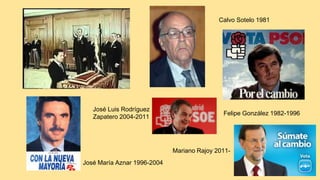
Since 1981 different Presidents have been taking turns in the government:
-1981: Leopoldo Calvo Sotelo. Spain entered the OTAN.
-1982-1996: Felipe González (PSOE). Spain joins the European Union in 1986.
-1996-2004: José María Aznar (PP) gave financial stability and in 2002 Spain joined the Euro,
substituting the peseta.
-2004-2011: José Luis Rodríguez Zapatero (PSOE) . An increase of unemployment was caused by
an important economic crisis.
-2011: Mariano Rajoy (PP) In 2014 The king Juan Carlos I abdicate and his son Felipe VI
succeeded to the throne.
Calvo Sotelo 1981
Felipe González 1982-1996
José María Aznar 1996-2004
José Luis Rodríguez
Zapatero 2004-2011
Mariano Rajoy 2011-
9.- Modern Art XX century
Modern art breaks with all possible traditions, and it is called Avant-garde
Art or Arte de Vanguardia. Paintings show reality according to its on
interests, it is called abstract painting, through shapes and colors. Some of
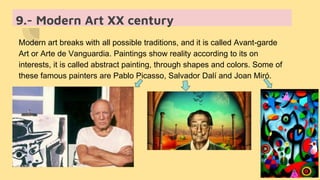
these famous painters are Pablo Picasso, Salvador Dalí and Joan Miró.
Pablo Picasso
Joan Miró
Salvador Dalí
10.- XX century literature
Great writers appeared in this century. some of these playwrights were Jacinto Benavente,
Antonio Buero Vallejo or Fernando Fernán Gómez.
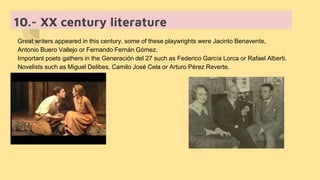
Important poets gathers in the Generación del 27 such as Federico García Lorca or Rafael Alberti.
Novelists such as Miguel Delibes, Camilo José Cela or Arturo Pérez Reverte.
Rafael Alberti
Federico García Lorca
Miguel
Delibes
Camilo
José Cela

Modern spain II

  • 1.
  • 2.
    1.-End of XIXcentury In the middle of the XIX century Spanish people were not happy due to the social and economic changes which didn’t go along democratic changes, since governments were very authoritarian. The period between 1868 and 1873 was known as the “Sexenio Revolucionario” In 1868, a rebelion expelled Isabel II from the throne. Amadeo de Saboya was elected king; he was an Italian king with liberal ideas. But this was a disaster. In 1873 the First Republic was proclaimed, but it only lasted a year. Political conflicts were common during this period. Republicans divided themselves in the Centralistas: in favour of a Estado, governed from the capital and those who wanted a federal State, where each Spanish region would have their own government.
  • 4.
    2.-Restoration In 1874 Thepolitical situation was more stable with Alfonso XII, son of Isabel II. With Alfonso XII there was a new political regime called the Restauration. This was a conservative regime that gave the king a lot of power. During this period two political parties exchanged peacefully: Conservatives and Liberals. Textile industries settled in Cataluña and the industria siderúrgica in the País Vasco, the workers gather together creating the first unions. This period brought political stability but not democracy. A the beginning the sufragio censitario (only men were allowed to vote, but only high income men) was established but later the sufragio universal masculino, was established, were all men were allowed to vote. Elections were not clean and fair: the local leaders or caciques changed the results buying votes or threaten voters.
  • 6.
    3.- Alfonso XIII AlfonsoXIII was the last king of the Restoration, son of Alfonso XII who was proclaimed king in 1902. While his kingdom Spain suffered social and political conflicts, such as: -Strikes: unions tried to improve workers conditions by going of strike. -Nationalism: Cataluña, País Vasco ans Galicia demanded their autonomy -Morocco’s War: the north of Morocco revolted against the Spanish army, that controlled that area and started a war. Three crisis were the cause of the end of the Restauration from 1909 1.- La Semana Trágica: 1909. Many peasants or workers from Cataluña were sent to the Morocco’s War 2.- The General Strike of 1917: Unions called a general strike to fight against the increase of prices and bad living conditions of the workers. 3.- The Annual Disaster: In the area of Annual, in the north of Morocco , the Spanish army was defeated by the rebels. 10.000 Spanish soldiers died.
  • 8.
    4.- Primo deRivera Coup d’état After the Disaster in Annual the social discomfort increased, and in order to restore the order, Miguel Primo de Rivera lead the coup d’état in 1923 Alfonso XIII was in the throne. Social and political problems lead to the coup d’état Primo de Rivera established a dictatorship, eliminating political parties and freedoms. He acquired all the State Powers, cancelled the constitution, forbade the political parties and unions and eliminated citizens’ freedoms. The king had poor power. He supported the dictatorship and lead the government in his hands. People were against him and wanted more rights, so in 1930 Alfonso XIII took back his support and Primo de Rivera resigned
  • 10.
    5.- Second Republic AlfonsoXIII supported the dictatorship, so the defenders of the democratic ideas didn’t trust him and backed the republic. When Primo de Rivera resigned, Alfonso XIII ordered the creation of a new government in order to restore the Constitution and calle elections, so in April 12th 1931 election took place and the republicans won in the most important cities. The king wasn’t supported and decided to live Spain. April 14th, 1931 after Alfonso XII exile, the Second Republic was proclaimed and Niceto Alcalá Zamora was proclaimed president. That same year the new constitution was approved and the new political system was a Democracy. - The Universal suffrage was introduced. women had the right to vote. Spain was one of the first European Countries to recognise this right. - Church and State were divided. Catholicism was not the official religion anymore. Divorce was approved as well as civil weddings. Before this, only religious weddings were held. - Creation of Autonomous Regions In 1932 the Autonomous Statute of Cataluña was approved an in 1936 the Pais Vasco Autonomous Statute was approved. The Statute for Galicia was never approved. The Republic modernized the country and improved the workers situation to the right monarchy, backed by the big proprietors and the church never accepted the new regime. From the left side, politicians thought reforms were not enough and very slowly, they tried to force them during the Second Republic the following reforms took place in order to modernize the country. 1.- Agriculture Reform: big lands which were not exploited were shared with peasants with no land. Their lives were improved as well as the agricultural production. 2.- Educational Reform: many schools were built throughout the country in order to improve education. 3.-Labour Reform: a minimum salary was established and the working week was reduced. Some of these Reforms were not accepted by part of the population and the situation was more fragile.
  • 12.
    6.- Spanish CivilWar 1936-39 Confrontations between Republicans supporters and their enemies were more and more frequent and violent. The political tension and the uneven social situation made the situation unsustainable and July 18th, 1936 a big part of the army rose up against the Republic, starting the Civil War. Francisco Franco supported by part of the army and all those who were against the Reforms of the Republic gave a coup t’état against the government of the time, this was the beginning of the Civil War. Dividing Spain in two groups or parts: -The Nationals, who had a well organized army and supported Franco -The Republicans: whose army had a poor coordination, with a lot of inside confrontations and supported a republican government. After three years of war, Franco’s troops took control of all the Spanish territory. He established a dictatorship in the national territories April 1st 1939 Franco’s army took Madrid. This was the end of the civil war. The country was devastated . A lot of people had to exile. Spain entered into a long period of dictatorship and a period of isolation. War consequences: 1.- Food shortage: basic food were limited to a minimum consumption 2.- Fear to combats and bombings led citizens to leave their houses and finding protection somewhere else. 3.- Destruction of houses, infrastructure and industries lead to a big economic crisis that lasted many year after the end of the war. The consequences of the war were very dramatic: -Many hundred thousand people were killed or exiled. -Economic losses -Divided society: winners and losers.
  • 14.
    7.-Franquismo 1939-1975 Franco tookunder his rule all the powers. Rights and freedoms were abolished as well as the political parties. All the reforms that started during the Republic were also eliminated. This long period was known as Franquismo. This period was divided in two periods 1.- After the end of the civil war: economy suffered big difficulties and food scarce. Spain suffered an international isolation. The repression was very very strong. People that supported the Republic were persecuted and imprisoned. Many others exiled. spain was isolated. Economy suffered a great crisis .During this period: - The constitution was abolished: the new laws limited citizens rights. - All the power was centered in one person: Franci, chief of the State, Government and Army. - Political parties were forbidden as well as the unions. There was only one political party and one union controlled by the government. - The Autonomous Statues were abolished. Spanish was imposed as the only official language (Catalán and Euskera were forbidden) - Censorship was being enforced: books, movies, theater plays and many other things were forbidden. 2.- Second period starts in the mid 1950’s. spain breaks its isolation after the military treaty with the USA in 1953, also improving the economy and the industrialisation process. In 1955 Spain was admitted as member of the ONU (Organización de Naciones Unidas) Many workers from Andalucía, Galicia and Extremadura emigrated to european countries looking for a job. Tourism also increased the wealth of the country and helped change all the spanish traditions, from the 60’s on. Between 1970-75 the opposition to Franco’s government increased.Unions,even though they were still forbidden, they started to organise secretly afraid of been arrested. Students also proclaimed a Democratic government Franco died November 20th 1975. With his death the dictatorship arrived to its end and the beginning of Democracy.
  • 16.
    8.- Democracy. 1975.Juan Carlos I Franco planned that when he died, Spain would go back to a monarchy, assigning prince Juan Carlos, Alfonso XIII’s grandson, king of Spain in 1975. Juan Carlos I pushed all the reforms needed to transform Spain into a Democratic State: -Legalizing political parties -Political prisoners were released. In 1976 Juan Carlos named Adolfo Suárez president. A new period of Reforms started: - Political parties were legalized again. - Unions were also legalized - Prisoners who went against Franco’s ideas were freed - The exiles returned home - The first democratic election took place since 1936. They were celebrated June 1977. UCD won. (Unión de Centro Democrático) headed by Adolfo Suárez. - December 6th 1978 The Constitution was approved.:This Constitution establishes Spain as a Democratic Country. The national sovereignty resides with the Spanish people. Spain is now a Parliamentary Monarchy. - It ensures citizens rights. Such as - Equality before the law - Freedom of Expression - Universal Suffrage (the right to vote at the age of 18 years old.) The Constitution also organises Spain in Autonomous communities. Between 1979-1995 Spain was organized in 17 Communities and 2 Autonomous cities, Ceuta y Melilla.
  • 18.
    This has beenthe longest democratic period that Spain has ever lived. In 1979 new elections were called and Adolfo Suárez, UCD won again. During this period Spain wen through an important economic crisis. As well as frequent terrorist attacks from ETA. Due to this situation Adolfo Suarez resigned. February 23rd 1981 when Leopoldo Calvo Sotelo was been named President, substituting Adolfo Suarez. a group of soldiers headed by Colonel Antonio Tejero carried out a coup d’état. This failed por the king’s intervention in favor of Democracy and for the lack of support of the political parties and the majority of the citizens. Since 1981 different Presidents have been taking turns in the government: -1981: Leopoldo Calvo Sotelo. Spain entered the OTAN. -1982-1996: Felipe González (PSOE). Spain joins the European Union in 1986. -1996-2004: José María Aznar (PP) gave financial stability and in 2002 Spain joined the Euro, substituting the peseta. -2004-2011: José Luis Rodríguez Zapatero (PSOE) . An increase of unemployment was caused by an important economic crisis. -2011: Mariano Rajoy (PP) In 2014 The king Juan Carlos I abdicate and his son Felipe VI succeeded to the throne.
  • 19.
    Calvo Sotelo 1981 FelipeGonzález 1982-1996 José María Aznar 1996-2004 José Luis Rodríguez Zapatero 2004-2011 Mariano Rajoy 2011-
  • 20.
    9.- Modern ArtXX century Modern art breaks with all possible traditions, and it is called Avant-garde Art or Arte de Vanguardia. Paintings show reality according to its on interests, it is called abstract painting, through shapes and colors. Some of these famous painters are Pablo Picasso, Salvador Dalí and Joan Miró.
  • 21.
  • 22.
    10.- XX centuryliterature Great writers appeared in this century. some of these playwrights were Jacinto Benavente, Antonio Buero Vallejo or Fernando Fernán Gómez. Important poets gathers in the Generación del 27 such as Federico García Lorca or Rafael Alberti. Novelists such as Miguel Delibes, Camilo José Cela or Arturo Pérez Reverte.
  • 23.
    Rafael Alberti Federico GarcíaLorca Miguel Delibes Camilo José Cela