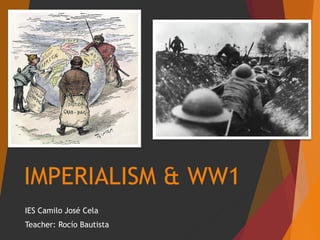
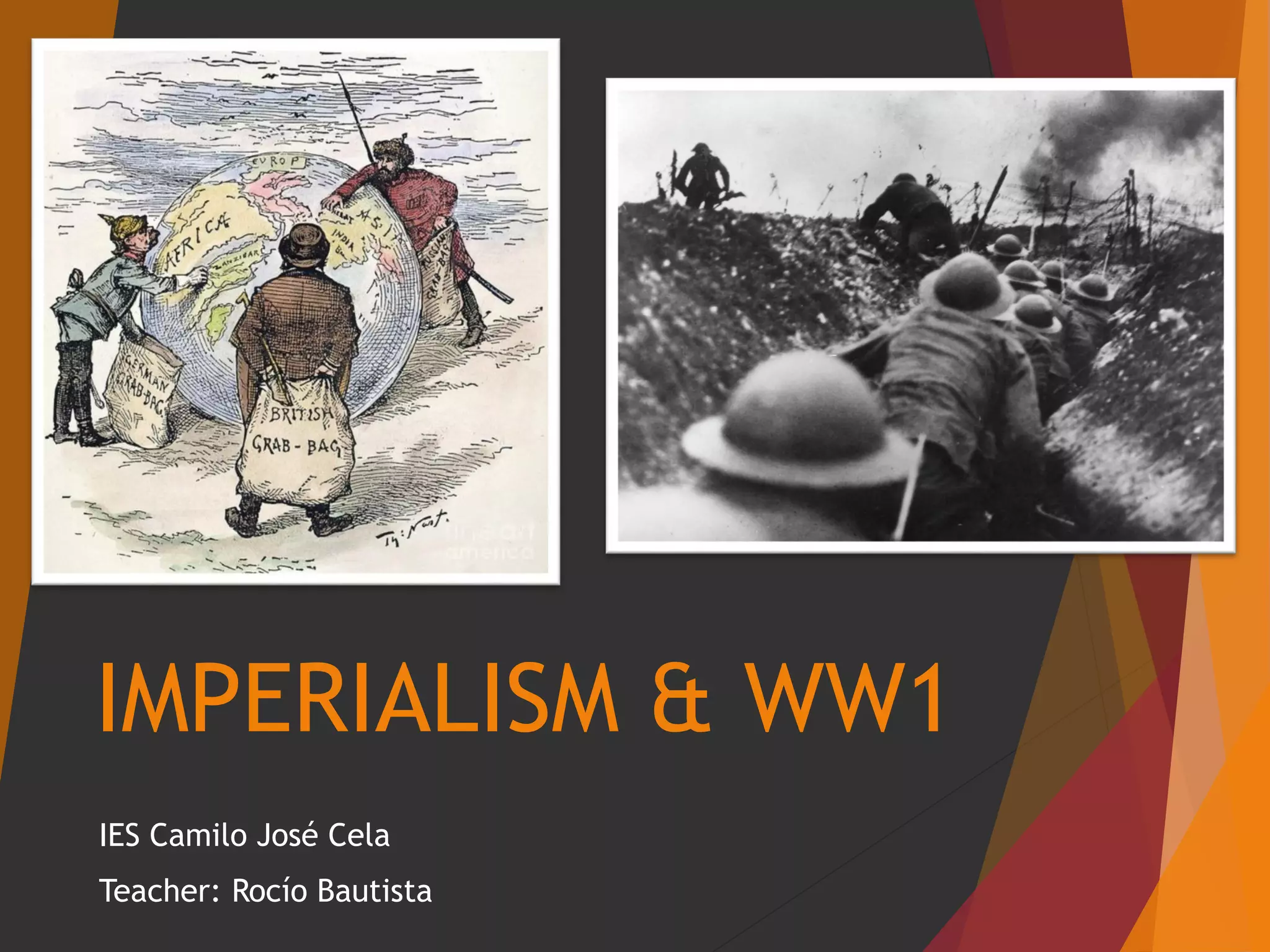
IMPERIALISM & WW1
IES Camilo José Cela
Teacher: Rocío Bautista
 In order to understand the WW1 (1914-18),
it is necessary to know what was the
international situation of Europe before 1914.
What new countries had been
formed in the 1870’s?
The expansion of which ideology
favoured the unification of
these countries?
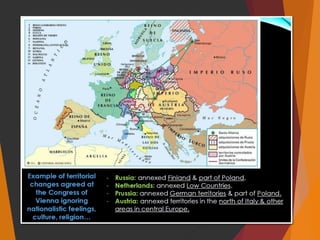
How did the Congress of Vienna (1815)
re-established European Balance after the
Napoleonic period?
What emergent ideology did they ignored?
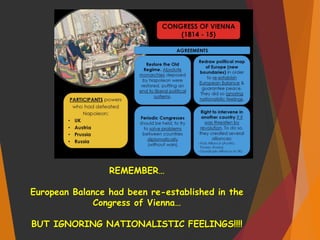
REMEMBER…
European Balance had been re-established in the
Congress of Vienna…
BUT IGNORING NATIONALISTIC FEELINGS!!!!
REMEMBER…
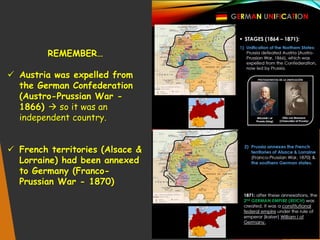
 Austria was expelled from
the German Confederation
(Austro-Prussian War -
1866)  so it was an
independent country.
 French territories (Alsace &
Lorraine) had been annexed
to Germany (Franco-
Prussian War - 1870)
 During the 19th Century the forces of
NATIONALISM had been at work in Europe.
 By 1871 it had created two major new
countries: Germany & Italy.
 At the end of the century, Nationalism
continued to threaten the stability of
multi-national states…
POLITICS & INTERNATIONAL
RELATIONS
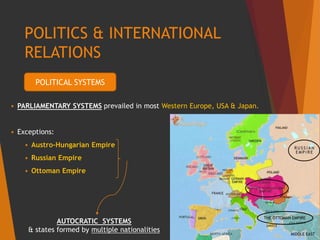
 PARLIAMENTARY SYSTEMS prevailed in most Western Europe, USA & Japan.
 Exceptions:
 Austro-Hungarian Empire
 Russian Empire
 Ottoman Empire
AUTOCRATIC SYSTEMS
& states formed by multiple nationalities
POLITICAL SYSTEMS
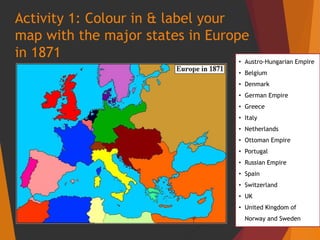
• Austro-Hungarian Empire
• Belgium
• Denmark
• German Empire
• Greece
• Italy
• Netherlands
• Ottoman Empire
• Portugal
• Russian Empire
• Spain
• Switzerland
• UK
• United Kingdom of
Norway and Sweden
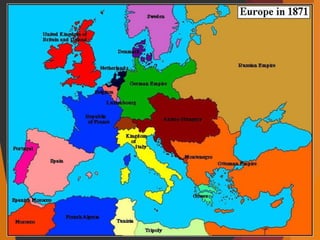
Activity 1: Colour in & label your
map with the major states in Europe
in 1871
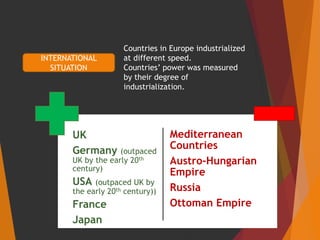
INTERNATIONAL
SITUATION
UK
Germany (outpaced
UK by the early 20th
century)
USA (outpaced UK by
the early 20th century))
France
Japan
Mediterranean
Countries
Austro-Hungarian
Empire
Russia
Ottoman Empire
Countries in Europe industrialized
at different speed.
Countries’ power was measured
by their degree of
industrialization.
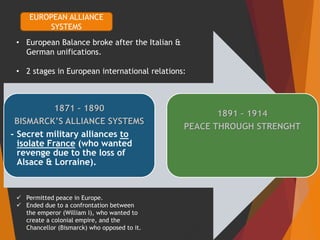
1871 – 1890
BISMARCK’S ALLIANCE SYSTEMS
- Secret military alliances to
isolate France (who wanted
revenge due to the loss of
Alsace & Lorraine).
1891 – 1914
PEACE THROUGH STRENGHT
EUROPEAN ALLIANCE
SYSTEMS
• European Balance broke after the Italian &
German unifications.
• 2 stages in European international relations:
 Permitted peace in Europe.
 Ended due to a confrontation between
the emperor (William I), who wanted to
create a colonial empire, and the
Chancellor (Bismarck) who opposed to it.
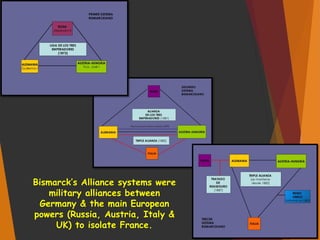
Bismarck’s Alliance systems were
military alliances between
Germany & the main European
powers (Russia, Austria, Italy &
UK) to isolate France.
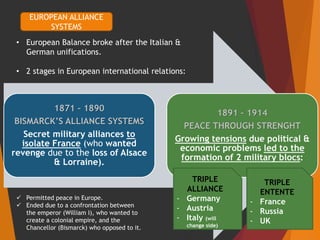
1871 – 1890
BISMARCK’S ALLIANCE SYSTEMS
Secret military alliances to
isolate France (who wanted
revenge due to the loss of Alsace
& Lorraine).
1891 – 1914
PEACE THROUGH STRENGHT
Growing tensions due political &
economic problems led to the
formation of 2 military blocs:
EUROPEAN ALLIANCE
SYSTEMS
• European Balance broke after the Italian &
German unifications.
• 2 stages in European international relations:
 Permitted peace in Europe.
 Ended due to a confrontation between
the emperor (William I), who wanted to
create a colonial empire, and the
Chancellor (Bismarck) who opposed to it.
TRIPLE
ALLIANCE
- Germany
- Austria
- Italy (will
change side)
TRIPLE
ENTENTE
- France
- Russia
- UK
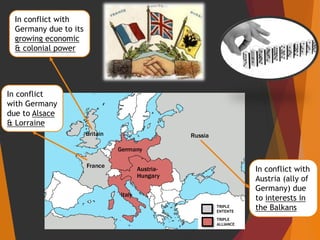
TRIPLE
ENTENTE
TRIPLE
ALLIANCE
In conflict with
Germany due to its
growing economic
& colonial power
In conflict
with Germany
due to Alsace
& Lorraine
In conflict with
Austria (ally of
Germany) due
to interests in
the Balkans
 Which states were threaten by
nationalism?
 P. 101  exercises 4 & 5
Activity 2
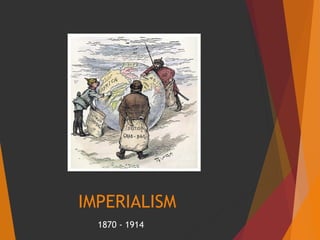
IMPERIALISM
1870 - 1914
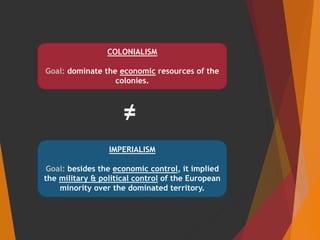
IMPERIALISM
Goal: besides the economic control, it implied
the military & political control of the European
minority over the dominated territory.
COLONIALISM
Goal: dominate the economic resources of the
colonies.
≠
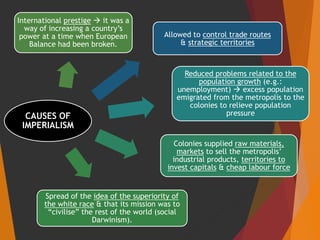
CAUSES OF
IMPERIALISM
Allowed to control trade routes
& strategic territories
Reduced problems related to the
population growth (e.g.:
unemployment)  excess population
emigrated from the metropolis to the
colonies to relieve population
pressure
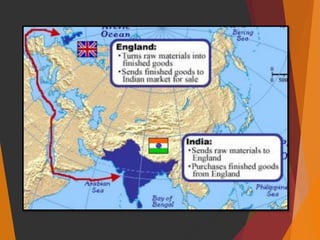
Colonies supplied raw materials,
markets to sell the metropolis’
industrial products, territories to
invest capitals & cheap labour force
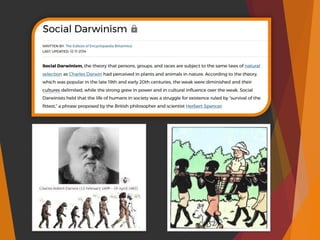
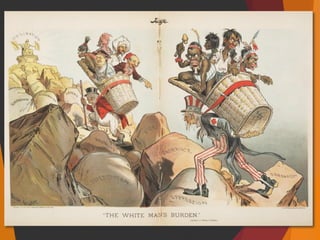
Spread of the idea of the superiority of
the white race & that its mission was to
“civilise” the rest of the world (social
Darwinism).
International prestige  it was a
way of increasing a country’s
power at a time when European
Balance had been broken.
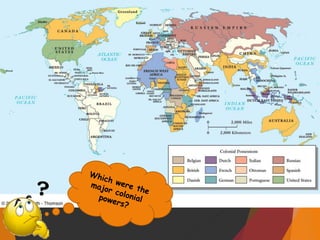
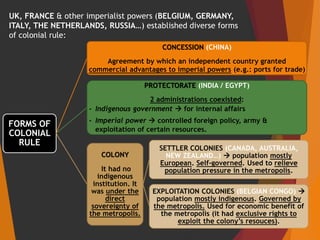
UK, FRANCE & other imperialist powers (BELGIUM, GERMANY,
ITALY, THE NETHERLANDS, RUSSIA…) established diverse forms
of colonial rule:
FORMS OF
COLONIAL
RULE
CONCESSION (CHINA)
Agreement by which an independent country granted
commercial advantages to imperial powers (e.g.: ports for trade)
PROTECTORATE (INDIA / EGYPT)
2 administrations coexisted:
- Indigenous government  for internal affairs
- Imperial power  controlled foreign policy, army &
exploitation of certain resources.
COLONY
It had no
indigenous
institution. It
was under the
direct
sovereignty of
the metropolis.
SETTLER COLONIES (CANADA, AUSTRALIA,
NEW ZEALAND…)  population mostly
European. Self-governed. Used to relieve
population pressure in the metropolis.
EXPLOITATION COLONIES (BELGIAN CONGO) 
population mostly indigenous. Governed by
the metropolis. Used for economic benefit of
the metropolis (it had exclusive rights to
exploit the colony’s resouces).
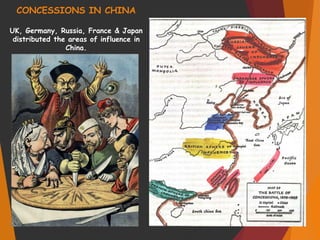
CONCESSIONS IN CHINA
UK, Germany, Russia, France & Japan
distributed the areas of influence in
China.
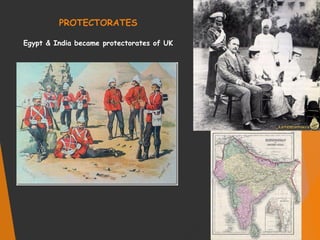
PROTECTORATES
Egypt & India became protectorates of UK
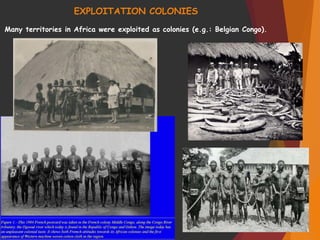
EXPLOITATION COLONIES
Many territories in Africa were exploited as colonies (e.g.: Belgian Congo).
THE SCRAMBLE OF AFRICA
(“El reparto de África”)
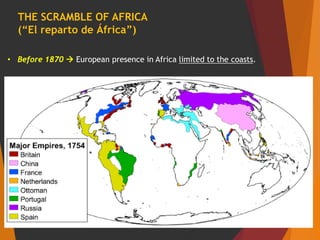
• Before 1870  European presence in Africa limited to the coasts.
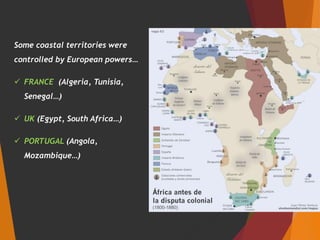
Some coastal territories were
controlled by European powers…
 FRANCE (Algeria, Tunisia,
Senegal…)
 UK (Egypt, South Africa…)
 PORTUGAL (Angola,
Mozambique…)
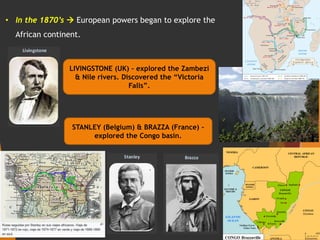
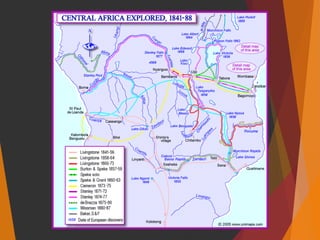
• In the 1870’s  European powers began to explore the
African continent.
LIVINGSTONE (UK) – explored the Zambezi
& Nile rivers. Discovered the “Victoria
Falls”.
STANLEY (Belgium) & BRAZZA (France) –
explored the Congo basin.
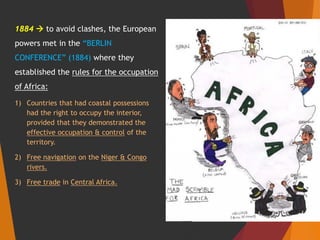
1884  to avoid clashes, the European
powers met in the “BERLIN
CONFERENCE” (1884) where they
established the rules for the occupation
of Africa:
1) Countries that had coastal possessions
had the right to occupy the interior,
provided that they demonstrated the
effective occupation & control of the
territory.
2) Free navigation on the Niger & Congo
rivers.
3) Free trade in Central Africa.
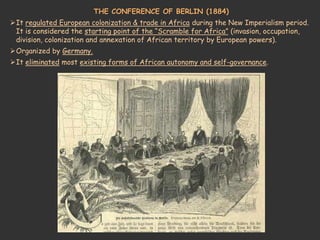
THE CONFERENCE OF BERLIN (1884)
It regulated European colonization & trade in Africa during the New Imperialism period.
It is considered the starting point of the “Scramble for Africa” (invasion, occupation,
division, colonization and annexation of African territory by European powers).
Organized by Germany.
It eliminated most existing forms of African autonomy and self-governance.
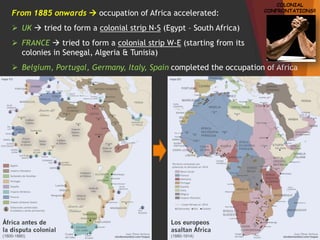
From 1885 onwards  occupation of Africa accelerated:
 UK  tried to form a colonial strip N-S (Egypt – South Africa)
 FRANCE  tried to form a colonial strip W-E (starting from its
colonies in Senegal, Algeria & Tunisia)
 Belgium, Portugal, Germany, Italy, Spain completed the occupation of Africa
COLONIAL
CONFRONTATIONS!!
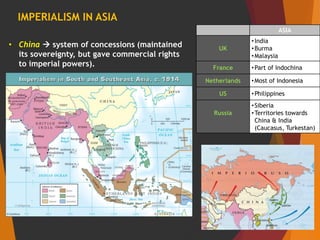
IMPERIALISM IN ASIA
• China  system of concessions (maintained
its sovereignty, but gave commercial rights
to imperial powers).
ASIA
UK
•India
•Burma
•Malaysia
France •Part of Indochina
Netherlands •Most of Indonesia
US •Philippines
Russia
•Siberia
•Territories towards
China & India
(Caucasus, Turkestan)
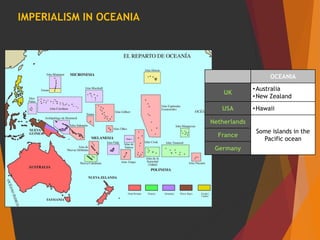
IMPERIALISM IN OCEANIA
OCEANIA
UK
•Australia
•New Zealand
USA •Hawaii
Netherlands
Some islands in the
Pacific ocean
France
Germany
 P.108 – 109  exercises 1 & 3
 What ideology supported & justified
imperialism? Explain it. Do you agree
with it?
 P.110 – 111  1b / 2 / 4
Activity 3
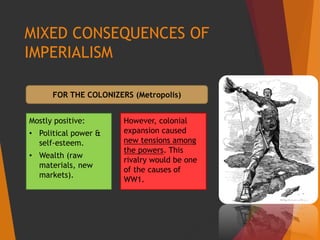
MIXED CONSEQUENCES OF
IMPERIALISM
Mostly positive:
• Political power &
self-esteem.
• Wealth (raw
materials, new
markets).
FOR THE COLONIZERS (Metropolis)
However, colonial
expansion caused
new tensions among
the powers. This
rivalry would be one
of the causes of
WW1.
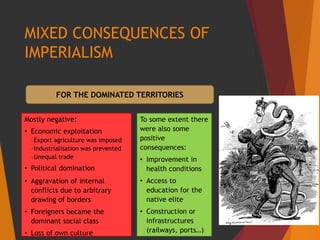
MIXED CONSEQUENCES OF
IMPERIALISM
To some extent there
were also some
positive
consequences:
• Improvement in
health conditions
• Access to
education for the
native elite
• Construction or
infrastructures
(railways, ports…)
FOR THE DOMINATED TERRITORIES
Mostly negative:
• Economic exploitation
–Export agriculture was imposed
–Industrialisation was prevented
–Unequal trade
• Political domination
• Aggravation of internal
conflicts due to arbitrary
drawing of borders
• Foreigners became the
dominant social class
• Loss of own culture
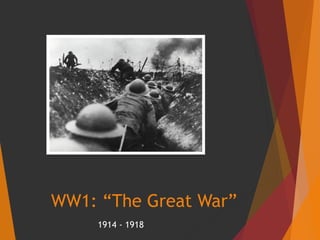
WW1: “The Great War”
1914 - 1918
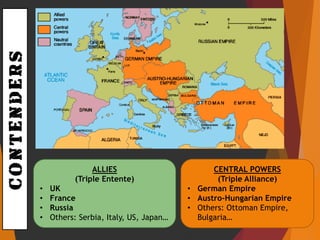
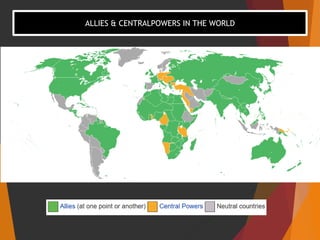
CONTENDERS
ALLIES
(Triple Entente)
• UK
• France
• Russia
• Others: Serbia, Italy, US, Japan…
CENTRAL POWERS
(Triple Alliance)
• German Empire
• Austro-Hungarian Empire
• Others: Ottoman Empire,
Bulgaria…
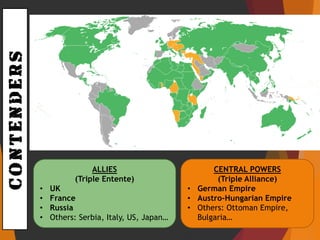
ALLIES
(Triple Entente)
• UK
• France
• Russia
• Others: Serbia, Italy, US, Japan…
CENTRAL POWERS
(Triple Alliance)
• German Empire
• Austro-Hungarian Empire
• Others: Ottoman Empire,
Bulgaria…
CONTENDERS
CAUSESOFWW1
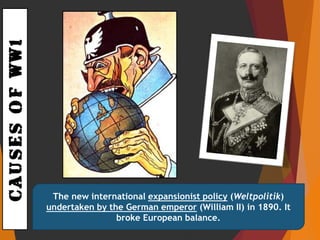
The new international expansionist policy (Weltpolitik)
undertaken by the German emperor (William II) in 1890. It
broke European balance.
CAUSESOFWW1
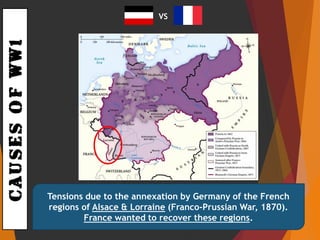
Tensions due to the annexation by Germany of the French
regions of Alsace & Lorraine (Franco-Prussian War, 1870).
France wanted to recover these regions.
VS
CAUSESOFWW1
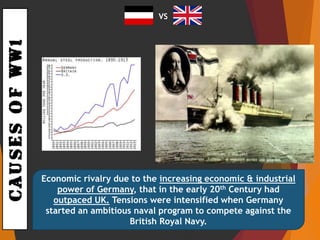
Economic rivalry due to the increasing economic & industrial
power of Germany, that in the early 20th Century had
outpaced UK. Tensions were intensified when Germany
started an ambitious naval program to compete against the
British Royal Navy.
VS
CAUSESOFWW1
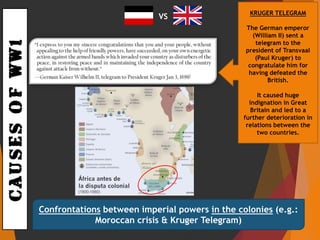
Confrontations between imperial powers in the colonies (e.g.:
Moroccan crisis & Kruger Telegram)
KRUGER TELEGRAM
The German emperor
(William II) sent a
telegram to the
president of Transvaal
(Paul Kruger) to
congratulate him for
having defeated the
British.
It caused huge
indignation in Great
Britain and led to a
further deterioration in
relations between the
two countries.
VS
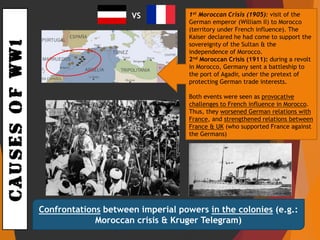
CAUSESOFWW1 1st Moroccan Crisis (1905): visit of the
German emperor (William II) to Morocco
(territory under French influence). The
Kaiser declared he had come to support the
sovereignty of the Sultan & the
independence of Morocco.
2nd Moroccan Crisis (1911): during a revolt
in Morocco, Germany sent a battleship to
the port of Agadir, under the pretext of
protecting German trade interests.
Both events were seen as provocative
challenges to French influence in Morocco.
Thus, they worsened German relations with
France, and strengthened relations between
France & UK (who supported France against
the Germans)
VS
Confrontations between imperial powers in the colonies (e.g.:
Moroccan crisis & Kruger Telegram)
CAUSESOFWW1
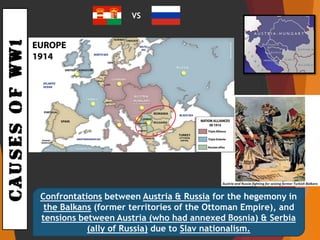
Confrontations between Austria & Russia for the hegemony in
the Balkans (former territories of the Ottoman Empire), and
tensions between Austria (who had annexed Bosnia) & Serbia
(ally of Russia) due to Slav nationalism.
VS
CAUSESOFWW1
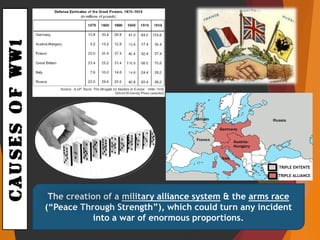
The creation of a military alliance system & the arms race
(“Peace Through Strength”), which could turn any incident
into a war of enormous proportions.
TRIPLE ENTENTE
TRIPLE ALLIANCE
THESPARKOFTHEWAR VIDEO
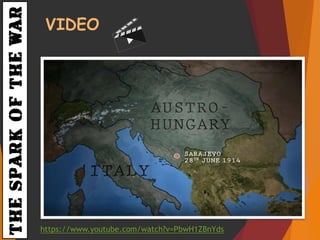
https://www.youtube.com/watch?v=PbwH1ZBnYds
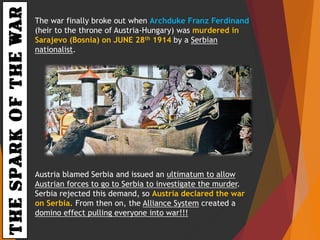
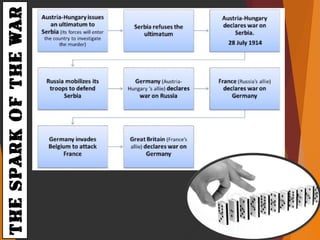
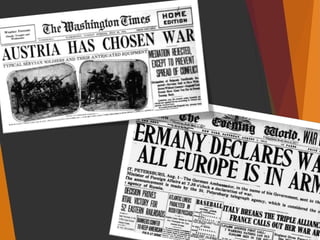
THESPARKOFTHEWAR The war finally broke out when Archduke Franz Ferdinand
(heir to the throne of Austria-Hungary) was murdered in
Sarajevo (Bosnia) on JUNE 28th 1914 by a Serbian
nationalist.
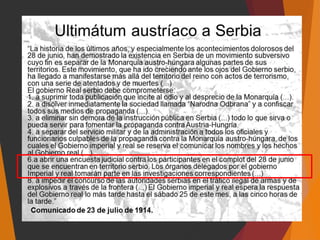
Austria blamed Serbia and issued an ultimatum to allow
Austrian forces to go to Serbia to investigate the murder.
Serbia rejected this demand, so Austria declared the war
on Serbia. From then on, the Alliance System created a
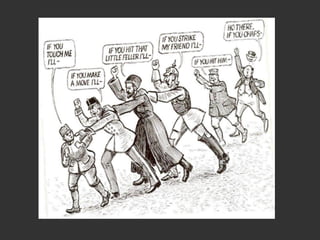
domino effect pulling everyone into war!!!
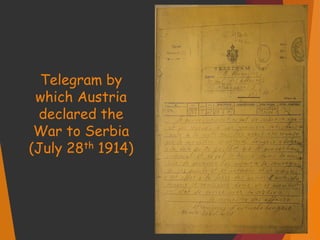
Telegram by
which Austria
declared the
War to Serbia
(July 28th 1914)
THESPARKOFTHEWAR
ALLIES & CENTRALPOWERS IN THE WORLD
a) List 4 new weapons that were used in WW1.
b) What was propaganda used for in WW1?
c) Why did Russia left WW1?
d) What was the main turning point in WW1?
e) Why did Germany felt humiliated in the Paris
Peace Conference? What consequence did this
brought?
f) Indicate at least 7 territorial changes in the
map of Europe after WW1.
Activity 4: copy & answer as we go.
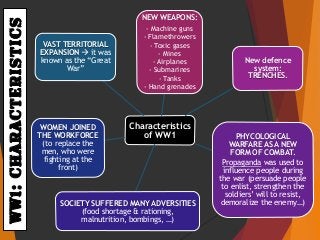
WW1:CHARACTERISTICS
Characteristics
of WW1
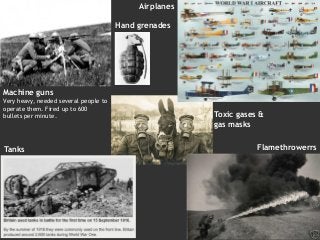
NEW WEAPONS:
- Machine guns
- Flamethrowers
- Toxic gases
- Mines
- Airplanes
- Submarines
- Tanks
- Hand grenades
New defence
system:
TRENCHES.
PHYCOLOGICAL
WARFARE AS A NEW
FORM OF COMBAT.
Propaganda was used to
influence people during
the war (persuade people
to enlist, strengthen the
soldiers’ will to resist,
demoralize the enemy…)SOCIETY SUFFERED MANY ADVERSITIES
(food shortage & rationing,
malnutrition, bombings, …)
WOMEN JOINED
THE WORKFORCE
(to replace the
men, who were
fighting at the
front)
VAST TERRITORIAL
EXPANSION  it was
known as the “Great
War”
Hand grenades
Machine guns
Very heavy, needed several people to
operate them. Fired up to 600
bullets per minute.
Airplanes
Tanks
Toxic gases &
gas masks
Flamethrowerrs
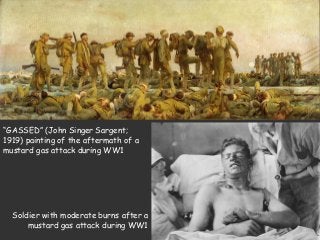
Soldier with moderate burns after a
mustard gas attack during WW1
“GASSED” (John Singer Sargent;
1919) painting of the aftermath of a
mustard gas attack during WW1
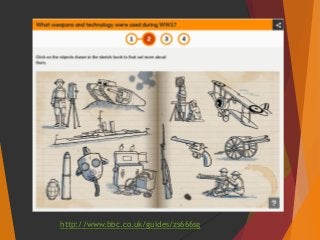
http://www.bbc.co.uk/guides/zs666sg
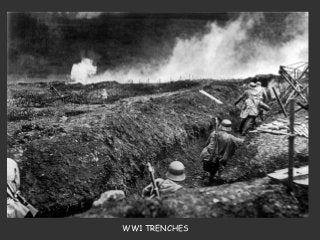
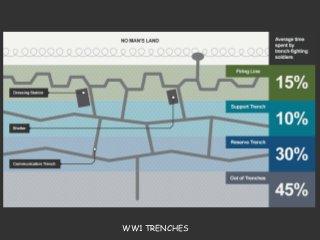
WW1 TRENCHES
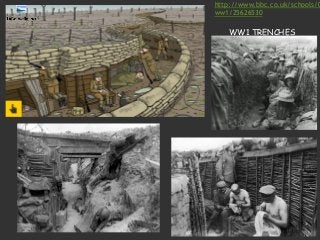
WW1 TRENCHES
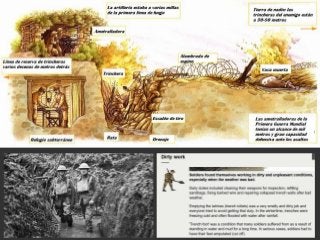
WW1 TRENCHES
http://www.bbc.co.uk/schools/0
ww1/25626530
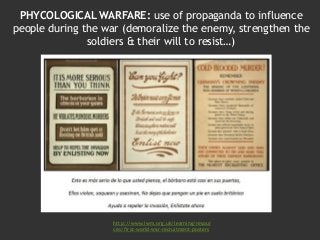
PHYCOLOGICAL WARFARE: use of propaganda to influence
people during the war (demoralize the enemy, strengthen the
soldiers & their will to resist…)
http://www.iwm.org.uk/learning/resour
ces/first-world-war-recruitment-posters
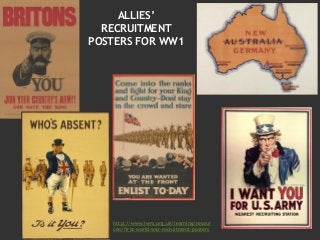
ALLIES’
RECRUITMENT
POSTERS FOR WW1
http://www.iwm.org.uk/learning/resour
ces/first-world-war-recruitment-posters
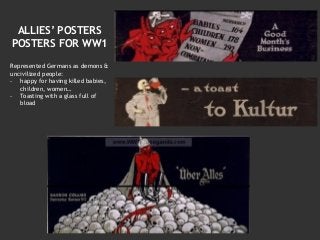
ALLIES’ POSTERS
POSTERS FOR WW1
Represented Germans as demons &
uncivilized people:
- happy for having killed babies,
children, women…
- Toasting with a glass full of
bload
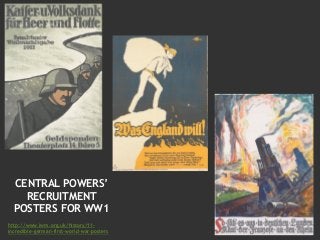
CENTRAL POWERS’
RECRUITMENT
POSTERS FOR WW1
http://www.iwm.org.uk/history/11-
incredible-german-first-world-war-posters
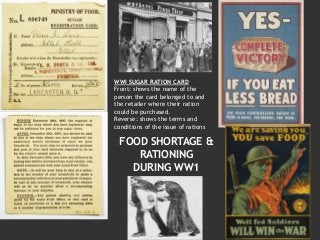
FOOD SHORTAGE &
RATIONING
DURING WW1
WWI SUGAR RATION CARD
Front: shows the name of the
person the card belonged to and
the retailer where their ration
could be purchased.
Reverse: shows the terms and
conditions of the issue of rations
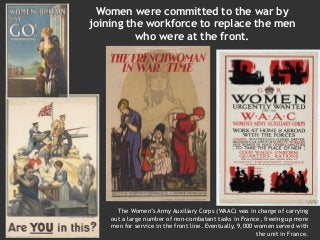
The Women’s Army Auxiliary Corps (WAAC) was in charge of carrying
out a large number of non-combatant tasks in France, freeing up more
men for service in the front line. Eventually, 9,000 women served with
the unit in France.
Women were committed to the war by
joining the workforce to replace the men
who were at the front.
Ww1:MAINFRONTS
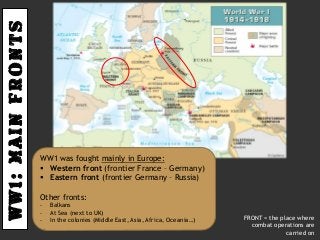
WW1 was fought mainly in Europe:
 Western front (frontier France – Germany)
 Eastern front (frontier Germany – Russia)
Other fronts:
- Balkans
- At Sea (next to UK)
- In the colonies (Middle East, Asia, Africa, Oceania…) FRONT = the place where
combat operations are
carried on
Ww1:PHASES
1914  WAR OF MOVEMENTS (“Guerra de Movimientos”)
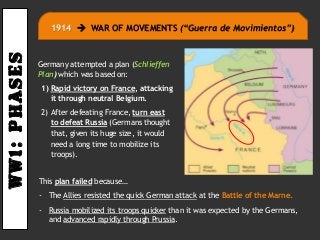
This plan failed because…
- The Allies resisted the quick German attack at the Battle of the Marne.
- Russia mobilized its troops quicker than it was expected by the Germans,
and advanced rapidly through Prussia.
Germany attempted a plan (Schlieffen
Plan) which was based on:
1) Rapid victory on France, attacking
it through neutral Belgium.
2) After defeating France, turn east
to defeat Russia (Germans thought
that, given its huge size, it would
need a long time to mobilize its
troops).
Ww1:PHASES
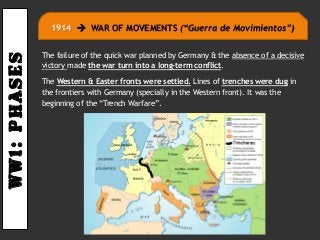
The failure of the quick war planned by Germany & the absence of a decisive
victory made the war turn into a long-term conflict.
The Western & Easter fronts were settled. Lines of trenches were dug in
the frontiers with Germany (specially in the Western front). It was the
beginning of the “Trench Warfare”.
1914  WAR OF MOVEMENTS (“Guerra de Movimientos”)
Ww1:PHASES
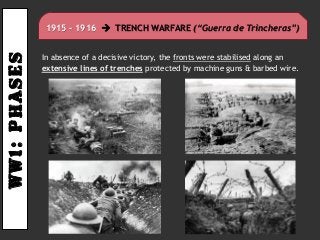
In absence of a decisive victory, the fronts were stabilised along an
extensive lines of trenches protected by machine guns & barbed wire.
1915 – 1916  TRENCH WARFARE (“Guerra de Trincheras”)
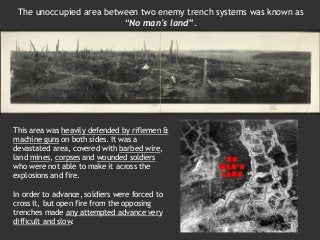
The unoccupied area between two enemy trench systems was known as
“No man's land”.
N O
M A N ’ S
L A N D
This area was heavily defended by riflemen &
machine guns on both sides. It was a
devastated area, covered with barbed wire,
land mines, corpses and wounded soldiers
who were not able to make it across the
explosions and fire.
In order to advance, soldiers were forced to
cross it, but open fire from the opposing
trenches made any attempted advance very
difficult and slow.
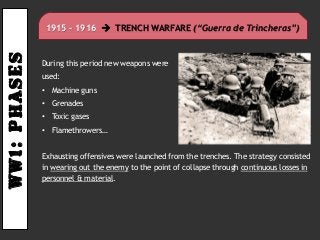
During this period new weapons were
used:
• Machine guns
• Grenades
• Toxic gases
• Flamethrowers…
Exhausting offensives were launched from the trenches. The strategy consisted
in wearing out the enemy to the point of collapse through continuous losses in
personnel & material.
Ww1:PHASES
1915 – 1916  TRENCH WARFARE (“Guerra de Trincheras”)
Ww1:PHASES
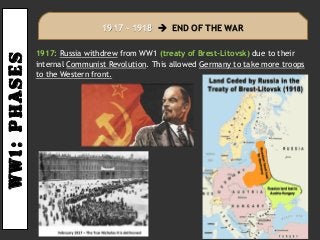
1917: Russia withdrew from WW1 (treaty of Brest-Litovsk) due to their
internal Communist Revolution. This allowed Germany to take more troops
to the Western front.
1917 – 1918  END OF THE WAR
Ww1:PHASES
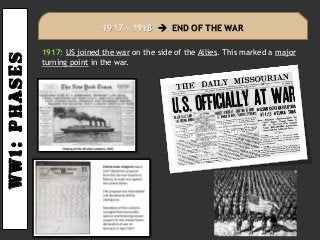
1917: US joined the war on the side of the Allies. This marked a major
turning point in the war.
1917 – 1918  END OF THE WAR
Ww1:PHASES
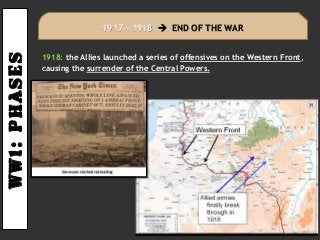
1918: the Allies launched a series of offensives on the Western Front,
causing the surrender of the Central Powers.
1917 – 1918  END OF THE WAR
Ww1:PEACETREATIES
 The LEAGUE OF NATIONS (“Sociedad de Naciones”) was created 
international organization for promoting peace.
 Several treaties were signed:
 The Central Powers had to:
 Reduce their armies
 Pay war reparations
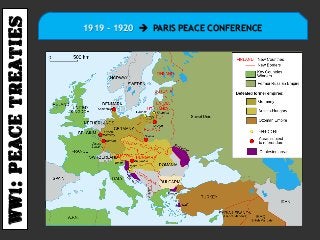
 Make territorial concessions, from which new states emerged (Poland,
Hungary, Czechoslovakia, Yugoslavia, Estonia, Latvia, Lithuania,
Finland...)
 Germany (Treaty of Versailles):
 Was blamed for the war
 Gave Alsace & Lorraine back to France
 Lost all its colonies
1919 – 1920  PARIS PEACE CONFERENCE
Felt humiliated  wanted
revenge
Ww1:PEACETREATIES
1919 – 1920  PARIS PEACE CONFERENCE
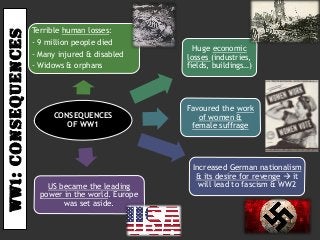
Ww1:CONSEQUENCES
CONSEQUENCES
OF WW1
Terrible human losses:
- 9 million people died
- Many injured & disabled
- Widows & orphans
Huge economic
losses (industries,
fields, buildings…)
Favoured the work
of women &
female suffrage
Increased German nationalism
& its desire for revenge  it
will lead to fascism & WW2US became the leading
power in the world. Europe
was set aside.
 Define the following concepts:
 Trenches
 No man’s land
 Paris Peace Conference
 Devise a diagram about the characteristics,
phases & consequences of WW1.
Activity 5

U5. imperialism & WW1

  • 1.
    IMPERIALISM & WW1 IESCamilo José Cela Teacher: Rocío Bautista
  • 2.
     In orderto understand the WW1 (1914-18), it is necessary to know what was the international situation of Europe before 1914. What new countries had been formed in the 1870’s? The expansion of which ideology favoured the unification of these countries? How did the Congress of Vienna (1815) re-established European Balance after the Napoleonic period? What emergent ideology did they ignored?
  • 3.
    REMEMBER… European Balance hadbeen re-established in the Congress of Vienna… BUT IGNORING NATIONALISTIC FEELINGS!!!!
  • 5.
    REMEMBER…  Austria wasexpelled from the German Confederation (Austro-Prussian War - 1866)  so it was an independent country.  French territories (Alsace & Lorraine) had been annexed to Germany (Franco- Prussian War - 1870)
  • 6.
     During the19th Century the forces of NATIONALISM had been at work in Europe.  By 1871 it had created two major new countries: Germany & Italy.  At the end of the century, Nationalism continued to threaten the stability of multi-national states…
  • 7.
    POLITICS & INTERNATIONAL RELATIONS PARLIAMENTARY SYSTEMS prevailed in most Western Europe, USA & Japan.  Exceptions:  Austro-Hungarian Empire  Russian Empire  Ottoman Empire AUTOCRATIC SYSTEMS & states formed by multiple nationalities POLITICAL SYSTEMS
  • 8.
    • Austro-Hungarian Empire •Belgium • Denmark • German Empire • Greece • Italy • Netherlands • Ottoman Empire • Portugal • Russian Empire • Spain • Switzerland • UK • United Kingdom of Norway and Sweden Activity 1: Colour in & label your map with the major states in Europe in 1871
  • 10.
    INTERNATIONAL SITUATION UK Germany (outpaced UK bythe early 20th century) USA (outpaced UK by the early 20th century)) France Japan Mediterranean Countries Austro-Hungarian Empire Russia Ottoman Empire Countries in Europe industrialized at different speed. Countries’ power was measured by their degree of industrialization.
  • 11.
    1871 – 1890 BISMARCK’SALLIANCE SYSTEMS - Secret military alliances to isolate France (who wanted revenge due to the loss of Alsace & Lorraine). 1891 – 1914 PEACE THROUGH STRENGHT EUROPEAN ALLIANCE SYSTEMS • European Balance broke after the Italian & German unifications. • 2 stages in European international relations:  Permitted peace in Europe.  Ended due to a confrontation between the emperor (William I), who wanted to create a colonial empire, and the Chancellor (Bismarck) who opposed to it.
  • 12.
    Bismarck’s Alliance systemswere military alliances between Germany & the main European powers (Russia, Austria, Italy & UK) to isolate France.
  • 13.
    1871 – 1890 BISMARCK’SALLIANCE SYSTEMS Secret military alliances to isolate France (who wanted revenge due to the loss of Alsace & Lorraine). 1891 – 1914 PEACE THROUGH STRENGHT Growing tensions due political & economic problems led to the formation of 2 military blocs: EUROPEAN ALLIANCE SYSTEMS • European Balance broke after the Italian & German unifications. • 2 stages in European international relations:  Permitted peace in Europe.  Ended due to a confrontation between the emperor (William I), who wanted to create a colonial empire, and the Chancellor (Bismarck) who opposed to it. TRIPLE ALLIANCE - Germany - Austria - Italy (will change side) TRIPLE ENTENTE - France - Russia - UK
  • 14.
    TRIPLE ENTENTE TRIPLE ALLIANCE In conflict with Germanydue to its growing economic & colonial power In conflict with Germany due to Alsace & Lorraine In conflict with Austria (ally of Germany) due to interests in the Balkans
  • 15.
     Which stateswere threaten by nationalism?  P. 101  exercises 4 & 5 Activity 2
  • 16.
  • 17.
    IMPERIALISM Goal: besides theeconomic control, it implied the military & political control of the European minority over the dominated territory. COLONIALISM Goal: dominate the economic resources of the colonies. ≠
  • 18.
    CAUSES OF IMPERIALISM Allowed tocontrol trade routes & strategic territories Reduced problems related to the population growth (e.g.: unemployment)  excess population emigrated from the metropolis to the colonies to relieve population pressure Colonies supplied raw materials, markets to sell the metropolis’ industrial products, territories to invest capitals & cheap labour force Spread of the idea of the superiority of the white race & that its mission was to “civilise” the rest of the world (social Darwinism). International prestige  it was a way of increasing a country’s power at a time when European Balance had been broken.
  • 24.
    UK, FRANCE &other imperialist powers (BELGIUM, GERMANY, ITALY, THE NETHERLANDS, RUSSIA…) established diverse forms of colonial rule: FORMS OF COLONIAL RULE CONCESSION (CHINA) Agreement by which an independent country granted commercial advantages to imperial powers (e.g.: ports for trade) PROTECTORATE (INDIA / EGYPT) 2 administrations coexisted: - Indigenous government  for internal affairs - Imperial power  controlled foreign policy, army & exploitation of certain resources. COLONY It had no indigenous institution. It was under the direct sovereignty of the metropolis. SETTLER COLONIES (CANADA, AUSTRALIA, NEW ZEALAND…)  population mostly European. Self-governed. Used to relieve population pressure in the metropolis. EXPLOITATION COLONIES (BELGIAN CONGO)  population mostly indigenous. Governed by the metropolis. Used for economic benefit of the metropolis (it had exclusive rights to exploit the colony’s resouces).
  • 25.
    CONCESSIONS IN CHINA UK,Germany, Russia, France & Japan distributed the areas of influence in China.
  • 26.
    PROTECTORATES Egypt & Indiabecame protectorates of UK
  • 27.
    EXPLOITATION COLONIES Many territoriesin Africa were exploited as colonies (e.g.: Belgian Congo).
  • 28.
    THE SCRAMBLE OFAFRICA (“El reparto de África”) • Before 1870  European presence in Africa limited to the coasts.
  • 29.
    Some coastal territorieswere controlled by European powers…  FRANCE (Algeria, Tunisia, Senegal…)  UK (Egypt, South Africa…)  PORTUGAL (Angola, Mozambique…)
  • 30.
    • In the1870’s  European powers began to explore the African continent. LIVINGSTONE (UK) – explored the Zambezi & Nile rivers. Discovered the “Victoria Falls”. STANLEY (Belgium) & BRAZZA (France) – explored the Congo basin.
  • 32.
    1884  toavoid clashes, the European powers met in the “BERLIN CONFERENCE” (1884) where they established the rules for the occupation of Africa: 1) Countries that had coastal possessions had the right to occupy the interior, provided that they demonstrated the effective occupation & control of the territory. 2) Free navigation on the Niger & Congo rivers. 3) Free trade in Central Africa.
  • 33.
    THE CONFERENCE OFBERLIN (1884) It regulated European colonization & trade in Africa during the New Imperialism period. It is considered the starting point of the “Scramble for Africa” (invasion, occupation, division, colonization and annexation of African territory by European powers). Organized by Germany. It eliminated most existing forms of African autonomy and self-governance.
  • 34.
    From 1885 onwards occupation of Africa accelerated:  UK  tried to form a colonial strip N-S (Egypt – South Africa)  FRANCE  tried to form a colonial strip W-E (starting from its colonies in Senegal, Algeria & Tunisia)  Belgium, Portugal, Germany, Italy, Spain completed the occupation of Africa COLONIAL CONFRONTATIONS!!
  • 35.
    IMPERIALISM IN ASIA •China  system of concessions (maintained its sovereignty, but gave commercial rights to imperial powers). ASIA UK •India •Burma •Malaysia France •Part of Indochina Netherlands •Most of Indonesia US •Philippines Russia •Siberia •Territories towards China & India (Caucasus, Turkestan)
  • 36.
    IMPERIALISM IN OCEANIA OCEANIA UK •Australia •NewZealand USA •Hawaii Netherlands Some islands in the Pacific ocean France Germany
  • 37.
     P.108 –109  exercises 1 & 3  What ideology supported & justified imperialism? Explain it. Do you agree with it?  P.110 – 111  1b / 2 / 4 Activity 3
  • 39.
    MIXED CONSEQUENCES OF IMPERIALISM Mostlypositive: • Political power & self-esteem. • Wealth (raw materials, new markets). FOR THE COLONIZERS (Metropolis) However, colonial expansion caused new tensions among the powers. This rivalry would be one of the causes of WW1.
  • 40.
    MIXED CONSEQUENCES OF IMPERIALISM Tosome extent there were also some positive consequences: • Improvement in health conditions • Access to education for the native elite • Construction or infrastructures (railways, ports…) FOR THE DOMINATED TERRITORIES Mostly negative: • Economic exploitation –Export agriculture was imposed –Industrialisation was prevented –Unequal trade • Political domination • Aggravation of internal conflicts due to arbitrary drawing of borders • Foreigners became the dominant social class • Loss of own culture
  • 41.
    WW1: “The GreatWar” 1914 - 1918
  • 42.
    CONTENDERS ALLIES (Triple Entente) • UK •France • Russia • Others: Serbia, Italy, US, Japan… CENTRAL POWERS (Triple Alliance) • German Empire • Austro-Hungarian Empire • Others: Ottoman Empire, Bulgaria…
  • 43.
    ALLIES (Triple Entente) • UK •France • Russia • Others: Serbia, Italy, US, Japan… CENTRAL POWERS (Triple Alliance) • German Empire • Austro-Hungarian Empire • Others: Ottoman Empire, Bulgaria… CONTENDERS
  • 45.
    CAUSESOFWW1 The new internationalexpansionist policy (Weltpolitik) undertaken by the German emperor (William II) in 1890. It broke European balance.
  • 46.
    CAUSESOFWW1 Tensions due tothe annexation by Germany of the French regions of Alsace & Lorraine (Franco-Prussian War, 1870). France wanted to recover these regions. VS
  • 47.
    CAUSESOFWW1 Economic rivalry dueto the increasing economic & industrial power of Germany, that in the early 20th Century had outpaced UK. Tensions were intensified when Germany started an ambitious naval program to compete against the British Royal Navy. VS
  • 48.
    CAUSESOFWW1 Confrontations between imperialpowers in the colonies (e.g.: Moroccan crisis & Kruger Telegram) KRUGER TELEGRAM The German emperor (William II) sent a telegram to the president of Transvaal (Paul Kruger) to congratulate him for having defeated the British. It caused huge indignation in Great Britain and led to a further deterioration in relations between the two countries. VS
  • 49.
    CAUSESOFWW1 1st MoroccanCrisis (1905): visit of the German emperor (William II) to Morocco (territory under French influence). The Kaiser declared he had come to support the sovereignty of the Sultan & the independence of Morocco. 2nd Moroccan Crisis (1911): during a revolt in Morocco, Germany sent a battleship to the port of Agadir, under the pretext of protecting German trade interests. Both events were seen as provocative challenges to French influence in Morocco. Thus, they worsened German relations with France, and strengthened relations between France & UK (who supported France against the Germans) VS Confrontations between imperial powers in the colonies (e.g.: Moroccan crisis & Kruger Telegram)
  • 50.
    CAUSESOFWW1 Confrontations between Austria& Russia for the hegemony in the Balkans (former territories of the Ottoman Empire), and tensions between Austria (who had annexed Bosnia) & Serbia (ally of Russia) due to Slav nationalism. VS
  • 51.
    CAUSESOFWW1 The creation ofa military alliance system & the arms race (“Peace Through Strength”), which could turn any incident into a war of enormous proportions. TRIPLE ENTENTE TRIPLE ALLIANCE
  • 52.
  • 53.
    THESPARKOFTHEWAR The warfinally broke out when Archduke Franz Ferdinand (heir to the throne of Austria-Hungary) was murdered in Sarajevo (Bosnia) on JUNE 28th 1914 by a Serbian nationalist. Austria blamed Serbia and issued an ultimatum to allow Austrian forces to go to Serbia to investigate the murder. Serbia rejected this demand, so Austria declared the war on Serbia. From then on, the Alliance System created a domino effect pulling everyone into war!!!
  • 56.
    Telegram by which Austria declaredthe War to Serbia (July 28th 1914)
  • 57.
  • 59.
  • 60.
    a) List 4new weapons that were used in WW1. b) What was propaganda used for in WW1? c) Why did Russia left WW1? d) What was the main turning point in WW1? e) Why did Germany felt humiliated in the Paris Peace Conference? What consequence did this brought? f) Indicate at least 7 territorial changes in the map of Europe after WW1. Activity 4: copy & answer as we go.
  • 61.
    WW1:CHARACTERISTICS Characteristics of WW1 NEW WEAPONS: -Machine guns - Flamethrowers - Toxic gases - Mines - Airplanes - Submarines - Tanks - Hand grenades New defence system: TRENCHES. PHYCOLOGICAL WARFARE AS A NEW FORM OF COMBAT. Propaganda was used to influence people during the war (persuade people to enlist, strengthen the soldiers’ will to resist, demoralize the enemy…)SOCIETY SUFFERED MANY ADVERSITIES (food shortage & rationing, malnutrition, bombings, …) WOMEN JOINED THE WORKFORCE (to replace the men, who were fighting at the front) VAST TERRITORIAL EXPANSION  it was known as the “Great War”
  • 62.
    Hand grenades Machine guns Veryheavy, needed several people to operate them. Fired up to 600 bullets per minute. Airplanes Tanks Toxic gases & gas masks Flamethrowerrs
  • 63.
    Soldier with moderateburns after a mustard gas attack during WW1 “GASSED” (John Singer Sargent; 1919) painting of the aftermath of a mustard gas attack during WW1
  • 64.
  • 65.
  • 66.
  • 67.
  • 69.
    PHYCOLOGICAL WARFARE: useof propaganda to influence people during the war (demoralize the enemy, strengthen the soldiers & their will to resist…) http://www.iwm.org.uk/learning/resour ces/first-world-war-recruitment-posters
  • 70.
  • 71.
    ALLIES’ POSTERS POSTERS FORWW1 Represented Germans as demons & uncivilized people: - happy for having killed babies, children, women… - Toasting with a glass full of bload
  • 72.
    CENTRAL POWERS’ RECRUITMENT POSTERS FORWW1 http://www.iwm.org.uk/history/11- incredible-german-first-world-war-posters
  • 73.
    FOOD SHORTAGE & RATIONING DURINGWW1 WWI SUGAR RATION CARD Front: shows the name of the person the card belonged to and the retailer where their ration could be purchased. Reverse: shows the terms and conditions of the issue of rations
  • 74.
    The Women’s ArmyAuxiliary Corps (WAAC) was in charge of carrying out a large number of non-combatant tasks in France, freeing up more men for service in the front line. Eventually, 9,000 women served with the unit in France. Women were committed to the war by joining the workforce to replace the men who were at the front.
  • 75.
    Ww1:MAINFRONTS WW1 was foughtmainly in Europe:  Western front (frontier France – Germany)  Eastern front (frontier Germany – Russia) Other fronts: - Balkans - At Sea (next to UK) - In the colonies (Middle East, Asia, Africa, Oceania…) FRONT = the place where combat operations are carried on
  • 76.
    Ww1:PHASES 1914  WAROF MOVEMENTS (“Guerra de Movimientos”) This plan failed because… - The Allies resisted the quick German attack at the Battle of the Marne. - Russia mobilized its troops quicker than it was expected by the Germans, and advanced rapidly through Prussia. Germany attempted a plan (Schlieffen Plan) which was based on: 1) Rapid victory on France, attacking it through neutral Belgium. 2) After defeating France, turn east to defeat Russia (Germans thought that, given its huge size, it would need a long time to mobilize its troops).
  • 77.
    Ww1:PHASES The failure ofthe quick war planned by Germany & the absence of a decisive victory made the war turn into a long-term conflict. The Western & Easter fronts were settled. Lines of trenches were dug in the frontiers with Germany (specially in the Western front). It was the beginning of the “Trench Warfare”. 1914  WAR OF MOVEMENTS (“Guerra de Movimientos”)
  • 78.
    Ww1:PHASES In absence ofa decisive victory, the fronts were stabilised along an extensive lines of trenches protected by machine guns & barbed wire. 1915 – 1916  TRENCH WARFARE (“Guerra de Trincheras”)
  • 79.
    The unoccupied areabetween two enemy trench systems was known as “No man's land”. N O M A N ’ S L A N D This area was heavily defended by riflemen & machine guns on both sides. It was a devastated area, covered with barbed wire, land mines, corpses and wounded soldiers who were not able to make it across the explosions and fire. In order to advance, soldiers were forced to cross it, but open fire from the opposing trenches made any attempted advance very difficult and slow.
  • 80.
    During this periodnew weapons were used: • Machine guns • Grenades • Toxic gases • Flamethrowers… Exhausting offensives were launched from the trenches. The strategy consisted in wearing out the enemy to the point of collapse through continuous losses in personnel & material. Ww1:PHASES 1915 – 1916  TRENCH WARFARE (“Guerra de Trincheras”)
  • 81.
    Ww1:PHASES 1917: Russia withdrewfrom WW1 (treaty of Brest-Litovsk) due to their internal Communist Revolution. This allowed Germany to take more troops to the Western front. 1917 – 1918  END OF THE WAR
  • 82.
    Ww1:PHASES 1917: US joinedthe war on the side of the Allies. This marked a major turning point in the war. 1917 – 1918  END OF THE WAR
  • 83.
    Ww1:PHASES 1918: the Allieslaunched a series of offensives on the Western Front, causing the surrender of the Central Powers. 1917 – 1918  END OF THE WAR
  • 84.
    Ww1:PEACETREATIES  The LEAGUEOF NATIONS (“Sociedad de Naciones”) was created  international organization for promoting peace.  Several treaties were signed:  The Central Powers had to:  Reduce their armies  Pay war reparations  Make territorial concessions, from which new states emerged (Poland, Hungary, Czechoslovakia, Yugoslavia, Estonia, Latvia, Lithuania, Finland...)  Germany (Treaty of Versailles):  Was blamed for the war  Gave Alsace & Lorraine back to France  Lost all its colonies 1919 – 1920  PARIS PEACE CONFERENCE Felt humiliated  wanted revenge
  • 85.
    Ww1:PEACETREATIES 1919 – 1920 PARIS PEACE CONFERENCE
  • 87.
    Ww1:CONSEQUENCES CONSEQUENCES OF WW1 Terrible humanlosses: - 9 million people died - Many injured & disabled - Widows & orphans Huge economic losses (industries, fields, buildings…) Favoured the work of women & female suffrage Increased German nationalism & its desire for revenge  it will lead to fascism & WW2US became the leading power in the world. Europe was set aside.
  • 88.
     Define thefollowing concepts:  Trenches  No man’s land  Paris Peace Conference  Devise a diagram about the characteristics, phases & consequences of WW1. Activity 5