Provincia	
  Marista	
  Mediterránea	


  Colegio	
  “La	
  Sagrada	
  Familia”	


UNIT 8: ENERGY	


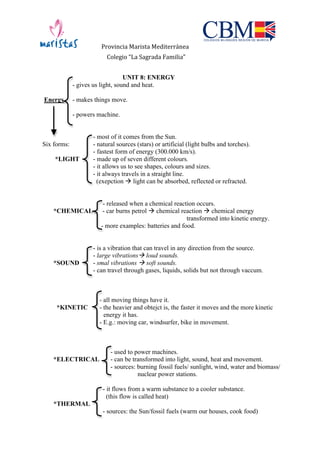
- gives us light, sound and heat.
Energy - makes things move.
- powers machine.
- most of it comes from the Sun.
Six forms: - natural sources (stars) or artificial (light bulbs and torches).
- fastest form of energy (300.000 km/s).
*LIGHT - made up of seven different colours.
- it allows us to see shapes, colours and sizes.
- it always travels in a straight line.
(exepction  light can be absorbed, reflected or refracted.
- released when a chemical reaction occurs.
*CHEMICAL - car burns petrol  chemical reaction  chemical energy
transformed into kinetic energy.
- more examples: batteries and food.
- is a vibration that can travel in any direction from the source.
- large vibrations loud sounds.
*SOUND - smal vibrations  soft sounds.
- can travel through gases, liquids, solids but not through vaccum.
- all moving things have it.
*KINETIC - the heavier and obtejct is, the faster it moves and the more kinetic
energy it has.
- E.g.: moving car, windsurfer, bike in movement.
- used to power machines.
*ELECTRICAL - can be transformed into light, sound, heat and movement.
- sources: burning fossil fuels/ sunlight, wind, water and biomass/
nuclear power stations.
- it flows from a warm substance to a cooler substance.
(this flow is called heat)
*THERMAL
- sources: the Sun/fossil fuels (warm our houses, cook food)


  Provincia	
  Marista	
  Mediterránea	


  Colegio	
  “La	
  Sagrada	
  Familia”	


UNIT 8: ENERGY	


RENEWABLE ENERGY SOURCES (can be replaced)
- doesn´t pollute.
*SOLAR EN.
- solar panels are used.
- clean.
*WIND EN. - only in windy places.
- wind turbines are used - can damage habitats.
- can kill birds.
- doesn´t pollute.
*WATER EN. -damage habitats.
- dams
- cause biodiversity loss.
- organic material derived from living things (wood, dried vegetation, food
waste)
*BIOMASS - biomass is burned  steam produced turns a turbine  electricity.
- causes air pollution.
- heat produced by the decomposition of underground radioactive
substances
*GEOTHERMAL EN. - doesn´t pollute.
- limited to certain geographic areas.


  Provincia	
  Marista	
  Mediterránea	


  Colegio	
  “La	
  Sagrada	
  Familia”	


UNIT 8: ENERGY	


NON-RENEWABLE ENERGY SOURCES (limited)
*FOSSIL FUELS: decomposed organic material that has been deep underground for millions
of years.
- pollutes.
- COAL
- produces lots of energy.
- oil spills can cause ecological disasters.
- OIL
- easy to transport and store
- NATURAL GAS
- nuclear power stations use a radioactive metal to generate electricity.
*URANIUM - we have enough to generate electricity for many centuries.
are expensive.
- stations
produce radioactive waste products (can cause cancer).


  Provincia	
  Marista	
  Mediterránea	


  Colegio	
  “La	
  Sagrada	
  Familia”	


UNIT 8: ENERGY	


ELECTRICITY
Objects have electrical charges. They can be positive or negative charges.
- conductors (copper, aluminium).
Materials can be electrical
- insulators (wood, rubber, cotton, plastic).
- current  it´s when an electrical charge moves (flow) in an
electrical conductor.
Two types of electricity
- static  it´s a form of electricity that doesn´t flow (lightning,
hair after brushing it)
MAGNETISM
A magnet is an object which can attract certain metals (iron, steel…). They can be natural
(magnetite) or man-made.
Magnets have two poles: north pole and south pole.
N&N
repel S&N  attract
S&S

Unit 8(naturales)

  • 1.
                     Provincia  Marista  Mediterránea                                                                                                        Colegio  “La  Sagrada  Familia”     UNIT 8: ENERGY     - gives us light, sound and heat. Energy - makes things move. - powers machine. - most of it comes from the Sun. Six forms: - natural sources (stars) or artificial (light bulbs and torches). - fastest form of energy (300.000 km/s). *LIGHT - made up of seven different colours. - it allows us to see shapes, colours and sizes. - it always travels in a straight line. (exepction  light can be absorbed, reflected or refracted. - released when a chemical reaction occurs. *CHEMICAL - car burns petrol  chemical reaction  chemical energy transformed into kinetic energy. - more examples: batteries and food. - is a vibration that can travel in any direction from the source. - large vibrations loud sounds. *SOUND - smal vibrations  soft sounds. - can travel through gases, liquids, solids but not through vaccum. - all moving things have it. *KINETIC - the heavier and obtejct is, the faster it moves and the more kinetic energy it has. - E.g.: moving car, windsurfer, bike in movement. - used to power machines. *ELECTRICAL - can be transformed into light, sound, heat and movement. - sources: burning fossil fuels/ sunlight, wind, water and biomass/ nuclear power stations. - it flows from a warm substance to a cooler substance. (this flow is called heat) *THERMAL - sources: the Sun/fossil fuels (warm our houses, cook food)
  • 2.
                     Provincia  Marista  Mediterránea                                                                                                        Colegio  “La  Sagrada  Familia”     UNIT 8: ENERGY     RENEWABLE ENERGY SOURCES (can be replaced) - doesn´t pollute. *SOLAR EN. - solar panels are used. - clean. *WIND EN. - only in windy places. - wind turbines are used - can damage habitats. - can kill birds. - doesn´t pollute. *WATER EN. -damage habitats. - dams - cause biodiversity loss. - organic material derived from living things (wood, dried vegetation, food waste) *BIOMASS - biomass is burned  steam produced turns a turbine  electricity. - causes air pollution. - heat produced by the decomposition of underground radioactive substances *GEOTHERMAL EN. - doesn´t pollute. - limited to certain geographic areas.
  • 3.
                     Provincia  Marista  Mediterránea                                                                                                        Colegio  “La  Sagrada  Familia”     UNIT 8: ENERGY     NON-RENEWABLE ENERGY SOURCES (limited) *FOSSIL FUELS: decomposed organic material that has been deep underground for millions of years. - pollutes. - COAL - produces lots of energy. - oil spills can cause ecological disasters. - OIL - easy to transport and store - NATURAL GAS - nuclear power stations use a radioactive metal to generate electricity. *URANIUM - we have enough to generate electricity for many centuries. are expensive. - stations produce radioactive waste products (can cause cancer).
  • 4.
                     Provincia  Marista  Mediterránea                                                                                                        Colegio  “La  Sagrada  Familia”     UNIT 8: ENERGY     ELECTRICITY Objects have electrical charges. They can be positive or negative charges. - conductors (copper, aluminium). Materials can be electrical - insulators (wood, rubber, cotton, plastic). - current  it´s when an electrical charge moves (flow) in an electrical conductor. Two types of electricity - static  it´s a form of electricity that doesn´t flow (lightning, hair after brushing it) MAGNETISM A magnet is an object which can attract certain metals (iron, steel…). They can be natural (magnetite) or man-made. Magnets have two poles: north pole and south pole. N&N repel S&N  attract S&S