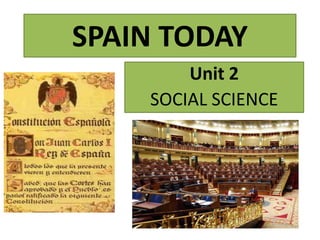
SPAIN TODAY
Unit 2
SOCIAL SCIENCE
WHAT DO YOU
KNOW ABOUT
SPAIN?
How is Spain organised?
SPANISH
CONSTITUTION
What do Spanish citizens celebrate on the
6th of December?
What do Spanish citizens celebrate on the
12th of October?
That day in 1978 Spanish citizens over 18 voted
and approved in a referendum
the Spanish Constitution
That day in 1492 Christopher Columbus reached
America after leaving Spain on the 3rd of August
How is Spain organised?
A CONSTITUTION is a legal document where a
set of laws are established which defines how
a State is organized, what type of government
it has and what rights and responsibilities the
citizens have.
The Spanish Constitution (approved in 1978) is the
most important law in the country.
Types or forms of GOVERNMENTS
A form of government is how the power
of a state is organised
TOTALITARIANISM
(no freedom)
DEMOCRACY
(freedom)
MONARCHY
REPUBLIC
PARLIAMENTARY
MONARCHYABSOLUTE MONARCHY
DICTATORSHIP
Types or forms of GOVERNMENTS
TOTALITARIANISM: absolute control by
government. There isn’t freedom.
Dictatorship: is a FORM OF GOVERNMENT where
political authority is monopolized/held by a person
(dictator).
-Absolute monarchy: Everything is controlled by
the monarchy (Catholic Monarchs).
TOTALITARIANISM
ADOLF HITLER
FRANCISCO FRANCO
CATHOLIC MONARCHS
Types or forms of GOVERNMENTS
DEMOCRACY: is a form of government in which all
the people of a state are involved in making decisions by
voting to elect representatives (politicians).
Republic: democratic state without monarchy. It is a form of
government in which power resides in elected individuals (politicians)
representing the citizens.
PARLIAMENTARY MONARCHY is a form of government in which the
powers of the Monarch is restricted by a Constitution. They don’t have real power
over laws or the governing the country. They are a symbol/representative of the country.
DEMOCRACY
FELIPE VI
JUAN CARLOS I
FRANCOIS HOLLANDE
president of the French
Republic
Spain has a king who is the HEAD OF STATE
(he can’t pass the laws) but there is
PARLIAMENT that is responsible for making and
approving new laws.
How is Spain organised?
The Constitution
Spain is a democratic (freedom) State with a
parliamentary monarchy
How is Spain organised?
The Constitution
Spain is divided in 17 Autonomous Communities
and 2 Autonomous Cities (Ceuta and Melilla)
These Autonomous Communities are governed
by their Statutes of Autonomy (it defines their
names, boundaries, symbols and language).
Autonomous Communities are divided into
provinces and municipalities.
Spanish coat of arms
The Spanish Constitution
Some important RIGHTS:
• We are all equal. Discrimination is forbidden.
• We have the right to be free and to be protected
by the law.
• We have the right to use public services
(education and health)
• We have the right to choose where to live and
travel freely.
• We have the right to have a job.
• We have the right to vote and elect leaders.
The Spanish Constitution
Some important responsibilities:
• We must pay taxes to pay for public services.
• We must protect the environment.
• We must respect the law.
• We must respect other people’s beliefs, culture,
language and religion.
• We must respect public services.
• We mustn´t tolerate discrimination or unfair
behaviour.
General Elections
The Constitution
• Citizens in Spain who are eighteen and over
vote for members of Parliament in general
elections every four years.
• People vote by secret ballot. So they have to
take a ballot paper, choose their political
party and put in inside an envelope so that no
one can see it.
THE STATE
The Constitution
(Sets 3 powers)
Executive Power
Government
(organises the
country and
proposes ideas/laws)
Legislative
Power
Parliament
(develops laws
proposed by the
government)
Judicial Power
Justice (monitors
if laws follow the
Constitution)
Executive Power
Government:
organises the country
President Ministers
The Government
• The party that gets the most votes forms the
government.
• The President is the head of the government.
• The Presidents chooses the ministers who will
help him/her.
President and Ministers
• Each minister is responsible for one area of
organisation.
• The ministers present plans to Parliament
(propose ideas/laws), and Parliament votes to
approve these plans or not.
http://www.lamoncloa.gob.es/gobierno/gabinete/Paginas/index.aspx
Legislative Power
Parliament: develops laws proposed
by the government
Congress
Deputies
(members of the
congress)
Senate
Senators
(members of the
senate)
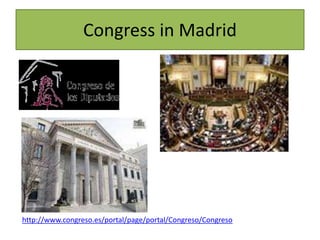
Congress of Deputies
• Deputies belong to different political parties.
• They can approve or veto laws.
• The number of deputies each political party
has in the congress depends on the number of
votes they receive in general elections.
Congress of Deputies
Congress in Madrid
http://www.congreso.es/portal/page/portal/Congreso/Congreso
Senate and Senators
• Senators represent the Autonomous
Communities. Senators ensure that the
Autonomous Communities follow the
Constitution.
Senate of Spain
Justice monitors if laws follow the
Constitution
• The Constitutional Court
decides if these laws
follow the Constitution.
http://www.tribunalconstitucional.es/es/const
itucion/Paginas/ConstitucionCastellano.aspx
• The Supreme Court accepts or reject
sentences approved in lower courts.
Cristina Cifuentes. Community of Madrid
President
Manuela Carmena. Madrid Mayor

Unit 2. Spain today

  • 1.
  • 2.
    WHAT DO YOU KNOWABOUT SPAIN?
  • 3.
    How is Spainorganised? SPANISH CONSTITUTION
  • 4.
    What do Spanishcitizens celebrate on the 6th of December? What do Spanish citizens celebrate on the 12th of October? That day in 1978 Spanish citizens over 18 voted and approved in a referendum the Spanish Constitution That day in 1492 Christopher Columbus reached America after leaving Spain on the 3rd of August
  • 5.
    How is Spainorganised? A CONSTITUTION is a legal document where a set of laws are established which defines how a State is organized, what type of government it has and what rights and responsibilities the citizens have. The Spanish Constitution (approved in 1978) is the most important law in the country.
  • 6.
    Types or formsof GOVERNMENTS A form of government is how the power of a state is organised TOTALITARIANISM (no freedom) DEMOCRACY (freedom) MONARCHY REPUBLIC PARLIAMENTARY MONARCHYABSOLUTE MONARCHY DICTATORSHIP
  • 7.
    Types or formsof GOVERNMENTS TOTALITARIANISM: absolute control by government. There isn’t freedom. Dictatorship: is a FORM OF GOVERNMENT where political authority is monopolized/held by a person (dictator). -Absolute monarchy: Everything is controlled by the monarchy (Catholic Monarchs).
  • 8.
  • 9.
    Types or formsof GOVERNMENTS DEMOCRACY: is a form of government in which all the people of a state are involved in making decisions by voting to elect representatives (politicians). Republic: democratic state without monarchy. It is a form of government in which power resides in elected individuals (politicians) representing the citizens. PARLIAMENTARY MONARCHY is a form of government in which the powers of the Monarch is restricted by a Constitution. They don’t have real power over laws or the governing the country. They are a symbol/representative of the country.
  • 10.
    DEMOCRACY FELIPE VI JUAN CARLOSI FRANCOIS HOLLANDE president of the French Republic
  • 11.
    Spain has aking who is the HEAD OF STATE (he can’t pass the laws) but there is PARLIAMENT that is responsible for making and approving new laws. How is Spain organised? The Constitution Spain is a democratic (freedom) State with a parliamentary monarchy
  • 12.
    How is Spainorganised? The Constitution Spain is divided in 17 Autonomous Communities and 2 Autonomous Cities (Ceuta and Melilla) These Autonomous Communities are governed by their Statutes of Autonomy (it defines their names, boundaries, symbols and language). Autonomous Communities are divided into provinces and municipalities.
  • 13.
  • 14.
    The Spanish Constitution Someimportant RIGHTS: • We are all equal. Discrimination is forbidden. • We have the right to be free and to be protected by the law. • We have the right to use public services (education and health) • We have the right to choose where to live and travel freely. • We have the right to have a job. • We have the right to vote and elect leaders.
  • 15.
    The Spanish Constitution Someimportant responsibilities: • We must pay taxes to pay for public services. • We must protect the environment. • We must respect the law. • We must respect other people’s beliefs, culture, language and religion. • We must respect public services. • We mustn´t tolerate discrimination or unfair behaviour.
  • 16.
    General Elections The Constitution •Citizens in Spain who are eighteen and over vote for members of Parliament in general elections every four years. • People vote by secret ballot. So they have to take a ballot paper, choose their political party and put in inside an envelope so that no one can see it.
  • 17.
    THE STATE The Constitution (Sets3 powers) Executive Power Government (organises the country and proposes ideas/laws) Legislative Power Parliament (develops laws proposed by the government) Judicial Power Justice (monitors if laws follow the Constitution)
  • 18.
    Executive Power Government: organises thecountry President Ministers
  • 19.
    The Government • Theparty that gets the most votes forms the government. • The President is the head of the government. • The Presidents chooses the ministers who will help him/her.
  • 20.
    President and Ministers •Each minister is responsible for one area of organisation. • The ministers present plans to Parliament (propose ideas/laws), and Parliament votes to approve these plans or not. http://www.lamoncloa.gob.es/gobierno/gabinete/Paginas/index.aspx
  • 21.
    Legislative Power Parliament: developslaws proposed by the government Congress Deputies (members of the congress) Senate Senators (members of the senate)
  • 22.
    Congress of Deputies •Deputies belong to different political parties. • They can approve or veto laws. • The number of deputies each political party has in the congress depends on the number of votes they receive in general elections.
  • 23.
  • 24.
  • 25.
    Senate and Senators •Senators represent the Autonomous Communities. Senators ensure that the Autonomous Communities follow the Constitution.
  • 26.
  • 27.
    Justice monitors iflaws follow the Constitution • The Constitutional Court decides if these laws follow the Constitution. http://www.tribunalconstitucional.es/es/const itucion/Paginas/ConstitucionCastellano.aspx • The Supreme Court accepts or reject sentences approved in lower courts.
  • 28.
    Cristina Cifuentes. Communityof Madrid President Manuela Carmena. Madrid Mayor