Unit 4 THE PLANT KINGDOM SUMMARY
1
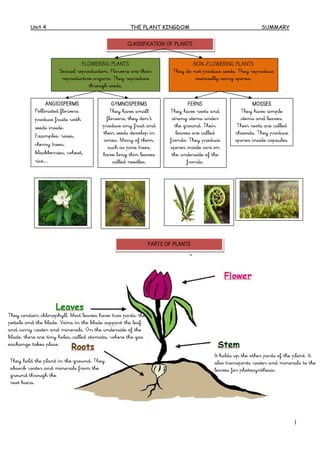
CLASSIFICATION OF PLANTS
FLOWERING PLANTS
Sexual reproduction. Flowers are their
reproductive organs. They reproduce
through seeds.
NON-FLOWERING PLANTS
They do not produce seeds. They reproduce
asexually using spores.
ANGIOSPERMS
Pollinated flowers
produce fruits with
seeds inside.
Examples: roses,
cherry trees,
blackberries, wheat,
rice,…
GYMNOSPERMS
They have small
flowers, they don’t
produce any fruit and
their seeds develop in
cones. Many of them,
such as pine trees,
have long thin leaves
called needles.
FERNS
They have roots and
strong stems under
the ground. Their
leaves are called
fronds. They produce
spores inside sori on
the underside of the
fronds.
MOSSES
They have simple
stems and leaves.
Their roots are called
rhizoids. They produce
spores inside capsules.
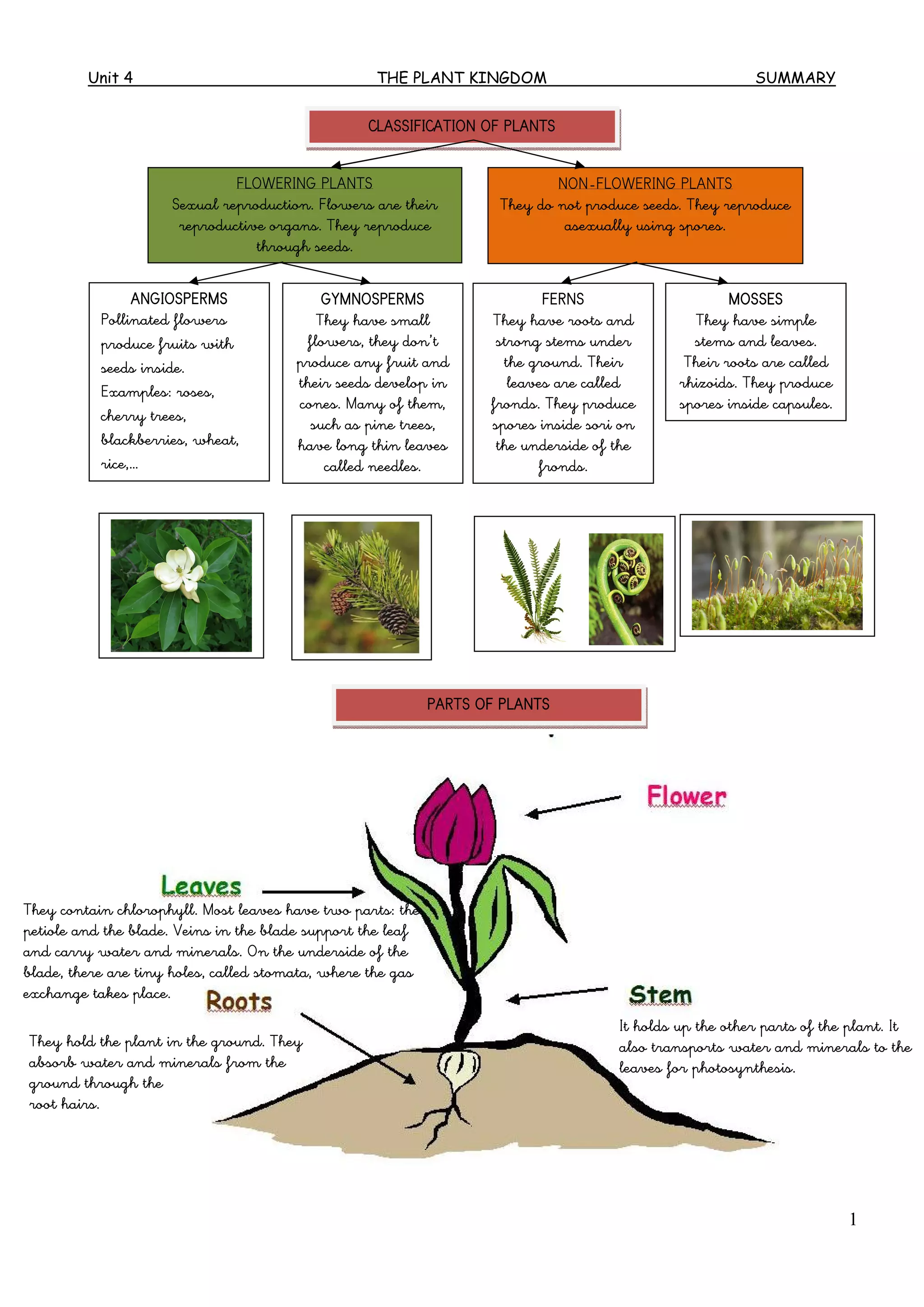
PARTS OF PLANTS
They hold the plant in the ground. They
absorb water and minerals from the
ground through the
root hairs.
It holds up the other parts of the plant. It
also transports water and minerals to the
leaves for photosynthesis.
They contain chlorophyll. Most leaves have two parts: the
petiole and the blade. Veins in the blade support the leaf
and carry water and minerals. On the underside of the
blade, there are tiny holes, called stomata, where the gas
exchange takes place.
Unit 4 THE PLANT KINGDOM SUMMARY
2
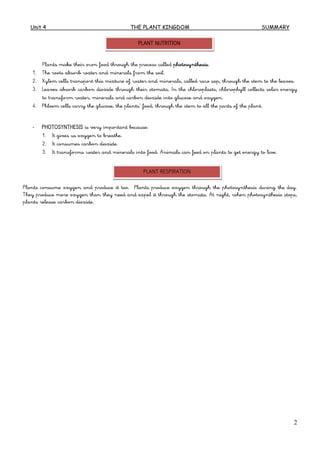
Plants make their own food through the process called photosynthesis.
1. The roots absorb water and minerals from the soil.
2. Xylem cells transport this mixture of water and minerals, called raw sap, through the stem to the leaves.
3. Leaves absorb carbon dioxide through their stomata. In the chloroplasts, chlorophyll collects solar energy
to transform water, minerals and carbon dioxide into glucose and oxygen.
4. Phloem cells carry the glucose, the plants’ food, through the stem to all the parts of the plant.
- PHOTOSYNTHESIS is very important because:
1. It gives us oxygen to breathe.
2. It consumes carbon dioxide.
3. It transforms water and minerals into food. Animals can feed on plants to get energy to live.
Plants consume oxygen and produce it too. Plants produce oxygen through the photosynthesis during the day.
They produce more oxygen than they need and expel it through the stomata. At night, when photosynthesis stops,
plants release carbon dioxide.
PLANT NUTRITION
PLANT RESPIRATION

Unit 4 diagram

  • 1.
    Unit 4 THEPLANT KINGDOM SUMMARY 1 CLASSIFICATION OF PLANTS FLOWERING PLANTS Sexual reproduction. Flowers are their reproductive organs. They reproduce through seeds. NON-FLOWERING PLANTS They do not produce seeds. They reproduce asexually using spores. ANGIOSPERMS Pollinated flowers produce fruits with seeds inside. Examples: roses, cherry trees, blackberries, wheat, rice,… GYMNOSPERMS They have small flowers, they don’t produce any fruit and their seeds develop in cones. Many of them, such as pine trees, have long thin leaves called needles. FERNS They have roots and strong stems under the ground. Their leaves are called fronds. They produce spores inside sori on the underside of the fronds. MOSSES They have simple stems and leaves. Their roots are called rhizoids. They produce spores inside capsules. PARTS OF PLANTS They hold the plant in the ground. They absorb water and minerals from the ground through the root hairs. It holds up the other parts of the plant. It also transports water and minerals to the leaves for photosynthesis. They contain chlorophyll. Most leaves have two parts: the petiole and the blade. Veins in the blade support the leaf and carry water and minerals. On the underside of the blade, there are tiny holes, called stomata, where the gas exchange takes place.
  • 2.
    Unit 4 THEPLANT KINGDOM SUMMARY 2 Plants make their own food through the process called photosynthesis. 1. The roots absorb water and minerals from the soil. 2. Xylem cells transport this mixture of water and minerals, called raw sap, through the stem to the leaves. 3. Leaves absorb carbon dioxide through their stomata. In the chloroplasts, chlorophyll collects solar energy to transform water, minerals and carbon dioxide into glucose and oxygen. 4. Phloem cells carry the glucose, the plants’ food, through the stem to all the parts of the plant. - PHOTOSYNTHESIS is very important because: 1. It gives us oxygen to breathe. 2. It consumes carbon dioxide. 3. It transforms water and minerals into food. Animals can feed on plants to get energy to live. Plants consume oxygen and produce it too. Plants produce oxygen through the photosynthesis during the day. They produce more oxygen than they need and expel it through the stomata. At night, when photosynthesis stops, plants release carbon dioxide. PLANT NUTRITION PLANT RESPIRATION