POLITICS
Unit 7
1. DEMOCRACY AND THE
CONSTITUTION
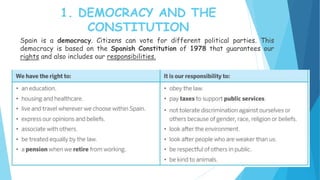
Spain is a democracy. Citizens can vote for different political parties. This
democracy is based on the Spanish Constitution of 1978 that guarantees our
rights and also includes our responsibilities.
Elections in Spain
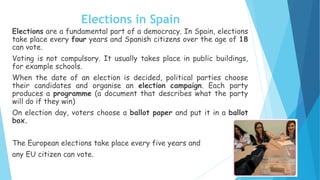
Elections are a fundamental part of a democracy. In Spain, elections
take place every four years and Spanish citizens over the age of 18
can vote.
Voting is not compulsory. It usually takes place in public buildings,
for example schools.
When the date of an election is decided, political parties choose
their candidates and organise an election campaign. Each party
produces a programme (a document that describes what the party
will do if they win)
On election day, voters choose a ballot paper and put it in a ballot
box.
The European elections take place every five years and
any EU citizen can vote.
2.THE SEPARATION OF POWERS
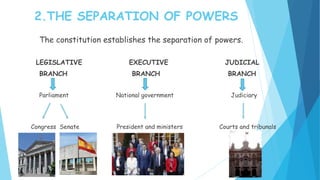
The constitution establishes the separation of powers.
LEGISLATIVE EXECUTIVE JUDICIAL
BRANCH BRANCH BRANCH
Parliament National government Judiciary
Congress Senate President and ministers Courts and tribunals
THE LEGISLATIVE BRANCH
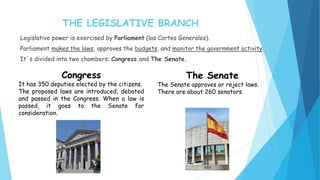
Legislative power is exercised by Parliament (las Cortes Generales).
Parliament makes the laws, approves the budgets, and monitor the government activity.
It`s divided into two chambers: Congress and The Senate.
Congress
It has 350 deputies elected by the citizens.
The proposed laws are introduced, debated
and passed in the Congress. When a law is
passed, it goes to the Senate for
consideration.
The Senate
The Senate approves or reject laws.
There are about 260 senators.
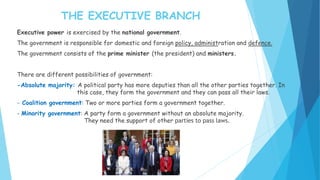
Executive power is exercised by the national government.
The government is responsible for domestic and foreign policy, administration and defence.
The government consists of the prime minister (the president) and ministers.
There are different possibilities of government:
-Absolute majority: A political party has more deputies than all the other parties together. In
this case, they form the government and they can pass all their laws.
- Coalition government: Two or more parties form a government together.
- Minority government: A party form a government without an absolute majority.
They need the support of other parties to pass laws.
THE EXECUTIVE BRANCH
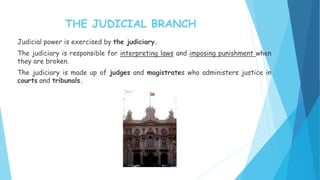
Judicial power is exercised by the judiciary.
The judiciary is responsible for interpreting laws and imposing punishment when
they are broken.
The judiciary is made up of judges and magistrates who administers justice in
courts and tribunals.
THE JUDICIAL BRANCH
3. SPAIN`S ORGANISATION
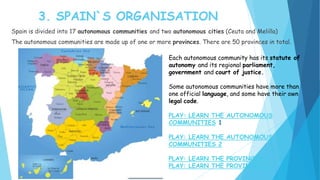
Spain is divided into 17 autonomous communities and two autonomous cities (Ceuta and Melilla)
The autonomous communities are made up of one or more provinces. There are 50 provinces in total.
Each autonomous community has its statute of
autonomy and its regional parliament,
government and court of justice.
Some autonomous communities have more than
one official language, and some have their own
legal code.
PLAY: LEARN THE AUTONOMOUS
COMMUNITIES 1
PLAY: LEARN THE AUTONOMOUS
COMMUNITIES 2
PLAY: LEARN THE PROVINCES 1
PLAY: LEARN THE PROVINCES 2
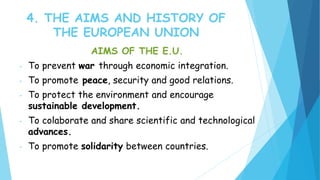
4. THE AIMS AND HISTORY OF
THE EUROPEAN UNION
AIMS OF THE E.U.
- To prevent war through economic integration.
- To promote peace, security and good relations.
- To protect the environment and encourage
sustainable development.
- To colaborate and share scientific and technological
advances.
- To promote solidarity between countries.
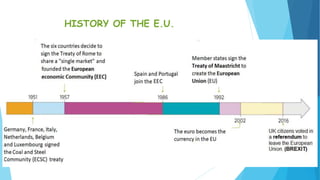
HISTORY OF THE E.U.
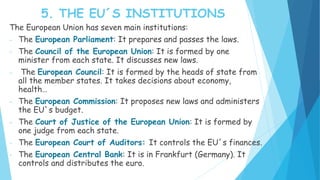
5. THE EU´S INSTITUTIONS
The European Union has seven main institutions:
- The European Parliament: It prepares and passes the laws.
- The Council of the European Union: It is formed by one
minister from each state. It discusses new laws.
- The European Council: It is formed by the heads of state from
all the member states. It takes decisions about economy,
health…
- The European Commission: It proposes new laws and administers
the EU`s budget.
- The Court of Justice of the European Union: It is formed by
one judge from each state.
- The European Court of Auditors: It controls the EU´s finances.
- The European Central Bank: It is in Frankfurt (Germany). It
controls and distributes the euro.
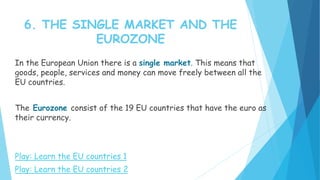
6. THE SINGLE MARKET AND THE
EUROZONE
In the European Union there is a single market. This means that
goods, people, services and money can move freely between all the
EU countries.
The Eurozone consist of the 19 EU countries that have the euro as
their currency.
Play: Learn the EU countries 1
Play: Learn the EU countries 2

Unit 6. politics

  • 1.
  • 2.
    1. DEMOCRACY ANDTHE CONSTITUTION Spain is a democracy. Citizens can vote for different political parties. This democracy is based on the Spanish Constitution of 1978 that guarantees our rights and also includes our responsibilities.
  • 3.
    Elections in Spain Electionsare a fundamental part of a democracy. In Spain, elections take place every four years and Spanish citizens over the age of 18 can vote. Voting is not compulsory. It usually takes place in public buildings, for example schools. When the date of an election is decided, political parties choose their candidates and organise an election campaign. Each party produces a programme (a document that describes what the party will do if they win) On election day, voters choose a ballot paper and put it in a ballot box. The European elections take place every five years and any EU citizen can vote.
  • 4.
    2.THE SEPARATION OFPOWERS The constitution establishes the separation of powers. LEGISLATIVE EXECUTIVE JUDICIAL BRANCH BRANCH BRANCH Parliament National government Judiciary Congress Senate President and ministers Courts and tribunals
  • 5.
    THE LEGISLATIVE BRANCH Legislativepower is exercised by Parliament (las Cortes Generales). Parliament makes the laws, approves the budgets, and monitor the government activity. It`s divided into two chambers: Congress and The Senate. Congress It has 350 deputies elected by the citizens. The proposed laws are introduced, debated and passed in the Congress. When a law is passed, it goes to the Senate for consideration. The Senate The Senate approves or reject laws. There are about 260 senators.
  • 6.
    Executive power isexercised by the national government. The government is responsible for domestic and foreign policy, administration and defence. The government consists of the prime minister (the president) and ministers. There are different possibilities of government: -Absolute majority: A political party has more deputies than all the other parties together. In this case, they form the government and they can pass all their laws. - Coalition government: Two or more parties form a government together. - Minority government: A party form a government without an absolute majority. They need the support of other parties to pass laws. THE EXECUTIVE BRANCH
  • 7.
    Judicial power isexercised by the judiciary. The judiciary is responsible for interpreting laws and imposing punishment when they are broken. The judiciary is made up of judges and magistrates who administers justice in courts and tribunals. THE JUDICIAL BRANCH
  • 8.
    3. SPAIN`S ORGANISATION Spainis divided into 17 autonomous communities and two autonomous cities (Ceuta and Melilla) The autonomous communities are made up of one or more provinces. There are 50 provinces in total. Each autonomous community has its statute of autonomy and its regional parliament, government and court of justice. Some autonomous communities have more than one official language, and some have their own legal code. PLAY: LEARN THE AUTONOMOUS COMMUNITIES 1 PLAY: LEARN THE AUTONOMOUS COMMUNITIES 2 PLAY: LEARN THE PROVINCES 1 PLAY: LEARN THE PROVINCES 2
  • 9.
    4. THE AIMSAND HISTORY OF THE EUROPEAN UNION AIMS OF THE E.U. - To prevent war through economic integration. - To promote peace, security and good relations. - To protect the environment and encourage sustainable development. - To colaborate and share scientific and technological advances. - To promote solidarity between countries.
  • 10.
  • 11.
    5. THE EU´SINSTITUTIONS The European Union has seven main institutions: - The European Parliament: It prepares and passes the laws. - The Council of the European Union: It is formed by one minister from each state. It discusses new laws. - The European Council: It is formed by the heads of state from all the member states. It takes decisions about economy, health… - The European Commission: It proposes new laws and administers the EU`s budget. - The Court of Justice of the European Union: It is formed by one judge from each state. - The European Court of Auditors: It controls the EU´s finances. - The European Central Bank: It is in Frankfurt (Germany). It controls and distributes the euro.
  • 12.
    6. THE SINGLEMARKET AND THE EUROZONE In the European Union there is a single market. This means that goods, people, services and money can move freely between all the EU countries. The Eurozone consist of the 19 EU countries that have the euro as their currency. Play: Learn the EU countries 1 Play: Learn the EU countries 2