Spain today
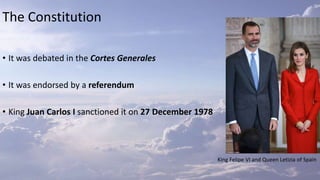
The Constitution
• It was debated in the Cortes Generales
• It was endorsed by a referendum
• King Juan Carlos I sanctioned it on 27 December 1978
King Felipe VI and Queen Letizia of Spain
Government
• Spain is a democratic state and a parliamentary monarchy
• A King – a symbolic Head of State (can’t pass laws and he is
symbolically Commander-in-Chief of the Spanish Armed Forces)
• The Crown is hereditary
Organisation
• 17 Autonomous Communities governed by Statutes of Autonomy
and 2 Autonomous Cities
provinces
• Autonomous Communities
municipalities
Symbols
• The flag
• The coat of arms
• The national anthem (La Marcha Real)
• Castilian Spanish – the official language (other languages are granted
official status in their Autonomous Communities)
Citizens’ rights and responsibilities
RIGHTS
• Equality
• Freedom of speech
• Peaceful protests
• Healthcare and education
• Legal protection
• Freedom to work and travel
• Adequate housing
RESPONSIBILITIES
• Pay taxes
• Respect the law
• Be tolerant towards other
people’s religion, culture,
gender, or race
• Take care of the environment
• Respect public services
Elections
• Right to vote – Spanish citizens over the age of 18
• Elections are held every 4 years (under certain circumstances even
earlier)
• People vote by secret ballot
• Voters take a ballot paper they put a mark next to the political
party they vote for they put the paper in an envelope
The State
• The Constitution sets out 3 powers:
• Legislative
• Executive carried out by different people and held in different institutions
• Judicial
Legislative Power
• Parliament in Spain (Cortes Generales) - represents all Spanish citizens
• It’s divided into 2 legislative chambers – it’s bicameral
The lower chamber: The Congress of Deputies (El Congreso de los Diputados)
The upper chamber: The Senate (El Senado)
• both chambers of Parliament make joint decisions on budgets and controlling
the Executive
The Congress of
Deputies
• The members are called
deputies (diputados)
• They approve and veto
laws
• They belong to different
political parties
• their number depends on
the number of votes they
receive
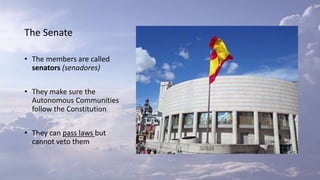
The Senate
• The members are called
senators (senadores)
• They make sure the
Autonomous Communities
follow the Constitution
• They can pass laws but
cannot veto them
Executive Power
• The party that gets the most
votes in the elections forms
the Government
• The members of the Congress
select the Prime minister
the head of the Government
chooses the ministers who will
help him/her
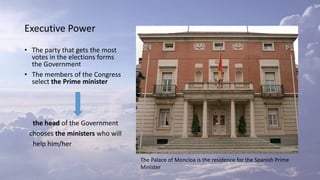
The Palace of Moncloa is the residence for the Spanish Prime
Minister
There are 12 ministries in Spain (they propose ideas that
are voted on in Parliament)
• Health, Social Services and
Equality
• Education, Culture and Sport
• Employment and Social Security
• Economic Affairs and
Competitiveness
• Treasury and Public
Administrations
• Agriculture, Food and
Environmental Affairs
• Defence
• Interior
• Justice
• Public Works
• Industry, Energy and Tourism
• Foreign Affairs and Cooperation
Judicial Power
• It belongs to courts and tribunals
ensure that laws are obeyed
• These are composed of judges and magistrates
• The highest judicial bodies are the Supreme Court (El Tribunal Supremo)
and
the Constitutional Court (El Tribunal Constitucional)
The Supreme Court
• Can accept or reject sentences
passed in the lower courts
• Can start legal proceedings
against ministers, senators and
the Prime Minister if necessary
The Constitutional Court
• Decides whether laws are in
accordance with the Constitution
• Can reject decisions by the Supreme
Court if human rights have been
violated
Thank you for your attention 
Spain today presentation

Spain today presentation

  • 2.
  • 3.
    The Constitution • Itwas debated in the Cortes Generales • It was endorsed by a referendum • King Juan Carlos I sanctioned it on 27 December 1978 King Felipe VI and Queen Letizia of Spain
  • 4.
    Government • Spain isa democratic state and a parliamentary monarchy • A King – a symbolic Head of State (can’t pass laws and he is symbolically Commander-in-Chief of the Spanish Armed Forces) • The Crown is hereditary
  • 5.
    Organisation • 17 AutonomousCommunities governed by Statutes of Autonomy and 2 Autonomous Cities provinces • Autonomous Communities municipalities
  • 6.
    Symbols • The flag •The coat of arms • The national anthem (La Marcha Real) • Castilian Spanish – the official language (other languages are granted official status in their Autonomous Communities)
  • 7.
    Citizens’ rights andresponsibilities RIGHTS • Equality • Freedom of speech • Peaceful protests • Healthcare and education • Legal protection • Freedom to work and travel • Adequate housing RESPONSIBILITIES • Pay taxes • Respect the law • Be tolerant towards other people’s religion, culture, gender, or race • Take care of the environment • Respect public services
  • 8.
    Elections • Right tovote – Spanish citizens over the age of 18 • Elections are held every 4 years (under certain circumstances even earlier) • People vote by secret ballot • Voters take a ballot paper they put a mark next to the political party they vote for they put the paper in an envelope
  • 9.
    The State • TheConstitution sets out 3 powers: • Legislative • Executive carried out by different people and held in different institutions • Judicial
  • 10.
    Legislative Power • Parliamentin Spain (Cortes Generales) - represents all Spanish citizens • It’s divided into 2 legislative chambers – it’s bicameral The lower chamber: The Congress of Deputies (El Congreso de los Diputados) The upper chamber: The Senate (El Senado) • both chambers of Parliament make joint decisions on budgets and controlling the Executive
  • 11.
    The Congress of Deputies •The members are called deputies (diputados) • They approve and veto laws • They belong to different political parties • their number depends on the number of votes they receive
  • 12.
    The Senate • Themembers are called senators (senadores) • They make sure the Autonomous Communities follow the Constitution • They can pass laws but cannot veto them
  • 13.
    Executive Power • Theparty that gets the most votes in the elections forms the Government • The members of the Congress select the Prime minister the head of the Government chooses the ministers who will help him/her The Palace of Moncloa is the residence for the Spanish Prime Minister
  • 14.
    There are 12ministries in Spain (they propose ideas that are voted on in Parliament) • Health, Social Services and Equality • Education, Culture and Sport • Employment and Social Security • Economic Affairs and Competitiveness • Treasury and Public Administrations • Agriculture, Food and Environmental Affairs • Defence • Interior • Justice • Public Works • Industry, Energy and Tourism • Foreign Affairs and Cooperation
  • 15.
    Judicial Power • Itbelongs to courts and tribunals ensure that laws are obeyed • These are composed of judges and magistrates • The highest judicial bodies are the Supreme Court (El Tribunal Supremo) and the Constitutional Court (El Tribunal Constitucional)
  • 16.
    The Supreme Court •Can accept or reject sentences passed in the lower courts • Can start legal proceedings against ministers, senators and the Prime Minister if necessary The Constitutional Court • Decides whether laws are in accordance with the Constitution • Can reject decisions by the Supreme Court if human rights have been violated
  • 17.
    Thank you foryour attention 