UNIT 1.
HOW IS THE SPANISH STATE
ORGANISED?
INITIAL QUESTIONS
• How many Autonomous Communities are
there in Spain?
• How many provinces are there in Spain?
• Do you know the name of some Autonomous
Community with only one province?
• Do you know what is a Constitution?
• When was the current Spanish Constitution
approved?
1. POLITICAL MAP OF SPAIN.
• Spain is a country on the European continent.
• It lies between two large bodies of water: the
Atlantic Ocean and the Mediterranean Sea.
• Most of its territory is located on the Iberian
Peninsula, although it also consists of two
archipelagos (the Islas Canarias and the Islas
Baleares) and two cities in North Africa: Ceuta
and Melilla. Besides, other smaller islands are part of
Spanish territory: the Chafarinas Islands, the Alhucemas
Islands and Alborán Island.
• Spain is organised into 17 Autonomous
Communities and 2 autonomous cities. The
Autonomous Communities are divided into
provinces (50), which are made up of
municipalities.
AUTONOMUS COMMUNITIES
WHY IS THE SPANISH STATE ORGANIZED IN THIS WAY?
 Because of the Spanish Constitution of 1978. It regulates the form of the state and
the main characteristics of the territorial organisation.
 Title VIII: The territorial organization of the State. Principles around which the
territorial organization of Spain is established. Some articles:
– “Artículo 137: El Estado se organiza territorialmente en municipios, en provincias y en las
Comunidades Autónomas que se constituyan […]”.
– “Artículo 139: Todos los españoles tienen los mismos derechos y obligaciones en cualquier
parte del territorio del Estado […]”.
– “Artículo 141: La provincia es una entidad local con personalidad jurídica propia,
determinada por la agrupación de municipios […]”.
– “Artículo 155: Si una Comunidad Autónoma no cumpliere las obligaciones
que la Constitución […], o actuare de forma que atente gravemente al interés
general de España, el Gobierno, previo requerimiento al Presidente de la
Comunidad Autónoma y, en el caso de no ser atendido, con la aprobación por
mayoría absoluta del Senado, podrá adoptar las medidas necesarias para obligar
a aquélla al cumplimiento forzoso de dichas […]”.
LET´S PRACTICE!!!!!!
• Provinces:
• https://mapasinteractivos.didactalia.net/comunidad/mapasfla
shinteractivos/recurso/provincias-de-espaa/108fb9ee-6654-
465a-a9ed-e84be977a27a
• Autonomous Communities:
• https://mapasinteractivos.didactalia.net/comunidad/mapasfla
shinteractivos/recurso/comunidades-autonomas-de-
espaa/9f69dbbf-8dda-4403-b8e1-47d77887b7a6
THE SPANISH CONSTITUTION OF 1978
The Constitution: is the fundamental law of the state, which establishes
its basic principles and laws. In Spain, it was approved in 1978.
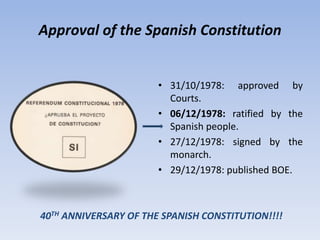
Approval of the Spanish Constitution
• 31/10/1978: approved by
Courts.
• 06/12/1978: ratified by the
Spanish people.
• 27/12/1978: signed by the
monarch.
• 29/12/1978: published BOE.
40TH ANNIVERSARY OF THE SPANISH CONSTITUTION!!!!
BASIC PRINCIPLES
• A SOCIAL AND DEMOCRATIC STATE.
• A PARLIAMENTARY MONARCHY.
• SEPARATION OF POWERS.
• SOVEREIGNTY OF THE PEOPLE.
• A SOCIAL AND DEMOCRATIC STATE
Artículo 1.1: http://www.congreso.es/consti/constitucion/indice/titulos/articulos.jsp?ini=1&fin=9&tipo=2
– There are rights for all the citizens (social). Fundamental laws (from article 14 to
29 and 30.2)
• http://www.congreso.es/consti/constitucion/indice/titulos/articulos.jsp?ini=10&fin=55&tipo=2
– The citizens can vote the governors, who have to respect the laws
or should be subject to the law (democratic).
• A PARLIAMENTARY MONARCHY
Article 1.3: http://www.congreso.es/consti/constitucion/indice/titulos/articulos.jsp?ini=1&fin=9&tipo=2
– The head of the State is the Monarch, Felipe VI: he represents
Spain in international relations. He does not intervene in
government matters.
– The head of the Government is the President of Spain (currently,
Pedro Sánchez).
• Functions of the monarch (article 62):
• http://www.congreso.es/consti/constitucion/indice/titulos/articulos.jsp?ini=56&fin=65&tipo=2
• SEPARATION OF POWERS.
– Legislative power: make laws (Cortes Generales: Congress of
Deputies y Senate).
– Executive power: govern the country according to the laws
(Government). It is made up of the Prime Minister (Mariano
Rajoy) and the ministers.
– Judicial power: enforce laws (judges and magistrates).
• SOVEREIGNTY OF THE PEOPLE
• Articulo 1.2: http://www.congreso.es/consti/constitucion/indice/titulos/articulos.jsp?ini=1&fin=9&tipo=2
– Sovereignty resides in the people, because citizens can elect
their political representatives.
– The elections are held every four years by universal suffrage.
It means that all Spanish people over 18 can vote.
CENTRAL GOVERNMENT
• Is composed of all the institutions that can act throughout
the whole Spain.
• All the central government bodies reside in the capital of
the state: Madrid.
http://www.lamoncloa.gob.es/gobierno/Paginas/index.aspx
AUTONOMOUS AND LOCAL GOVERNMENTS
AUTONOMOUS GOVERNMENT
• 17 Autonomous Communities
and two Autonomous cities.
• Each Autonomous
Community has its own set of
laws: Statute of Autonomy.
• Autonomous Parliament.
LOCAL GOVERNMENT
• Autonomous Communities are
divided into provinces, which are
made up of municipalities.
• Municipalities: cities, towns or
villages. It is governed by the council,
presided by the mayor and made up
od councillors.
• Provinces: there are 50 in Spain. The
institutions that are responsible for
governing are the Provincial Councils.
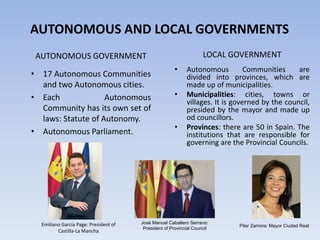
Emiliano García Page: President of
Castilla-La Mancha
José Manuel Caballero Serrano:
President of Provincial Council
Pilar Zamora: Mayor Ciudad Real

Unit 1

  • 1.
    UNIT 1. HOW ISTHE SPANISH STATE ORGANISED?
  • 2.
    INITIAL QUESTIONS • Howmany Autonomous Communities are there in Spain? • How many provinces are there in Spain? • Do you know the name of some Autonomous Community with only one province? • Do you know what is a Constitution? • When was the current Spanish Constitution approved?
  • 3.
  • 4.
    • Spain isa country on the European continent. • It lies between two large bodies of water: the Atlantic Ocean and the Mediterranean Sea. • Most of its territory is located on the Iberian Peninsula, although it also consists of two archipelagos (the Islas Canarias and the Islas Baleares) and two cities in North Africa: Ceuta and Melilla. Besides, other smaller islands are part of Spanish territory: the Chafarinas Islands, the Alhucemas Islands and Alborán Island. • Spain is organised into 17 Autonomous Communities and 2 autonomous cities. The Autonomous Communities are divided into provinces (50), which are made up of municipalities.
  • 5.
  • 6.
    WHY IS THESPANISH STATE ORGANIZED IN THIS WAY?  Because of the Spanish Constitution of 1978. It regulates the form of the state and the main characteristics of the territorial organisation.  Title VIII: The territorial organization of the State. Principles around which the territorial organization of Spain is established. Some articles: – “Artículo 137: El Estado se organiza territorialmente en municipios, en provincias y en las Comunidades Autónomas que se constituyan […]”. – “Artículo 139: Todos los españoles tienen los mismos derechos y obligaciones en cualquier parte del territorio del Estado […]”. – “Artículo 141: La provincia es una entidad local con personalidad jurídica propia, determinada por la agrupación de municipios […]”. – “Artículo 155: Si una Comunidad Autónoma no cumpliere las obligaciones que la Constitución […], o actuare de forma que atente gravemente al interés general de España, el Gobierno, previo requerimiento al Presidente de la Comunidad Autónoma y, en el caso de no ser atendido, con la aprobación por mayoría absoluta del Senado, podrá adoptar las medidas necesarias para obligar a aquélla al cumplimiento forzoso de dichas […]”.
  • 7.
    LET´S PRACTICE!!!!!! • Provinces: •https://mapasinteractivos.didactalia.net/comunidad/mapasfla shinteractivos/recurso/provincias-de-espaa/108fb9ee-6654- 465a-a9ed-e84be977a27a • Autonomous Communities: • https://mapasinteractivos.didactalia.net/comunidad/mapasfla shinteractivos/recurso/comunidades-autonomas-de- espaa/9f69dbbf-8dda-4403-b8e1-47d77887b7a6
  • 8.
    THE SPANISH CONSTITUTIONOF 1978 The Constitution: is the fundamental law of the state, which establishes its basic principles and laws. In Spain, it was approved in 1978.
  • 9.
    Approval of theSpanish Constitution • 31/10/1978: approved by Courts. • 06/12/1978: ratified by the Spanish people. • 27/12/1978: signed by the monarch. • 29/12/1978: published BOE. 40TH ANNIVERSARY OF THE SPANISH CONSTITUTION!!!!
  • 10.
    BASIC PRINCIPLES • ASOCIAL AND DEMOCRATIC STATE. • A PARLIAMENTARY MONARCHY. • SEPARATION OF POWERS. • SOVEREIGNTY OF THE PEOPLE.
  • 11.
    • A SOCIALAND DEMOCRATIC STATE Artículo 1.1: http://www.congreso.es/consti/constitucion/indice/titulos/articulos.jsp?ini=1&fin=9&tipo=2 – There are rights for all the citizens (social). Fundamental laws (from article 14 to 29 and 30.2) • http://www.congreso.es/consti/constitucion/indice/titulos/articulos.jsp?ini=10&fin=55&tipo=2 – The citizens can vote the governors, who have to respect the laws or should be subject to the law (democratic). • A PARLIAMENTARY MONARCHY Article 1.3: http://www.congreso.es/consti/constitucion/indice/titulos/articulos.jsp?ini=1&fin=9&tipo=2 – The head of the State is the Monarch, Felipe VI: he represents Spain in international relations. He does not intervene in government matters. – The head of the Government is the President of Spain (currently, Pedro Sánchez). • Functions of the monarch (article 62): • http://www.congreso.es/consti/constitucion/indice/titulos/articulos.jsp?ini=56&fin=65&tipo=2
  • 12.
    • SEPARATION OFPOWERS. – Legislative power: make laws (Cortes Generales: Congress of Deputies y Senate). – Executive power: govern the country according to the laws (Government). It is made up of the Prime Minister (Mariano Rajoy) and the ministers. – Judicial power: enforce laws (judges and magistrates). • SOVEREIGNTY OF THE PEOPLE • Articulo 1.2: http://www.congreso.es/consti/constitucion/indice/titulos/articulos.jsp?ini=1&fin=9&tipo=2 – Sovereignty resides in the people, because citizens can elect their political representatives. – The elections are held every four years by universal suffrage. It means that all Spanish people over 18 can vote.
  • 13.
    CENTRAL GOVERNMENT • Iscomposed of all the institutions that can act throughout the whole Spain. • All the central government bodies reside in the capital of the state: Madrid. http://www.lamoncloa.gob.es/gobierno/Paginas/index.aspx
  • 14.
    AUTONOMOUS AND LOCALGOVERNMENTS AUTONOMOUS GOVERNMENT • 17 Autonomous Communities and two Autonomous cities. • Each Autonomous Community has its own set of laws: Statute of Autonomy. • Autonomous Parliament. LOCAL GOVERNMENT • Autonomous Communities are divided into provinces, which are made up of municipalities. • Municipalities: cities, towns or villages. It is governed by the council, presided by the mayor and made up od councillors. • Provinces: there are 50 in Spain. The institutions that are responsible for governing are the Provincial Councils. Emiliano García Page: President of Castilla-La Mancha José Manuel Caballero Serrano: President of Provincial Council Pilar Zamora: Mayor Ciudad Real