
UNIT 13.6 CONICSUNIT 13.6 CONICS
FROM EQUATIONSFROM EQUATIONS
Warm Up
Solve by completing the square.
1. x
2
+ 6x = 91
2. 2x
2
+ 8x – 90 = 0
Identify and transform conic functions.
Use the method of completing the
square to identify and graph conic
sections.
Objectives
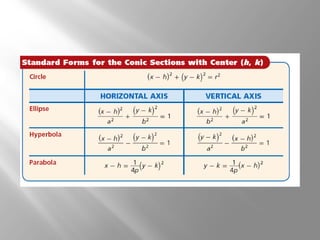
In Lesson 10-2 through 10-5, you learned
about the four conic sections. Recall the
equations of conic sections in standard form.
In these forms, the characteristics of the conic
sections can be identified.
Identify the conic section that each equation
represents.
Example 1: Identifying Conic Sections in Standard
Form
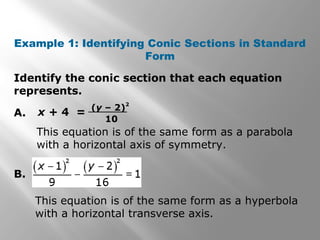
A.
This equation is of the same form as a parabola
with a horizontal axis of symmetry.
x + 4 = (y – 2)
2
10
B.
This equation is of the same form as a hyperbola
with a horizontal transverse axis.
Identify the conic section that each equation
represents.
Example 1: Identifying Conic Sections in Standard
Form
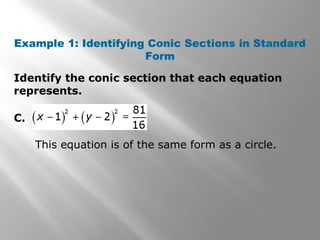
This equation is of the same form as a circle.
C.
Identify the conic section that each equation
represents.
Check It Out! Example 1
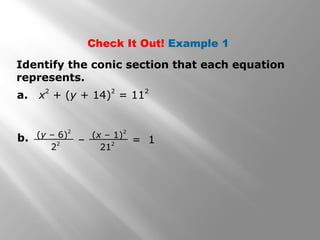
a. x
2
+ (y + 14)
2
= 11
2
– = 1
(y – 6)
2
2
2
(x – 1)
2
21
2
b.
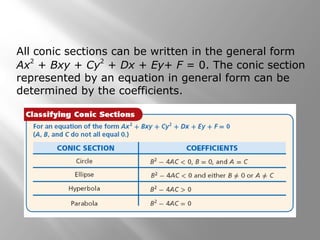
All conic sections can be written in the general form
Ax
2
+ Bxy + Cy
2
+ Dx + Ey+ F = 0. The conic section
represented by an equation in general form can be
determined by the coefficients.
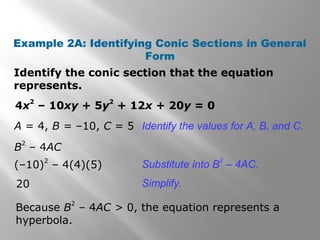
Identify the conic section that the equation
represents.
Example 2A: Identifying Conic Sections in General
Form
20
Identify the values for A, B, and C.
4x
2
– 10xy + 5y
2
+ 12x + 20y = 0
A = 4, B = –10, C = 5
B
2
– 4AC
Substitute into B
2
– 4AC.(–10)
2
– 4(4)(5)
Simplify.
Because B
2
– 4AC > 0, the equation represents a
hyperbola.
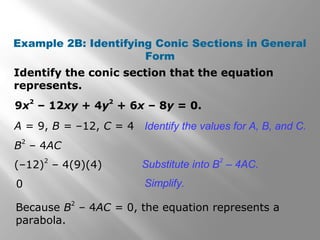
Identify the conic section that the equation
represents.
Example 2B: Identifying Conic Sections in General
Form
0
Identify the values for A, B, and C.
9x
2
– 12xy + 4y
2
+ 6x – 8y = 0.
A = 9, B = –12, C = 4
B
2
– 4AC
Substitute into B
2
– 4AC.(–12)
2
– 4(9)(4)
Simplify.
Because B
2
– 4AC = 0, the equation represents a
parabola.
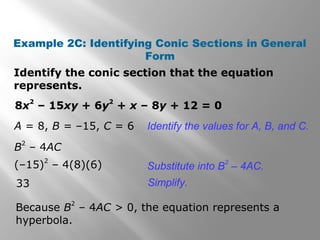
Identify the conic section that the equation
represents.
Example 2C: Identifying Conic Sections in General
Form
33
Identify the values for A, B, and C.
8x
2
– 15xy + 6y
2
+ x – 8y + 12 = 0
A = 8, B = –15, C = 6
B
2
– 4AC
Substitute into B
2
– 4AC.(–15)
2
– 4(8)(6)
Simplify.
Because B
2
– 4AC > 0, the equation represents a
hyperbola.
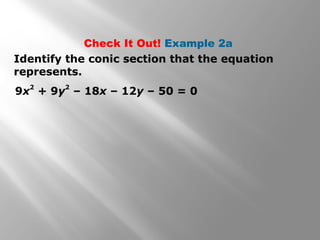
Identify the conic section that the equation
represents.
9x
2
+ 9y
2
– 18x – 12y – 50 = 0
Check It Out! Example 2a
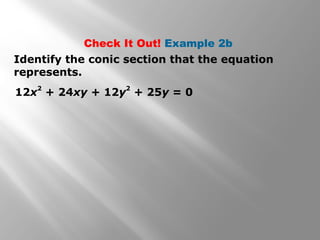
Identify the conic section that the equation
represents.
12x
2
+ 24xy + 12y
2
+ 25y = 0
Check It Out! Example 2b
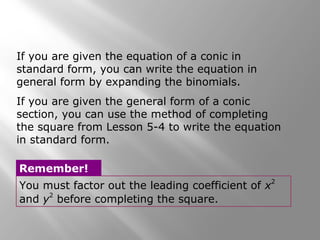
You must factor out the leading coefficient of x
2
and y
2
before completing the square.
Remember!
If you are given the equation of a conic in
standard form, you can write the equation in
general form by expanding the binomials.
If you are given the general form of a conic
section, you can use the method of completing
the square from Lesson 5-4 to write the equation
in standard form.
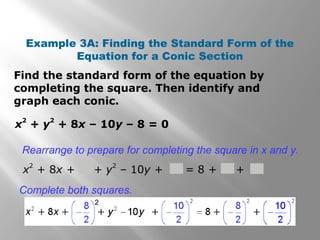
Find the standard form of the equation by
completing the square. Then identify and
graph each conic.
Example 3A: Finding the Standard Form of the
Equation for a Conic Section
Rearrange to prepare for completing the square in x and y.
x
2
+ y
2
+ 8x – 10y – 8 = 0
x
2
+ 8x + + y
2
– 10y + = 8 + +
Complete both squares.
2
Example 3A Continued
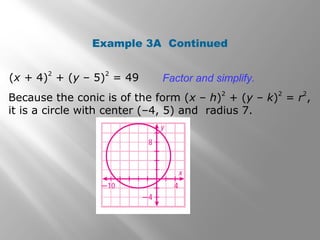
(x + 4)
2
+ (y – 5)
2
= 49 Factor and simplify.
Because the conic is of the form (x – h)
2
+ (y – k)
2
= r
2
,
it is a circle with center (–4, 5) and radius 7.
Example 3B: Finding the Standard Form of the
Equation for a Conic Section
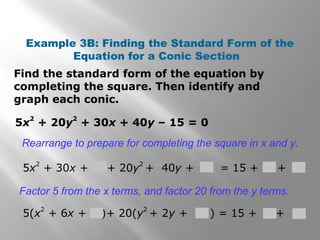
Rearrange to prepare for completing the square in x and y.
5x
2
+ 20y
2
+ 30x + 40y – 15 = 0
5x
2
+ 30x + + 20y
2
+ 40y + = 15 + +
Factor 5 from the x terms, and factor 20 from the y terms.
5(x2
+ 6x + )+ 20(y2
+ 2y + ) = 15 + +
Find the standard form of the equation by
completing the square. Then identify and
graph each conic.
Example 3B Continued
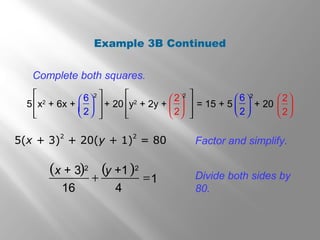
Complete both squares.
5(x + 3)
2
+ 20(y + 1)
2
= 80 Factor and simplify.
Divide both sides by
80.
6
5 x2
+ 6x + + 20 y2
+ 2y + = 15 + 5 + 20
2
2
2
2
 















6
2









2
2






2 2



( ) ( )
1
16 4
x + 3 2
y +1 2
+ =
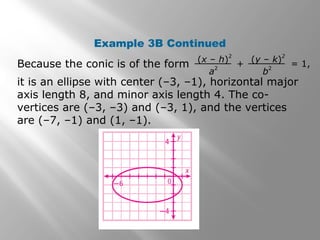
Because the conic is of the form (x – h)
2
a
2
+ = 1,(y – k)
2
b
2
it is an ellipse with center (–3, –1), horizontal major
axis length 8, and minor axis length 4. The co-
vertices are (–3, –3) and (–3, 1), and the vertices
are (–7, –1) and (1, –1).
Example 3B Continued
Find the standard form of the equation by
completing the square. Then identify and
graph each conic.
y
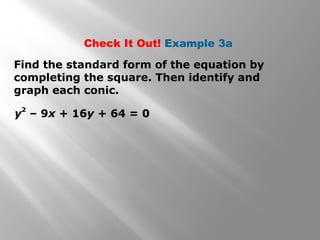
2
– 9x + 16y + 64 = 0
Check It Out! Example 3a
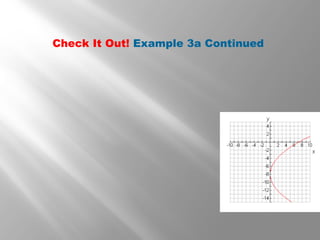
Check It Out! Example 3a Continued
16x
2
+ 9y
2
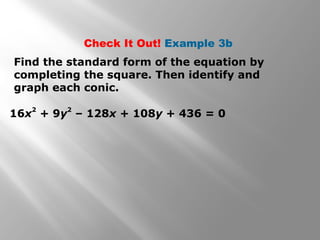
– 128x + 108y + 436 = 0
Check It Out! Example 3b
Find the standard form of the equation by
completing the square. Then identify and
graph each conic.
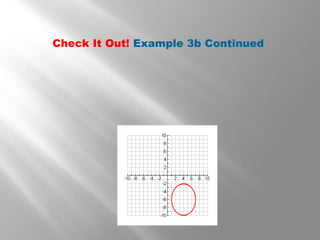
Check It Out! Example 3b Continued
All rights belong to their respective owners.
Copyright Disclaimer Under Section 107 of
the Copyright Act 1976, allowance is made
for "fair use" for purposes such as criticism,
comment, news reporting, TEACHING,
scholarship, and research.
Fair use is a use permitted by copyright
statute that might otherwise be infringing.
Non-profit, EDUCATIONAL or personal use
tips the balance in favor of fair use.

Unit 13.6

  • 1.
    UNIT 13.6 CONICSUNIT13.6 CONICS FROM EQUATIONSFROM EQUATIONS
  • 2.
    Warm Up Solve bycompleting the square. 1. x 2 + 6x = 91 2. 2x 2 + 8x – 90 = 0
  • 3.
    Identify and transformconic functions. Use the method of completing the square to identify and graph conic sections. Objectives
  • 4.
    In Lesson 10-2through 10-5, you learned about the four conic sections. Recall the equations of conic sections in standard form. In these forms, the characteristics of the conic sections can be identified.
  • 6.
    Identify the conicsection that each equation represents. Example 1: Identifying Conic Sections in Standard Form A. This equation is of the same form as a parabola with a horizontal axis of symmetry. x + 4 = (y – 2) 2 10 B. This equation is of the same form as a hyperbola with a horizontal transverse axis.
  • 7.
    Identify the conicsection that each equation represents. Example 1: Identifying Conic Sections in Standard Form This equation is of the same form as a circle. C.
  • 8.
    Identify the conicsection that each equation represents. Check It Out! Example 1 a. x 2 + (y + 14) 2 = 11 2 – = 1 (y – 6) 2 2 2 (x – 1) 2 21 2 b.
  • 9.
    All conic sectionscan be written in the general form Ax 2 + Bxy + Cy 2 + Dx + Ey+ F = 0. The conic section represented by an equation in general form can be determined by the coefficients.
  • 10.
    Identify the conicsection that the equation represents. Example 2A: Identifying Conic Sections in General Form 20 Identify the values for A, B, and C. 4x 2 – 10xy + 5y 2 + 12x + 20y = 0 A = 4, B = –10, C = 5 B 2 – 4AC Substitute into B 2 – 4AC.(–10) 2 – 4(4)(5) Simplify. Because B 2 – 4AC > 0, the equation represents a hyperbola.
  • 11.
    Identify the conicsection that the equation represents. Example 2B: Identifying Conic Sections in General Form 0 Identify the values for A, B, and C. 9x 2 – 12xy + 4y 2 + 6x – 8y = 0. A = 9, B = –12, C = 4 B 2 – 4AC Substitute into B 2 – 4AC.(–12) 2 – 4(9)(4) Simplify. Because B 2 – 4AC = 0, the equation represents a parabola.
  • 12.
    Identify the conicsection that the equation represents. Example 2C: Identifying Conic Sections in General Form 33 Identify the values for A, B, and C. 8x 2 – 15xy + 6y 2 + x – 8y + 12 = 0 A = 8, B = –15, C = 6 B 2 – 4AC Substitute into B 2 – 4AC.(–15) 2 – 4(8)(6) Simplify. Because B 2 – 4AC > 0, the equation represents a hyperbola.
  • 13.
    Identify the conicsection that the equation represents. 9x 2 + 9y 2 – 18x – 12y – 50 = 0 Check It Out! Example 2a
  • 14.
    Identify the conicsection that the equation represents. 12x 2 + 24xy + 12y 2 + 25y = 0 Check It Out! Example 2b
  • 15.
    You must factorout the leading coefficient of x 2 and y 2 before completing the square. Remember! If you are given the equation of a conic in standard form, you can write the equation in general form by expanding the binomials. If you are given the general form of a conic section, you can use the method of completing the square from Lesson 5-4 to write the equation in standard form.
  • 16.
    Find the standardform of the equation by completing the square. Then identify and graph each conic. Example 3A: Finding the Standard Form of the Equation for a Conic Section Rearrange to prepare for completing the square in x and y. x 2 + y 2 + 8x – 10y – 8 = 0 x 2 + 8x + + y 2 – 10y + = 8 + + Complete both squares. 2
  • 17.
    Example 3A Continued (x+ 4) 2 + (y – 5) 2 = 49 Factor and simplify. Because the conic is of the form (x – h) 2 + (y – k) 2 = r 2 , it is a circle with center (–4, 5) and radius 7.
  • 18.
    Example 3B: Findingthe Standard Form of the Equation for a Conic Section Rearrange to prepare for completing the square in x and y. 5x 2 + 20y 2 + 30x + 40y – 15 = 0 5x 2 + 30x + + 20y 2 + 40y + = 15 + + Factor 5 from the x terms, and factor 20 from the y terms. 5(x2 + 6x + )+ 20(y2 + 2y + ) = 15 + + Find the standard form of the equation by completing the square. Then identify and graph each conic.
  • 19.
    Example 3B Continued Completeboth squares. 5(x + 3) 2 + 20(y + 1) 2 = 80 Factor and simplify. Divide both sides by 80. 6 5 x2 + 6x + + 20 y2 + 2y + = 15 + 5 + 20 2 2 2 2                  6 2          2 2       2 2    ( ) ( ) 1 16 4 x + 3 2 y +1 2 + =
  • 20.
    Because the conicis of the form (x – h) 2 a 2 + = 1,(y – k) 2 b 2 it is an ellipse with center (–3, –1), horizontal major axis length 8, and minor axis length 4. The co- vertices are (–3, –3) and (–3, 1), and the vertices are (–7, –1) and (1, –1). Example 3B Continued
  • 21.
    Find the standardform of the equation by completing the square. Then identify and graph each conic. y 2 – 9x + 16y + 64 = 0 Check It Out! Example 3a
  • 22.
    Check It Out!Example 3a Continued
  • 23.
    16x 2 + 9y 2 – 128x+ 108y + 436 = 0 Check It Out! Example 3b Find the standard form of the equation by completing the square. Then identify and graph each conic.
  • 24.
    Check It Out!Example 3b Continued
  • 25.
    All rights belongto their respective owners. Copyright Disclaimer Under Section 107 of the Copyright Act 1976, allowance is made for "fair use" for purposes such as criticism, comment, news reporting, TEACHING, scholarship, and research. Fair use is a use permitted by copyright statute that might otherwise be infringing. Non-profit, EDUCATIONAL or personal use tips the balance in favor of fair use.