

RESEARCH METHOD
  Qualitative Research


       Dr Ahmad Faisal
RESEARCH METHOD
      Qualitative Research


   Expected Learning Outcome


Able to conduct further research on
        qualitative research
re-search / rē, sərCH/
Noun: The systematic investigation into and study of
materials and sources in order to establish facts and reach
new conclusions.
Verb: Investigate systematically.

Synonyms:
noun. investigation - exploration - search - study – inquiry
verb. explore - investigate - search - study - inquire
Research METHOD


"Research methods are the particular strategies
researchers use to collect the evidence necessary for
building and testing theories" Frey, Botan, Friedman, & Kreps (1991)
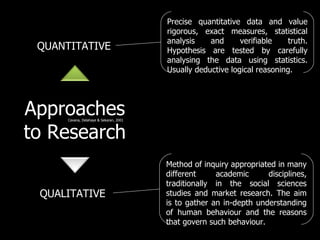
Precise quantitative data and value
                                         rigorous, exact measures, statistical
                                         analysis    and      verifiable   truth.
 QUANTITATIVE                            Hypothesis are tested by carefully
                                         analysing the data using statistics.
                                         Usually deductive logical reasoning.


Approaches
      Cavana, Delahaye & Sekaran, 2001


to Research
                                         Method of inquiry appropriated in many
                                         different     academic      disciplines,
                                         traditionally in the social sciences
 QUALITATIVE                             studies and market research. The aim
                                         is to gather an in-depth understanding
                                         of human behaviour and the reasons
                                         that govern such behaviour.
why we go through this?


want to make sense of a particular
            situation
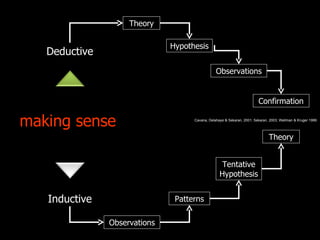
Theory

                              Hypothesis
   Deductive
                                                Observations


                                                                        Confirmation

making sense                        Cavana, Delahaye & Sekaran, 2001; Sekaran, 2003; Wellman & Kruger 1999


                                                                              Theory


                                                   Tentative
                                                  Hypothesis


   Inductive                   Patterns

               Observations
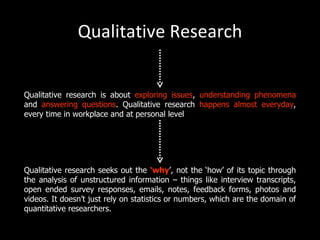
Qualitative Research


Qualitative research is about exploring issues, understanding phenomena
and answering questions. Qualitative research happens almost everyday,
every time in workplace and at personal level


Qualitative research seeks out the ‘why’, not the ‘how’ of its topic through
the analysis of unstructured information – things like interview transcripts,
open ended survey responses, emails, notes, feedback forms, photos and
videos. It doesn’t just rely on statistics or numbers, which are the domain of
quantitative researchers.
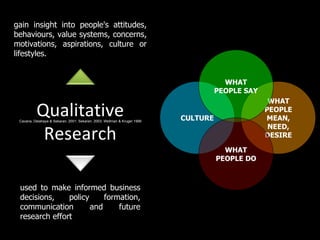
gain insight into people's attitudes,
behaviours, value systems, concerns,
motivations, aspirations, culture or
lifestyles.


                                                                                      WHAT
                                                                                    PEOPLE SAY
                                                                                                  WHAT
          Qualitative
 Cavana, Delahaye & Sekaran, 2001; Sekaran, 2003; Wellman & Kruger 1999
                                                                          CULTURE
                                                                                                 PEOPLE
                                                                                                 MEAN,

           Research
                                                                                                  NEED,
                                                                                                 DESIRE

                                                                                      WHAT
                                                                                    PEOPLE DO


 used to make informed business
 decisions,    policy     formation,
 communication        and     future
 research effort
Qualitative research


   Characteristics
  Cavana, Delahaye & Sekaran, 2001; Sekaran, 2003; Wellman & Kruger 1999
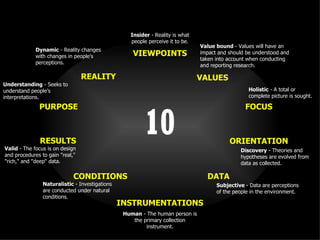
Insider - Reality is what
                                                   people perceive it to be.
                                                                               Value bound - Values will have an
             Dynamic - Reality changes
             with changes in people’s               VIEWPOINTS                 impact and should be understood and
                                                                               taken into account when conducting
             perceptions.
                                                                               and reporting research.

                                 REALITY                                       VALUES
Understanding - Seeks to
understand people’s                                                                               Holistic - A total or
interpretations.                                                                                  complete picture is sought.


                                                        10
              PURPOSE                                                                           FOCUS


              RESULTS                                                                     ORIENTATION
Valid - The focus is on design                                                                Discovery - Theories and
and procedures to gain "real,"                                                                hypotheses are evolved from
"rich," and "deep" data.                                                                      data as collected.

                             CONDITIONS                                          DATA
                Naturalistic - Investigations                                        Subjective - Data are perceptions
                are conducted under natural                                          of the people in the environment.
                conditions.
                                                INSTRUMENTATIONS
                                                 Human - The human person is
                                                    the primary collection
                                                         instrument.
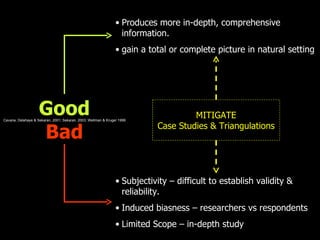
• Produces more in-depth, comprehensive
                                                                  information.
                                                                • gain a total or complete picture in natural setting


                    Good
Cavana, Delahaye & Sekaran, 2001; Sekaran, 2003; Wellman & Kruger 1999
                                                                                    MITIGATE

                    Bad                                                    Case Studies & Triangulations


                                                                • Subjectivity – difficult to establish validity &
                                                                  reliability.
                                                                • Induced biasness – researchers vs respondents
                                                                • Limited Scope – in-depth study
CASE & CASE STUDIES
     Research Context
Case: the term given in SPSS to a particular
respondent to a questionnaire or interview.
                             (Cavana, Delahaye & Sekaran, 2001)


A Case: is a description of an actual situation,
commonly involving a decision, a challenge, an
opportunity, a problem or an issue faced by a person
or persons in an organisation.  (Leenders, Muaffette-Leenders & Erskine, 2001; Ellet, 2007)
Case Study: a comprehensive description and analysis
of a single situation or case – e.g. a detailed study of
an individual, group or organisation.   (Cavana, Delahaye & Sekaran, 2001)


The term Case study pertains to the fact that a
limited number of units of analysis (often only one),
such as individual, a group or an organisation, are
studied intensively.                              (Wellman & Kruger, 1999)
When to use case studies
Cavana, Delahaye & Sekaran, 2001; Sekaran, 2003; Wellman & Kruger 1999


Case studies, are directed towards understanding the
uniqueness and the idiosyncrasy of a particular case
in all its complexity


Objective: to investigate the dynamics of some single
bounded system, such as social system of a family, an
organisation, a community, a group or participants in
a project.
triangulation
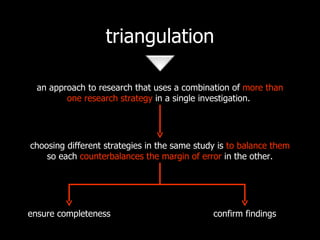
triangulation

  an approach to research that uses a combination of more than
         one research strategy in a single investigation.


choosing different strategies in the same study is to balance them
    so each counterbalances the margin of error in the other.


ensure completeness                           confirm findings
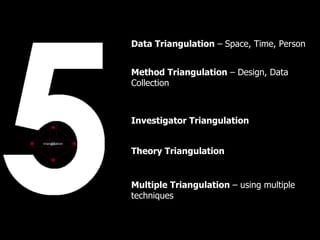
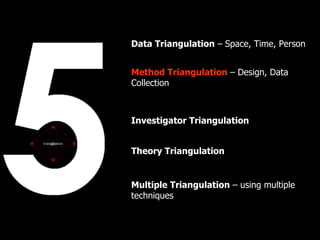
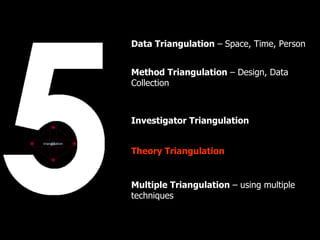
Data Triangulation – Space, Time, Person


                Method Triangulation – Design, Data
                Collection


                Investigator Triangulation

triangulation

                Theory Triangulation


                Multiple Triangulation – using multiple
                techniques
Data
           Triangulation


time triangulation, researchers collect data
about a phenomenon at different points in
                    time.
Data
            Triangulation


space triangulation consists of collecting data
           at more than one site.
Data
           Triangulation


person triangulation collect data from more
 than one level of person, that is, a set of
    individuals, groups, or collectives.
Data Triangulation – Space, Time, Person


                Method Triangulation – Design, Data
                Collection


                Investigator Triangulation

triangulation

                Theory Triangulation


                Multiple Triangulation – using multiple
                techniques
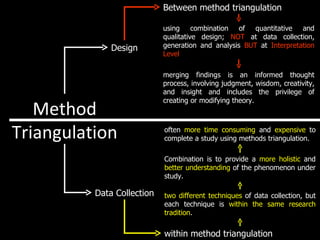
Between method triangulation

                            using combination of quantitative and
                            qualitative design; NOT at data collection,
              Design        generation and analysis BUT at Interpretation
                            Level

                            merging findings is an informed thought
                            process, involving judgment, wisdom, creativity,
                            and insight and includes the privilege of
                            creating or modifying theory.
   Method
Triangulation               often more time consuming and expensive to
                            complete a study using methods triangulation.

                            Combination is to provide a more holistic and
                            better understanding of the phenomenon under
                            study.

          Data Collection   two different techniques of data collection, but
                            each technique is within the same research
                            tradition.


                            within method triangulation
Data Triangulation – Space, Time, Person


                Method Triangulation – Design, Data
                Collection


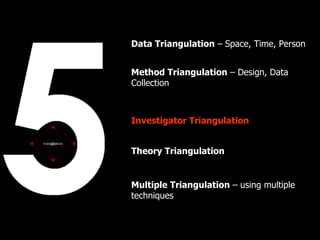
                Investigator Triangulation

triangulation

                Theory Triangulation


                Multiple Triangulation – using multiple
                techniques
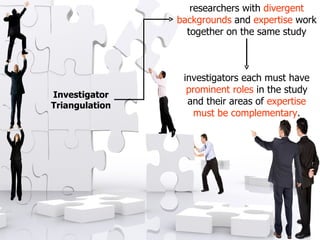
researchers with divergent
                backgrounds and expertise work
                  together on the same study


                 investigators each must have
                  prominent roles in the study
Investigator
Triangulation     and their areas of expertise
                    must be complementary.
Data Triangulation – Space, Time, Person


                Method Triangulation – Design, Data
                Collection


                Investigator Triangulation

triangulation

                Theory Triangulation


                Multiple Triangulation – using multiple
                techniques
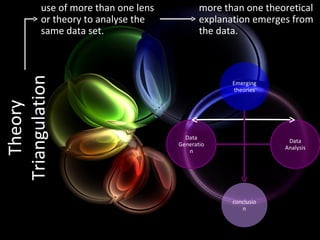
use of more than one lens          more than one theoretical
          or theory to analyse the           explanation emerges from
          same data set.                     the data.
Triangulation

                                                    Emerging
                                                    theories
   Theory


                                        Data
                                                                 Data
                                      Generatio
                                                                Analysis
                                         n


                                                    conclusio
                                                       n
why do we go through case
 studies and triangulation
ensure                   confirm
completeness                findings


          trustworthiness


               
               criteria
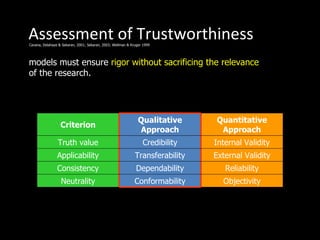
Assessment of Trustworthiness
Cavana, Delahaye & Sekaran, 2001; Sekaran, 2003; Wellman & Kruger 1999


models must ensure rigor without sacrificing the relevance
of the research.


                                                               Qualitative     Quantitative
                  Criterion
                                                               Approach         Approach
                Truth value                                      Credibility   Internal Validity
                Applicability                                Transferability   External Validity
                Consistency                                   Dependability       Reliability
                  Neutrality                                 Conformability      Objectivity
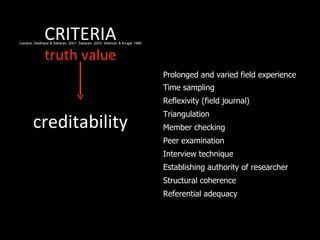
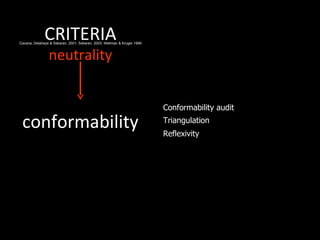
CRITERIA
Cavana, Delahaye & Sekaran, 2001; Sekaran, 2003; Wellman & Kruger 1999


              truth value
                                                                         Prolonged and varied field experience
                                                                         Time sampling
                                                                         Reflexivity (field journal)
                                                                         Triangulation
       creditability                                                     Member checking
                                                                         Peer examination
                                                                         Interview technique
                                                                         Establishing authority of researcher
                                                                         Structural coherence
                                                                         Referential adequacy
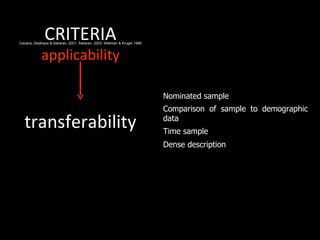
CRITERIA
Cavana, Delahaye & Sekaran, 2001; Sekaran, 2003; Wellman & Kruger 1999


            applicability

                                                                         Nominated sample
                                                                         Comparison of sample to demographic

  transferability                                                        data
                                                                         Time sample
                                                                         Dense description
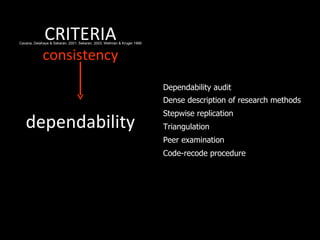
CRITERIA
Cavana, Delahaye & Sekaran, 2001; Sekaran, 2003; Wellman & Kruger 1999


             consistency
                                                                         Dependability audit
                                                                         Dense description of research methods
                                                                         Stepwise replication
   dependability                                                         Triangulation
                                                                         Peer examination
                                                                         Code-recode procedure
CRITERIA
Cavana, Delahaye & Sekaran, 2001; Sekaran, 2003; Wellman & Kruger 1999


                neutrality


                                                                         Conformability audit

 conformability                                                          Triangulation
                                                                         Reflexivity
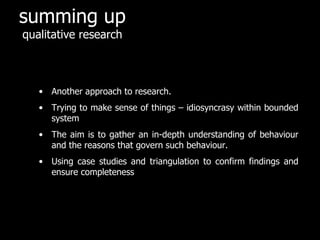
summing up
qualitative research


   • Another approach to research.
   • Trying to make sense of things – idiosyncrasy within bounded
     system
   • The aim is to gather an in-depth understanding of behaviour
     and the reasons that govern such behaviour.
   • Using case studies and triangulation to confirm findings and
     ensure completeness
RESEARCH METHOD
  Qualitative Research


        Thank You

Qualitative Research

  • 1.
    RESEARCH METHOD Qualitative Research Dr Ahmad Faisal
  • 2.
    RESEARCH METHOD Qualitative Research Expected Learning Outcome Able to conduct further research on qualitative research
  • 3.
    re-search / rē,sərCH/ Noun: The systematic investigation into and study of materials and sources in order to establish facts and reach new conclusions. Verb: Investigate systematically. Synonyms: noun. investigation - exploration - search - study – inquiry verb. explore - investigate - search - study - inquire
  • 4.
    Research METHOD "Research methodsare the particular strategies researchers use to collect the evidence necessary for building and testing theories" Frey, Botan, Friedman, & Kreps (1991)
  • 5.
    Precise quantitative dataand value rigorous, exact measures, statistical analysis and verifiable truth. QUANTITATIVE Hypothesis are tested by carefully analysing the data using statistics. Usually deductive logical reasoning. Approaches Cavana, Delahaye & Sekaran, 2001 to Research Method of inquiry appropriated in many different academic disciplines, traditionally in the social sciences QUALITATIVE studies and market research. The aim is to gather an in-depth understanding of human behaviour and the reasons that govern such behaviour.
  • 6.
    why we gothrough this? want to make sense of a particular situation
  • 7.
    Theory Hypothesis Deductive Observations Confirmation making sense Cavana, Delahaye & Sekaran, 2001; Sekaran, 2003; Wellman & Kruger 1999 Theory Tentative Hypothesis Inductive Patterns Observations
  • 8.
    Qualitative Research Qualitative researchis about exploring issues, understanding phenomena and answering questions. Qualitative research happens almost everyday, every time in workplace and at personal level Qualitative research seeks out the ‘why’, not the ‘how’ of its topic through the analysis of unstructured information – things like interview transcripts, open ended survey responses, emails, notes, feedback forms, photos and videos. It doesn’t just rely on statistics or numbers, which are the domain of quantitative researchers.
  • 9.
    gain insight intopeople's attitudes, behaviours, value systems, concerns, motivations, aspirations, culture or lifestyles. WHAT PEOPLE SAY WHAT Qualitative Cavana, Delahaye & Sekaran, 2001; Sekaran, 2003; Wellman & Kruger 1999 CULTURE PEOPLE MEAN, Research NEED, DESIRE WHAT PEOPLE DO used to make informed business decisions, policy formation, communication and future research effort
  • 10.
    Qualitative research Characteristics Cavana, Delahaye & Sekaran, 2001; Sekaran, 2003; Wellman & Kruger 1999
  • 11.
    Insider - Realityis what people perceive it to be. Value bound - Values will have an Dynamic - Reality changes with changes in people’s VIEWPOINTS impact and should be understood and taken into account when conducting perceptions. and reporting research. REALITY VALUES Understanding - Seeks to understand people’s Holistic - A total or interpretations. complete picture is sought. 10 PURPOSE FOCUS RESULTS ORIENTATION Valid - The focus is on design Discovery - Theories and and procedures to gain "real," hypotheses are evolved from "rich," and "deep" data. data as collected. CONDITIONS DATA Naturalistic - Investigations Subjective - Data are perceptions are conducted under natural of the people in the environment. conditions. INSTRUMENTATIONS Human - The human person is the primary collection instrument.
  • 12.
    • Produces morein-depth, comprehensive information. • gain a total or complete picture in natural setting Good Cavana, Delahaye & Sekaran, 2001; Sekaran, 2003; Wellman & Kruger 1999 MITIGATE Bad Case Studies & Triangulations • Subjectivity – difficult to establish validity & reliability. • Induced biasness – researchers vs respondents • Limited Scope – in-depth study
  • 13.
    CASE & CASESTUDIES Research Context
  • 14.
    Case: the termgiven in SPSS to a particular respondent to a questionnaire or interview. (Cavana, Delahaye & Sekaran, 2001) A Case: is a description of an actual situation, commonly involving a decision, a challenge, an opportunity, a problem or an issue faced by a person or persons in an organisation. (Leenders, Muaffette-Leenders & Erskine, 2001; Ellet, 2007)
  • 15.
    Case Study: acomprehensive description and analysis of a single situation or case – e.g. a detailed study of an individual, group or organisation. (Cavana, Delahaye & Sekaran, 2001) The term Case study pertains to the fact that a limited number of units of analysis (often only one), such as individual, a group or an organisation, are studied intensively. (Wellman & Kruger, 1999)
  • 16.
    When to usecase studies Cavana, Delahaye & Sekaran, 2001; Sekaran, 2003; Wellman & Kruger 1999 Case studies, are directed towards understanding the uniqueness and the idiosyncrasy of a particular case in all its complexity Objective: to investigate the dynamics of some single bounded system, such as social system of a family, an organisation, a community, a group or participants in a project.
  • 17.
  • 18.
    triangulation anapproach to research that uses a combination of more than one research strategy in a single investigation. choosing different strategies in the same study is to balance them so each counterbalances the margin of error in the other. ensure completeness confirm findings
  • 19.
    Data Triangulation –Space, Time, Person Method Triangulation – Design, Data Collection Investigator Triangulation triangulation Theory Triangulation Multiple Triangulation – using multiple techniques
  • 20.
    Data Triangulation time triangulation, researchers collect data about a phenomenon at different points in time.
  • 21.
    Data Triangulation space triangulation consists of collecting data at more than one site.
  • 22.
    Data Triangulation person triangulation collect data from more than one level of person, that is, a set of individuals, groups, or collectives.
  • 23.
    Data Triangulation –Space, Time, Person Method Triangulation – Design, Data Collection Investigator Triangulation triangulation Theory Triangulation Multiple Triangulation – using multiple techniques
  • 24.
    Between method triangulation using combination of quantitative and qualitative design; NOT at data collection, Design generation and analysis BUT at Interpretation Level merging findings is an informed thought process, involving judgment, wisdom, creativity, and insight and includes the privilege of creating or modifying theory. Method Triangulation often more time consuming and expensive to complete a study using methods triangulation. Combination is to provide a more holistic and better understanding of the phenomenon under study. Data Collection two different techniques of data collection, but each technique is within the same research tradition. within method triangulation
  • 25.
    Data Triangulation –Space, Time, Person Method Triangulation – Design, Data Collection Investigator Triangulation triangulation Theory Triangulation Multiple Triangulation – using multiple techniques
  • 26.
    researchers with divergent backgrounds and expertise work together on the same study investigators each must have prominent roles in the study Investigator Triangulation and their areas of expertise must be complementary.
  • 27.
    Data Triangulation –Space, Time, Person Method Triangulation – Design, Data Collection Investigator Triangulation triangulation Theory Triangulation Multiple Triangulation – using multiple techniques
  • 28.
    use of morethan one lens more than one theoretical or theory to analyse the explanation emerges from same data set. the data. Triangulation Emerging theories Theory Data Data Generatio Analysis n conclusio n
  • 29.
    why do wego through case studies and triangulation
  • 30.
    ensure confirm completeness findings trustworthiness  criteria
  • 31.
    Assessment of Trustworthiness Cavana,Delahaye & Sekaran, 2001; Sekaran, 2003; Wellman & Kruger 1999 models must ensure rigor without sacrificing the relevance of the research. Qualitative Quantitative Criterion Approach Approach Truth value Credibility Internal Validity Applicability Transferability External Validity Consistency Dependability Reliability Neutrality Conformability Objectivity
  • 32.
    CRITERIA Cavana, Delahaye &Sekaran, 2001; Sekaran, 2003; Wellman & Kruger 1999 truth value Prolonged and varied field experience Time sampling Reflexivity (field journal) Triangulation creditability Member checking Peer examination Interview technique Establishing authority of researcher Structural coherence Referential adequacy
  • 33.
    CRITERIA Cavana, Delahaye &Sekaran, 2001; Sekaran, 2003; Wellman & Kruger 1999 applicability Nominated sample Comparison of sample to demographic transferability data Time sample Dense description
  • 34.
    CRITERIA Cavana, Delahaye &Sekaran, 2001; Sekaran, 2003; Wellman & Kruger 1999 consistency Dependability audit Dense description of research methods Stepwise replication dependability Triangulation Peer examination Code-recode procedure
  • 35.
    CRITERIA Cavana, Delahaye &Sekaran, 2001; Sekaran, 2003; Wellman & Kruger 1999 neutrality Conformability audit conformability Triangulation Reflexivity
  • 36.
    summing up qualitative research • Another approach to research. • Trying to make sense of things – idiosyncrasy within bounded system • The aim is to gather an in-depth understanding of behaviour and the reasons that govern such behaviour. • Using case studies and triangulation to confirm findings and ensure completeness
  • 37.
    RESEARCH METHOD Qualitative Research Thank You