DR. SUBRAHAM PANY
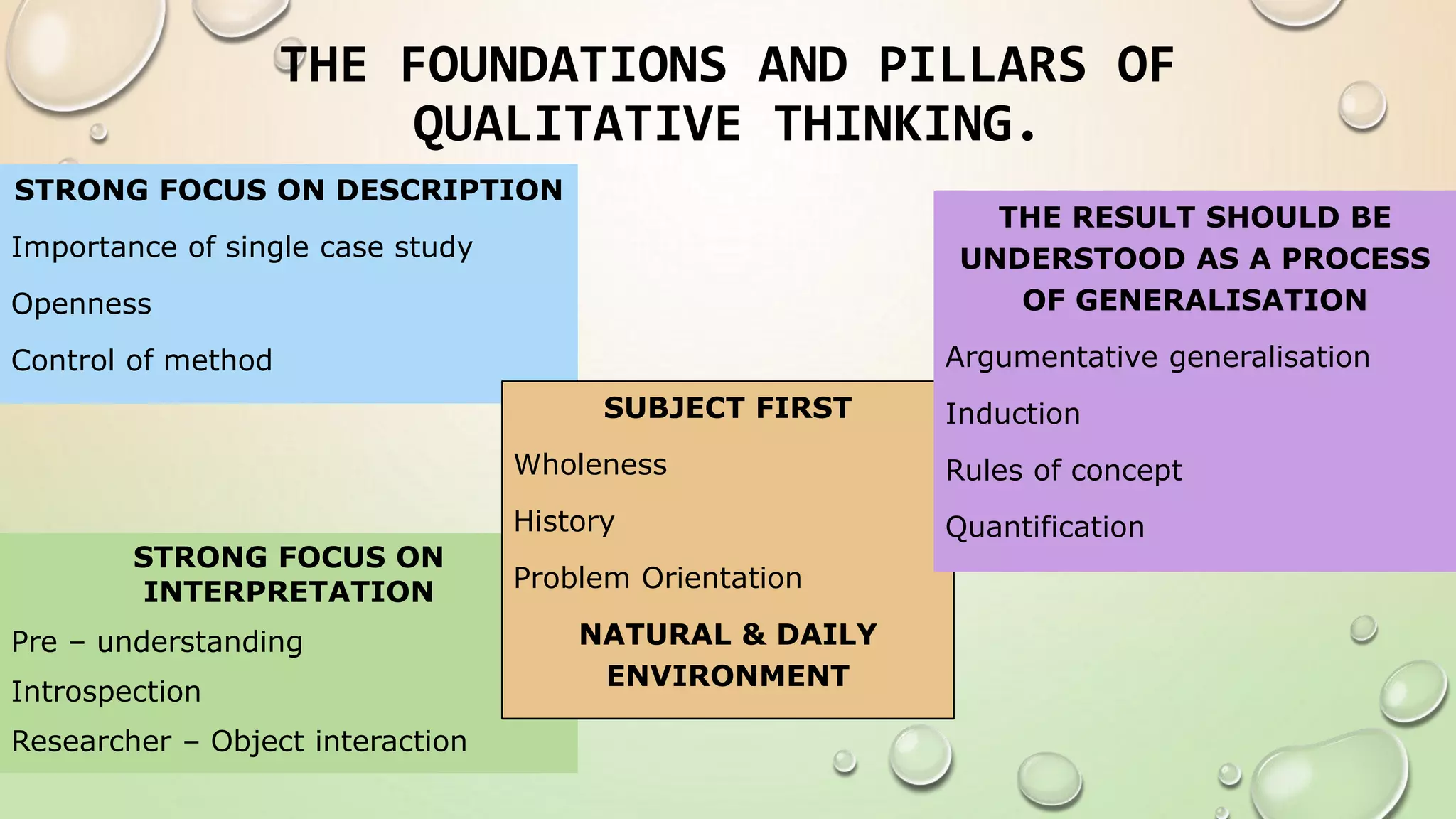
THE FOUNDATIONS AND PILLARS OF
QUALITATIVE THINKING.
STRONG FOCUS ON DESCRIPTION
Importance of single case study
Openness
Control of method
STRONG FOCUS ON
INTERPRETATION
Pre – understanding
Introspection
Researcher – Object interaction
SUBJECT FIRST
Wholeness
History
Problem Orientation
NATURAL & DAILY
ENVIRONMENT
THE RESULT SHOULD BE
UNDERSTOOD AS A PROCESS
OF GENERALISATION
Argumentative generalisation
Induction
Rules of concept
Quantification
INTRODUCTION
• Qualitative research can be defined as a research that seeks the
answer to the questions in the real world.
• It has a person centred perspective.
• Qualitative research is a form of social enquiry that focuses on
the way people interpret and make sense of their experiences
and the world in which they live.
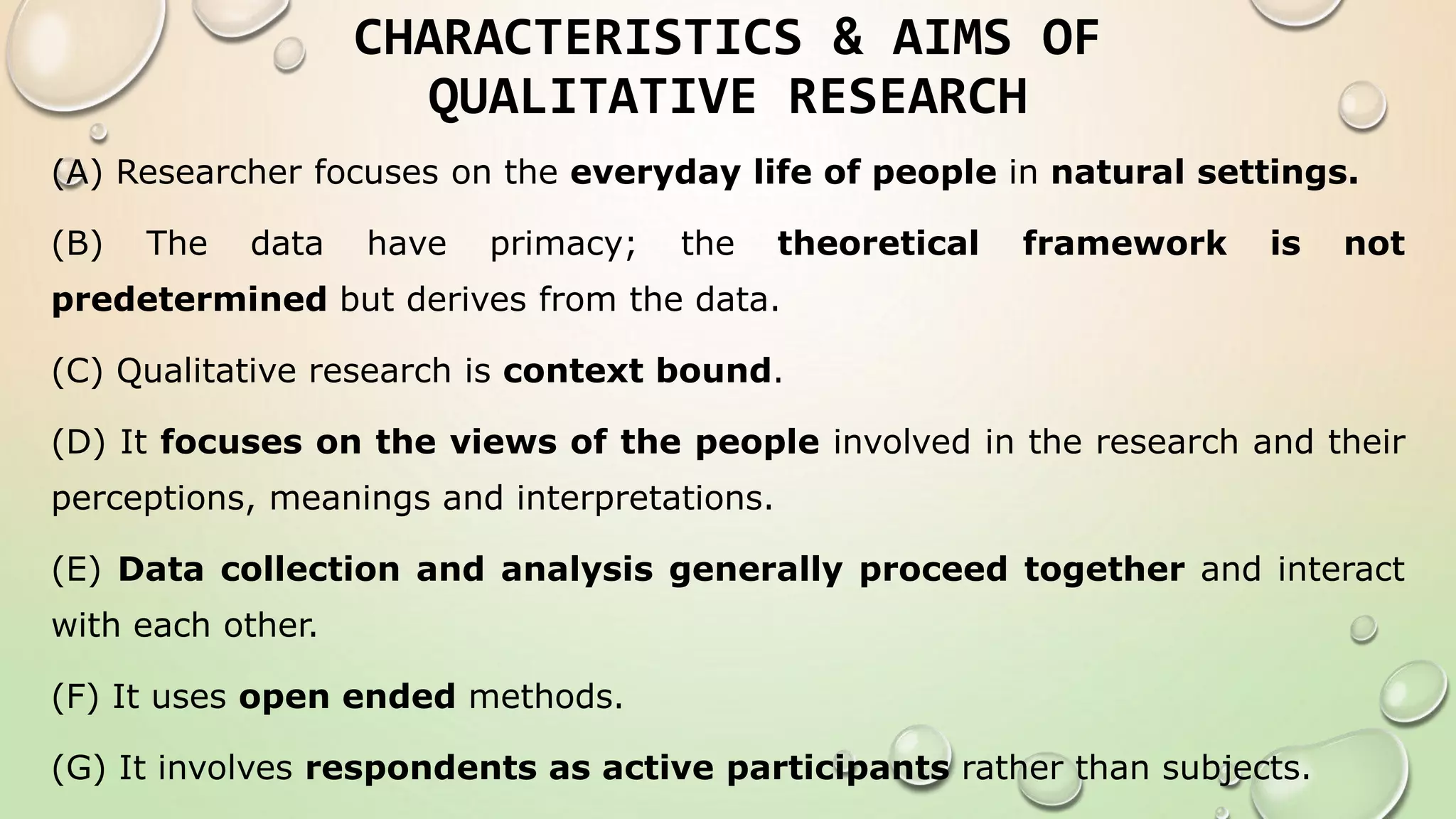
CHARACTERISTICS & AIMS OF
QUALITATIVE RESEARCH
(A) Researcher focuses on the everyday life of people in natural settings.
(B) The data have primacy; the theoretical framework is not
predetermined but derives from the data.
(C) Qualitative research is context bound.
(D) It focuses on the views of the people involved in the research and their
perceptions, meanings and interpretations.
(E) Data collection and analysis generally proceed together and interact
with each other.
(F) It uses open ended methods.
(G) It involves respondents as active participants rather than subjects.
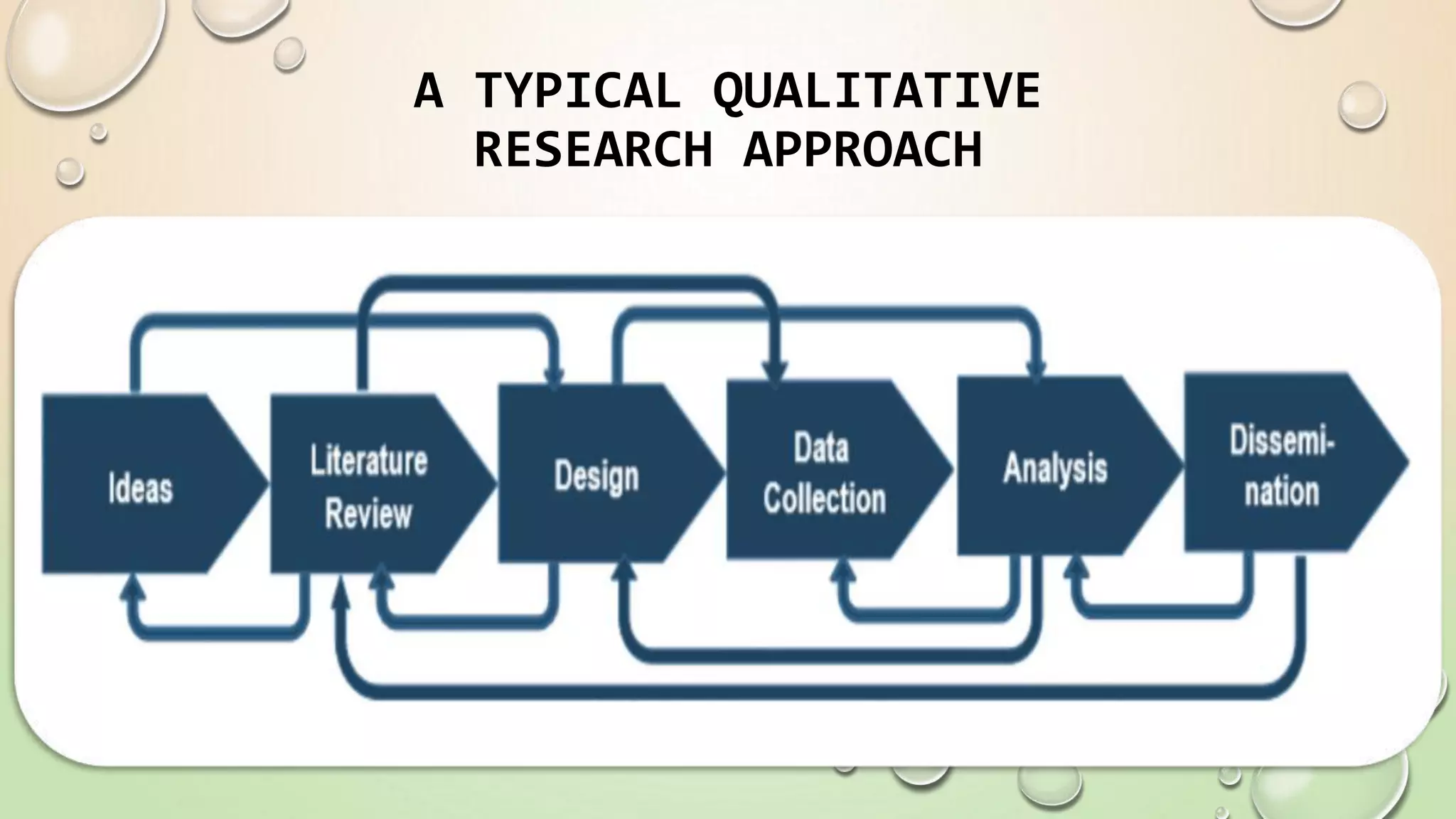
A TYPICAL QUALITATIVE
RESEARCH APPROACH
IDEAS
Research begins with rough ideas that turn slowly into research
questions.
LITERATURE REVIEW
The literature review gradually builds up knowledge about the
research ideas.
DESIGN
The design is the plan to be followed in order to carry out the research.
It must include strategies for the selection of the samples.
DATA COLLECTION
The data collection & organization phase is devoted to gathering the data
for the research and organizing it, so that it can be properly analysed.
These are difficult tasks, since the volume of data collected in qualitative
research can be enormous.
ANALYSIS
The analysis includes three concurrent flows of action:
Datareduction
•which focuses,
simplifies, and
transforms raw
data into more
manageable
forms;
Datadisplay
which presents the
data as organized
and compressed
assemblies of
information that
permit conclusions
to be analytically
drawn;
Conclusions&
Verification
where the
researchers review
and finalize all their
conclusions and
make sure that they
satisfy the
requirements of
validity.
DISSEMINATION
Dissemination takes the form of very well written and detailed
documents, so that other researchers can evaluate the analysis and
conclusions obtained & decide if they trust the results and want to
use them to feed their own research.
QUALITATIVE DATA COLLECTION TECHNIQUES
Participant observation
(descriptive observations of verbal & non - verbal behaviour),
Interactive interviewing
(people asked to verbally describe their experiences),
Written descriptions by participants
(people asked to write descriptions of their experiences).
PARTICIPANT OBSERVATION
• The researcher as observer looks at places
and people in their natural settings.
• Qualitative researchers use the term ‘participant observation’, a
term originally coined by Lindemann (1924).
• Participant observation always takes place in community settings, in
locations believed to have some relevance to the research
questions.
• The researcher approaches participants in their own
environment rather than having the participants come to the
researcher.
• The researcher engaged tries to learn what life is like for an
“insider” while remaining, inevitably, an “outsider”.
• The researcher makes careful, objective notes about what he
sees, recording all accounts & observations as field notes in a
field notebook.
PARTICIPANT OBSERVATION [CONT.]
Informal conversation & interaction with members of the study
population are important components and should be recorded in field
notes, in as much detail as possible.
To be an efficient participant observer one needs to
establish a rapport in the community,
have the skills of knowing the native language,
have explicit awareness of own behaviour,
have a good memory,
maintain consciously a naiveté (in order to genuinely know maximum
possible about the researched).
PARTICIPANT OBSERVATION [CONT.]
QUESTIONS TO BE ASKED IN THE OBSERVATION
• The ‘who’ questions - who all are in the setting, how many people are present
? what are their characteristics and roles?
• The ‘what’ questions - what is happening in the setting, what are the actions
and rules of behaviour/ what are the variations in the behaviour observed?
• The ‘where’ questions - where do interactions occur? Where are people
located in the physical space?
• The ‘when’ questions - when do conversations and interactions take place?
What is the timing of activities?
• The ‘why’ questions - why do people in the setting act the way they do? Why
are there variations in behaviour?
PARTICIPANT OBSERVATION [CONT.]
IN - DEPTH INTERVIEWS
• It is a ‘conversation with a purpose’ in which the interviewer aims
to obtain the perspectives, feelings and perceptions from the
participants in the research.
• The in - depth interview is a technique designed to elicit a vivid picture
of the participant’s perspective on the research topic.
• During in - depth interviews, the person being interviewed is
considered the expert and the interviewer is considered the student.
• The researcher’s interviewing techniques are motivated by the desire
to learn everything the participant can share about the research
topic.
• Researchers engage with participants by posing
questions in a neutral manner, listening attentively
to participant’s responses, and asking follow - up questions and
probes based on those responses.
• They do not lead participants according to any preconceived
notions, nor do they encourage participants to provide particular
answers by expressing approval or disapproval of what they say.
• In - depth interviews are usually conducted face - to - face and
involve one interviewer and one participant.
IN - DEPTH INTERVIEWS [CONT.]
KEY INFORMANT (KI)
INTERVIEWS
• Key informant interviews are in - depth interviews of 10 to 20 people
selected for their first - hand knowledge about a topic of interest.
• Interviews are loosely structured around issues to be discussed.
• KI interviews resemble a conversation among acquaintances, allowing
a free flow of ideas and information.
• Interviewers frame questions spontaneously, probe for information and
takes notes, which are elaborated on later.
• Key to a KI is selection of the key informant.
• The KI should be articulate, willing to participate, trustworthy
and should have other personal attributes conducive of
conducting detailed interviews.
• The KI is known as key because of his/her unique position by
virtue of which he/she can impart a useful piece of
information.
• This method is useful in all phases of development activities
identification, planning, implementation and evaluation.
KEY INFORMANT (KI) INTERVIEWS [CONT.]
Specifically, it is useful in the following situations :
(a)When there is a need to understand motivation, behaviour, and
perspectives of our clientele and health partners.
For example, in - depth interviews of program planners and managers, service
providers, host government officials, and beneficiaries concerning their attitudes and
behaviours about a health program activity can help explain its successes and
shortcomings.
(b)When the main purpose is to generate recommendations, key
informants can help formulate recommendations that can improve a
program’s performance.
(c) Key informant interviews can help frame the issues before the survey is
undertaken.
KEY INFORMANT (KI) INTERVIEWS [CONT.]
FOCUS GROUP DISCUSSIONS (FGD)
• FGD helps researchers learn the social norms of a community or
subgroup, as well as the range of perspectives that exist within that
community or subgroup.
• Focus groups seek to illuminate group opinion.
• This method is especially well suited for
socio - behavioural research that will be
used to develop and measure health services
that meet the needs of a given population.
An FGD requires the following :
(a) 6 - 12 participants who are willing to talk about the issue under
discussion.
(b) They should be as homogenous as possible.
(c) A moderator conducts the discussion but doesn't lead it.
(d) There is a recorder who notes down the proceedings and draws the
sociogram.
(e) There should be a predetermined FGD guide.
(f) Recording equipment with a backup should be present.
FOCUS GROUP DISCUSSIONS (FGD) [CONT.]
BENEFITS OF FGD:
• A principal advantage of focus groups is that they yield a large
amount of information over a relatively short period of time.
• They are also effective for accessing a broad range of views on
a specific topic, as opposed to achieving group consensus.
DISADVANTAGES OF FGD:
• Focus groups are not the best method for acquiring information on
highly personal or socially sensitive topics;
(One - on - one interviews are better - suited for such topics.)
FOCUS GROUP DISCUSSIONS (FGD) [CONT.]
Focus groups are commonly used
in the following areas :
(a)Exploratory studies in health issues.
(b)Testing ideas about acceptances of
a new program.
(c)Solving specific program problems.
(d)Evaluating health programs.
FOCUS GROUP DISCUSSIONS (FGD) [CONT.]
SPECIFIC COMPONENTS OF AN FGD
INCLUDE:
• Preparation,
• Conduct of the session and
• Decisions regarding number and
duration of the sessions.
FOCUS GROUP DISCUSSIONS (FGD) [CONT.]
PREPARATION
(a) Recruitment of participants : Participants should be homogenous with respect to
the socio - economic group, sex, age and status.
(b) Physical arrangements : Neutral, well lit and a quiet place are very essential for
the participants to be able to discuss freely.
Semi-circular sitting arrangement: so that each participant is in view of other.
(c) FGD guide:
It is a written list of the topics that need to be discussed in the group and
consists of a series of open ended questions.
It should cover the most necessary issues & avoid unnecessary ones.
Topics should be arranged in a logical sequence and a thorough familiarisation
with the topics is a must for the moderator.
FOCUS GROUP DISCUSSIONS (FGD) [CONT.]
CONDUCT OF THE SESSION :
• Moderating a focus group discussion is an art.
• The moderator must be vigilant about covering all the material
in the focus group guide, while also ensuring that the entire
group participates and that a wide range of perspectives has
been solicited and expressed.
• The role requires you to be fully engaged in the discussion,
yet refrain from participating too much in it.
• The moderator must know how and when to interject and
intervene, yet not interfere.
FOCUS GROUP DISCUSSIONS (FGD) [CONT.]
FACILITATING GROUP DISCUSSION:
• Open with a general comment and wait for
a response.
• Invite a wide range of commentary.
• Use silence to your advantage.
• Limit your own participation once the
discussion begins.
• Covering the material in the guide.
• Encouraging maximum participation.
FOCUS GROUP DISCUSSIONS (FGD) [CONT.]
THE NUMBER AND DURATION OF SESSIONS :
• A typical FGD should not last for more than an hour and a
half.
• The number of sessions should be decided based on the
nature of the project need, resources and whether the
information coming is redundant or not.
• 2 to 3 FGD’s are considered enough for each population
subgroup.
FOCUS GROUP DISCUSSIONS (FGD) [CONT.]
SAMPLING IN QUALITATIVE RESEARCH
• In qualitative research, only a sample of a population is selected for
any given study.
• The study’s research objectives and the characteristics of the study
population (size and diversity) will determine which and how many
people to select.
• Qualitative research uses non -
probability sampling methods.
• Selection of the respondents is
usually flexible and evolves as the
study progresses.
• There are many approaches for selecting samples
in qualitative research, the most commonly used
is the purposive sampling.
• The sample size in qualitative research is
relatively small but consists of ‘information rich’
cases.
• Usually sampling goes on till saturation is
achieved, that is until no new information is
generated and informational redundancy occurs.
SAMPLING IN QUALITATIVE RESEARCH [CONT.]
DATA ANALYSIS IN QUALITATIVE RESEARCH
• Qualitative analysis deals in words and is guided by fewer universal
rules and standardized procedures, rather than statistical analysis.
• In qualitative research, the researcher captures the thoughts and
experiences of individual people, and every set of qualitative data
collected is distinct.
• In qualitative evaluation, data collection & data analysis are not
temporally discrete stages : as soon as the first pieces of data are
collected, the evaluator begins the process of making sense of the
information.
STEPS TO ANALYSE THE DATA OF A QUALITATIVE STUDY :
1. Description of sample population :
Qualitative data is derived from small samples, more information
is needed to place the data in their context,
E.G.,
Who were the KI?,
What were the factors that made them qualify as such?
Who all took part in the FGD’s?
How representative were the participants of the population /
group they represented?
Who all were observed etc.
DATA ANALYSIS IN QUALITATIVE RESEARCH [CONT.]
2. Data reduction (ordering and coding of data) :
• Data reduction refers to the process of selecting, focusing,
simplifying, abstracting, and transforming the data that appear
in written up field notes or transcriptions.
• Not only do the data need to be condensed for the sake of
manageability, they also have to be transformed so they can be
made intelligible in terms of the issues being researched.
• Coding of data should be as per topics of discussion guide or
check list of observation or semi structured interviews.
3. Data display :
• Data display goes a step beyond data reduction to provide
“an organized, compressed assembly of information that
permits conclusion drawing.
• Data displays, whether in word or diagrammatic form, allow
the analyst to extrapolate from the data enough to begin to
discern systematic patterns and interrelationships.
• By displaying data in form of a chart (matrix), a figure (flow
chart) or other graphic forms, one is already analysing the
data.
4. Conclusion drawing and verification :
Conclusion means what the analysed data means and
to assess the implications for the research issue at
hand.
Verification is integrally linked to conclusion drawing;
it involves revisiting the data as many times as
necessary to cross - check or verify the emergent
conclusions.
The meanings emerging from the data have to be
tested for their plausibility, their sturdiness, their
validity.
SOFTWARE PACKAGES FOR
QUALITATIVE ANALYSIS
• Software packages that can be used to aid analysis of qualitative data
have been developed in recent years.
• Most of these packages were reviewed by Weitzman and Miles (1995),
who grouped them into six types :
• WORD PROCESSORS,
• WORD RETRIEVERS,
• TEXT BASE MANAGERS,
• CODE - AND - RETRIEVE PROGRAMS,
• CODE - BASED THEORY BUILDERS, AND
• CONCEPTUAL NETWORK BUILDERS.
Limitations with software's used in qualitative research.
• First, the software cannot determine meaningful
categories for coding and analysis or define salient
themes or factors.
• Second, it takes time and resources to become adept in
utilizing a given software package and learning its
peculiarities.
SOFTWARE PACKAGES FOR
QUALITATIVE ANALYSIS [CONT.]
REFERENCES
• TEXT BOOK OF PUBLIC HEALTH AND COMMUNITY MEDICINE – RAJVIR
BHALWAR, AFMC PUNE.
• QUALITATIVE RESEARCH METHODOLOGY – AN INTRODUCTION; PROF. DR. HORA
TJITRA, ZHEJIANG UNIVERSITY.
• QUALITATIVE RESEARCH METHODS: A DATA COLLECTOR’S FIELD GUIDE; FAMILY
HEALTH INTERNATIONAL
• A CONCISE INTRODUCTION TO QUALITATIVE RESEARCH METHODS IN
INFORMATION SCIENCES & TECHNOLOGIES - DEPARTMENT OF INFORMATICS
ENGINEERING UNIVERSITY OF COIMBRA.
Qualitative research by Dr. Subraham Pany

Qualitative research by Dr. Subraham Pany

  • 1.
  • 2.
    THE FOUNDATIONS ANDPILLARS OF QUALITATIVE THINKING. STRONG FOCUS ON DESCRIPTION Importance of single case study Openness Control of method STRONG FOCUS ON INTERPRETATION Pre – understanding Introspection Researcher – Object interaction SUBJECT FIRST Wholeness History Problem Orientation NATURAL & DAILY ENVIRONMENT THE RESULT SHOULD BE UNDERSTOOD AS A PROCESS OF GENERALISATION Argumentative generalisation Induction Rules of concept Quantification
  • 3.
    INTRODUCTION • Qualitative researchcan be defined as a research that seeks the answer to the questions in the real world. • It has a person centred perspective. • Qualitative research is a form of social enquiry that focuses on the way people interpret and make sense of their experiences and the world in which they live.
  • 4.
    CHARACTERISTICS & AIMSOF QUALITATIVE RESEARCH (A) Researcher focuses on the everyday life of people in natural settings. (B) The data have primacy; the theoretical framework is not predetermined but derives from the data. (C) Qualitative research is context bound. (D) It focuses on the views of the people involved in the research and their perceptions, meanings and interpretations. (E) Data collection and analysis generally proceed together and interact with each other. (F) It uses open ended methods. (G) It involves respondents as active participants rather than subjects.
  • 5.
  • 6.
    IDEAS Research begins withrough ideas that turn slowly into research questions.
  • 7.
    LITERATURE REVIEW The literaturereview gradually builds up knowledge about the research ideas.
  • 8.
    DESIGN The design isthe plan to be followed in order to carry out the research. It must include strategies for the selection of the samples.
  • 9.
    DATA COLLECTION The datacollection & organization phase is devoted to gathering the data for the research and organizing it, so that it can be properly analysed. These are difficult tasks, since the volume of data collected in qualitative research can be enormous.
  • 10.
  • 11.
    The analysis includesthree concurrent flows of action: Datareduction •which focuses, simplifies, and transforms raw data into more manageable forms; Datadisplay which presents the data as organized and compressed assemblies of information that permit conclusions to be analytically drawn; Conclusions& Verification where the researchers review and finalize all their conclusions and make sure that they satisfy the requirements of validity.
  • 12.
    DISSEMINATION Dissemination takes theform of very well written and detailed documents, so that other researchers can evaluate the analysis and conclusions obtained & decide if they trust the results and want to use them to feed their own research.
  • 13.
    QUALITATIVE DATA COLLECTIONTECHNIQUES Participant observation (descriptive observations of verbal & non - verbal behaviour), Interactive interviewing (people asked to verbally describe their experiences), Written descriptions by participants (people asked to write descriptions of their experiences).
  • 14.
    PARTICIPANT OBSERVATION • Theresearcher as observer looks at places and people in their natural settings. • Qualitative researchers use the term ‘participant observation’, a term originally coined by Lindemann (1924). • Participant observation always takes place in community settings, in locations believed to have some relevance to the research questions.
  • 15.
    • The researcherapproaches participants in their own environment rather than having the participants come to the researcher. • The researcher engaged tries to learn what life is like for an “insider” while remaining, inevitably, an “outsider”. • The researcher makes careful, objective notes about what he sees, recording all accounts & observations as field notes in a field notebook. PARTICIPANT OBSERVATION [CONT.]
  • 16.
    Informal conversation &interaction with members of the study population are important components and should be recorded in field notes, in as much detail as possible. To be an efficient participant observer one needs to establish a rapport in the community, have the skills of knowing the native language, have explicit awareness of own behaviour, have a good memory, maintain consciously a naiveté (in order to genuinely know maximum possible about the researched). PARTICIPANT OBSERVATION [CONT.]
  • 17.
    QUESTIONS TO BEASKED IN THE OBSERVATION • The ‘who’ questions - who all are in the setting, how many people are present ? what are their characteristics and roles? • The ‘what’ questions - what is happening in the setting, what are the actions and rules of behaviour/ what are the variations in the behaviour observed? • The ‘where’ questions - where do interactions occur? Where are people located in the physical space? • The ‘when’ questions - when do conversations and interactions take place? What is the timing of activities? • The ‘why’ questions - why do people in the setting act the way they do? Why are there variations in behaviour? PARTICIPANT OBSERVATION [CONT.]
  • 18.
    IN - DEPTHINTERVIEWS • It is a ‘conversation with a purpose’ in which the interviewer aims to obtain the perspectives, feelings and perceptions from the participants in the research. • The in - depth interview is a technique designed to elicit a vivid picture of the participant’s perspective on the research topic. • During in - depth interviews, the person being interviewed is considered the expert and the interviewer is considered the student. • The researcher’s interviewing techniques are motivated by the desire to learn everything the participant can share about the research topic.
  • 19.
    • Researchers engagewith participants by posing questions in a neutral manner, listening attentively to participant’s responses, and asking follow - up questions and probes based on those responses. • They do not lead participants according to any preconceived notions, nor do they encourage participants to provide particular answers by expressing approval or disapproval of what they say. • In - depth interviews are usually conducted face - to - face and involve one interviewer and one participant. IN - DEPTH INTERVIEWS [CONT.]
  • 20.
    KEY INFORMANT (KI) INTERVIEWS •Key informant interviews are in - depth interviews of 10 to 20 people selected for their first - hand knowledge about a topic of interest. • Interviews are loosely structured around issues to be discussed. • KI interviews resemble a conversation among acquaintances, allowing a free flow of ideas and information. • Interviewers frame questions spontaneously, probe for information and takes notes, which are elaborated on later.
  • 21.
    • Key toa KI is selection of the key informant. • The KI should be articulate, willing to participate, trustworthy and should have other personal attributes conducive of conducting detailed interviews. • The KI is known as key because of his/her unique position by virtue of which he/she can impart a useful piece of information. • This method is useful in all phases of development activities identification, planning, implementation and evaluation. KEY INFORMANT (KI) INTERVIEWS [CONT.]
  • 22.
    Specifically, it isuseful in the following situations : (a)When there is a need to understand motivation, behaviour, and perspectives of our clientele and health partners. For example, in - depth interviews of program planners and managers, service providers, host government officials, and beneficiaries concerning their attitudes and behaviours about a health program activity can help explain its successes and shortcomings. (b)When the main purpose is to generate recommendations, key informants can help formulate recommendations that can improve a program’s performance. (c) Key informant interviews can help frame the issues before the survey is undertaken. KEY INFORMANT (KI) INTERVIEWS [CONT.]
  • 23.
    FOCUS GROUP DISCUSSIONS(FGD) • FGD helps researchers learn the social norms of a community or subgroup, as well as the range of perspectives that exist within that community or subgroup. • Focus groups seek to illuminate group opinion. • This method is especially well suited for socio - behavioural research that will be used to develop and measure health services that meet the needs of a given population.
  • 24.
    An FGD requiresthe following : (a) 6 - 12 participants who are willing to talk about the issue under discussion. (b) They should be as homogenous as possible. (c) A moderator conducts the discussion but doesn't lead it. (d) There is a recorder who notes down the proceedings and draws the sociogram. (e) There should be a predetermined FGD guide. (f) Recording equipment with a backup should be present. FOCUS GROUP DISCUSSIONS (FGD) [CONT.]
  • 27.
    BENEFITS OF FGD: •A principal advantage of focus groups is that they yield a large amount of information over a relatively short period of time. • They are also effective for accessing a broad range of views on a specific topic, as opposed to achieving group consensus. DISADVANTAGES OF FGD: • Focus groups are not the best method for acquiring information on highly personal or socially sensitive topics; (One - on - one interviews are better - suited for such topics.) FOCUS GROUP DISCUSSIONS (FGD) [CONT.]
  • 28.
    Focus groups arecommonly used in the following areas : (a)Exploratory studies in health issues. (b)Testing ideas about acceptances of a new program. (c)Solving specific program problems. (d)Evaluating health programs. FOCUS GROUP DISCUSSIONS (FGD) [CONT.]
  • 29.
    SPECIFIC COMPONENTS OFAN FGD INCLUDE: • Preparation, • Conduct of the session and • Decisions regarding number and duration of the sessions. FOCUS GROUP DISCUSSIONS (FGD) [CONT.]
  • 30.
    PREPARATION (a) Recruitment ofparticipants : Participants should be homogenous with respect to the socio - economic group, sex, age and status. (b) Physical arrangements : Neutral, well lit and a quiet place are very essential for the participants to be able to discuss freely. Semi-circular sitting arrangement: so that each participant is in view of other. (c) FGD guide: It is a written list of the topics that need to be discussed in the group and consists of a series of open ended questions. It should cover the most necessary issues & avoid unnecessary ones. Topics should be arranged in a logical sequence and a thorough familiarisation with the topics is a must for the moderator. FOCUS GROUP DISCUSSIONS (FGD) [CONT.]
  • 31.
    CONDUCT OF THESESSION : • Moderating a focus group discussion is an art. • The moderator must be vigilant about covering all the material in the focus group guide, while also ensuring that the entire group participates and that a wide range of perspectives has been solicited and expressed. • The role requires you to be fully engaged in the discussion, yet refrain from participating too much in it. • The moderator must know how and when to interject and intervene, yet not interfere. FOCUS GROUP DISCUSSIONS (FGD) [CONT.]
  • 32.
    FACILITATING GROUP DISCUSSION: •Open with a general comment and wait for a response. • Invite a wide range of commentary. • Use silence to your advantage. • Limit your own participation once the discussion begins. • Covering the material in the guide. • Encouraging maximum participation. FOCUS GROUP DISCUSSIONS (FGD) [CONT.]
  • 33.
    THE NUMBER ANDDURATION OF SESSIONS : • A typical FGD should not last for more than an hour and a half. • The number of sessions should be decided based on the nature of the project need, resources and whether the information coming is redundant or not. • 2 to 3 FGD’s are considered enough for each population subgroup. FOCUS GROUP DISCUSSIONS (FGD) [CONT.]
  • 34.
    SAMPLING IN QUALITATIVERESEARCH • In qualitative research, only a sample of a population is selected for any given study. • The study’s research objectives and the characteristics of the study population (size and diversity) will determine which and how many people to select. • Qualitative research uses non - probability sampling methods. • Selection of the respondents is usually flexible and evolves as the study progresses.
  • 35.
    • There aremany approaches for selecting samples in qualitative research, the most commonly used is the purposive sampling. • The sample size in qualitative research is relatively small but consists of ‘information rich’ cases. • Usually sampling goes on till saturation is achieved, that is until no new information is generated and informational redundancy occurs. SAMPLING IN QUALITATIVE RESEARCH [CONT.]
  • 36.
    DATA ANALYSIS INQUALITATIVE RESEARCH • Qualitative analysis deals in words and is guided by fewer universal rules and standardized procedures, rather than statistical analysis. • In qualitative research, the researcher captures the thoughts and experiences of individual people, and every set of qualitative data collected is distinct. • In qualitative evaluation, data collection & data analysis are not temporally discrete stages : as soon as the first pieces of data are collected, the evaluator begins the process of making sense of the information.
  • 37.
    STEPS TO ANALYSETHE DATA OF A QUALITATIVE STUDY : 1. Description of sample population : Qualitative data is derived from small samples, more information is needed to place the data in their context, E.G., Who were the KI?, What were the factors that made them qualify as such? Who all took part in the FGD’s? How representative were the participants of the population / group they represented? Who all were observed etc. DATA ANALYSIS IN QUALITATIVE RESEARCH [CONT.]
  • 38.
    2. Data reduction(ordering and coding of data) : • Data reduction refers to the process of selecting, focusing, simplifying, abstracting, and transforming the data that appear in written up field notes or transcriptions. • Not only do the data need to be condensed for the sake of manageability, they also have to be transformed so they can be made intelligible in terms of the issues being researched. • Coding of data should be as per topics of discussion guide or check list of observation or semi structured interviews.
  • 39.
    3. Data display: • Data display goes a step beyond data reduction to provide “an organized, compressed assembly of information that permits conclusion drawing. • Data displays, whether in word or diagrammatic form, allow the analyst to extrapolate from the data enough to begin to discern systematic patterns and interrelationships. • By displaying data in form of a chart (matrix), a figure (flow chart) or other graphic forms, one is already analysing the data.
  • 40.
    4. Conclusion drawingand verification : Conclusion means what the analysed data means and to assess the implications for the research issue at hand. Verification is integrally linked to conclusion drawing; it involves revisiting the data as many times as necessary to cross - check or verify the emergent conclusions. The meanings emerging from the data have to be tested for their plausibility, their sturdiness, their validity.
  • 41.
    SOFTWARE PACKAGES FOR QUALITATIVEANALYSIS • Software packages that can be used to aid analysis of qualitative data have been developed in recent years. • Most of these packages were reviewed by Weitzman and Miles (1995), who grouped them into six types : • WORD PROCESSORS, • WORD RETRIEVERS, • TEXT BASE MANAGERS, • CODE - AND - RETRIEVE PROGRAMS, • CODE - BASED THEORY BUILDERS, AND • CONCEPTUAL NETWORK BUILDERS.
  • 42.
    Limitations with software'sused in qualitative research. • First, the software cannot determine meaningful categories for coding and analysis or define salient themes or factors. • Second, it takes time and resources to become adept in utilizing a given software package and learning its peculiarities. SOFTWARE PACKAGES FOR QUALITATIVE ANALYSIS [CONT.]
  • 43.
    REFERENCES • TEXT BOOKOF PUBLIC HEALTH AND COMMUNITY MEDICINE – RAJVIR BHALWAR, AFMC PUNE. • QUALITATIVE RESEARCH METHODOLOGY – AN INTRODUCTION; PROF. DR. HORA TJITRA, ZHEJIANG UNIVERSITY. • QUALITATIVE RESEARCH METHODS: A DATA COLLECTOR’S FIELD GUIDE; FAMILY HEALTH INTERNATIONAL • A CONCISE INTRODUCTION TO QUALITATIVE RESEARCH METHODS IN INFORMATION SCIENCES & TECHNOLOGIES - DEPARTMENT OF INFORMATICS ENGINEERING UNIVERSITY OF COIMBRA.

Editor's Notes

  • #5 this means that the researcher has to be sensitive to the context of the research and immerse himself in the settings and the situation.
  • #14 Several methods exist for data collection in qualitative research, however there are three main methods of data collection, namely
  • #15 Observation is one of the strategies in data collection.
  • #17 Naiveté = innocence or unsophistication.
  • #19 The qualitative in - depth interview is a favoured strategy of data collection in qualitative research and produces rich data.
  • #25 sociogram - a pictorial representation of the way the interactions have occurred between various participants.
  • #41 Here validity encompasses a much broader concern for whether the conclusions being drawn from the data are credible, defensible, warranted, and able to withstand alternative explanations.